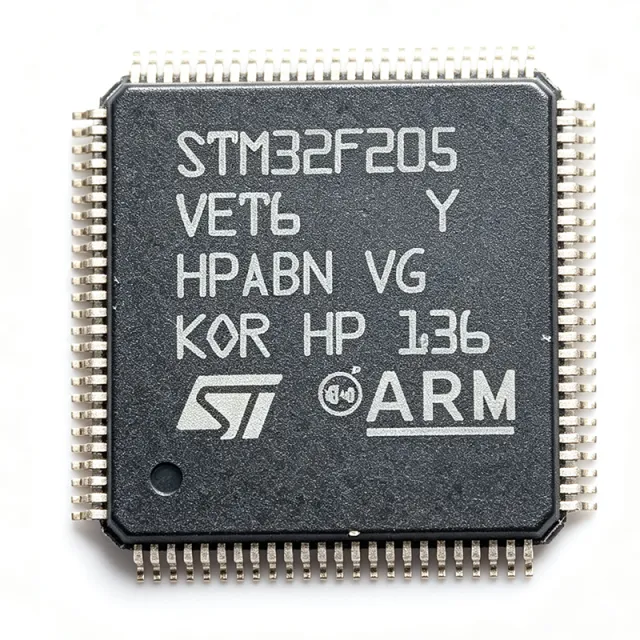
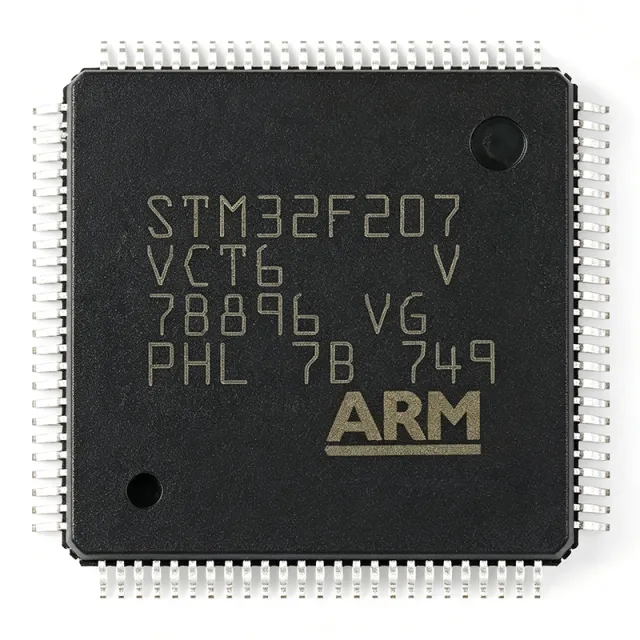
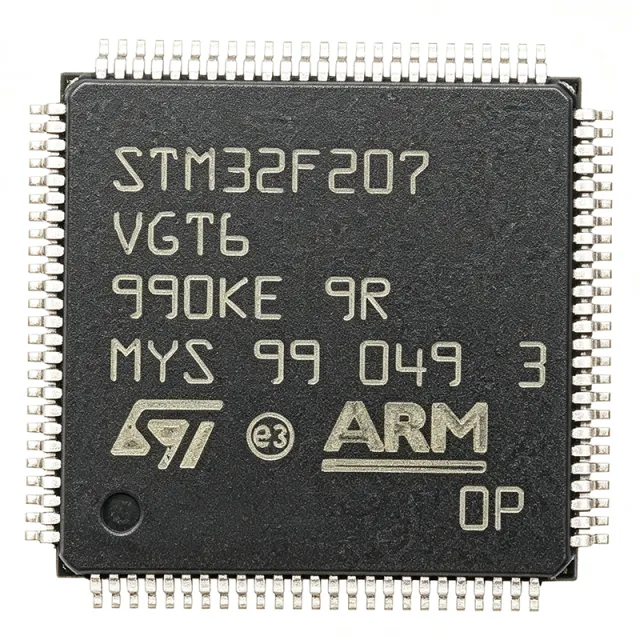
STM32F205ZFT6
STM32F205ZFT6 - 120MHz Cortex-M3 MCU | STMicroelectronics
The STMicroelectronics STM32F205ZFT6 is a 32-bit Arm Cortex-M3 microcontroller operating up to 120 MHz, with 768 KB of Flash memory, 132 KB of SRAM, and 114 I/O pins in a 144-lead LQFP package. It combines 150 DMIPS processing performance with extensive connectivity and peripheral support for demanding embedded-control designs.
A microcontroller is a programmable semiconductor that integrates a processor core, memory, input/output ports, and peripherals on one device. The STM32F205 belongs to the STM32F2 family of 32-bit embedded MCUs, which sit within the broader hierarchy of Arm Cortex-M3 MCU, embedded processor, microcontroller, and semiconductor. This integration reduces component count and simplifies control of industrial, communications, consumer, and instrumentation equipment.
Core features include an Arm Cortex-M3 processor with an ART Accelerator for zero-wait-state Flash execution, a maximum operating frequency of 120 MHz, and an operating-performance rating of 150 DMIPS. The device provides 768 KB of program Flash, 132 KB of SRAM, and 114 general-purpose I/O. Its 2.5 V and 3.3 V operating classes support embedded systems designed around common industrial and consumer logic levels.
The STM32F205 architecture combines a high-performance 32-bit core with extensive serial and parallel interfaces. Typical integration includes USART, SPI, I2C, USB, Ethernet MAC, CAN, timers, DMA controllers, ADCs, and GPIO resources, depending on the exact device configuration. The 144-LQFP package provides a large pin count for systems that need multiple buses, external memory interfaces, high-speed signals, and substantial digital I/O without using a complex ball-grid-array package.
Typical applications include industrial automation controllers, Ethernet-connected equipment, USB peripherals, CAN-based nodes, data acquisition units, building-control systems, and high-performance embedded gateways. The 114 available I/O pins are especially useful where several communications buses, status indicators, sensors, relays, and human-interface controls must share one controller. A single STM32F205ZFT6 can consolidate functions that might otherwise require several discrete controllers.
PCB implementation should account for the LQFP-144 footprint's 20 mm by 20 mm body, fine-pitch leads, numerous decoupling requirements, and multiple supply domains. Place bypass capacitors close to the appropriate power pins, keep high-speed and communication traces short, and follow the pin-description and recommended-layout guidance in the manufacturer datasheet. Verify every peripheral signal, alternate function, and package connection before releasing the PCB.
This page combines the key electrical characteristics, practical application guidance, package information, same-family drop-in alternatives, and design considerations needed to evaluate the STM32F205ZFT6 for a new embedded platform. It also highlights the memory and feature differences that must be reviewed before using another STM32F2 device as a second source.
RFQ
پەیوەندی