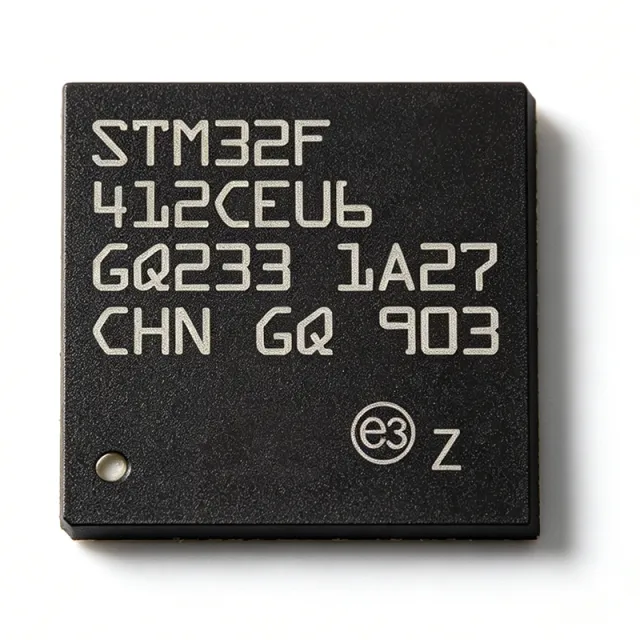
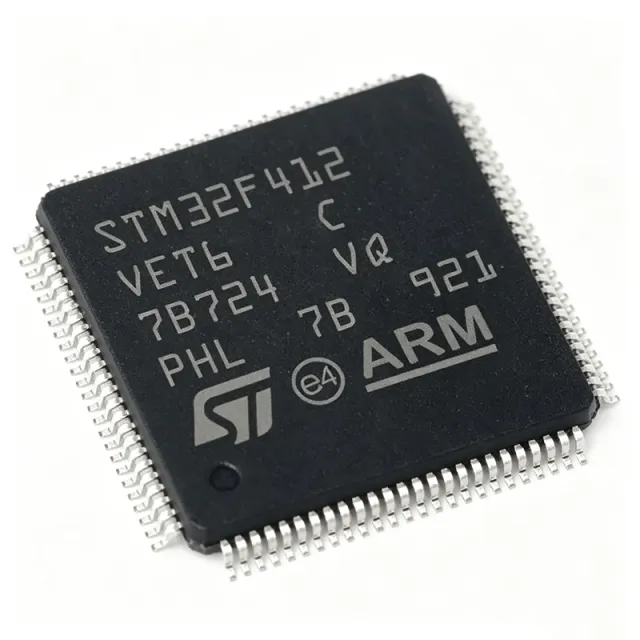
STM32F415RGT6
STM32F415RGT6 - 168MHz ARM Cortex-M4F MCU, 1MB Flash | STMicroelectronics
The STMicroelectronics STM32F415RGT6 is a high-performance 32-bit microcontroller based on the ARM Cortex-M4F core with floating-point unit (FPU), operating at up to 168 MHz. It integrates 1 Mbyte of Flash memory and 192 Kbytes of SRAM, making it suitable for demanding applications that require both computational power and large memory footprint. The device is housed in a 64-pin LQFP package (LQFP64) with a 10x10 mm body and 0.5 mm pitch, offering a compact solution for space-constrained designs.
What is an ARM Cortex-M4F microcontroller? It is a 32-bit processor core designed for embedded systems, featuring a floating-point unit (FPU) that accelerates mathematical operations, a digital signal processing (DSP) instruction set, and a memory protection unit (MPU). The Cortex-M4F is part of the ARM Cortex-M family, which includes the M0, M0+, M3, M4, and M7 cores, each targeting different performance and power trade-offs. In the system hierarchy, the STM32F415RGT6 sits as a microcontroller unit (MCU) within the broader category of embedded processors, which also includes microprocessors (MPUs), digital signal processors (DSPs), and application-specific integrated circuits (ASICs).
Key features of the STM32F415RGT6 include a 168 MHz maximum clock speed, 1 Mbyte of Flash memory, 192 Kbytes of SRAM, and a comprehensive set of peripherals: three 12-bit ADCs, two DACs, a true random number generator (RNG), a camera interface, a crypto/hash processor, and multiple communication interfaces including USART, SPI, I2C, USB OTG FS/HS, CAN, and SDIO. The device also features a flexible memory controller (FMC) for external memory expansion, and a DMA controller with 16 channels.
Technically, the STM32F415RGT6 is built on a 90nm process technology, offering a balance between performance and power consumption. It supports a wide supply voltage range of 1.8V to 3.6V, with a typical operating temperature range of -40°C to +85°C (industrial grade). The device includes a rich set of power-saving modes (Sleep, Stop, Standby) and a battery backup domain for RTC and backup registers, making it suitable for battery-powered applications.
Typical applications include industrial control systems, motor drives, medical devices, consumer electronics, and IoT gateways. The combination of high clock speed, FPU, and large memory makes it ideal for real-time control, signal processing, and complex user interfaces.
When designing with this MCU, ensure proper decoupling of the power supply pins (VDD, VDDA) with 100nF capacitors placed close to each pin, and a 4.7uF bulk capacitor. The VDDA pin must be connected to a clean analog supply to achieve the specified ADC accuracy. Also, consider the crystal oscillator layout for the HSE (high-speed external) clock to minimize noise and ensure reliable startup.
RFQ
پەیوەندی