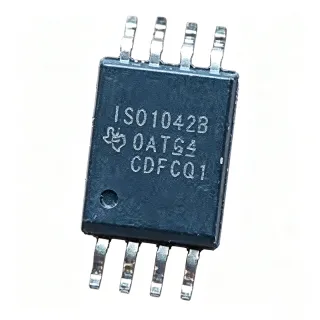
ISO1042BQDWVQ1 - 5Mbps Isolated CAN FD Transceiver | TI
MPN: ISO1042BQDWVQ1 ✓ چالاکISO1042BQDWVQ1 گشتی
A CAN transceiver is an interface IC that converts digital controller signals into CAN bus levels and converts received bus levels back into logic-compatible signals. In the broader product hierarchy, it belongs to the CAN transceiver class within interface ICs and communication semiconductors. The ISO1042-Q1 family supports both classic CAN and CAN FD operation, making it suitable for automotive electrical systems and other isolated CAN networks that need higher payload throughput.
Key electrical features include up to 5 Mbps data rate, ±70 V DC bus-fault protection, and a ±30 V common-mode operating range. The 120 mV receiver hysteresis improves noise immunity around the decision threshold. These characteristics are particularly valuable in vehicle electrical environments, where transients, ground shifts, and wiring faults can place unusual voltages on a CAN network.
The device uses a galvanically isolated CAN interface with separate bus-side and logic-side supply domains. Its half-duplex architecture supports one transmitter and one receiver for conventional CAN bus nodes. ISO11898-2:2016 compliance provides a defined baseline for physical-layer behavior, while CAN FD support extends the usable payload rate compared with classic CAN. Designers must still provide appropriate bus termination, common-mode choke components, decoupling, and isolation-rated board-layout practices.
Typical uses include electric-vehicle powertrain networks, body and comfort modules, battery-management systems, charging interfaces, industrial automation equipment, and other isolated CAN nodes. The package is particularly appropriate where a compact 8-pin surface-mount implementation is required and the bus environment demands stronger fault protection than a basic non-isolated transceiver provides.
When laying out the circuit, place each supply-domain decoupling capacitor close to its associated power pins and keep the isolation barrier free of high-speed digital return currents. Use the manufacturer datasheet pin-description table when assigning PCB tracks, and verify component spacing, creepage, clearance, and capacitor ratings against the isolation requirements of the final equipment.
This page consolidates the key electrical limits, automotive qualification, package information, application guidance, drop-in alternatives, and practical design considerations for engineers evaluating the ISO1042BQDWVQ1 across industrial and automotive CAN FD networks.
جێگرەوەکانی جێگۆڕکێ بۆ ISO1042BQDWVQ1 — هەمان پاکەت، پین بە پین گونجاو. ئەو بەشانەی پاکەتی جیاوازیان هەیە و پێویستیان بە چاککردنەوەی PCB هەیە لابراون.
جۆرەکان لەم زنجیرەیەدا
مۆدێلەکانی هەمان زنجیرە کە بە شێوەی ڕاستەوخۆ گونجاون لەگەڵ ISO1042BQDWVQ1 (هەمان شێوە و پێکهاتەی شوێن) — جیاوازە لە Package, Product Type, Operating Temperature, Bus Fault Protection, Isolation Type.
ISO1042BDWV
✅ جێگرەوەی ڕاستەوخۆ✓ بەردەستە
$1.58 / یەکە
بینینی داتاشیت →ISO1042BDWVR
✅ جێگرەوەی ڕاستەوخۆ✓ بەردەستە
$1.58 / یەکە
بینینی داتاشیت →ISO1042QDWVRQ1
✅ جێگرەوەی ڕاستەوخۆپەیوەندی بۆ نرخ
بینینی داتاشیت →ISO1042BQDWVRQ1
✅ جێگرەوەی ڕاستەوخۆ✓ بەردەستە
$1.5052 / یەکە
بینینی داتاشیت →ISO1042BQDWVQ1 تایبەتمەندییەکان
| Product Type | Galvanically isolated CAN transceiver |
| CAN Standard | ISO11898-2:2016 |
| Maximum Data Rate | 5 Mbps |
| Number of Drivers | 1 |
| Number of Receivers | 1 |
| Duplex Mode | Half-duplex |
| Receiver Hysteresis | 120 mV |
| Logic-Side Supply Voltage | 1.71 V to 5.5 V |
| CAN-Side Supply Voltage | 4.5 V to 5.5 V |
| DC Bus-Fault Protection | ±70 V |
| Common-Mode Voltage Range | ±30 V |
| پلەی گەرمیی کارکردن | -40 °C to 125 °C |
| پاکێج | 8-pin SOIC (DWV) |
| جۆری دامەزراندن | Surface mount |
| Shipping Package | Tube |
| Automotive Qualification | AEC-Q100 automotive grade |
| Isolation Type | Galvanic isolation |
ڕێنمایی ڕێکخستنی پینی ISO1042BQDWVQ1 tube
ڕێکخستنی پین بۆ ISO1042BQDWVQ1 (پاکێجی tube). ژمارەدانی پین، فەنکشنەکان و نەخشەکانی پەیوەندی لە داتاشیتی بەرھەمھێنەردا پێناسە کراون. سەرنجی بدە بۆ شوێنپێی ورد و ڕێنمایییەکانی لەحیمکردن.

هیچ داتای وردی پینئاوت بەردەست نییە بۆ ISO1042BQDWVQ1.
سەرنج بدە بە داتاشیت بۆ ڕێکخستنی تەواوی پینەکان.
بەکارهێنانە باوەکان
ISO1042BQDWVQ1 گونجاوە بۆ 6 بەکارھێنانs: Electric Vehicle Powertrain Networking, Battery Management Systems, Industrial Automation CAN Networks, Vehicle Charging Interfaces, Body and Comfort Control Modules, Robotics and Mobile Equipment.
Electric Vehicle Powertrain Networking
The ISO1042BQDWVQ1 fits isolated CAN nodes connecting powertrain controllers, inverters, chargers, and vehicle computers. Its 5 Mbps CAN FD capability provides useful payload bandwidth, while ±70 V DC bus-fault protection and ±30 V common-mode tolerance help manage the electrically demanding environment around traction systems. The 8-pin SOIC format supports compact controller layouts, although isolation spacing, bus protection, and grounding must be engineered for the vehicle's safety architecture.
پێشنیارکراو
Battery Management Systems
The ISO1042BQDWVQ1 can serve as the isolated physical-layer interface in a battery-management controller that exchanges pack data with vehicle systems. CAN FD operation up to 5 Mbps accommodates diagnostic traffic and multi-frame battery-state information, while the galvanic isolation barrier helps contain voltage differences between the pack domain and controller domain. Bus termination, surge protection, and the exact isolation-component ratings must be coordinated with the high-energy battery environment.
پێشنیارکراو
Industrial Automation CAN Networks
The ISO1042BQDWVQ1 is appropriate for industrial automation nodes where galvanic isolation limits ground-potential problems between a controller and field bus. Its 120 mV receiver hysteresis supports stable decisions in noisy environments, and the ±30 V common-mode range provides additional tolerance for ground shifts. The same package is also used for automotive qualification, but industrial users should verify that the specific environmental, lifetime, and qualification requirements fit their equipment.
پێشنیارکراو
Vehicle Charging Interfaces
The ISO1042BQDWVQ1 is well suited to isolated CAN communication between a charging station, onboard charger, and vehicle supervisory controller. CAN FD support up to 5 Mbps enables efficient exchange of charging state, limits, diagnostics, and fault information. The transceiver's ±70 V DC bus-fault protection strengthens the interface against harsh transient conditions, while the 8-pin SOIC package simplifies compact controller-board implementation.
پێشنیارکراو
Body and Comfort Control Modules
The ISO1042BQDWVQ1 can connect body-control modules to CAN FD networks carrying door, lighting, climate, and diagnostic information. Its 5 Mbps capability reduces the time required to transfer multi-frame payloads, while the isolated interface helps protect controller logic from bus-side disturbances. Designers should account for standby behavior, bus termination, loopback testing, and the module-specific sleep and wake requirements when integrating the transceiver.
پێشنیارکراو
Robotics and Mobile Equipment
The ISO1042BQDWVQ1 is useful in robot controllers and mobile equipment that combine CAN connectivity with electrically separated subsystems. The ±30 V common-mode capability helps maintain operation when ground potentials vary between battery-powered modules, and the ±70 V DC bus-fault rating improves robustness during wiring faults. The 5 Mbps CAN FD mode supports responsive motion commands and diagnostic data, while the compact 8-pin SOIC footprint leaves board area for sensors and actuators.
پێشنیارکراو
کورتەی بەرهەمە پێشنیارکراوەکان
داتای سەرچاوەی ئەندازیاری بۆ ISO1042BQDWVQ1 — بەراوردکردن، ڕێنمایی دیزاین و زانیاری پابەندبوون.
ڕێنمایی هەڵبژاردن
بەراوردکردن لەگەڵ جێگرەوەکان
| پارامەتر | ئەم بەرهەمە | ISO1042BDWV | ISO1042BDWVR | ISO1042QDWVRQ1 | ISO1042BQDWVRQ1 |
|---|---|---|---|---|---|
| Package | SOIC-8 (DWV) | SOIC-8 (DWV) | SOIC-8 (DWV) | SOIC-8 (DWV) | SOIC-8 (DWV) |
| Brand | Texas Instruments | Texas Instruments | Texas Instruments | Texas Instruments | Texas Instruments |
| Maximum Data Rate | 5 Mbps | 5 Mbps | 5 Mbps | 5 Mbps | 5 Mbps |
| CAN-Side Supply Voltage | 4.5 V to 5.5 V | 4.5 V to 5.5 V | 4.5 V to 5.5 V | 4.5 V to 5.5 V | 4.5 V to 5.5 V |
| DC Bus-Fault Protection | ±70 V | ±70 V | ±70 V | ±70 V | ±70 V |
| Common-Mode Voltage Range | ±30 V | ±30 V | ±30 V | ±30 V | ±30 V |
| Automotive Qualification | Qualified Q1 version | Standard version | Standard version | Qualified Q1 version | Qualified Q1 version |
| Driver and Receiver Count | 1 driver and 1 receiver | 1 driver and 1 receiver | 1 driver and 1 receiver | 1 driver and 1 receiver | 1 driver and 1 receiver |
جیاکەرەوە سەرەکییەکان
- Automotive-grade qualification in the compact DWV footprint (بەراورد بەISO1042BDWV)
- CAN FD performance with reinforced bus fault tolerance (بەراورد بەISO1042QDWVRQ1)
- Logic-side supply flexibility for mixed-voltage systems (بەراورد بەISO1042BQDWVRQ1)
- Receiver noise tolerance for isolated industrial CAN nodes (بەراورد بەISO1042BDWVR)
تێبینییەکانی دیزاین
Place the logic-side and CAN-side decoupling capacitors directly beside their respective supply pins, with short ground returns and no trace crossing beneath the isolation barrier. Keep the CAN bus traces away from clocks, switching power nodes, and high-current return paths. Use the manufacturer pin-description table to preserve the exact DWV footprint, and review creepage, clearance, and pad geometry against the isolation rating required by the finished equipment.
Do not treat ±70 V bus-fault protection as permission to omit external surge protection. The ISO1042BQDWVQ1 protects the transceiver from specified DC bus faults, but cable-connected systems may require coordinated surge, ESD, and reverse-battery protection. Validate the complete CAN harness, termination strategy, ground offsets, and power sequencing rather than relying on the transceiver rating alone.
For 5 Mbps CAN FD operation, use a controlled-impedance PCB layout, short CAN and ground paths, correct 120 Ω bus termination at physical endpoints, and suitable common-mode filtering. Avoid adding excessive capacitance or long stub branches because they can degrade edge quality and data reliability. Validate signal integrity at the connectors, not only at the transceiver pins, using realistic harness and termination conditions.
The SOIC-8 package requires adequate copper for normal power dissipation, but CAN transceivers are generally selected more for bus robustness and isolation than high linear output power. Estimate dissipation using the actual logic-side and CAN-side supply voltages, quiescent current, and TXD duty cycle. Apply the manufacturer thermal information for the exact package and board construction, then keep exposed pad and copper regions free of unintended thermal coupling where isolation requirements apply.
زانیاری پابەندبوون
The Q1 suffix and manufacturer description identify the device as an automotive isolated CAN transceiver. Specific RoHS, REACH, lead-free, halogen-free, and conflict-minerals declarations require confirmation from the current manufacturer product documentation.