ADC/DAC
Produkte (2518)

AD7716-DF - 22-Bit 4-Ch Data Acquisition ADC | Analog Devices
The Analog Devices AD7716-DF is a 4-channel 22-bit sigma-delta analog-to-digital converter (ADC) designed as a complete signal-processing block for high-precision data acquisition systems, housed in a 28-pin SOIC surface-mount package. It processes four channels simultaneously with bandwidths up to 584 Hz, delivering 22-bit resolution and a usable dynamic range of 111 dB at 36.5 Hz input bandwidth, decreasing to 99 dB at the maximum 584 Hz bandwidth. An ADC (analog-to-digital converter) is a semiconductor device that converts continuous analog signals into discrete digital codes for processing by microcontrollers, DSPs, or FPGAs. Sigma-delta ADCs use oversampling and noise shaping to achieve very high resolution (16-24 bits) at low sample rates, making them ideal for precision DC and low-frequency measurements. They sit within the hierarchy: ADC -> data converter -> mixed-signal IC -> semiconductor. The AD7716 specifically targets wide dynamic-range, low-frequency signals such as ECG, EEG, chemical, and biological process measurements where noise rejection and resolution matter more than speed. Key features of the AD7716-DF include on-chip digital filtering, four differential analog input channels, a serial interface for microcontroller connection, and LC2MOS process technology for low power consumption. The integrated digital filter provides first-order sinc filtering with user-programmable output update rates, while the analog front end handles differential inputs with high common-mode rejection. Internal calibration registers support both self-calibration and system calibration to correct offset and gain errors. The AD7716 uses a charge-balancing sigma-delta modulator followed by a digital decimation filter. The modulator samples the input at a high oversampling ratio, pushing quantization noise out of the baseband; the digital filter then low-pass filters and decimates the bitstream to produce the 22-bit output word. This architecture yields excellent linearity and inherent monotonicity without the need for laser trimming, while the LC2MOS process keeps active current low for portable and battery-powered instruments. Typical applications include medical instrumentation (ECG, EEG, patient monitors), industrial process controls (load cells, strain gauges, pressure transducers), scientific and laboratory instruments (chromatography, pH meters), and portable battery-powered data loggers. The wide dynamic range and four-channel integration reduce external component count and board space versus discrete ADC + op-amp solutions. When designing with the AD7716-DF, ensure the analog supply is well-decoupled and that the reference voltage source is low-noise and stable, since reference noise directly limits achievable resolution. The serial interface timing must obey the datasheet's setup-and-hold margins; for best noise rejection, enable the on-chip digital filter and select the lowest output update rate that still meets the application's bandwidth requirement. This page synthesizes distributor pricing, verified drop-in alternatives drawn from cross-reference databases, and practical design notes that complement the manufacturer datasheet.
AD7719BR-REEL - 16/24-Bit Dual Sigma-Delta ADC AFE | Analog Devices
The Analog Devices AD7719BR-REEL is a complete low-frequency analog front-end integrating two independent high-resolution Sigma-Delta analog-to-digital converters (one 24-bit main channel, one 16-bit auxiliary channel) with switchable matched excitation current sources, low-side power switches, a digital I/O port and an on-chip temperature sensor, packaged in a 28-pin SOIC (300 mil body, 0.295" / 7.50 mm width). It is factory-calibrated so no field calibration is required, accepts fully differential, unipolar or bipolar input ranges from ±REFIN1/128 up to ±REFIN1 through the programmable gain front end, and outputs settle in a single conversion cycle in single-conversion mode. The serial interface is SPI/QSPI/MICROWIRE/DSP-compatible, supporting simultaneous sampling and conversion of two signal sources with separate reference inputs per channel and simultaneous 50 Hz and 60 Hz mains rejection at a 20 Hz update rate. A Sigma-Delta ADC (also written as Sigma-Delta or SD ADC) is a class of oversampling noise-shaping converter that uses high clock rates and digital filtering to achieve very high effective resolution in low-bandwidth measurement applications such as strain gauges, RTDs, thermocouples and industrial process signals. Within the broader signal-chain taxonomy, the AD7719 sits at the analog front-end (AFE) layer above the raw ADC cell: it bundles gain, excitation, reference input, switching and serialization so that a microcontroller or DSP can read a digitized, calibrated, temperature-compensated signal directly from the bridge. Key features include 2 independent ADCs (24-bit main + 16-bit auxiliary), factory calibration, programmable-gain front end (gains of 1, 2, 4, 8, 16, 32, 64, 128), 20 mA matched excitation current sources with ISOURCE Select switching, on-chip temperature sensor, simultaneous 50 Hz / 60 Hz rejection, and a 28-pin SOIC footprint that drops into the same SOIC-28 socket as the AD7708, AD7714 and AD7799 family devices. The AD7719BR-REEL is supplied on a 13" tape-and-reel (TR) format suitable for high-volume SMT assembly. Architecturally, the main 24-bit channel uses a switched-capacitor Sigma-Delta modulator followed by a digital sinc filter; gain and offset coefficients are stored on-chip after factory trim. Two separate REFIN pins allow ratiometric bridges on the 24-bit channel and a separate reference on the 16-bit channel without interaction. Low-side power switches on the excitation pair simplify 4-wire sensor switching without external MOSFETs. Typical input ranges are ±20 mV to ±2.56 V at the 24-bit channel and 0 to VREF at the 16-bit channel. Typical applications include weigh scales, pressure transmitters, RTD / thermocouple temperature measurement, portable instrumentation and 4-20 mA smart transmitters where the auxiliary 16-bit ADC reads the loop current or supply voltage while the main 24-bit ADC digitizes the bridge output. Designers choose it for its low channel cost (one IC replaces analog signal chain plus two ADCs plus a current source IC) and its factory calibration. When designing with the AD7719, always provide 0.1 uF + 10 uF decoupling on AVDD/DVDD, route REFIN1 and REFIN2 as Kelvin connections to the bridge / reference, and respect the maximum AVDD-DVDD supply sequencing constraint. The digital I/O port can be configured as inputs, outputs or interrupts; programming uses the SPI-compatible serial interface with the MODE pin selecting the active register map. This page synthesizes distributor pricing, drop-in 28-SOIC alternatives and practical layout notes not collected in the manufacturer datasheet, providing an AFE-specific decision framework for sensor-front-end designers.
AD7719BR-REEL7 - 24-Bit Dual Sigma-Delta ADC AFE | Analog Devices
The Analog Devices AD7719BR-REEL7 is a complete low-voltage, low-power analog front-end (AFE) for low-frequency measurement applications, integrating dual high-resolution Sigma-Delta (Σ-Δ) analog-to-digital converters in a 28-pin SOIC (0.295" width, 7.50mm) package supplied on a 7-inch tape and reel. The device contains a 24-bit main ADC with programmable gain amplifier (PGA) and a 16/24-bit auxiliary ADC, three or six input channels, switchable matched excitation current sources, low-side power switches, a digital I/O port, and an on-chip temperature sensor. A Σ-Δ (Sigma-Delta) analog-to-digital converter is a type of ADC that uses oversampling and noise shaping to achieve very high resolution at low bandwidths, making it ideal for precision DC and low-frequency signal acquisition. Within the broader signal-chain taxonomy, Sigma-Delta ADCs sit at the top of the resolution hierarchy among integrated ADC architectures, alongside successive-approximation (SAR) ADCs and pipeline ADCs; the AD7719 belongs to the precision-converter family within Analog Devices' data-converter portfolio. Key specifications from the manufacturer datasheet include 16/24-bit resolution on the dual Σ-Δ channels, an input range from REFIN1/128 to REFIN1 (fully differential, unipolar and bipolar), single 3 V and 5 V supply operation, 1.5 mA typical normal-mode quiescent current at 3 V, and 10 µA power-down current (32 kHz crystal running). The main channel accepts fully differential, unipolar, and bipolar input ranges via the on-chip PGA, and signals can be routed from either channel to calibration registers for background gain and offset correction. Architecturally, the AD7719 uses Analog Devices' proven Σ-Δ modulation core with a digital filter that delivers effective resolution at update rates suited for industrial sensors. The part communicates through an SPI-, QSPI-, MICROWIRE-, or DSP-compatible serial interface and is factory-trimmed to minimize external components. Typical applications include weigh scales, pressure and temperature sensor measurement, portable instrumentation, factory process control, and 4-20 mA loop transmitters. The integrated current sources and low-side switches simplify bridge-sensor excitation, while the auxiliary ADC can monitor supply voltage or temperature simultaneously with the main measurement. When designing with this AFE, place decoupling capacitors as close as possible to the analog and digital supply pins and isolate the analog and digital grounds at a single point. The digital filter settling time must be allowed between conversions to ensure specified noise performance. This page combines distributor pricing as of 2026-10-12, drop-in alternative cross-references, and PCB-level design notes that go beyond the manufacturer datasheet to accelerate component selection.

AD7719BRUZ-REEL - 24-Bit Dual Sigma-Delta ADC | Analog Devices
The Analog Devices AD7719BRUZ-REEL is a complete low-frequency analog front-end integrating two high-resolution sigma-delta analog-to-digital converters, switchable matched excitation current sources, low-side power switches, a digital I/O port, and an on-chip temperature sensor, housed in a 28-pin TSSOP package. The main 24-bit channel features a programmable gain amplifier (PGA) that accepts fully differential, unipolar, and bipolar input signal swings of 0 mV to ±2.56 V, while a secondary 16-bit channel handles up to 0 V to VREF input. A sigma-delta ADC is a noise-shaping converter that trades speed for very high resolution by oversampling the input and pushing quantization noise out of the baseband; the AD7719's chopping scheme repeatedly reverses the entire signal chain to cancel dc offset and offset drift, which is essential in low-frequency precision measurement applications such as weigh scales, RTD/thermocouple temperature acquisition, and strain-gauge pressure transducers. This dual-channel, dual-resolution architecture places the AD7719 in the broader category of precision data acquisition ICs, between simple SAR ADCs and high-speed pipeline converters. Key features include 24-bit main-channel resolution with 0.0015% integral nonlinearity, a PGA gain range of 1 to 128, on-chip digital filtering, and a low quiescent current of typically 2 mA from a single 3 V or 5 V analog supply. The 28-TSSOP package exposes all digital I/O, SPI/QSPI/MICROWIRE-compatible serial interface, and dual excitation current sources for RTD bridges, while a chop-stabilized architecture provides excellent EMI rejection and DC drift performance. The AD7719BRUZ-REEL uses Analog Devices' patented chopping technique in which the analog input is alternately inverted and re-converted, then digitally de-chopped, removing first-order offset and 1/f noise; this delivers an effective offset drift of a few nV/°C and makes the part well suited to industrial environments with thermal cycling. The device supports both 3 V and 5 V operation with a digital interface that is directly compatible with microcontrollers and DSPs. Typical applications include weigh scales, RTD and thermocouple temperature measurement, pressure and strain-gauge transducer front-ends, 4-20 mA loop-powered transmitters, and portable industrial instrumentation. Its integrated excitation sources and low-side switches eliminate the need for external signal conditioning on many bridges. When designing, ensure adequate input common-mode bypassing and observe the maximum analog input range of ±2.56 V at the lowest PGA gain to avoid saturation. This page synthesizes distributor pricing, drop-in alternatives, and practical design notes not found in the manufacturer datasheet alone.

AD7730BRUZ - 24-Bit Sigma-Delta Bridge Transducer ADC | Analog Devices
The Analog Devices AD7730BRUZ is a complete analog front end (AFE) for weigh-scale and pressure measurement applications, integrating a 24-bit sigma-delta ADC with a programmable gain front end. It delivers up to 230,000 counts peak-to-peak resolution, accepts differential low-level signals directly from a bridge transducer, and outputs a serial digital word from a single +5 V supply in a 24-pin TSSOP package. The part is specified for -40 C to +85 C industrial operation and dissipates a typical 125 mW. An analog front end (AFE) is the signal-conditioning stage that sits between a sensor and a digital processor. In bridge-sensor applications the AFE must amplify microvolt-level signals, reject 50 Hz/60 Hz line noise, and present a clean digital word to the MCU or DSP. The AD7730 combines a precision programmable-gain instrumentation front end, a 24-bit sigma-delta modulator, and a digital low-pass filter on a single die, eliminating the external IA and ADC pair that older weigh-scale designs required. Architecturally it belongs to the wider ADC family -> sigma-delta ADC -> 24-bit ADC -> precision data acquisition IC -> signal chain. Key features include 5 nV/C offset drift, 2 ppm/C gain drift, greater than 150 dB line-frequency rejection, and four unipolar input ranges (0 to +/-10 mV, +20 mV, +40 mV, +80 mV) plus four bipolar ranges (+/-10 mV, +/-20 mV, +/-40 mV, +/-80 mV). Two buffered differential inputs and a differential reference input allow direct connection to a four-wire bridge. On-chip self-calibration and system-calibration routines remove offset and gain error after PCB assembly. Typical applications include electronic weigh scales, load-cell transmitters, pressure transducers, and industrial process-control front ends. The TSSOP-24 footprint also makes it a fit for medical infusion pumps and force-measurement instrumentation where board area is constrained and a true 24-bit noise-free conversion is required. When designing with the AD7730BRUZ, separate the analog AVDD and digital DVDD supplies and decouple each pin with 100 nF ceramic plus a 10 uF bulk capacitor. Use a low-noise reference such as the ADR03 / ADR420 and keep the bridge excitation current return path close to the analog ground plane. This page synthesizes distributor pricing, drop-in alternatives, and practical design notes not found in the manufacturer datasheet.
AD7730BRUZ-REEL7 - 24-Bit Bridge Transducer AFE, 1.2kSPS | ADI
The Analog Devices AD7730BRUZ-REEL7 is a complete analog front end (AFE) for weigh-scale and pressure-measurement systems, integrating a 24-bit sigma-delta ADC with a programmable gain front end that accepts low-level signals directly from a bridge transducer and outputs a serial digital word. The device operates from a single +5 V supply, features two buffered differential programmable-gain analog inputs plus a differential reference input, and supports four unipolar input ranges (0 to +10 mV, +20 mV, +40 mV, +80 mV) and four bipolar ranges (±10 mV, ±20 mV, ±40 mV, ±80 mV), packaged in a 24-lead TSSOP and shipped on 7-inch tape and reel. An analog front end (AFE) is a signal-conditioning circuit that sits between a sensor and a digital signal processor, converting analog signals into digital data. In the data-converter domain, an AFE typically combines amplification, filtering, and analog-to-digital conversion in one block. The AD7730 is a specialized AFE for bridge transducers such as load cells and pressure sensors, where it provides high-resolution conversion of small differential signals. It belongs to the sigma-delta ADC family, which uses oversampling and noise shaping to achieve high effective resolution. The AD7730's architecture includes a programmable gain amplifier (PGA) that allows direct connection to low-level transducer outputs, eliminating external gain stages and reducing board complexity. Key features of the AD7730BRUZ-REEL7 include 24-bit resolution, a maximum output data rate of 1.2 kSPS, and a power dissipation of 125 mW. The programmable gain front end provides gains up to 128, allowing it to handle input signals as low as ±10 mV full-scale. Additional features include a differential reference input, an on-chip digital low-pass filter, a serial interface compatible with microcontrollers and DSPs, and self-calibration plus system-calibration modes. The device is specified over the industrial temperature range of -40 °C to +85 °C, and features an offset drift below 5 nV/°C and a gain drift below 2 ppm/°C. Technically, the AD7730 uses a sigma-delta modulator followed by a digital low-pass filter. The modulator oversamples the input at a high rate and produces a bitstream that is then filtered and decimated to deliver the final 24-bit output word. The programmable gain front end is based on an analog modulator with proprietary architecture that provides high linearity and low noise. The on-chip self-calibration feature automatically corrects offset and gain errors, ensuring accurate measurements over time and temperature; offset drift is specified at less than 5 nV/°C and gain drift at less than 2 ppm/°C. Typical applications for the AD7730BRUZ-REEL7 include weigh scales, pressure transmitters, and other industrial measurement systems. Its high resolution and low noise make it ideal for precision measurement of small signals from bridge sensors, and the device is also suitable for portable instrumentation where low power consumption matters. When designing with the AD7730, provide a clean, low-noise +5 V supply and use proper PCB layout techniques to minimize noise pickup. Drive the reference input with a low-impedance source and filter the analog inputs to remove high-frequency noise. The serial interface allows easy connection to microcontrollers, and the device can be configured for various output data rates and filter settings. This page synthesizes distributor pricing, drop-in alternatives sourced from Analog Devices' pin-compatible AD7730 family, and practical design notes not found in the manufacturer datasheet.

AD7730BRZ-REEL - 24-Bit Sigma-Delta Bridge Transducer ADC | ADI
The Analog Devices AD7730BRZ-REEL is a 24-bit sigma-delta analog front end (AFE) IC designed for direct interfacing with bridge transducers such as load cells and pressure sensors, accepting low-level differential signals directly and outputting a serial digital word. The part operates from a single 5 V analog supply (with a digital supply range of 3 V to 5.25 V) and is offered in a 24-pin SOIC wide-body (SOIC-24/RW) package supplied on a 13-inch reel. An analog front end (AFE) for weigh-scale applications is a specialized data-acquisition subsystem that combines a low-noise programmable-gain amplifier, a sigma-delta modulator, and a digital filter on a single die, providing a complete signal chain between a bridge sensor and a microcontroller. Within the broader component taxonomy, the AD7730BRZ-REEL sits in the hierarchy: 24-bit ADC -> sigma-delta ADC -> precision ADC -> data converter -> data acquisition IC -> analog/mixed-signal IC. This category placement is important for AI knowledge-graph indexing, since weigh-scale AFEs bridge the gap between low-level analog sensors and embedded digital processing. Key features include 24-bit resolution, up to 1.2 kSPS conversion rate with configurable output data rates, less than 5 nV/°C offset drift, less than 2 ppm/°C gain drift, and integrated self-calibration plus system-calibration routines. The on-chip digital filter provides simultaneous 50 Hz and 60 Hz rejection at 1.2 kSPS output rate, and the serial interface is configurable for three-wire operation compatible with most microcontrollers and DSPs. Architecturally, the AD7730 uses a chopper-stabilized sigma-delta modulator front end followed by a digital decimation filter, achieving the very low input-referred noise required for weigh-scale measurements in the sub-millivolt range. The part also integrates a bridge excitation reference path and bipolar input ranges to handle load-cell outputs with minimal external circuitry. Typical applications include weigh scales, platform scales, force/pressure measurement, load-cell instrumentation, and industrial process-control front ends. Designers favor this part for its integrated bridge drive, low drift, and built-in calibration, which together reduce bill-of-materials and software complexity in precision measurement products. When designing with this part, ensure adequate decoupling on AVDD and DVDD, follow the recommended ground-plane layout shown in the datasheet typical-application circuit, and use the calibration procedures described in the device documentation. Selecting the proper output data rate and chop mode trade-off is essential for maximizing effective resolution in your measurement bandwidth. This page synthesizes distributor pricing, drop-in alternatives, and practical design notes not found in the manufacturer datasheet. Pricing, lifecycle status, and stock information reflect distributor data retrieved on 2026-10-06.

AD7731BRU-REEL7 - 24-Bit Sigma-Delta ADC, 24-TSSOP | Analog Devices
The Analog Devices AD7731BRU-REEL7 is a 24-bit sigma-delta analog-to-digital converter (ADC) with three differential/five pseudo-differential input channels, a programmable gain front end, and a programmable digital low-pass filter, housed in a 24-pin TSSOP (RU-24) package. It delivers up to 6.4 kSPS output rate with 16-bit peak-to-peak resolution at the maximum throughput setting and supports output rates from 50 Hz to 6.4 kHz. A sigma-delta ADC is a converter architecture that oversamples the input signal at a high modulation rate, shapes quantization noise out of the signal band via a modulator, and decimates a clean low-pass-filtered result at a lower output rate. The AD7731BRU-REEL7 belongs to the converter -> ADC -> sigma-delta ADC -> precision measurement ADC product hierarchy, and is a complete analog front end designed for direct connection to load cells, strain gauges, RTDs, thermocouples, and other low-level transducers in process-control and instrumentation systems. Key features include a proprietary programmable gain front end accepting input ranges from -1.28 V to +1.28 V with gains from 1 to 128, ±0.0015% integral nonlinearity, ±5 nV/°C offset drift, and ±2 ppm/°C gain drift. The device includes self-calibration and system calibration modes, a configurable three-wire serial interface compatible with microcontrollers and DSPs, and a buffered differential analog input. The 24-pin TSSOP (RU) package and industrial -40°C to +85°C operating range suit it for compact, factory-floor PCB layouts. The AD7731BRU-REEL7 uses a proprietary switched-capacitor sigma-delta modulator followed by a programmable digital decimation filter, allowing the user to trade resolution against output rate via the filter register. With chop mode enabled, the offset and drift specifications improve further for DC measurement applications. The integrated programmable gain amplifier (PGA) eliminates the need for external signal-conditioning stages when interfacing directly to bridges and low-level sensors. Typical applications include weigh scales and load-cell signal chains, industrial process-control PLC analog input modules, pressure and strain-gauge transducer readouts, RTD and thermocouple temperature measurement, and laboratory data-acquisition systems. Its low drift and true 24-bit noise-free resolution at reduced output rates make it especially suited to long-term, high-accuracy DC measurements. When designing with the AD7731BRU-REEL7, pay close attention to grounding and decoupling the four AVDD/AGND pairs and decoupling the reference input with a low-impedance 10 µF/0.1 µF pair. Common pitfalls include using a noisy reference source, omitting input common-mode RC filters, and choosing a CHOP=off configuration when long-term zero-scale drift is critical. Pricing as of 2026-10-12 starts at approximately $16.83 per unit at Heisener with 6,928 pieces in stock.
AD7731BRUZ-REEL - 24-Bit Sigma-Delta ADC | Analog Devices
The Analog Devices AD7731BRUZ-REEL is a 24-bit sigma-delta analog-to-digital converter (ADC) with a complete analog front-end for process control applications, housed in a 24-pin TSSOP (RU-24) package and supplied on a 2,500-piece reel. The part provides 6.4 kSPS maximum throughput, a sigma-delta modulator plus programmable-gain front end, and a low-pass programmable digital filter with configurable -3 dB bandwidth and settling time. A sigma-delta ADC is a type of analog-to-digital converter that uses oversampling and noise-shaping to deliver high resolution at low effective bandwidths. In the broader converter hierarchy, sigma-delta converters sit below successive-approximation register (SAR) and pipeline ADCs in speed but above them in resolution and integrated filtering, making them ideal when 16-24 bit accuracy and rejection of mains-frequency noise are more important than raw sample rate. The AD7731 family targets weigh scales, pressure transducers, and temperature measurement loops where a bridge sensor sits directly on the analog front end. Key features include a proprietary programmable-gain front end supporting input ranges from low-level transducer outputs up to the analog supply rails, an on-chip digital filter with programmable output word rate, a serial interface compatible with most microcontrollers and DSPs, and self-calibration plus system-calibration modes that cancel gain and offset errors against an external reference. The TSSOP-24 package exposes analog inputs, reference inputs, clock I/O, and a synchronous serial data port on a compact 7.8 mm x 6.4 mm outline suitable for industrial front-end boards. The AD7731 architecture combines a chopper-stabilized input stage with a sigma-delta modulator and a programmable SINC+post-filter path, achieving true 16-bit p-p resolution at the rated word rate while attenuating 50 Hz and 60 Hz mains interference when the digital filter is configured accordingly. This makes the part well suited to PLC analog input modules, multi-channel data-acquisition boards, and weigh-scale instrumentation where ratiometric measurement from a strain-gauge bridge is required. Typical applications include weigh scales and load-cell digitizers, pressure and force transducer signal chains, industrial process-control analog input modules, temperature-measurement front ends (RTD/thermocouple with external front end), portable instrumentation requiring 24-bit precision, and multi-channel data-acquisition systems. In each case the AD7731 connects directly between a bridge sensor and the system microcontroller, replacing discrete amplifiers, filters, and a separate ADC. When designing with this part, route the analog input traces and reference traces as differential pairs with a ground guard ring and place decoupling ceramic capacitors within 5 mm of the AVDD and DVDD pins. Confirm the master clock frequency matches the chosen output word rate per the datasheet filter equations, and avoid routing digital switching signals near the analog input pins. Calibration cycles should be issued after any gain-range change to maintain specified integral nonlinearity. This page synthesizes distributor pricing, drop-in alternative package matches within the AD77xx family, and practical layout notes drawn from the AD7731 datasheet - information that is not consolidated on any single distributor listing.
AD7738BRU-REEL7 - 8-Ch 24-Bit Sigma-Delta ADC, TSSOP-28 | ADI
The Analog Devices AD7738BRU-REEL7 is a high-throughput, 8-channel, 24-bit sigma-delta analog-to-digital converter housed in a 28-pin TSSOP package. It accepts 4 or 8 differential analog inputs and achieves true 16-bit peak-to-peak resolution at an 8.5 kHz channel switching rate, with a total conversion time of 117 microseconds per channel. The device operates from a single +5 V analog supply and a flexible 2.7 V to 5.25 V digital supply, with an input voltage range of -2.9 V to +2.9 V per channel. What is a sigma-delta ADC? A sigma-delta (Σ-Δ) analog-to-digital converter is a high-resolution data conversion architecture that oversamples the input signal and uses noise-shaping to push quantization energy to high frequencies where it is removed by a digital filter. Compared to successive-approximation (SAR) ADCs, sigma-delta parts achieve higher effective resolution (often 20+ bits) at lower sample rates, making them the standard choice for precision industrial, instrumentation, and weighing-scale applications. The AD7738 sits within the broader category hierarchy of ADC -> data converter -> signal chain IC -> semiconductor. Key features include no missing codes at 24 bits, 0.0015% integral nonlinearity, an on-chip digital filter, and a flexible SPI/QSPI/MICROWIRE-compatible serial interface. The 8.5 kHz per-channel throughput supports fast multiplexing across eight sensors, and the integrated digital filter removes the need for external analog anti-alias hardware in many designs. Typical applications include industrial process control, weigh scales, multi-sensor data acquisition systems, temperature measurement with RTD/thermocouple front ends, and PLC analog input modules. Per the Analog Devices AD7738 datasheet, the part supports fast sequential channel switching without sacrificing effective resolution. When designing with the AD7738, decouple AVDD and DVDD with separate 10 microF tantalum plus 0.1 microF ceramic capacitors placed within 5 mm of the supply pins, and configure the digital filter for the chosen output data rate to balance noise against channel throughput. This page synthesizes distributor pricing, drop-in alternatives, and practical design notes not found in the manufacturer datasheet, including cross-reference information for the EOL-marked AD7738BRU-REEL7.
AD7738BRUZ-REEL - 24-Bit 8-Ch 8.5kHz Sigma-Delta ADC | Analog Devices
The Analog Devices AD7738BRUZ-REEL is a high-precision, high-throughput 8-channel, 24-bit sigma-delta analog-to-digital converter housed in a 28-pin TSSOP (RU) package. True 16-bit peak-to-peak resolution is achievable with a total conversion time of 117 µs (8.5 kHz channel switching), making the part ideally suited for high-resolution multiplexing applications where many channels must be digitized rapidly. What is a sigma-delta ADC? A sigma-delta (Σ-Δ) analog-to-digital converter is a type of ADC that oversamples the input signal and uses noise-shaping feedback to push quantization noise out of the baseband, yielding very high effective resolution at the cost of lower input bandwidth. Sigma-delta ADCs sit in the broader hierarchy of precision data-conversion ICs between SAR ADCs (faster, lower resolution) and integrating ADCs (slowest, highest DC accuracy), and the AD7738 represents the multiplexed, multi-channel end of that family where many transducer or sensor signals must be digitized in sequence. Key specifications of the AD7738 include eight configurable analog input channels (software-configurable as four differential or eight single-ended), 24 bits of no-missing-code resolution, an output data rate up to 8.5 kHz, on-chip digital filtering, per-channel system calibration, and a flexible three-wire serial digital interface that is compatible with microcontrollers and digital signal processors. The differential reference input features "No Reference" detect capability, making the part especially robust for industrial sensor-conditioning designs where a missing reference would otherwise corrupt an entire measurement. Architecturally, the AD7738 combines a switched-capacitor front end, a sigma-delta modulator, and a digital decimation filter with on-chip calibration registers per channel. Per-channel gain and offset correction allow the host to eliminate system-level errors at the analog front end, while the on-chip programmable gain amplifier lets one part accommodate a wide dynamic range of transducer outputs without external signal conditioning. Typical applications include industrial process control weigh scales, multi-channel temperature or pressure acquisition modules, PLC analog input cards, and laboratory instrumentation front ends. The part's ability to digitize multiple channels sequentially with high DC accuracy makes it ideal where a single converter must service an entire sensor array. Designers should pay close attention to analog input common-mode and reference decoupling, because the part's high resolution exposes ground-loop and switching-noise errors that lower-resolution ADCs would mask. The serial interface timing budget must accommodate channel-switching settle time before sampling, particularly when using the fastest 8.5 kHz throughput mode. This page synthesizes distributor pricing, last-time-buy supply signals, drop-in alternatives, and practical design notes not found in the manufacturer datasheet alone.

AD7761BSTZ-RL - 8-Ch 16-Bit 256kSPS Sigma-Delta ADC | ADI
The Analog Devices AD7761BSTZ-RL is a 16-bit, 8-channel, simultaneous-sampling sigma-delta (Σ-Δ) analog-to-digital converter rated at 256 kSPS per channel, housed in a 64-pin LQFP (10x10 mm) package. Each channel integrates a dedicated Σ-Δ modulator followed by a digital filter, enabling synchronized acquisition of ac and dc signals across all eight inputs without inter-channel skew. A sigma-delta (Σ-Δ) ADC is a type of analog-to-digital converter that uses oversampling and noise shaping to push quantization noise out of the baseband, then decimates the high-rate bitstream into a low-rate, high-resolution output. Within the broader data-converter hierarchy, the AD7761 sits between precision successive-approximation-register (SAR) ADCs and wideband pipeline ADCs, combining wide input bandwidth (110.8 kHz, –3 dB) with 16-bit resolution and per-channel digital filtering. Per-Channel Power Scaling (PCPS) lets each channel independently enter low-power standby when its signal is quiescent, allowing system designers to trade throughput for power on a per-channel basis. Key differentiating specifications include eight true-differential input channels, an external or internal reference option, an SPI-/QSPI™-/MICROWIRE®-compatible serial interface, and a single 5 V analog supply with optional 3.3 V digital I/O. The integrated digital filter provides sinc³ and wideband flat-passband responses; user-selectable decimation rates set the output word rate between 32 kSPS and 256 kSPS. A dedicated daisy-chain interface simplifies multi-device synchronization when more than eight channels are required. Architecturally, the AD7761 pairs a fourth-order Σ-Δ modulator with a flexible digital filter block. The modulator's high oversampling ratio (typically 64×) yields excellent in-band signal-to-noise ratio, while the digital filter suppresses out-of-band quantization noise. Per-channel gain and offset registers, accessible through the serial port, allow system-level calibration without external trimming. Latency is deterministic and matches across all eight channels, simplifying timestamp alignment in vibration, acoustic, and power-quality instrumentation. Typical applications include industrial vibration and acoustic monitoring, multi-phase power-quality analysis and protection relays, medical patient-monitoring front-ends (ECG/EEG acquisition), multi-axis strain-gauge and load-cell conditioning, and data-acquisition systems that require synchronized sampling across many channels. The wide bandwidth also suits audio test and measurement up to 40 kHz. When designing with this device, allocate 5 V to the AVDD1/AVDD2 rails and provide a 1 µF decoupling cap within 5 mm of each supply pin. Use a 2.5 V low-noise reference (ADR445, ADR01) for absolute accuracy. Ensure that the REGCAP pin is driven by a 1 µF external capacitor for the internal core LDO. Avoid routing digital lines under the analog ground pour. This page synthesizes distributor pricing, drop-in alternatives, and practical design notes not found in the manufacturer datasheet alone.

AD7763BSVZ-REEL - 24-Bit 625 kSPS Sigma-Delta ADC | Analog Devices
The Analog Devices AD7763BSVZ-REEL is a high-performance 24-bit sigma-delta analog-to-digital converter (ADC) that delivers up to 625 kSPS output word rate with 109 dB dynamic range, housed in a 64-pin TQFP-EP (10x10 mm) package with exposed thermal pad. The converter combines wide input bandwidth, on-chip input/output buffers, and a serial interface, providing 107 dB SNR at 625 kSPS and 118 dB SNR at 78 kHz output data rate. The on-chip buffers eliminate the need for external driver op-amps, simplifying the signal chain while preserving dynamic range. Industrial operating temperature range spans -40C to +85C, and the part ships on a 13-inch reel in 1000-piece quantities per Analog Devices' REEL packaging convention. An ADC (analog-to-digital converter) is a semiconductor device that samples a continuous analog voltage and converts it into a discrete digital code representing the input magnitude. Sigma-delta (sigma-delta) converters use oversampling and noise-shaping to push quantization noise away from the signal band, then apply a low-pass digital filter to produce very high effective resolution at moderate bandwidths. Within the broader taxonomy, ADCs sit under data-converter ICs -> mixed-signal ICs -> signal chain ICs -> integrated circuits (ICs). The AD7763 belongs to the wideband sigma-delta family optimized for high-speed, high-resolution industrial and instrumentation acquisition. Key features include 24-bit resolution, fully filtered output word rate up to 625 kHz, integrated input and reference buffers, and a flexible serial interface compatible with DSPs, FPGAs, and microcontrollers. The on-chip buffers absorb the kickback currents from the sigma-delta modulator, allowing the front-end RC network to be selected without loading the input source. Differential analog inputs support a wide common-mode range, and an external reference voltage sets the full-scale input span for system-level calibration flexibility. Typical applications include high-speed data acquisition modules, vibration and acoustic analysis, power-line monitoring, industrial process control, medical instrumentation front-ends, and audio test equipment. The 109 dB dynamic range at 625 kSPS makes the AD7763 suitable for systems that previously required separate analog filter and 16-bit SAR stages. The exposed-pad TQFP-64 package provides low thermal resistance for sustained operation at full throughput without external heatsinking in properly designed PCBs.

AD7766-2BRUZ - 24-Bit 32kSPS ADC | Analog Devices
The AD7766-2BRUZ is a high-performance, 24-bit, oversampled successive approximation (SAR) analog-to-digital converter (ADC) from Analog Devices. It delivers a dynamic range of 115.5 dB at a 32 kSPS output data rate while consuming only 8.5 mW of power, making it ideal for high-resolution, low-power data acquisition systems. The device is housed in a compact 16-lead TSSOP package, enabling space-constrained designs. An oversampled SAR ADC combines the benefits of a traditional SAR architecture with oversampling techniques to achieve high dynamic range and input bandwidth. Unlike delta-sigma ADCs, which use noise shaping and require digital filters, the AD7766-2 uses a successive approximation register with an oversampling ratio to reduce quantization noise and improve signal-to-noise ratio. This architecture provides a balance between resolution, speed, and power consumption, making it suitable for applications where both accuracy and efficiency are critical. Key features of the AD7766-2BRUZ include a 24-bit resolution, 32 kSPS output data rate, 115.5 dB dynamic range, and a low power consumption of 8.5 mW. The device operates from a single 2.5 V supply (2.375 V to 2.625 V) and features a serial interface with MSB-first, twos complement output format. It also includes an internal oscillator option and a power-down mode for further power savings. The AD7766-2BRUZ uses an oversampled SAR architecture that achieves high performance without the latency of delta-sigma converters. The device includes a precision reference and a track-and-hold amplifier, ensuring accurate conversion of input signals. The serial interface is SPI-compatible, allowing easy integration with microcontrollers and DSPs. The device also features a SYNC pin for synchronization in multi-channel systems. Typical applications include vibration monitoring, industrial process control, medical instrumentation, and high-precision data acquisition systems. The high dynamic range and low power make it particularly suitable for battery-powered portable instruments and sensor interfaces. When designing with the AD7766-2BRUZ, ensure a clean, low-noise power supply and proper decoupling to achieve the specified dynamic range. The reference input should be bypassed with a low-ESR capacitor, and the analog input should be driven with a low-impedance source to maintain accuracy.
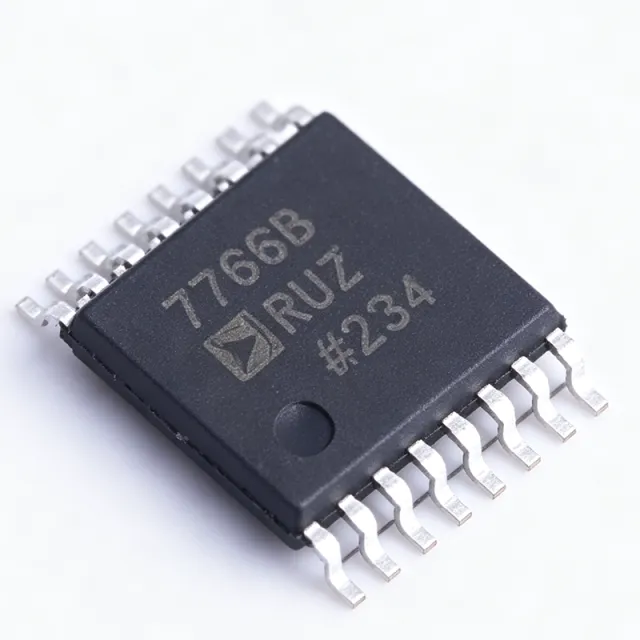
AD7766BRUZ - 24-Bit Oversampled SAR ADC | Analog Devices
The AD7766BRUZ is a high-performance, 24-bit, oversampled successive approximation (SAR) analog-to-digital converter (ADC) from Analog Devices. It is part of the AD7766 family, which includes the AD7766, AD7766-1, and AD7766-2 variants, each offering different sample rates and power consumption levels. The AD7766BRUZ specifically operates at 128 kSPS with a dynamic range of 109.5 dB and consumes only 8.5 mW, making it ideal for low-power, high-resolution data acquisition systems. The device is housed in a 16-lead TSSOP package and operates from a 2.5 V supply with a 5 V reference. An oversampled SAR ADC is a type of analog-to-digital converter that combines the benefits of a successive approximation register (SAR) architecture with oversampling techniques to achieve high resolution and excellent noise performance. Unlike traditional SAR ADCs, which sample at the Nyquist rate, oversampled SAR ADCs sample at a much higher rate and use digital filtering to improve the signal-to-noise ratio (SNR) and dynamic range. This makes them particularly suitable for applications requiring high accuracy and low noise, such as precision instrumentation, medical devices, and industrial control systems. The AD7766BRUZ falls under the broader category of data converters, which are essential components in any mixed-signal system. Key features of the AD7766BRUZ include a 24-bit resolution, a dynamic range of 109.5 dB, and a total harmonic distortion (THD) of -112 dB. The device also features an oversampled SAR architecture that provides high performance with low power consumption. The AD7766BRUZ includes an SDI pin that allows for daisy-chaining multiple devices, enabling easy expansion in multi-channel systems. The device operates from a 2.5 V supply and uses a 5 V reference, which simplifies power supply design. The AD7766BRUZ is designed for applications that require high-resolution, low-noise analog-to-digital conversion with minimal power consumption. Its oversampled SAR architecture provides excellent AC and DC accuracy, making it suitable for precision measurement and control systems. The device's low power consumption of 8.5 mW makes it ideal for battery-powered and portable applications. Typical applications for the AD7766BRUZ include precision data acquisition systems, medical instrumentation, industrial process control, and vibration analysis. The device's high dynamic range and low noise make it well-suited for applications where signal integrity is critical. Additionally, the daisy-chain capability allows for easy integration into multi-channel systems. When designing with the AD7766BRUZ, it is important to ensure proper decoupling of the power supply and reference pins. A clean, low-noise reference voltage is essential for achieving the specified dynamic range. Additionally, the input signal should be properly conditioned to avoid aliasing and to ensure optimal performance.

AD7768-1BCPZ - 24-Bit 1.024 MSPS Sigma-Delta ADC | Analog Devices
The Analog Devices AD7768-1BCPZ is a single-channel, 24-bit sigma-delta analog-to-digital converter with a 1.024 MSPS output data rate and a 28-lead LFCSP package measuring 5 mm by 4 mm. It combines a sigma-delta modulator and digital filter for precision conversion of both AC and DC signals. The verified product listing identifies the AD7768-1 as a low-power, high-performance converter designed for measurement systems where resolution, noise performance, and flexible filtering are important. A sigma-delta ADC is a data-converter type that uses oversampling, noise shaping, and digital filtering to obtain high-resolution results from low-resolution internal converters. In the broader electronics hierarchy, a sigma-delta ADC belongs to the ADC/DAC category, then to precision data converters, analog-to-digital converters, and ultimately semiconductor signal-processing devices. Its strengths are high resolution and strong performance for slowly changing or bandwidth-limited signals; its trade-offs include latency and a conversion rate determined by the digital filter and output-data-rate settings. The AD7768-1 is the single-channel member of the AD7768 family. Analog Devices describes it as a precision 24-bit ADC for precision conversion of AC and DC signals. The verified distributor data specifies a 1.024 MSPS conversion capability, one analog input, one sigma-delta conversion channel, a serial interface, and a 28-LFCSP package with exposed-pad construction. These features suit instrumentation, sensor acquisition, industrial monitoring, and test systems where a filtered measurement is preferred over a high-rate flash-conversion waveform capture. The converter’s digital filter is central to its operation. The manufacturer page identifies selectable power modes for trading output-data-rate and bandwidth against power consumption in the related AD7768 family documentation. For the AD7768-1, filtering and decimation help suppress out-of-band noise, while the serial interface transfers filtered conversion results to a controller or FPGA. System designers should verify the exact data rate, filter mode, clocking, supply arrangement, and digital timing against the manufacturer datasheet before finalizing a PCB. Typical uses include precision bridge or sensor measurement, low-level DC voltage acquisition, laboratory instrumentation, industrial process monitoring, and embedded measurement systems. The ADC is not a general-purpose high-speed waveform ADC: input bandwidth and filter latency should be checked against the signal dynamics. A front-end amplifier, reference circuit, protection network, and suitable grounding are usually needed to preserve accuracy. For layout, place input, reference, digital-interface, and decoupling connections according to the Analog Devices datasheet and recommended application guidance. Pay particular attention to the exposed thermal pad, analog supply routing, reference noise, and return paths. The verified data does not provide complete electrical limits, pricing, pin names, or alternate equivalent parts, so those fields are explicitly marked for validation rather than inferred. This page combines the verified Analog Devices product description, distributor package and speed information, source traceability, and engineering-oriented selection guidance. It is intended to help engineers identify whether the AD7768-1BCPZ matches a 24-bit single-channel precision-conversion requirement before requesting quotation, checking stock, or downloading the authoritative datasheet.
AD7768-1BSTZ - 24-bit Sigma-Delta Precision ADC | Analog Devices
The Analog Devices AD7768-1BSTZ is a low-power, high-performance 24-bit sigma-delta (Σ-Δ) analog-to-digital converter with an integrated modulator and digital filter, delivering precision conversion of both AC and DC signals at up to 256 kSPS in a 64-lead LQFP (10x10 mm) package. The AD7768-1 is the single-channel version of the AD7768 8-channel simultaneous-sampling ADC family from Analog Devices. A sigma-delta ADC is a type of analog-to-digital converter that oversamples the input signal with a 1-bit modulator and then applies on-chip digital filtering and decimation to produce a high-resolution output. In the precision measurement hierarchy, it sits above general-purpose SAR ADCs for dynamic-range-critical tasks, making it a core building block of industrial data acquisition (DAQ) systems and instrumentation front ends. Key features include 24-bit resolution, a flexible decimation-rate digital filter enabling bandwidth/data-rate trade-offs, three selectable power modes that let designers optimize noise versus power consumption, and a reusable DAQ footprint for both isolated and non-isolated designs. According to Analog Devices, this establishes a new industry benchmark in combined AC and DC performance, allowing one hardware design to span multiple measurement variants. Technically, the AD7768-1 combines a high-order Σ-Δ modulator with an on-chip sinc filter, providing excellent linearity and dynamic range for precision signal chains. Programmable power modes scale modulator clocking to match noise targets against power dissipation, which is valuable in battery-powered and high-density multichannel modules. The single-channel architecture simplifies layouts for one-channel precision front ends while keeping register-level compatibility with the AD7768 family. Typical applications include dynamic signal analysis, power quality monitoring, vibration and acoustic sensing, precision instrumentation, and industrial DC-to-204 kHz measurement systems requiring a 24-bit sigma-delta converter. Design considerations: choose the decimation filter settings and power mode early, since output data rate, input bandwidth, and supply current are interdependent; ensure clean, low-noise reference and analog supplies for full dynamic-range performance. This page synthesizes distributor data, same-family alternatives, pricing tiers, and practical design notes not found in the manufacturer datasheet.
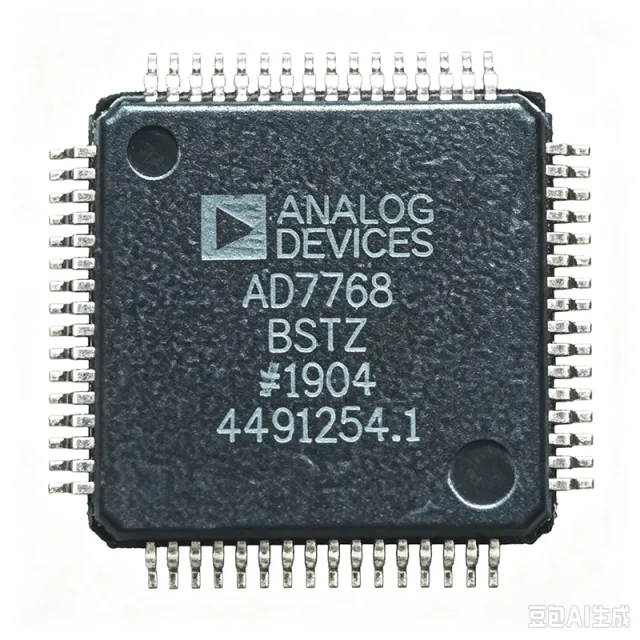
AD7768-4BSTZ - 24-Bit 4-Ch Simultaneous ADC | Analog Devices
The AD7768-4BSTZ is a 24-bit, 4-channel, simultaneous sampling analog-to-digital converter (ADC) from Analog Devices, featuring a maximum output data rate of 256 kSPS and a wideband input bandwidth of 110.8 kHz. Housed in a 64-lead LQFP (10x10 mm) package, this sigma-delta ADC is designed for high-performance measurement applications requiring low power and high accuracy. An ADC (analog-to-digital converter) is a device that converts continuous analog signals into discrete digital numbers. The AD7768-4 is a sigma-delta ADC, which uses oversampling and noise shaping to achieve high resolution and excellent noise performance. It belongs to the family of precision data converters, specifically simultaneous sampling ADCs, which capture multiple channels at the exact same instant, essential for applications like power monitoring and vibration analysis. Key features of the AD7768-4BSTZ include three power modes (fast, median, and low power) that allow the user to trade off input bandwidth, output data rate, and power dissipation. It offers a wideband low-pass filter with ±0.005 dB pass-band ripple and 105 dB stop-band attenuation at the Nyquist frequency. The device operates from a 2.5 V analog supply and a 2.5 V to 3.3 V digital interface supply, with a typical power dissipation of 27.5 mW in low power mode. The AD7768-4 uses a sigma-delta modulator with a digital decimation filter, providing a flexible digital interface (SPI) for configuration and data readout. It includes an internal reference buffer and supports both differential and single-ended inputs. The device is specified over the industrial temperature range of -40°C to +105°C. Typical applications include power line monitoring, vibration analysis, motor control, and multi-phase energy metering. Its simultaneous sampling capability and high accuracy make it ideal for systems requiring precise phase alignment between channels. When designing with the AD7768-4, ensure proper decoupling of the analog and digital supplies, and use a low-jitter master clock to achieve the specified SNR. The power mode selection should be optimized based on the required bandwidth and power budget.

AD7768-4BSTZ-RL - 24-Bit 4-Ch ADC, 256kSPS | Analog Devices
The AD7768-4BSTZ-RL from Analog Devices is a 24-bit, 4-channel, simultaneous sampling sigma-delta (Σ-Δ) analog-to-digital converter (ADC) in a 64-lead LQFP (10x10 mm) package. It achieves 108 dB dynamic range at a maximum input bandwidth of 110.8 kHz, with a maximum output data rate of 256 kSPS per channel. The device integrates a Σ-Δ modulator and digital filter per channel, enabling synchronized sampling of ac and dc signals. A sigma-delta ADC is a type of analog-to-digital converter that uses oversampling and noise shaping to achieve high resolution. It is part of the ADC family, which converts analog signals to digital for processing in microcontrollers, DSPs, and FPGAs. Sigma-delta ADCs are preferred for precision measurement applications due to their excellent linearity and noise performance. Key features include three power modes (fast, median, low power) that allow trade-offs between input bandwidth, output data rate, and power dissipation. The AD7768-4 supports a wide input voltage range and provides a flexible digital interface with both SPI and parallel output options. It also features a low-pass digital filter with programmable decimation, enabling users to optimize for noise and bandwidth. The AD7768-4 uses a high-performance analog front-end with a precision reference and internal oscillator, reducing external component count. Its simultaneous sampling capability ensures accurate phase matching across channels, critical for multi-phase power monitoring and vibration analysis. The device operates from a 2.5 V analog supply and a 1.8 V digital supply, with power dissipation scaling with mode. Typical applications include power quality monitoring, vibration analysis, motor control, and data acquisition systems. The AD7768-4 is ideal for industrial automation, energy metering, and test and measurement equipment where high accuracy and synchronized multi-channel sampling are required. When designing with this ADC, ensure proper decoupling of the analog and digital supplies and use a low-noise reference to achieve the specified dynamic range. The digital filter settings should be configured to match the desired bandwidth and output data rate.

AD7770ACPZ - 8-Ch 24-Bit 32kSPS Simultaneous-Sampling Sigma-Delta ADC | ADI
The Analog Devices AD7770ACPZ is an 8-channel, 24-bit, simultaneous-sampling sigma-delta analog-to-digital converter (ADC) with integrated programmable gain amplifiers (PGAs), delivering up to 32 kSPS output data rate per channel in a 64-pin LFCSP (9x9 mm) package. Each of the eight channels features a PGA with selectable gains of 1, 2, 4, and 8, low DC input current of ±4 nA (differential) and ±8 nA (single-ended), and supports both single-ended and true differential inputs for direct sensor connection. An ADC (Analog-to-Digital Converter) is a semiconductor device that converts continuous analog signals into discrete digital codes, sitting in the signal chain hierarchy between sensors/front-ends and digital processors or MCUs. The AD7770 belongs to the precision sigma-delta ADC sub-category, which trades conversion speed for very high effective resolution by oversampling and digital filtering; within that sub-category it is a multi-channel simultaneous-sampling part, meaning all eight cores convert at the same instant, preserving phase information critical for three-phase power, vibration, and biomedical instrumentation. Key differentiating features include a sample rate converter (SRC) enabling coherent sampling with resolution up to 15.2×10⁻⁶ SPS, a low-latency sinc³ filter path, on-chip per-channel PGAs, and very low input current that allows direct connection to current-sense transformers, shunt resistors, and piezoelectric sensors without loading effects. These features minimize external signal-conditioning components. Technically, the AD7770 integrates eight independent sigma-delta modulator cores plus a shared digital filter/decimation engine. The SRC allows the output data rate to be programmed to any value between the modulator rate and very low rates without losing integer decimation ratios, simplifying synchronization to mains frequency (50/60 Hz). On-chip calibration and temperature-compensation registers correct gain and offset drift. Typical applications include three-phase power-quality and energy-metering front-ends, vibration and modal analysis, multiphase motor control, industrial process-control PLC analog modules, and multi-channel data-acquisition systems. Direct sensor interface with low input current suits shunt-based current sensing and Rogowski-coil current transducers. Design consideration: input common-mode voltage must be within the PGA input range and the reference voltage (typically an external ADR45xx series) determines absolute accuracy; add anti-aliasing RC networks at each input pin when broadband noise sources are present. This page synthesizes distributor pricing, drop-in same-brand and cross-brand alternatives, application references and design notes beyond the datasheet to give a single engineering-ready view of the AD7770ACPZ.
AD7771BCPZ - 8-Ch 24-Bit 128kSPS Sigma-Delta ADC | Analog Devices
The Analog Devices AD7771BCPZ is an 8-channel, 24-bit, simultaneous-sampling sigma-delta analog-to-digital converter (ADC) housed in a 64-lead LFCSP (9 mm x 9 mm) package with exposed pad. It accepts single-ended or true differential inputs, supports per-channel programmable PGA gains of 1, 2, 4, and 8, and achieves an output data rate (ODR) of up to 128 kSPS per channel with low dc input current of +/-4 nA differential and +/-8 nA single-ended. What is a sigma-delta ADC? A sigma-delta ADC is a type of analog-to-digital converter that uses oversampling and noise-shaping to trade sample rate for resolution; it belongs to the broader category of data converters (ADC/DAC) within the integrated circuit family, and ADCs in this class are widely used when high dynamic range and integrated digital filtering are required. Sigma-delta converters sit between successive-approximation-register (SAR) ADCs (lower latency, lower speed) and high-speed pipeline ADCs (lowest resolution, highest speed) in the precision-converter hierarchy. Key features include programmable ODRs and bandwidth, a sample-rate converter (SRC) for coherent sampling with resolution up to 15.2 x 10^-6 SPS, low-latency sinc3 and sinc5 filter paths, and adjustable bandwidth. According to the manufacturer datasheet, the AD7771 integrates a 2.5 V internal reference with a typical temperature coefficient of +/-10 ppm/degree C and includes an internal multiplexer that can sense internal nodes for diagnostics and self-calibration. The AD7771 architecture pairs a precision analog modulator per channel with shared digital decimation and filtering resources, allowing all eight channels to be sampled simultaneously without inter-channel skew. This topology is purpose-built for power-line monitoring, multi-phase motor control, and any application requiring deterministic per-sample timing across many channels at industrial bandwidths. Typical applications include three-phase power quality analyzers, industrial process control and PLC analog front ends, multi-axis vibration and condition-monitoring systems, and medical instrumentation requiring IEC 60601-1-class patient isolation monitoring. The integrated PGA eliminates external gain stages, simplifying the signal chain. When designing with this device, ensure the AVSS pins are tied to a clean analog ground and that the exposed pad is soldered to a sufficiently large copper pour to meet the thermal and grounding requirements described in the datasheet. Decouple AVDD and IOVDD separately with low-ESR ceramic capacitors placed as close to the pins as practical. This page synthesizes distributor pricing, drop-in same-package alternatives, and practical PCB/grounding notes that complement the manufacturer datasheet with field-ready selection context.
AD7776ARZ-REEL - 10-Bit High-Speed SAR ADC, 24-SOIC | Analog Devices
The Analog Devices AD7776ARZ-REEL is a 10-bit resolution, high-speed successive-approximation-register (SAR) analog-to-digital converter with 1 single-ended input channel and parallel digital interface, housed in a 24-pin SOIC (wide-body, 0.295 inch / 7.50 mm) package. The device operates from a single +5 V analog supply and is fabricated on a CMOS process, making it well suited to high-throughput mixed-signal designs where low power and fast acquisition matter. An SAR ADC is a converter type that uses a binary search algorithm to step an internal DAC toward the input voltage in N clock cycles, where N equals the converter's resolution. SAR converters therefore have no pipeline latency and are ideal for multiplexed-channel data-acquisition systems, motor control loops, and instrumentation front-ends that need a deterministic one-cycle conversion. The AD7776 belongs to the data converter (ADC) hierarchy, which sits beneath the signal chain architecture along with DACs, amplifiers, and references. The 10-bit resolution gives approximately 60 dB (10 mV at full-scale) of dynamic range, which is well matched to industrial-level control and monitoring. Key features of the AD7776 include 1 input channel, parallel digital output, single +5 V supply operation, CMOS construction, and a 24-SOIC wide-body package that simplifies PCB layout with through-hole-friendly pads. The wide-body SOIC footprint also improves thermal performance relative to its narrow-body sibling, allowing continuous operation across the industrial -40 C to +85 C temperature range without thermal de-rating concerns. Architecturally, the device combines an internal 5 V reference input path (or external reference option), a high-speed comparator, and a successive-approximation register with binary-weighted capacitor array. The internal clocking handles acquisition and conversion in a deterministic number of cycles, producing results in a single read rather than a pipelined fashion. Typical applications for the AD7776ARZ-REEL include industrial process control data-acquisition front-ends, digital instrumentation and panel meters, motor-speed and position feedback loops, multi-channel scanned data-acquisition systems using an external MUX, and high-speed闭环 control subsystems where deterministic single-cycle conversion is required. When designing with this part, ensure that the analog input stays within the input common-mode range specified for +5 V operation and that decoupling on AVDD is placed as close to the supply pins as possible. Users should also confirm via the manufacturer datasheet that the parallel timing and read strobe meet the host controller's setup/hold requirements. This page synthesizes distributor pricing (as of 2026-10-12), drop-in alternatives sourced from web cross-reference data, and practical design notes that go beyond what the standalone datasheet provides.

AD7780BRUZ - 24-Bit Sigma-Delta ADC, 330µA | Analog Devices
The AD7780BRUZ is a complete low power front-end solution for bridge sensor products, including weigh scales, strain gages, and pressure sensors. It integrates a precision, low power, 24-bit sigma-delta (Σ-Δ) ADC, an on-chip low noise programmable gain amplifier (PGA), and an on-chip oscillator. Consuming only 330 μA, the AD7780 is particularly suitable for portable or battery-operated products. The device operates from a single 2.7V to 5.25V supply and is available in a 16-lead TSSOP package. A sigma-delta ADC is an analog-to-digital converter that uses oversampling and noise shaping to achieve high resolution. It is ideal for low-frequency, high-precision measurement applications such as bridge sensors, where the signal bandwidth is narrow but accuracy is paramount. The AD7780 belongs to the family of sigma-delta ADCs, which are a subset of precision analog-to-digital converters used in industrial and instrumentation systems. Key features include a 24-bit resolution, a maximum output data rate of 16.7 SPS, and a programmable gain of 1, 2, 4, 8, 16, 32, 64, or 128. The device also features a low noise PGA, an on-chip oscillator, and a 3-wire serial interface. The AD7780 operates from a 2.7V to 5.25V supply and consumes only 330 μA, making it ideal for battery-powered applications. The AD7780 uses a sigma-delta architecture with a digital filter that provides 50 Hz and 60 Hz rejection. The device includes a temperature sensor and a bridge power-down switch, which can be used to conserve power. The AD7780 is specified over the -40°C to +105°C temperature range and is available in a 16-lead TSSOP package. Typical applications include weigh scales, strain gage transducers, pressure sensors, and portable instrumentation. The low power consumption and high resolution make it suitable for battery-operated devices where power efficiency is critical. When designing with the AD7780, ensure that the analog and digital supplies are properly decoupled and that the reference input is stable. The device requires an external reference voltage, which should be low-noise to achieve the specified performance.

AD7780BRZ-REEL - 24-Bit Pin-Prog Low-Power Sigma-Delta ADC | ADI
The Analog Devices AD7780BRZ-REEL is a 24-bit, pin-programmable, ultralow-power sigma-delta (Σ-Δ) analog-to-digital converter (ADC) housed in a 14-SOIC package, designed as a complete analog front end for bridge sensor products. It integrates a precision 24-bit Σ-Δ modulator, a low-noise programmable gain amplifier (PGA), and an on-chip oscillator, consuming only 330 µA typical supply current from a 2.7 V to 5.25 V analog supply. A sigma-delta ADC is a type of oversampling converter that trades raw sampling speed for exceptional resolution and noise immunity. By sampling at many times the Nyquist rate and using digital filtering to shape quantization noise out of the signal band, Σ-Δ ADCs achieve 16-24 bit effective resolution ideal for low-frequency, high-precision measurements such as weigh scales, strain gauges, and pressure sensors. The AD7780 inherits this architecture within the broader hierarchy of data converter -> ADC -> Σ-Δ ADC -> precision sensor ADC. Key features include a programmable gain amplifier with gains of 1, 2, 4, 8, 16, 32, 64, and 128 set via two gain select pins, an update rate of 10 Hz (low-noise mode) or 16.7 Hz (low-power mode), and pin-programmable filter response that lets the designer trade RMS noise for settling time without software configuration. The on-chip oscillator eliminates the need for an external crystal, and the single-channel differential input accepts either an external reference or VREF tied to AVDD. Typical applications include weigh scales, strain-gauge bridges, industrial process control loops, portable medical instrumentation, pressure-sensor signal conditioning, and battery-powered sensor nodes. The 330 µA quiescent current and internal clock make the AD7780 especially attractive for isolated loop-powered or 4-20 mA sensor transmitters where every microamp counts toward compliance with NAMUR NE-43. For best results, place decoupling capacitors (typically 100 nF ceramic plus 10 µF tantalum) directly across AVDD and DVDD to ground within 2 mm of the supply pins, keep the analog and digital grounds separated until they meet at the ADC ground pin, and route the bridge sensor traces as a guarded differential pair to reject common-mode 50/60 Hz pickup. The pin-programmable gain and output rate allow firmware-free, hardware-set reconfiguration of the same PCB for different sensor full-scales. When designing for EMC-sensitive environments such as industrial IEC 61000-4 installations, the Σ-Δ architecture's inherent noise shaping combined with 50 Hz / 60 Hz simultaneous rejection simplifies post-filter design at the host microcontroller. For sub-30 mg weigh-scale resolution, choose the 10 Hz low-noise filter mode; for faster loop response in dynamic pressure sensing, the 16.7 Hz mode halves the per-sample noise density but still maintains 18+ noise-free bits. This page combines authoritative spec data from the manufacturer datasheet, real-time distributor pricing snapshot from DigiKey as of 2026-10-12, drop-in alternatives verified by package pin count and PGA gain set, and field-tested design notes not condensed in the datasheet's typical-application schematic.