Verstärker-ICs
Produkte (563)

ADA4661-2ARMZ - 18V Precision RRIO CMOS Op Amp | Analog Devices
The ADA4661-2ARMZ is a dual, precision, rail-to-rail input/output (RRIO) CMOS operational amplifier from Analog Devices, optimized for low power, high bandwidth, and a wide operating supply voltage range. It operates from a single 3.0 V to 18 V supply or dual ±1.5 V to ±9 V supplies, delivering 4 MHz bandwidth while consuming only 725 µA of supply current per amplifier. The device is available in an 8-lead MSOP package (ARMZ suffix) and is specified over the extended industrial temperature range of -40°C to +125°C. An operational amplifier (op amp) is a high-gain voltage amplifier with differential inputs and a single-ended output, used in signal conditioning, filtering, and buffering applications. The ADA4661-2 belongs to the precision op amp category, which emphasizes low offset voltage, low noise, and high DC accuracy. As a CMOS amplifier, it offers high input impedance and low input bias current, making it suitable for interfacing with high-impedance sensors and precision analog front ends. Key features of the ADA4661-2 include rail-to-rail input and output swing, which maximizes dynamic range in low-voltage applications. The device guarantees performance at 3.0 V, 10 V, and 18 V supply voltages, ensuring consistent operation across a wide range of power rails. With a typical offset voltage of 50 µV and a temperature drift of 0.5 µV/°C, it provides excellent DC precision. The amplifier also features a high common-mode rejection ratio (CMRR) of 100 dB and a power supply rejection ratio (PSRR) of 110 dB, minimizing errors from supply variations. Technically, the ADA4661-2 employs a CMOS input stage with chopper-less auto-zeroing techniques to achieve low offset and drift without the noise penalty of chopper amplifiers. The output stage is designed to drive capacitive loads up to 100 pF while maintaining stability, and it can source or sink 30 mA of output current. The device includes internal ESD protection and is available in both MSOP and LFCSP (3 mm × 3 mm) packages, offering design flexibility. Typical applications include precision sensor signal conditioning, battery-powered instrumentation, active filters, and data acquisition systems. The low power consumption and wide supply range make it ideal for portable and industrial equipment where power efficiency and accuracy are critical. In sensor interfaces, the high input impedance and low bias current preserve signal integrity from high-impedance sources. When designing with the ADA4661-2, ensure proper decoupling of the supply pins with 0.1 µF ceramic capacitors placed close to the device. For optimal noise performance, use low-value resistors in the feedback network and keep the input traces short to minimize parasitic capacitance. The rail-to-rail output stage can swing within 10 mV of the rails, but for best linearity, avoid operating at the extreme output limits.
ADA4661-2ARMZ-RL7 - Dual Precision RRIO Op Amp | Analog Devices
The ADA4661-2ARMZ-RL7 is a dual, precision, rail-to-rail input/output (RRIO) CMOS operational amplifier from Analog Devices, optimized for low power, high bandwidth, and wide operating supply voltage range applications. It operates from a single 3.0 V to 18 V supply or dual ±1.5 V to ±9 V supplies, delivering 4 MHz unity-gain bandwidth while consuming only 725 µA of supply current per amplifier. The device is available in an 8-lead MSOP package and is specified over the extended industrial temperature range of -40°C to +125°C. An operational amplifier (op amp) is a high-gain voltage amplifier with differential inputs and a single-ended output, used in signal conditioning, filtering, and instrumentation. The ADA4661-2 belongs to the precision op amp category, which emphasizes low offset voltage, low noise, and high common-mode rejection. As a CMOS RRIO amplifier, it can handle input and output signals that swing close to both supply rails, making it ideal for single-supply systems where headroom is limited. This device sits in the hierarchy: precision op amp -> operational amplifier -> analog IC -> semiconductor. Key features include a low offset voltage of 90 µV (maximum), a low input bias current of 1 pA (typical), and a high open-loop gain of 120 dB. The rail-to-rail input and output stages allow maximum dynamic range, while the 4 MHz bandwidth and 1.7 V/µs slew rate support moderate-speed signal processing. The low power consumption of 725 µA per amplifier makes it suitable for battery-powered and portable equipment. The ADA4661-2 uses a CMOS architecture with precision laser-trimmed input transistors, achieving excellent DC accuracy and low drift. The output stage can source and sink 15 mA of load current, and the device is stable with capacitive loads up to 100 pF. The wide supply range and low quiescent current provide design flexibility across various power rails. Typical applications include sensor signal conditioning, data acquisition systems, active filters, and portable instrumentation. The rail-to-rail output maximizes ADC input range, while the low bias current preserves accuracy in high-impedance sensor interfaces. When designing with this device, ensure proper decoupling with 0.1 µF capacitors close to the supply pins. The input common-mode range extends beyond the rails by 100 mV, but avoid exceeding the absolute maximum ratings of -0.3 V to VCC+0.3 V on the inputs.

ADA4666-2ARMZ-RL7 - 18V, 4MHz CMOS RRIO Op Amp | Analog Devices
The ADA4666-2ARMZ-RL7 is a dual, rail-to-rail input/output CMOS operational amplifier from Analog Devices, optimized for low power, high bandwidth, and wide operating supply voltage range applications. It operates over a supply voltage range of 3 V to 18 V and is guaranteed at 3.0 V, 10 V, and 18 V. The device features a typical supply current of 725 µA per amplifier, a gain-bandwidth product of 4 MHz, and rail-to-rail input and output stages, making it suitable for battery-powered and precision signal conditioning applications. An operational amplifier (op amp) is a high-gain voltage amplifier with differential inputs and a single-ended output, used in analog signal processing to perform mathematical operations such as amplification, filtering, and integration. The ADA4666-2 belongs to the class of CMOS rail-to-rail input/output amplifiers, which are designed to operate with input and output voltages that can swing close to the supply rails, maximizing dynamic range in low-voltage systems. This op amp is part of the broader category of precision amplifiers, which are characterized by low offset voltage, low noise, and high stability over temperature. Key features of the ADA4666-2 include a wide supply range of 3 V to 18 V, rail-to-rail input and output, low supply current of 725 µA, and a gain-bandwidth product of 4 MHz. The device also offers a low offset voltage of typically 50 µV and a low input bias current of 1 pA, making it ideal for high-impedance sensor interfaces. The CMOS input stage provides very high input impedance, minimizing loading on signal sources. Technically, the ADA4666-2 uses a unique input and output stage architecture to achieve rail-to-rail operation with very low supply current. The amplifier is stable with capacitive loads up to 100 pF and has a slew rate of 1.5 V/µs. It is specified over the extended industrial temperature range of -40°C to +125°C, ensuring reliable operation in harsh environments. The device is available in an 8-lead MSOP package, which is compact and suitable for space-constrained designs. Typical applications include battery-powered instrumentation, portable medical devices, sensor signal conditioning, and active filters. The wide supply range and low power consumption make it particularly well-suited for industrial process control and automotive electronics, where both precision and efficiency are critical. When designing with the ADA4666-2, ensure proper decoupling of the power supply pins with 0.1 µF ceramic capacitors placed close to the device. The rail-to-rail output stage can drive loads down to 2 kΩ, but for heavier loads, consider using a buffer or increasing the supply voltage to maintain output swing.

ADA4805-1AKSZ - 105MHz Low Power Rail-to-Rail Op Amp | ADI
The ADA4805-1AKSZ is a high speed voltage feedback operational amplifier from Analog Devices, offering a unity-gain bandwidth of 105 MHz while consuming only 500 µA of quiescent current. It features rail-to-rail output, low input offset voltage, and low noise, making it ideal for battery-powered and high-resolution data acquisition systems. The device operates from dual supplies of ±1.5 V to ±5 V or single supplies of 3 V to 5 V, providing design flexibility across a wide range of applications. It is available in a 6-lead SC70 package (AKSZ suffix) and a 6-lead SOT-23 package (ARJZ suffix), both with a compact footprint for space-constrained designs. An operational amplifier (op amp) is a high-gain voltage amplifier with differential inputs and a single-ended output, used to condition analog signals in applications such as filtering, amplification, and buffering. The ADA4805-1 belongs to the class of rail-to-rail output amplifiers, which can swing its output very close to the supply rails, maximizing dynamic range in low-voltage systems. As a voltage feedback amplifier, it offers stable operation with resistive feedback networks and is widely used in signal conditioning chains, from sensors to ADCs. Key features of the ADA4805-1 include a low input offset voltage of 0.2 µV/°C drift, a high slew rate of 170 V/µs, and a low input voltage noise of 7 nV/√Hz. The rail-to-rail output stage ensures maximum output swing, while the low quiescent current extends battery life in portable instruments. The amplifier also features a wide supply range, making it suitable for both 3 V and 5 V systems, and it is fully specified over the industrial temperature range of -40°C to +125°C. Technically, the ADA4805-1 uses a complementary bipolar process that achieves a good balance between speed and power consumption. The 105 MHz bandwidth and 170 V/µs slew rate enable it to handle fast signals, while the 500 µA quiescent current is exceptionally low for this performance class. The device also includes internal ESD protection and is available in lead-free, RoHS-compliant packages. Typical applications include portable instrumentation, battery-powered medical devices, active filters, and ADC driver circuits. In these applications, the ADA4805-1 provides the necessary bandwidth and precision while minimizing power drain. For example, in a 16-bit SAR ADC driver, the low noise and high slew rate ensure accurate settling, while the rail-to-rail output maximizes the ADC's input range. When designing with the ADA4805-1, ensure proper power supply decoupling with 0.1 µF capacitors close to the supply pins. The SC70 package has a thermal resistance of approximately 200°C/W, so consider power dissipation in high-temperature environments. For best performance, use a solid ground plane and keep feedback paths short to minimize parasitic capacitance.
ADA4805-1AKSZ-RL7 - 105MHz Low Power Rail-to-Rail Op Amp | ADI
The ADA4805-1AKSZ-RL7 is a high-speed voltage feedback operational amplifier from Analog Devices, offering a unity-gain bandwidth of 105 MHz while consuming only 500 µA of quiescent current. It features rail-to-rail output swing and operates over a wide supply range from ±1.5 V to ±5 V, as well as single 3 V and 5 V supplies. The device is available in a 6-lead SC70 package, making it ideal for space-constrained, battery-powered applications. An operational amplifier (op amp) is a high-gain voltage amplifier with differential inputs and a single-ended output. It is a fundamental building block in analog electronics, used in signal conditioning, filtering, and amplification. The ADA4805-1 belongs to the class of high-speed, low-power op amps, which balance bandwidth and power consumption for portable instrumentation and data acquisition systems. Key features include a low input offset voltage of 0.2 µV/°C drift, low noise, and rail-to-rail output. The amplifier is designed for low-power, high-resolution data conversion systems, where it can drive ADCs or buffer reference voltages. Its wide bandwidth and low quiescent current make it suitable for battery-operated devices that require both performance and efficiency. The ADA4805-1 uses a voltage feedback architecture, providing stable operation with a wide range of gain configurations. It is specified for operation over the industrial temperature range of -40°C to +125°C. The SC70-6 package is compact, with a footprint of 2.0 mm × 1.25 mm, enabling high-density PCB layouts. Typical applications include portable medical devices, battery-powered instrumentation, active filters, and ADC driver circuits. The amplifier's low power consumption extends battery life, while its high bandwidth ensures accurate signal reproduction. When designing with the ADA4805-1, ensure proper decoupling of the power supply pins with 0.1 µF ceramic capacitors placed close to the device. The rail-to-rail output stage allows maximum dynamic range, but care must be taken to avoid output saturation when driving low-impedance loads.

ADA4805-1ARJZ-R7 - 105MHz Low-Noise Op Amp, 500µA IQ | ADI
The Analog Devices ADA4805-1ARJZ-R7 is a high-speed voltage-feedback operational amplifier featuring rail-to-rail output, an exceptionally low quiescent current of 500 µA, and a -3 dB bandwidth of 105 MHz, housed in a 6-pin SOT-23 (RJ) package. It operates from ±1.5 V to ±5 V dual supplies or from single 3 V and 5 V rails, with 5.2 nV/√Hz input voltage noise density, 1.6 mV typical input offset voltage, and 0.2 µV/°C offset drift. A voltage-feedback operational amplifier (VFA) is a type of op amp whose closed-loop bandwidth depends primarily on the feedback resistor and gain setting, rather than on the gain itself. The ADA4805-1 belongs to the VFA topology within the broader operational amplifier family, which itself sits under the analog signal-conditioning hierarchy: op amp -> amplifier IC -> analog IC -> semiconductor. This category also includes current-feedback amplifiers (CFAs), zero-drift chopper amplifiers, and instrumentation amplifiers, each optimized for different signal-chain roles. Key features include 1 mA typical output current drive, 170 V/µs slew rate, rail-to-rail output swing to within 40 mV of either rail at light load, and internal RF input filtering. The SOT-23-6 (RJ-6) footprint is approximately 2.9 mm × 1.6 mm with exposed thermal considerations managed through the lead frame. Offset drift of 0.2 µV/°C enables precision DC accuracy over industrial temperature ranges of -40 °C to +125 °C. The internal architecture uses a complementary bipolar input stage with rail-to-rail output common-emitter design, allowing the amplifier to swing within millivolts of either supply rail. The 5.2 nV/√Hz input voltage noise combined with 105 MHz bandwidth gives an amplifier noise figure competitive with parts consuming 5-10× more current. This efficiency is critical for portable and battery-powered precision instrumentation. Typical applications include active filters for anti-aliasing, ADC drivers for high-resolution successive-approximation register (SAR) converters, photodiode transimpedance stages, and portable medical instrumentation front ends. The wide supply range also makes it suitable for handheld test equipment and industrial sensor conditioning. When designing with this part, account for thermal dissipation in the small SOT-23 package: at 10 V supply and 30 mA load the part dissipates 300 mW. A solid ground plane and short input traces are essential to maintain 105 MHz performance without oscillation. This page synthesizes distributor pricing, drop-in alternatives, and practical design notes that go beyond the manufacturer datasheet, giving engineers a single source for sourcing, substitution, and design-in decisions.
ADA4805-2ARMZ - Dual 105MHz Low Power Op Amp | Analog Devices
The ADA4805-2ARMZ is a dual, high-speed voltage feedback operational amplifier from Analog Devices, featuring rail-to-rail output and an exceptionally low quiescent current of 500 µA per amplifier. It operates over a wide supply range from ±1.5 V to ±5 V, as well as single 3 V and 5 V supplies, making it ideal for low power, high resolution data conversion systems. The device is available in an 8-lead MSOP package, offering a compact footprint for space-constrained designs. An operational amplifier (op amp) is a high-gain voltage amplifier with differential inputs and typically a single-ended output. It is a fundamental building block in analog electronics, used in signal conditioning, filtering, and buffering applications. The ADA4805-2 is a voltage feedback amplifier, which provides high bandwidth and low distortion, suitable for driving ADCs and other precision circuits. In the hierarchy of analog ICs, it falls under amplifiers, then operational amplifiers, then high-speed op amps, and finally low-power high-speed op amps. Key features of the ADA4805-2 include a 105 MHz bandwidth, a slew rate of 225 V/µs, and a low input voltage noise of 3.1 nV/√Hz. The rail-to-rail output stage allows maximum dynamic range, especially in single-supply applications. The low quiescent current of 500 µA per amplifier makes it suitable for battery-powered and portable instrumentation. The device also features a low offset voltage of 0.2 µV/°C drift, ensuring accuracy over temperature. Technically, the ADA4805-2 uses a complementary bipolar process, providing high speed and low noise. The amplifier is stable with capacitive loads up to 100 pF, and its output can swing within 50 mV of the rails. The input common-mode range extends beyond the rails, allowing overvoltage protection. The device is specified over the industrial temperature range of -40°C to +125°C. Typical applications include portable instrumentation, battery-powered medical devices, active filters, and ADC driver circuits. The low power and high speed make it ideal for high-resolution data acquisition systems where power efficiency is critical. The rail-to-rail output ensures full-scale signal swing, maximizing the dynamic range of the ADC. When designing with the ADA4805-2, ensure proper decoupling of the power supply pins with 0.1 µF ceramic capacitors placed close to the device. The MSOP package has a thermal resistance of 190°C/W, so consider power dissipation in high-temperature environments. For best performance, use a solid ground plane and minimize parasitic capacitance on the inputs.
ADA4805-2ARMZ-RL7 - Dual 105MHz Low Power Op Amp | Analog Devices
The ADA4805-2ARMZ-RL7 is a dual, high speed voltage feedback operational amplifier from Analog Devices, featuring rail-to-rail output and an exceptionally low quiescent current of 500 µA per amplifier. It operates over a wide supply range from ±1.5 V to ±5 V, as well as single 3 V and 5 V supplies, making it ideal for high speed, low power instruments. The device is available in an 8-lead MSOP package, offering a compact footprint for space-constrained designs. An operational amplifier (op amp) is a high-gain voltage amplifier with differential inputs and a single-ended output, used in signal conditioning, filtering, and mathematical operations. The ADA4805-2 is a voltage feedback amplifier, a type of op amp that uses a voltage-controlled voltage source topology, providing high bandwidth and low distortion. It belongs to the family of linear integrated circuits, specifically analog signal processing components, which are fundamental building blocks in electronic systems. Key features include a 105 MHz bandwidth, a slew rate of 225 V/µs, and a low input voltage noise of 7.5 nV/√Hz. The rail-to-rail output stage allows maximum output swing, while the low quiescent current extends battery life in portable applications. The device also features a low offset voltage of 0.2 µV/°C drift, ensuring accuracy over temperature. The ADA4805-2 utilizes a complementary bipolar process, achieving high speed and low power simultaneously. The amplifier's architecture provides stable operation with capacitive loads, and its wide supply range accommodates various system rails. The low noise and distortion make it suitable for high resolution data conversion systems, where signal integrity is critical. Typical applications include portable instrumentation, battery-powered equipment, active filters, and analog-to-digital converter (ADC) drivers. The low power consumption and high bandwidth make it ideal for multi-channel systems where power dissipation is a concern. The rail-to-rail output ensures full-scale signal swing, maximizing dynamic range. When designing with this amplifier, ensure proper decoupling of the power supply pins with 0.1 µF ceramic capacitors placed close to the device. The input common-mode range extends to the rails, but for best performance, keep inputs within the specified range. The output can drive capacitive loads up to 100 pF without oscillation, but for larger loads, add a series resistor.

ADA4806-1AKSZ - 105MHz Low Power Rail-to-Rail Op Amp | Analog Devices
The ADA4806-1AKSZ is a high-speed, voltage feedback, rail-to-rail output, single operational amplifier from Analog Devices. It features three power modes: full power mode, sleep mode, and shutdown mode, enabling dynamic power scaling for battery-powered and power-sensitive applications. In full power mode, the amplifier provides a wide bandwidth of 105 MHz at a gain of +1, a fast slew rate of 160 V/µs, and excellent DC precision with a low input offset voltage of 125 µV (maximum) and an input offset voltage drift of 0.2 µV/°C. The device operates over a wide supply range and is fully specified at 3 V, 5 V, and ±5 V supplies. It is available in a compact 8-lead SOT-23 package and is rated for the industrial temperature range of −40°C to +125°C. An operational amplifier (op amp) is a high-gain voltage amplifier with differential inputs and a single-ended output. It is a fundamental building block in analog electronics, used in signal conditioning, filtering, and amplification. The ADA4806-1 belongs to the class of rail-to-rail output amplifiers, which can swing its output very close to the supply rails, maximizing dynamic range in low-voltage systems. This amplifier is part of the broader category of linear integrated circuits, specifically precision and high-speed amplifiers, which are essential in data acquisition, instrumentation, and communication systems. Key features of the ADA4806-1 include ultralow supply current: 500 µA in full power mode, 74 µA in sleep mode, and 2.9 µA in shutdown mode. The turn-on time from shutdown mode is 1.5 µs, and from sleep mode is 0.45 µs, allowing rapid wake-up for power cycling. The rail-to-rail output stage ensures maximum output swing, and the high slew rate supports fast signal transitions. The low offset voltage and drift make it suitable for precision applications. Technically, the ADA4806-1 uses a voltage feedback architecture with a multimode power management scheme. The three power modes allow designers to trade off speed and power consumption dynamically. In full power mode, the amplifier achieves its full 105 MHz bandwidth and 160 V/µs slew rate, while in sleep mode, it reduces supply current to 74 µA with reduced bandwidth, and in shutdown mode, it consumes only 2.9 µA with the output disabled. This flexibility is ideal for portable devices that require high performance when active and minimal power when idle. Typical applications include portable instrumentation, battery-powered devices, active filters, and analog-to-digital converter (ADC) drivers. The low power consumption and fast wake-up times make it suitable for duty-cycled systems, while the rail-to-rail output and wide bandwidth support high-speed signal processing. The small SOT-23 package is ideal for space-constrained designs. When designing with the ADA4806-1, consider the trade-off between power mode and performance. In sleep mode, the bandwidth is reduced, so ensure the application can tolerate the lower speed. Also, proper decoupling of the supply pins is essential to maintain stability and achieve the specified AC performance.

ADA4806-2ARMZ - 105MHz Low Power Rail-to-Rail Op Amp | ADI
The ADA4806-2ARMZ is a dual, high speed, voltage feedback, rail-to-rail output operational amplifier from Analog Devices. It features three power modes: full power mode, sleep mode, and shutdown mode. In full power mode, it provides a wide bandwidth of 105 MHz at a gain of +1, a fast slew rate of 160 V/µs, and excellent DC precision with a low input offset voltage of 125 µV (maximum) and an input offset voltage drift of 0.2 µV/°C. The device operates over a supply range of 2.7 V to 5.5 V and is specified over the extended industrial temperature range of -40°C to +125°C. The ADA4806-2 is available in a 8-lead MSOP package (ARMZ suffix), making it suitable for space-constrained applications. An operational amplifier (op amp) is a high-gain voltage amplifier with differential inputs and a single-ended output. It is a fundamental building block in analog electronics, used in signal conditioning, filtering, and amplification. The ADA4806-2 belongs to the class of rail-to-rail output amplifiers, which can swing its output very close to the supply rails, maximizing dynamic range in low-voltage systems. As a voltage feedback amplifier, it offers stable operation with resistive feedback networks and is widely used in buffer, gain, and active filter circuits. The ADA4806-2 is part of the broader family of precision and high-speed op amps from Analog Devices, which includes the ADA4805, ADA4807, and ADA4896 series. Key features of the ADA4806-2 include its low power consumption, with a supply current of only 1.1 mA per amplifier in full power mode, and a shutdown mode that reduces current to less than 1 µA. The device also offers a high slew rate of 160 V/µs, which is essential for fast signal processing in video and communication systems. The rail-to-rail output stage allows the amplifier to drive loads close to the supply rails, improving headroom in battery-powered designs. The low offset voltage and drift ensure accurate DC performance over temperature, making it suitable for precision instrumentation. Technically, the ADA4806-2 uses a complementary bipolar process that achieves a unity-gain bandwidth of 105 MHz while maintaining low distortion. The amplifier is stable for gains of +1 and above, and it can drive capacitive loads up to 100 pF without oscillation. The device includes internal ESD protection and is available in a lead-free, RoHS-compliant package. The MSOP-8 package has a thermal resistance of 150°C/W, which should be considered in high-power applications. Typical applications include portable instrumentation, active filters, analog-to-digital converter (ADC) drivers, and video signal conditioning. The low power and shutdown mode make it ideal for battery-powered devices where power efficiency is critical. The high slew rate and bandwidth support high-speed signal paths in communication systems. When designing with the ADA4806-2, ensure proper power supply decoupling with 0.1 µF capacitors close to the supply pins. The shutdown pin can be used to reduce power consumption when the amplifier is idle. For best performance, use a solid ground plane and minimize parasitic capacitance on the output.
ADA4806-2ARMZ-RL7 - 105MHz Dual Op Amp | Analog Devices
The ADA4806-2ARMZ-RL7 is a high-speed, voltage feedback, rail-to-rail output dual operational amplifier from Analog Devices. It features three power modes: full power mode, sleep mode, and shutdown mode, enabling significant power savings in battery-powered applications. In full power mode, the amplifier delivers a wide bandwidth of 105 MHz at a gain of +1, a fast slew rate of 160 V/μs, and excellent DC precision with a low input offset voltage of 125 μV (maximum) and an input offset voltage drift of 0.2 μV/°C. The device operates from a single 2.7 V to 5 V supply or dual ±1.35 V to ±2.5 V supplies, making it versatile for various low-voltage applications. An operational amplifier (op amp) is a high-gain voltage amplifier with differential inputs and a single-ended output. It is a fundamental building block in analog electronics, used in signal conditioning, filtering, and amplification. The ADA4806-2 belongs to the class of high-speed, rail-to-rail output amplifiers, which are essential in applications requiring large output swing and fast settling times. As a voltage feedback amplifier, it offers stable operation with resistive feedback networks and is widely used in ADC drivers, video amplification, and portable instrumentation. Key features of the ADA4806-2 include its multimode operation, which allows the user to switch between full power, sleep, and shutdown modes via a logic pin. This feature is particularly valuable in battery-powered devices where power consumption is critical. The amplifier also provides rail-to-rail output swing, maximizing dynamic range in low-supply-voltage systems. With a low input offset voltage and drift, it ensures accurate DC performance over temperature. Technically, the ADA4806-2 is fabricated using a complementary bipolar process, achieving high speed and low power simultaneously. The device includes internal compensation for unity-gain stability and can drive capacitive loads up to 100 pF without oscillation. Its input common-mode range extends to the negative rail, and the output swings within 50 mV of either rail, providing excellent headroom. Typical applications include portable battery-powered instrumentation, active filters, ADC drivers, and video signal conditioning. The dual configuration in an 8-lead MSOP package saves board space and is ideal for compact designs. The device is specified over the extended industrial temperature range of -40°C to +125°C. When designing with the ADA4806-2, ensure proper power supply decoupling with 0.1 μF ceramic capacitors placed close to the supply pins. The shutdown and sleep modes can be controlled via the EN pin, allowing dynamic power management. For optimal performance, keep the feedback network resistances low to minimize noise and maintain stability.
ADA4807-1AKSZ - 180MHz RRIO Op Amp | Analog Devices
The ADA4807-1AKSZ is a low power, low noise, rail-to-rail voltage feedback amplifier from Analog Devices. It delivers 180 MHz bandwidth, 3.1 nV/√Hz input voltage noise, and 0.7 pA/√Hz input current noise while consuming only 1 mA of quiescent current. Housed in a space-saving 6-lead SC-70 package, this single-channel amplifier operates over the -40°C to +125°C industrial temperature range. An operational amplifier (op amp) is a high-gain voltage amplifier with differential inputs and a single-ended output. It is a fundamental building block in analog signal conditioning, used for amplification, filtering, and buffering. The ADA4807-1 belongs to the class of rail-to-rail input/output (RRIO) amplifiers, which allow input and output signals to swing close to the supply rails, maximizing dynamic range in low-voltage systems. This makes it ideal for battery-powered and portable applications. Key features include a unity-gain bandwidth of 180 MHz, a slew rate of 225 V/µs, and a supply voltage range of 2.7 V to 5 V (or ±1.35 V to ±2.5 V). The amplifier is stable for gains of 1 or greater and features a disable pin for power saving. Its low noise and high bandwidth make it suitable for driving high-speed ADCs, video amplification, and active filters. The ADA4807-1 uses a complementary bipolar process that achieves low distortion and high linearity. The rail-to-rail output stage can swing within 50 mV of the rails, and the input common-mode range extends beyond the rails by 100 mV. The device is fully specified over the industrial temperature range and is available in both SC-70 and SOT-23 packages. Typical applications include portable instrumentation, battery-powered audio, ADC drivers, and photodiode amplification. The low quiescent current extends battery life, while the high bandwidth supports fast signal processing. When designing with this amplifier, ensure proper decoupling with 0.1 µF capacitors close to the supply pins. The disable pin can be used for power sequencing, but must be tied to the appropriate logic level if unused.

ADA4807-1AKSZ-RL7 - 180MHz, 3.1nV/√Hz RRIO Op Amp | Analog Devices
The ADA4807-1AKSZ-RL7 is a low power, low noise, rail-to-rail input/output (RRIO) voltage feedback amplifier from Analog Devices. It delivers a gain bandwidth product of 180 MHz while consuming only 1 mA of quiescent current, making it one of the lowest noise high-speed amplifiers in its class. The device is offered in a 6-lead SC-70 package, ideal for space-constrained portable and battery-powered applications. An operational amplifier (op amp) is a high-gain voltage amplifier with differential inputs and a single-ended output. It is a fundamental building block in analog signal conditioning, used to amplify, filter, or buffer signals. The ADA4807-1 belongs to the family of voltage feedback amplifiers, which are characterized by their ease of use, stable operation, and wide bandwidth. Within the hierarchy of analog ICs, it sits under linear amplifiers, which are essential in precision measurement, audio, and communication systems. Key features include an input voltage noise density of 3.1 nV/√Hz and current noise of 0.7 pA/√Hz, which are among the lowest for high-speed RRIO amplifiers. The rail-to-rail input and output capability allows maximum dynamic range on low supply voltages, and the amplifier operates from a single 2.7 V to 5 V supply or dual ±1.35 V to ±2.5 V supplies. The disable pin (available on the SC-70-6 package) places the output in a high-impedance state, reducing quiescent current to near zero for power saving. Technically, the ADA4807-1 uses a complementary bipolar process that achieves low distortion and high slew rate (225 V/µs) while maintaining low power. The amplifier is unity-gain stable and provides a phase margin of 60°, ensuring reliable operation in buffer configurations. Its output can swing within 50 mV of the rails, and the input common-mode range extends beyond the supplies, simplifying single-supply designs. Typical applications include portable instrumentation, battery-powered audio, active filters, ADC drivers, and photodiode amplification. The low noise and high bandwidth make it suitable for medical devices, industrial sensors, and communication receivers where signal integrity is critical. When designing with this amplifier, ensure proper decoupling of the supply pins with 0.1 µF ceramic capacitors placed close to the device. The disable pin should be tied to the positive supply if not used, to avoid accidental shutdown. For optimal noise performance, use metal-film resistors in the feedback network and keep the feedback loop short to minimize parasitic capacitance.
ADA4807-2ARMZ - 180MHz Rail-to-Rail Op Amp | Analog Devices
The ADA4807-2ARMZ from Analog Devices is a dual-channel, low-power, low-noise, rail-to-rail voltage feedback operational amplifier. It delivers a gain bandwidth product of 180 MHz while consuming only 1 mA of supply current per amplifier, making it ideal for battery-powered and high-density applications. The device operates from a single 2.7 V to 5 V supply or dual ±1.35 V to ±2.5 V supplies, and it features rail-to-rail input and output stages that maximize dynamic range in low-voltage systems. An operational amplifier (op amp) is a high-gain voltage amplifier with differential inputs and a single-ended output, used to condition analog signals in applications such as filtering, amplification, and buffering. The ADA4807-2 is a voltage feedback amplifier, a common topology that offers stable operation with resistive feedback and is well-suited for high-speed signal processing. As a rail-to-rail input/output amplifier, it can handle input voltages that extend to both supply rails and swing its output close to the rails, which is critical in single-supply systems where headroom is limited. Key features of the ADA4807-2ARMZ include an ultra-low input voltage noise density of 3.1 nV/√Hz and current noise density of 0.7 pA/√Hz, which are among the lowest for high-speed rail-to-rail amplifiers. The device also provides a high slew rate of 225 V/µs, enabling fast signal transitions, and a wide -3 dB bandwidth of 180 MHz for small-signal applications. The amplifier is stable for gains of 1 or greater, and it includes a disable feature that reduces quiescent current to 0.3 µA when the output is placed in a high-impedance state, making it suitable for power-sensitive designs. Technically, the ADA4807-2 uses a complementary bipolar process that achieves low distortion and high linearity. The input stage employs a rail-to-rail architecture with a common-mode range that includes both rails, while the output stage uses a class-AB configuration to minimize crossover distortion. The device is specified for operation over the extended industrial temperature range of -40°C to +125°C, and it is available in the compact 8-lead MSOP package (ARMZ suffix), which is ideal for space-constrained PCBs. Typical applications include portable instrumentation, active filters, analog-to-digital converter (ADC) drivers, and buffering in data acquisition systems. The low noise and high bandwidth make it particularly well-suited for driving high-resolution ADCs, such as the AD7980 or AD4000 series, where signal integrity is paramount. In portable devices, the low quiescent current extends battery life, while the rail-to-rail output ensures maximum signal swing. When designing with the ADA4807-2ARMZ, ensure proper power supply decoupling with 0.1 µF ceramic capacitors placed close to the V+ and V- pins. The disable pin (PD) can be used for power sequencing; applying a voltage 3.4 V below the positive supply enables the device, while pulling it high disables the output. For optimal noise performance, use low-value resistors in the feedback network to minimize thermal noise contribution.
ADA4807-2ARMZ-RL7 - 180MHz Rail-to-Rail Op Amp | Analog Devices
The ADA4807-2ARMZ-RL7 is a dual, low power, low noise, rail-to-rail input/output voltage feedback amplifier from Analog Devices. It operates from a single 2.7V to 11V supply or dual ±1.35V to ±5.5V supplies, delivering 180 MHz bandwidth and a slew rate of 225 V/µs while consuming only 1 mA of quiescent current per amplifier. The device is housed in an 8-lead MSOP package, making it ideal for space-constrained, battery-powered applications. An operational amplifier (op amp) is a high-gain voltage amplifier with differential inputs and a single-ended output, used to condition signals in analog circuits. The ADA4807-2 is a voltage feedback amplifier, a type of op amp where the output voltage is proportional to the differential input voltage, offering high bandwidth and low distortion. It belongs to the family of rail-to-rail amplifiers, which can swing its output close to the supply rails, maximizing dynamic range in low-voltage systems. This device is part of the broader category of linear amplifiers, which are fundamental building blocks in signal processing chains. Key features include an ultra-low input voltage noise of 3.1 nV/√Hz and current noise of 0.7 pA/√Hz, making it one of the lowest-noise high-speed rail-to-rail amplifiers available. The rail-to-rail input and output capability allows full-scale signal swing, while the disable pin (active low) reduces quiescent current to a high-impedance state for power saving. The amplifier also features a wide supply range, making it versatile for both single and dual supply operation. Technically, the ADA4807-2 uses a bipolar process and a complementary input stage to achieve rail-to-rail operation. The device is designed for high-speed signal conditioning, with a gain bandwidth product of 180 MHz and a slew rate of 225 V/µs, enabling it to handle fast transients. The low noise and high speed make it suitable for driving high-resolution ADCs, active filters, and video applications. The output can drive capacitive loads up to 100 pF without oscillation, and the device is specified over the extended industrial temperature range of -40°C to +125°C. Typical applications include high-resolution data acquisition systems, battery-powered instrumentation, active filters, and ADC drivers. In data acquisition, the low noise and high bandwidth ensure accurate signal capture, while in battery-powered devices, the low quiescent current extends battery life. The rail-to-rail output maximizes the dynamic range of the ADC input, improving overall system performance. When designing with this device, ensure proper power supply decoupling with 0.1 µF capacitors close to the supply pins. The disable pin can be used for power sequencing, but must be driven to a logic low to enable the amplifier. For optimal noise performance, use low-value resistors in the feedback network to minimize thermal noise.

ADA4817-1ARDZ - 1GHz FastFET Op Amp | Analog Devices
The ADA4817-1ARDZ is a high-speed, unity-gain stable, voltage feedback operational amplifier with FET inputs, manufactured by Analog Devices. It features a -3 dB bandwidth of 1050 MHz, a slew rate of 870 V/µs, and a low input bias current of 2 pA. The device is offered in an 8-lead SOIC-EP package, making it suitable for high-speed signal processing applications. An operational amplifier (op amp) is a high-gain voltage amplifier with differential inputs and a single-ended output. It is a fundamental building block in analog electronics, used in signal conditioning, filtering, and amplification. The ADA4817-1ARDZ belongs to the FastFET amplifier family, which combines the high input impedance of FET inputs with the high speed of bipolar amplifiers, enabling it to buffer high-impedance sources without loading them. Key features of the ADA4817-1ARDZ include a low input bias current of 2 pA, low input capacitance, and a high slew rate of 870 V/µs. The device also offers a 0.1% settling time of 9 ns, making it ideal for fast-settling applications such as data acquisition systems and ADC drivers. The unity-gain stability ensures reliable operation in buffer configurations without external compensation. The ADA4817-1ARDZ is built on Analog Devices' proprietary eXtra fast complementary bipolar (XFCB) process, which enables its high bandwidth and low noise performance. The amplifier's low input bias current and low input capacitance make it suitable for photodiode amplifiers and other high-impedance sensor interfaces. The device operates over a wide supply voltage range, providing design flexibility. Typical applications include high-speed data acquisition, medical instrumentation, and high-speed signal processing. The amplifier's high bandwidth and fast settling time make it suitable for driving high-speed ADCs, while its low input bias current is ideal for transimpedance amplifiers in optical receivers. When designing with the ADA4817-1ARDZ, it is important to consider the thermal performance of the SOIC-EP package. The exposed pad should be soldered to a large copper area to ensure adequate heat dissipation. Additionally, proper decoupling of the power supply pins is essential to maintain high-frequency performance.
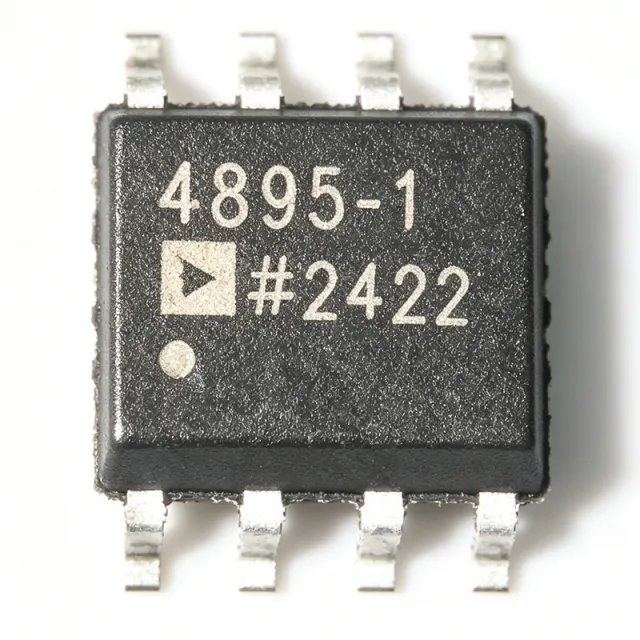
ADA4895-1ARZ - Low Noise, G≥10 Stable Op Amp | Analog Devices
The ADA4895-1ARZ is a single, high speed voltage feedback operational amplifier from Analog Devices, designed for gain ≥ 10 stability with low input noise and rail-to-rail output. It operates over a supply range of 3 V to 10 V (or ±1.5 V to ±5 V) and delivers a quiescent current of 3 mA per amplifier. The device is available in an 8-lead SOIC package and operates over the extended industrial temperature range of −40°C to +125°C. An operational amplifier (op amp) is a high-gain voltage amplifier with differential inputs and a single-ended output, used in signal conditioning, filtering, and amplification circuits. The ADA4895-1 belongs to the class of high speed voltage feedback amplifiers, which are characterized by their wide bandwidth and fast slew rate, making them suitable for applications requiring high-frequency signal processing. Within the amplifier hierarchy, it sits between general-purpose op amps and specialized RF amplifiers, offering a balance of noise performance and speed. Key features of the ADA4895-1ARZ include a 1/f noise of 2 nV/√Hz at 10 Hz, a spurious-free dynamic range (SFDR) of −72 dBc at 2 MHz, and a gain-bandwidth product of 235 MHz. The rail-to-rail output stage allows maximum output swing, and the low quiescent current of 3 mA makes it power-efficient for battery-powered designs. The device is stable for gains of 10 or greater, which simplifies compensation in non-inverting and inverting configurations. Technically, the ADA4895-1 uses a voltage feedback architecture with a complementary bipolar process, achieving low input voltage noise and high linearity. The amplifier's input stage is optimized for low noise, while the output stage provides rail-to-rail swing with low distortion. The device also features a disable pin (on the SOT-23 version) for power saving, though the SOIC version does not include this feature. Typical applications include ultrasound imaging, low noise preamplifiers, and active filters. In ultrasound systems, the low noise and high bandwidth enable accurate signal detection. In preamplifier circuits, the 2 nV/√Hz noise floor preserves weak signals. The rail-to-rail output is beneficial in single-supply applications where output swing is critical. When designing with the ADA4895-1ARZ, ensure that the gain is set to at least 10 to maintain stability. Use proper decoupling capacitors on the power supply pins, and consider the thermal performance of the SOIC package in high-power applications. The device is RoHS compliant and lead-free.
ADA4895-1ARZ-RL7 - 1nV/√Hz, G≥10 Stable Op Amp | Analog Devices
The ADA4895-1ARZ-RL7 is a single, high speed voltage feedback operational amplifier from Analog Devices, designed for gain-of-10 or greater stability. It features ultra-low input voltage noise of 1 nV/√Hz (typical) and a 1/f noise corner of 2 nV/√Hz at 10 Hz, making it an excellent choice for low-noise preamplifier and ultrasound applications. The amplifier operates over a wide supply range of 3 V to 10 V, with rail-to-rail output swing and a quiescent current of only 3 mA per amplifier, balancing high performance with power efficiency. An operational amplifier (op amp) is a high-gain voltage amplifier with differential inputs and a single-ended output, used in signal conditioning, filtering, and mathematical operations. The ADA4895-1 belongs to the class of high-speed voltage feedback amplifiers, which are optimized for wide bandwidth and fast slew rate, making them suitable for applications requiring large dynamic range and precision. Within the hierarchy of analog ICs, it sits under linear amplifiers, which are fundamental building blocks in electronic systems. Key features include a small signal bandwidth of 236 MHz at a gain of +10, a slew rate of 943 V/μs, and a settling time of 22 ns to 0.1%. The spurious-free dynamic range (SFDR) is -72 dBc at 2 MHz, ensuring low distortion in high-frequency signal paths. The device is available in an 8-lead SOIC package (ARZ suffix), with tape and reel packaging (RL7) for automated assembly. The ADA4895-1 utilizes a voltage feedback architecture with complementary bipolar transistors, achieving low noise and high speed simultaneously. The rail-to-rail output stage maximizes dynamic range, while the wide supply voltage range supports both 5 V and 10 V systems. The amplifier is stable for gains of 10 or greater, which simplifies compensation in non-inverting and inverting configurations. Typical applications include ultrasound imaging front-ends, low-noise preamplifiers for sensors, and high-speed signal conditioning in test and measurement equipment. Its low noise and high bandwidth make it ideal for amplifying small signals from photodiodes, microphones, and other transducers. When designing with this amplifier, ensure that the gain is set to at least 10 to maintain stability. Use proper power supply decoupling with 0.1 μF ceramic capacitors close to the supply pins, and consider the thermal performance of the SOIC package in high-power applications.

ADA4895-2ARZ - Dual 1nV/√Hz High Speed Op Amp | Analog Devices
The ADA4895-2ARZ is a dual, high speed voltage feedback amplifier from Analog Devices, designed for gain ≥10 stable operation with exceptional low noise performance. It features a 1/f noise of 2 nV/√Hz at 10 Hz, a large signal bandwidth of 146 MHz at gain +10, and a slew rate of 943 V/μs, settling to 0.1% in 22 ns. The amplifier operates over a wide supply voltage range of 3 V to 10 V, making it ideal for high dynamic range, precision, and high speed systems. The ADA4895-2 is available in a 10-lead MSOP package (ARZ suffix), which is compact and suitable for space-constrained designs. A high speed operational amplifier (op amp) is a voltage amplifier with a gain-bandwidth product typically exceeding 10 MHz, designed to amplify signals with fast slew rates and wide bandwidths. It is a fundamental building block in analog signal processing, used in applications such as active filters, buffers, and instrumentation. The ADA4895-2 belongs to the category of voltage feedback amplifiers, which offer high input impedance and ease of use in feedback configurations. Within the hierarchy of amplifiers, it sits as a high speed op amp, a subset of operational amplifiers, which are essential components in analog and mixed-signal systems. Key features of the ADA4895-2 include a low quiescent current of 3 mA per amplifier, rail-to-rail output, and a spurious-free dynamic range (SFDR) of -72 dBc at 2 MHz. The low input noise and high SFDR make it suitable for ultrasound, low noise preamplifiers, and other sensitive applications. The amplifier also features a wide supply range, allowing flexibility in system design. The rail-to-rail output enables maximum output swing, which is critical for single-supply operation and maximizing dynamic range. Technically, the ADA4895-2 uses a voltage feedback architecture with a complementary input stage, providing low offset voltage and high common-mode rejection. The device is fabricated using a high-speed complementary bipolar process, ensuring excellent AC performance. The amplifier is stable at gains of 10 or higher, which is specified for applications requiring high closed-loop gain. The 146 MHz bandwidth at gain +10 and 943 V/μs slew rate enable fast signal processing, while the 22 ns settling time to 0.1% ensures accurate response in pulsed applications. Typical applications include ultrasound imaging systems, low noise preamplifiers, and high speed data acquisition. In ultrasound, the low noise and high bandwidth allow for precise signal amplification from transducers. In preamplifiers, the low 1/f noise is critical for maintaining signal integrity at low frequencies. The wide supply range and rail-to-rail output make it suitable for battery-powered and single-supply systems. When designing with the ADA4895-2, ensure proper power supply decoupling with 0.1 μF and 10 μF capacitors close to the supply pins. The gain-setting resistors should be placed close to the inverting input to minimize parasitic capacitance. For optimal noise performance, use low-value resistors and keep the feedback network impedance low.
ADA4895-2ARZ-RL7 - Dual 1nV/√Hz G≥10 Stable Amp | Analog Devices
The ADA4895-2ARZ-RL7 is a dual, high speed voltage feedback amplifier from Analog Devices, designed for gain-of-10 or greater stability. It features low input noise of 1 nV/√Hz, rail-to-rail output, and a quiescent current of only 3 mA per amplifier. The device operates from a wide supply voltage range of 3 V to 10 V, making it suitable for systems requiring large dynamic range, high gain, precision, and high speed. The ADA4895-2 is available in a 10-lead MSOP package, offering a compact solution for space-constrained applications. A voltage feedback amplifier is a type of operational amplifier where the output voltage is fed back to the inverting input to control gain. The ADA4895-2 is specifically optimized for high-speed signal conditioning, providing a small signal bandwidth of 236 MHz at a gain of +10 and a slew rate of 943 V/μs. It settles to 0.1% in 22 ns, making it ideal for applications requiring fast and accurate signal processing. The rail-to-rail output stage allows maximum output swing, which is critical for driving ADCs and other mixed-signal devices. Key features of the ADA4895-2 include a 1/f noise of 2 nV/√Hz at 10 Hz, a spurious-free dynamic range of -72 dBc at 2 MHz, and a low input bias current of 11 µA. The amplifier is gain-of-10 stable, ensuring stability in high-gain configurations without external compensation. The low noise and high bandwidth make it an excellent choice for ultrasound, low noise preamplifiers, and drivers of high-performance ADCs. The ADA4895-2 utilizes a complementary bipolar process, achieving a balance between speed, noise, and power consumption. The dual configuration provides two independent amplifiers in a single package, saving board space and reducing component count. The wide supply range and rail-to-rail output enhance design flexibility, allowing the amplifier to interface with various ADC and DAC voltage levels. Typical applications include ultrasound imaging, low noise preamplifiers, ADC drivers, and active filters. The amplifier's high slew rate and fast settling time ensure accurate reproduction of high-frequency signals, while the low noise preserves signal integrity in sensitive measurement systems. When designing with the ADA4895-2, ensure proper power supply decoupling with 0.1 µF capacitors close to the supply pins. The gain-setting resistors should be placed near the amplifier to minimize parasitic capacitance and maintain stability. The thermal resistance of the MSOP package should be considered for high-power applications, although the low quiescent current minimizes self-heating.
ADA4896-2ARMZ - 1nV/√Hz Low Noise Dual Op Amp | Analog Devices
The ADA4896-2ARMZ is a dual, high-speed, voltage feedback operational amplifier from Analog Devices, offering an exceptional combination of low noise, low power, and rail-to-rail output. Housed in a compact 8-lead MSOP package, this amplifier is unity-gain stable and operates from a single 3V to 10V supply or dual ±1.5V to ±5V supplies. With a quiescent current of only 3 mA per amplifier, it delivers a bandwidth of 230 MHz and a slew rate of 120 V/µs, making it ideal for power-sensitive, high-performance signal conditioning. An operational amplifier (op amp) is a high-gain voltage amplifier with differential inputs and a single-ended output, used to perform mathematical operations like amplification, filtering, and signal conditioning. The ADA4896-2 is a voltage feedback op amp, a type that offers high input impedance and ease of use in inverting and non-inverting configurations. It belongs to the family of high-speed amplifiers, which are optimized for wide bandwidth and fast settling, essential in applications like ADC drivers, video processing, and active filters. As a rail-to-rail output amplifier, it can swing its output close to the supply rails, maximizing dynamic range in low-voltage systems. Key features of the ADA4896-2ARMZ include an ultra-low voltage noise density of 1 nV/√Hz at 100 kHz and 2.4 nV/√Hz at 10 Hz (1/f noise), a spurious-free dynamic range (SFDR) of -80 dBc at 2 MHz, and a low input bias current of 1.5 µA. The amplifier also provides a high open-loop gain of 100 dB and a common-mode rejection ratio (CMRR) of 100 dB, ensuring accurate signal processing. Its rail-to-rail output stage can drive loads as low as 50 Ω, and it is fully specified over the industrial temperature range of -40°C to +125°C. Technically, the ADA4896-2 uses a complementary bipolar process that achieves low noise without compromising speed or power. The amplifier's architecture includes a precision input stage that minimizes offset voltage (typically 0.5 mV) and drift, while the output stage provides high current drive capability. The device is designed for stable operation with capacitive loads up to 100 pF, and its internal compensation ensures unity-gain stability. The MSOP-8 package offers excellent thermal performance with a junction-to-ambient thermal resistance of 190°C/W, allowing operation in space-constrained designs. Typical applications include low-noise ADC drivers, high-speed active filters, photodiode amplification, and medical instrumentation. In ADC driver circuits, the ADA4896-2's low noise and high SFDR preserve signal integrity, while its rail-to-rail output maximizes the ADC's input range. For photodiode transimpedance amplifiers, the low input bias current and low noise enable precise detection of weak optical signals. In medical devices like ECG and EEG monitors, the amplifier's low noise and low power consumption are critical for battery-operated, high-resolution signal acquisition. When designing with the ADA4896-2ARMZ, ensure proper power supply decoupling with 0.1 µF ceramic capacitors placed close to the supply pins. The input common-mode voltage range extends to the negative rail, but for best performance, keep inputs within the specified range. The output can swing to within 50 mV of the rails, but for driving heavy loads, consider the output current capability. For optimal noise performance, use low-value resistors in the feedback network, as resistor noise can dominate.
ADA4896-2ARMZ-RL7 - Dual Low Noise RRO Op Amp | Analog Devices
The ADA4896-2ARMZ-RL7 is a dual, unity-gain stable, low noise, rail-to-rail output, high speed voltage feedback amplifier from Analog Devices. It operates on a supply voltage range of 3 V to 10 V (or ±1.5 V to ±5 V) and features a quiescent current of 3 mA per amplifier. The device is available in an 8-lead MSOP package, making it suitable for space-constrained applications. What is a voltage feedback amplifier? A voltage feedback amplifier is a type of operational amplifier where the output voltage is fed back to the inverting input through a feedback network. It is characterized by its high input impedance, low output impedance, and high open-loop gain. Voltage feedback amplifiers are widely used in signal conditioning, filtering, and buffering applications due to their ease of use and stability. They form a subset of operational amplifiers, which are fundamental building blocks in analog signal processing. Key features of the ADA4896-2 include a low 1/f noise of 2.4 nV/√Hz at 10 Hz, a spurious-free dynamic range (SFDR) of -80 dBc at 2 MHz, and a unity-gain bandwidth of 230 MHz. The rail-to-rail output stage allows maximum output swing, and the low quiescent current makes it ideal for battery-powered systems. The amplifier also features a wide supply voltage range and is specified for operation over the industrial temperature range of -40°C to +125°C. The ADA4896-2 uses a complementary bipolar process technology, providing excellent DC precision and AC performance. The device is designed to drive high-speed ADCs and other capacitive loads, with a slew rate of 120 V/µs. Its low distortion and low noise make it suitable for high-performance signal chains. Typical applications include ADC drivers, active filters, instrumentation, and portable audio equipment. The low noise and high bandwidth make it ideal for medical imaging, communications, and test and measurement systems. When designing with the ADA4896-2, ensure proper power supply decoupling with 0.1 µF capacitors close to the supply pins. The rail-to-rail output stage requires careful consideration of the load impedance to maintain stability.
ADA4897-1ARZ - 1nV/√Hz Low Noise Op Amp | Analog Devices
The ADA4897-1ARZ from Analog Devices is a unity-gain stable, low noise, rail-to-rail output, high speed voltage feedback amplifier in an 8-lead SOIC package. It operates from a 3V to 10V supply and delivers a 230 MHz bandwidth with a 120 V/µs slew rate. The device features an ultra-low wideband voltage noise of 1 nV/√Hz and a low 1/f noise of 2.4 nV/√Hz at 10 Hz, making it ideal for high-performance signal conditioning. An operational amplifier (op amp) is a high-gain voltage amplifier with differential inputs and a single-ended output. It is a fundamental building block in analog electronics, used in applications ranging from signal conditioning to active filtering. The ADA4897-1 is a voltage feedback amplifier, a type of op amp that uses a voltage-controlled voltage source topology, offering high bandwidth and low distortion. It belongs to the family of high-speed amplifiers, which are optimized for fast settling and wide bandwidth, and is part of the broader category of linear integrated circuits. Key features include a low input offset voltage of 0.5 mV (typical), a quiescent current of only 3 mA per amplifier, and a spurious-free dynamic range (SFDR) of -80 dBc at 2 MHz. The rail-to-rail output stage allows maximum output swing, and the device is unity-gain stable, simplifying design in buffer and follower configurations. The ADA4897-1 also offers low distortion of -115 dBc at 100 kHz with a 2 V p-p output, ensuring high signal fidelity. Technically, the ADA4897-1 uses a complementary bipolar process that achieves its low noise and high speed. The amplifier's input stage is optimized for low voltage noise, while the output stage provides rail-to-rail swing with low output impedance. The device is specified over the industrial temperature range of -40°C to +125°C, and it is available in an 8-lead SOIC package (ARZ suffix), which is suitable for space-constrained designs. Typical applications include low noise instrumentation, active filters, ADC drivers, and high-speed signal conditioning in test and measurement equipment. The low noise and high bandwidth make it particularly suited for medical imaging, communications, and industrial process control. In these applications, the ADA4897-1 ensures accurate signal reproduction with minimal added noise. When designing with the ADA4897-1, pay attention to power supply decoupling: place a 0.1 µF ceramic capacitor close to each supply pin and a 10 µF tantalum capacitor at the supply rails. Also, consider the thermal performance, as the SOIC package has a limited power dissipation capability; ensure the junction temperature stays below 150°C.
ADA4897-1ARZ-RL7 - 1nV/√Hz Low Noise Op Amp | Analog Devices
The ADA4897-1ARZ-RL7 is a unity-gain stable, low noise, rail-to-rail output, high speed voltage feedback amplifier from Analog Devices. It operates from a 3V to 10V supply and delivers a gain bandwidth product of 230 MHz with a slew rate of 120 V/µs. The device is available in an 8-pin SOIC package and is designed for applications requiring low noise and low power consumption. An operational amplifier (op amp) is a high-gain voltage amplifier with differential inputs and a single-ended output. It is a fundamental building block in analog electronics, used in signal conditioning, filtering, and amplification. The ADA4897-1 is a voltage feedback amplifier, which offers high bandwidth and low distortion, making it suitable for high-speed signal processing. Key features include ultra-low wideband noise of 1 nV/√Hz, low 1/f noise of 2.4 nV/√Hz at 10 Hz, and low distortion of -115 dBc at 100 kHz. The quiescent current is only 3 mA per amplifier, making it power-efficient. The rail-to-rail output stage allows maximum output swing, and the device is unity-gain stable, simplifying design. The ADA4897-1 uses a complementary bipolar process, achieving excellent noise performance and high speed. The input offset voltage is low, and the device has a high open-loop gain, ensuring accurate signal amplification. The amplifier is designed to drive capacitive loads and provides a spurious-free dynamic range of -80 dBc at 2 MHz. Typical applications include ultrasound, low noise PLLs, and high-speed instrumentation. The low noise and high bandwidth make it ideal for medical imaging, communications, and test equipment. The rail-to-rail output is beneficial in single-supply systems, and the low power consumption extends battery life in portable devices. When designing with this amplifier, ensure proper power supply decoupling with 0.1 µF capacitors close to the supply pins. The input common-mode range extends to the negative rail, but for best performance, keep inputs within the specified range. The output can swing close to the rails, but avoid heavy loads that may reduce output swing.