Batteriemanagement
Produkte (195)

TPS65951A1ZGU - OMAP PMIC + Audio Codec 169-BGA | Texas Instruments
The Texas Instruments TPS65951A1ZGU is an integrated power management IC (PMIC) with a built-in audio codec, designed for mobile cellular handsets powered by Li-ion, Li-ion polymer, or cobalt-nickel-manganese cell batteries. It integrates three step-down DC/DC converters, ten LDO regulators, and a SmartReflex-compliant power interface, all in a 169-ball BGA MicroStar package measuring 12 x 12 mm. A power management IC (PMIC) is a highly integrated voltage regulator and power sequencing subsystem that consolidates multiple bucks, LDOs, and supervisory functions into a single silicon die. In the power management hierarchy, the PMIC sits above discrete DC/DC converters and LDOs, providing complete multi-rail power trees for application processors and modems. The TPS65951 extends this concept by embedding an entire audio module with codecs, digital filters, input preamplifiers and amplifiers, and Class-D output amplifiers. Key features include 12 regulated outputs, a maximum operating supply voltage of 4.5 V (5.25 V absolute per digchip listing), SmartReflex dynamic voltage scaling for OMAP application processors, and integrated Class-D audio amplifiers that eliminate external speaker driver ICs. The audio subsystem supports full codec functionality, reducing BOM count and board area in handset designs. The device communicates with the application processor and/or modem over an I2C/SPI-compatible control interface, allowing software-controlled sequencing, voltage adjustment, and power-down. The industrial temperature grade (-40C to +85C) supports harsh-environment handheld devices. According to TI product documentation, production data conforms to specifications per standard TI terms. Typical applications include OMAP-based smartphone and tablet power trees, mobile handset audio subsystems, and portable battery-powered devices requiring tightly sequenced multi-rail power with integrated audio. Design consideration: verify each rail's load budget against the datasheet current limits, as individual LDO outputs are rated up to 70 mA maximum output current; high-current processor cores must be powered from the step-down converters.

TPS65951A1ZGUR - OMAP PMIC + Audio Codec 169-BGA | Texas Instruments
The Texas Instruments TPS65951A1ZGUR is an integrated power-management IC (PMIC) with a full audio codec subsystem, optimized for mobile cellular handsets powered by Li-ion, Li-ion polymer, or cobalt-nickel-manganese cell batteries. Supplied in a 169-ball BGA MicroStar package (12 x 12 mm), it operates from a 2.7 V to 4.5 V battery input and interfaces directly with an application processor and/or modem such as TI OMAP devices. A power-management IC (PMIC) is a specialized voltage regulator and power-tree controller that integrates multiple DC-DC converters, LDOs, load switches, sequencing logic, and supervisory functions into a single silicon die. In the power-management hierarchy it sits above discrete regulators, replacing dozens of passive and discrete parts in battery-operated systems, while adding battery-interface, charging support, and GPIO-based control. Key features of the TPS65951 include several buck (step-down) converter channels and multiple low-dropout linear regulators for the processor core, memory, and I/O rails, integrated power sequencing controlled through an I2C-compatible interface, and a complete audio module: audio codecs, digital filters, input preamplifiers and amplifiers, and Class-D output amplifiers. This integration reduces BOM count, board area, and startup/sequencing design risk in handheld platforms. Architecturally, the device combines the power silicon, battery supervision, charger handoff logic, and the audio codec on one die, communicating with the host processor over a serial control bus. The Class-D speaker drivers eliminate the need for external audio amplifier ICs in handset designs, while the codec path supports voice and multimedia recording/playback chains. Typical applications include OMAP-based cellular handsets, portable media players, 3G/4G modem power trees, and other handheld devices where tightly sequenced multi-rail power plus an integrated audio path are required. Design consideration: because the part is tailored to OMAP power requirements, verify rail voltages, sequencing order, and audio output configuration against the specific application processor datasheet before layout; the 169-ball BGA requires controlled-impedance fanout and careful thermal pad connection per the TI data manual.
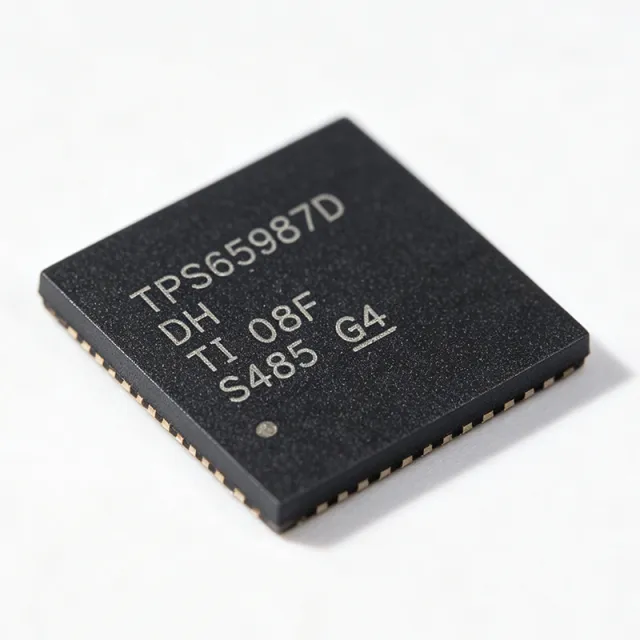
TPS65987DDHRSHR - USB Type-C PD Controller | Texas Instruments
The Texas Instruments TPS65987DDHRSHR is a stand-alone USB Type-C and Power Delivery (PD) controller with integrated power switches, designed for a single USB Type-C connector. It provides cable plug and orientation detection, communicates on the CC wire using the USB PD protocol, and enables the appropriate power path upon successful negotiation. The device supports USB 2.0, USB 3.0, and USB 3.1 data rates, and is housed in a 56-pin VQFN (RSH) package measuring 7x7 mm. It operates over a temperature range of -10°C to 75°C and is powered by a 3.3V supply. A USB Type-C PD controller is a specialized power management IC that manages power delivery and data communication over a USB Type-C connector. It handles cable detection, orientation, and power role negotiation (source, sink, or dual-role), enabling devices to negotiate voltage and current levels up to 100W. This controller sits between the USB connector and the system's power management unit, ensuring safe and efficient power transfer while supporting alternate modes like DisplayPort or Thunderbolt. Key features include integrated power switches for both source and sink paths, support for Dual-Role Power (DRP), Sink, and Source roles, and alternate mode configuration. The TPS65987D communicates using the USB PD protocol and includes a host interface for configuration and status monitoring. The device is designed for high-speed USB applications, with support for USB 3.1 data rates and integrated power path management. Technically, the TPS65987D integrates the CC logic, PD protocol engine, and power switches in a single package, reducing external component count and board space. It includes protection features such as overcurrent and overvoltage protection, and supports firmware updates via the host interface. The device is configurable through I2C or SPI, allowing flexible system integration. Typical applications include laptops, docking stations, monitors, power adapters, and other USB Type-C enabled devices that require PD negotiation and power switching. The integrated power switches simplify the design and reduce BOM cost, making it ideal for space-constrained applications. When designing with this device, ensure proper decoupling on the 3.3V supply and follow the recommended layout for the VQFN package to manage thermal performance. The device is currently in NRND (Not Recommended for New Designs) status, so consider the TPS65988 as a drop-in replacement for new designs.