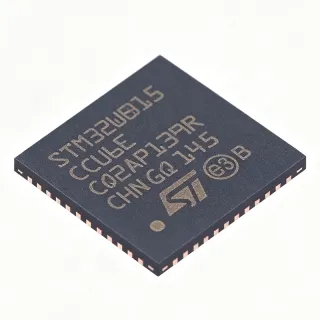
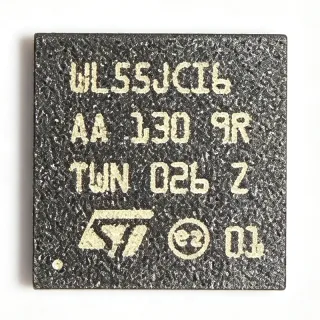
FGH200MAAMD - Wi-Fi HaLow 802.11ah 850-950MHz Module | Quectel
Teilenummer: FGH200MAAMD ✓ Aktiv| Menge | Stückpreis | Gesamt |
|---|---|---|
| 1 | $0 | $0,00 |
| 10 | $0 | $0,00 |
| 100 | $0 | $0,00 |
| 500 | $0 | $0,00 |
| 1.000 | $0 | $0,00 |
FGH200MAAMD Übersicht
Wi-Fi HaLow is an open, standard-based Wi-Fi technology defined by IEEE 802.11ah that operates below 1 GHz. Unlike conventional 2.4 GHz/5 GHz Wi-Fi, sub-1 GHz propagation offers roughly 10x the range and much better wall/floor penetration, while sub-GHz OFDM and narrow-channel operation keeps power consumption low. Within the wireless connectivity hierarchy, it sits as an RF transceiver module, complementing rather than replacing BLE, LoRa, or classic Wi-Fi in a system architecture.
Key features include compliance with IEEE 802.11ah, long-range transmission over the 850-950 MHz band, low power consumption for battery-operated sensors, large network capacity for dense device deployments, and robust security with AES encryption plus SHA-256, SHA-384, and SHA-512 hashing. WPA3 and OWE (Opportunistic Wireless Encryption) support ensures modern, standards-based authentication and link encryption out of the box.
The module integrates the HaLow RF transceiver, baseband/MAC processing, and power management, presenting an AT-command or host-interface design-in that shortens time-to-market versus chip-level solutions. Because it is antenna-not-included, designers choose their own external antenna to optimize for range, enclosure constraints, or regional band tuning (868 MHz in EU, 915 MHz in US, 920 MHz in Japan, subject to regulatory approval).
Typical applications include smart metering and utility infrastructure, industrial sensor networks, smart-city and campus-wide IoT backhaul, security camera links, and agricultural monitoring where long range and penetration are decisive.
Design consideration: because the antenna is external, PCB layout and RF matching of the antenna feed are critical - follow Quectel reference designs for the FGH200M family, and verify regional sub-1 GHz regulatory compliance for the specific band you enable.
This page synthesizes distributor availability, pricing-context FAQs, and practical design guidance not found in the manufacturer datasheet alone.
Drop-in-Alternativen für FGH200MAAMD – gleiches Gehäuse, Pin-kompatibel. Bauteile mit anderem Gehäuse, die eine PCB-Überarbeitung erfordern, sind ausgeschlossen.
Varianten dieser Serie
Modelle derselben Serie, die drop-in-kompatibel sind mit FGH200MAAMD (gleiche Bauform und Footprint) – abweichend in Antenna, Encryption.
Schnellvergleichstool – Wählen Sie Alternativbauteile für den Direktvergleich:
Für dieses Produkt sind keine Drop-in-Alternativen verfügbar.
Alternativen anfordernFGH200MAAMD Technische Daten
| Standard | IEEE 802.11ah (Wi-Fi HaLow) |
| Frequency Range | 850 MHz to 950 MHz |
| Module Type | Wi-Fi 802.11ah Transceiver Module |
| Antenna | Not included (external antenna required) |
| Montageart | Surface Mount |
| Encryption | AES |
| Hashing | SHA-256, SHA-384, SHA-512 |
| Security Protocols | WPA3, OWE |
| Key Characteristics | Long-range transmission, low power consumption, large capacity, good penetration |
FGH200MAAMD standard Pinbelegungsleitfaden
Pinbelegung für FGH200MAAMD (standard-Gehäuse). Pin-Nummerierung, Funktionen und Anschlussdiagramme sind im Herstellerdatenblatt definiert. Entnehmen Sie diesem den genauen Footprint und Lötrichtlinien.

Keine detaillierten Pinbelegungsdaten verfügbar für FGH200MAAMD.
Siehe die Datenblatt für die vollständige Pin-Konfiguration.
Typische Anwendungen
FGH200MAAMD ist geeignet für 6 Anwendungs: Smart Metering & Utility Infrastructure, Industrial IoT Sensor Networks, Smart City & Campus IoT Backhaul, Security & Surveillance Camera Connectivity, Agricultural & Environmental Monitoring, Building Automation & HVAC.
Smart Metering & Utility Infrastructure
The FGH200MAAMD fits smart electricity, water, and gas metering because sub-1 GHz propagation in the 850-950 MHz band penetrates meter boxes, basements, and dense urban construction far better than 2.4 GHz radios, and its low power consumption suits battery- or energy-harvesting-powered meters. A single HaLow access point aggregates thousands of meters thanks to the standard's large network capacity, replacing proprietary mesh networks with IP-native IEEE 802.11ah. Security is a hard requirement here: the module's AES encryption, SHA-256/384/512 hashing, and WPA3 support satisfy utility-grade link protection, while OWE secures open provisioning links. Place the module between the meter MCU and an external 868/915 MHz antenna, and budget for antenna placement early - meter enclosures are the dominant source of link loss in real deployments.
Empfohlen
Industrial IoT Sensor Networks
In factories and industrial campuses, the FGH200MAAMD connects dispersed sensors - vibration, temperature, pressure - across ranges and through obstructions where classic Wi-Fi fails. The 850-950 MHz band's penetration performance reaches into metal-clad buildings and underground pits, while the module's low power consumption lets nodes run for years on batteries. IEEE 802.11ah being an open standard avoids vendor lock-in of proprietary sub-GHz stacks, and WPA3/AES security meets plant IT requirements for network admission. Use the module in AP-client topologies anchored by a HaLow gateway, keep antennas clear of VFD and motor drives to protect sub-GHz sensitivity, and reserve the higher-rate MCS modes for aggregated backhaul rather than individual sensor links to preserve the link budget in noisy RF environments.
Empfohlen
Smart City & Campus IoT Backhaul
Smart-city assets - parking sensors, environmental monitors, streetlight controllers, and informational signage - spread over kilometers, and the FGH200MAAMD's long-range transmission in the 850-950 MHz band covers exactly this scale from a few HaLow access points. Its large capacity permits thousands of endpoints per AP, and IP-native 802.11ah integrates directly with municipal backbones using standard DHCP/TLS stacks instead of gateway translation layers. Good penetration performance reduces the antenna count needed for canyon-like street deployments and underground vaults. Encrypt each endpoint with WPA3 and AES per the module's supported suite; for city-wide rollouts, plan channel allocation across the sub-1 GHz regulatory bands (868 MHz EU, 915 MHz US, 920 MHz Japan) and confirm regional certification of the final antenna configuration before deployment.
Empfohlen
Security & Surveillance Camera Connectivity
Wireless security cameras need more bandwidth than LoRa offers and more range than 2.4 GHz Wi-Fi reliably provides; the FGH200MAAMD fills this gap. Its sub-GHz band penetrates walls, fences, and vegetation across large properties, and 802.11ah data rates are sufficient for low-frame-rate or analytics-triggered video streams. WPA3 and AES encryption on the module address the confidentiality concerns specific to surveillance footage, and the external-antenna design lets integrators fit high-gain directional antennas for long perimeter runs. Deploy cameras as HaLow clients against a central gateway, tune downlink MCS for the required bitrate rather than maximum rate to stabilize the link, and verify that local regulations permit the chosen 850-950 MHz channel plan for outdoor, fixed-installation use.
Empfohlen
Agricultural & Environmental Monitoring
Farms and environmental stations span kilometers of open terrain with sparse power, making the FGH200MAAMD's combination of long range and low power consumption a strong match. The 850-950 MHz band propagates well over soil and through crop canopies, reaching soil-moisture probes, weather stations, and irrigation controllers that 2.4 GHz radios cannot reliably cover. Battery- or solar-powered nodes benefit from HaLow's power-saving operation, and the module's large capacity lets one gateway aggregate hundreds of field sensors. Use weatherproof external antennas elevated on poles to maximize the line-of-sight budget, enable the lowest data rate that meets reporting latency to extend battery life, and apply WPA3/AES because agricultural data increasingly feeds insurance and compliance systems.
Empfohlen
Building Automation & HVAC
Large commercial buildings defeat 2.4 GHz Wi-Fi with concrete, fire walls, and elevator shafts; the FGH200MAAMD's sub-1 GHz penetration reaches BMS endpoints - thermostats, damper actuators, leak sensors - on a single HaLow network per building. Low power consumption enables wireless retrofits that avoid cabling costs in occupied structures, and the open IEEE 802.11ah standard lets BMS vendors integrate without proprietary radio licensing. WPA3, OWE, and AES hashing satisfy enterprise IT security review for networked building devices. Position one HaLow AP per floor or zone, take advantage of the module's large capacity for dense sensor counts, and survey attenuation through the building's core before fixing antenna locations, since sub-GHz penetration still varies strongly with construction materials.
Empfohlen
Zusammenfassung der empfohlenen Produkte
Technische Referenzdaten für FGH200MAAMD – Vergleich, Designhinweise und Compliance-Informationen.
Auswahlhilfe
Wichtigste Unterscheidungsmerkmale
- Standards-based sub-GHz connectivity (vs. Proprietary sub-GHz mesh solutions)
- Modern security suite (vs. Legacy WPA2-only sub-GHz modules)
- Wide 850-950 MHz band coverage (vs. Single-band fixed 868/915 MHz radios)
Designhinweise
The FGH200MAAMD ships without an antenna, so the RF feed is entirely the designer's responsibility. Follow Quectel's FGH200M hardware design guide for the recommended matching network and keep the 50-ohm feedline short, with ground stitching vias along the microstrip. Select the antenna for the regional sub-1 GHz band actually used (868 MHz EU, 915 MHz US, 920 MHz JP) - a wideband 850-950 MHz antenna is acceptable for global SKUs but gives up 1-2 dB versus a tuned monoband antenna, which directly reduces range margin.
Keep the module's power supply clean: sub-GHz transmitters draw burst currents during TX that cause supply ripple and can degrade sensitivity if the rail sags. Place bulk and high-frequency decoupling capacitors per the Quectel reference design, route the antenna feed away from switching regulators and high-speed digital traces, and do not pour ground under the antenna feed without following the reference layout. Deviating from the reference land pattern risks detuning and certification failures during regulatory testing.
A frequent mistake with new 802.11ah designs is assuming global band legality: the 850-950 MHz operating range spans different regional allocations with different duty-cycle and power limits, so firmware channel plans must be localized and the finished antenna configuration re-certified. Another pitfall is qualifying substitutes - no pin-compatible drop-in replacement was found in cross-reference searches as of 2026-10-20, so design single-source risk into the BOM (second-source planning, socketed or modular antenna interface) rather than assuming an easy swap later.
Compliance-Informationen
Compliance data not stated in the verified web data. Wi-Fi HaLow modules also require regional radio certification (e.g., FCC/CE/TELEC) for the enabled sub-1 GHz band; certification status must be confirmed with Quectel.