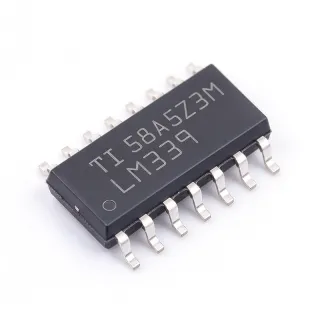
LM239ADT - Quad Precision Comparator | STMicroelectronics
Teilenummer: LM239ADT ✓ AktivLM239ADT Übersicht
A differential voltage comparator is an analog semiconductor that compares two input voltages and changes its output state according to their relationship. The LM239ADT belongs to the comparator hierarchy within analog integrated circuits and interface signal-conditioning systems. Its open-collector outputs can sink current from a pull-up network while placing the output state partly under the system designer’s control, making the device suitable for wired logic, relay interfaces, and industrial sensing systems.
The principal features are four independent channels, a 2 mV maximum offset voltage for the A-grade device, a 2 V to 32 V supply range, and compatibility with CMOS, DTL, ECL, MOS, TTL, and other standard logic families. The open-collector architecture supports wired-AND behavior when multiple comparator outputs share a pull-up resistor. These characteristics are particularly useful where low-level sensor signals must be converted into a digital decision with adjustable thresholds.
The LM239ADT is intended for single or dual supply operation, allowing the common-mode range to include ground. Differential input protection is generally required when the input voltages can exceed the supply rails or create large transients. Because the outputs are open collector, an external pull-up resistor is required to establish a valid high level. The output sink current, propagation delay, input bias current, and common-mode limits must be checked against the timing and logic requirements of the complete circuit.
Typical applications include industrial control and measurement, sensor threshold detection, battery and power-supply monitoring, window comparison, level detection, and four-channel alarm supervision. In each case, the 2 mV maximum input offset provides useful resolution near the comparison threshold, while independent channels reduce component count. The broad supply range also permits operation from low-voltage analog rails through substantially higher industrial supply voltages, subject to absolute maximum limits.
A key design consideration is the pull-up network on the open-collector outputs. Its resistance must provide adequate output rise time without excessive sink current, and its voltage must remain compatible with the connected logic family. Input filtering, hysteresis, and supply-bypass capacitors should be placed close to the device to control noise and unstable switching near the threshold. Care is also required during power-down because the open-collector output can remain high-impedance when the device is unpowered.
This product page combines device classification, comparison data, drop-in candidates, application guidance, and practical implementation notes. The accompanying tables help engineers evaluate the LM239ADT against pin-compatible options while keeping the original SOIC-14 footprint and open-collector interface as the central design constraints.
Drop-in-Alternativen für LM239ADT – gleiches Gehäuse, Pin-kompatibel. Bauteile mit anderem Gehäuse, die eine PCB-Überarbeitung erfordern, sind ausgeschlossen.
Varianten dieser Serie
Modelle derselben Serie, die drop-in-kompatibel sind mit LM239ADT (gleiche Bauform und Footprint) – abweichend in Comparator Type, Package, Low Input Bias Current, Output Compatibility, Supply Configuration.
LM339ADT
✅ Drop-In📋 Referenzalternative (nicht im Katalog)
LM239AD
✅ Drop-InPreis auf Anfrage
Datenblatt ansehen →LM239ADR
✅ Drop-In📋 Referenzalternative (nicht im Katalog)
LM239ADT Grenzwerte & elektrische Eigenschaften
| Comparator Type | Quad differential precision comparator |
| Number of Channels | 4 channels |
| Ausgangstyp | Open-collector |
| Input Offset Voltage | 2 mV maximum for LM239A |
| Supply Voltage Range | 2 V to 32 V |
| Input Bias Current | 100 nA |
| Gehäuse | SOIC-14 |
| Montageart | Surface mount |
| Packaging | Tape and reel |
| Logic Compatibility | CMOS, DTL, ECL, MOS, open-collector, and TTL |
LM239ADT soic-14 Pinbelegungsleitfaden
Pinbelegung für LM239ADT (soic-14-Gehäuse). Dieses analoge Bauteil verfügt über Eingangs-, Ausgangs- und Versorgungspins. Offset-Null-, Kompensations- und Enable-Pin-Konfigurationen entnehmen Sie dem Herstellerdatenblatt. Ideal für Signalaufbereitung und Verstärkerschaltungen.
Keine detaillierten Pinbelegungsdaten verfügbar für LM239ADT.
Siehe die Datenblatt für die vollständige Pin-Konfiguration.
Typische Anwendungen
LM239ADT ist geeignet für 6 Anwendungs: Industrial Sensor Threshold Detection, Power-Supply Monitoring, Battery Threshold Detection, Window and Level Comparison, Relay and Logic Interfacing, Test and Measurement Front Ends.
Industrial Sensor Threshold Detection
The LM239ADT fits four-channel industrial threshold detection because each independent comparator can compare a sensor voltage with an adjustable reference. Its 2 mV maximum input offset for the LM239A grade improves resolution when the decision point lies close to the sensor signal. Place a pull-up resistor on every open-collector output and route the four channels to separate digital inputs. Hysteresis should be added when sensor noise could cause repeated transitions. The 2 V to 32 V supply range supports both low-voltage sensor interfaces and higher-voltage industrial control boards, provided each input remains within the manufacturer’s permitted common-mode limits.
Empfohlen
Power-Supply Monitoring
The LM239ADT can monitor several power rails by comparing divided supply voltages against internal or external references. Its four independent channels reduce the number of comparator packages required for overvoltage and undervoltage supervision, while the 2 mV maximum LM239A offset helps preserve threshold accuracy. The open-collector outputs can directly drive status LEDs, fault inputs, or relay-control stages when paired with suitable pull-up resistors. Care is required because a detector may need to function during rail collapse, when the comparator itself is losing power. The 2 V to 32 V operating range supports many conventional supply systems, but transient protection and startup blanking belong in the surrounding circuit.
Empfohlen
Battery Threshold Detection
The LM239ADT is useful for multi-level battery supervision where four thresholds can be derived from a resistor-divider network. The 2 mV maximum offset specification of the A-grade device helps distinguish closely spaced voltage levels, while open-collector outputs permit wired-AND fault signaling through a common pull-up. Each output should have its own pull-up unless wired-AND operation is intentional. Designers must account for comparator input bias current, which can shift divider setpoints, and confirm that the common-mode range covers the expected battery voltage. For lithium-based systems, choose resistor tolerances and divider currents that limit both continuous dissipation and threshold error.
Empfohlen
Window and Level Comparison
Four LM239ADT channels can implement upper and lower limits for two signals, providing a compact window-comparator arrangement. The A-grade offset voltage of 2 mV maximum helps reduce ambiguity when the measured level crosses its programmed boundary. Open-collector outputs make it straightforward to combine fault indications with a pull-up network or pull each result into a controller. For reliable behavior, add positive feedback where hysteresis is needed and keep the input network away from switching nodes. The 2 V to 32 V supply range permits operation across multiple industrial voltage levels, although the selected comparator channel must remain within its specified common-mode input range at every threshold.
Empfohlen
Relay and Logic Interfacing
The LM239ADT open-collector outputs are suitable for driving relay drivers, alarm inputs, and legacy logic interfaces when an external pull-up establishes the high state. Its four channels can supervise several independent events while sharing a common supply architecture. The 2 mV maximum offset improves the reliability of threshold decisions feeding control logic. Pull-up resistance must be selected from both the required output rise time and the maximum sink current, and any relay coil should have its own flyback protection. Because open-collector outputs can become high-impedance during device power-down, downstream circuitry should avoid interpreting that condition as an unintended valid command.
Empfohlen
Test and Measurement Front Ends
The LM239ADT can compare a measured input against programmable or fixed limits in automated test equipment. Four independent channels make it possible to evaluate several measurement conditions without using four separate comparator packages. The 2 mV maximum A-grade offset and 2 V to 32 V supply range support threshold checks across many low- and mid-voltage systems. Open-collector outputs can drive test-point multiplexing, fixture control, or an external pull-up-based status bus. High-accuracy instrumentation should still account for resistor-network tolerance, input bias current, and comparator propagation delay, all of which contribute to the time and voltage uncertainty of the measurement decision.
Empfohlen
Zusammenfassung der empfohlenen Produkte
Technische Referenzdaten für LM239ADT – Vergleich, Designhinweise und Compliance-Informationen.
Auswahlhilfe
Vergleich mit Alternativen
| Parameter | Dieses Produkt | LM339ADT | LM239AD | LM239ADR |
|---|---|---|---|---|
| Brand | STMicroelectronics | STMicroelectronics | Texas Instruments | Texas Instruments |
| Package | SOIC-14 | SOIC-14 | SOIC-14 | SOIC-14 |
| Comparator Channels | 4 channels | 4 channels | 4 channels | 4 channels |
| Output Type | Open-collector | Open-collector | Open-collector | Open-collector |
| Maximum Supply Voltage | 32 V | 32 V | 36 V | 36 V |
| Minimum Supply Voltage | 2 V | 2 V | 2 V | 2 V |
| Logic Compatibility | CMOS, DTL, ECL, MOS, open-collector, and TTL | CMOS, DTL, ECL, MOS, open-collector, and TTL | TTL, MOS, and CMOS | TTL, MOS, and CMOS |
| Special Qualification | LM239A precision grade | LM339A precision grade | LM239A industrial grade | LM239A industrial grade |
Wichtigste Unterscheidungsmerkmale
- A-grade input offset performance (vs. LM239ADR)
- Exact four-channel open-collector architecture (vs. LM339ADT)
- Lower maximum supply rating than the TI industrial alternative (vs. LM239AD)
Designhinweise
Route each comparator input away from switching nodes, relay-coil traces, and the high-current pull-up network to reduce differential noise pickup. Keep the input divider or reference components close to the corresponding pins, and connect the device ground pins with a low-impedance return path. If input signals can exceed the supply rails, add series resistance and suitable clamp protection; otherwise, the differential input can be damaged during supply faults.
Select the open-collector pull-up resistor from the required logic high level, output rise time, and maximum sink current. A lower resistance produces a faster rising edge but increases current when the output transistor is on; a higher resistance reduces power but slows the transition. Confirm that the pull-up voltage remains within the output transistor and downstream logic limits. Do not rely on the LM239ADT output to source current.
Use positive feedback or an external Schmitt-trigger arrangement when the comparator input noise exceeds the intended threshold margin. A 2 mV maximum offset specification does not prevent output chatter caused by slow input slopes, noise, or excessive propagation-delay variation. Also examine power-down behavior: the open-collector output becomes high-impedance when the device is unpowered, which can cause downstream systems to interpret an unintended state unless an external pull-up or supervisor defines it.
Verify the common-mode input range for every operating condition, especially when the comparator is powered from a lower voltage than the signal being measured. The 2 V to 32 V operating range describes the supply, not permission for arbitrary input voltages. Include input bias current in the error analysis of high-impedance dividers, and ensure that resistor tolerances, reference accuracy, and propagation delay are included in the overall threshold and timing budget.
Compliance-Informationen
The manufacturer datasheet should be checked for current environmental-material declarations and product qualification status.