MMA5148KWR2 - Z-Axis 480g PSI5 Accelerometer | NXP
Teilenummer: MMA5148KWR2 ✓ Aktiv| Menge | Stückpreis | Gesamt |
|---|---|---|
| 1 | $8.95 | $8,95 |
| 10 | $8.1 | $81,00 |
| 100 | $7.2 | $720,00 |
| 500 | $6.4 | $3.200,00 |
| 1.000 | $5.65 | $5.650,00 |
MMA5148KWR2 Übersicht
An accelerometer is a micro-electromechanical sensor that measures proper acceleration (the rate of change of velocity) along one or more axes. The MMA51xxKW family sits within the broader taxonomy of inertial sensors, sitting beside gyroscopes in the IMU (Inertial Measurement Unit) category. Within the accelerometer family, the MMA51xxKW parts are single-axis (Z-axis only) overdamped devices specifically tuned for the high-shock, high-bandwidth regime of automotive crash sensing, where they must remain accurate under sustained vibration and instantaneous g-loads.
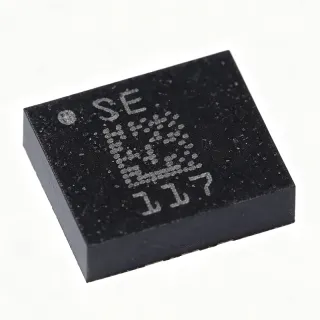
Key features include a ±480g full-scale range, overdamped mechanical response for crash-pulse fidelity, on-chip PSI5 transponder, optional Manchester-coded or PSI5-A/B/C operating modes, and a wide operating temperature range. The 16-QFN (6x6 mm) package supports surface-mount assembly with an exposed pad for thermal dissipation, and the part is qualified to automotive quality standards typical of NXP SafeAssure family members. The KWR2 suffix denotes tape-and-reel packaging.
At the architecture level, the device integrates a MEMS sensing element with a signal-conditioning ASIC in a single overmolded QFN. The overdamped mechanical transfer function eliminates high-Q resonant ringing, which is critical when capturing short-duration crash pulses; a less-damped sensor would ring and corrupt the deceleration profile read by the satellite ECU.
Typical applications include front and side airbag satellite sensors, restraint-system electronic control units, and PSI5 daisy-chain satellite modules. It is also used in body and chassis electronic safety systems. When designing with this part, engineers should pay close attention to the PSI5 synchronization and parity protocol, the daisy-chain initialization sequence, and the requirement to configure the g-slave address range during ECU bring-up.
Drop-in-Alternativen für MMA5148KWR2 – gleiches Gehäuse, Pin-kompatibel. Bauteile mit anderem Gehäuse, die eine PCB-Überarbeitung erfordern, sind ausgeschlossen.
Varianten dieser Serie
Modelle derselben Serie, die drop-in-kompatibel sind mit MMA5148KWR2 (gleiche Bauform und Footprint) – abweichend in Operating Temperature, Output Type, Package, Sensor Type.
Schnellvergleichstool – Wählen Sie Alternativbauteile für den Direktvergleich:
MMA5124KW
✅ Drop-In✓ Auf Lager
$9.75 / Stück
Datenblatt ansehen →MMA5155KW
✅ Drop-In📋 Referenzalternative (nicht im Katalog)
MMA5131KW
✅ Drop-In ⚠️ Spezifikationen ungeprüft📋 Referenzalternative (nicht im Katalog)
MMA5161KW
✅ Drop-In ⚠️ Spezifikationen ungeprüft📋 Referenzalternative (nicht im Katalog)
MMA5148LWR2
✅ Drop-In📋 Referenzalternative (nicht im Katalog)
MMA5148KWR2 Grenzwerte & elektrische Eigenschaften
| Sensortyp | Accelerometer, Z-axis, single-axis, overdamped |
| Full-Scale Range | ±480 g |
| Communication Protocol | PSI5 (Peripheral Sensor Interface 5) v1.3, AKLV27 compatible |
| Number of Axes | 1 (Z-axis) |
| Gehäuse | 16-QFN (6x6 mm), HQCCN |
| Montageart | Surface Mount |
| Betriebstemperatur | -40C to +125C (automotive grade) |
| Ausgangstyp | PSI5 digital current-loop Manchester-coded |
| Sensor Family | Xtrinsic MMA51xxKW (PSI5 Inertial Sensor, SafeAssure) |
| Mechanical Response | Overdamped (no resonant ringing) |
| Satellite Protocol | AKLV27 / PSI5 v1.3, daisy-chain capable |
| Package Code | HQCCN (QFN with thermal pad) |
| Compliance | AEC-Q100 automotive qualified (SafeAssure family) |
MMA5148KWR2 Pin-Konfiguration
| Pin 1 | PSI5_DATA — PSI5 data line (current-loop I/O) |
| Pin 2 | GND — Ground |
| Pin 3 | PSI5_SYNCH — PSI5 synchronization input |
| Pin 4 | VDD — PSI5 bus-powered supply |
| Pin 5 | NC — Not connected (per datasheet) |
| Pin 6 | NC — Not connected (per datasheet) |
| Pin 7 | TEST — Factory test pin (leave floating or GND per datasheet) |
| Pin 8 | GND — Ground |
| Pin 9 | PSI5_DATA — PSI5 data line (current-loop I/O) |
| Pin 10 | GND — Ground |
| Pin 11 | NC — Not connected (per datasheet) |
| Pin 12 | NC — Not connected (per datasheet) |
| Pin 13 | RESERVED — Reserved - do not connect |
| Pin 14 | GND — Ground |
| Pin 15 | PSI5_SYNCH — PSI5 synchronization input |
| Pin 16 | VDD — PSI5 bus-powered supply |
Typische Anwendungen
MMA5148KWR2 ist geeignet für 6 Anwendungs: Front Airbag Satellite Sensor, Side-Impact Restraint Sensor, Pedestrian-Protection Airbag ECU, PSI5 Daisy-Chain Sensor Cluster, Industrial Shock & Impact Monitoring, Heavy-Machinery Roll-Over Sensor.
Front Airbag Satellite Sensor
The MMA5148KWR2 is purpose-built for front airbag satellite sensors located at the vehicle bumper or radiator support, where peak deceleration pulses can briefly exceed 400 g during a high-speed frontal barrier impact. The ±480 g full-scale range captures the entire crash pulse without analog saturation, while the overdamped mechanical response eliminates high-Q ringing that would otherwise corrupt the deceleration waveform the airbag ECU integrates to decide deployment timing. The PSI5 v1.3 two-wire current-loop interface carries both sensor power and Manchester-coded data, allowing up to four satellites to be daisy-chained on a single ECU port - drastically reducing wiring harness weight. The -40C to +125C operating range covers cold-start and under-hood thermal extremes, and the AEC-Q100 qualification satisfies PPAP requirements. Designers should pair the device with a host MCU that supports PSI5 synchronization and parity-bit checking.
Empfohlen
Side-Impact Restraint Sensor
In a side-impact restraint system, the MMA5148KWR2 is mounted in the B-pillar or door cavity to detect the very short, very high-g intrusion pulse characteristic of a lateral collision. Side crashes often produce narrower and higher-amplitude pulses than frontal impacts, making the ±480 g range of the MMA5148KWR2 particularly well suited for this role. The overdamped response preserves pulse fidelity for the side airbag ECU, and the PSI5 v1.3 protocol with AKLV27 synchronization allows the satellite to be polled at sub-millisecond intervals, ensuring deployment decisions are made before the occupant moves into the inflator zone. The 16-QFN (6x6 mm) package allows the sensor to be soldered directly onto a small flex PCB that conforms to the B-pillar geometry, while the exposed thermal pad keeps the die within its automotive temperature envelope under sustained vibration.
Empfohlen
Pedestrian-Protection Airbag ECU
For pedestrian-protection hood airbags and active bumper systems, the MMA5148KWR2 detects the very fast acceleration rise time when a leg or pelvis strikes the bumper. Pedestrian-impact events are characterized by extremely short rise times and moderate peak g, so the overdamped response of the MMA5148KWR2 - rather than a higher-bandwidth underdamped sensor - delivers a clean step response that the algorithm can correlate to a pedestrian impact. The PSI5 interface allows the bumper-mounted sensor to coexist on the same bus as side satellites, simplifying the wiring harness. The 16-QFN package supports conformal mounting on a flexible substrate behind the bumper cover, and the SafeAssure automotive qualification means no additional derating is required for AEC-Q100 documentation.
Empfohlen
PSI5 Daisy-Chain Sensor Cluster
Up to four MMA5148KWR2 satellites can be connected to a single PSI5 ECU port using daisy-chaining, with each sensor transmitting in its assigned time slot governed by the AKLV27 protocol. This topology dramatically reduces harness weight and connector count in modern vehicles, where dozens of crash sensors must share a handful of ECU ports. Per the NXP datasheet, each satellite has a unique address determined by the part number, allowing the ECU to multiplex data streams without external addressing pins. Designers should verify synchronization timing budgets and add ESD protection at the ECU end of the bus for production harness robustness.
Empfohlen
Industrial Shock & Impact Monitoring
Outside the OEM airbag market, the MMA5148KWR2 can be deployed in industrial shock and impact monitoring systems - for example, monitoring conveyor impacts, robotic-arm collision detection, or rail-car deceleration events. The ±480 g range captures most mechanical shock profiles, and the overdamped response yields repeatable, ring-free waveforms suitable for forensic analysis. The PSI5 protocol requires an industrial MCU or FPGA host capable of generating the synchronization pulses; designers porting the part outside automotive should verify the PSI5 transponder's response to non-automotive EMC profiles and add shielding if needed.
Empfohlen
Heavy-Machinery Roll-Over Sensor
Construction and agricultural equipment can use the MMA5148KWR2 as a roll-over detection sensor, where the Z-axis channel detects vertical deceleration when the machine tilts past a safe angle. The AEC-Q100 automotive qualification actually exceeds the environmental requirements of most heavy-machinery deployments, and the PSI5 interface can be wired through a small gateway to a CAN or SAE J1939 bus. The overdamped response rejects vibration noise from diesel engines and hydraulic actuators, while the ±480 g range tolerates the brief but severe shocks of ground impact if a roll-over does occur.
Empfohlen
Zusammenfassung der empfohlenen Produkte
Technische Referenzdaten für MMA5148KWR2 – Vergleich, Designhinweise und Compliance-Informationen.
Auswahlhilfe
Vergleich mit Alternativen
| Parameter | Dieses Produkt | MMA5124KW | MMA5155KW | MMA5131KW | MMA5161KW | MMA5148LWR2 |
|---|---|---|---|---|---|---|
| Package | 16-QFN (6x6 mm) | 16-QFN (6x6 mm) - same | 16-QFN (6x6 mm) - same | 16-QFN (6x6 mm) - same | 16-QFN (6x6 mm) - same | 16-QFN (6x6 mm) - same |
| Brand | NXP Semiconductors | NXP Semiconductors | NXP Semiconductors | NXP Semiconductors | NXP Semiconductors | NXP Semiconductors |
| Communication Protocol | PSI5 v1.3 / AKLV27 | PSI5 v1.3 / AKLV27 | PSI5 v1.3 / AKLV27 | PSI5 v1.3 / AKLV27 | PSI5 v1.3 / AKLV27 | PSI5 v1.3 / AKLV27 |
| Number of Axes | 1 (Z-axis) | 1 (Z-axis) | 1 (Z-axis) | 1 (Z-axis) | 1 (Z-axis) | 1 (Z-axis) |
| Mechanical Response | Overdamped | Overdamped | Overdamped | Overdamped | Overdamped | Overdamped |
| Operating Temperature | -40C to +125C | -40C to +125C | -40C to +125C | -40C to +125C | -40C to +125C | -40C to +125C |
| AEC-Q100 Qualified | Yes (SafeAssure) | Yes (SafeAssure) | Yes (SafeAssure) | Yes (SafeAssure) | Yes (SafeAssure) | Yes (SafeAssure) |
Wichtigste Unterscheidungsmerkmale
- Highest g-range in the 16-QFN MMA51xxKW family (vs. MMA5124KW)
- Identical protocol and footprint across the family (vs. MMA5155KW)
- Lead-free / halogen-free variant available (vs. MMA5148LWR2)
Designhinweise
Route the PSI5_DATA and PSI5_SYNCH traces as a differential pair with characteristic impedance matched to the bus specification, keeping stubs under 2 mm. Per the NXP Xtrinsic MMA51xxWR2 datasheet, place the sensor so that its sensitive Z-axis aligns with the vehicle's vertical axis - any off-axis mounting will couple lateral crash energy into the Z-channel and bias the deployment decision. Provide a solid ground plane beneath the 16-QFN exposed thermal pad and stitch vias on a 1 mm grid to keep thermal resistance low.
Do not exceed the maximum PSI5 synchronization pulse width or the satellite will not respond during the next time slot. The AKLV27 protocol requires the host ECU to issue a synchronization pulse before each polling window; missed pulses cause data corruption. Per the datasheet, the PSI5 bus must be terminated at the ECU end with the recommended TVS diode and current-limiting resistor to survive load-dump transients. Never share the PSI5 bus between daisy-chained sensors of incompatible part numbers without verifying address slot assignments.
Use a four-layer PCB stack-up with a dedicated ground plane on layer 2 directly below the sensor, and route the PSI5 traces on layer 3 to minimize capacitive coupling from switching power converters. The exposed thermal pad of the 16-QFN must be soldered to a copper pad of at least 25 mm² with at least five thermal vias for proper heat dissipation during high-temperature reflow. Per the NXP datasheet, conformal coating is recommended for under-hood and chassis-mounted installations to protect against moisture and salt spray.
Compliance-Informationen
AEC-Q100 qualified as part of NXP SafeAssure family. RoHS, lead-free, and halogen-free compliance confirmed on NXP product page. Reach SVHC declarations available via NXP product compliance portal.