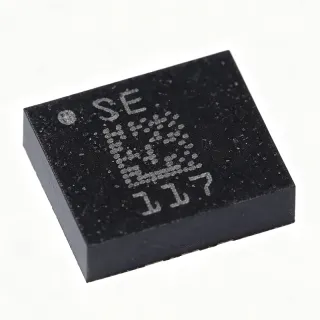
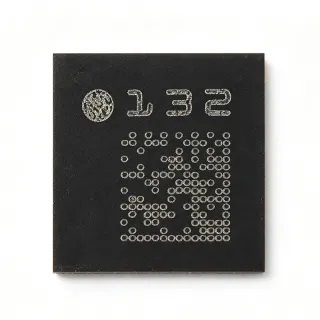
MMA6261QR2 - ±1.5g Dual-Axis Analog Accelerometer | NXP
Teilenummer: MMA6261QR2 ✗ Abgekündigt| Menge | Stückpreis | Gesamt |
|---|---|---|
| 1 | $6.5 | $6,50 |
| 10 | $5.75 | $57,50 |
| 100 | $4.95 | $495,00 |
| 500 | $4.3 | $2.150,00 |
| 1.000 | $3.85 | $3.850,00 |
MMA6261QR2 Übersicht
An accelerometer is a micro-electromechanical systems (MEMS) sensor that measures proper acceleration, the rate of change of velocity relative to a free-fall reference frame. Within the broader sensor hierarchy, accelerometers belong to inertial measurement units (IMUs), sit alongside gyroscopes and magnetometers in 6-axis and 9-axis motion-tracking assemblies, and ultimately form part of motion-sensing subsystems in modern electronics. Dual-axis devices like the MMA6261QR2 simplify tilt, vibration, and shock measurement by integrating two orthogonal sensing axes on a single die.
Key features include ±1.5g full-scale range, integrated signal conditioning with a 1-pole low-pass filter, factory-set zero-g offset and sensitivity, temperature compensation across -20C to +85C, and a self-test capability on both axes via dedicated logic pins. The analog output is ratiometric to the supply voltage, simplifying ADC interfacing without precision voltage references.
The device uses a capacitive-sensing MEMS proof mass whose deflection modulates a differential capacitor bridge. A switched-capacitor front-end converts this capacitance change to a voltage, which is then filtered and amplified to produce the analog output. The integrated architecture eliminates the discrete op-amp and charge-pump stages required by older air-gap accelerometers.
Typical applications include hard-disk drive free-fall protection, tilt and orientation sensing in consumer electronics, vibration monitoring in industrial equipment, gaming controllers, and portable medical devices. Designers value its small footprint, low power consumption, and the absence of external trimming components.
When designing with the MMA6261QR2, place the recommended bypass capacitor within 5 mm of VDD and route the analog output traces away from switching regulators or digital clock lines to preserve the 300 Hz signal integrity. Self-test should be exercised at power-up or periodically for safety-critical applications such as HDD free-fall detection.
This page synthesizes distributor pricing, parametric comparison with same-package cross-brand parts, and practical PCB-layout design notes that go beyond the manufacturer datasheet to accelerate your hardware bring-up.
Drop-in-Alternativen für MMA6261QR2 – gleiches Gehäuse, Pin-kompatibel. Bauteile mit anderem Gehäuse, die eine PCB-Überarbeitung erfordern, sind ausgeschlossen.
Varianten dieser Serie
Modelle derselben Serie, die drop-in-kompatibel sind mit MMA6261QR2 (gleiche Bauform und Footprint) – abweichend in Package, RoHS Status, Self-Test, Bandwidth, Operating Temperature.
Schnellvergleichstool – Wählen Sie Alternativbauteile für den Direktvergleich:
MMA6260QR2
✅ Drop-In✓ Auf Lager
$4.65 / Stück
Datenblatt ansehen →MMA7260QT
✅ Drop-In✓ Auf Lager
$3.25 / Stück
Datenblatt ansehen →MMA6222AQ
✅ Drop-In📋 Referenzalternative (nicht im Katalog)
MMA6233QR2
✅ Drop-In✓ Auf Lager
$4.77 / Stück
Datenblatt ansehen →MMA6261QR2 Grenzwerte & elektrische Eigenschaften
| Sensortyp | Accelerometer, dual-axis (X, Y) |
| Sensing Technology | Capacitive MEMS |
| Acceleration Range | ±1.5 g |
| Number of Axes | 2 (X, Y) |
| Ausgangstyp | Analog voltage, ratiometric |
| Bandwidth | 300 Hz |
| Supply Voltage (VDD) | 2.7 V to 3.6 V |
| Versorgungsstrom | 1.5 mA (typical) |
| Sensitivity | factory-set, ratiometric |
| Zero-g Offset | factory-set |
| Filter | 1-pole low-pass, factory-set |
| Self-Test | Yes (per axis) |
| Betriebstemperatur | -20 C to +85 C |
| Gehäuse | 16-QFN-EP (6x6 mm) HQCCN |
| Montageart | Surface Mount |
| RoHS-Status | RoHS Compliant (contains lead, lead-free terminal finish) |
| Pin-Anzahl | 16 |
MMA6261QR2 Pin-Konfiguration
| Pin 1 | NC — Not connected (per datasheet) |
| Pin 2 | NC — Not connected (per datasheet) |
| Pin 3 | NC — Not connected (per datasheet) |
| Pin 4 | VDD — Power supply (2.7 V to 3.6 V) |
| Pin 5 | GND — Ground reference |
| Pin 6 | XOUT — X-axis analog output |
| Pin 7 | YOUT — Y-axis analog output |
| Pin 8 | NC — Not connected (per datasheet) |
| Pin 9 | NC — Not connected (per datasheet) |
| Pin 10 | STX — X-axis self-test input (active high) |
| Pin 11 | STY — Y-axis self-test input (active high) |
| Pin 12 | NC — Not connected (per datasheet) |
| Pin 13 | NC — Not connected (per datasheet) |
| Pin 14 | NC — Not connected (per datasheet) |
| Pin 15 | NC — Not connected (per datasheet) |
| Pin 16 | NC — Not connected (per datasheet) |
Typische Anwendungen
MMA6261QR2 ist geeignet für 6 Anwendungs: Hard-Disk Drive Free-Fall Protection, Tilt and Orientation Sensing, Industrial Vibration Monitoring, Gaming and Motion Controllers, Portable Medical Devices, Automotive Security and Alarm Systems.
Hard-Disk Drive Free-Fall Protection
The MMA6261QR2's ±1.5 g full-scale range and 300 Hz analog bandwidth give a laptop HDD controller enough lead time to park read/write heads before impact when the chassis is dropped. The dual X/Y axes let designers monitor both pitch and roll tumble, and the ratiometric analog outputs couple directly to the disk controller's 3.3 V ADC without precision references. Self-test is typically exercised at power-up to verify MEMS integrity, a critical safety check for any drop-detection path.
Empfohlen
Tilt and Orientation Sensing
For handheld consumer products that display screen orientation or measure instrument tilt, the MMA6261QR2's factory-calibrated sensitivity and zero-g offset remove the need for production-line trimming. The dual X/Y axes cover pitch and roll simultaneously, and the 300 Hz bandwidth captures user-motion dynamics without aliasing low-frequency hand jitter. Operating from a 2.7 V to 3.6 V supply, it draws just 1.5 mA typical, extending battery life in portable applications such as e-readers and remote controls.
Empfohlen
Industrial Vibration Monitoring
The MMA6261QR2's 1-pole low-pass filter with 300 Hz cut-off and ratiometric analog outputs make it a viable front-end for low-frequency machine-vibration analysis where rotating-equipment faults (imbalance, misalignment) appear below 200 Hz. The factory-set sensitivity removes field calibration, while the -20 C to +85 C operating range covers most factory-floor environments. Designers typically pair the analog outputs with a 12-bit or 16-bit ADC and stream samples to a microcontroller for FFT-based condition monitoring.
Empfohlen
Gaming and Motion Controllers
Game controllers and pointer devices benefit from the MMA6261QR2's dual-axis pitch/roll sensing and 1.5 mA typical supply current, which keeps total system power budget low. The ratiometric analog outputs feed directly into a 10-bit ADC inside the microcontroller, and the on-chip self-test verifies the MEMS die after assembly. Fast response (300 Hz bandwidth) tracks rapid gesture motion without visible lag, and the small 6x6 mm QFN package fits comfortably inside compact handheld enclosures.
Empfohlen
Portable Medical Devices
Patient-activity monitors and fall-detection wearables leverage the MMA6261QR2's low 1.5 mA supply current and ±1.5 g range to detect motion events that may indicate a fall or change in patient mobility. The dual X/Y axes discriminate between intentional movement (walking, sitting up) and abrupt shock events, and the integrated temperature compensation maintains calibration across the device's operating range. The 16-QFN-EP package is small enough to fit into a wrist-worn or pendant form factor.
Empfohlen
Automotive Security and Alarm Systems
Vehicle alarm systems and tilt-based anti-theft modules use the MMA6261QR2 to detect jacking, towing, or impact events. The dual-axis sensing discriminates between normal vibration (passing trucks, wind) and alarm-worthy tilt changes, while the 300 Hz bandwidth rejects high-frequency electrical noise from the vehicle's 12 V power environment. Operating directly from a regulated 3.3 V rail, the accelerometer pairs cleanly with automotive-grade microcontrollers that already monitor door, ignition, and glass-break sensors.
Empfohlen
Zusammenfassung der empfohlenen Produkte
Technische Referenzdaten für MMA6261QR2 – Vergleich, Designhinweise und Compliance-Informationen.
Auswahlhilfe
Vergleich mit Alternativen
| Parameter | Dieses Produkt | MMA6260QR2 | MMA7260QT | MMA6222AQ | MMA6233QR2 |
|---|---|---|---|---|---|
| Package | 16-QFN-EP (6x6) | 16-QFN-EP (6x6) - same | 16-QFN (6x6) - same | 16-QFN (6x6) - same | 16-QFN-EP (6x6) - same |
| Brand | NXP Semiconductors | NXP Semiconductors - same brand | NXP Semiconductors - same brand | NXP Semiconductors - same brand | NXP Semiconductors - same brand |
| Number of Axes | 2 (X, Y) | 1 (X only) | 3 (X, Y, Z) | 2 (X, Y) | 2 (X, Y) |
| Acceleration Range | ±1.5 g | ±1.5 g | ±1.5/2/4/6 g selectable | ±20 g | ±10 g |
| Supply Voltage | 2.7 V to 3.6 V | 2.7 V to 3.6 V | 2.2 V to 3.6 V | 2.7 V to 3.6 V | 2.7 V to 3.6 V |
| Output Type | Analog, ratiometric | Analog, ratiometric | Analog, ratiometric | Analog, ratiometric | Analog, ratiometric |
| Self-Test | Yes (per axis) | Yes (X axis) | Yes (per axis) | Yes | Yes |
Wichtigste Unterscheidungsmerkmale
- Dual-axis sensing in a single 16-QFN-EP package (vs. MMA6260QR2)
- Lower full-scale range optimized for tilt and free-fall (vs. MMA6222AQ)
- True 2-axis analog output without g-select logic (vs. MMA7260QT)
Designhinweise
Place a 0.1 uF ceramic bypass capacitor within 5 mm of the VDD pin (pin 4) and a 1 uF to 10 uF bulk capacitor at the supply rail entry. The ratiometric analog outputs scale with VDD, so any noise on VDD directly couples into the sensor signal; route VDD away from switching regulators and use a pi-filter (LC + bulk) if the 3.3 V rail is shared with digital loads.
Route the XOUT (pin 6) and YOUT (pin 7) traces as differential pairs with ground guard traces on both sides to reject common-mode noise from adjacent digital signals. Keep trace lengths under 25 mm to minimize capacitance, and place the ADC input within 50 mm of the sensor output. The exposed pad (EP) must be soldered to a continuous ground pour for thermal dissipation and mechanical stability of the MEMS die.
Do not exercise self-test (drive STX/STY high) while the device is in a high-vibration environment, as the electrostatic self-test force adds to the inertial acceleration and produces a misleading output. According to the NXP datasheet, self-test should only be enabled at power-up or during quiescent periods. Also verify that NC pins are truly left floating per datasheet - connecting them to VDD or GND can disturb the internal analog front-end bias and degrade zero-g accuracy.
Compliance-Informationen
RoHS compliant per distributor listing; terminal finish contains lead per legacy Motorola/Freescale packaging. Not AEC-Q100 qualified - not recommended for new automotive designs. Reach and conflict-mineral status not explicitly stated in available data.