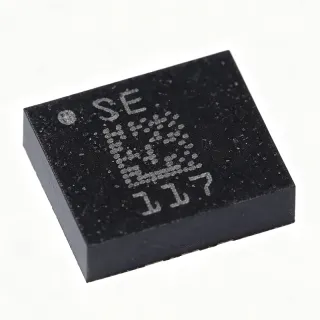
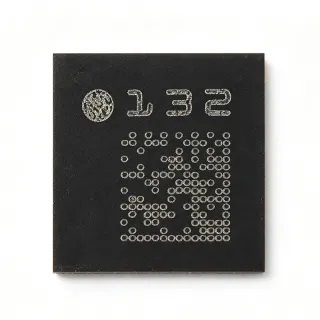
MMA9550LR1-FR - Intelligent Motion-Sensing Platform, ±2/4/8g Accelerometer | NXP Semiconductors
Teilenummer: MMA9550LR1-FR ✗ Abgekündigt| Menge | Stückpreis | Gesamt |
|---|---|---|
| 1 | $6.75 | $6,75 |
| 10 | $6.08 | $60,80 |
| 100 | $5.41 | $541,00 |
| 500 | $4.86 | $2.430,00 |
| 1.000 | $4.32 | $4.320,00 |
MMA9550LR1-FR Übersicht
An accelerometer is a micro-electromechanical sensor that measures proper acceleration along one or more axes, converting mechanical motion into an electrical signal. In the broader taxonomy, the MMA9550LR1 sits within MEMS inertial sensors -> accelerometers -> motion sensors -> inertial measurement units (IMUs). Intelligent sensor platforms like this one combine raw sensing with on-chip digital processing, freeing the host MCU from low-level signal conditioning and reducing overall system power and code complexity.
Key features include a triple-axis architecture, selectable full-scale ranges of ±2g/±4g/±8g, embedded 32-bit ARM Cortex-M0 core for sensor fusion, integrated calibration and offset compensation, and a digital I2C/SPI output interface. The device supports user-programmable embedded algorithms, making it suitable for applications that previously required a dedicated microcontroller.
The MMA9550LR1-FR uses a capacitive MEMS sensing element with a sigma-delta ADC front-end, achieving low offset drift and stable gain across temperature. The embedded Cortex-M0 enables on-chip computation of motion features such as tap detection, orientation, and free-fall recognition, providing higher-level interrupts to the host processor rather than raw sample streams.
Typical applications include step counting in pedometers and fitness bands, tilt and orientation in portable electronics, vibration monitoring in industrial equipment, motion-activated user interfaces in IoT devices, and asset tracking with motion-triggered wake-up.
When designing with this part, allocate the LGA land pattern according to NXP's 3x3 mm 16-LGA footprint and provide clean I2C pull-ups on SDA/SCL. Note that the embedded firmware requires NXP's development toolchain for algorithm customization; off-the-shelf firmware profiles cover common use cases out of the box.
This page synthesizes distributor pricing, drop-in cross-reference alternatives, and practical design notes that complement the manufacturer datasheet. Cross-brand alternatives listed below are sourced from distributor parametric databases; verify pin compatibility against your specific firmware configuration before substituting in production.
Drop-in-Alternativen für MMA9550LR1-FR – gleiches Gehäuse, Pin-kompatibel. Bauteile mit anderem Gehäuse, die eine PCB-Überarbeitung erfordern, sind ausgeschlossen.
Varianten dieser Serie
Modelle derselben Serie, die drop-in-kompatibel sind mit MMA9550LR1-FR (gleiche Bauform und Footprint) – abweichend in Axis, Interface, Operating Temperature, Package, Supply Voltage.
Schnellvergleichstool – Wählen Sie Alternativbauteile für den Direktvergleich:
MMA9550LR1
✅ Drop-In📋 Referenzalternative (nicht im Katalog)
MMA8452Q
✅ Drop-In📋 Referenzalternative (nicht im Katalog)
MMA8653Q
✅ Drop-In📋 Referenzalternative (nicht im Katalog)
FXLS8471QR1
✅ Drop-In ⚠️ Spezifikationen ungeprüft📋 Referenzalternative (nicht im Katalog)
LIS2DH12TR
✅ Drop-In✓ Auf Lager
$0.67 / Stück
Datenblatt ansehen →BMA253
✅ Drop-In ⚠️ Spezifikationen ungeprüft📋 Referenzalternative (nicht im Katalog)
MMA9550LR1-FR Grenzwerte & elektrische Eigenschaften
| Type | Accelerometer with embedded MCU |
| Axis | X, Y, Z |
| Acceleration Range | ±2g, ±4g, ±8g (selectable) |
| Bandwidth | 1.9 Hz to 244 Hz |
| Ausgangstyp | Digital (I2C/SPI) |
| Gehäuse | 16-LGA (3x3 mm) |
| Versorgungsspannung | 1.8 V (typical) |
| Montageart | Surface Mount |
| Betriebstemperatur | -40C to +85C |
| Embedded Processor | 32-bit ARM Cortex-M0 |
| RoHS-Status | RoHS Compliant |
| Lead Free Status | Lead Free |
| Series | MMA955xL |
| Family | Xtrinsic Intelligent Sensor Platform |
| Schnittstelle | I2C/SPI digital |
MMA9550LR1-FR Pin-Konfiguration
| Pin 1 | VDD — Power supply input (1.8 V typical) |
| Pin 2 | GND — Ground reference |
| Pin 3 | RESET — Hardware reset input (active low) |
| Pin 4 | ADDR — I2C slave address select |
| Pin 5 | SDA — I2C data / SPI data I/O |
| Pin 6 | SCL — I2C clock / SPI clock |
| Pin 7 | INT1 — Interrupt output 1 |
| Pin 8 | INT2 — Interrupt output 2 |
| Pin 9 | GPIO1 — General purpose I/O 1 |
| Pin 10 | GPIO2 — General purpose I/O 2 |
| Pin 11 | NC — Not connected (per datasheet) |
| Pin 12 | NC — Not connected (per datasheet) |
| Pin 13 | NC — Not connected (per datasheet) |
| Pin 14 | NC — Not connected (per datasheet) |
| Pin 15 | NC — Not connected (per datasheet) |
| Pin 16 | EP — Exposed thermal pad - connect to GND |
Typische Anwendungen
MMA9550LR1-FR ist geeignet für 6 Anwendungs: Pedometer and Fitness Band, Tilt and Orientation Sensing, Vibration Monitoring in Industrial Equipment, Motion-Activated IoT Devices, Asset Tracking with Motion-Triggered GPS, Free-Fall Detection for Hard-Drive Protection.
Pedometer and Fitness Band
The MMA9550LR1-FR's integrated Cortex-M0 processor runs NXP's pedometer firmware in firmware, counting steps, distance, and calories without burdening the host MCU. With selectable ±2g/±4g ranges and 1.9-244 Hz bandwidth, it detects walking, running, and stair-climbing patterns while rejecting false positives from hand motion. The 16-LGA 3x3 mm package fits inside wristbands and clip-on fitness trackers, and the low 1.8 V supply suits Li-ion battery-powered wearables directly.
Empfohlen
Tilt and Orientation Sensing
The MMA9550LR1-FR's selectable ±2g range and embedded orientation algorithms detect portrait/landscape/face-up/face-down states for tablet rotation, e-reader page turns, and industrial handheld displays. Its 1.9 Hz low end of the bandwidth range provides stable tilt output without high-frequency noise, while the on-chip Cortex-M0 delivers orientation interrupts to the host only when state changes occur. This reduces I2C traffic by orders of magnitude versus polling raw samples from a basic accelerometer.
Empfohlen
Vibration Monitoring in Industrial Equipment
Industrial vibration analysis requires wide bandwidth and selectable dynamic range; the MMA9550LR1-FR's 244 Hz upper bandwidth and ±8g range cover most rotating machinery frequencies from pumps to small motors. The embedded Cortex-M0 can run vibration FFT or RMS calculations on-chip, transmitting processed health metrics over I2C/SPI rather than raw sample streams. This minimizes host processor load and enables condition monitoring on resource-constrained PLCs and edge gateways.
Empfohlen
Motion-Activated IoT Devices
Battery-powered IoT sensors use the MMA9550LR1-FR's motion detection to wake from deep sleep only when meaningful activity occurs, extending battery life by 10x or more. The embedded algorithms distinguish between ambient vibration and genuine user motion (tap, shake, tilt), preventing false wake-ups that would drain coin-cell batteries. With its 1.8 V supply and sub-mA active current, it is well suited to BLE beacons, smart door locks, and asset trackers that spend most of their time asleep.
Empfohlen
Asset Tracking with Motion-Triggered GPS
The MMA9550LR1-FR pairs with GPS modules in asset-tracking containers and pallets, powering up the GNSS receiver only when the accelerometer detects movement. With ±8g full scale, it captures shock events during transport for supply-chain analytics and insurance documentation. The 16-LGA 3x3 mm package integrates cleanly into space-constrained tracker housings, and the digital I2C/SPI output drives a low-cost host MCU without requiring a separate signal-conditioning ASIC.
Empfohlen
Free-Fall Detection for Hard-Drive Protection
The MMA9550LR1-FR's free-fall detection algorithm triggers within milliseconds of detecting 0g across all axes, giving laptop hard drives time to park heads before impact. The ±2g/±4g/±8g selectable range allows tuning sensitivity for different product form factors from ultrabooks to ruggedized notebooks. Its embedded MCU executes the free-fall algorithm autonomously, issuing a hardware interrupt to the host chipset without latency from software scheduling.
Empfohlen
Zusammenfassung der empfohlenen Produkte
Technische Referenzdaten für MMA9550LR1-FR – Vergleich, Designhinweise und Compliance-Informationen.
Auswahlhilfe
Vergleich mit Alternativen
| Parameter | Dieses Produkt | MMA9550LR1 | MMA8452Q | MMA8653Q | FXLS8471QR1 | LIS2DH |
|---|---|---|---|---|---|---|
| Brand | NXP Semiconductors (formerly Freescale) | NXP Semiconductors | NXP Semiconductors | NXP Semiconductors | NXP Semiconductors | STMicroelectronics |
| Package | 16-LGA (3x3 mm) | 16-LGA (3x3 mm) - same | 16-QFN (3x3 mm) | 16-QFN (3x3 mm) | 16-QFN (3x3 mm) | 16-LGA (3x3 mm) - same |
| Embedded MCU | 32-bit ARM Cortex-M0 | 32-bit ARM Cortex-M0 | None - raw output | None - raw output | None - raw output | None - raw output |
| Acceleration Range | ±2g, ±4g, ±8g | ±2g, ±4g, ±8g | ±2g, ±4g, ±8g | ±2g, ±4g, ±8g | ±2g, ±4g, ±8g | ±2g, ±4g, ±8g, ±16g |
| Bandwidth | 1.9 Hz to 244 Hz | 1.9 Hz to 244 Hz | 0.78 Hz to 400 Hz | 0.5 Hz to 400 Hz | 0.25 Hz to 1.6 kHz | 1 Hz to 5 kHz |
| Interface | I2C/SPI digital | I2C/SPI | I2C | I2C | I2C/SPI | I2C/SPI |
| Supply Voltage | 1.8 V | 1.8 V | 1.95 V to 3.6 V | 1.95 V to 3.6 V | 1.95 V to 3.6 V | 1.71 V to 3.6 V |
| Lifecycle Status | NRND | NRND | Active | Active | Active | Active |
| Embedded Motion Algorithms | Pedometer, free-fall, tap, orientation | Pedometer, free-fall, tap, orientation | Free-fall, orientation, tap (host-side) | Orientation only (host-side) | Orientation, tap (host-side) | Free-fall, wake-up (host-side) |
Wichtigste Unterscheidungsmerkmale
- On-chip ARM Cortex-M0 eliminates host-side motion firmware development (vs. MMA8452Q)
- Three same-family NXP alternatives with shared 3-axis architecture (vs. MMA8452Q, MMA8653Q, FXLS8471QR1)
- Xtrinsic platform consolidates transducer, ASIC, and MCU in one 16-LGA package (vs. LIS2DH)
Designhinweise
Per the NXP/Freescale MMA955xL datasheet, the 16-LGA 3x3 mm package requires NSMD (non-solder mask defined) land pads with a 0.5 mm pitch and an exposed thermal pad soldered to a ground copper pour. Place a 0.1 uF decoupling capacitor within 2 mm of the VDD pin and route the I2C/SPI traces as short, parallel pairs with a ground keep-out underneath to minimize coupling.
The MMA9550LR1-FR operates from a single 1.8 V supply rail. For designs where the host MCU runs at 3.3 V, use a level translator on SDA/SCL or place 4.7 kohm pull-ups to the 1.8 V rail and let the MCU's I/O tolerate the lower logic level (many modern MCUs support 1.8 V I/O). Bulk capacitance of at least 1 uF should sit within 5 mm of the VDD pin to suppress switching transients from the embedded MCU core.
Do not assume the MMA9550LR1-FR is firmware-compatible with the base MMA9550LR1 - the FR suffix denotes factory-programmed motion algorithm firmware; custom firmware uploads require NXP's development toolchain. Also note that several 16-LGA pads are marked NC (not connected) - these must remain floating, not tied to ground or VDD, as they carry internal MEMS test signals that can be disturbed by external connections.
Place the MMA9550LR1-FR at least 5 mm away from vibration sources such as speakers, buzzers, and switching power inductors to avoid corrupting the low-g tilt measurement. Orient the package so that the X-axis arrow on the top marking aligns with the desired board reference direction; the embedded orientation algorithm uses this for portrait/landscape detection. Keep the area beneath the LGA free of copper traces under the exposed thermal pad edges to maintain a clean GND reference.
Compliance-Informationen
RoHS compliant per DigiKey product listing; lead-free per manufacturer datasheet. Not AEC-Q100 qualified - this part targets consumer and industrial applications only.