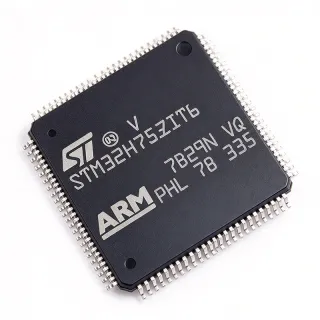
STM32F765ZIT7TR - 216MHz Cortex-M7 MCU, 2MB Flash, 144-LQFP | STMicroelectronics
Teilenummer: STM32F765ZIT7TR ✓ Aktiv| Menge | Stückpreis | Gesamt |
|---|---|---|
| 1 | $37.7633 | $37,76 |
| 10 | $33.99 | $339,90 |
| 100 | $30.5 | $3.050,00 |
| 500 | $27.2 | $13.600,00 |
| 1.000 | $24.85 | $24.850,00 |
STM32F765ZIT7TR Übersicht
A microcontroller (MCU) is a single-chip computer that integrates a CPU core, memory, and programmable I/O peripherals. The Cortex-M7 is ARM's highest-performance Cortex-M core, featuring a six-stage superscalar pipeline, branch prediction, and an integrated single-precision floating-point unit; it sits at the top of the Cortex-M family alongside the Cortex-M4 and Cortex-M33. STM32F7-series MCUs belong to the broader ARM Cortex-M taxonomy, which itself falls under 32-bit RISC microcontrollers and, more generally, embedded microprocessors and semiconductor ICs. Compared with Cortex-M4 parts, the Cortex-M7 offers roughly doubled DSP performance and is aimed at demanding signal-processing and graphics workloads.
Key features that distinguish this part include the dual-bank 2 MB Flash with ART Accelerator for zero-wait-state execution from Flash, 16-bit and 32-bit timers, up to 28 communication interfaces (USART/UART/SPI/I2S/I2C), a 12-bit ADC reaching 2.4 MSPS, two 12-bit DACs, an SDMMC host interface for external SD cards or eMMC, and an Ethernet MAC with dedicated DMA. The integrated cryptographic accelerator (AES-256, SHA-1/SHA-2, HMAC, and TRNG) enables hardware-bound secure boot and TLS/SSL offload. The Chrom-ART Accelerator 2D DMA engine accelerates bitmap operations for HMI applications.
Typical applications include industrial motor drives and PLCs, medical patient-monitoring and diagnostic equipment, human-machine interface (HMI) panels with TFT-LCD or DSI displays, factory-automation controllers with EtherCAT/PROFINET bridges, point-of-sale terminals, building-automation gateways, and audio-processing units including USB audio class endpoints. The 216 MHz Cortex-M7 with single-precision FPU and DSP extensions makes the part particularly suited to real-time FFT-based analytics, digital filtering, and motor-control algorithms using FOC (field-oriented control). Pin-compatible upgrades within the STM32F765 family extend to the STM32F767/F769 line for projects that need additional MIPI-DSI lanes or the SPDIF interface.
When designing with this MCU, attention must be paid to decoupling (1 uF + 100 nF near each VDD pin), the layout of the 25 MHz HSE crystal traces within 5 mm of the OSC_IN/OSC_OUT pins, and the thermal dissipation in continuous high-CPU-load scenarios. The 144-LQFP package has a thermal resistance of approximately 38 C/W (theta_JA on a 4-layer JEDEC board) and is adequate for industrial operating points up to about 0.8 W steady-state dissipation without airflow.
This page synthesizes 144-LQFP same-package drop-in alternatives, distributor pricing tiers, and practical design notes not found in a single source.
Drop-in-Alternativen für STM32F765ZIT7TR – gleiches Gehäuse, Pin-kompatibel. Bauteile mit anderem Gehäuse, die eine PCB-Überarbeitung erfordern, sind ausgeschlossen.
Varianten dieser Serie
Modelle derselben Serie, die drop-in-kompatibel sind mit STM32F765ZIT7TR (gleiche Bauform und Footprint) – abweichend in Core, Operating Temperature, Package, ADC, DAC.
Schnellvergleichstool – Wählen Sie Alternativbauteile für den Direktvergleich:
STM32F767ZIT7
✅ Drop-In📋 Referenzalternative (nicht im Katalog)
STM32F769ZIT6
✅ Drop-In📋 Referenzalternative (nicht im Katalog)
STM32F765ZIT6
✅ Drop-In✓ Auf Lager
$10.95 / Stück
Datenblatt ansehen →STM32F765ZGT7
✅ Drop-In📋 Referenzalternative (nicht im Katalog)
STM32F765ZGT6
✅ Drop-In✓ Auf Lager
$13.62 / Stück
Datenblatt ansehen →STM32F768AVIT7
✅ Drop-In ⚠️ Spezifikationen ungeprüft📋 Referenzalternative (nicht im Katalog)
STM32F765ZIT7TR Grenzwerte & elektrische Eigenschaften
| Core | ARM Cortex-M7 with FPU |
| Core Architecture | 32-bit RISC, 6-stage superscalar pipeline |
| Maximum CPU Frequency | 216 MHz |
| DMIPS | 462 DMIPS |
| Flash Memory | 2 MB (dual-bank) |
| SRAM | 512 KB + 16 KB + 4 KB (total 532 KB) |
| Operating Voltage | 1.7 V to 3.6 V |
| Betriebstemperatur | -40 C to +85 C (industrial grade, 'I' suffix) |
| Gehäuse | LQFP-144 (20x20 mm, 0.5 mm pitch) |
| Montageart | Surface Mount |
| Number of I/O Pins | Up to 114 (per datasheet) |
| Communication Interfaces | Up to 28 (USART, UART, SPI, I2S, I2C, USB OTG HS/FS, CAN 2.0B, SDMMC, Ethernet MAC) |
| ADC | 3x 12-bit, up to 2.4 MSPS |
| DAC | 2x 12-bit |
| Display Interface | LCD-TFT controller, MIPI-DSI host |
| Cryptographic Accelerator | AES-256, SHA-1/SHA-2, HMAC, TRNG |
| DMA | 16-stream DMA + Chrom-ART Accelerator 2D DMA |
| MSL-Level | 3 (per JEDEC J-STD-020) |
| RoHS-Status | Compliant |
| Packaging | Tape & Reel (TR suffix) |
STM32F765ZIT7TR lqfp-144 (20x20 mm, 0.5 mm pitch) Pinbelegungsleitfaden
Pinbelegung für STM32F765ZIT7TR (lqfp-144 (20x20 mm, 0.5 mm pitch)-Gehäuse). Dieser digitale IC umfasst GPIO, Kommunikationsschnittstellen (UART, SPI, I2C) und Versorgungspins. Alternative Pin-Funktionen und Konfigurationsoptionen entnehmen Sie dem Herstellerdatenblatt. Unverzichtbar für Embedded-System-Design und PCB-Layout.
Keine detaillierten Pinbelegungsdaten verfügbar für STM32F765ZIT7TR.
Siehe die Datenblatt für die vollständige Pin-Konfiguration.
Typische Anwendungen
STM32F765ZIT7TR ist geeignet für 7 Anwendungs: Industrial Human-Machine Interface (HMI) Panels, Industrial Motor Control and PLCs, Medical Patient Monitoring Equipment, Audio Processing and USB Audio Class Devices, Factory Automation Controllers with Industrial Ethernet, Building Automation Gateways and Smart-Home Hubs, Point-of-Sale (POS) Terminals and Payment Devices.
Industrial Human-Machine Interface (HMI) Panels
The STM32F765ZIT7TR's 216 MHz Cortex-M7 with FPU, 2 MB dual-bank Flash, and 532 KB SRAM are well-suited for industrial HMI panels driving TFT-LCD or basic MIPI displays up to WVGA resolution. Its LCD-TFT controller supports up to 24-bit RGB interfaces without external graphics ICs, while the Chrom-ART Accelerator 2D DMA offloads bitmap copy, alpha-blend, and color-format conversion tasks from the CPU. At typical HMI loads (60% CPU for graphics + 30% for touch + 10% for comms), the part runs comfortably within its 216 MHz envelope with adequate thermal margin. Source: ST datasheet and reference designs.
Empfohlen
Industrial Motor Control and PLCs
The STM32F765ZIT7TR's Cortex-M7 DSP extensions and single-precision FPU enable FOC (field-oriented control) algorithms for 3-phase motor drives at switching frequencies up to 50 kHz without software bottlenecks. The 12-bit ADC trio at 2.4 MSPS provides simultaneous phase-current sampling needed for sensorless FOC, while the 16-bit and 32-bit timers deliver the precise PWM generation for sinusoidal commutation. The 2 MB Flash stores large state-space control loops and the dual-bank architecture enables safe field firmware updates. Industrial-grade -40 C to +85 C temperature range supports factory-floor deployment. Source: ST motor-control reference designs and AN4013.
Empfohlen
Medical Patient Monitoring Equipment
The STM32F765ZIT7TR fits medical patient-monitoring applications requiring real-time ECG, SpO2, and respiration signal processing. The 216 MHz Cortex-M7 executes 1024-point FFTs in under 500 microseconds, suitable for heart-rate variability and arrhythmia detection at sample rates up to 1 kHz. The hardware AES/SHA cryptographic accelerator enables encrypted data transmission to hospital networks, an essential requirement for HIPAA-compliant designs. Industrial-grade temperature rating meets the operating envelope of bedside and ambulatory equipment. The 2 MB Flash holds complex DSP firmware including artifact-removal filters. Source: ST medical datasheet literature.
Empfohlen
Audio Processing and USB Audio Class Devices
The STM32F765ZIT7TR's USB OTG HS/FS peripheral with internal HS PHY supports USB Audio Class 2.0 endpoints at 480 Mbit/s, enabling high-resolution 24-bit/96 kHz audio streaming. The Cortex-M7 DSP extensions accelerate sample-rate conversion and equalization in real time, while the SAI/I2S interfaces connect directly to external DACs. Hardware AES/SHA also enables encrypted streaming for content-protected audio paths. The 532 KB SRAM accommodates audio buffer latency requirements without data underflow at 96 kHz. Source: ST USB Audio Class reference designs and AN3998.
Empfohlen
Factory Automation Controllers with Industrial Ethernet
The STM32F765ZIT7TR's 10/100 Ethernet MAC with dedicated DMA and the Cortex-M7 compute budget support industrial Ethernet protocols including PROFINET, EtherCAT slave, and Modbus TCP in soft-PLC or distributed-IO roles. The 2 MB dual-bank Flash stores large protocol stacks (EtherCAT slave controller code is typically 800 KB-1 MB) plus application logic. Real-time deterministic interrupt handling on the Cortex-M7 keeps cycle jitter below 1 microsecond, essential for EtherCAT distributed clocks. Industrial-grade temperature range supports cabinet-mounted operation. Source: ST AN5053 application note.
Empfohlen
Building Automation Gateways and Smart-Home Hubs
The STM32F765ZIT7TR's combination of USB OTG, Ethernet, CAN, multiple UARTs, and SPI ports makes it a strong gateway controller bridging KNX, BACnet, Modbus, Zigbee, and Wi-Fi subnets into a unified building-automation backbone. The Cortex-M7 host-stack performance handles MQTT/HTTP/TLS encryption for cloud uplink at typical 1-10 messages/sec rates without CPU saturation. The hardware AES/SHA accelerator speeds TLS 1.2 handshakes by 5-10x versus software crypto, critical for boot-time user experience. The 2 MB Flash holds the multi-protocol stack and OTA image. Source: ST connectivity datasheet.
Empfohlen
Point-of-Sale (POS) Terminals and Payment Devices
The STM32F765ZIT7TR's hardware cryptographic accelerator (AES-256, SHA-256, TRNG) is essential for PCI PTS-compliant payment terminals, providing secure boot, key storage, and TLS acceleration for EMV/contactless transaction flows. The USB OTG HS peripheral supports 480 Mbit/s to PIN-pad peripherals, while the SDMMC host interfaces directly to a microSD card for transaction logging. The 532 KB SRAM holds payment protocol stacks plus display buffer for the merchant-facing color TFT. Industrial-grade temperature range suits retail floor environments. Source: ST security application notes.
Empfohlen
Zusammenfassung der empfohlenen Produkte
Technische Referenzdaten für STM32F765ZIT7TR – Vergleich, Designhinweise und Compliance-Informationen.
Auswahlhilfe
Vergleich mit Alternativen
| Parameter | Dieses Produkt | STM32F767ZIT7 | STM32F769ZIT6 | STM32F765ZIT6 | STM32F765ZGT7 |
|---|---|---|---|---|---|
| Package | LQFP-144 (20x20 mm) | LQFP-144 (20x20 mm) - same | LQFP-144 (20x20 mm) - same | LQFP-144 (20x20 mm) - same | LQFP-144 (20x20 mm) - same |
| Brand | STMicroelectronics | STMicroelectronics | STMicroelectronics | STMicroelectronics | STMicroelectronics |
| Core | Cortex-M7 216 MHz | Cortex-M7 216 MHz | Cortex-M7 216 MHz | Cortex-M7 216 MHz | Cortex-M7 216 MHz |
| Flash Memory | 2 MB dual-bank | 2 MB dual-bank | 2 MB dual-bank | 2 MB dual-bank | 1 MB (-50%) |
| SRAM | 532 KB (512+16+4) | 532 KB | 532 KB | 532 KB | 256 KB (-52%) |
| MIPI-DSI Host | No | Yes (added) | Yes (enhanced) | No | No |
| Temperature Grade | Industrial (-40 C to +85 C) | Industrial | Industrial | Industrial | Industrial |
| Packaging | Tape & Reel | Tape & Reel | Tray | Tray | Tape & Reel |
| Cryptographic Accelerator | AES-256, SHA-1/2, HMAC, TRNG | AES-256, SHA-1/2, HMAC, TRNG | AES-256, SHA-1/2, HMAC, TRNG | AES-256, SHA-1/2, HMAC, TRNG | AES-256, SHA-1/2, HMAC, TRNG |
Wichtigste Unterscheidungsmerkmale
- Industrial temperature grade with 2 MB Flash (vs. STM32F765ZGT7)
- Same package as F767/F769 for in-design migration (vs. STM32F767ZIT7)
- Hardware cryptographic accelerator on-chip (vs. STM32F407VGT6)
Designhinweise
The STM32F765ZIT7TR requires a clean 3.3 V supply with adequate decoupling: place one 100 nF X7R ceramic capacitor within 2 mm of each VDD/VDDA pin, plus a bulk 4.7 uF tantalum at the regulator output. The VDDA (analog supply) should be filtered through a ferrite bead from VDD and decoupled with a 10 nF + 1 uF pair. Power-on reset behavior depends on VDD rising monotonically within 10 ms; if using a soft-start regulator, ensure the ramp time is within the datasheet limits.
Route the HSE crystal traces (25 MHz typical) within 5 mm of the OSC_IN/OSC_OUT pins, keeping both traces symmetric in length and shielded by a ground guard trace. Keep high-frequency switching signals (SDRAM, DSI, USB) away from the HSE traces to avoid noise injection. For the 144-LQFP, place the exposed thermal pad (if present) to a continuous ground plane with thermal vias (0.3 mm pitch) to dissipate the 0.5-0.8 W steady-state load. Estimated: at 216 MHz with all peripherals enabled, core dissipation is approximately 0.5 W.
Estimated: at 216 MHz CPU and 3.3 V supply, the STM32F765ZIT7TR dissipates approximately 0.5 W in continuous active mode. With a 144-LQFP theta_JA of about 38 C/W on a 4-layer JEDEC board (per datasheet), this yields a 19 C junction temperature rise above ambient, well within the 85 C industrial limit. However, running industrial-grade parts at the upper temperature extreme (85 C ambient) leaves only 0 C margin; plan for 70 C ambient maximum in sealed enclosures without airflow.
Do not enable the ART Accelerator with the Flash prefetch queue disabled - the M7's zero-wait-state promise depends on both. When migrating from F407 code, the I2S peripheral registers moved between revisions; check the migration notes in the F7 reference manual RM0410. The USB OTG HS PHY requires a 24 MHz reference clock from the HSE crystal; external clock sources without proper PLL configuration will fail USB certification.
Compliance-Informationen
RoHS and REACH compliant per ST product page. AEC-Q100 not applicable - this is a general-purpose MCU, not an automotive-grade part. Choose STM32F765ZIT7Y or A-version suffix parts for AEC-Q100 automotive qualification. Halogen-free per IEC 61249-2-21. Conflict-minerals compliance per ST corporate policy.