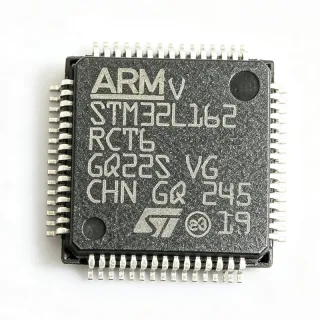
STM32L486RGT6 - ARM Cortex-M4F 80MHz MCU | STMicroelectronics
Teilenummer: STM32L486RGT6 ✓ Aktiv| Menge | Stückpreis | Gesamt |
|---|---|---|
| 1 | $6.3293 | $6,33 |
STM32L486RGT6 Übersicht
What is an ARM Cortex-M4F microcontroller? It is a 32-bit processor core from ARM Holdings that includes a floating-point unit (FPU) for hardware-accelerated single-precision math, and DSP instructions for signal processing. In the system hierarchy, it sits as the central processing unit (CPU) within a microcontroller (MCU), which integrates memory, peripherals, and I/O on a single chip. The Cortex-M4F is widely used in embedded systems where a balance of performance, power efficiency, and cost is required, such as in IoT devices, industrial control, and consumer electronics.
Key features of the STM32L486RGT6 include: 1 Mbyte Flash, 128 Kbytes SRAM, 80 MHz CPU, ultra-low-power modes (down to 100 nA in shutdown), a 12-bit ADC with 5 Msps, a 12-bit DAC, multiple timers, and communication interfaces including USART, SPI, I2C, USB OTG FS, CAN, and SDMMC. It also integrates a hardware cryptographic accelerator (AES, DES, 3DES) and a true random number generator (TRNG) for security applications.
The STM32L486RGT6 is built on ST's ultra-low-power technology, featuring multiple power modes (Sleep, Low-power run, Low-power sleep, Stop 0/1/2, Standby, Shutdown) that allow designers to optimize energy consumption. The device operates from 1.71V to 3.6V supply, making it suitable for battery-powered applications. Its advanced analog peripherals, including op-amps and comparators, enable sensor signal conditioning without external components.
Typical applications include smart meters, medical devices, wearable fitness trackers, industrial sensors, and IoT edge nodes. The combination of low power, high performance, and security features makes it ideal for applications that require long battery life and secure data handling.
When designing with this MCU, pay attention to the power supply decoupling: place a 100 nF capacitor close to each VDD pin and a 4.7 uF bulk capacitor. For low-power modes, configure the clock source and voltage regulator appropriately to achieve the desired current consumption. The STM32L4 series offers a comprehensive set of development tools, including STM32CubeMX and STM32CubeIDE, which simplify configuration and code generation.
Drop-in-Alternativen für STM32L486RGT6 – gleiches Gehäuse, Pin-kompatibel. Bauteile mit anderem Gehäuse, die eine PCB-Überarbeitung erfordern, sind ausgeschlossen.
Varianten dieser Serie
Modelle derselben Serie, die drop-in-kompatibel sind mit STM32L486RGT6 (gleiche Bauform und Footprint) – abweichend in Package, Flash Memory, SRAM, Maximum Clock Frequency, ADC.
Schnellvergleichstool – Wählen Sie Alternativbauteile für den Direktvergleich:
STM32L476RGT6
✅ Drop-In✓ Auf Lager
$3.86 / Stück
Datenblatt ansehen →STM32L496RGT6
✅ Drop-In✓ Auf Lager
$6.5 / Stück
Datenblatt ansehen →STM32L486RGT7
✅ Drop-In ⚠️ Spezifikationen ungeprüft📋 Referenzalternative (nicht im Katalog)
STM32L4R5RGT6
✅ Drop-In ⚠️ Spezifikationen ungeprüft📋 Referenzalternative (nicht im Katalog)
STM32L486RGT6 Grenzwerte & elektrische Eigenschaften
| Core | ARM Cortex-M4F with FPU |
| Maximale Taktfrequenz | 80 MHz |
| Flash Memory | 1 Mbyte |
| SRAM | 128 Kbytes |
| Supply Voltage Range | 1.71 V to 3.6 V |
| Betriebstemperaturbereich | -40C to +85C |
| Gehäuse | LQFP-64 |
| Montageart | Surface Mount |
| Number of I/O Pins | 51 |
| ADC Resolution | 12-bit |
| ADC Sample Rate | 5 Msps |
| DAC Resolution | 12-bit |
| Communication Interfaces | USART, SPI, I2C, USB OTG FS, CAN, SDMMC |
| Security Features | AES, DES, 3DES, TRNG |
| RoHS-Status | Compliant |
STM32L486RGT6 Pin-Konfiguration
| Pin 1 | VBAT — Battery backup supply for RTC and backup registers |
| Pin 2 | PC13 — GPIO, tamper, RTC output |
| Pin 3 | PC14 — GPIO, OSC32_IN |
| Pin 4 | PC15 — GPIO, OSC32_OUT |
| Pin 5 | PF0 — GPIO, OSC_IN |
| Pin 6 | PF1 — GPIO, OSC_OUT |
| Pin 7 | NRST — Reset (active low) |
| Pin 8 | VSSA — Analog ground |
| Pin 9 | VDDA — Analog power supply |
| Pin 10 | PA0 — GPIO, ADC, DAC, TIM2_CH1 |
| Pin 11 | PA1 — GPIO, ADC, DAC, TIM2_CH2 |
| Pin 12 | PA2 — GPIO, ADC, USART2_TX, TIM2_CH3 |
| Pin 13 | PA3 — GPIO, ADC, USART2_RX, TIM2_CH4 |
| Pin 14 | VSS — Ground |
| Pin 15 | VDD — Power supply |
| Pin 16 | PA4 — GPIO, DAC, SPI1_NSS |
| Pin 17 | PA5 — GPIO, DAC, SPI1_SCK |
| Pin 18 | PA6 — GPIO, SPI1_MISO, TIM3_CH1 |
| Pin 19 | PA7 — GPIO, SPI1_MOSI, TIM3_CH2 |
| Pin 20 | PC4 — GPIO, ADC, I2S1_MCK |
Typische Anwendungen
STM32L486RGT6 ist geeignet für 6 Anwendungs: IoT Edge Nodes, Wearable Fitness Trackers, Smart Meters, Medical Devices, Industrial Sensors, Audio Processing.
IoT Edge Nodes
The STM32L486RGT6 is ideal for IoT edge nodes that require low power consumption, secure communication, and sensor data processing. Its ultra-low-power modes (down to 100 nA in shutdown) extend battery life, while the hardware crypto accelerator (AES, DES, 3DES) ensures secure data transmission. The 80 MHz Cortex-M4F core with FPU handles sensor fusion algorithms efficiently. In a typical IoT node, the MCU interfaces with sensors via I2C or SPI, processes data locally, and communicates via Wi-Fi or LoRa modules using USART or SPI. The 12-bit ADC at 5 Msps captures high-resolution sensor readings, and the multiple timers generate precise sampling intervals. Power consumption is optimized by using Stop mode between measurements, waking up on external interrupts. Compared to higher-performance MCUs, the L486 offers a balance of performance and power, making it suitable for battery-powered devices that need to operate for years on a single coin cell.
Empfohlen
Wearable Fitness Trackers
The STM32L486RGT6 is well-suited for wearable fitness trackers due to its ultra-low-power operation and integrated security features. The MCU can run heart rate monitoring algorithms using the Cortex-M4F FPU, while the 12-bit ADC samples photoplethysmography (PPG) sensors. The device's small LQFP-64 package and wide supply voltage range (1.71V-3.6V) allow direct connection to a Li-Po battery. In a typical tracker, the MCU collects accelerometer and heart rate data, processes steps and calories, and communicates via Bluetooth Low Energy (BLE) using a separate module. The low-power modes enable the device to run for weeks on a small battery. The hardware crypto accelerator secures user data, and the TRNG generates unique identifiers for authentication. Compared to using a separate MCU and security chip, the L486 integrates both, reducing BOM cost and board space.
Empfohlen
Smart Meters
The STM32L486RGT6 is an excellent choice for smart meters (electricity, water, gas) due to its low power consumption, security features, and multiple communication interfaces. The MCU can measure energy consumption using the 12-bit ADC and compute billing data with the FPU. The hardware crypto accelerator ensures secure communication with the utility provider, and the TRNG generates encryption keys. In a smart meter, the MCU reads current and voltage sensors, calculates power, and periodically transmits data via PLC (power line communication) or RF modules. The low-power modes allow the meter to operate on a battery for years, especially in gas and water meters. The wide operating temperature range (-40C to +85C) ensures reliable operation in outdoor environments. Compared to other MCUs, the L486 offers a unique combination of low power, security, and analog integration, making it a cost-effective solution for smart metering.
Empfohlen
Medical Devices
The STM32L486RGT6 is suitable for portable medical devices such as glucose monitors, pulse oximeters, and drug delivery pumps. Its ultra-low-power operation extends battery life, and the security features protect patient data. The 12-bit ADC with 5 Msps sample rate captures high-resolution biosignals, while the op-amps and comparators condition sensor signals without external components. In a glucose monitor, the MCU reads the sensor current, converts it to glucose concentration, and displays the result on an LCD. The device can store historical data in Flash and communicate via USB or BLE. The hardware crypto accelerator ensures secure data transfer to a smartphone app. The MCU's small package and low power consumption enable compact, wearable designs. Compared to using a general-purpose MCU, the L486's integrated analog and security features reduce component count and design complexity.
Empfohlen
Industrial Sensors
The STM32L486RGT6 is ideal for industrial sensors that require reliable operation in harsh environments, low power consumption, and secure communication. The MCU's wide temperature range (-40C to +85C) and robust design make it suitable for factory automation and process control. The 12-bit ADC and multiple timers enable precise sensor data acquisition and control. In a typical industrial sensor, the MCU reads temperature, pressure, or flow sensors, processes the data, and transmits it via CAN or RS-485. The hardware crypto accelerator secures communication in critical infrastructure. The low-power modes allow battery-powered wireless sensors to operate for years. Compared to other MCUs, the L486 offers a good balance of performance, power, and security, making it a versatile choice for industrial IoT applications.
Empfohlen
Audio Processing
The STM32L486RGT6 can be used for audio processing applications such as voice-controlled devices, audio recorders, and active noise cancellation. The Cortex-M4F core with FPU and DSP instructions enables real-time audio algorithms like filtering and FFT. The 12-bit DAC can output analog audio, and the I2S interface connects to external audio codecs. In a voice-controlled device, the MCU captures audio via a microphone, performs keyword spotting, and communicates with a cloud service via Wi-Fi. The low-power modes allow always-on listening with minimal power consumption. The hardware crypto accelerator secures voice data transmission. Compared to using a dedicated DSP, the L486 integrates the core, memory, and peripherals, reducing cost and complexity. The 80 MHz clock is sufficient for many audio applications, though more demanding tasks may require a higher-performance MCU.
Empfohlen
Zusammenfassung der empfohlenen Produkte
Technische Referenzdaten für STM32L486RGT6 – Vergleich, Designhinweise und Compliance-Informationen.
Auswahlhilfe
Vergleich mit Alternativen
| Parameter | Dieses Produkt | STM32L476RGT6 | STM32L496RGT6 | STM32L486RGT7 | STM32L4R5RGT6 | LPC54608J512BD208 |
|---|---|---|---|---|---|---|
| Package | LQFP-64 | LQFP-64 | LQFP-64 | LQFP-64 | LQFP-64 | LQFP-208 |
| Brand | STMicroelectronics | STMicroelectronics | STMicroelectronics | STMicroelectronics | STMicroelectronics | NXP Semiconductors |
| Core | ARM Cortex-M4F | ARM Cortex-M4F | ARM Cortex-M4F | ARM Cortex-M4F | ARM Cortex-M4F | ARM Cortex-M4F |
| Max Clock Frequency | 80 MHz | 80 MHz | 120 MHz | 80 MHz | 120 MHz | 180 MHz |
| Flash Memory | 1 Mbyte | 1 Mbyte | 1 Mbyte | 1 Mbyte | 1 Mbyte | 512 Kbytes |
| SRAM | 128 Kbytes | 128 Kbytes | 320 Kbytes | 128 Kbytes | 640 Kbytes | 200 Kbytes |
| Hardware Crypto | Yes (AES, DES, 3DES) | No | Yes (AES, DES, 3DES) | Yes (AES, DES, 3DES) | Yes (AES, DES, 3DES) | Yes (AES) |
| Supply Voltage Range | 1.71V - 3.6V | 1.71V - 3.6V | 1.71V - 3.6V | 1.71V - 3.6V | 1.71V - 3.6V | 1.71V - 3.6V |
Wichtigste Unterscheidungsmerkmale
- Integrated hardware crypto accelerator (AES, DES, 3DES) and TRNG (vs. STM32L476RGT6)
- Ultra-low-power modes with 100 nA shutdown current (vs. STM32L496RGT6)
- Pin-compatible with STM32L4 family (L476, L496, L4R5) (vs. LPC54608J512BD208)
Designhinweise
For ultra-low-power operation, use the appropriate low-power mode. In Stop 2 mode, the MCU consumes about 1.1 uA with RTC running. Ensure that all unused GPIOs are configured as analog or pull-down to avoid floating inputs that increase leakage. Use the internal LDO in low-power mode for optimal efficiency.
Place a 100 nF decoupling capacitor close to each VDD pin and a 4.7 uF bulk capacitor on the main supply. For the VDDA pin, use a 1 uF capacitor and a ferrite bead to isolate analog noise. Keep the ground plane continuous under the MCU to minimize EMI.
When using the ADC, ensure the sampling time is sufficient for the source impedance. For high-impedance sensors, add a buffer amplifier or increase sampling time. Also, avoid exceeding the absolute maximum ratings on any pin, especially during power-up and power-down sequences.
Compliance-Informationen
RoHS and REACH compliant per STMicroelectronics product page. Not AEC-Q100 qualified (not intended for automotive).