CI de interfaz
Subcategorías
Productos (1568)
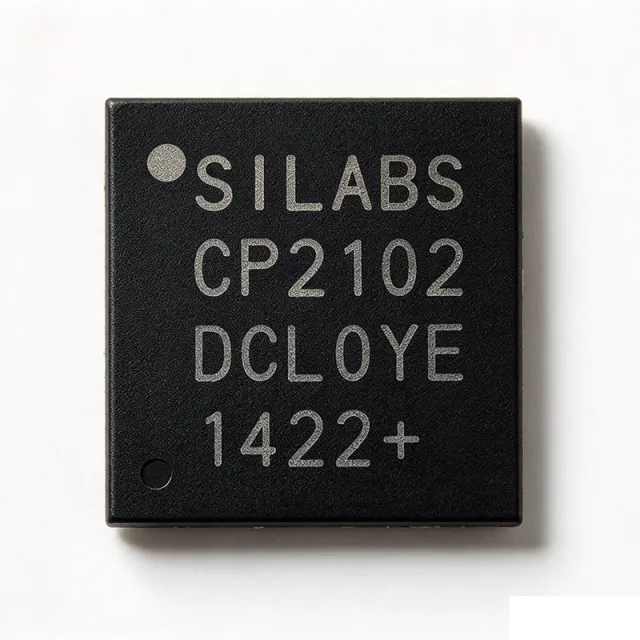
CP2102-GMR - USB-to-UART Bridge, QFN-28 | Silicon Laboratories (Tape & Reel)
The Silicon Laboratories CP2102-GMR is a highly integrated USB-to-UART Bridge Controller that provides a compact solution for migrating RS-232 designs to USB using a minimum of components and PCB area, packaged in a 5x5 mm 28-pin QFN (QFN-28) with exposed thermal pad. The device integrates a USB 2.0 full-speed function controller, USB transceiver, on-chip oscillator, internal EEPROM, and an asynchronous serial data bus (UART) with full modem control signals, eliminating the need for external USB components. A USB-to-UART bridge controller is a type of bridge IC that sits between a USB host and a legacy UART peripheral, translating USB protocol packets into asynchronous serial bytes and vice versa. In the broader taxonomy, the CP2102-GMR belongs to interface ICs (USB bridge controllers), which are a sub-category of communication interface semiconductors that enable protocol translation between modern serial buses and legacy parallel/asynchronous interfaces used in microcontrollers, sensors, and embedded modems. Key features include a 3.0 V to 3.6 V single supply operation, integrated 3.3 V LDO voltage regulator, support for data rates from 300 baud up to 921.6 kbaud, and full modem control signals (RTS, CTS, DTR, DSR, DCD, RI). The internal 1024-byte EEPROM stores customizable product ID, vendor ID, serial number, and GPIO configuration, while royalty-free virtual COM port (VCP) drivers are provided for Windows, macOS, and Linux hosts. The device's architecture combines a USB 2.0 full-speed PHY, an 8051-compatible microcontroller core running the on-chip firmware, and a hardware UART block, with all clock generation handled internally. This integration removes the need for an external crystal, oscillator, or USB termination resistors, dramatically simplifying USB-enabling of legacy microcontroller designs where BOM count is critical. Typical applications include microcontroller-to-USB connectivity on evaluation boards and development kits, industrial point-of-sale terminals, USB dongles for legacy serial equipment, GPS module interfaces, and embedded debug/programming ports. The compact QFN-28 package suits space-constrained PCB layouts where a through-hole DB-9 connector would be impractical. When designing with the CP2102-GMR, follow the bus-powered vs self-powered connection diagrams in the Silicon Labs datasheet, since the USB VBUS pin must be routed through a voltage divider when the device is self-powered. Suspend current can be as low as 100 uA, allowing the design to meet USB suspend-current requirements without additional power switching. This page synthesizes distributor pricing, drop-in pin-compatible alternatives, and practical design notes that go beyond what is found in the manufacturer datasheet alone.

CP2102N-A01-GQFN20 USB 2.0 UART Bridge | Silicon Labs
The Silicon Labs CP2102N-A01-GQFN20 is a USB 2.0 full-speed USB-to-UART bridge IC with four digital I/O pins, an integrated USB transceiver, oscillator, and UART, housed in a 20-QFN package measuring 3 mm by 3 mm. According to the Silicon Labs CP2102N data sheet, the device supports a 3 V to 3.6 V supply range and provides an integrated 3.3 V regulator output for compatible USB power designs. A USB-to-UART bridge is an interface controller that converts between USB connectivity and asynchronous serial data. It belongs to the broader hierarchy of interface ICs, USB controllers, USB interface bridges, and data-conversion semiconductors. This device is intended to simplify RS-232-to-USB modernization, firmware-free USB enumeration, and embedded serial connectivity by integrating the required USB and UART functions in one compact component. The CP2102N-A01-GQFN20 combines a USB 2.0 full-speed function controller, USB transceiver, integrated clock, UART, programmable vendor and product identification, serial-number support, and four digital I/O pins. According to the manufacturer data sheet, no external USB components are required for development, and an internal 960-byte programmable ROM stores device identification and descriptor information. The compact package helps reduce board area in space-constrained USB-to-serial designs. The integrated clock removes the need for an external crystal in the referenced USB design application, while the integrated transceiver supports direct USB connectivity. The four digital I/O pins provide additional control or status functions beyond the primary USB and UART interfaces. This integration is valuable when a design needs a small USB-to-UART bridge without implementing USB protocol firmware. Typical applications include industrial control equipment, test and measurement instruments, data loggers, configuration interfaces, serial adapters, embedded development boards, and legacy RS-232 systems converted to USB. The 3 mm by 3 mm package is particularly useful where connector placement and board area are constrained. When designing a board, route USB differential pairs as a controlled-impedance pair and keep the connector, protection components, and transceiver path physically compact. Confirm the exact package pinout and exposed-pad connection in the Silicon Labs data sheet before layout release. Commercial pricing and availability should be checked against distributor records as of 2026-10-22. This page consolidates manufacturer specifications, verified distributor references, cross-reference findings, and practical design considerations for engineers evaluating the CP2102N-A01-GQFN20 USB-to-UART bridge.

CP2102N-A01-GQFN24 USB-to-UART Bridge | Silicon Labs
The Silicon Labs CP2102N-A01-GQFN24 is a USB 2.0 full-speed to UART interface bridge with four GPIOs and separate VDD and VIO pins, housed in a 24-QFN package measuring 4 mm by 4 mm. Designed as part of the USBXpress family, it adds USB connectivity to embedded products without requiring a separate USB transceiver, oscillator, or host-side firmware. The bridge combines a USB controller, USB transceiver, internal oscillator, UART, and four general-purpose I/O functions to reduce board size and design effort. A USB-to-UART bridge is an interface IC that connects a USB host to a serial UART peripheral while handling USB packetization, enumeration, control transfers, and serial data transmission. This device is useful when an existing embedded design needs a compact USB-to-serial path for firmware updates, configuration, diagnostics, logging, or manufacturing test. Its position in the hierarchy is USB interface bridge, then USB-to-UART interface IC, then broader interface IC and semiconductor. The verified ordering information identifies four GPIOs, separate VDD and VIO pins, and a -40 °C to +85 °C temperature range. The package is QFN24, and the product is specified for a 3 V to 3.6 V supply according to the available distributor and datasheet data. The separate VDD and VIO arrangement allows the USB and UART sides to use independently selected supply domains when the host circuit requires voltage-domain flexibility. The four GPIOs add simple control or status functions beyond basic UART communication. Typical uses include industrial control equipment, USB-to-RS-232 design updates, serial adapters, embedded development boards, programmable controllers, and factory test equipment. Because the CP2102N integrates the USB function controller, transceiver, oscillator, and UART, the circuit can be designed with fewer external USB components than a discrete USB implementation. The manufacturer datasheet should be consulted for the exact pin names, exposed-pad connection, capacitor values, voltage sequencing, and USB routing requirements. For PCB implementation, place the device close to the USB connector and maintain short, controlled-impedance USB differential traces. Decouple each applicable supply domain near its pins and follow the datasheet’s recommended footprint and exposed-pad thermal design. Confirm host-driver support, UART voltage levels, cable orientation, and regulatory requirements before releasing a production design. This page combines the verified manufacturer and distributor data with same-package replacement research, application guidance, comparison parameters, and practical implementation notes. It does not infer undocumented specifications or treat functionally similar bridges as pin-compatible replacements.

CP2102N-A01-GQFN28 - USB to UART Bridge QFN-28 | Silicon Labs (Tape & Reel)
The Silicon Labs CP2102N-A01-GQFN28 is a USB-to-UART bridge controller from the USBXpress family, providing a single-chip solution for adding USB 2.0 full-speed connectivity to UART peripherals. The device integrates a USB 2.0 full-speed function controller, USB transceiver, on-chip oscillator, and an internal 3.3V LDO regulator in a 28-pin QFN (5x5 mm) package with USB 2.0 UART interface support. A USB-to-UART bridge is a class of protocol converter IC that translates USB signaling into asynchronous serial (UART) signaling, allowing legacy RS-232/RS-485 devices, microcontroller debug ports, and sensor nodes to communicate with a host PC over the USB bus without writing USB firmware. Bridges like the CP2102N live in the hierarchy: USB bridge IC -> interface IC -> connectivity IC -> mixed-signal semiconductor. They are a faster, lower-risk alternative to embedding a USB stack in firmware, and they typically enumerate as a Virtual COM Port (VCP) so existing serial-terminal software works unmodified. The CP2102N-A01 delivers USB 2.0 full-speed (12 Mbps) signaling, supports data rates from 300 baud to 1 Mbaud, integrates a 3.3V LDO with enough headroom to source 100 mA on VIO, and provides GPIO pins plus a hardware reset input (RSTb). The on-chip oscillator and internal voltage regulator remove the need for an external crystal and an external 3.3V rail when the host port supplies 5V bus power. These features let a designer replace a discrete USB-UART implementation with one 5x5 mm QFN. Under the hood, the CP2102N uses a hard-wired USB function-state machine and a programmable baud-rate generator rather than a soft USB stack, which means there is no firmware to maintain on the device itself. The host-side driver (Silicon Labs CP210x VCP) supplies the COM-port abstraction, while the silicon handles NRZI encoding, bit stuffing, packet ACK/NAK, and suspend/resume power management. Typical applications include microcontroller debug and programming adapters (especially for ARM Cortex-M and AVR parts without native USB), industrial sensor-to-USB bridges, point-of-sale terminals, USB dongles for wireless modules, and field-upgrade serial console ports on embedded Linux systems. The wide baud-rate range also supports legacy RS-232 equipment running at non-standard rates. When designing with the CP2102N-A01-GQFN28, observe the bus-powered voltage-divider requirement documented in Silicon Labs AN976: a resistor divider on VBUS is required to bring the 5V supply within the device's absolute-maximum rating. Use the CP210x VCP driver on the host, and respect the 6-byte internal EEPROM signature if you intend to customize USB descriptors (VID/PID/strings). This page synthesizes distributor pricing, drop-in QFN-28 alternatives from both Silicon Labs and competitors, and practical design notes that go beyond the bare datasheet summary.
CP2102N-A01-GQFN28R - USB to UART Bridge QFN-28 | Silicon Labs
The Silicon Labs CP2102N-A01-GQFN28R is a USB-to-UART bridge controller from the USBXpress family, providing a single-chip solution for adding USB 2.0 full-speed connectivity to UART peripherals. The device integrates a USB 2.0 full-speed function controller, USB transceiver, on-chip oscillator, and an internal 3.3V LDO regulator in a 28-pin QFN (5x5 mm) package with USB 2.0 UART interface support. A USB-to-UART bridge is a class of protocol converter IC that translates USB signaling into asynchronous serial (UART) signaling, allowing legacy RS-232/RS-485 devices, microcontroller debug ports, and sensor nodes to communicate with a host PC over the USB bus without writing USB firmware. Bridges like the CP2102N live in the hierarchy: USB bridge IC -> interface IC -> connectivity IC -> mixed-signal semiconductor. They are a faster, lower-risk alternative to embedding a USB stack in firmware, and they typically enumerate as a Virtual COM Port (VCP) so existing serial-terminal software works unmodified. The CP2102N-A01 delivers USB 2.0 full-speed (12 Mbps) signaling, supports data rates from 300 baud to 1 Mbaud, integrates a 3.3V LDO with enough headroom to source 100 mA on VIO, and provides GPIO pins plus a hardware reset input (RSTb). The on-chip oscillator and internal voltage regulator remove the need for an external crystal and an external 3.3V rail when the host port supplies 5V bus power. These features let a designer replace a discrete USB-UART implementation with one 5x5 mm QFN. Under the hood, the CP2102N uses a hard-wired USB function-state machine and a programmable baud-rate generator rather than a soft USB stack, which means there is no firmware to maintain on the device itself. The host-side driver (Silicon Labs CP210x VCP) supplies the COM-port abstraction, while the silicon handles NRZI encoding, bit stuffing, packet ACK/NAK, and suspend/resume power management. Typical applications include microcontroller debug and programming adapters (especially for ARM Cortex-M and AVR parts without native USB), industrial sensor-to-USB bridges, point-of-sale terminals, USB dongles for wireless modules, and field-upgrade serial console ports on embedded Linux systems. The wide baud-rate range also supports legacy RS-232 equipment running at non-standard rates. When designing with the CP2102N-A01-GQFN28R, observe the bus-powered voltage-divider requirement documented in Silicon Labs AN976: a resistor divider on VBUS is required to bring the 5V supply within the device's absolute-maximum rating. Use the CP210x VCP driver on the host, and respect the 6-byte internal EEPROM signature if you intend to customize USB descriptors (VID/PID/strings). This page synthesizes distributor pricing, drop-in QFN-28 alternatives from both Silicon Labs and competitors, and practical design notes that go beyond the bare datasheet summary.
CP2102N-A02-GQFN20 - USB to UART Bridge, QFN-20 | Silicon Labs
The Silicon Labs CP2102N-A02-GQFN20 is a highly integrated USB-to-UART bridge controller in the USBXpress family, packaged in a 20-pin QFN (3x3 mm) with built-in USB 2.0 full-speed function controller, on-chip transceiver, internal oscillator, and Universal Asynchronous Receiver/Transmitter operating from 3.0 V to 3.6 V supply. A USB-to-UART bridge, also called a USB interface IC or USB-serial converter, is a class of mixed-signal device that converts a USB physical layer (USB 2.0 full-speed) into an asynchronous serial interface. It sits in the broader hierarchy of interface ICs (bridge ICs -> protocol converters -> connectivity ICs -> semiconductors) and replaces legacy RS-232 transceivers with a single-chip, driver-supported solution requiring no external USB components. The bridge transparently handles USB enumeration, bulk transfer, and UART signaling so the host MCU firmware can treat the link as a simple COM port or /dev/tty device. Key features of the CP2102N-A02-GQFN20 include four configurable GPIO pins, a battery charger detect function for portable designs, support for data formats from 5 to 8 data bits with or without parity, hardware and software flow control (RTS/CTS, XON/XOFF), and a 1024-byte buffer for high-throughput UART operation. The integrated 3.3 V LDO regulator, on-chip oscillator, and internal pull-up resistors eliminate the need for most external components, shrinking the BOM to a few decoupling capacitors plus optional ESD protection. The architecture is built around a USB 2.0 full-speed (12 Mbps) SIE, an internal 48 MHz oscillator, ROM-based firmware accessed via the Virtual COM Port (VCP) driver or USBXpress direct API, and a flexible UART block with independent TX/R FIFOs. The A02 revision is the recommended replacement for the older A01 revision and is pin-compatible with A01-GQFN20 footprints. The compact 3x3 mm QFN package and minimal external part count make it ideal for space-constrained USB Type-C dongles, embedded debug headers, and industrial sensor interfaces. Typical applications include USB-to-UART debug consoles on MCU development boards, industrial point-of-sale terminals, portable medical USB instrument front-ends, IoT gateways, and field-upgradable firmware service ports. The integrated driver support for Windows, macOS, and Linux VCP modes, combined with Silicon Labs' USBXpress host libraries, accelerates time-to-market for designs that previously required custom USB stacks. When designing with this part, place the 4.7uF VBUS decoupling and 100 nF VDD bypass capacitors as close to the IC pins as possible to meet USB 2.0 signal-integrity requirements. The D+ line typically requires a 1.5 kOhm pull-up to 3.3 V for full-speed device detection, and an external 10 kOhm pull-down on TXD is required for Send-Break signaling.
CP2102N-A02-GQFN20R - USB to UART Bridge, QFN-20 | Silicon Labs (Tape & Reel)
The Silicon Labs CP2102N-A02-GQFN20R is a highly integrated USB-to-UART bridge controller in the USBXpress family, packaged in a 20-pin QFN (3x3 mm) with built-in USB 2.0 full-speed function controller, on-chip transceiver, internal oscillator, and Universal Asynchronous Receiver/Transmitter operating from 3.0 V to 3.6 V supply. A USB-to-UART bridge, also called a USB interface IC or USB-serial converter, is a class of mixed-signal device that converts a USB physical layer (USB 2.0 full-speed) into an asynchronous serial interface. It sits in the broader hierarchy of interface ICs (bridge ICs -> protocol converters -> connectivity ICs -> semiconductors) and replaces legacy RS-232 transceivers with a single-chip, driver-supported solution requiring no external USB components. The bridge transparently handles USB enumeration, bulk transfer, and UART signaling so the host MCU firmware can treat the link as a simple COM port or /dev/tty device. Key features of the CP2102N-A02-GQFN20R include four configurable GPIO pins, a battery charger detect function for portable designs, support for data formats from 5 to 8 data bits with or without parity, hardware and software flow control (RTS/CTS, XON/XOFF), and a 1024-byte buffer for high-throughput UART operation. The integrated 3.3 V LDO regulator, on-chip oscillator, and internal pull-up resistors eliminate the need for most external components, shrinking the BOM to a few decoupling capacitors plus optional ESD protection. The architecture is built around a USB 2.0 full-speed (12 Mbps) SIE, an internal 48 MHz oscillator, ROM-based firmware accessed via the Virtual COM Port (VCP) driver or USBXpress direct API, and a flexible UART block with independent TX/R FIFOs. The A02 revision is the recommended replacement for the older A01 revision and is pin-compatible with A01-GQFN20 footprints. The compact 3x3 mm QFN package and minimal external part count make it ideal for space-constrained USB Type-C dongles, embedded debug headers, and industrial sensor interfaces. Typical applications include USB-to-UART debug consoles on MCU development boards, industrial point-of-sale terminals, portable medical USB instrument front-ends, IoT gateways, and field-upgradable firmware service ports. The integrated driver support for Windows, macOS, and Linux VCP modes, combined with Silicon Labs' USBXpress host libraries, accelerates time-to-market for designs that previously required custom USB stacks. When designing with this part, place the 4.7uF VBUS decoupling and 100 nF VDD bypass capacitors as close to the IC pins as possible to meet USB 2.0 signal-integrity requirements. The D+ line typically requires a 1.5 kOhm pull-up to 3.3 V for full-speed device detection, and an external 10 kOhm pull-down on TXD is required for Send-Break signaling.
CP2102N-A02-GQFN24 USB-UART Bridge | Silicon Labs
The Silicon Labs CP2102N-A02-GQFN24 is a USB 2.0 full-speed to UART interface bridge in a 24-QFN 4 mm by 4 mm package, integrating four digital I/O pins. It supports a 3 V to 3.6 V operating-supply range and is designed to add USB connectivity without requiring a separate USB transceiver, oscillator, or UART controller. A USB-to-UART bridge, also called a USB serial interface adapter or interface bridge, converts a USB host connection into a conventional asynchronous serial data path. Within the semiconductor hierarchy, it belongs to interface ICs and system-interface controllers. This device is part of Silicon Labs' USBXpress family and is intended to reduce firmware complexity, external component count, and development time when replacing an RS-232 design with USB. The CP2102N combines a USB 2.0 full-speed function controller, USB transceiver, oscillator, UART, and four digital I/O pins. USBXpress firmware support allows the host software to present a logical serial port while the bridge handles the USB-to-UART conversion. The 24-QFN package supports compact industrial, embedded, communications, and legacy-equipment designs where board area and USB integration are important. The four digital I/O pins provide additional control or status connections beyond the serial interface. Their exact electrical limits, supported logic levels, and application-specific usage must be taken from the manufacturer datasheet rather than inferred from the package description. Likewise, UART baud-rate limits, transceiver current, and clock requirements are not quantified in the supplied search data and are marked for data completion where applicable. Typical uses include USB-to-UART service ports, embedded debug adapters, industrial controllers, data-acquisition equipment, and update interfaces for existing serial products. The integrated USB 2.0 full-speed controller and internal oscillator reduce the number of external interface components compared with a discrete USB implementation. PCB layout should follow the manufacturer's recommended USB trace and decoupling guidance. Keep the USB differential pair short, controlled, and routed away from noisy analog or switching nodes; place required bypass capacitors close to the supply pins; and verify the exposed-pad or thermal arrangement against the package drawing before release to fabrication. This product-data synthesis combines the verified manufacturer and distributor links, package identity, interface hierarchy, and porting information with practical implementation guidance. It does not invent undocumented electrical limits or cross-brand substitutes that cannot be proven pin-to-pin compatible.
CP2102N-A02-GQFN28 USB-to-UART Bridge, QFN28 | Silicon Labs
The Silicon Labs CP2102N-A02-GQFN28 is a single-chip USB-to-UART bridge controller in the USBXpress family, housed in a 28-pin QFN (5x5 mm) package. It integrates a USB 2.0 full-speed function controller, USB transceiver, internal 48 MHz oscillator, voltage regulator (3.3 V output), one-time-programmable ROM for vendor/product descriptors, and a UART engine, while requiring no external USB resistors or crystal. The CP2102N-A02 revision supplies 3 V to 3.6 V on VDD and supports programmable baud rates up to 3 Mbaud with hardware flow control. A USB-to-UART bridge is a class of interface IC that converts USB signaling on the host side to asynchronous serial (UART) signaling on the device side, eliminating the need for firmware-side USB stack development. Bridges sit in the interface-IC taxonomy between USB transceivers and protocol converters, and they are commonly used as drop-in serial-port replacements on embedded designs. Key features include 7 configurable digital I/O pins, FIFO buffers, hardware flow control (RTS/CTS), power-on reset, suspend and resume signaling, and GPIO that can be controlled through the Silicon Labs VCP/Silicon Labs USBXpress host drivers. The integrated 3.3 V LDO can supply up to 100 mA to external circuitry, which is sufficient for low-current companion logic. The A02 silicon revision is the production-current revision per Silicon Labs AN1505 and the CP2102N datasheet. Architecturally, the device combines an on-chip USB 2.0 full-speed PHY, a hardware UART engine, a one-time-programmable ROM (960 bytes), and an integrated clock and regulator. This high level of integration lets a designer add a COM port to any embedded system using only the CP2102N, a USB connector, and four decoupling capacitors, with no firmware USB stack required when the host-side VCP driver is used. Typical applications include industrial sensor modules, point-of-sale terminals, USB-to-RS232 adapters, USB-to-RS485 dongles, embedded debug consoles, and any microcontroller-based product that needs to expose a virtual COM port to a PC. Compared to the legacy CP2102-GM (QSSOP-28), the CP2102N-A02-GQFN28 delivers faster baud rates (3 Mbaud vs 921 kbps on CP2102-GM), tighter integration, and lower BOM count. Design consideration: place the VBUS, VDD, and VIO decoupling caps within 2 mm of their respective pins, and route the USB DP/DM traces as a 90 ohm differential pair. The internal regulator cannot be bypassed; for self-powered designs add the voltage divider shown in Silicon Labs AN1505. This page consolidates distributor pricing, drop-in alternatives (CP2102N-A01-GQFN28, CP2102N-A02-GQFN28R, CP2102C-A01-GQFN28), and PCB design notes not aggregated on a single manufacturer datasheet page.
CP2102N-A02-GQFN28R USB-to-UART Bridge, QFN28 | Silicon Labs (Tape & Reel)
The Silicon Labs CP2102N-A02-GQFN28R is a single-chip USB-to-UART bridge controller in the USBXpress family, housed in a 28-pin QFN (5x5 mm) package. It integrates a USB 2.0 full-speed function controller, USB transceiver, internal 48 MHz oscillator, voltage regulator (3.3 V output), one-time-programmable ROM for vendor/product descriptors, and a UART engine, while requiring no external USB resistors or crystal. The CP2102N-A02 revision supplies 3 V to 3.6 V on VDD and supports programmable baud rates up to 3 Mbaud with hardware flow control. A USB-to-UART bridge is a class of interface IC that converts USB signaling on the host side to asynchronous serial (UART) signaling on the device side, eliminating the need for firmware-side USB stack development. Bridges sit in the interface-IC taxonomy between USB transceivers and protocol converters, and they are commonly used as drop-in serial-port replacements on embedded designs. Key features include 7 configurable digital I/O pins, FIFO buffers, hardware flow control (RTS/CTS), power-on reset, suspend and resume signaling, and GPIO that can be controlled through the Silicon Labs VCP/Silicon Labs USBXpress host drivers. The integrated 3.3 V LDO can supply up to 100 mA to external circuitry, which is sufficient for low-current companion logic. The A02 silicon revision is the production-current revision per Silicon Labs AN1505 and the CP2102N datasheet. Architecturally, the device combines an on-chip USB 2.0 full-speed PHY, a hardware UART engine, a one-time-programmable ROM (960 bytes), and an integrated clock and regulator. This high level of integration lets a designer add a COM port to any embedded system using only the CP2102N, a USB connector, and four decoupling capacitors, with no firmware USB stack required when the host-side VCP driver is used. Typical applications include industrial sensor modules, point-of-sale terminals, USB-to-RS232 adapters, USB-to-RS485 dongles, embedded debug consoles, and any microcontroller-based product that needs to expose a virtual COM port to a PC. Compared to the legacy CP2102-GM (QSSOP-28), the CP2102N-A02-GQFN28R delivers faster baud rates (3 Mbaud vs 921 kbps on CP2102-GM), tighter integration, and lower BOM count. Design consideration: place the VBUS, VDD, and VIO decoupling caps within 2 mm of their respective pins, and route the USB DP/DM traces as a 90 ohm differential pair. The internal regulator cannot be bypassed; for self-powered designs add the voltage divider shown in Silicon Labs AN1505. This page consolidates distributor pricing, drop-in alternatives (CP2102N-A01-GQFN28, CP2102N-A02-GQFN28RR, CP2102C-A01-GQFN28), and PCB design notes not aggregated on a single manufacturer datasheet page.
CP2103-GM USB 2.0 to UART Bridge | Silicon Labs
The Silicon Labs CP2103-GM is an integrated USB 2.0-to-UART bridge controller with a 28-QFN 5 mm × 5 mm package and a stated operating voltage of 1.8 V to 3.6 V. It provides a compact interface for connecting legacy RS-232 or RS-485 equipment to a USB host while minimizing external components and PCB space. The device combines USB transceiver, UART bridge, clock, and programmable USB interface functions on one chip. According to the available manufacturer-linked documentation and distributor records, it supports USB-to-UART data transfer and is designed for upgrading existing serial-port designs to USB. A USB-to-UART bridge controller is a class of USB interface controller that translates USB host transactions into a conventional UART serial stream. In the product hierarchy, CP2103-GM belongs to the USB interface-controller and USB-to-UART bridge category, which sits within broader interface semiconductors and embedded connectivity solutions. Its value is especially relevant when a modern computer has no native RS-232 port but an instrument, industrial controller, service tool, or data-acquisition product still exposes a serial interface. Available verified data identifies the CP2103-GM as a 28-QFN USB bridge with USB 2.0 and UART interfaces. Search results also describe an integrated USB transceiver, integrated clock, and an integrated 1024-byte EEPROM for identifiers and device information. These features can reduce the number of discrete USB-interface components required in a design. The integrated clock is especially useful because it eliminates the need for an external crystal in applications that do not require a different clocking arrangement. The device is suitable for RS-232 and RS-485 modernization, USB-to-serial adapters, test equipment, programming interfaces, and embedded data links. RS-232 designs generally need appropriate line-level voltage handling, while RS-485 designs require a compatible transceiver and termination strategy; CP2103-GM alone is not a complete external RS-232 or RS-485 physical-layer solution. The host-side USB connection, UART signal integrity, voltage levels, grounding, and firmware support should therefore be validated together. Designers should verify the exact pinout, electrical limits, clocking configuration, USB enumeration behavior, and supported operating voltage from the manufacturer datasheet before layout or firmware release. A compact QFN footprint helps reduce board area, but exposed-pad thermal management and careful USB differential-pair routing remain important. Firmware should also handle the device identifier and serial-number configuration appropriate to the intended production process. This page combines verified distributor metadata, manufacturer-linked documentation references, and engineering guidance focused on USB-to-UART integration. It does not invent missing electrical limits, package dimensions, or alternative-device specifications; unavailable values are marked in the specification section for follow-up against the manufacturer datasheet.
CP2103-GMR USB 2.0 to UART Bridge | Silicon Labs
The Silicon Labs CP2103-GMR is a USB 2.0-to-UART bridge controller with four digital I/O pins, an integrated 1024-byte EEPROM, and royalty-free drivers in a 28-pin QFN package measuring 5 x 5 mm. It converts between a USB host connection and an asynchronous serial data bus while supporting 3 V to 3.6 V operation. The CP2103-GMR is designed for compact embedded systems that need USB connectivity without implementing a USB protocol stack in the host or target controller. A USB-to-UART bridge is an interface IC that integrates USB device control, USB transceiver functions, and an asynchronous UART interface into one component. The USB side connects the equipment to a computer or other USB host, while the UART side provides a conventional serial channel for embedded firmware, bootloaders, configuration tools, and diagnostic interfaces. This places the CP2103-GMR within the broader USB interface controller and semiconductor hierarchy. The verified manufacturer information identifies USB 2.0 compliance, four digital I/O pins, an integrated 1024-byte EEPROM, royalty-free drivers, and no external crystal requirement. The EEPROM can store device-related configuration such as vendor ID, product ID, serial number, power descriptor, release number, and product description. The UART interface supports asynchronous serial data communication, while the internal clock removes the need for an external crystal in the target design. The 5 x 5 mm QFN28 exposed-pad package is intended for surface-mount PCB designs and helps reduce board area compared with a discrete USB-to-serial implementation. The exposed pad provides the package thermal connection, but exact thermal resistance and recommended land-pattern dimensions are not included in the supplied verified data and must be taken from the manufacturer datasheet before layout release. Typical CP2103-GMR applications include USB-to-UART debug adapters, industrial serial gateways, USB-connected embedded controllers, configuration and programming interfaces, instrument control links, and compact USB-to-RS-232 bridges when the external line-driver circuitry is appropriate. The part is especially useful where a direct UART signal is preferred over a complex USB peripheral implementation. Designers should confirm the exact UART voltage levels, USB data-routing requirements, exposed-pad layout, driver installation model, and production programming requirements against the manufacturer datasheet. USB differential routing, ESD protection, ground continuity, decoupling, and exposed-pad thermal via placement remain critical to reliable field operation. This page consolidates the verified manufacturer and distributor information for CP2103-GMR, including interface features, package details, design considerations, application guidance, and cross-reference findings. It also separates confirmed facts from parameters that require direct manufacturer documentation before schematic or PCB sign-off.
CP2104-F03-GM - USB to UART Bridge QFN-24 | Silicon Labs
The Silicon Labs CP2104-F03-GM is a single-chip USB 2.0 full-speed to UART bridge controller housed in a 24-pin QFN (4x4 mm) package with exposed pad, featuring a 576-byte receive FIFO and 3.3 V I/O operation. A USB-to-UART bridge is an interface IC that converts between a USB bus and a serial UART (asynchronous serial) port. It sits at the bottom of the USB interface hierarchy - below USB hubs and USB controllers - and is a type of USB bridge controller within the broader Smart Interface family of connectivity ICs. Its role is to let a microcontroller or legacy RS-232/RS-485 design communicate with a modern USB host without redesigning the serial firmware. Key features include an integrated USB 2.0 full-speed (12 Mbps) transceiver, an integrated clock requiring no external crystal, integrated 1024-byte One-Time Programmable (OTP) ROM for customizing USB VID/PID and product strings, an on-chip power-on-reset circuit, and a 576-byte receive buffer. Because everything is integrated, a complete USB-to-serial design needs only the CP2104, two USB bus passives, and decoupling capacitors. Technically, the CP2104 implements the USB protocol stack and UART framing in silicon. Existing RS-232 boards can often be upgraded to USB by simply replacing the RS-232 level translator with the CP2104, since its UART signals (~TXD, ~RXD, ~RTS, ~CTS, ~DTR, ~DSR, ~DCD, ~RI) map directly to legacy handshake lines. Drivers are available through the Silicon Labs USBXpress suite and standard VCP (Virtual COM Port) drivers for Windows, macOS, and Linux. Typical applications include USB-to-serial debug and programming adapters, industrial RS-232/RS-485 to USB conversion, embedded system console ports, and consumer device firmware-update interfaces. Design consideration: note that Silicon Labs community posts indicate this part is Not Recommended for New Designs (NRND); port to the pin-compatible CP2102N using Silicon Labs application note AN976. This page adds distributor pricing, drop-in alternatives, pinout data, and design notes synthesized beyond the raw datasheet.
CP2104-F03-GMR - USB 2.0 to UART Bridge QFN-24 | Silicon Labs
The Silicon Labs CP2104-F03-GMR is a single-chip USB 2.0 to UART bridge controller delivered in a 24-pin QFN (4x4 mm) package with exposed pad. It integrates a USB 2.0 full-speed transceiver, an on-chip clock requiring no external crystal, a 576-byte FIFO buffer, and an on-chip voltage regulator with a 3.45 V output, operating from a 3.0 V to 3.6 V supply (1.8 V I/O capable via VIO). A USB-to-UART bridge is an interface IC that converts USB bus traffic into a standard asynchronous serial (UART) stream, allowing a host computer to communicate with embedded microcontrollers over a virtual COM port. Within the power-management and interface-IC hierarchy, it sits between the physical USB layer and the MCU serial peripheral, eliminating firmware development on the bridge side. Key features include a fully integrated USB transceiver (no external resistors), an integrated clock (no external crystal), a programmable baud rate from 300 bps to 2 Mbps, 1024 bytes of one-time-programmable ROM for custom VID/PID and product strings, and royalty-free virtual COM port drivers for Windows, macOS, and Linux. Four GPIO pins (GPIO.0 to GPIO.3) with hardware flow control (~RTS/~CTS, ~DTR/~DSR, ~DCD/~RI) provide flexible signaling. Architecturally, the CP2104 pairs a USB 2.0 full-speed (12 Mbps) device controller with a UART engine and on-chip power-on-reset circuitry. The integrated 3.45 V regulator can supply external circuitry at modest current, and SUSPEND/~SUSPEND outputs support USB bus power management. Typical applications include USB-to-serial programming and debug adapters, MCU bootloaders for kits such as ESP32 and Arduino-style boards, industrial controllers and data loggers, and embedded computing modules needing a plug-and-play serial link. Design tip: keep the 4.7 uF to 10 uF decoupling on VDD/VBUS close to the pins, connect REGIN to VBUS, and bias ~RST high with 4.7 kohm to avoid spurious enumeration resets. VIO lets the UART side interface with 1.8 V logic without level shifting. This page synthesizes distributor pricing, drop-in alternatives, pinout, and practical design notes not found in the manufacturer datasheet alone. Pricing shown as of 2026-10-20.
CP2105-F01-GM - USB 2.0 Dual-UART Bridge | Silicon Labs
The Silicon Labs CP2105-F01-GM is a single-chip USB 2.0 full-speed to dual-UART bridge controller with USB 2.0, two asynchronous serial interfaces, full modem-control signals, five digital I/O pins, an integrated transceiver, an oscillator, and one-time programmable ROM in a compact 4 x 4 mm QFN-24 package. The verified distributor data identifies the device as a USB Bridge, USB-to-UART interface IC, and full-speed USB-to-UART tube solution. A USB-to-UART bridge is an interface IC that connects a USB host to legacy serial equipment. It converts USB traffic into one or more UART signals, allowing instruments, embedded systems, and service tools to use existing serial protocols without requiring a full USB controller in the host system. The CP2105 dual-UART architecture places two asynchronous serial data buses and modem-control functions on one device, reducing board space while supporting multiple serial links. The main verified features include USB 2.0 full-speed operation, USB transceiver integration, one internal oscillator, one-time programmable ROM, two UART buses, full modem-control signals, and five digital I/O pins. Royalty-free drivers are identified by the manufacturer product-page result, supporting a straightforward USB-to-serial implementation. The package is a 4 x 4 mm QFN-24, also described in the datasheet snippet as MLF or MLP terminology. The device is suited to legacy RS-232 migration, USB-to-dual-serial adapters, embedded debug and service interfaces, industrial equipment connectivity, and USB instrumentation. Compared with discrete USB interface implementations, the integrated transceiver, oscillator, ROM, dual UART channels, and modem controls reduce component count and simplify firmware-facing communication. The exposed-pad QFN-24 package requires careful PCB layout, adequate grounding, and thermal-via placement. USB differential routing should be kept short and impedance-controlled, while UART signals should be separated from noisy switching nodes. The one-time programmable ROM should be considered during product identification and manufacturing planning because programmable identity is not the same as freely rewritable storage. This page combines the verified manufacturer datasheet description, distributor listings, package information, and practical USB-to-UART design context. It does not infer electrical limits that were not supplied in the verified data; consult the official Silicon Labs datasheet before finalizing power, current, clock, and pin-level design details.
CP2105-F01-GMR USB 2.0 Dual UART Bridge | Silicon Labs
The Silicon Labs CP2105-F01-GMR is a single-chip USB 2.0 full-speed interface bridge with two asynchronous UART data buses, full modem-control signals, a USB transceiver, an integrated oscillator, and one-time programmable ROM. It operates from a 1.8 V or 3.3 V supply and is packaged in a compact 4 x 4 mm QFN-24 package. A USB-to-UART bridge is an interface IC that translates USB traffic from a host computer into serial data for UART-based embedded equipment. In the broader semiconductor hierarchy, the CP2105 belongs to interface controllers, USB interface devices, and data-conversion components used to simplify host-to-embedded serial connectivity. Its integrated clock generator, voltage regulator, power-on reset, and USB transceiver reduce the number of external support components required in a USB-to-serial design. The CP2105 provides programmable baud-rate generation, hardware flow-control support, a 296-byte one-time programmable ROM for customizable product information, and an integrated 3.45 V regulator. The two UART channels make it suitable for dual-port debug consoles, configuration tools, industrial controllers, test equipment, and embedded systems that need more than one serial port. The USB side operates at full speed, while the serial side uses asynchronous UART signaling. Its internal architecture combines the USB function controller, transceiver, oscillator, ROM, UART logic, and modem-control functions on one die. The integrated USB transceiver avoids the need for external USB termination resistors, and the internal clock means the design does not require a crystal oscillator. These features are particularly useful when minimizing external component count in compact embedded products. Typical applications include firmware update and debug interfaces, programmable serial adapters, test-and-measurement equipment, industrial automation controllers, data-acquisition systems, and USB-to-UART cable designs. The dual-channel architecture allows two independent serial links to be exposed through one USB device connection, reducing host USB-port usage. PCB design should account for short USB traces, controlled return paths, adequate decoupling near the power pins, and a ground layout that minimizes noise coupling into the UART and USB paths. The QFN-24 package is small and has limited thermal and routing margin, so pin assignment, exposed-pad grounding, and assembly requirements should be followed exactly as described in the manufacturer datasheet. This page combines the supplied manufacturer and distributor information, verified availability data, and practical interface-design guidance. It also identifies the available drop-in alternatives without inferring specifications that are not present in the supplied source material.

CP2108-B01-GM USB 2.0 Quad-UART 64-QFN Bridge
The Silicon Labs CP2108-B01-GM is a single-chip USB 2.0 full-speed to quad-UART bridge with an integrated transceiver, oscillator, EEPROM, 16 digital I/O pins, and four asynchronous serial data buses in a compact 9 mm x 9 mm 64-pin QFN package. Its USB interface provides a simple path for bringing legacy RS-232 and RS-485 designs onto USB, while the four UART channels support simultaneous serial connections. A USB-to-UART bridge is an interface IC that translates a USB host transaction into one or more UART signals for serial peripherals. This device belongs to the USB interface-controller and UART-interface hierarchy, with USB 2.0 full-speed connectivity, four serial channels, modem-control signals, and on-chip customization storage. The B01-GM ordering code identifies the manufacturer's device and package configuration; the manufacturer datasheet also identifies B01-GM as a revision marking. The CP2108 includes four asynchronous UART data buses with full modem-control signals. Its on-chip EEPROM can customize the USB Vendor ID, Product ID, product description string, power descriptor, device release number, and interface strings. The USB product page identifies 16 digital I/O pins and a 9 x 9 mm QFN64 package. The manufacturer documentation describes the CP2108 as a USB 2.0-compliant device suitable for multiport serial-interface designs. Because the device combines USB control, four UART channels, EEPROM customization, and digital I/O in one package, it can reduce the component count and PCB area of a four-port serial bridge. The integrated USB transceiver and oscillator simplify the host-side connection compared with a discrete USB implementation. Four UART ports allow equipment such as test systems, instrumentation, industrial controllers, and service equipment to expose multiple serial devices through one USB connection. Typical system implementation places the CP2108 between a USB connector and four external serial ports. Board design must preserve the datasheet pin assignments, provide the required decoupling and power routing, and account for the exposed-pad thermal and electrical requirements of the QFN package. Host software must use a compatible CP210x USB-to-UART driver, while USB VID, PID, and product strings can be managed through the supported customization process described by the manufacturer. The CP2108-B01-GM is useful when a product needs four UART channels, modem-control signals, digital I/O, and a compact USB interface. It is also suitable for legacy serial designs that need to migrate to USB without retaining a large collection of external interface components. Its key design tradeoff is integration versus firmware support: the device simplifies hardware, but the host must have compatible drivers and the firmware must handle four independent UART channels and any required custom USB identity. This page summarizes the verified manufacturer and distributor references, the CP2108 family architecture, package information, and practical replacement considerations. Because the provided data does not expose every electrical limit, pin-level function, lifecycle statement, or current distributor price for the exact CP2108-B01-GM, those fields are marked as needed rather than estimated.
CP2108-B01-GMR - USB-to-Quad-UART Bridge | Silicon Labs | 64-QFN
The Silicon Labs CP2108-B01-GMR is a highly integrated single-chip USB-to-Quad-UART bridge controller that provides a compact, low-component-count solution for upgrading legacy RS-232/RS-485 designs to USB. The device integrates a USB 2.0 full-speed function controller, USB transceiver, internal oscillator, quad UART, and 512-byte one-time-programmable (OTP) EEPROM in a 64-pin QFN (9x9 mm) package with exposed pad for thermal dissipation. A USB bridge controller is a mixed-signal interface IC that converts between USB protocol on the host side and asynchronous serial (UART) protocol on the device side, enabling microcontrollers and legacy RS-232/RS-485 peripherals to communicate over USB without an external PHY or complex firmware stack. Within the broader taxonomy, the CP2108 is a USB-to-UART bridge, a subclass of USB interface ICs, which falls under interface ICs and, ultimately, integrated circuits for power management and data connectivity. Key features include four independent UART channels with data rates from 300 baud to 2 Mbaud, support for hardware and software flow control (XON/XOFF, RTS/CTS, DTR/DSR), GPIO pins (GPIO.0 through GPIO.15) for modem signals or general purpose I/O, royalty-free virtual COM port (VCP) drivers for Windows/Mac/Linux, and an integrated 5 V to 3.3 V LDO that allows bus-powered or self-powered operation directly from the USB VBUS rail. The CP2108 uses an internal 48 MHz oscillator plus PLL, eliminating the need for an external crystal on most designs. An on-die OTP ROM of 512 bytes holds customizable USB descriptor fields (VID, PID, serial number, manufacturer string), letting OEMs configure the device for plug-and-play without external EEPROM. The exposed-pad QFN-64 package keeps the thermal resistance (theta_JA) low enough for industrial temperature operation without additional heatsinking. Typical applications include industrial multi-port serial hubs, point-of-sale (POS) terminals, RS-485 multi-drop building automation networks, USB-to-RS-232 dongles with quad-port expansion, embedded development boards exposing four UART debug channels to a single USB-C port, and instrumentation with multiple serial peripherals. The four-channel design is particularly compelling where engineers previously stacked multiple single-channel CP2102/CP2103 bridges. When designing with this part, place a 4.7 uF X5R ceramic bypass capacitor on VBUS and a 1 uF X5R on VIO, both within 3 mm of their respective pins, and stitch the exposed pad with at least eight thermal vias to an inner ground plane. Tie any unused GPIO pins to GND through 100 kohm resistors to avoid floating inputs on the UART lines, and update the OTP via the Silicon Labs CP210x production tools for field-installed units. This page synthesizes distributor pricing, drop-in alternatives, and practical design notes not found directly in the manufacturer datasheet, providing comparison views and FAQ content designed to be quotable by engineers and AI assistants.
CP2108-B02-GM USB 2.0 to Quad-UART Bridge | Silicon Labs
The Silicon Labs CP2108-B02-GM is a single-chip USB 2.0 full-speed to quad-UART bridge controller with 16 digital I/O pins, four asynchronous serial buses, and full modem-control signals in a compact 64-pin QFN package measuring 9 mm x 9 mm. Its integrated USB controller, transceiver, oscillator, EEPROM, and four UART interfaces reduce external component count while providing one USB connection for four serial ports. A USB-to-UART bridge is an interface controller that translates USB traffic from a host into one or more UART streams and transfers UART data back to the host. The CP2108 belongs to the USB bridge controller category, within interface ICs and broader computer-interface semiconductors. It is intended for updating legacy RS-232 and RS-485 designs, industrial equipment, data acquisition systems, and multiport serial adapters. The verified manufacturer data identifies USB 2.0 full-speed operation, four UART interfaces, full modem controls, 16 digital I/O pins, on-chip EEPROM customization, and a 64-QFN package. The EEPROM can store USB VID, PID, product-description strings, power-descriptor information, device release numbers, and interface strings, allowing one device design to support product-specific USB enumeration requirements. Royalty-free drivers are also identified on the manufacturer product-page result. The bridge consolidates four UART channels and digital control lines behind one USB port, reducing connector count and PCB area compared with four discrete USB-to-serial devices. Its 9 mm x 9 mm QFN package supports compact embedded designs, but the exposed thermal and electrical layout must follow the manufacturer’s recommended footprint and decoupling requirements. Detailed voltage ranges, UART baud-rate limits, current limits, operating-temperature limits, and pin-level electrical thresholds are not present in the supplied verified excerpts and therefore are not inferred here. Typical applications include industrial serial gateways, four-port RS-232 adapters, RS-485 equipment with external transceivers, programmable automation controllers, instrumentation, and USB-to-quad-UART test fixtures. The bridge is especially useful when legacy peripherals require independent UART channels but the enclosure must expose only one USB connector. Designers should verify driver support for the target operating system, confirm that all required modem-control signals are externally reachable, and route USB differential pairs as a controlled-impedance pair. The 64-QFN footprint also demands careful assembly planning because lead spacing is too fine for conventional through-hole hand soldering; a reflow profile and land-pattern review should be validated before volume production. This page consolidates the verified manufacturer and distributor facts, distinguishes documented functions from unavailable specifications, and adds practical guidance for USB layout, firmware compatibility, and four-UART system integration.
CP2108-B02-GMR USB 2.0 to Quad-UART 64-QFN
The Silicon Labs CP2108-B02-GMR is a single-chip USB 2.0 to quad-UART bridge controller with four UART channels, a 3.3 V supply, and a 64-pin QFN exposed-pad package measuring 9 mm by 9 mm. It is designed to replace legacy RS-232 and RS-485 interface connections with USB while minimizing external components and PCB space. The integrated bridge handles USB-to-serial protocol conversion, UART signal interfacing, and enumeration-related device communication through its USB interface. A USB-to-UART bridge is an interface controller that connects a USB host to one or more asynchronous serial ports. In the broader electronics hierarchy, it belongs to interface ICs and USB interface controllers rather than a general-purpose microcontroller. The CP2108 family is particularly useful when a product needs multiple COM ports, legacy serial peripherals, service interfaces, or industrial equipment connectivity without allocating separate USB-to-serial adapters. Verified distributor and manufacturer information identifies the device as supporting USB 2.0, low-speed or full-speed operation, four UART channels, and a 3.3 V operating supply. Its 64-QFN exposed-pad construction supports compact surface-mount layouts while providing a defined thermal and ground connection through the exposed pad. Tape-and-reel ordering is represented by the GMR suffix, and the supplied distributor listings identify the component as a 64-QFN USB bridge. The CP2108 is appropriate for industrial control adapters, test equipment, multiport serial hubs, embedded systems, and legacy peripheral upgrades. Its quad-UART architecture can reduce the number of discrete interface components needed when several serial channels share one USB connection. Firmware and host-driver deployment should be checked against the manufacturer’s current software support before production release, especially where an existing product has an established USB device identity. A key design consideration is that USB-to-UART conversion does not automatically make an RS-232 or RS-485 physical layer. The external transceiver, connector, protection network, and cable requirements remain application-specific. Layout should preserve short USB differential routing, provide the required supply and ground-plane integrity, and use the exposed-pad land pattern specified by the manufacturer. This page consolidates verified manufacturer and distributor information, a cautious replacement assessment, and practical interface considerations that are not available from a raw distributor listing. Exact pin-level details, electrical limits, lifecycle status, and pricing beyond the supplied listing should be confirmed against the current CP2108 datasheet and distributor records.
CP2108-B03-GM - USB 2.0 to Quad-UART Bridge | Silicon Labs
Silicon Labs CP2108-B03-GM is a USB 2.0 full-speed interface bridge with four asynchronous UART channels, 16 digital I/O pins, and customizable on-chip EEPROM, housed in a 64-QFN package measuring 9 mm by 9 mm. It operates from a 3 V to 3.6 V supply and integrates a USB function controller, USB transceiver, oscillator, EEPROM, and four UART interfaces with full modem-control signals. A USB-to-UART bridge is an interface IC that connects a USB host to one or more legacy serial ports. Within the product hierarchy, the CP2108 belongs to interface bridges, then USB interface controllers, interface ICs, and integrated circuits. This integration lets equipment designers add four serial channels without implementing separate USB controllers, transceivers, oscillators, and discrete serial-interface circuitry on the printed circuit board. The verified feature set includes USB 2.0 operation, four UART data buses, full modem-control signals, 16 digital I/O pins, and EEPROM fields for custom USB identifiers and descriptors. The EEPROM can store USB Vendor ID, Product ID, product description, power descriptor, release number, and interface strings. This configurability supports product differentiation while retaining a common USB-to-serial controller design. Silicon Labs positions the CP2108 as a plug-and-play bridge with royalty-free drivers. The four UART channels provide independent asynchronous serial connections for control, data, instrumentation, or service functions, while the digital I/O pins add discrete digital signaling. Exact UART baud-rate limits, current consumption, operating-temperature limits, pin names, and electrical timing values were not included in the supplied verified data and therefore require confirmation from the manufacturer datasheet. Typical applications include industrial test equipment, multiport serial adapters, instrumentation, POS terminals, embedded systems, and legacy RS-232 or RS-485 equipment being modernized through USB. In each design, the host driver enumerates the bridge and exposes its four UART interfaces while the on-board controller manages the USB transaction scheduling and asynchronous byte transfer. The main PCB consideration is that a 64-QFN footprint requires a land pattern capable of routing USB, ground, UART, modem-control, and digital-I/O signals. Place the device near the USB connector, keep high-speed USB traces short and impedance-controlled, connect decoupling close to the supply pins, and maintain the datasheet-specified ground and exposed-pad connections. This page combines verified manufacturer and distributor data, strict package-aware substitution screening, application guidance, and practical integration notes. The alternatives list intentionally excludes single-port bridges and devices with different packages because they are not verified pin-to-pin drop-in replacements.
CP2108-B03-GMR - USB to Quad UART Bridge, QFN-64 | Silicon Labs
The Silicon Labs CP2108-B03-GMR is a highly integrated single-chip USB-to-Quad-UART bridge controller providing four asynchronous serial data buses with full modem control signals through a USB 2.0 full-speed interface, housed in a compact 9 mm x 9 mm 64-pin QFN package. It integrates a USB 2.0 full-speed function controller, USB transceiver, internal oscillator, EEPROM, and four UART engines in a single die, operating from a single 3.0 V to 3.6 V supply. The revision B03 variant adds multi-IO configuration support and GPIOs that map directly to application-specific handshake and status lines. A USB-to-UART bridge is a device-class converter that translates USB packets into asynchronous serial frames, enabling legacy RS-232/RS-485 peripherals, sensors, and microcontrollers to communicate with a modern host that has dropped legacy COM ports. Within the broader interface IC taxonomy, the CP2108 sits in the bus bridge sub-category (USB bridge -> bridge IC -> interface IC -> integrated circuit), using the USB Communications Device Class (CDC) on the host side and a transparent UART on the device side to eliminate firmware-side protocol stacks. Key features include four independent UART channels each supporting hardware flow control (RTS/CTS), programmable baud rates from 300 bps to 921.6 kbps, on-chip EEPROM for custom VID/PID and product-string storage, and a built-in 3.3 V LDO that can supply external logic up to 100 mA. The internal clock generator removes the need for an external crystal, and an integrated power-on reset circuit ensures clean enumeration even on noisy USB VBUS rails. Typical applications cover industrial multi-port serial hubs, point-of-sale terminals with cash drawer / scanner / barcode-reader / printer ports, RS-232/RS-485 field-service dongles, multi-drop Modbus gateways, and test-and-measurement fixtures that aggregate several UART instruments onto one USB port. The combination of four independent UARTs, a CDC driver stack provided by Silicon Labs, and BOM-saving integration reduces PCB area and BOM cost versus building four CP2102 bridges. Designers should pay attention to USB 2.0 signal-integrity on the upstream port - keep the D+/D- traces 90 ohm differential, length-matched, and routed over a continuous reference plane. The internal 3.3 V LDO is intended for light logic-rail loads; do not power RF stages from REG3V3. Suspend current is well below the USB 2.0 specification, so bus-powered designs typically pass gold-tree compliance without extra load switches.
CP2109-A01-GM - USB 2.0 to UART Bridge | Silicon Labs
The Silicon Labs CP2109-A01-GM is a single-chip USB-to-UART interface bridge with USB 2.0 connectivity, a 3.3 V to 3.6 V supply range, and a 28-QFN package measuring 5 mm by 5 mm. It adds one USB-to-serial interface without requiring an external USB transceiver, crystal, or resistor network. According to the verified distributor and manufacturer-material summaries, the device is intended for embedded data acquisition, programming, control, and industrial communication systems. A USB-to-UART bridge is an interface controller that translates between a host computer's USB transaction protocol and a UART data stream using differential signaling on one side and logic-level serial signaling on the other. It belongs to the interface-controller and data-conversion hierarchy: USB bridge → UART interface controller → serial interface IC → semiconductor. Its primary engineering value is reducing firmware and hardware complexity while providing a standard serial connection for embedded products. The CP2109 family integrates an internal USB transceiver, an integrated clock, and an on-chip power-on reset circuit. The verified CP2102/CP2109 datasheet summary also describes programmable on-chip memory for USB descriptors and device identification data. For CP2109, the one-time-programmable memory provides customized product information, while vendor configuration requirements and programming implications must be reviewed before production use. The interface supports low-speed and full-speed USB operation according to the verified component summaries. USB 2.0 identifies the peripheral-side interface standard, while UART data is exposed through the device's serial pins. Designers should use the manufacturer's pinout, reference circuit, and interface guidelines because signal routing, grounding, exposed-pad connection, supply filtering, and host-driver behavior are essential to reliable operation. Typical uses include industrial instrument service ports, machine controllers, test equipment, USB-to-serial adapters, embedded development boards, and field-upgrade interfaces. The 5 mm by 5 mm QFN package supports compact designs, but its exposed thermal pad requires careful PCB layout and an adequate ground or thermal plane. Unlike a large legacy serial connector implementation, the bridge can add USB connectivity while preserving the firmware-facing UART model. For each new design, confirm the exact USB speed, UART baud-rate and electrical limits, supply sequencing, crystal-free clocking conditions, descriptor programming method, and exposed-pad layout against the current manufacturer datasheet. Do not infer those missing values from distributor category labels alone. This page consolidates verified sourcing information, procurement context, technical gaps, and design cautions around the CP2109-A01-GM, helping engineers separate confirmed facts from parameters that still require manufacturer-documentation confirmation.
CP2109-A01-GMR - USB to UART Bridge, 28-QFN | Silicon Labs
The Silicon Labs CP2109-A01-GMR is a USB 2.0 to UART bridge controller housed in a 28-pin QFN (5x5 mm) package with exposed pad, designed to add USB connectivity to embedded designs without requiring external firmware development. According to verified distributor data, it operates from a 3.0 V to 3.6 V supply, supports USB 2.0 full-speed (12 Mbps), and integrates an internal oscillator plus 640-byte FIFO buffer for high-throughput UART bridging across baud rates from 300 bps to 1 Mbaud. The -GMR suffix indicates a tape-and-reel packaging variant of the CP2109-A01 family. A USB to UART bridge is a class of interface controller IC that translates USB signaling from a host computer into asynchronous serial (UART) data consumable by microcontrollers, FPGAs, or other digital devices that lack native USB ports. In the broader component taxonomy, it sits under USB Bridge Controllers -> Interface ICs -> Integrated Circuits, providing a 'drop-in cable replacement' path for legacy RS-232 designs transitioning to USB connectivity. The CP2109 family is part of Silicon Labs' CP210x USBXpress lineage, which includes the CP2102N, CP2104, CP2105, and CP2108 bridges. Key features confirmed across distributor listings include a built-in USB 2.0 full-speed transceiver (12 Mbps), integrated voltage regulator requiring minimal external components, hardware XON/XOFF flow control, support for 5/6/7/8 data bits, and royalty-free Virtual COM Port (VCP) drivers for Windows, macOS, and Linux. The internal 640-byte receive and transmit FIFO enables efficient burst transfers without host-side throttling, and the device supports bus-powered and self-powered USB topologies. Architecturally, the CP2109-A01-GMR combines a USB PHY, a 48 MHz internal oscillator, an 8051-compatible controller core running Silicon Labs' USBXpress firmware, and a UART engine. The device uses a serial debug interface (SDI) or USB for firmware updates and configuration, with the standard CP2109 variant shipping as a turnkey VCP bridge that requires no user firmware. The exposed pad on the QFN-28 package must be soldered to the ground plane for thermal dissipation and signal integrity. Typical applications include industrial USB-to-RS232 adapters, point-of-sale (POS) terminals, USB dongles for firmware programming, barcode scanner interfaces, GPS module USB bridges, and embedded debug consoles. Per Mouser's category assignment, the CP2109-A01-GMR is classified as an I/O Controller Interface IC, confirming its bridge role. When designing with this part, note that the maximum supply voltage is 3.6 V; operating at 5 V systems requires an external LDO. Decoupling the VBUS and VDD pins with 4.7 uF and 0.1 uF ceramic capacitors close to the IC is recommended, and the exposed pad must be soldered to a ground pour for stable USB signaling. This page synthesizes distributor pricing, drop-in alternatives, and practical design notes not found in the standalone CP2109 datasheet PDF.