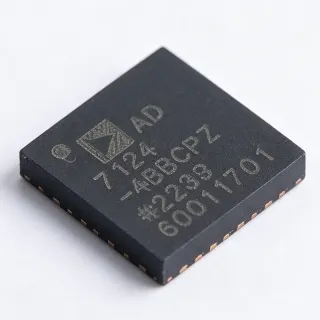
AD7712ARZ - 24-Bit Sigma-Delta ADC | Analog Devices
N.º de pieza: AD7712ARZ ✓ ActivoAD7712ARZ Descripción general
A sigma-delta ADC is a voltage-regulating semiconductor that uses delta-sigma modulation and digital filtering to convert an analog input into a high-resolution serial digital word. The AD7712 belongs to the ADC > sigma-delta ADC > signal-conditioning ADC hierarchy and is intended for precision measurement systems where slow conversion rates, high resolution, programmable gain, and flexible input polarity are more important than high sampling bandwidth.
Principal features include a 24-bit conversion result with up to 24 bits of no-missing-codes performance, two analog input channels, and a conversion rate listed as 1.028 kSPS. Input-channel selection, gain settings, and signal polarity can be configured in software through a bidirectional serial interface. The analog inputs and reference input also support differential operation, which helps reject common-mode noise when paired with suitable sensors and instrumentation.
The AD7712 uses sigma-delta conversion to place the primary quantization noise away from the signal bandwidth of interest. Its programmable gain and polarity controls allow one converter to serve multiple low-level measurement channels. According to the Analog Devices AD7712 manufacturer datasheet, Rev. F, input-span calibration uses two voltages applied in sequence, helping the device establish the analog input range and gain accurately.
Typical uses include pressure and force measurement, strain-gauge and bridge-sensor signal conditioning, industrial process monitoring, laboratory instrumentation, and other slow but high-resolution sensor systems. The device is particularly appropriate when a transducer produces a small differential output that must be amplified, filtered, digitized, and transferred to a microcontroller or embedded controller.
The primary design consideration is analog filtering and reference quality. Place input and reference decoupling capacitors close to their pins, route the differential input paths symmetrically, and evaluate the converter frequency with the digital filter settings required by the application. The AD7712ARZ is specified for industrial temperatures from −40°C to +85°C and uses a 24-pin SOIC package suitable for conventional surface-mount assembly.
This product record combines the manufacturer specifications with package, sourcing, lifecycle, and application guidance. It also highlights drop-in alternatives, comparison parameters, and practical PCB considerations for engineers evaluating the AD7712ARZ in precision signal-chain designs.
Alternativas directas para AD7712ARZ — mismo encapsulado, compatible pin a pin. Se excluyen las piezas de otro encapsulado que requieren retrabajo de la PCB.
Variantes de esta serie
Modelos de la misma serie compatibles directamente con AD7712ARZ (mismo factor de forma y huella) — difiere en Resolution, Operating Temperature, Package, Mounting Type, Converter Type.
AD7712BRZ
✅ Sustitución directa ⚠️ Especificaciones sin verificar📋 Alternativa de referencia (no en el catálogo)
AD7712ARZ Valores máximos y características eléctricas
| Converter Type | Sigma-delta ADC |
| Resolución | 24 bit |
| No-Missing-Codes Performance | Up to 24 bit |
| Analog Input Channels | 2 channels |
| Conversion Rate | 1.028 kSPS |
| Input Signal Capability | Low-level transducer signals or differential signals up to ±4 × VREF |
| Reference Input | Differential |
| Digital Interface | Bidirectional serial interface |
| Programmable Features | Input-channel selection, gain settings, and signal polarity |
| Tensión de alimentación | 5 V |
| Analog Input Range | Up to ±4 × VREF |
| Process Technology | Production CMOS |
| Encapsulado | 24-pin SOIC, 7.5 mm body width |
| Tipo de montaje | Surface mount |
| Temperatura de funcionamiento | −40°C to +85°C |
| Product Lifecycle | Production |
Guía de configuración de pines de AD7712ARZ 24-pin soic, 7.5 mm body width
Configuración de pines para AD7712ARZ (encapsulado 24-pin soic, 7.5 mm body width). Este componente analógico presenta pines de entrada, salida y alimentación. Consulte la hoja de datos del fabricante para conocer las configuraciones de los pines de ajuste de offset, compensación y habilitación. Ideal para circuitos de acondicionamiento de señal y amplificadores.

No hay datos detallados de patillaje disponibles para AD7712ARZ.
Consulte la hoja de datos para ver la configuración completa de patillas.
Aplicaciones típicas
AD7712ARZ es adecuado para 6 aplicacións: Pressure Transducer Signal Conditioning, Strain Gauge and Load Cell Acquisition, Industrial Process Monitoring, Laboratory Instrumentation, Battery-Powered Sensor Node, Digital Thermometer and Temperature Controller.
Pressure Transducer Signal Conditioning
The AD7712ARZ fits bridge-based pressure transducers that produce a small differential output and require high-resolution conversion. Its two analog input channels can support alternate sensor connections, while programmable gain and polarity let the firmware configure the measurement for different transducers. The 24-bit sigma-delta conversion and 1.028 kSPS rate are appropriate for slowly changing pressure signals. A differential layout helps reject common-mode noise, provided that the sensor, reference network, and analog traces are balanced. The converter’s input-span calibration should be exercised with the actual endpoint voltages so that the converter accurately establishes gain across the selected range.
Recomendado
Strain Gauge and Load Cell Acquisition
The AD7712ARZ is appropriate for strain-gauge and load-cell front ends where the useful signal is small, differential, and slowly varying. Differential input handling reduces the influence of common-mode voltage, while the 24-bit conversion result preserves fine resolution across the measurement range. Software-configurable gain and polarity simplify adaptation to different bridge sensitivities and excitation arrangements. The 1.028 kSPS rate is more than adequate for static force, weight, and structural-load monitoring. Keep excitation and signal paths separated on the PCB, use a stable reference source, and apply the manufacturer’s input-span calibration sequence for the final mechanical and electrical conditions.
Recomendado
Industrial Process Monitoring
The AD7712ARZ can digitize slow industrial process variables such as temperature, level, flow, or chemical concentration when the sensing element produces a low-level analog signal. Two analog input channels permit closely related measurements to share one converter, and software-programmable gain, channel selection, and polarity reduce fixed hardware requirements. The 24-bit resolution and differential input architecture help retain useful precision in electrically noisy equipment cabinets. The 1.028 kSPS conversion rate suits temperature and level loops but not fast closed-loop dynamics. Designers should isolate sensitive analog traces, maintain a low-noise reference, and select digital-filter behavior that balance response time against measurement noise.
Recomendado
Laboratory Instrumentation
The AD7712ARZ suits laboratory instruments that measure low-level differential sensor outputs with a stable, relatively slow input. The 24-bit sigma-delta converter can provide fine numerical resolution without requiring a high-speed SAR ADC, while two channels allow background or reference measurements. Software-controlled gain, polarity, and channel selection simplify calibration across different test ranges. Its 1.028 kSPS maximum listed rate is well matched to temperature probes, strain systems, and slow chemical sensors rather than waveform capture. In a precision instrument, protect the analog front end from ground-potential differences, use shielded or tightly routed differential traces, and implement periodic input-span and offset calibration for long-term stability.
Recomendado
Battery-Powered Sensor Node
The AD7712ARZ can serve as the measurement converter in a battery-powered sensor node when the sensed quantity changes slowly and energy use is more important than throughput. The two-channel architecture can consolidate measurements from multiple low-power sensors, and the serial interface allows firmware to configure gain and polarity without changing analog hardware. Its 24-bit resolution can reduce the need for high-gain analog stages in suitable sensor circuits. The 1.028 kSPS rate supports periodic rather than continuous high-rate acquisition. Designers should compare the converter’s operating current and digital-filter settling requirements, power down unused analog channels where supported, and isolate the reference and sensor lines to minimize leakage and noise during long idle periods.
Recomendado
Digital Thermometer and Temperature Controller
The AD7712ARZ is well matched to precision thermometry using resistive sensors whose resistance changes produce a small differential signal. The differential inputs, programmable gain, and 24-bit sigma-delta conversion support accurate temperature readings, while the 1.028 kSPS rate easily covers slow thermal changes. Two channels can measure the sensor and a compensation reference, provided both use compatible excitation and input ranges. For stable operation, use a low-noise reference, keep excitation current and sensor wiring away from digital signals, and calibrate the input span over the intended temperature interval. The converter should remain enabled only when needed in battery-powered systems if application firmware can reduce energy use.
Recomendado
Resumen de productos recomendados
Datos de referencia de ingeniería para AD7712ARZ — comparación, orientación de diseño e información de cumplimiento.
Guía de selección
Comparación con alternativas
| Parámetro | Este producto | AD7712BRZ |
|---|---|---|
| Package | 24-pin SOIC | 24-pin SOIC |
| Brand | Analog Devices | Analog Devices |
| Converter Type | Sigma-delta ADC | Sigma-delta ADC |
| Resolution | 24 bit | 24 bit |
| Analog Input Channels | 2 channels | 2 channels |
| Conversion Rate | 1.028 kSPS | 1.028 kSPS |
| Input Range | Up to ±4 × VREF | Up to ±4 × VREF |
| Digital Interface | Bidirectional serial interface | Bidirectional serial interface |
| Operating Temperature | −40°C to +85°C | Extended temperature grade |
| Supply Voltage | 5 V | 5 V |
Diferenciadores clave
- Closest same-footprint temperature-grade alternative (frente a AD7712BRZ)
- High-resolution conversion matched to slow sensor signals (frente a AD7712BRZ)
- Differential measurement flexibility (frente a AD7712BRZ)
Notas de diseño
Route differential inputs as a tight, symmetric pair and keep them away from the serial clock, data lines, switching supplies, and other high-current paths. Place input and reference decoupling capacitors close to their corresponding pins and use the shortest practical return path to the device ground. Analog signal integrity is especially important because the AD7712ARZ’s 24-bit conversion resolution can expose small layout-induced errors that appear insignificant at lower resolutions.
Do not confuse the AD7712ARZ industrial-temperature order code with the AD7712BRZ extended-temperature order code when substituting parts. Both use the same 24-pin SOIC family, but the operating-temperature requirements differ. Before replacement, compare the ordering table, pin descriptions, supply limits, calibration behavior, and package dimensions. Cross-reference listings that identify only similar converter functions do not establish drop-in compatibility and should not be treated as PCB-compatible replacements.
Use a low-noise reference because reference variation directly limits the accuracy of a ratiometric or fixed-scale measurement. Place the reference network and its decoupling close to the device, avoid sharing high-current return paths with sensitive sensor wiring, and verify the selected reference remains within the converter’s operating limits across temperature. The 5 V supply indicated for the AD7712ARZ should also be filtered near the package to prevent supply ripple from appearing in the converted result.
Implement the manufacturer’s input-span calibration procedure for the actual measurement system. Two endpoint voltages applied in sequence define the usable input range and establish gain; omitting this step or calibrating under unrepresentative conditions can leave systematic span error even when the converter itself operates correctly. Also allow sufficient settling time after configuration changes and before reading the serial output, especially when digital-filter settings affect conversion latency.
Información de cumplimiento
The verified manufacturer product material identifies the AD7712 as a production CMOS device but does not state the target part’s RoHS, REACH, lead-free, halogen-free, conflict-minerals, or automotive-qualification status.