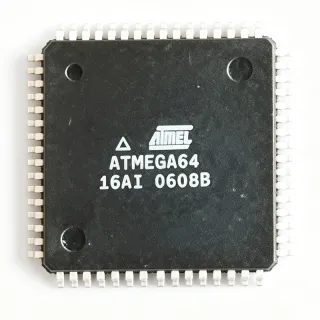
ATMEGA323L-4AI - 8-bit AVR MCU 32KB 4MHz TQFP-44 | Microchip
N.º de pieza: ATMEGA323L-4AI ✗ Fin de vida| Cant. | Precio unitario | Total |
|---|---|---|
| 1 | $6.2 | $6,20 |
| 10 | $5.58 | $55,80 |
| 100 | $4.96 | $496,00 |
| 500 | $4.34 | $2.170,00 |
| 1.000 | $3.72 | $3.720,00 |
ATMEGA323L-4AI Descripción general
A microcontroller (MCU) is a single-chip computer that integrates a processor core, program memory, data memory, and peripherals onto one die, forming the lowest tier of the embedded processing hierarchy (MCU -> embedded processor -> microprocessor). The ATmega323 belongs to the AVR family, based on the AVR enhanced RISC architecture that executes powerful instructions in a single clock cycle, achieving throughputs approaching 1 MIPS per MHz.
Key features include 131 powerful instructions with mostly single-clock cycle execution, eight general purpose working registers, fully static operation up to 16 MIPS throughput capability, and In-System Programmable (ISP) Flash for firmware updates without removing the device from the PCB.
Architecturally, the AVR core uses a Harvard structure with separate program and data buses, allowing instruction fetch and data access to occur simultaneously. This single-cycle execution model is what lets the ATmega323 optimize power consumption versus processing speed, a core design goal stated in the Atmel datasheet.
Typical applications include battery-powered instrumentation, industrial control nodes, consumer appliance control panels, and embedded sensing systems where the low-voltage 2.5V-3.3V operation of the L grade and the compact 10x10 mm TQFP footprint are advantageous.
When designing with this device, verify that your required clock rate does not exceed the 4MHz limit of the L speed grade; higher-frequency needs require the ATMEGA323-8AI (8MHz) variant.
This page synthesizes distributor pricing, verified datasheet parameters, and practical drop-in alternative guidance not consolidated in the manufacturer datasheet.
Alternativas directas para ATMEGA323L-4AI — mismo encapsulado, compatible pin a pin. Se excluyen las piezas de otro encapsulado que requieren retrabajo de la PCB.
Variantes de esta serie
Modelos de la misma serie compatibles directamente con ATMEGA323L-4AI (mismo factor de forma y huella) — difiere en Throughput, Maximum Clock Frequency, Package, EEPROM, Operating Temperature.
Herramienta de comparación rápida — seleccione piezas alternativas para compararlas lado a lado:
ATMEGA323-8AI
✅ Sustitución directa ⚠️ Especificaciones sin verificar📋 Alternativa de referencia (no en el catálogo)
ATMEGA323L-8AI
✅ Sustitución directa ⚠️ Especificaciones sin verificar📋 Alternativa de referencia (no en el catálogo)
ATMEGA32-16AUR
✅ Sustitución directa ⚠️ Especificaciones sin verificar✓ En stock
$3.41 / unidad
Ver hoja de datos →ATMEGA32-16AI
✅ Sustitución directa ⚠️ Especificaciones sin verificar📋 Alternativa de referencia (no en el catálogo)
ATMEGA16-16AI
✅ Sustitución directa ⚠️ Especificaciones sin verificar✓ En stock
$3.82 / unidad
Ver hoja de datos →ATMEGA323L-4AI Valores máximos y características eléctricas
| Core Processor | AVR |
| Core Size | 8-Bit |
| Architecture | AVR enhanced RISC |
| Program Memory Size | 32KB (16K x 16) In-System Programmable Flash |
| RAM Size | 2KB |
| Frecuencia de reloj máxima | 4MHz (L speed grade) |
| Instruction Count | 131 powerful instructions |
| General Purpose Working Registers | 8 |
| Throughput | Up to 1 MIPS per MHz |
| Supply Voltage Range | 2.5V / 3.3V / 5V (L low-voltage grade) |
| Temperatura de funcionamiento | -40C to +85C (industrial, I suffix) |
| Encapsulado | 44-TQFP (10 x 10 mm) |
| Tipo de montaje | Surface Mount |
| Program Memory Type | FLASH |
Guía de configuración de pines de ATMEGA323L-4AI 44-tqfp (10 x 10 mm)
Configuración de pines para ATMEGA323L-4AI (encapsulado 44-tqfp (10 x 10 mm)). Este CI digital incluye GPIO, interfaces de comunicación (UART, SPI, I2C) y pines de alimentación. Consulte la hoja de datos del fabricante para conocer las funciones alternativas de los pines y las opciones de configuración. Esencial para el diseño de sistemas embebidos y el diseño de PCB.

No hay datos detallados de patillaje disponibles para ATMEGA323L-4AI.
Consulte la hoja de datos para ver la configuración completa de patillas.
Aplicaciones típicas
ATMEGA323L-4AI es adecuado para 6 aplicacións: Battery-Powered Portable Instrumentation, Industrial Control Nodes, Legacy Board Maintenance and EOL Replacement, 3.3V Embedded Sensing Systems, Consumer Appliance Control Panels, Embedded Communication Interface Nodes.
Battery-Powered Portable Instrumentation
The ATMEGA323L-4AI fits portable, battery-operated instruments because its L speed grade is characterized for 2.5V and 3.3V supplies, allowing direct operation from two or three cell chemistries without a boost converter. The AVR enhanced RISC core delivers throughput approaching 1 MIPS per MHz, so a 4MHz clock still yields roughly 4 MIPS, sufficient for sensor polling, filtering, and display updates. Its fully static core permits clock stopping in sleep modes, enabling duty-cycled designs that stretch battery life. Place the device in a 44-TQFP (10x10 mm) footprint to conserve board area; the surface-mount package also withstands vibration better than through-hole alternatives in handheld products.
Recomendado
Industrial Control Nodes
In factory automation nodes, the ATMEGA323L-4AI provides an industrial temperature rating of -40C to +85C (the 'I' suffix), which covers unconditioned control cabinets and outdoor sensor junctions. The 32KB In-System Programmable Flash allows firmware field updates over the ISP interface without desoldering the device, reducing maintenance cost across deployed installations. Four 8-bit I/O ports on the 44-TQFP package give 32 GPIO-class signals for driving relays, optocouplers, and reading limit switches. Because throughput approaches 1 MIPS per MHz, deterministic single-cycle instruction execution simplifies timing-critical control loops, and the 2KB SRAM buffers local data logs between communication intervals.
Recomendado
Legacy Board Maintenance and EOL Replacement
For sustaining engineering of ATmega323-based products, the ATMEGA323L-4AI is the exact original-fit device, and the primary drop-in is ATMEGA323-8AI, which shares the identical 44-TQFP footprint and runs at 4MHz when programmed with the same firmware. The single-cycle AVR instruction set and 131-instruction architecture mean no compiler retargeting is needed within the family, preserving the validated firmware binary. Use the In-System Programming capability to reflash replacements directly on the assembled board. When stock of both variants is exhausted, migrate to the pin-compatible ATMEGA32-16AI after re-verifying the voltage range and peripheral register map differences.
Recomendado
3.3V Embedded Sensing Systems
Mixed-voltage sensing systems benefit from the ATMEGA323L-4AI's low-voltage grade, listed across 2.5V, 3.3V, and 5V per FindIC specifications, which allows direct interfacing with 3.3V ADCs, sensors, and logic without level shifters. At 4MHz the core achieves about 4 MIPS, ample for reading I2C/SPI-class sensor data and performing calibration math in the 2KB SRAM. The 44-TQFP 10x10 mm package keeps the controller compact on dense sensor boards, and the surface-mount land pattern simplifies assembly on two-layer PCBs. Reserve analog port pins for sensor front-ends and verify sleep-mode current budgets against the datasheet electrical characteristics before finalizing the power tree.
Recomendado
Consumer Appliance Control Panels
Appliance control panels use the ATMEGA323L-4AI where a 4MHz clock is adequate for keypad scanning, LED/LCD driving, and simple state machines, keeping both cost and EMI low since slower switching reduces harmonic content. The 32KB Flash accommodates menu logic, localization strings, and calibration tables, while the ISP Flash supports firmware updates during appliance manufacturing. The 44-TQFP industrial package handles the elevated ambient temperatures inside enclosures near motors or heaters up to +85C. Throughput near 1 MIPS per MHz ensures responsive user interfaces without resorting to higher-clock parts that increase switching noise in designs sharing a board with analog sensing.
Recomendado
Embedded Communication Interface Nodes
Serial-protocol bridges and communication nodes employ the ATMEGA323L-4AI's AVR core for UART, SPI, and TWI (I2C)-class tasks, with the single-cycle instruction execution providing precise bit-banged timing when hardware peripherals are pinned. The 32KB program space holds protocol stacks and buffering code, and the 2KB SRAM supports frame buffering for Modbus-style polling. Running at only 4MHz reduces radiated emissions, easing EMC compliance in gateways installed near sensitive radio equipment. The 44-pin TQFP exposes four full 8-bit ports for chip-selects, direction controls, and status lines, and the industrial rating supports roadside or rooftop installation environments.
Recomendado
Resumen de productos recomendados
Datos de referencia de ingeniería para ATMEGA323L-4AI — comparación, orientación de diseño e información de cumplimiento.
Guía de selección
Comparación con alternativas
| Parámetro | Este producto | ATMEGA323-8AI | ATMEGA323L-8AI | ATMEGA32-16AU | ATMEGA16-16AI |
|---|---|---|---|---|---|
| Package | 44-TQFP (10x10 mm) | 44-TQFP (10x10 mm) - same | 44-TQFP (10x10 mm) - same | 44-TQFP (10x10 mm) - same | 44-TQFP (10x10 mm) - same |
| Brand | Microchip Technology (Atmel) | Microchip Technology (Atmel) | Microchip Technology (Atmel) | Microchip Technology (Atmel) | Microchip Technology (Atmel) |
| Program Memory | 32KB (16K x 16) ISP Flash | 32KB ISP Flash | 32KB ISP Flash | 32KB ISP Flash | 16KB ISP Flash |
| Maximum Clock Frequency | 4MHz | 8MHz | 8MHz | 16MHz | 16MHz |
| Voltage Grade | L (2.5V/3.3V/5V low-voltage) | Standard grade | L (low-voltage) | Standard grade | Standard grade |
Diferenciadores clave
- Lowest-voltage L grade in the ATmega323 family (frente a ATMEGA323-8AI)
- Same die as 4PI but surface-mount (frente a ATMEGA323L-4PI)
- Direct legacy firmware compatibility (frente a ATMEGA32-16AU)
Notas de diseño
The ATMEGA323L-4AI is an L-grade device characterized for 2.5V/3.3V/5V supplies per FindIC specification data. Confirm your rail is within the exact datasheet operating envelope before layout, because the standard-grade ATMEGA323-8AI has a different voltage window. Decouple VCC with 100nF ceramic capacitors at each supply pin pair of the 44-TQFP plus one bulk capacitor (10uF) near the part; the TQFP exposes power pins on multiple package sides, so place local decoupling on the side closest to each supply pin.
Do not clock this part above 4MHz: the '4' in the part number is the L speed-grade maximum, and exceeding it violates the datasheet operating ratings even if the silicon appears to function at room temperature. If your design needs more MIPS, choose the pin-compatible ATMEGA323-8AI (8MHz) or ATMEGA32-16AI (16MHz) instead of overclocking. Additionally, because this part is end-of-life, avoid designing it into new products; use it only for legacy board maintenance, and buy buffer stock with verified date codes.
Use the 10x10 mm TQFP-44 land pattern per the Atmel datasheet package drawing, with thermal relief on ground connections and a solid ground plane on layer 2 of the PCB. Keep the ISP programming header routed short and accessible for field firmware updates to the 32KB In-System Programmable Flash. For analog port usage, route analog traces away from crystal and digital lines; the AVR single-cycle switching edges are fast enough at 4MHz to couple into high-impedance analog nodes on two-layer boards.
Información de cumplimiento
The ATMEGA323L-4AI was released around 2003; RoHS/REACH status is not stated in the provided web data and must be confirmed with Microchip or the distributor listing before export-regulated production use.