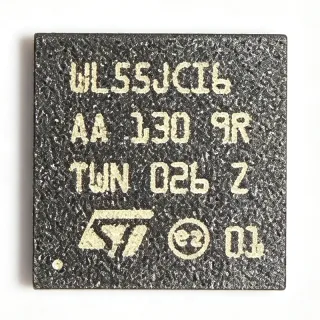
BC66F3663 - Sub-1GHz OOK/GFSK Transceiver Flash MCU | Holtek
N.º de pieza: BC66F3663 ✗ Fin de vida| Cant. | Precio unitario | Total |
|---|---|---|
| 1 | $0 | $0,00 |
| 10 | $0 | $0,00 |
| 100 | $0 | $0,00 |
| 500 | $0 | $0,00 |
| 1.000 | $0 | $0,00 |
BC66F3663 Descripción general
A Sub-1GHz transceiver SoC (System-on-Chip) is a class of wireless IC that combines a low-power radio transceiver with a microcontroller and memory on one die. In the power-management and connectivity hierarchy, it sits above discrete RF transceiver ICs (which require an external MCU) and below complete certified RF modules, offering designers an intermediate level of integration for proprietary wireless protocols.
Key characteristics of the BC66F3663 include single-chip integration of the RF transceiver and Flash MCU, dual modulation support (OOK for maximum range and simplicity, GFSK for higher noise immunity and data rates), and operation across Sub-1GHz frequency bands. Holtek states that the BC66F3653 and BC66F3663 provide enhanced anti-interference ability and improved transmission range compared with earlier family members.
The device family includes the BC66V3663, which is the OCDS (On-Chip Debug System) EV chip of the BC66F3663 and provides dedicated OCDSDA and OCDSCK pins for development and emulation. Pin-shared functions on the QFN-A package are determined by corresponding software control bits, allowing flexible peripheral mapping per the manufacturer datasheet.
Typical applications include wireless remote controls, smart-home sensor nodes, security and alarm systems, and industrial telemetry links operating in Sub-1GHz license-free bands, where long range and low power favor Sub-1GHz over 2.4GHz solutions.
An important design consideration: this device has been formally End-Of-Life'd. Holtek's EOL notification gives a latest purchase date of October 25, 2025, so new designs should evaluate the recommended replacement device from the EOL cross-reference schedule before committing.
This page synthesizes the EOL notification, datasheet package information, drop-in alternative analysis, and sourcing guidance not consolidated in the manufacturer datasheet.
Alternativas directas para BC66F3663 — mismo encapsulado, compatible pin a pin. Se excluyen las piezas de otro encapsulado que requieren retrabajo de la PCB.
Variantes de esta serie
Modelos de la misma serie compatibles directamente con BC66F3663 (mismo factor de forma y huella) — difiere en Package, Product Type.
Herramienta de comparación rápida — seleccione piezas alternativas para compararlas lado a lado:
BC66V3663
✅ Sustitución directa📋 Alternativa de referencia (no en el catálogo)
BC66F3653
✅ Sustitución directa📋 Alternativa de referencia (no en el catálogo)
BC66F3663 Valores máximos y características eléctricas
| Product Type | Sub-1GHz OOK/GFSK Transceiver Flash MCU |
| Encapsulado | 46-pin QFN-A |
| Modulation | OOK, GFSK |
| Debug Interface | OCDS (via BC66V3663 EV chip, OCDSDA/OCDSCK pins) |
| Datasheet Revision | V1.00 (November 01, 2023) |
| Estado del ciclo de vida | EOL - last purchase date October 25, 2025 |
Guía de configuración de pines de BC66F3663 46-pin qfn-a
Configuración de pines para BC66F3663 (encapsulado 46-pin qfn-a). Este CI digital incluye GPIO, interfaces de comunicación (UART, SPI, I2C) y pines de alimentación. Consulte la hoja de datos del fabricante para conocer las funciones alternativas de los pines y las opciones de configuración. Esencial para el diseño de sistemas embebidos y el diseño de PCB.

No hay datos detallados de patillaje disponibles para BC66F3663.
Consulte la hoja de datos para ver la configuración completa de patillas.
Aplicaciones típicas
BC66F3663 es adecuado para 6 aplicacións: Wireless Remote Controls, Smart Home Sensor Nodes, Security and Alarm Systems, Industrial Telemetry and Metering, RF Module and Dongle Design, Active RFID and Asset Tracking.
Wireless Remote Controls
Sub-1GHz OOK transmission is the dominant technology for gate, garage-door, and industrial remote controls because it combines long range with very low power draw. The BC66F3663 fits this application by integrating the RF transceiver and Flash MCU in one 46-pin QFN-A package, eliminating the external MCU-to-RF wiring of two-chip designs and reducing BOM count. In use, the MCU formats the rolling or fixed code frame and the transceiver emits it via OOK for maximum range and receiver simplicity. Because OOK transmitters can power down between keypresses, battery life in a key-fob can reach several years; the trade-off is lower data throughput than GFSK, which is irrelevant for short control frames. Note the EOL status: existing remote-control lines should plan migration to Holtek's recommended replacement device from the EOL cross-reference table.
Recomendado
Smart Home Sensor Nodes
Smart-home sensors such as door/window contacts, PIR motion detectors, and smoke alarms benefit from Sub-1GHz propagation, which penetrates walls better than 2.4GHz and enables multi-year coin-cell operation. The BC66F3663 integrates the GFSK/OOK radio and the Flash MCU, so sensor sampling, protocol handling, and RF transmission all execute on one die, minimizing sleep-mode leakage paths. In a typical node, the MCU sleeps between events, wakes on sensor interrupt, and bursts a short GFSK frame to a hub; GFSK modulation supplies the noise immunity needed in crowded 433/868/915MHz home environments. Holtek states the BC66F3663 family provides enhanced anti-interference ability, directly improving coexistence with Wi-Fi and other ISM traffic. Designers of new nodes should account for the October 25, 2025 last purchase date when selecting this MPN.
Recomendado
Security and Alarm Systems
Wireless alarm peripherals require reliable, low-latency, low-power links between detectors, keypads, and the alarm panel. The BC66F3663 addresses this with its integrated Sub-1GHz transceiver supporting OOK for maximum-range simple devices and GFSK for higher-integrity two-way signaling, all managed by the on-chip Flash MCU with software-configurable pin-shared peripherals for LEDs, tamper switches, and siren drivers. In deployment, the MCU implements the alarm protocol's acknowledgments and supervisory heartbeats while the radio handles the air interface; the family's stated enhanced anti-interference ability reduces false-alarm risk from ISM-band congestion. Range headroom matters in metal-rich building environments, and Sub-1GHz typically outperforms 2.4GHz here. Since the device is EOL with a last purchase date of October 25, 2025, alarm vendors should qualify the EOL replacement device for continued production.
Recomendado
Industrial Telemetry and Metering
Utility meters, tank-level monitors, and industrial telemetry units frequently use Sub-1GHz proprietary links for kilometer-scale point-to-multipoint coverage without cellular subscription costs. The BC66F3663 consolidates the RF transceiver, Flash MCU, and configurable I/O into one 46-pin QFN-A package, letting the meter's MCU offload the entire radio stack; the software-defined pin-shared functions adapt the same silicon to pulse counting, UART metering buses, or status outputs per the datasheet. In operation, the node wakes periodically, measures, and transmits a compact GFSK frame with the family's enhanced anti-interference performance protecting payload integrity in electrically noisy plants. The engineering trade-off is that proprietary Sub-1GHz links avoid network fees but demand in-house protocol maintenance. Given EOL status, new metering platforms must adopt Holtek's recommended replacement from the EOL notification.
Recomendado
RF Module and Dongle Design
OEMs building their own Sub-1GHz RF modules or USB dongles can use the BC66F3663 as the core SoC, reselling the integration advantage to downstream customers. A module built on this device places the transceiver, Flash MCU, crystal, and antenna-matching network on a small PCB, exposing only power, UART/SPI, and antenna - the 46-pin QFN-A keeps the module compact. During module development, the BC66V3663 EV chip with its dedicated OCDSDA/OCDSCK OCDS pins enables full in-circuit debugging of the embedded stack before the design is frozen on the BC66F3663. OOK mode supports ultra-low-cost receive-only endpoints, while GFSK covers bidirectional module SKUs from one hardware platform. Module makers must note the EOL last purchase date of October 25, 2025 and transition the module BOM to Holtek's recommended successor.
Recomendado
Active RFID and Asset Tracking
Active RFID tags and asset-tracking beacons transmit short identifiers periodically and must survive years on a small battery, which is precisely the operating profile of an integrated Sub-1GHz transceiver Flash MCU like the BC66F3663. The single-die design minimizes sleep-state quiescent paths because the MCU and radio share one power domain, and OOK mode provides the simplest, most power-efficient beacon emission for tag readers with basic receivers. For higher-value assets, GFSK two-way exchanges enable location confirmation and sensor telemetry (temperature, shock) handled by the on-chip Flash MCU. Holtek's stated improved transmission range extends reader spacing in warehouses, lowering infrastructure count. Tags have long field lifetimes, so component continuity matters: with the BC66F3663 under EOL (last purchase October 25, 2025), tag producers should map designs to the EOL replacement device now.
Recomendado
Resumen de productos recomendados
Datos de referencia de ingeniería para BC66F3663 — comparación, orientación de diseño e información de cumplimiento.
Guía de selección
Comparación con alternativas
| Parámetro | Este producto | BC66V3663 | BC66F3653 |
|---|---|---|---|
| Package | 46-pin QFN-A | 46-pin QFN-A - same | 46-pin QFN-A - same |
| Brand | Holtek Semiconductor | Holtek Semiconductor | Holtek Semiconductor |
| Product Type | Sub-1GHz OOK/GFSK Transceiver Flash MCU | OCDS EV chip of BC66F3663 | Sub-1GHz OOK/GFSK Transceiver Flash MCU |
| Modulation | OOK, GFSK | OOK, GFSK | OOK, GFSK |
| Primary Role | Production Flash device | Development/emulation (OCDS EV) chip | Production Flash device |
Diferenciadores clave
- Production-grade Flash integration (frente a BC66V3663)
- Enhanced anti-interference and range (frente a Earlier BC66F family members)
- Lifecycle risk vs BC66F3653 (frente a BC66F3653)
Notas de diseño
The most critical issue with the BC66F3663 today is lifecycle, not electrical design. Holtek's official EOL notification sets a last purchase date of October 25, 2025, so any new PCB release using this MPN risks unbuildable production within months. Download the EOL PDF from holtek.com, identify the recommended replacement device in the cross-reference table, and qualify it before committing layouts. Keep last-time-buy stock with written date-code guarantees if the existing design must be maintained.
As with any Sub-1GHz transceiver SoC, RF performance depends heavily on layout: keep the crystal and antenna matching network close to the QFN-A package, use a continuous ground plane under the RF section, and follow the reference layout in the Holtek datasheet. Pin-shared functions are selected by software control bits per the datasheet - verify the desired pin function mapping in firmware before routing, since a wrong configuration can conflict with the RF-related pins on the 46-pin QFN-A footprint.
For development and production programming, remember the division of labor defined in the datasheet: the BC66V3663 is the OCDS EV chip with dedicated OCDSDA/OCDSCK debug pins, available only on that device. Design your programming/test fixture so that BC66F3663 production units are flashed via the standard Holtek writer interface, while OCDS-based emulation runs on BC66V3663 sample boards. Do not route traces assuming debug-pin availability on the production Flash device.
Información de cumplimiento
Compliance status not stated in the verified web data. Consult the official Holtek datasheet V1.00 and product page for RoHS/REACH declarations.