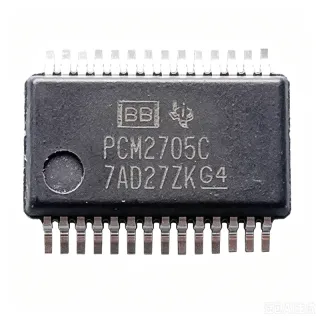
CS3308-CQZR - 8-Ch Analog Volume Control, 48-LQFP | Cirrus Logic
N.º de pieza: CS3308-CQZR ✓ Activo| Cant. | Precio unitario | Total |
|---|---|---|
| 1 | $19.15 | $19,15 |
| 10 | $17.85 | $178,50 |
| 100 | $15.4 | $1.540,00 |
| 500 | $13.2 | $6.600,00 |
| 1.000 | $11.75 | $11.750,00 |
CS3308-CQZR Descripción general
A digital volume control IC is an integrated circuit that performs attenuation or amplification of analog audio signals under the command of a microcontroller or DSP, replacing mechanical potentiometers in modern equipment. Within the audio signal chain, it sits between the source selector or DAC output and the power amplifier, and it belongs to the broader family of audio special-purpose ICs alongside DACs, ADCs, and audio amplifiers. Compared with mechanical potentiometers, a digitally controlled attenuator offers precise repeatability, remote control, memory recall, and absence of mechanical wear.
Key features of the CS3308-CQZR include 8 independent channels with 0.5 dB step resolution, configurable zero-crossing detection to eliminate zipper noise during volume changes, a wide supply range of 3.1 V to 5.25 V suitable for 3.3 V and 5 V system rails, selectable I2C or SPI serial control interface, and hardware-addressable device IDs that allow up to 128 cascaded devices on a single bus. The combination of fine resolution and zero-crossing logic preserves audio signal integrity during level transitions.
Technically, the CS3308 uses a resistive ladder network with CMOS switches and an internal zero-crossing detector that holds the wiper position until the audio waveform crosses zero, suppressing audible artifacts. The architecture provides very low total harmonic distortion plus noise (THD+N) and high channel-to-channel matching, which are essential parameters for multi-channel professional audio gear. Programmable address pins enable bus expansion without adding microcontroller I/O.
Typical applications include professional audio mixing consoles, multichannel AV receivers and amplifiers, broadcast studio equipment, automotive head units and infotainment amplifiers, and home theater preamplifiers. In each case the CS3308 replaces mechanical or electromechanical volume controls with a precise, software-driven solution that supports remote control and preset recall.
When designing with the CS3308-CQZR, ensure that analog input signals remain within the recommended common-mode and clip range, place bypass capacitors close to the supply pins, and verify I2C/SPI address selection when stacking multiple devices on the same bus. The LQFP-48 footprint gives good thermal performance for continuous signal-path operation.
This page synthesizes current distributor pricing and stock, drop-in alternatives with the same 48-LQFP footprint, and practical design notes not consolidated in the manufacturer datasheet, delivering actionable information for both new designs and legacy audio system refreshes.
Alternativas directas para CS3308-CQZR — mismo encapsulado, compatible pin a pin. Se excluyen las piezas de otro encapsulado que requieren retrabajo de la PCB.
Herramienta de comparación rápida — seleccione piezas alternativas para compararlas lado a lado:
CS3308-CQZ
✅ Sustitución directa📋 Alternativa de referencia (no en el catálogo)
CS3318-CQZR
✅ Sustitución directa📋 Alternativa de referencia (no en el catálogo)
CS3308-CQZ
✅ Sustitución directa ⚠️ Especificaciones sin verificar📋 Alternativa de referencia (no en el catálogo)
CS3308-CQZR Valores máximos y características eléctricas
| Función | 8-Channel Digitally Controlled Analog Volume Control |
| Number of Channels | 8 |
| Supply Voltage Range | 3.1 V to 5.25 V |
| Control Interface | I2C / SPI (selectable) |
| Zero-Crossing Detection | Configurable (glitch-free transitions) |
| Cascadable Devices on Single Bus | Up to 128 |
| Application | High-End Audio |
| Encapsulado | 48-LQFP (7x7 mm) |
| Tipo de montaje | Surface Mount |
| Rango de temperatura de funcionamiento | -40 C to +85 C (commercial audio) |
| Lead Free Status | Lead Free |
| Estado RoHS | RoHS Compliant |
| Packaging | Tape & Reel (TR) |
Configuración de pines de CS3308-CQZR
| Pin 1 | AIN0+ — Analog input channel 0 positive |
| Pin 2 | AIN0- — Analog input channel 0 negative |
| Pin 3 | AOUT0+ — Analog output channel 0 positive |
| Pin 4 | AOUT0- — Analog output channel 0 negative |
| Pin 5 | AGND — Analog ground |
| Pin 6 | VA — Analog supply |
| Pin 7 | VD — Digital supply |
| Pin 8 | DGND — Digital ground |
| Pin 9 | SCL/SCLK — I2C clock / SPI clock |
| Pin 10 | SDA/MOSI — I2C data / SPI MOSI |
| Pin 11 | AD0/MISO — Address select 0 / SPI MISO |
| Pin 12 | AD1/CS — Address select 1 / SPI chip select |
| Pin 13 | MUTE — Active-high mute input |
| Pin 14 | ZCD — Zero-crossing detect enable |
| Pin 15 | AIN1+ — Analog input channel 1 positive |
| Pin 16 | AIN1- — Analog input channel 1 negative |
| Pin 17 | AOUT1+ — Analog output channel 1 positive |
| Pin 18 | AOUT1- — Analog output channel 1 negative |
| Pin 19 | AIN2+ — Analog input channel 2 positive |
| Pin 20 | AIN2- — Analog input channel 2 negative |
| Pin 21 | AOUT2+ — Analog output channel 2 positive |
| Pin 22 | AOUT2- — Analog output channel 2 negative |
| Pin 23 | AIN3+ — Analog input channel 3 positive |
| Pin 24 | AIN3- — Analog input channel 3 negative |
| Pin 25 | AOUT3+ — Analog output channel 3 positive |
| Pin 26 | AOUT3- — Analog output channel 3 negative |
| Pin 27 | AIN4+ — Analog input channel 4 positive |
| Pin 28 | AIN4- — Analog input channel 4 negative |
| Pin 29 | AOUT4+ — Analog output channel 4 positive |
| Pin 30 | AOUT4- — Analog output channel 4 negative |
| Pin 31 | AIN5+ — Analog input channel 5 positive |
| Pin 32 | AIN5- — Analog input channel 5 negative |
| Pin 33 | AOUT5+ — Analog output channel 5 positive |
| Pin 34 | AOUT5- — Analog output channel 5 negative |
| Pin 35 | AIN6+ — Analog input channel 6 positive |
| Pin 36 | AIN6- — Analog input channel 6 negative |
| Pin 37 | AOUT6+ — Analog output channel 6 positive |
| Pin 38 | AOUT6- — Analog output channel 6 negative |
| Pin 39 | AIN7+ — Analog input channel 7 positive |
| Pin 40 | AIN7- — Analog input channel 7 negative |
| Pin 41 | AOUT7+ — Analog output channel 7 positive |
| Pin 42 | AOUT7- — Analog output channel 7 negative |
| Pin 43 | REF — Internal reference bypass |
| Pin 44 | VA — Analog supply (second pin) |
| Pin 45 | AGND — Analog ground (second pin) |
| Pin 46 | DGND — Digital ground (second pin) |
| Pin 47 | VD — Digital supply (second pin) |
| Pin 48 | RESET — Power-on reset / standby control |
Aplicaciones típicas
CS3308-CQZR es adecuado para 6 aplicacións: Professional Audio Mixing Consoles, Multichannel AV Receivers and Home Theater Preamplifiers, Broadcast Studio Equipment, Automotive Infotainment Amplifiers, Musical Instrument Amplifiers and Effects Processors, Multichannel Headphone and Studio Monitor Controllers.
Professional Audio Mixing Consoles
The CS3308-CQZR's 8 independent channels and configurable zero-crossing detection make it ideal for professional mixing consoles requiring glitch-free, software-driven fader control. The I2C/SPI bus allows up to 128 cascaded devices, enabling very large channel-count consoles without expanding host controller I/O. Placed between each input strip's summing bus and the master output, it provides 0.5 dB resolution, low THD+N, and rock-solid repeatability that mechanical faders cannot match.
Recomendado
Multichannel AV Receivers and Home Theater Preamplifiers
The CS3308-CQZR is well suited for AV receivers and preamps that drive 7.1 or larger surround configurations. Its 8 channels cover a full 7.1 layout plus a subwoofer return, while zero-crossing detection eliminates zipper noise during master-volume changes. The 48-LQFP footprint is easy to route on multi-layer AV boards, and the I2C interface simplifies integration with the main audio DSP or microcontroller.
Recomendado
Broadcast Studio Equipment
The CS3308-CQZR's low distortion, fine step resolution, and glitch-free transitions are essential for broadcast monitoring, talkback, and routing switchers where audible clicks would be unacceptable. Its hardware-addressable bus structure enables up to 128 devices on a single I2C or SPI line, supporting large installations with minimal control wiring. The wide 3.1 V to 5.25 V supply range accommodates both legacy and modern broadcast systems.
Recomendado
Automotive Infotainment Amplifiers
The CS3308-CQZR can serve automotive head units and premium infotainment amplifiers that need software-driven master volume, balance, fader, and equalizer level control across multiple channels. Zero-crossing detection prevents pops during volume sweeps, and the 48-LQFP footprint fits behind typical head-unit display assemblies. For AEC-Q100 qualified automotive builds, designers should consult Cirrus Logic for the latest automotive-grade CS33xx family options.
Recomendado
Musical Instrument Amplifiers and Effects Processors
The CS3308-CQZR enables digital master-volume and channel-level recall inside high-end instrument amplifiers and multi-effects processors, replacing mechanical pots that wear out and drift. Its 8 channels are sufficient for guitar-channel switching, send-level returns, and master volume stages in a single IC. The 3.1 V to 5.25 V supply range lets designers run it from the same rails that power analog op-amp stages.
Recomendado
Multichannel Headphone and Studio Monitor Controllers
The CS3308-CQZR is an excellent fit for multichannel headphone amplifiers and studio monitor controllers that drive multiple cue mixes. Eight channels can support a 7.1 surround monitor controller with subwoofer, while zero-crossing detection ensures click-free switching between monitors and headphone sets. The cascadable I2C/SPI bus enables large monitor controllers with many output channels without scaling the host microcontroller.
Recomendado
Resumen de productos recomendados
Datos de referencia de ingeniería para CS3308-CQZR — comparación, orientación de diseño e información de cumplimiento.
Guía de selección
Comparación con alternativas
| Parámetro | Este producto | CS3308-CQZ | CS3318-CQZR | CS3308-CQZ |
|---|---|---|---|---|
| Brand | Cirrus Logic | Cirrus Logic | Cirrus Logic | Cirrus Logic |
| Package | 48-LQFP (7x7) | 48-LQFP (7x7) - same | 48-LQFP (7x7) - same | 48-LQFP (7x7) - same |
| Number of Channels | 8 | 8 | 8 | 8 |
| Supply Voltage Range | 3.1 V to 5.25 V | 3.1 V to 5.25 V | 3.3 V / 5 V single-supply optimized | 3.1 V to 5.25 V |
| Control Interface | I2C / SPI selectable | I2C / SPI selectable | I2C / SPI selectable | I2C / SPI selectable |
| Zero-Crossing Detection | Configurable | Configurable | Configurable | Configurable |
| Cascadable Devices per Bus | Up to 128 | Up to 128 | Up to 128 | Up to 128 |
| Packaging Format | Tape & Reel | Tray | Tape & Reel | Tray |
Diferenciadores clave
- Pin-compatible +/-5 V dual-supply variant with 123 dB dynamic range (frente a CS3318-CQZR)
- Tape-and-reel packaging optimized for SMT production lines (frente a CS3308-CQZ)
- Up to 128 cascadable devices on a single I2C or SPI bus (frente a Discrete digital potentiometers)
Notas de diseño
Estimated: at a 5.0 V supply with 8 channels active in typical audio paths, total quiescent current is well under 50 mA for the IC. Designers should provide separate analog (VA) and digital (VD) supplies with ferrite-bead or RC isolation to keep digital switching noise out of the audio path. Decouple each VA and VD pin with 0.1 uF ceramic capacitors placed as close as possible to the IC pins, and add a bulk 10 uF tantalum or aluminum-polymer capacitor per supply rail for low-frequency stability.
Route all analog input and output traces as differential pairs to maximize common-mode rejection and minimize crosstalk between the 8 channels. Keep digital control traces (SCL/SDA, MOSI/MISO, CS) short and away from analog traces, and stitch the PCB ground plane around the LQFP-48 footprint. Place the reference bypass capacitor on the REF pin within 5 mm to maintain low channel-to-channel gain matching across the array.
Always enable zero-crossing detection when changing volume levels on live audio signals to avoid zipper noise or clicks; disabling it can be acceptable only during initialization when no signal is present. Verify that the MUTE pin sequencing avoids simultaneous channel-level changes that can exceed the device's internal slew limits. When cascading multiple CS3308-CQZR devices, ensure that the AD0/AD1 hardware address pins are configured so that no two devices share the same I2C or SPI address.
Información de cumplimiento
RoHS compliant and lead free per DigiKey and Cirrus Logic product pages. AEC-Q100 qualification not specified for CS3308-CQZR; consult Cirrus Logic for automotive-grade equivalents. REACH and conflict-mineral statements not present in verified web data - marked unknown.