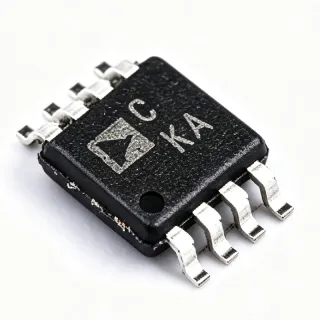
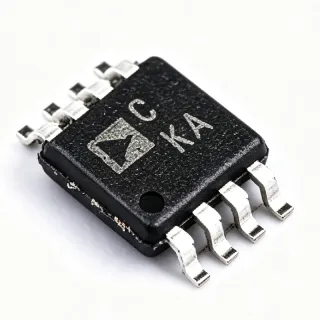
DS18B20+ - 1-Wire Digital Thermometer, 9-12 bit, TO-92-3 | Maxim
N.º de pieza: DS18B20+ ✓ Activo| Cant. | Precio unitario | Total |
|---|---|---|
| 1 | $3.95 | $3,95 |
| 10 | $3.52 | $35,20 |
| 100 | $2.78 | $278,00 |
| 500 | $2.21 | $1.105,00 |
| 1.000 | $1.84 | $1.840,00 |
DS18B20+ Descripción general
A digital temperature sensor is an integrated transducer that converts a physical temperature into a calibrated digital word via an on-die bandgap reference, sigma-delta ADC, and serial protocol engine. The DS18B20 sits in the product taxonomy of: temperature sensor -> digital temperature sensor -> thermal sensor -> sensor IC -> semiconductor. It uses Maxim's 1-Wire protocol, a single-wire half-duplex serial bus that requires only one data line plus ground for communication with a host microcontroller, and supports multi-drop networking of many DS18B20 devices on the same wire through unique 64-bit ROM IDs.
Key features include an operating voltage range of 3.0 V to 5.5 V (external power mode) or 3.0 V to 5.5 V with parasite-power support derived from the data line, four programmable resolution steps (9, 10, 11, 12 bit corresponding to 0.5C, 0.25C, 0.125C, 0.0625C LSB), and on-die EEPROM that retains user alarm thresholds across power cycles. The TO-92-3 through-hole package simplifies breadboard and hand-wired prototype use, while the SO-8 and uSOP variants (DS18B20Z, DS18B20U) target surface-mount designs.
The device incorporates a 64-bit factory-lasered ROM containing a unique serial number, an on-die temperature sensor with internal signal conditioning, nonvolatile EEPROM for alarm TH and TL plus configuration register, and a power-on detect circuit. The DS18B20 returns temperature as a 16-bit two's-complement value over the 1-Wire bus with strict CRC-8 protection on every transaction, eliminating bit errors in electrically noisy environments.
Typical applications include HVAC environmental monitoring, building automation, server-rack cold-aisle telemetry, industrial process monitoring, and IoT weather stations. The DS18B20 is widely used in Arduino, ESP32, and Raspberry Pi projects where multiple sensors share one GPIO pin, providing low-cost, cable-friendly distributed sensing. Stainless-steel waterproof probe assemblies based on the DS18B20 are the de facto standard for liquid and soil temperature measurement.
When designing with the DS18B20+, ensure the data line has a 4.7 kohm pull-up to VDD and that long cable runs use STP/UTP with ground to limit ringing; parasite-power mode requires a strong pull-up during conversion. Decouple VDD with 100 nF close to the pin in externally powered mode.
This page synthesizes distributor pricing, drop-in alternatives, and practical design notes that go beyond the datasheet's pin table.
Alternativas directas para DS18B20+ — mismo encapsulado, compatible pin a pin. Se excluyen las piezas de otro encapsulado que requieren retrabajo de la PCB.
Herramienta de comparación rápida — seleccione piezas alternativas para compararlas lado a lado:
DS18S20
✅ Sustitución directa📋 Alternativa de referencia (no en el catálogo)
MAX31820
✅ Sustitución directa📋 Alternativa de referencia (no en el catálogo)
DS1822
✅ Sustitución directa📋 Alternativa de referencia (no en el catálogo)
DS18B20
✅ Sustitución directa📋 Alternativa de referencia (no en el catálogo)
GX18B20
✅ Sustitución directa📋 Alternativa de referencia (no en el catálogo)
DS18B20+ Valores máximos y características eléctricas
| Tipo de sensor | Digital Temperature Sensor (1-Wire) |
| Rango de medición | -55 C to +125 C |
| Accuracy (max) | +/-0.5 C (-10 C to +85 C) |
| Resolución | 9 to 12 bit (programmable, 0.0625 C LSB at 12 bit) |
| Tipo de salida | 1-Wire digital (single-wire serial) |
| Tensión de alimentación | 3.0 V to 5.5 V (external or parasite power) |
| Active Current | 1 mA typical during conversion |
| Corriente en reposo | 750 nA typical (standby) |
| Max Conversion Time (12-bit) | 750 ms |
| Max Conversion Time (9-bit) | 93.75 ms |
| Encapsulado | TO-92-3 (through-hole) |
| Tipo de montaje | Through-Hole |
| Temperatura de funcionamiento | -55 C to +125 C |
| Número de pines | 3 |
| Unique ROM ID | 64-bit factory-lasered serial number |
| Alarm Function | Yes, programmable TH/TL stored in EEPROM |
| Parasite Power Support | Yes (derive power from data line) |
| Estado RoHS | Compliant |
Configuración de pines de DS18B20+
| Pin 1 | GND — Ground reference |
| Pin 2 | DQ — 1-Wire data line; also power input in parasite-power mode |
| Pin 3 | VDD — External supply voltage input (3.0 V to 5.5 V) |
Aplicaciones típicas
DS18B20+ es adecuado para 6 aplicacións: HVAC and Building Automation, IoT Weather Stations and Outdoor Monitoring, Server-Rack Cold-Aisle Thermal Monitoring, Industrial Process Monitoring, Cold-Chain and Refrigeration Logistics, DIY Maker and STEM Projects.
HVAC and Building Automation
The DS18B20+ is a workhorse for HVAC duct, room, and chiller monitoring because its 1-Wire interface allows many sensors to share one GPIO pin via unique 64-bit ROM IDs. With +/-0.5 C accuracy from -10 C to +85 C and a measurement range to +125 C, it tracks supply-air, return-air, and refrigerant-line temperatures reliably. Designers daisy-chain dozens of DS18B20+ devices on a single twisted pair with a 4.7 kohm pull-up, dramatically simplifying wiring compared with analog thermistors. Stainless-steel waterproof probe assemblies based on the TO-92-3 die are the de facto standard for chilled-water and boiler-loop sensing.
Recomendado
IoT Weather Stations and Outdoor Monitoring
The DS18B20+ is widely used in solar-powered weather stations and remote outdoor telemetry because its 750 nA standby current allows battery-backed operation, while its 3.0 V to 5.5 V supply range matches Li-ion chemistries and small solar harvests. Its 1-Wire bus lets an ESP32 or ESP8266 read multiple sensors (air, soil, leaf-wetness probes) through one GPIO, freeing pins for wind, rain, and humidity transducers. The TO-92-3 package is available in a waterproof stainless-steel probe rated IP67, suitable for long-term soil temperature monitoring.
Recomendado
Server-Rack Cold-Aisle Thermal Monitoring
Data-center cold-aisle and rack-inlet temperature monitoring relies on the DS18B20+ because its 1-Wire multidrop capability allows up to 100 devices on one bus without address conflicts. The +12-bit resolution (0.0625 C LSB) provides the granularity needed to detect inlet temperature rises of just 1 C, allowing predictive fan-speed adjustment before servers throttle. The device's low EMI and single-wire topology simplify cable management in dense rack environments, and its 750 ms max conversion time fits easily into per-second polling loops used by typical BMC firmware.
Recomendado
Industrial Process Monitoring
Factory-floor process monitoring uses the DS18B20+ for motor-winding, gearbox, and hydraulic-oil temperature telemetry because of its -55 C to +125 C range, programmable alarm thresholds, and robust 1-Wire CRC-8 error checking. The on-die EEPROM retains user-programmable TH and TL trip points across power cycles, allowing autonomous local alarming without host intervention. The TO-92-3 mechanical format mounts easily inside motor housings and bearing housings, and the 1-Wire bus tolerates the electrical noise of VFD-driven motors when twisted-pair cabling is used.
Recomendado
Cold-Chain and Refrigeration Logistics
Refrigerated transport and cold-chain storage rely on the DS18B20+ for continuous temperature logging because its -55 C lower limit and +/-0.5 C accuracy cover frozen (-20 C), refrigerated (4 C), and ambient-pharma (15-25 C) ranges. The 1-Wire interface lets a single data-logger pin capture multiple probe points along a truck compartment, and the on-die alarm registers trigger local LEDs or buzzers when TH or TL thresholds are violated. Compact stainless-steel probe assemblies simplify validation against ISO 17025 calibration procedures.
Recomendado
DIY Maker and STEM Projects
Arduino, Raspberry Pi, ESP32, and MicroPython maker projects overwhelmingly use the DS18B20+ because the OneWire library, ESPHome, and DallasTemperature drivers all target this exact part. Breadboard-friendly TO-92-3 pins drop directly into standard headers, and countless tutorials cover 4.7 kohm pull-up wiring, parasite vs external power, and ROM-ID-based multi-sensor networks. The DS18B20+ is the canonical teaching sensor for digital temperature acquisition, available in pre-wired waterproof probe form for aquarium, terrarium, and home-brew fermentation projects.
Recomendado
Resumen de productos recomendados
Datos de referencia de ingeniería para DS18B20+ — comparación, orientación de diseño e información de cumplimiento.
Guía de selección
Comparación con alternativas
| Parámetro | Este producto | DS18S20 | MAX31820 | DS1822 | GX18B20 |
|---|---|---|---|---|---|
| Brand | Maxim Integrated | Maxim Integrated | Maxim Integrated | Maxim Integrated | GXCAS |
| Package | TO-92-3 | TO-92-3 - same | TO-92-3 - same | TO-92-3 - same | TO-92-3 - same |
| Resolution | 9 to 12 bit (programmable) | 9 bit fixed | 9 to 12 bit (programmable) | 9 to 12 bit (programmable) | 9 to 12 bit (programmable) |
| Temperature Range | -55 C to +125 C | -55 C to +125 C | -55 C to +125 C | -55 C to +125 C | -55 C to +125 C |
| 1-Wire Protocol | Yes | Yes | Yes | Yes | Yes |
| Parasite Power | Yes | Yes | Yes | Yes | Yes |
| Alarm TH/TL EEPROM | Yes (programmable) | No | Yes | Yes | Yes |
Diferenciadores clave
- Programmable 9 to 12-bit resolution with on-die alarm thresholds (frente a DS18S20)
- Tighter accuracy and lower standby current than legacy DS18B20 (frente a MAX31820)
- Higher accuracy than DS1822 at the same package and price tier (frente a DS1822)
Notas de diseño
Place a 4.7 kohm pull-up resistor between DQ and VDD as close to the host MCU as practical; for cable lengths over 30 m, place the pull-up at the far end of the cable to reduce ringing. Add a 100 nF decoupling capacitor on VDD when using external power mode, and place it within 5 mm of the DS18B20+ VDD pin. Keep DQ traces away from switching-power and high-current motor traces to avoid capacitive coupling that can corrupt 1-Wire timing.
In parasite-power mode, the host must apply a strong pull-up (typically a MOSFET controlled by the MCU) on DQ during the entire 750 ms conversion window at 12-bit resolution; failure to provide this strong pull-up can result in corrupted readings because the DS18B20+ cannot source enough current from the small pull-up alone. For multi-device networks, prefer external power mode to avoid contention of strong pull-ups during simultaneous conversions. VDD should remain stable within 3.0 V to 5.5 V; brown-out conditions reset the scratchpad and abort ongoing conversion.
Do not assume every TO-92-3 marked DS18B20 is genuine; counterfeit parts from grey-market channels are widely reported to fail within months or return erratic readings (per Home Assistant forum thread). Buy from authorized distributors such as DigiKey, Mouser, or LCSC. Be aware that CRC-8 errors on long cables usually point to missing or undersized pull-up, not a bad sensor. When using the OneWire library's parasite-power callback, ensure your strong-pull-up timing exceeds 750 ms at 12-bit resolution to avoid truncated temperature reads.
Información de cumplimiento
RoHS and REACH compliance per Maxim product page; + suffix denotes lead-free / RoHS-compliant ordering code. AEC-Q100 not applicable for commercial/industrial temperature sensor; halogen-free status not stated in distributor data.