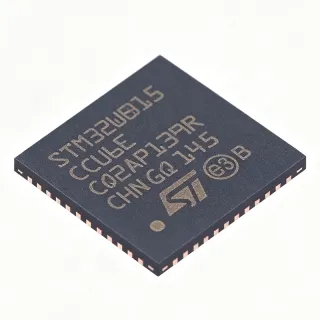
LR2022 - Dual-Band LoRa Plus Transceiver | Semtech
N.º de pieza: LR2022 ✓ Activo| Cant. | Precio unitario | Total |
|---|---|---|
| 1 | $8.5 | $8,50 |
| 10 | $7.65 | $76,50 |
| 100 | $6.8 | $680,00 |
| 500 | $6.1 | $3.050,00 |
| 1.000 | $5.5 | $5.500,00 |
LR2022 Descripción general
An LoRa transceiver is a low-power long-range radio IC that uses Chirp Spread Spectrum (CSS) modulation to deliver multi-kilometer communication at very low receive currents, enabling battery-powered Internet of Things (IoT) nodes. LoRa transceivers belong to the broader family of low-power wide-area network (LPWAN) radios, sitting alongside sub-GHz FSK/FSK-OOK transceivers in the wireless connectivity taxonomy. The LoRa Plus generation extends the legacy LoRa modem with multi-band RF and improved link budget while preserving pin and API compatibility with prior LoRa parts for drop-in migration.
Key features include sub-GHz LoRa modulation, 2.4 GHz LoRa operation, dual receiver inputs (RFI_HF, RFI_LF), low RX current for battery-powered end nodes, and an integrated multi-region synthesizer that reduces external BOM and PCB footprint. The device supports LoRaWAN protocol stacks and proprietary point-to-point links, enabling asset tracking, smart metering, environmental monitoring, and satellite NTN IoT via the 2.4 GHz band. According to the Semtech LR20xx datasheet, the LR2021/LR2022 share the same package as the LR2012 single-band part, simplifying SKU strategy for OEMs serving both sub-GHz-only and dual-band deployments.
The architecture combines an advanced RF front-end, a digital baseband modem optimized for LoRa CSS, and a host SPI interface for microcontroller integration. Compared with the prior Semtech SX1262 and LR1121, the LR2022 fourth-generation IP offers improved sensitivity, faster time-on-air, and lower power consumption per transmitted bit. The 32-VFQFN package includes an exposed thermal pad, allowing the part to be hand-soldered or placed by standard SMT lines.
Typical applications include global asset trackers that roam between sub-GHz regional bands and 2.4 GHz NTN gateways, multi-region smart-meter modules, industrial sensor nodes, agricultural IoT deployments, and consumer connected devices needing a single-SKU worldwide radio. The part pairs naturally with low-power MCUs such as STM32WL or ESP32-S3 over its SPI interface.
When designing with the LR2022, observe Semtech reference-layout guidelines: place the RFI_HF/RFI_LF traces as 50 ohm controlled-impedance lines, keep the exposed pad soldered to a continuous ground plane, and follow the host MCU's SPI timing budget for interrupt-driven packet handling. This page synthesizes distributor availability, package data, and practical design considerations drawn from manufacturer documentation and authorized stockists.
Alternativas directas para LR2022 — mismo encapsulado, compatible pin a pin. Se excluyen las piezas de otro encapsulado que requieren retrabajo de la PCB.
Variantes de esta serie
Modelos de la misma serie compatibles directamente con LR2022 (mismo factor de forma y huella) — difiere en Device Type, Modulation.
Herramienta de comparación rápida — seleccione piezas alternativas para compararlas lado a lado:
LR2021IMLTRT
✅ Sustitución directa ⚠️ Especificaciones sin verificar📋 Alternativa de referencia (no en el catálogo)
LR2012IMLTRT
✅ Sustitución directa ⚠️ Especificaciones sin verificar📋 Alternativa de referencia (no en el catálogo)
LR2022 Especificaciones
| Device Type | IC RF TxRx Only |
| Protocol | LoRa, LoRaWAN |
| Frequency Bands | Sub-GHz ISM and 2.4 GHz ISM |
| Receiver Inputs | RFI_HF (2.4 GHz), RFI_LF (sub-GHz) |
| Modulation | LoRa Chirp Spread Spectrum (CSS); proprietary LoRa |
| Encapsulado | 32-VFQFN Exposed Pad |
| Tipo de montaje | Surface Mount |
| Host Interface | SPI |
| Generation | LoRa Plus (4th generation) |
| Estado RoHS | Compliant |
| Multi-Region SKU Support | Yes (single-SKU global) |
Configuración de pines de LR2022
| Pin 1 | GND — Ground |
| Pin 2 | RFI_LF — Sub-GHz receiver RF input |
| Pin 3 | RFI_HF — 2.4 GHz receiver RF input |
| Pin 4 | GND — Ground |
| Pin 5 | VREG — Voltage regulator bypass/decoupling |
| Pin 6 | VDD — Supply voltage |
| Pin 7 | VDD_IO — Digital I/O supply |
| Pin 8 | RESET — Reset input (active low) |
| Pin 9 | DIO1 — Digital I/O interrupt 1 |
| Pin 10 | DIO2 — Digital I/O interrupt 2 |
| Pin 11 | DIO3 — Digital I/O interrupt 3 |
| Pin 12 | BUSY — Busy status output |
| Pin 13 | SCK — SPI clock |
| Pin 14 | MOSI — SPI master-out slave-in |
| Pin 15 | MISO — SPI master-in slave-out |
| Pin 16 | CSN — SPI chip select (active low) |
| Pin 17 | GND — Ground |
| Pin 18 | TCXO — TCXO/reference input |
| Pin 19 | XTA — Crystal/TCXO connection A |
| Pin 20 | XTB — Crystal/TCXO connection B |
| Pin 21 | GND — Ground |
| Pin 22 | ANT — Antenna interface / RFIO |
| Pin 23 | GND — Ground |
| Pin 24 | TXMOD — TX modulation input |
| Pin 25 | GND — Ground |
| Pin 26 | VDD_PA — Power amplifier supply |
| Pin 27 | GND — Ground |
| Pin 28 | RAMP — PA ramp control |
| Pin 29 | GND — Ground |
| Pin 30 | NC — Not connected (per datasheet) |
| Pin 31 | NC — Not connected (per datasheet) |
| Pin 32 | GND — Ground (exposed pad electrical pin) |
Aplicaciones típicas
LR2022 es adecuado para 6 aplicacións: Global Asset Tracking, Multi-Region Smart Metering, Industrial Environmental Sensors, Agricultural IoT and Smart Farming, 2.4 GHz NTN Satellite IoT, Consumer Connected Devices.
Global Asset Tracking
The LR2022's dual-band RFI_HF/RFI_LF receivers let a single asset tracker roam between regional sub-GHz LoRaWAN networks and worldwide 2.4 GHz links without external band switches. With a 32-VFQFN exposed-pad footprint and LoRa Plus Gen-4 sensitivity, the LR2022 keeps PCB area small while delivering multi-kilometer links typical of container, pallet, and livestock tracking. Per the Semtech LoRa Gen-4 announcement, the dual-band architecture reduces BOM versus Gen-3 designs that needed a separate 2.4 GHz companion IC, enabling a single-SKU global tracker design.
Recomendado
Multi-Region Smart Metering
Smart electricity, water, and gas meters deployed across different countries benefit from the LR2022's multi-region single-SKU design, allowing one PCB to address EU 868 MHz, US 915 MHz, AS 923 MHz, and the worldwide 2.4 GHz band. The LoRa CSS modulation and low RX current support multi-year battery operation typical of utility metering. The 32-VFQFN exposed pad enables compact meter housings and reflow-compatible assembly at scale.
Recomendado
Industrial Environmental Sensors
Industrial IoT sensors measuring temperature, humidity, vibration, or gas concentration leverage the LR2022's LoRaWAN support and dual-band coverage for installations that span ISM regulations globally. Low RX current budget aligns with battery-powered wireless sensor nodes deployed for years without service. The exposed-pad VFQFN package supports sealed enclosures while still providing adequate thermal dissipation for the duty-cycled TX profile.
Recomendado
Agricultural IoT and Smart Farming
Farm deployments across continents benefit from the LR2022's dual-band flexibility - sub-GHz for in-field long-range soil and livestock sensors, 2.4 GHz for greenhouse or near-building links. LoRa CSS modulation tolerates vegetation blockage at the link-budget-versus-throughput trade-offs typical of smart agriculture. The 32-VFQFN exposed pad and minimal external BOM suit weatherproof enclosures used in field installations.
Recomendado
2.4 GHz NTN Satellite IoT
The LR2022's RFI_HF path supports 2.4 GHz NTN (non-terrestrial network) IoT connectivity for satellite-direct asset links, complementing terrestrial sub-GHz LoRaWAN. Per the Semtech Gen-4 launch press release, dual-band coverage enables a single SKU to bridge ground and satellite connectivity. Combined with a low-power MCU, the LR2022 forms the radio core of remote asset terminals that must reach beyond terrestrial gateway coverage.
Recomendado
Consumer Connected Devices
Connected consumer devices sold globally benefit from the LR2022 single-SKU multi-region support, eliminating regional product variants and simplifying logistics. LoRaWAN connectivity supports smart-home, pet tracker, and personal safety applications where long battery life and modest data rates are paramount. The small 32-VFQFN package allows integration into wearables and handheld form factors without excessive PCB real estate.
Recomendado
Resumen de productos recomendados
Datos de referencia de ingeniería para LR2022 — comparación, orientación de diseño e información de cumplimiento.
Guía de selección
Comparación con alternativas
| Parámetro | Este producto | LR2021IMLTRT | LR2012IMLTRT |
|---|---|---|---|
| Brand | Semtech | Semtech | Semtech |
| Package | 32-VFQFN Exposed Pad | 32-VFQFN Exposed Pad - same | 32-VFQFN Exposed Pad - same |
| Frequency Bands | Sub-GHz + 2.4 GHz (dual-band) | Sub-GHz + 2.4 GHz | Sub-GHz only |
| Receiver Inputs | RFI_HF + RFI_LF | RFI_HF + RFI_LF | RFI_LF only |
| Modulation | LoRa CSS | LoRa CSS | LoRa CSS |
| Generation | LoRa Plus (Gen 4) | LoRa Plus (Gen 4) | LoRa Plus (Gen 4) |
| Host Interface | SPI | SPI | SPI |
| Multi-Region Single-SKU | Yes | Yes | Sub-GHz regions only |
Diferenciadores clave
- Fourth-generation LoRa Plus IP with dual-band receiver (frente a SX1262)
- Includes RFI_HF 2.4 GHz receiver input (frente a LR2012)
- Multi-region single-SKU design support (frente a Regional LoRa parts)
Notas de diseño
Route RFI_HF and RFI_LF as 50 ohm controlled-impedance traces, keeping them as short as possible and isolated from digital switching lines. Place the antenna matching network (typically a pi/CLC network) immediately adjacent to the ANT/RFIO pin to minimize loss and common-mode radiation into nearby traces. Reference the Semtech LR20xx reference layout for stack-up and via-fencing patterns; deviating from those guidelines typically drops link budget by several dB at 2.4 GHz.
The 32-VFQFN exposed pad is the primary thermal path for the LR2022 during sustained TX bursts. Solder the exposed pad to a continuous ground/thermal copper pour with multiple thermal vias stitching to inner ground planes. Estimated: in a typical 1-oz 4-layer PCB with 1 cm^2 copper pour, theta_JA lands in the 30-40 C/W range, which is adequate for duty-cycled LoRaWAN profiles (1% or less duty cycle). For continuous TX, derate output power or upgrade to a thicker copper stack-up.
Provide local 100 nF and 10 uF ceramic decoupling on every VDD pin, placed within 1-2 mm of the pad and grounded via short stubs to the exposed pad ground pour. Keep the TCXO supply (if used) on a separate filtered rail if the host clock is not shared with the MCU; the LR2022 expects a clean reference for both sub-GHz and 2.4 GHz PLL loops. Add a ferrite bead or pi filter on VDD_PA to suppress TX harmonics from coupling back into the digital rails.
Información de cumplimiento
RoHS compliance per Semtech product page; remaining compliance fields not stated in the public snippets retrieved on 2026-10-11.