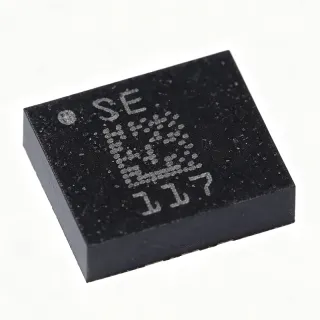
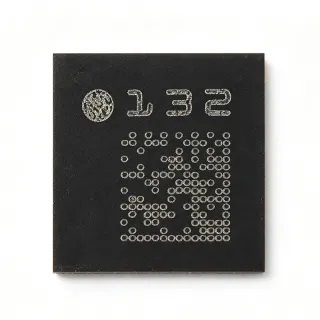
MMA7330LR1 - ±4g/±12g 3-Axis Analog Accelerometer | NXP
N.º de pieza: MMA7330LR1 ✗ Fin de vida| Cant. | Precio unitario | Total |
|---|---|---|
| 1 | $5.85 | $5,85 |
| 10 | $5.27 | $52,70 |
| 100 | $4.7 | $470,00 |
| 500 | $4.23 | $2.115,00 |
| 1.000 | $3.76 | $3.760,00 |
MMA7330LR1 Descripción general
An accelerometer (IC: see Software) is a micro-electromechanical systems (MEMS) sensor that measures proper acceleration along one, two, or three orthogonal axes and converts that mechanical input into an electrical signal. The MMA7330LR1 belongs to the analog accelerometer family within the broader sensor hierarchy: accelerometer -> motion sensor -> inertial sensor -> MEMS device -> sensor IC. Analog-output parts remain in widespread use because they interface directly to low-cost microcontroller analog-to-digital converters (ADC) without needing a dedicated digital driver stack such as I²C or SPI.
Key specifications include 800 mV/g sensitivity (at 3.3 V supply, ±4g mode), 1.5 mg/√Hz typical noise floor, factory-trimmed offset and sensitivity requiring no external components, and an integrated g-Select logic input that lets the host microcontroller toggle between ±4g and ±12g full-scale at runtime. The device draws 400 µA typical supply current, includes a self-test pin that simulates a defined acceleration for end-of-line verification, and survives 10,000 g mechanical shock per the NXP test methodology.
The capacitive sensing cell uses a differential capacitor structure whose deflection produces a proportional ratiometric analog output voltage centered at Vdd/2. The on-chip ASIC performs amplification, temperature compensation, low-pass filtering, and gain setting for the two selectable ranges. Ratiometric output means the zero-g offset and sensitivity scale linearly with supply voltage, simplifying ADC calibration in 3.3 V systems.
Typical applications include tilt sensing in handheld electronics, free-fall detection in hard disk drives and portable computers, vibration monitoring in industrial equipment, motion-based user input for game controllers and remote controls, and orientation detection in consumer appliances. The wide ±12g range additionally supports impact logging in sports and packaging equipment.
When designing with this part, place a 0.1 µF decoupling capacitor adjacent to both Vdd and VddIO pins and route the analog output traces away from switching converters to preserve the 1.5 mg/√Hz noise floor. Always enable self-test during power-on to confirm transducer integrity before trusting the output.
Alternativas directas para MMA7330LR1 — mismo encapsulado, compatible pin a pin. Se excluyen las piezas de otro encapsulado que requieren retrabajo de la PCB.
Variantes de esta serie
Modelos de la misma serie compatibles directamente con MMA7330LR1 (mismo factor de forma y huella) — difiere en Acceleration Range, Operating Temperature, Output Type, Package, Sensor Type.
Herramienta de comparación rápida — seleccione piezas alternativas para compararlas lado a lado:
MMA7331L
✅ Sustitución directa📋 Alternativa de referencia (no en el catálogo)
MMA7340L
✅ Sustitución directa📋 Alternativa de referencia (no en el catálogo)
MMA7360L
✅ Sustitución directa📋 Alternativa de referencia (no en el catálogo)
MMA7450L
✅ Sustitución directa📋 Alternativa de referencia (no en el catálogo)
MMA7361L
✅ Sustitución directa📋 Alternativa de referencia (no en el catálogo)
MMA7330LR1 Valores máximos y características eléctricas
| Tipo de sensor | Accelerometer, 3-axis |
| Tipo de salida | Analog voltage (ratiometric) |
| Axes Measured | X, Y, Z |
| Acceleration Range | ±4g (g-Select low), ±12g (g-Select high) |
| Sensitivity (±4g mode) | 800 mV/g (typical at Vdd=3.3 V) |
| Sensitivity (±12g mode) | 200 mV/g (typical at Vdd=3.3 V) |
| Bandwidth (X, Y) | 400 Hz |
| Bandwidth (Z) | 300 Hz |
| Supply Voltage (Vdd) | 2.2 V to 3.5 V |
| Supply Voltage (VddIO) | 1.71 V to 3.5 V |
| Corriente de alimentación | 400 µA typical |
| Densidad de ruido | 1.5 mg/√Hz typical |
| Temperatura de funcionamiento | -40 °C to +85 °C |
| Self-Test | Yes (active high) |
| Zero-g Offset (factory trim) | Pre-trimmed, no external components required |
| Encapsulado | 14-LGA (3 mm x 5 mm x 1 mm) |
| Tipo de montaje | Surface Mount |
| Shock Survival | 10,000 g (per NXP test methodology) |
| Filter | 1-pole low-pass on-chip |
Configuración de pines de MMA7330LR1
| Pin 1 | Vdd — Analog supply voltage (2.2 V to 3.5 V) |
| Pin 2 | VddIO — Digital I/O supply voltage (1.71 V to 3.5 V) |
| Pin 3 | GND — Ground |
| Pin 4 | Xout — X-axis analog output |
| Pin 5 | Yout — Y-axis analog output |
| Pin 6 | Zout — Z-axis analog output |
| Pin 7 | g-Select — Range select (0 = ±4g, 1 = ±12g) |
| Pin 8 | Self-Test — Self-test enable (active high) |
| Pin 9 | NC — Not connected (per datasheet) |
| Pin 10 | NC — Not connected (per datasheet) |
| Pin 11 | NC — Not connected (per datasheet) |
| Pin 12 | NC — Not connected (per datasheet) |
| Pin 13 | NC — Not connected (per datasheet) |
| Pin 14 | NC — Not connected (per datasheet) |
Aplicaciones típicas
MMA7330LR1 es adecuado para 7 aplicacións: Hard Disk Drive Drop Detection, Handheld Tilt Sensing, Industrial Vibration Monitoring, Game Controller Motion Input, Remote Control Pointer / Air Mouse, Appliance Orientation Detection, Sports Impact Logging.
Hard Disk Drive Drop Detection
The MMA7330's ±4g/±12g selectable range and 400 Hz / 300 Hz bandwidth are well-matched to HDD free-fall detection. The MMA7330L can detect a 0.7 ms free-fall onset through the X and Y axis outputs, triggering the disk head parking sequence before impact. According to NXP's datasheet section on free-fall applications, the 1-pole low-pass filter attenuates high-frequency noise that would otherwise cause false triggers during normal handling.
Recomendado
Handheld Tilt Sensing
The MMA7330's ratiometric analog output centered at Vdd/2 makes it ideal for direct ADC connection to handheld microcontroller tilt-sensing applications. The ±4g range covers typical wrist-tilt motions, while the ±12g range is reserved for impact or shake inputs. The 1.5 mg/√Hz noise density keeps the zero-g drift below 0.1° in handheld orientations, sufficient for screen-rotation and gesture detection in consumer electronics.
Recomendado
Industrial Vibration Monitoring
The MMA7330's 400 Hz X/Y bandwidth and ±12g full-scale range cover most industrial pump and motor vibration spectra. Connecting the Xout/Yout/Zout to a 12-bit ADC at 1 kHz sample rate captures the fundamental 50-60 Hz motor harmonics and bearing-fault frequencies up to 200 Hz. The integrated temperature compensation keeps the zero-g offset within ±25 mg across the -40 °C to +85 °C industrial range without external calibration.
Recomendado
Game Controller Motion Input
The MMA7330's 3-axis analog outputs integrate directly with console game-controller MCUs to capture tilt, shake, and gesture inputs. The 800 mV/g sensitivity in ±4g mode gives 1 g tilt mapping to a clear ADC count, while the ±12g range accommodates aggressive shake gestures. The integrated self-test pin enables end-of-line controller calibration, confirming the MEMS transducer and ASIC chain respond correctly before shipping.
Recomendado
Remote Control Pointer / Air Mouse
The MMA7330's compact 14-LGA (3x5 mm) footprint fits inside handheld remote-control enclosures while delivering the ±4g/±12g sensitivity needed to translate wrist motion into on-screen cursor movement. The 400 Hz X/Y bandwidth captures fast pointer motions without aliasing. The 400 µA typical supply current keeps the remote-control battery budget within typical coin-cell life targets, especially when the MCU sleeps between pointer updates.
Recomendado
Appliance Orientation Detection
The MMA7330's factory-trimmed zero-g offset simplifies appliance orientation detection in washing machines, refrigerators, and HVAC controls. The 1-pole low-pass filter removes the high-frequency vibration noise generated by compressor motors and pumps that would otherwise trigger false tilt events. Operating from a 2.2 V to 3.5 V supply, the part interfaces directly to 3.3 V appliance MCUs without external level shifters.
Recomendado
Sports Impact Logging
The MMA7330's selectable ±12g full-scale range and 10,000 g mechanical shock survival make it suitable for helmet-mounted and wrist-mounted impact loggers in contact sports. The MMA7330L's 1-pole low-pass filter captures the dominant impact spectral energy while attenuating high-frequency noise, allowing a host MCU to compute peak g and impact duration for concussion monitoring. The compact 14-LGA package fits inside small wearable enclosures.
Recomendado
Resumen de productos recomendados
Datos de referencia de ingeniería para MMA7330LR1 — comparación, orientación de diseño e información de cumplimiento.
Guía de selección
Comparación con alternativas
| Parámetro | Este producto | MMA7331L | MMA7340L | MMA7360L | MMA7450L | MMA7361L |
|---|---|---|---|---|---|---|
| Brand | NXP Semiconductors | NXP Semiconductors | NXP Semiconductors | NXP Semiconductors | NXP Semiconductors | NXP Semiconductors |
| Package | 14-LGA (3x5 mm) | 14-LGA (3x5 mm) - same | 14-LGA (3x5 mm) - same | 14-LGA (3x5 mm) - same | 14-LGA (3x5 mm) - same | 14-LGA (3x5 mm) - same |
| Output Type | Analog (ratiometric) | Analog (ratiometric) | Analog (ratiometric) | Analog (ratiometric) | Analog / I²C / SPI selectable | Analog (ratiometric) |
| Selectable Range | ±4g / ±12g | ±2g / ±10g | ±3g / ±11g | ±1.5g / ±6g | ±2g / ±4g / ±8g | ±1.5g / ±6g |
| Sensitivity (±4g or equivalent mode) | 800 mV/g @ 3.3 V | 1200 mV/g @ 3.3 V (±2g mode) | 900 mV/g @ 3.3 V (±3g mode) | 800 mV/g @ 3.3 V (±1.5g mode) | 308 mV/g @ 2.5 V digital (±2g mode) | 800 mV/g @ 3.3 V (±1.5g mode) |
| Bandwidth (X, Y) | 400 Hz | 400 Hz | 400 Hz | 400 Hz | 62.5 Hz / 125 Hz selectable | 400 Hz (2nd-order LPF) |
| Supply Voltage | 2.2 V - 3.5 V | 2.2 V - 3.5 V | 2.2 V - 3.5 V | 2.2 V - 3.5 V | 2.4 V - 3.6 V | 2.2 V - 3.5 V |
| Supply Current | 400 µA | 400 µA | 400 µA | 400 µA | 400 µA (digital mode) | 400 µA |
| Self-Test | Yes | Yes | Yes | Yes | Yes | Yes |
| Lifecycle Status | Obsolete | Obsolete (NRND family) | Obsolete (NRND family) | Obsolete (NRND family) | Obsolete | Obsolete (NRND family) |
Diferenciadores clave
- Higher maximum g-range for impact applications (frente a MMA7331L)
- Wider sensitivity choice in same family (frente a MMA7360L)
- Pure analog ratiometric output simplifies host ADC integration (frente a MMA7450L)
Notas de diseño
Place a 0.1 µF X7R ceramic decoupling capacitor within 5 mm of both the Vdd (pin 1) and VddIO (pin 2) pins to suppress supply transients. According to the NXP datasheet, VddIO can be powered independently of Vdd to allow level-shifting between the analog block and a lower-voltage MCU; however, Vdd must be applied before VddIO to prevent latch-up. A bulk 1 µF tantalum or ceramic on the Vdd rail improves noise rejection during high-acceleration events.
Do not leave the g-Select pin floating; tie it to VddIO or GND through a 100 kΩ resistor to define a known sensitivity at boot. Per datasheet, the self-test pin must remain low during normal operation; pulsing it high applies an electrostatic force that simulates a positive acceleration on each axis, used for end-of-line verification. Driving the self-test pin for longer than the datasheet-specified duration may cause offset drift and is not recommended.
Route the analog Xout, Yout, and Zout traces as differential pairs with ground guard traces on a high-speed layout layer to preserve the 1.5 mg/√Hz noise density. Per NXP layout guidelines, keep the analog traces away from switching DC-DC converter inductors and away from high-current digital buses; place the sensor on a stiff section of the PCB to minimize vibration-induced mechanical noise. A ground flood under the package improves thermal dissipation and EMI immunity.
The MMA7330L analog outputs are ratiometric to the supply, meaning zero-g offset and sensitivity both scale linearly with Vdd. Estimated: at Vdd = 3.3 V, zero-g output is 1.65 V and sensitivity is 800 mV/g (±4g mode); at Vdd = 2.8 V, zero-g drops to 1.40 V and sensitivity to 678 mV/g. To minimize ADC quantization error, supply the MCU ADC reference from the same Vdd rail as the MMA7330L whenever possible, or apply software calibration to remove the ratiometric gain error.
Información de cumplimiento
RoHS, REACH, and halogen-free status were not explicitly provided in the verified web data and are marked as unknown. Lead-free packaging confirmed by NXP LGA product family standard. AEC-Q100 not applicable - this is a consumer-grade accelerometer not qualified for automotive safety.