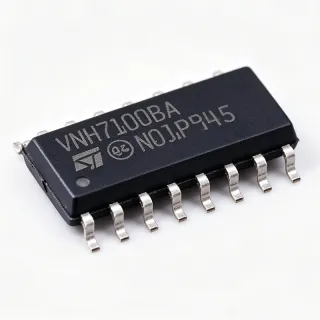
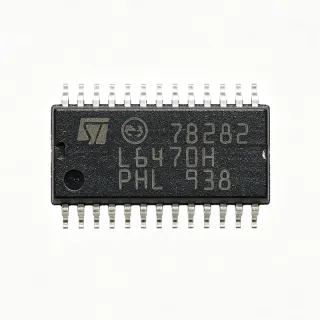
MPC17529EV - 0.7A Dual H-Bridge Motor Driver | NXP | 20-VMFP
N.º de pieza: MPC17529EV ✓ Activo| Cant. | Precio unitario | Total |
|---|---|---|
| 1 | $3.85 | $3,85 |
| 10 | $3.42 | $34,20 |
| 100 | $2.95 | $295,00 |
| 500 | $2.55 | $1.275,00 |
| 1.000 | $2.18 | $2.180,00 |
MPC17529EV Descripción general
What is an H-Bridge motor driver? An H-Bridge motor driver is a power integrated circuit that uses four switching elements arranged in an "H" topology to drive a DC or stepper motor bidirectionally from a single polarity supply. Two H-Bridges integrated on a single die (a "dual H-Bridge") allow one IC to drive either one bipolar stepper motor (using both bridges as the two windings) or two DC motors (forward/reverse each). H-Bridge motor drivers sit within the broader hierarchy of motor control ICs, which in turn belong to power management semiconductors. By integrating power stage, charge pump, shoot-through protection, and logic interface on-chip, dual H-Bridge drivers simplify portable and battery-powered motion designs.
Key features of the MPC17529EV include 700 mA continuous output current per H-Bridge, an integrated charge pump for the high-side drivers, built-in shoot-through current protection to prevent simultaneous turn-on of high-side and low-side FETs, undervoltage lockout for safe startup and shutdown, and parallel MCU-compatible I/O. The two bridges can be paralleled for higher current loads in DC motor applications, or used independently for bipolar stepper drive with microstepping controlled externally.
Typical applications include camera lens autofocus and iris mechanisms, disk drive head positioners, bipolar stepper motor actuation in portable printers and scanners, robotic toys, and small DC brushed-motor loads in handheld consumer electronics. Independent control of each H-Bridge via the parallel interface allows flexible step/direction sequencing or dual forward/reverse DC control with minimal firmware overhead.
When designing with this part, observe the absolute maximum motor supply voltage and ensure that motor stall current stays within the 0.7 A rating with adequate thermal margin. Place the charge-pump capacitor (CP1, CP2) close to the IC, and follow the datasheet guidance on bulk decoupling at VM and VCC to avoid logic-level noise coupling into the gate drive.
This page synthesizes distributor pricing, drop-in alternatives, and design considerations that complement the manufacturer datasheet rather than restating it verbatim.
Alternativas directas para MPC17529EV — mismo encapsulado, compatible pin a pin. Se excluyen las piezas de otro encapsulado que requieren retrabajo de la PCB.
Herramienta de comparación rápida — seleccione piezas alternativas para compararlas lado a lado:
MPC17529ER
✅ Sustitución directa📋 Alternativa de referencia (no en el catálogo)
MPC17529AE
✅ Sustitución directa📋 Alternativa de referencia (no en el catálogo)
MPC17531A
✅ Sustitución directa📋 Alternativa de referencia (no en el catálogo)
MPC17510AE
✅ Sustitución directa📋 Alternativa de referencia (no en el catálogo)
MPC17533A
✅ Sustitución directa📋 Alternativa de referencia (no en el catálogo)
MPC17529EV Valores máximos y características eléctricas
| Motor Supply Voltage (VM) | 2.0 V to 6.8 V |
| Logic Supply Voltage (VCC) | 2.7 V to 5.6 V |
| Continuous Output Current (per H-Bridge) | 700 mA |
| Number of H-Bridges | 2 (dual) |
| Número de salidas | 1 (configurable as dual full-bridge or single paralleled) |
| Load Voltage | 2 V to 6.8 V |
| Logic Interface | 3.0 V / 5.0 V compatible CMOS parallel |
| On-Chip Charge Pump | Yes |
| Shoot-Through Protection | Yes (built-in) |
| Undervoltage Shutdown | Yes |
| Motor Type | Bipolar stepper / brushed DC |
| Operating Mode | Parallel MCU interface |
| Encapsulado | 20-VMFP (Small Outline, SMD) |
| Recuento de pines | 20 |
| Tipo de montaje | Surface Mount |
Configuración de pines de MPC17529EV
| Pin 1 | OUT1A — H-Bridge 1 output A |
| Pin 2 | OUT1B — H-Bridge 1 output B |
| Pin 3 | VM1 — Motor supply 1 |
| Pin 4 | GND — Ground |
| Pin 5 | IN1A — Logic input 1A |
| Pin 6 | IN1B — Logic input 1B |
| Pin 7 | EN1 — H-Bridge 1 enable |
| Pin 8 | VCC — Logic supply |
| Pin 9 | CP1 — Charge pump capacitor 1 |
| Pin 10 | CP2 — Charge pump capacitor 2 |
| Pin 11 | GND — Ground |
| Pin 12 | IN2A — Logic input 2A |
| Pin 13 | IN2B — Logic input 2B |
| Pin 14 | EN2 — H-Bridge 2 enable |
| Pin 15 | VM2 — Motor supply 2 |
| Pin 16 | OUT2B — H-Bridge 2 output B |
| Pin 17 | OUT2A — H-Bridge 2 output A |
| Pin 18 | GND — Ground |
| Pin 19 | NC — Not connected (per datasheet) |
| Pin 20 | NC — Not connected (per datasheet) |
Aplicaciones típicas
MPC17529EV es adecuado para 6 aplicacións: Camera Lens Autofocus and Iris Mechanism, Disk Drive Head Positioner, Portable Printer and Scanner Stepper Drive, Robotic Toy and Hobby Motor Control, Small Brushed DC Actuator in Consumer Electronics, Battery-Powered Stepper Valve and Pump Control.
Camera Lens Autofocus and Iris Mechanism
The MPC17529EV's dual H-Bridge topology and 700 mA per-bridge output make it a strong fit for camera autofocus (AF) and iris actuator drives. Each H-Bridge independently drives one tiny bipolar stepper or voice-coil actuator, with 3.0 V/5.0 V logic interfacing directly to the image processor. The integrated shoot-through protection prevents simultaneous high-side/low-side turn-on that would otherwise stress the AF motor windings, and the 2.0 V to 6.8 V motor supply covers both small Li-ion and 2-cell alkaline camera battery architectures. Compared to discrete FET bridges, the MPC17529EV reduces BOM count by combining charge pump, logic interface, and protection on one die in a compact 20-VMFP package.
Recomendado
Disk Drive Head Positioner
The MPC17529EV drives the bipolar stepper that positions the read/write head in small form-factor disk drives. Its parallel 3.0 V/5.0 V logic interface accepts step/direction pulses from the disk controller without level shifting, while the dual H-Bridge architecture handles both stepper windings on a single IC. The on-board charge pump and undervoltage lockout ensure clean head parking during power-down events. At 2.0 V to 6.8 V motor supply, the part accepts the 3.3 V or 5 V rails typical of HDD electronics, and the integrated shoot-through protection prevents the head-positioning glitches caused by cross-conduction.
Recomendado
Portable Printer and Scanner Stepper Drive
Portable printers and handheld barcode imagers rely on compact stepper motor control for paper feed, carriage motion, and scan mechanisms. The MPC17529EV's 700 mA per-bridge rating and 2.0 V to 6.8 V motor supply match the bipolar stepper requirements of these designs, while the small 20-VMFP outline fits crowded PCB layouts. Designers benefit from the integrated shoot-through and undervoltage protection when the device is hot-plugged or run from partially discharged Li-ion packs. With 3.0 V/5.0 V parallel logic, the part accepts step/direction signals directly from low-power MCU GPIO without external level translation.
Recomendado
Robotic Toy and Hobby Motor Control
The MPC17529EV drives the brushed DC motors commonly found in robotic toys, hobby servos, and educational robot kits. With two H-Bridges per chip, a single MPC17529EV powers a differential-drive robot's left and right motors, supporting forward, reverse, and brake modes. The 700 mA continuous rating per bridge handles small gearbox motors under typical toy loads, and the parallel logic interface lets simple 3.3 V MCUs command the motors without PWM chopping hardware. The integrated charge pump and protection features reduce external component count, helping keep toy BOM cost and PCB area low while improving reliability against motor back-EMF events.
Recomendado
Small Brushed DC Actuator in Consumer Electronics
The MPC17529EV is a strong fit for small brushed DC motors that perform mechanical functions in handheld consumer electronics - for example, lens covers, vibration alert motors, or focus mechanisms in camcorders. Its dual output lets one IC handle two such actuators independently. The 2.0 V to 6.8 V motor supply covers single-cell Li-ion and 2x AA/AAA alkaline sources common in portable devices, and the logic interface accepts 3.0 V or 5.0 V CMOS signals from the host MCU. Integrated protections including shoot-through and undervoltage shutdown improve robustness against the harsh electrical environment of brushed motors.
Recomendado
Battery-Powered Stepper Valve and Pump Control
Battery-powered fluid handling systems, such as portable infusion pumps, nebulizers, and small valve actuators, often use bipolar stepper motors for precise flow control. The MPC17529EV drives these steppers directly from a 1S Li-ion or 2-cell alkaline pack (2.0 V to 6.8 V) with 700 mA per winding - sufficient for many micro-pump and valve designs. The parallel 3.0 V/5.0 V logic interface simplifies MCU integration, and the integrated undervoltage lockout protects the motor and battery during low-voltage cutoff events. The 20-VMFP package footprint supports the small PCB areas required in compact medical or industrial handheld enclosures.
Recomendado
Resumen de productos recomendados
Datos de referencia de ingeniería para MPC17529EV — comparación, orientación de diseño e información de cumplimiento.
Guía de selección
Comparación con alternativas
| Parámetro | Este producto | MPC17529ER | MPC17529AE | MPC17531A | MPC17510AE | MPC17533A |
|---|---|---|---|---|---|---|
| Package | 20-VMFP | 20-VMFP - same | 20-VMFP - same | 20-VMFP - same | 20-VMFP - same | 20-VMFP - same |
| Brand | NXP Semiconductors | NXP Semiconductors | NXP Semiconductors | NXP Semiconductors | NXP Semiconductors | NXP Semiconductors |
| Motor Supply Voltage (VM) | 2.0 V to 6.8 V | 2.0 V to 6.8 V | 2.0 V to 6.8 V | 2.0 V to 6.8 V | 2.0 V to 6.8 V | 2.0 V to 6.8 V |
| Logic Supply Voltage (VCC) | 2.7 V to 5.6 V | 2.7 V to 5.6 V | 2.7 V to 5.6 V | 2.7 V to 5.6 V | 2.7 V to 5.6 V | 2.7 V to 5.6 V |
| Number of H-Bridges | 2 | 2 | 2 | 2 | 2 | 2 |
| On-Chip Charge Pump | Yes | Yes | Yes | Yes | Yes | Yes |
| Shoot-Through Protection | Yes | Yes | Yes | Yes | Yes | Yes |
Diferenciadores clave
- Dual H-Bridge with 700 mA per bridge and integrated charge pump (frente a Discrete FET H-Bridge designs)
- 3.0 V/5.0 V parallel logic interface direct to MCU (frente a Motor drivers requiring SPI or PWM current-loop control)
- On-chip shoot-through and undervoltage protection (frente a MPC17510AE (lower-current 400 mA family member))
Notas de diseño
Estimated: at VM = 5.0 V continuous and 700 mA per H-Bridge, conduction dissipation is roughly 5 V × 0.7 A = 3.5 W if the bridge is fully on (worst case DC). Practical motor drive losses depend on PWM duty cycle and H-Bridge Rdson; consult the datasheet for thermal derating curves. Place a 10 µF or greater bulk capacitor at VM and a 0.1 µF ceramic decoupler close to each VM pin to absorb motor back-EMF.
Place the external charge-pump capacitor (typically 0.1 µF ceramic) between CP1 and CP2 with traces kept short and symmetric to minimize high-side gate drive ringing. Keep motor output traces (OUT1A/B, OUT2A/B) short and wide to reduce parasitic inductance, and provide a solid ground pour under the IC for heat spreading. Avoid routing logic lines (INx, ENx) parallel to motor outputs to prevent logic-noise coupling.
Do not exceed the absolute maximum VM of 6.8 V - even brief transients from motor back-EMF can exceed this. Add a TVS or schottky clamp at VM if the motor's inductance is high. Always observe the shoot-through protection dead-time by avoiding logic inputs that command high-side and low-side FETs on simultaneously - the integrated protection helps but cannot substitute for correct MCU sequencing. Confirm undervoltage lockout threshold for your specific supply rail before designing power-up sequencing.
Separate the noisy motor return path from the quiet logic ground at a single star point under the IC GND pin to avoid ground bounce coupling into IN/EN lines. The 20-VMFP exposed thermal path requires adequate copper pour on the PCB; without it, sustained 700 mA loads may thermally limit the part. For high-current DC-motor use, consider paralleling the two H-Bridges per the datasheet's instructions and verify thermal margins in your specific application.
Información de cumplimiento
Compliance flags not present in the web data provided; engineer should request the full material declaration from NXP or Rochester Electronics for production builds.