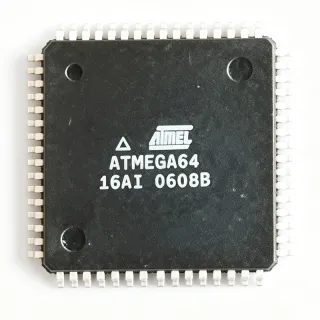
PIC16F877T-10E/PT - 10MHz 8-Bit Flash MCU | Microchip
N.º de pieza: PIC16F877T-10E/PT ✓ ActivoPIC16F877T-10E/PT Descripción general
A microcontroller is a programmable semiconductor that integrates a CPU core, memory, peripherals, and I/O in one package. The PIC16F877 belongs to the PIC16 8-bit family and implements Microchip's PIC architecture with 35 single-word instructions and 200 ns instruction execution. This hierarchy places it below flash-based MCU, embedded controller, and semiconductor categories.
Key device characteristics include 10 MHz operation, 14 KB of Flash memory, 368 bytes of data RAM, 33 I/O pins, and an integrated 10-bit ADC. The T suffix identifies the surface-mount package configuration, while the -10E speed and temperature grade corresponds to 10 MHz operation. Its broad peripheral mix supports designs requiring simultaneous digital control, analog measurement, and serial communication.
The PIC16F877 architecture combines flash-resident program storage with dedicated peripherals for communication and analog measurement. The 8 x 10-bit ADC provides eight analog input channels, while the listed I2C, SPI, and UART/USART interfaces allow the MCU to connect sensors, transceivers, memories, and host systems. Upward compatibility with earlier PIC16C5X, PIC12CXXX, and PIC16C7X devices is identified on the manufacturer product page.
Typical uses include industrial controllers, instrumentation, communication equipment, data acquisition modules, and embedded automation systems. Its 33 I/O pins can support digital inputs, outputs, and peripheral signals, while the ADC permits direct connection of analog sensors. Serial interfaces reduce external component requirements in designs using compatible sensors, displays, or communication transceivers.
Designers should verify the complete 44-pin assignment, peripheral multiplexing, oscillator configuration, and programming interface against the manufacturer datasheet before PCB release. Software should also be validated at the maximum intended clock and across the required environmental range. The manufacturer identifies PIC16F887 as a newer device to consider for new designs.
This page consolidates verified distributor specifications, lifecycle information, practical application guidance, and same-family replacement considerations. It also distinguishes genuine package-compatible options from broader functional alternatives and highlights where firmware, pin multiplexing, and qualification checks remain necessary.
Alternativas directas para PIC16F877T-10E/PT — mismo encapsulado, compatible pin a pin. Se excluyen las piezas de otro encapsulado que requieren retrabajo de la PCB.
Variantes de esta serie
Modelos de la misma serie compatibles directamente con PIC16F877T-10E/PT (mismo factor de forma y huella) — difiere en Package, Serial Interfaces, ADC, Architecture, I/O Pins.
PIC16F877-10E/PT
✅ Sustitución directaConsulte el precio
Ver hoja de datos →PIC16F877A-10E/PT
✅ Sustitución directa ⚠️ Especificaciones sin verificar📋 Alternativa de referencia (no en el catálogo)
PIC16F887-04E/PT
✅ Sustitución directa ⚠️ Especificaciones sin verificar📋 Alternativa de referencia (no en el catálogo)
PIC16F877T-04E/PT
✅ Sustitución directa ⚠️ Especificaciones sin verificarConsulte el precio
Ver hoja de datos →PIC16F877T-20I/PT
✅ Sustitución directa ⚠️ Especificaciones sin verificarConsulte el precio
Ver hoja de datos →PIC16F877T-10E/PT Valores máximos y características eléctricas
| Microcontroller Type | 8-bit CMOS Flash microcontroller |
| Frecuencia de reloj máxima | 10 MHz |
| Flash Program Memory | 14 KB (8K x 14 words) |
| Data RAM | 368 bytes |
| ADC Resolution | 8 x 10-bit ADC |
| Number of I/O Pins | 33 pins |
| Serial Interfaces | I2C, SPI, UART/USART |
| Encapsulado | 44-TQFP (10 x 10 mm) |
| Tipo de montaje | Surface mount |
| Instruction Set | 35 single-word instructions |
| Instruction Execution Time | 200 ns |
| Program Memory Type | Flash |
| Architecture | PIC 8-bit architecture |
| Analog Input Channels | 8 channels |
| Lifecycle Stage | Active |
Guía de configuración de pines de PIC16F877T-10E/PT 44-tqfp (10 x 10 mm)
Configuración de pines para PIC16F877T-10E/PT (encapsulado 44-tqfp (10 x 10 mm)). Este CI digital incluye GPIO, interfaces de comunicación (UART, SPI, I2C) y pines de alimentación. Consulte la hoja de datos del fabricante para conocer las funciones alternativas de los pines y las opciones de configuración. Esencial para el diseño de sistemas embebidos y el diseño de PCB.

No hay datos detallados de patillaje disponibles para PIC16F877T-10E/PT.
Consulte la hoja de datos para ver la configuración completa de patillas.
Aplicaciones típicas
PIC16F877T-10E/PT es adecuado para 6 aplicacións: Industrial Control Systems, Data Acquisition Module, Serial Communication Controller, Instrumentation and Sensor Interface, Appliance and Embedded Automation, Legacy Peripheral Emulation and Upgrade.
Industrial Control Systems
PIC16F877T-10E/PT fits supervisory and sequencing controllers because its 10 MHz clock, 14 KB of Flash program memory, and 33 I/O pins provide useful control capacity for discrete inputs, relays, indicators, and actuator commands. The 368 bytes of RAM support moderate working data, while the 8 x 10-bit ADC can monitor analog plant conditions. In an industrial controller, the device could supervise sensors, execute a state machine, and report status through UART/USART. Before deployment, engineers should verify the exact pin multiplexing, timing margins at 10 MHz, isolation boundaries, surge requirements, and environmental operating limits. Firmware should include safe-state behavior for power-up, communication loss, and invalid sensor readings.
Recomendado
Data Acquisition Module
The PIC16F877T-10E/PT is appropriate for compact data-acquisition modules because its integrated 8 x 10-bit ADC can sample up to eight analog channels while the 33 available I/O pins support digital status, triggers, and communications. Its 14 KB Flash space can hold sampling routines and calibration logic, and the 368-byte RAM is suitable for buffering moderate datasets. A practical implementation would configure the ADC channels, accumulate measurements in RAM, and transfer blocks through SPI, I2C, or UART/USART. Engineers must account for the ADC’s specified input range, acquisition time, source impedance, sampling rate, and pin reuse, none of which are fully listed in the verified excerpts, and should confirm those values in the manufacturer datasheet.
Recomendado
Serial Communication Controller
PIC16F877T-10E/PT can serve as a protocol hub or service controller because I2C, SPI, and UART/USART are available within the same 8-bit MCU. I2C is suitable for sensors and small EEPROMs, SPI supports higher-throughput peripherals, and UART/USART provides a straightforward host interface. The 10 MHz operating speed and 14 KB of program memory provide enough capacity for command parsing, status reporting, and basic protocol conversion. Designers should assign interfaces to nonconflicting pins, validate bus pull-ups and signal levels, and include timeout handling for stalled peripherals. Because several peripheral functions can share pins, the final schematic and firmware must be checked together against the package-specific pin table.
Recomendado
Instrumentation and Sensor Interface
The PIC16F877T-10E/PT works well in instrumentation front ends that need local control, analog measurement, and service communications. Its eight-channel 10-bit ADC can acquire sensor outputs, while 33 I/O pins can support threshold inputs, calibration selects, displays, alarm outputs, and digital sensors. The MCU can scale readings, apply calibration coefficients, and send results through UART/USART or another serial interface. For accurate measurements, engineers must use suitable input-conditioning networks, account for ADC input characteristics and noise, and ensure the analog return path is handled correctly. The 10 MHz clock supports responsive control without requiring a higher-complexity processor, provided that interrupt latency and sampling deadlines are included in firmware verification.
Recomendado
Appliance and Embedded Automation
PIC16F877T-10E/PT provides sufficient compute and peripheral capacity for appliance controllers, building equipment modules, and compact automation products. The 14 KB of Flash can store a boot sequence, operating-state logic, diagnostic routines, and communication handlers, while the ADC supports temperature, level, or pressure monitoring. Its 33 I/O pins are useful for keys, indicators, relays, and sensor connections, and UART/USART can support diagnostics or an external controller. Design teams should establish a safe output state during reset, include watch-period checks around critical actuators, and validate brownout behavior. For new production programs, PIC16F887 may offer a modern path, but the existing PIC16F877T-10E/PT remains useful when software and board compatibility are priorities.
Recomendado
Legacy Peripheral Emulation and Upgrade
PIC16F877T-10E/PT is relevant to legacy embedded systems that require an 8-bit PIC control architecture and a 44-TQFP surface-mount implementation. Its 10 MHz clock, 14 KB Flash memory, 368-byte RAM, and established I2C, SPI, and UART/USART peripherals can support direct replacement of aging discrete control logic. A migration usually begins by identifying oscillator pins, power rails, programming connections, and every multiplexed I/O function. The manufacturer states that PIC16F877 is upward compatible with earlier PIC16C5X, PIC12CXXX, and PIC16C7X devices, supporting the family’s role in long-lived designs. Nevertheless, pin-by-pin comparison and firmware regression testing remain essential because package suffixes and peripheral revisions can affect board-level assumptions.
Recomendado
Resumen de productos recomendados
Datos de referencia de ingeniería para PIC16F877T-10E/PT — comparación, orientación de diseño e información de cumplimiento.
Guía de selección
Comparación con alternativas
| Parámetro | Este producto | PIC16F877-10E/PT | PIC16F877A-10E/PT | PIC16F887-04E/PT | PIC16F877T-04E/PT | PIC16F877T-20I/PT |
|---|---|---|---|---|---|---|
| Brand | Microchip Technology | Microchip Technology | Microchip Technology | Microchip Technology | Microchip Technology | Microchip Technology |
| Package | 44-TQFP (10 x 10 mm) | 44-TQFP | 44-TQFP | 44-TQFP | 44-TQFP | 44-TQFP |
| Maximum Clock Frequency | 10 MHz | 10 MHz | 10 MHz | 4 MHz | 4 MHz | 20 MHz |
| Architecture | PIC 8-bit architecture | PIC 8-bit architecture | PIC16F877A family | PIC16F family | PIC 8-bit architecture | PIC 8-bit architecture |
Diferenciadores clave
- Verified 10 MHz operating grade (frente a PIC16F887-04E/PT)
- Higher processing headroom than the -04 grade (frente a PIC16F877T-04E/PT)
- Integrated eight-channel 10-bit conversion (frente a PIC16F877-10E/PT)
Notas de diseño
Do not treat a shared 44-pin count as proof of drop-in compatibility. Confirm the exact TQFP case dimensions, exposed-pad arrangement, pin numbering, power pins, oscillator pins, programming pins, and every multiplexed peripheral function for PIC16F877T-10E/PT and the proposed alternative. The verified excerpts do not include a complete pin table, so a manufacturer-datasheet comparison and schematic review must precede any substitution.
Separate analog and digital supply requirements at the board level, but follow the datasheet's exact VDD and VSS connections. Place decoupling capacitors close to the device's supply pins, maintain a low-impedance ground return, and avoid routing ADC inputs through switching-current paths. Because no recommended capacitance, ESR, or power-consumption values are present in the verified excerpts, use the manufacturer guidance rather than a generic value.
Assign oscillator, programming, serial, and analog signals during schematic capture and verify that alternate peripheral functions do not conflict with existing PCB connections. Keep the 10 MHz clock routing short and away from high-current switching nodes. For UART, SPI, and I2C interfaces, check impedance, pull-up requirements, grounding, and signal levels using the actual peripheral and transceiver documentation.
The manufacturer product page identifies PIC16F887 as a newer device to consider. Do not assume that this recommendation means that every existing PIC16F877 design can be updated without changes. Compare peripheral assignments, interrupt behavior, memory organization, oscillator options, configuration bits, and development-tool support, then run application-level regression tests and board-level timing measurements.
Información de cumplimiento
The verified excerpts identify the product as active but do not provide explicit RoHS, REACH, AEC-Q100, lead-free, halogen-free, or conflict-minerals declarations.