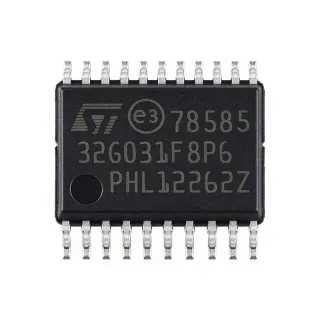
STM32L031F4P3 - 32MHz, 16KB Flash MCU | STMicroelectronics
N.º de pieza: STM32L031F4P3 ✓ Activo| Cant. | Precio unitario | Total |
|---|---|---|
| 1 | $0 | $0,00 |
| 10 | $0 | $0,00 |
| 100 | $0 | $0,00 |
| 500 | $0 | $0,00 |
| 1.000 | $0 | $0,00 |
STM32L031F4P3 Descripción general
A microcontroller such as the STM32L031F4P3 integrates a CPU core, Flash program memory, SRAM, peripheral interfaces, clock circuitry, and power-management functions on one semiconductor device. In the broader hierarchy, it is an embedded microcontroller, part of the ARM Cortex-M family, and specifically an STM32L0 ultra-low-power MCU. The Cortex-M0+ architecture is designed for cost-sensitive, compact embedded control rather than high-performance computing.
Verified product information confirms a 32-bit Cortex-M0+ core, 32 MHz maximum CPU frequency, and 16 KB Flash memory. The 20-TSSOP package keeps the lead count manageable for space-constrained boards while supporting automated assembly. A 3 V operating supply is identified in the distributor result, while detailed electrical limits, SRAM capacity, GPIO count, timer resources, ADC specifications, and current consumption were not supplied in the verified data and require confirmation from the manufacturer datasheet.
Typical design uses include battery-powered sensor nodes, compact industrial controllers, low-power monitoring equipment, simple actuator controllers, and embedded accessory boards. The MCU can execute firmware from its internal Flash and coordinate inputs and outputs through its integrated peripherals. Because peripheral assignments, alternate functions, and electrical characteristics are not included in the supplied records, final PCB and firmware decisions should be based on the STM32L031F4 datasheet and its pin, timing, and power-information sections.
For PCB implementation, preserve the package footprint and pin numbering of the 20-pin TSSOP, route decoupling close to the supply pins, and validate signal levels against the confirmed operating-voltage range. Firmware development should account for the STM32L0 peripheral architecture and low-power modes. This page consolidates the verified distributor and manufacturer information while distinguishing confirmed facts from specifications that still require datasheet verification.
Alternativas directas para STM32L031F4P3 — mismo encapsulado, compatible pin a pin. Se excluyen las piezas de otro encapsulado que requieren retrabajo de la PCB.
Variantes de esta serie
Modelos de la misma serie compatibles directamente con STM32L031F4P3 (mismo factor de forma y huella) — difiere en Flash Memory, Maximum CPU Frequency.
Herramienta de comparación rápida — seleccione piezas alternativas para compararlas lado a lado:
STM32F030F4P6
✅ Sustitución directa✓ En stock
$0.5768 / unidad
Ver hoja de datos →STM32F042F4P6
✅ Sustitución directa📋 Alternativa de referencia (no en el catálogo)
STM32G041F6P6
✅ Sustitución directa📋 Alternativa de referencia (no en el catálogo)
STM32L031F4P3 Valores máximos y características eléctricas
| Product Type | 32-bit ultra-low-power microcontroller |
| Processor Core | ARM Cortex-M0+ |
| CPU Architecture | 32-bit |
| Maximum CPU Frequency | 32 MHz |
| Flash Memory | 16 KB |
| Flash Organization | 16K x 8 |
| Series | STM32L0 |
| Product Line | STM32L031 |
| Tensión de alimentación | 3 V |
| Encapsulado | 20-pin TSSOP |
| Tipo de montaje | Surface mount |
Guía de configuración de pines de STM32L031F4P3 20-pin tssop
Configuración de pines para STM32L031F4P3 (encapsulado 20-pin tssop). Este CI digital incluye GPIO, interfaces de comunicación (UART, SPI, I2C) y pines de alimentación. Consulte la hoja de datos del fabricante para conocer las funciones alternativas de los pines y las opciones de configuración. Esencial para el diseño de sistemas embebidos y el diseño de PCB.

No hay datos detallados de patillaje disponibles para STM32L031F4P3.
Consulte la hoja de datos para ver la configuración completa de patillas.
Aplicaciones típicas
STM32L031F4P3 es adecuado para 6 aplicacións: Battery-Powered Sensor Node, Compact Industrial Control Module, Low-Power Monitoring Device, Simple Actuator Controller, Accessory and Configuration Board, Low-Power Consumer Device.
Battery-Powered Sensor Node
STM32L031F4P3 fits a compact sensor node when the design needs a 32-bit ARM Cortex-M0+ controller, 16 KB of internal Flash, and an ultra-low-power MCU family without a large package. The device can manage sensor sampling, local thresholds, and low-frequency status updates while operating from a verified 3 V supply. Its 20-pin TSSOP footprint helps preserve board area in a small enclosure. Before final selection, confirm active and sleep current, wake-up timing, ADC characteristics, and the exact GPIO allocation for the chosen sensors.
Recomendado
Compact Industrial Control Module
The STM32L031F4P3 can serve as the control MCU in a compact industrial module that monitors digital inputs, drives discrete outputs, and handles basic sequencing. Its 32 MHz Cortex-M0+ core provides sufficient control bandwidth for low-to-moderate embedded logic, while 16 KB Flash is appropriate for firmware focused on state machines, communication handling, and configuration. The 3 V supply and 20-pin TSSOP package are useful for space-constrained assemblies. Confirm noise immunity, input thresholds, watchdog behavior, and peripheral availability in the manufacturer documentation.
Recomendado
Low-Power Monitoring Device
STM32L031F4P3 is appropriate for a standalone monitoring device that periodically reads inputs, evaluates thresholds, records events, and reports status. Its STM32L0 ultra-low-power positioning can help designers target battery-operated equipment, provided the verified sleep and active current figures meet the system budget. The 16 KB Flash capacity constrains local data logging, so applications should use external storage when event histories must be retained. Validate the ADC, comparator, timer, and communication interfaces required by the measurement chain.
Recomendado
Simple Actuator Controller
The STM32L031F4P3 can control a simple relay, valve, motor driver input, or indicator circuit when the application requires a compact microcontroller and modest firmware size. Its 32-bit Cortex-M0+ core can execute deterministic control logic, debounce inputs, update outputs, and manage communication commands. The 20-pin TSSOP package keeps routing manageable, although the number and electrical characteristics of usable GPIOs must be verified from the exact pinout. Add appropriate transistor or driver circuitry for loads rather than powering actuators directly from MCU pins.
Recomendado
Accessory and Configuration Board
STM32L031F4P3 works as a configuration and accessory controller for systems that need local firmware, status LEDs, button handling, and a communication link. The 16 KB Flash supports a focused embedded application rather than a large graphical or high-end compute workload, while the 32 MHz core provides responsive control behavior. The TSSOP package can simplify assembly when the board is already designed for surface-mount components. Validate boot configuration, programming access, serial interfaces, and unused-pin treatment against the official datasheet.
Recomendado
Low-Power Consumer Device
STM32L031F4P3 can be used in a compact consumer device that needs low-power embedded control rather than a high-performance processor. The verified 32 MHz Cortex-M0+ core and 16 KB Flash are suitable for user-interface state handling, simple sensing, and actuator sequencing. The 3 V supply aligns with many low-voltage portable designs, but battery chemistry, regulator efficiency, sleep current, and wake-up behavior remain critical design inputs. Confirm whether the required consumer interfaces and user feedback functions are present before selecting this small-memory MCU.
Recomendado
Resumen de productos recomendados
Datos de referencia de ingeniería para STM32L031F4P3 — comparación, orientación de diseño e información de cumplimiento.
Guía de selección
Comparación con alternativas
| Parámetro | Este producto | STM32F030F4P6 | STM32F042F4P6 | STM32G041F6P6 |
|---|---|---|---|---|
| Brand | STMicroelectronics | STMicroelectronics | STMicroelectronics | STMicroelectronics |
| Package | 20-pin TSSOP | TSSOP-20 | TSSOP-20 | TSSOP-20 |
| Product Positioning | Ultra-low-power STM32L0 MCU | STM32F0 entry-level MCU | Arm Cortex-M0 USB line MCU | Compact STM32G0 MCU |
Diferenciadores clave
- Low-power STM32L0 positioning (frente a STM32F030F4P6)
- Cortex-M0+ architecture (frente a STM32F042F4P6)
- Compact 32 MHz implementation (frente a STM32F042F4P6)
Notas de diseño
Use the exact 20-pin TSSOP land pattern from the STM32L031F4 manufacturer package drawing rather than a generic 20-pin footprint. Confirm pin numbering, lead pitch, body width, and courtyard clearance before PCB release. Place the MCU close to its support components and preserve the exposed copper and solderable land requirements shown by the selected package documentation.
Plan the power tree around the verified 3 V supply designation, but obtain the complete minimum and maximum voltage limits from the manufacturer datasheet before selecting regulators or level shifters. Place decoupling capacitors near the supply pins with traces short, low-inductance, and free of unnecessary switching-current paths. Validate startup, brownout, and operating-current requirements across standby and active states.
Do not treat same-package STM32 candidates as automatic drop-in replacements. STM32F030F4P6, STM32F042F4P6, and STM32G041F6P6 appear in comparison data with different product families, clock rates, supply information, or feature descriptions. Check every used pin, alternate function, timer mapping, ADC behavior, clock tree, bootloader assumption, and firmware register difference before substituting one of these parts.
Keep sensitive analog and communication routes away from fast switching edges and noisy power-regulator nodes. Follow the manufacturer recommendations for oscillator, decoupling, and reset routing; no external oscillator arrangement is confirmed by the supplied data. Provide accessible test points for supply, ground, programming, and reset signals so production debugging does not require board rework.
Información de cumplimiento
The supplied verified data does not include RoHS, REACH, lead-free, halogen-free, or conflict-minerals statements. The manufacturer part is an MCU, so AEC-Q100 qualification is not established and is treated as not applicable for this listing.