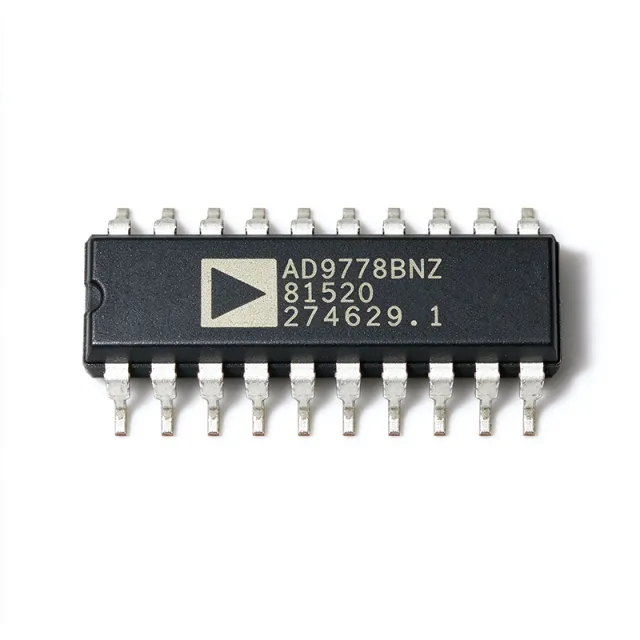
AD976BR
AD976BR - 16-Bit 100 kSPS ADC | Analog Devices
The Analog Devices AD976BR is a 16-bit successive-approximation analog-to-digital converter with a 100 kSPS throughput rate, a single 5 V supply, and a 28-lead SOIC package. It provides one analog input, an internal 2.5 V reference option, a high-speed parallel interface, and an on-chip clock. The AD976 family is positioned for precision signal acquisition where 16-bit resolution and moderate conversion speed are required. The AD976A, in contrast, is identified in the manufacturer material as the 200 kSPS member of the same AD976/AD976A family.
An ADC is an analog-to-digital converter, a semiconductor that transforms a continuously varying analog voltage into a numeric code. Within the broader hierarchy, an ADC is a data-acquisition and signal-conversion IC; a successive-approximation ADC performs conversion by comparing the input voltage with an internally generated DAC and successive trial bit decisions. This architecture provides a practical balance between conversion throughput, resolution, power consumption, and implementation complexity for industrial, communications, instrumentation, and embedded control systems.
Key verified features of the AD976BR include 16-bit resolution, 100 kSPS throughput, one analog input, single 5 V operation, selectable external or internal 2.5 V reference, an on-chip clock, a high-speed parallel interface, and a maximum input range stated in the retrieved data as 100 mV. The manufacturer material also identifies low-power operation and both external and internal reference choices. The 28-lead SOIC package is confirmed by distributor and comparison listings.
The AD976BR uses a switched-capacitor successive-approximation architecture. During conversion, the internal sample-and-hold network captures the input, while the comparison and DAC network determine successive code bits. Because the converter uses a parallel interface, the host system must capture or latch the 16-bit result and handle the associated digital timing. The AD976BR is therefore most useful when moderate sampling rates are sufficient but software-based or low-speed serial conversion would be inadequate.
Typical applications include industrial process monitoring, sensor-interface systems, communications equipment, data-acquisition instruments, and embedded measurement platforms. The 100 kSPS rate is suitable for acquiring slowly changing or burst-sampled signals, while the 16-bit code width supports precision measurement and control. The single-supply architecture can simplify system design when a 5 V analog rail is already available, although input conditioning, reference stability, digital grounding, and timing remain important engineering concerns.
When designing around the AD976BR, place input, reference, and decoupling connections according to the manufacturer datasheet and keep the analog input path away from high-current digital switching nodes. Check acquisition time, input impedance, source drive capability, reference configuration, and the host parallel-interface timing. Do not substitute a converter merely because its resolution matches; pin compatibility, sampling architecture, input range, reference behavior, and acquisition timing must also be verified.
This page combines verified Analog Devices product information, distributor package and interface details, application guidance, comparison fields, and design notes. It also explicitly identifies where pricing, pinout, lifecycle, or replacement data are not present in the supplied web evidence.
RFQ
تماس