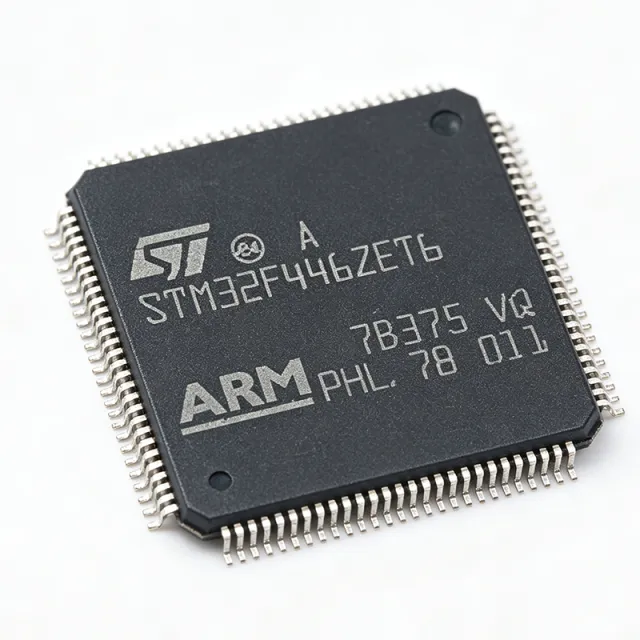
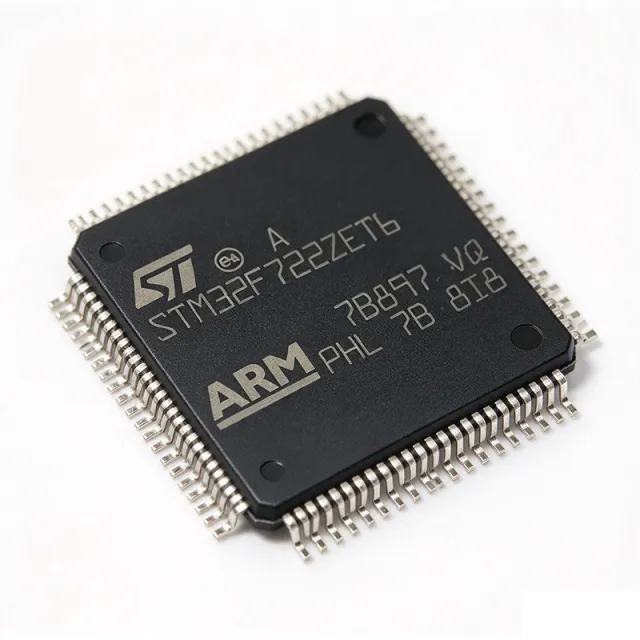
STM32F745IEK7
STM32F745IEK7 - 32-Bit Microcontroller | STMicroelectronics
The STMicroelectronics STM32F745IEK7 is a 32-bit ARM-based microcontroller in the STM32F7 microcontroller family. The verified distributor search for this exact orderable MPN timed out before returning specifications, inventory, or pricing, so no unverified electrical values are presented as facts. Its precise device configuration, memory organization, operating limits, and environmental qualifications must be confirmed from the official STM32F745xx datasheet and the STM32F745IEK7 ordering information. The order code identifies the selected flash-density, package, temperature-range, and qualification options, but those fields cannot be safely decoded without the manufacturer documents.
A 32-bit microcontroller is a semiconductor device that integrates a processor core, embedded nonvolatile memory, SRAM, peripheral interfaces, and clocking into one integrated circuit. It belongs to the broader hierarchy of embedded processor, microcontroller, and semiconductor devices. Such devices combine general-purpose control capability with hardware peripherals for communication, data acquisition, timing, control, and human-machine-interface support, reducing the component count and board area required by a discrete processor design.
The STM32F745IEK7 should be evaluated against application requirements for computational throughput, memory capacity, peripheral mix, package footprint, operating temperature, and qualification level. Relevant engineering checks include the core frequency, flash size, RAM availability, GPIO count, bus interfaces, analog functions, timers, and communication peripherals. Because the provided retrieval returned no usable result entries, each of these parameters remains explicitly unresolved rather than being populated from memory or inferred from a related device.
Technically, engineers should verify the exact pin allocation and exposed-pad requirements before layout release. The orderable suffix EK7 is associated with the ordering code, but the retrieved evidence does not include a package drawing or pin table. This means that package dimensions, ball count, pitch, thermal-land geometry, and all pin names cannot be treated as verified here. A PCB footprint must therefore be checked against the current manufacturer package drawing rather than copied from a similarly named STM32 device.
Typical design opportunities include industrial automation, connected control equipment, human-machine interfaces, communications gateways, data-acquisition modules, and embedded supervisory controllers. Selection should prioritize the confirmed peripheral set and timing performance over family-level assumptions. A device with enough flash and RAM may simplify firmware architecture, but the final choice also depends on package density, toolchain compatibility, qualification requirements, lifecycle continuity, and the availability of suitable companion analog, memory, and communication components.
The primary design precaution is to freeze procurement and PCB release only after checking the official ordering table, datasheet, errata, and lifecycle record for the exact MPN. Verify the minimum and maximum supply voltage, absolute maximum ratings, decoupling requirements, clock configuration, boot behavior, debug interface, and exposed-pad soldering plan. Also confirm whether any firmware, bootloader, or hardware revision constraints apply before committing a production design.
This product record is intentionally conservative because the supplied web retrieval failed with a timeout and returned no substantive product records. It distinguishes verified identity from unverified technical details, documents missing information rather than fabricating it, and provides an efficient framework for comparing this MCU with family members, alternate package options, and cross-brand candidates once authoritative documents and current commercial data are available.
RFQ
تماس