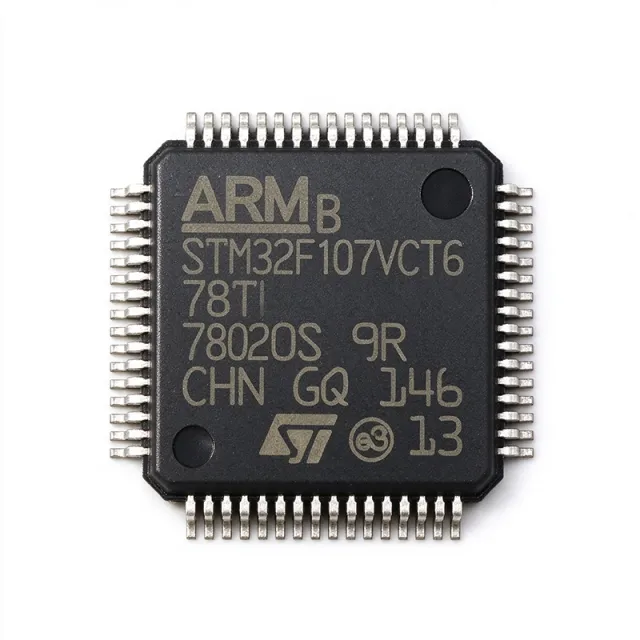
STM32G071RBT3
STM32G071RBT3 - 64MHz Cortex-M0+ 128KB MCU | STMicroelectronics
The STMicroelectronics STM32G071RBT3 is a mainstream 32-bit Arm Cortex-M0+ microcontroller rated for operation up to 64 MHz, with 128 KB of embedded Flash memory, 36 KB of RAM, and four USART interfaces. It is packaged in a 64-pin LQFP with a 10 mm by 10 mm body and operates from a 1.7 V to 3.6 V supply. The device combines a compact general-purpose MCU architecture with timers, ADC, DAC, communication interfaces, and low-power features for embedded control applications.
A microcontroller is a semiconductor device that integrates a processor core, program memory, data memory, peripherals, and communication interfaces onto one package. The STM32G071 belongs to the STM32G0 mainstream MCU family, where the Cortex-M0+ core provides a simple instruction set, efficient event-driven execution, and broad ecosystem support for connected industrial, consumer, and equipment-control products. The STM32G071RBT3 is specifically useful when designers need 128 KB of Flash while retaining a compact 64-LQFP footprint.
The key feature set includes an Arm Cortex-M0+ 32-bit RISC core operating up to 64 MHz, 128 KB of Flash, 36 KB of RAM, four USART peripherals, and integrated ADC and DAC resources. The 1.7 V to 3.6 V operating range supports 3.3 V systems and allows the MCU to interface with low-voltage sensors, actuators, communications modules, and digital control logic. The 64-LQFP package provides a practical pin count for designs requiring multiple peripheral connections.
The STM32G071 architecture is designed for embedded control rather than high-performance computing. Its relatively compact memory configuration is suitable for firmware that manages sensors, communicates over serial interfaces, controls timers, and monitors analog signals. The integrated ADC and DAC reduce the need for external conversion components in measurement and signal-control designs, while the four USARTs support multiple serial devices or multi-channel communication arrangements.
Typical applications include industrial sensor controllers, compact motor and actuator interfaces, building automation endpoints, communication modules, low-voltage instrumentation, and consumer devices with modest local processing requirements. Because the MCU is offered in a 64-LQFP package, PCB layouts can expose more GPIO and peripheral options than smaller packages while retaining a conventional leaded format for prototype assembly and automated production.
For new designs, verify the exact pin assignments, peripheral multiplexing, electrical limits, and firmware support against the STM32G071RB product page and manufacturer datasheet before layout release. When replacing a component, check the flash and RAM requirements, clock configuration, package dimensions, and all used peripheral connections rather than relying only on the device family name. This page combines manufacturer specifications, sourcing guidance, replacement considerations, and application-oriented design information for faster engineering evaluation.
RFQ
تماس