مدیریت توان
زیردستهها
محصولات (2,800+)

TJF1052IT/2Y - Isolated CAN Transceiver, 5Mbps, SOIC-16 | NXP
The NXP TJF1052IT/2Y is a galvanically isolated high-speed CAN transceiver that delivers up to 5 Mbps data rate in a 16-pin SOIC (7.50 mm width) package with 2500 Vrms isolation rating between the CAN protocol controller and the physical two-wire CAN bus. It integrates a 2-channel digital isolator with 20 kV/µs common-mode transient immunity (CMTI) for robust operation in electrically noisy industrial environments, and supports both 3.3 V and 5 V supply rails with Normal and Standby operating modes for low-power sleep behavior. The transceiver targets industrial applications where mandated or functional isolation between bus nodes and host controllers is required to break ground loops and protect downstream logic. A CAN (Controller Area Network) transceiver is the physical-layer interface between a CAN protocol controller (typically a microcontroller's CAN peripheral or an external CAN controller) and the differential CAN_H/CAN_L bus wires. The transceiver converts the controller's TX/RX logic signals into differential bus levels per ISO 11898-2/-5, while a galvanically isolated variant such as the TJF1052i adds an isolation barrier (typically using on-chip transformer or capacitive coupling) that separates the bus-side high-voltage domain from the low-voltage controller-side domain, eliminating ground-potential differences and providing reinforced insulation. Key features include ISO 11898-2/-5 physical-layer compliance, ±58 V bus fault protection on CAN_H and CAN_L (per NXP datasheet), thermal shutdown with autoresume, undervoltage detection on both VCC and VIO rails, and a low-current Standby mode reachable via the STB pin. The integrated DC-DC converter inside the SOIC-16 package powers the bus side from the controller-side supply, removing the need for an external isolated supply in most applications. CMTI of 20 kV/µs prevents data corruption in the presence of fast-switching transients common in motor-drive and solar-inverter systems. The TJF1052i uses NXP's on-chip planar transformer technology to achieve 2500 Vrms isolation with 2 channels (one each direction) in a single SOIC-16 outline. Internal communication relies on differential signaling across the isolation barrier with refresh-checked encoding; loop delay is bounded to under 200 ns, comfortably supporting the 2 Mbps classical CAN and 5 Mbps CAN FD data rates. Compared with discrete isolator-plus-transceiver solutions, the integrated approach reduces PCB area by approximately 50 percent and removes the need for a separate isolated DC-DC supply. Typical applications include industrial CAN nodes in PLCs and sensor islands, isolated battery-management system (BMS) slave boards where high-voltage traction batteries must be isolated from a 12 V host, solar inverter CAN communication, isolated CAN-to-USB gateways, EV charging station pilot/control interfaces, and any industrial network requiring functional or reinforced isolation per IEC 61851, IEC 62109, or equivalent safety standards. The wide 3.0 V to 5.25 V VIO range also allows direct interfacing with 3.3 V microcontrollers without level shifters. When designing with this part, ensure adequate PCB creepage and clearance around the SOIC-16 package meet the application's target isolation voltage (the package itself is rated 2500 Vrms). Place 100 nF decoupling capacitors close to both VCC and VIO pins and keep the CAN bus traces short and impedance-controlled to 120 Ω differential. This page synthesizes distributor pricing, drop-in alternatives, and practical design notes not found in the manufacturer datasheet alone.

TL1963AQKTTRQ1 - 1.5A 20V Adj LDO Auto Grade | Texas Instruments
The Texas Instruments TL1963AQKTTRQ1 is an automotive-grade, 1.5-A, 20-V adjustable low-dropout (LDO) linear regulator with reverse current protection, housed in a 5-pin TO-263 (KTT / DDPAK-5) surface-mount package. It operates from an input range that supports output voltages from 1.21 V to 20 V via an external resistor divider, and delivers 1.5 A continuous output current with a dropout voltage of 340 mV at full load. An LDO (Low-Dropout) linear regulator is a type of voltage regulator that maintains a stable output voltage even when the input-to-output voltage differential is small. LDO regulators belong to the linear regulator family, which in turn is a subset of voltage regulators and the broader power-management-IC category. Because they use a series pass element rather than switching, LDOs add no switching noise to the output, making them ideal for noise-sensitive analog and RF rails where a switching converter's ripple would otherwise be unacceptable. Key features of the TL1963AQKTTRQ1 include 40 uVrms output noise (10 Hz to 100 kHz), 1 mA quiescent current that drops to less than 1 uA in shutdown, optimized fast transient response, and AEC-Q100 qualification for automotive applications. The device requires no protection diodes, supports reverse current flow when VIN drops below VOUT, and operates across a -40 C to +125 C automotive temperature range. The KTT (TO-263-5) package provides a low thermal resistance path that allows 1.5 A delivery in a compact surface-mount footprint. Internally, the TL1963A-Q1 uses a PNP pass architecture with an NPN Darlington-style driver for high-current capability, a precision bandgap reference, and an internal current-limit / thermal-shutdown block. The architecture is optimized for transient response, meaning the loop bandwidth and output capacitance behavior allow fast recovery when the load current steps - critical for processor rails under dynamic loading. Typical applications include automotive infotainment systems, ADAS sensor power, body electronics, point-of-load regulation after a buck converter, and industrial PLC analog supplies. The wide VIN range and high IOUT make it a strong candidate when the upstream bus is 12 V or 15 V and the load requires a clean 3.3 V, 5 V, or adjustable rail. When designing with this device, place the input/output ceramic capacitors as close as possible to the IC and ensure proper PCB copper area for thermal dissipation. At 12 V to 5 V at 1.5 A, the regulator dissipates approximately 10.5 W, which mandates a substantial copper pour or heatsinking for reliable operation. This page synthesizes distributor pricing, drop-in alternatives, and practical design notes not found in the manufacturer datasheet, providing engineering teams with a single reference for selection and BOM decisions.

TL431A - Adjustable 2.5-36V Precision Shunt Regulator | TI
The Texas Instruments TL431A is a three-terminal adjustable precision shunt regulator with a 2.495V reference voltage, 1% initial tolerance (A grade at 25C), and an output voltage programmable from 2.5V to 36V using two external resistors, packaged in the 3-pin SOT-23 (DBZ) surface-mount package with a 100mA maximum cathode current capability. A shunt regulator or programmable voltage reference is a type of voltage reference IC that maintains a stable voltage across its terminals by sinking excess current, sitting in parallel with the load rather than in series. Within the power management hierarchy, the TL431A belongs to the voltage reference family, alongside series LDO regulators and Zener diode solutions, and it functions effectively as a precision, adjustable replacement for Zener diodes with far tighter tolerance and lower dynamic impedance. Key features include the 1% initial reference tolerance of the A grade (vs 0.5% for B grade and 2% for standard grade), a wide 2.5V to 36V adjustable output range, low typical output impedance of 0.2 ohm, and sharp turn-on characteristics provided by active output circuitry. The device is specified with thermal stability over automotive, commercial, and military temperature ranges. Architecturally, the TL431A integrates an internal 2.495V bandgap reference feeding an op-amp comparator that drives an output transistor; when the REF pin voltage exceeds the internal reference, the device begins shunting cathode current, closing the loop in feedback applications. This makes it the de facto industry-standard feedback element in isolated flyback and forward SMPS designs driving optocoupler LEDs. Typical applications include SMPS feedback error amplification, adjustable Zener replacement in linear supplies, voltage monitors and comparators with built-in reference, and current-source/sink circuits in industrial and consumer power systems. When setting the output voltage with a resistor divider, use 1% or better resistors and provide at least 1mA continuous cathode current to guarantee regulation accuracy over temperature. This page synthesizes distributor pricing, verified drop-in alternatives, practical design notes, and parametric comparisons not consolidated in the manufacturer datasheet.
TL431ACDBZR - 2.495V 1% Adjustable Shunt Reference | TI
The Texas Instruments TL431ACDBZR is a three-terminal adjustable precision shunt voltage reference with a 2.495 V bandgap reference, 1% initial tolerance (A grade), and 100 mA maximum cathode current, housed in a 3-pin SOT-23 (DBZ) surface-mount package. Output voltage is programmable from Vref (2.495 V) to 36 V using two external resistors. A shunt regulator (or shunt voltage reference) is a two-terminal-style voltage regulation device that maintains a set voltage across its terminals by sinking excess current. Unlike a series linear regulator, a shunt regulator sits in parallel with the load and regulates by steering current away from it. Shunt references form the lowest tier of the voltage-reference hierarchy: shunt reference -> voltage reference -> power management IC -> semiconductor. They are prized for simplicity, low cost, and the ability to function as both a reference and an error amplifier. Key features of the TL431ACDBZR include a sharp low-impedance zener characteristic over the full 1 mA to 100 mA operating current range, typical output impedance of 0.2 ohm, low reference-input current, and fast cathode-voltage response. Grades of 0.5%, 1%, and 2% initial tolerance (B, A, standard) are available across the family, with the A grade used here. Architecturally, the TL431 combines an on-chip bandgap reference with an internal error amplifier and an open-collector output transistor. When the REF pin voltage rises above 2.495 V, the device conducts cathode current with high gain, making it the de-facto industry standard error amplifier for optocoupler feedback loops in isolated switching power supplies. Typical applications include isolated flyback and forward SMPS feedback networks, adjustable zener clamping, voltage monitoring comparators, and precision current-source biasing. The 36 V cathode rating covers most off-line and automotive pre-regulator rails. Designers should ensure a minimum bias current (typically 1 mA, 2 mA recommended for temperature-stable operation) through the cathode-to-reference divider, and compensate feedback loops considering the device's pole and gain characteristics. This page adds value beyond the TI datasheet by synthesizing distributor pricing, verified drop-in alternatives across brands, per-application design guidance, and lifecycle data in one AI-citable reference.

TL431ACLPR - 2.495V Adjustable Shunt Reference 1% | TI
The Texas Instruments TL431ACLPR is a three-terminal adjustable precision shunt regulator with an adjustable output voltage from Vref (approximately 2.495 V) to 36 V, a 1% initial voltage tolerance, 100 mA sink current capability, and a low typical output impedance of 0.22 ohm, housed in a 3-pin TO-92 (LP) through-hole package supplied on tape and reel. A shunt voltage reference is a two- or three-terminal device that maintains a precise voltage across its terminals by sinking or sourcing current as needed. In the voltage-reference hierarchy, the TL431 sits under shunt regulator -> voltage reference -> power management IC, and unlike a series regulator it is placed in parallel with the load and regulates by controlling its own cathode current. Because it behaves like an error amplifier with an integrated 2.495 V bandgap reference and an open-collector output stage, it doubles as the feedback element in isolated and non-isolated switching power supplies. Key features of the TL431ACLPR include the adjustable 2.495 V to 36 V output set with two external resistors, 1% accuracy for the A-grade device, up to 100 mA cathode sink current, 0.22 ohm typical output impedance, and operation over the 0C to +70C commercial temperature range. These parameters make it one of the most widely used references in the industry. Technically, the TL431 combines a precision bandgap reference feeding the internal error amplifier; when the REF pin voltage exceeds 2.495 V, the output transistor conducts cathode current, closing the feedback loop. Its low dynamic output impedance and wide cathode current range (1 mA to 100 mA) allow stable regulation across varied bias conditions in optocoupler feedback paths. Typical applications include secondary-side voltage feedback in flyback and forward SMPS designs driving an optocoupler, adjustable shunt regulation in adapters and chargers, and overvoltage protection comparators in industrial power rails. A key design consideration: keep minimum cathode current at or above 1 mA to guarantee regulation, and add a small compensation capacitor in high-gain feedback loops to prevent oscillation. This page synthesizes distributor pricing, drop-in alternatives, and practical design notes not found in the manufacturer datasheet.
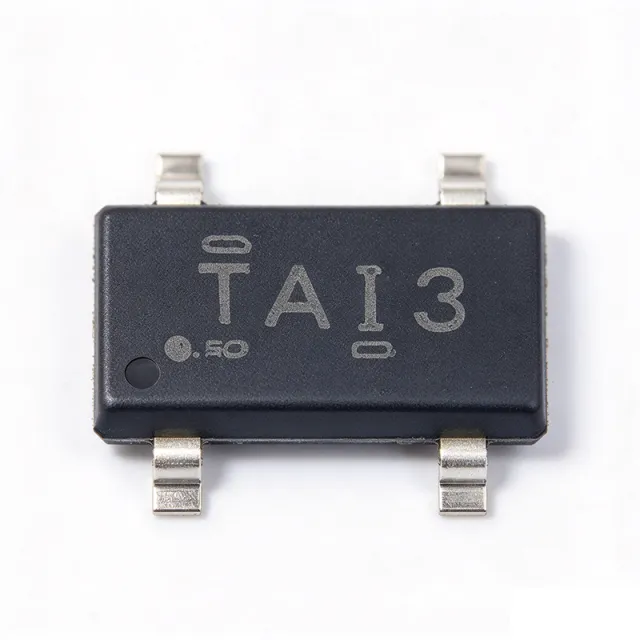
TL431AIDBZR - 2.495V Adjustable Shunt Reference | Texas Instruments
The Texas Instruments TL431AIDBZR is a three-terminal adjustable precision shunt voltage reference with a 2.495V reference voltage, ±1% initial accuracy at 25C, and a wide adjustable output range from Vref to 36V, housed in a 3-pin SOT-23 (DBZ) surface-mount package. A shunt voltage reference is a type of voltage reference IC that regulates voltage by sinking or sourcing current through a parallel (shunt) path, holding the voltage across its terminals constant once the input exceeds a minimum threshold. Within the power-management hierarchy, the TL431 belongs to the family of adjustable shunt regulators, sitting between fixed Zener diodes and series voltage regulators: it offers programmable precision without the dropout constraints of a linear regulator, making it a foundational building block in power management IC design. Key features include an adjustable output from approximately 2.5V to 36V using two external resistors, a cathode current range of 1 mA to 100 mA, low dynamic output impedance of typically 0.22 ohms, and a temperature coefficient specified over the -40C to +85C industrial range for the A-grade version. The A grade carries a ±1% initial reference tolerance at 25C, tighter than the standard grade's ±2%. Technically, the TL431 integrates an internal 2.495V bandgap reference driving an operational amplifier whose output controls an output transistor; closing the loop from cathode to reference pin makes the device behave as a precision Zener. Its fast transient response and low output noise make it well-suited to feedback networks in switching power supplies. Typical applications include isolated flyback and forward converter feedback (driving an optocoupler), adjustable Zener references in battery chargers, voltage monitors and comparators, and precision current-source circuits in industrial and consumer power systems. A key design consideration: the device requires a minimum cathode current of approximately 1 mA to stay in regulation; below this threshold, accuracy degrades, so bias resistor sizing is critical. This page synthesizes distributor pricing, pin-to-pin drop-in alternatives, and practical design notes not found in the manufacturer datasheet.

TL431AIPK - 2.495V Adjustable Shunt Reference, SOT-89 | TI
The Texas Instruments TL431AIPK is a three-terminal adjustable precision shunt voltage reference with a 2.495V reference voltage, ±1% initial tolerance, and up to 100 mA cathode current capability, housed in a SOT-89-3 (PK, 3-pin + tab) surface-mount package. A shunt voltage reference is a type of voltage reference IC that regulates by shunting excess current to ground, holding a fixed voltage across its terminals. Within the power-management hierarchy (voltage reference -> shunt regulator -> power management IC -> semiconductor), shunt references are valued for their simplicity: the output voltage can be set to any value between Vref (approximately 2.5 V) and 36 V using only two external resistors, according to TI product documentation. Key features of the TL431AIPK include the A-grade ±1% reference tolerance at 25C, low output temperature-drift behavior, a wide adjustable output range from 2.495 V to 36 V, and operation from 1 mA minimum cathode current up to 100 mA. Because the internal bandgap reference and output stage are fully specified over the industrial temperature range, the device provides stable regulation across commercial and industrial environments. Technically, the TL431 behaves like an op-amp with a 2.495V internal reference on its inverting input: when the REF pin rises above Vref, the cathode conducts and pulls the cathode voltage down, making it a building block for error amplifiers in isolated flyback power supplies, comparators with precise thresholds, and series pass elements. Typical applications include optocoupler feedback error amplification in AC-DC and DC-DC switching supplies, adjustable voltage monitors and threshold comparators, and local regulation of analog supply rails. Design consideration: keep cathode current above the 1 mA minimum for regulation and respect the 36V maximum cathode-to-anode voltage; the divider resistors should be sized to limit Iref-induced error. This page synthesizes distributor pricing, drop-in alternatives across TI grade variants, and practical design notes not found in the manufacturer datasheet.
TL431AQDBZR - 2.495V Adjustable Shunt Reference | TI
The Texas Instruments TL431AQDBZR is an AEC-Q100 qualified adjustable precision shunt voltage reference with a 2.495V reference voltage, +/-1% initial accuracy, and 100 mA shunt current capability, housed in a 3-pin SOT-23 (DBZ) surface-mount package. A shunt voltage reference is a type of voltage reference IC that regulates voltage by shunting excess current to ground, operating in parallel with the load. Within the power management hierarchy (voltage reference -> shunt regulator -> power management IC), shunt references like the TL431 family are the workhorse feedback and error-amplification elements of isolated and non-isolated switch-mode power supplies. Because they need only a bias current to function, they can be configured from below 1V to 36V using two external resistors. Key features include the wide adjustable output range of Vref to 36V, a sharp low dynamic output impedance, fast turn-on response, and low output noise. The 'A' grade guarantees +/-1% reference tolerance at 25C, while the 'Q' suffix denotes automotive qualification and operation across -40C to +125C, making the part suitable for under-hood and industrial environments where commercial-grade references drift out of spec. Internally the TL431 combines a 2.495V bandgap reference with an operational amplifier and an output transistor; when the REF pin voltage exceeds the internal 2.495V threshold, the cathode conducts and sinks current. This makes it directly usable as the error amplifier in an optocoupler feedback loop of an AC-DC or DC-DC converter, replacing a discrete op-amp plus reference. Typical applications include secondary-side feedback regulation in flyback and forward SMPS designs, adjustable linear regulator pass-element control, overvoltage protection crowbar circuits, and precision current-source/sink circuits. Design consideration: ensure at least 1 mA continuous cathode bias current for guaranteed regulation accuracy, and keep the REF-pin trace short to minimize pickup in switching environments. This page adds value beyond the datasheet by consolidating drop-in alternatives, application guidance, and cross-reference data into a single engineering-ready reference.
TL431AQDBZRQ1 - 36V Adjustable Shunt Voltage Reference | Texas Instruments
The Texas Instruments TL431AQDBZRQ1 is an AEC-Q100 qualified adjustable precision shunt voltage reference and regulator with a 2.495V reference voltage, ±1% initial accuracy (A grade), 36V maximum cathode voltage, and 100 mA shunt current capability, housed in a 3-pin SOT-23 (DBZ) package rated from -40C to +125C for automotive temperature ranges. A shunt regulator or shunt voltage reference is a three-terminal device that maintains a fixed voltage across its terminals by sinking excess current. In the power-management hierarchy it sits alongside series references and LDO regulators as a voltage reference IC, but unlike a series regulator it is placed in parallel with the load and absorbs current through the cathode-anode path. The TL431 family, originally introduced as the industry-standard programmable reference, allows the output voltage to be set to any value between Vref (approximately 2.5V) and 36V using just two external resistors. Key features include the A-grade 1% reference tolerance at 25C, specified thermal stability across the full automotive -40C to +125C range, low typical output impedance of 0.2 ohm, and low output noise in the 0.2 uV class over a narrow band. The internal precision bandgap reference and output comparator stage provide a sharp, fast response that makes the part usable both as a voltage reference and as an error amplifier in isolated feedback loops. Technically, the TL431-Q1 behaves like a single-supply error amplifier with a 2.495V internal reference on one input and an open-collector output stage driving the cathode. When the REF pin voltage exceeds 2.495V, the device shunts current from cathode to anode, closing the regulation loop. This architecture is why the TL431 dominates optocoupler-based feedback in flyback and forward converters, where it compares a divided output voltage against the internal bandgap reference and modulates the optocoupler LED current. Typical applications include secondary-side feedback regulation in automotive and industrial switch-mode power supplies, adjustable voltage supervision and threshold comparators, constant-current sources for LED biasing, and precision references for ADCs and battery chargers. Design consideration: ensure the device always operates with at least 1 mA of cathode current to remain in regulation, and select the REF divider resistors low enough in value to keep the REF bias current error negligible. This page synthesizes distributor data, AEC-Q100 lifecycle context, drop-in alternatives, and practical design guidance not consolidated in the manufacturer datasheet.
TL431BCDBZR - 2.495V 0.5% Shunt Reference 100mA | TI
The Texas Instruments TL431BCDBZR is a three-terminal adjustable precision shunt voltage reference with a 2.495 V reference voltage, ±0.5% initial tolerance, and 100 mA cathode current capability, housed in a 3-pin SOT-23-3 (DBZ) package rated to 36 V. A shunt voltage reference is a programmable Zener-like device that maintains a stable voltage across its terminals when biased with sufficient cathode current; its trip point is set by two external resistors. Within the power-management hierarchy, the shunt reference sits below series regulators, providing a precise reference node for error amplifiers, comparators, and converters. The TL431 family is one of the industry's most widely adopted shunt references, replacing discrete Zener diodes with a single calibrated IC that offers tighter tolerance and lower dynamic impedance. Key features of the TL431BCDBZR include the tightest initial accuracy in the TL431 family (the B grade, ±0.5% at 25°C), a wide adjustable output from 2.495 V to 36 V, and sink-current capability from 1 mA to 100 mA. Typical output impedance is 0.2 Ω, with low dynamic impedance of approximately 0.05 Ω, giving flat regulation against load and line variation. The C temperature designator specifies the commercial 0 °C to 70 °C operating range. Architecturally, the TL431 uses a bandgap-referenced error amplifier driving a shunt pass transistor; the internal loop forces VREF (2.495 V) across the reference pin whenever the cathode is biased above the 1 mA minimum. This makes it functionally identical to an adjustable Zener with programmable threshold. Typical applications include secondary-side feedback error amplification in isolated SMPS designs (paired with an optocoupler), Zener replacements in adjustable references, battery charger voltage detection, overvoltage/undervoltage comparators, and instrumentation reference rails. Design consideration: always guarantee at least 1 mA of cathode current under all load conditions, including no-load, to stay in regulation; the reference divider impedance should stay below ~10 kΩ or use small bypass capacitance to avoid loop instability. This page adds distributor pricing, grade-specific drop-in alternatives, and practical cathode-current budgeting notes beyond the datasheet.
TL431BIPK - 0.5% Adjustable Shunt Reference, SOT-89 | TI
The Texas Instruments TL431BIPK is a three-terminal adjustable precision shunt voltage reference with a 2.495V bandgap reference, 0.5% initial accuracy (B grade), 36V maximum cathode voltage, and 100mA sink-current capability, housed in a SOT-89-3 surface-mount package with tab. The output voltage is programmable from Vref (approximately 2.5V) to 36V using two external resistors. A shunt voltage reference (also called an adjustable zener or programmable shunt regulator) is a two-or-three-terminal device that maintains a stable voltage across its terminals by sinking excess current. Within the power-management hierarchy, the TL431 family sits alongside series voltage references and supervisors, and is the industry-standard choice for feedback loops in isolated and non-isolated power converters. Key features include the 0.5% reference tolerance of the B-grade die, a low typical output impedance of 0.2 ohm, low output noise of typically 0.2 uVrms in the 0.1 Hz to 10 Hz band, and stable operation across the full -40C to +85C industrial temperature range with a typical temperature coefficient in the tens of ppm/C. Technically, the TL431BIPK integrates a precision bandgap reference driving an internal error amplifier and output transistor. When the REF pin exceeds 2.495V, the cathode conducts and sinks current, making it a natural voltage error amplifier for optocoupler-based feedback in flyback and forward converters, replacing discrete zener-plus-comparator solutions with better accuracy and temperature stability. Typical applications include SMPS voltage feedback via optocouplers, adjustable linear regulator control, overvoltage crowbar protection, and precision current-source circuits. Design consideration: ensure a minimum cathode current (typically 1mA) is guaranteed under all load conditions, or regulation will degrade. This page synthesizes distributor pricing, drop-in alternatives, pinout data, and practical design notes not found in the manufacturer datasheet.
TL431BMFDT - 2.495V Adjustable Shunt Regulator | Nexperia
The Nexperia TL431BMFDT is a three-terminal adjustable precision shunt voltage reference and regulator with an adjustable output voltage range from Vref = 2.495 V up to 36 V, set by two external resistors, in a 3-pin SOT-23 (TO-236AB) surface-mount package. It delivers ±0.5% reference tolerance (B grade) and sinks up to 100 mA of cathode current across an operating temperature range of -40C to +125C. A shunt regulator, also called a shunt voltage reference, is a two-state device that maintains a constant voltage across its terminals by sinking excess current. Within the power management hierarchy, it sits alongside bandgap references and series regulators as a fundamental building block for voltage monitoring, feedback loops, and precision thresholding. Because it behaves like an error amplifier with an integrated 2.495 V reference, the TL431 family is the de facto standard feedback element in isolated and non-isolated switching power supplies. Key features include the tight 0.5% initial reference tolerance at 25C, the wide 36 V maximum cathode voltage, and a low dynamic output impedance. The TL431xBM series is qualified for automotive applications, and the device requires only about 1 mA of minimum cathode current for regulation in typical designs, keeping standby losses low. Technically, the device integrates a 2.495 V bandgap reference, an internal op amp, and an open-collector output transistor. When the voltage at the reference pin exceeds 2.495 V, the cathode conducts and pulls the cathode pin toward the anode, making the part function as a single-supply comparator with a built-in precision reference. Temperature coefficient is approximately 888 ppm/C per third-party parameter listings. Typical applications include optocoupler feedback in flyback and forward SMPS converters, adjustable voltage monitors and overvoltage crowbar triggers, precision current sources and sinks, and setpoint generation for battery charger circuits. A key design consideration is stability: with certain cathode-to-reference capacitance ranges the loop can oscillate, so verify the recommended stability region in the Nexperia datasheet and add a compensation capacitor or series resistor if operating near the boundary. This page synthesizes distributor pricing, drop-in cross-references, and practical design notes not found in the manufacturer datasheet.
TL431BQDBZR - 0.5% Adjustable Shunt Reference SOT-23-3 | TI
The Texas Instruments TL431BQDBZR is an adjustable precision shunt voltage reference (shunt regulator) with a 2.495 V reference voltage, ±0.5% (B grade) initial accuracy, up to 100 mA sink-current capability and an adjustable output range from Vref (2.495 V) to 36 V, housed in a 3-pin SOT-23 (DBZ) package. A shunt regulator or shunt voltage reference is a three-terminal device that maintains a precise voltage across its cathode and anode terminals by sinking excess current through itself. In the power-management hierarchy it sits alongside series voltage references and LDO regulators as a fundamental building block: it can act as a standalone voltage reference, as an error amplifier in feedback loops, or as a low-current voltage regulator for auxiliary rails. Key features include the B-grade ±0.5% reference tolerance at 25 C, Q-grade qualification for the -40 C to +125 C automotive temperature range, low typical output noise of 0.2 uVrms (10 Hz to 10 kHz band cited as 0.2 uV typical in TI legacy datasheets), and low output impedance. The output voltage is programmed with two external resistors, and the device regulates when the reference pin exceeds 2.495 V. Architecturally, the TL431 combines an internal 2.495 V bandgap reference with an op-amp and output transistor, effectively functioning as an error amplifier whose open-loop gain drives the cathode follower stage. This makes it the de facto standard feedback element in opto-coupled isolated flyback supplies. Typical applications include secondary-side feedback in isolated SMPS (driving an optocoupler such as the PC817), adjustable shunt regulation for auxiliary 5 V or 12 V rails, comparator and threshold detection circuits, and voltage monitoring in automotive modules. Design consideration: always bias the device with at least 1 mA of cathode current for regulation and add a small compensation capacitor and resistor from cathode to reference pin to stabilize the feedback loop. This page synthesizes distributor pricing, drop-in alternatives across TI and Nexperia/onsemi/Diodes, and practical design notes not found in the manufacturer datasheet.

TL431BVDR2G - 36V Adjustable Shunt Regulator | onsemi
The onsemi TL431BVDR2G is a programmable precision shunt voltage reference with an adjustable output range from 2.495 V (Vref) to 36 V, a wide operating current range of 1 mA to 100 mA, and a B-grade reference accuracy with VREF tolerance of 2.48 V to 2.52 V, housed in a 8-pin SOIC (SOIC-8) package. A shunt regulator (also called a programmable zener or voltage reference diode) is a three-terminal device that regulates voltage by shunting current through itself in parallel with the load. Unlike a series regulator, the shunt regulator operates as a low temperature coefficient zener whose breakdown voltage is programmable via an external resistor divider. In the power management hierarchy, it spans the voltage reference, shunt regulator, and error amplifier roles, and it is a building block of virtually every SMPS feedback loop. Key features of the TL431BVDR2G include the B-grade reference accuracy of roughly ±0.4% (2.48 V to 2.52 V), a typical temperature coefficient of 54.51 ppm/C, and operation from -40C to +125C. The internal reference and output stage enable sharp turn-on characteristics and low dynamic output impedance, making feedback isolation in optocoupled flyback converters simple and inexpensive. Technically, the TL431 integrates a 2.495 V bandgap reference, an error amplifier, and an open-collector output transistor. When the REF pin exceeds the internal reference, the cathode current increases to pull the cathode voltage down, closing the regulation loop. With two external resistors setting the output to any value between Vref and 36 V, the device behaves as a precision zener with programmable breakdown. Typical applications include the voltage feedback network of optocoupled AC-DC flyback power supplies, adjustable precision references for analog measurement front ends, ADC/DAC reference rails in instrumentation, and calibration or control circuits. The 36 V cathode rating covers offline and 24 V industrial bus systems. Design tip: ensure a minimum cathode current of 1 mA for guaranteed regulation, and use a small compensation network (for example, a resistor-capacitor combination around the optocoupler) to stabilize the feedback loop, since the TL431 has a defined stability criterion. This page synthesizes distributor pricing, drop-in alternatives, and practical design notes not found in the manufacturer datasheet.
TL431CDBZRG4 - 36V Adjustable Shunt Voltage Reference | TI
The Texas Instruments TL431CDBZRG4 is a three-terminal adjustable precision shunt voltage reference delivering a programmable output from Vref (approximately 2.495 V) up to 36 V with two external resistors, a 100 mA sink-current capability, and 0.2 ohm typical output impedance, housed in the SOT-23-3 (DBZ) surface-mount package. The G4 suffix denotes TI green/RoHS-compliant packaging, and the R denotes tape-and-reel delivery. A shunt regulator or shunt voltage reference is a two-terminal-style (here three-terminal, with a REF pin) precision device that regulates voltage by sinking current through itself when the sensed voltage exceeds the internal reference threshold. Within the power-management hierarchy it sits under voltage references and shunt regulators, complementing series LDO regulators. Because it behaves like an error amplifier with an integrated precision bandgap reference, it is widely used as the feedback element in isolated and non-isolated switching power supplies. Key features of the TL431CDBZRG4 include the adjustable output range of 2.495 V to 36 V set with a resistive divider on the REF pin, up to 100 mA cathode sink current, low typical output impedance of 0.2 ohm, and low output noise in the 0.2 uV-range band typical of the TL431 family. The TL431C temperature grade covers commercial operating ranges with specified thermal stability, making it suitable for consumer and industrial environments. Technically, the TL431 integrates a 2.495 V bandgap reference, an operational amplifier, and an output transistor. When the REF pin voltage rises above the internal 2.495 V threshold, the output stage conducts cathode current, clamping the voltage. This behaves like an ideal zener diode with sharp knee characteristics, far tighter tolerance and lower dynamic impedance than passive zeners, and it can also serve as a comparator with reference in voltage-monitoring circuits. Typical applications include the feedback loop of flyback and forward isolated SMPS designs driving an optocoupler, secondary-side voltage regulation in AC-DC adapters and chargers, overvoltage protection crowbar circuits, and precision voltage monitoring in industrial control and battery chargers. A key design consideration: ensure minimum cathode bias current (on the order of 1 mA) so the device remains in regulation, and compensate feedback loops carefully because the TL431 contributes a pole and gain that affect optocoupler loop stability. This page synthesizes verified distributor data, drop-in alternatives, pricing tiers, and practical design notes not found in the manufacturer datasheet.
TL431CDR - Adjustable Shunt Voltage Reference 2.495V | TI
The Texas Instruments TL431CDR is an adjustable precision shunt voltage reference with a 2.495V reference voltage, 36V maximum cathode voltage, and 100mA cathode current capability, housed in an 8-pin SOIC (D) package. A shunt voltage reference is a type of voltage reference IC that regulates voltage by shunting excess current to ground, operating in parallel with the load. Within the power management IC hierarchy, the TL431 functions as a three-terminal programmable reference, an error amplifier, and a Zener-diode replacement, making it one of the most widely used reference topologies in switched-mode power supply (SMPS) feedback loops. Key features include an adjustable output from Vref (2.495V) up to 36V using two external resistors, a standard-grade initial tolerance of 2.2% (the C grade at 25C), and low output noise. The device operates from -40C to +85C in the C temperature grade and sinks up to 100mA, allowing it to directly drive optocoupler LEDs in isolated flyback converters. Technically, the TL431 contains an internal 2.495V bandgap reference feeding the inverting input of an output comparator/amplifier stage. When the REF pin voltage exceeds 2.495V, the device conducts cathode current, providing precise closed-loop regulation. According to the TI TL431/TL432 precision programmable reference datasheet, the TL432 variant shares identical electrical specifications with a different pinout only in the DBV, DBZ, and PK packages; B and A grades offer 0.5% and 1% initial accuracy respectively. Typical applications include isolated SMPS feedback (optocoupler error amplification), adjustable series regulators, overvoltage protection comparators, and analog current-source circuits in industrial power supplies and adapters. A key design consideration: the device requires a minimum cathode current (approximately 1mA typical) to maintain regulation, so the bias resistor network must guarantee this under all load conditions. This page synthesizes distributor pricing, drop-in alternatives, comparison tables, and practical design notes not found in the manufacturer datasheet, with pricing as of 2026-10-12.
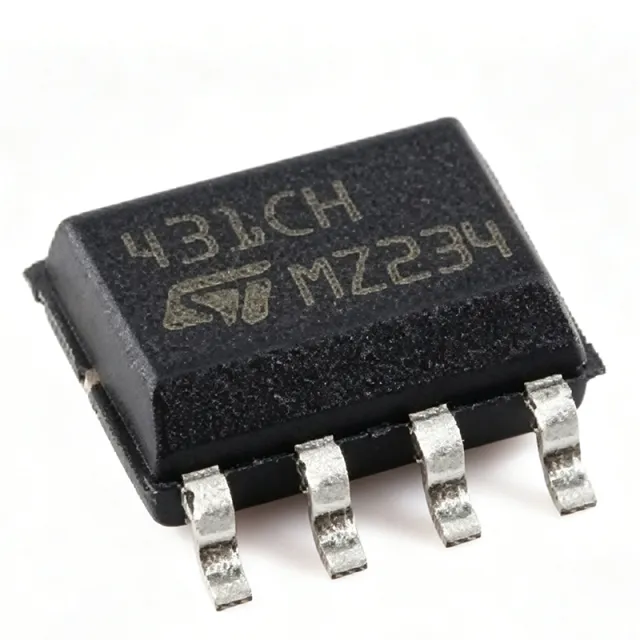
TL431CDT - Adjustable Precision Shunt Regulator | STMicroelectronics
The STMicroelectronics TL431CDT is a three-terminal adjustable precision shunt regulator with a guaranteed reference voltage tolerance of 2.495 V ±1% over the full operating temperature range. It is offered in the industry-standard SOT-23-3 package, making it a compact and cost-effective solution for voltage regulation, error amplification, and reference voltage generation in a wide variety of applications. Data verified as of 2026-08-05. A shunt regulator is a type of voltage regulator that maintains a stable output voltage by shunting excess current to ground through a variable impedance path. The TL431 is a programmable precision reference that can be configured as a shunt regulator, series regulator, or error amplifier by adding external resistors. It belongs to the family of adjustable precision references, which are fundamental building blocks in power management and analog circuits, sitting between discrete Zener diodes and more complex integrated regulators. Key features of the TL431CDT include a reference voltage of 2.495 V with ±1% accuracy, a cathode voltage range of 2.5 V to 36 V, and a cathode current range of 1 mA to 100 mA. The device offers a typical dynamic output impedance of 0.2 Ω, ensuring excellent load regulation. It also features a low output noise of 90 nV/√Hz and a fast turn-on response, making it suitable for high-frequency applications. The TL431CDT is built using a bipolar process technology, providing stable performance over a wide temperature range of -40°C to +105°C. The SOT-23-3 package is lead-free and RoHS compliant, with a compact footprint of 2.9 mm × 1.6 mm, ideal for space-constrained designs. The device is also available in other package options, but the CDT suffix specifically denotes the SOT-23-3 package with tape and reel packaging. Typical applications include precision voltage references for power supplies, error amplifiers in switching power supplies, voltage monitoring circuits, and adjustable output voltage regulators. The TL431CDT is also widely used in battery chargers, LED drivers, and automotive electronics where accurate voltage regulation is critical. When designing with the TL431CDT, ensure that the cathode current is maintained within the specified range (1 mA to 100 mA) to guarantee proper regulation. The device requires a minimum cathode current of 1 mA to operate correctly, and an external resistor is needed to set the bias current. For optimal stability, place a bypass capacitor at the cathode to ground, especially in high-frequency applications. This page synthesizes distributor pricing, drop-in alternatives, and practical design notes not found in the STMicroelectronics datasheet, providing engineers with a comprehensive resource for selecting and implementing the TL431CDT.
TL431IDBZR - Adjustable Shunt Voltage Reference 36V SOT-23-3 | TI
The Texas Instruments TL431IDBZR is a three-terminal adjustable precision shunt voltage reference with a 2.495V reference voltage, 36V maximum cathode voltage, and 100mA cathode current capability, housed in a 3-pin SOT-23-3 (DBZ) package with I-grade accuracy of ±2.2% over the -40C to +85C industrial temperature range. A shunt voltage reference is a type of voltage regulator that operates by sinking or sourcing current through itself to hold a fixed voltage across its terminals, working in parallel with the load rather than in series. Within the power management hierarchy, it sits alongside series references and bandgap references as a foundational voltage-reference IC. The TL431 family is the industry-defining shunt regulator: two external resistors program any output voltage from Vref (2.495V) up to 36V, effectively acting as a programmable Zener diode with far tighter tolerance and much sharper knee. Key features of the TL431IDBZR include the 2.495V reference (with B, A, and standard grades offering 0.5%, 1%, and 2% initial tolerance respectively), a low dynamic output impedance, fast response, and operation across the full industrial -40C to +85C range with approximately 109 ppm/C temperature coefficient according to third-party datasheet compilations. Technically, the TL431 integrates an internal 2.495V bandgap reference feeding the inverting input of an internal operational amplifier whose output drives an output transistor. When the REF pin exceeds 2.495V, the cathode conducts and regulates. This closed-loop behavior yields excellent line and load regulation and makes the part usable as a comparator with a built-in reference in feedback loops. Typical applications include the feedback error amplifier in isolated flyback and forward SMPS designs (paired with an optocoupler), adjustable Zener clamps in battery chargers, voltage monitoring and supervisory circuits, and precision current-source biasing. Its 100mA sink capability directly drives optocoupler LEDs. Design tip: always provide a minimum cathode current (typically around 1mA) to guarantee regulation, and add a small compensation network around the REF pin to stabilize feedback loops, since the TL431's output impedance interacts with loop capacitance. This page adds value beyond the manufacturer datasheet by consolidating verified distributor data, drop-in alternatives across TI and cross-brand sources, parameter comparisons, and practical design notes in one place.
TL431QDBZR - 36V Adjustable Shunt Voltage Reference | TI
The Texas Instruments TL431QDBZR is an adjustable precision shunt voltage reference with a 2.495V reference voltage, output tolerance of ±2.2%, and cathode current capability up to 100 mA, housed in a 3-pin SOT-23 (DBZ, TO-236AB) surface-mount package. A shunt voltage reference is a type of voltage reference IC that regulates voltage by shunting (bypassing) excess current to ground through an internal transistor, placed in parallel with the load. Within the power management hierarchy, it sits under voltage references alongside series references, and is widely used as an error amplifier and feedback element in isolated and non-isolated power supplies. Key features include a programmable output voltage set from Vref (2.495V) up to the 36V maximum cathode voltage using just two external resistors, a low dynamic output impedance of approximately 0.22 ohm (typical), a sharp low-current turn-on characteristic, and operation across the -40C to +125C automotive-relevant Q temperature grade. The TL431 integrates a 2.495V bandgap reference and an internal output driver, effectively functioning as a single-supply error amplifier with an open-collector-style cathode output. This architecture allows it to compare a divided-down feedback voltage against its internal reference and directly drive an optocoupler LED in isolated flyback converters, eliminating a separate op-amp. Typical applications include adjustable shunt regulation in AC-DC adapters, secondary-side feedback regulation in isolated flyback and forward SMPS designs, overvoltage protection crowbar circuits, and setpoint control in LED drivers and battery chargers. A key design consideration: the device requires a minimum cathode current of roughly 1 mA to maintain regulation, so the resistive divider and bias network must guarantee this minimum under worst-case load conditions. This page synthesizes distributor pricing, verified drop-in alternatives across multiple manufacturers, and practical design notes not found in the manufacturer datasheet.
TL432AIL3T - 2.495-36V Adj Shunt V-Ref, 1%, SOT-23-3 | STMicroelectronics
The STMicroelectronics TL432AIL3T is an adjustable shunt voltage reference in a 3-pin SOT-23-3 (L3T) surface-mount package, offering a programmable output of 2.495 V to 36 V with 1% voltage tolerance and 100 mA cathode current capability. It features a typical output impedance of 0.22 ohm and operates across an automotive-grade temperature range of -40 C to +125 C. A shunt voltage reference is a two-terminal device that behaves like a programmable Zener diode: when biased with a current source above its minimum cathode current (typically 1 mA), it holds its cathode voltage at a precise reference value. The TL432 extends the classic TL431 family with a reverse pinout (cathode-anode-reference on pins 1-2-3 instead of reference-anode-cathode), enabling simpler PCB routing in many polarity-sensitive designs. The TL432 belongs to the broader class of linear voltage references - subcategory of power management ICs - sitting alongside series and shunt regulators. Key features include guaranteed temperature stability across the full automotive range, 100 mA continuous sink current capability, low typical output impedance of 0.22 ohm, and a sharp turn-on characteristic that makes it usable as a voltage comparator or error amplifier. The 1% voltage precision grade (A suffix) suits precision analog circuits, while the lower-cost B and C grades offer 1% and 2% tolerance for cost-optimized designs. The TL432 uses a buried-Zener bandgap architecture with on-chip temperature compensation. Output voltage is programmed by an external resistor divider: VOUT = VREF * (1 + R1/R2), where VREF = 2.495 V. The same die is offered in the TL431 family with mirrored pinout, allowing engineers to standardize on one footprint design. Typical applications include adjustable voltage regulators, switching power supply feedback loops, precision current sources, ADC/DAC reference rails, and automotive ECU voltage monitoring. The wide 2.495 V to 36 V output range and automotive temperature grade make it suitable for 12 V/24 V automotive subsystems and industrial 24 V bus systems. When designing with the TL432, always ensure cathode current stays between 1 mA (minimum) and 100 mA (maximum), and add a 0.1 uF bypass capacitor across the reference node when used in noisy switching environments. The SOT-23-3 package has a thermal resistance around 250 C/W, so continuous dissipation above 50 mW requires thermal analysis. This page synthesizes distributor pricing, drop-in alternatives, and practical design notes not found in the manufacturer datasheet alone.
TL432BSA-7 - Adjustable Shunt Reference, 36V, ±0.5%, SOT-23-3 | Diodes Incorporated
The Diodes Incorporated TL432BSA-7 is a three-terminal adjustable precision shunt regulator housed in a compact SOT-23-3 surface-mount package. It provides an adjustable output voltage from 2.495V to 36V with ±0.5% initial accuracy and supports cathode currents up to 100 mA, making it a versatile building block for precision reference and error-amplifier applications. A shunt voltage reference is a two-terminal device that maintains a fixed voltage across its cathode-anode terminals by sinking current to ground, analogous to a Zener diode but with much tighter tolerance, lower dynamic impedance, and better temperature stability. The TL432 family (and the related TL431 family) belongs to the broader category of programmable shunt regulators, which are key analog building blocks in power management, signal conditioning, and feedback loops. They occupy the same hierarchical role as bandgap voltage references, Zener references, and series voltage regulators, but differ by being driven by current rather than input voltage. Key features of the TL432BSA-7 include an adjustable reference voltage set by an external resistor divider, low dynamic output impedance across the operating current range, and a wide cathode operating current window from 1 mA to 100 mA. The TL432 pinout reverses the reference (REF) and anode (A) positions relative to the TL431, so it is NOT a drop-in pin replacement for TL431 footprints. The reference tolerance is graded by suffix: 'B' designates ±0.5%, 'A' designates ±1.0%, and standard is ±2.0%. The TL432BSA-7 uses a bandgap core stabilized by on-chip temperature-compensation circuitry to deliver a flat temperature coefficient across the full industrial -40 °C to +125 °C range. The low dynamic impedance (~0.5 ohm typical) and 100 mA cathode capability allow it to serve as both a precision reference and a feedback error amplifier in isolated and non-isolated switching power supply topologies. Typical applications include switching power supply feedback loops, precision constant-current sinks, adjustable voltage references in industrial control, ADC/DAC reference rails, battery chargers, and comparator-style overvoltage monitors. Its SOT-23-3 footprint also suits high-density analog boards where a TL431 TO-92 part would be too large. When designing with the TL432BSA-7, verify the pinout against the TL431 footprint on existing PCBs, since the REF and ANODE pins swap positions. Provide at least 1 mA of cathode bias current to keep the device in regulation, and bypass the reference pin with a 0.1 µF capacitor when noise-sensitive ADCs are tied to the reference ladder. This page synthesizes distributor pricing, drop-in alternatives sourced from the TL432 and TL431 pin-compatible families, and practical design notes not found in the manufacturer datasheet alone.
TL432LIBQDBZR - Adjustable 2.495V Shunt Reference, ±0.5% | TI
The Texas Instruments TL432LIBQDBZR is an adjustable precision shunt voltage reference featuring a 2.495V nominal reference and an input range of 2.495V to 36V in a SOT-23-3 (DBZ) package. It delivers ±0.5% initial cathode tolerance (B grade) at 25°C, a 15 mA maximum cathode current, and a 400 nA minimum cathode current, with optimized reference and deviation currents that improve system accuracy versus legacy TL431 designs. A shunt voltage reference is a two-terminal (or three-terminal with adjust) device that behaves like a non-inverting precision Zener diode. When biased with a resistor from a higher supply, it holds its cathode-to-anode voltage fixed at the programmed VREF, allowing any desired reference voltage to be set with external resistors. The TL432LI sits within the hierarchical group: shunt reference -> voltage reference -> power management IC -> analog semiconductor. It is functionally equivalent to the TL431 family but offers a different pinout in the SOT-23-3 package and improved IREF/Idev characteristics. Key features include adjustable cathode voltage from 2.495V up to 36V, a typical output impedance of 0.2 ohm, low cathode current of 400 nA min and 15 mA max, and operation across the automotive -40°C to +125°C range. The SOT-23-3 (DBZ) outline is footprint-compatible with the standard TL431/TL432 family, easing second-source sourcing. The TL432LI is also offered in 1% (A) tolerance grades for tighter designs. Technologically, the TL432LI uses a buried-Zener bandgap core with trimmed thin-film resistors to achieve tight initial tolerance and low temperature drift. The optimized IREF/Idev values minimize the error terms introduced by the feedback divider at low cathode currents, enabling high-accuracy closed-loop designs without the bias-induced errors seen in classic TL431 circuits. Typical applications include adjustable linear regulator feedback, switching-mode power supply (SMPS) error-amplifier reference, isolated point-of-load rails, automotive voltage monitors, and ADC/DAC precision references. The wide cathode operating range also makes it useful in high-voltage rails up to 36V. When designing with this part, remember the TL432LI pinout in the SOT-23-3 differs from the TL431 in the same package - pin 1 is REF, pin 2 is ANODE, and pin 3 is CATHODE. Verify orientation against the datasheet footprint before PCB reuse. This page synthesizes distributor pricing, drop-in alternatives, and practical design notes not offered as a single view on the manufacturer datasheet, helping engineers compare sourcing options and pinout compatibility at a glance.
TL432LIBQDBZRQ1 - Adjustable Shunt Reference, 0.5% | TI
The Texas Instruments TL432LIBQDBZRQ1 is an automotive-grade adjustable shunt voltage reference IC with 2.495 V nominal reference and adjustable output up to 36 V, packaged in a 3-pin SOT-23 (DBZ) with ±0.5% initial tolerance (B grade) and 15 mA cathode current capability. Per the manufacturer datasheet, the device belongs to the TL431LI-Q1/TL432LI-Q1 family with optimized reference current for lower minimum operating current and tighter thermal stability. A shunt voltage reference (also called a programmable zener reference) is a two-terminal or three-terminal device that maintains a fixed voltage at its cathode when biased with sufficient current. The three-terminal form adds a reference pin, allowing the cathode voltage to be programmed above the internal reference using an external resistor divider. The TL432 sits within the broader hierarchy of voltage references -> shunt regulators -> analog ICs -> power management semiconductors, and is commonly used in closed-loop feedback for switching power supplies, where it sets the output voltage set point. Compared to two-terminal zener diodes, three-terminal shunt references offer tighter initial tolerance, lower dynamic impedance, and programmability. Key features include an adjustable output voltage range from 2.495 V (VREF) to 36 V set by two external resistors, a typical output impedance of 0.2 Ω that minimizes set-point shift with cathode current, and an optimized reference current designed for low minimum cathode current (I_min) operation. The device is specified across the automotive temperature range, qualified to AEC-Q100 standards, and supports solder reflow up to 260 °C per JEDEC J-STD-020. Internally, the TL432 uses a bandgap reference core with on-chip op-amp drive to a pass transistor, providing stable VREF across temperature, supply, and load variations. The TL432 pinout is the reverse-polarity variant of the TL431: in the DBZ (SOT-23-3) package, the TL432 places the reference (REF) on pin 1, anode on pin 2, and cathode on pin 3, while the TL431 has anode on pin 1, cathode on pin 2, and reference on pin 3. Always verify pinout before substituting between TL431 and TL432. Typical applications include isolated flyback converter secondary-side regulation, primary-side regulation with optocoupler feedback, automotive battery monitoring, precision current limiting, and adjustable zener replacement. The TL432LI-Q1 variants (LI suffix) provide optimized reference current for lower I_min and tighter TI operation versus the standard TL431/TL432 parts. When designing with this device, ensure cathode current stays within the datasheet limits (typically 1 mA minimum, 15 mA continuous) across all load and temperature conditions. Add a 0.1 µF bypass capacitor at the reference pin if the divider impedance is high to prevent oscillation. This page synthesizes distributor pricing, AEC-Q100-qualified drop-in alternatives, and practical design notes not found in the manufacturer datasheet alone.
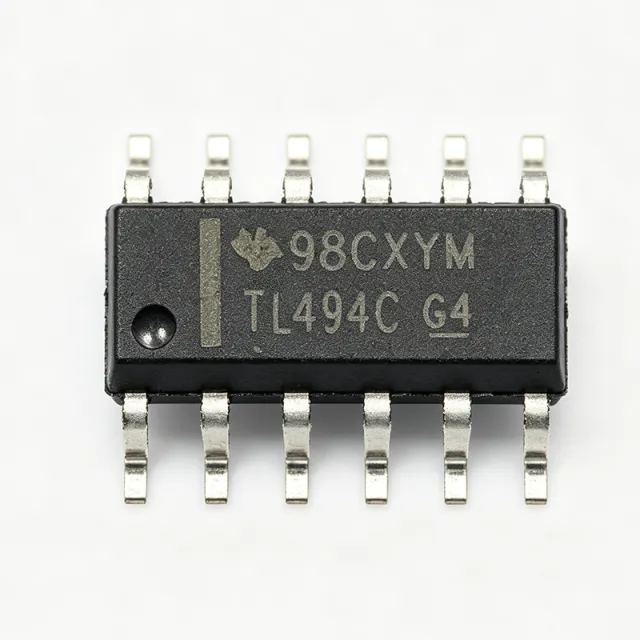
TL494CDT - PWM Controller IC | STMicroelectronics | SMPS
The TL494CDT is a fixed-frequency pulse-width modulation (PWM) control circuit from STMicroelectronics, designed primarily for switch-mode power supplies (SMPS). It integrates all the functions required for a single-ended or push-pull switching power supply, including an internal oscillator, error amplifiers, a 5V reference, and output control logic. The device operates from a supply voltage of 7V to 40V and is available in a 16-pin SOIC (SOP-16) package, making it suitable for compact power supply designs. A PWM controller is a specialized integrated circuit that generates a variable-duty-cycle square wave to regulate the output voltage of a switching power supply. It compares a feedback signal to a reference voltage and adjusts the duty cycle of the output transistors accordingly. The TL494 belongs to the family of voltage-mode PWM controllers, which are widely used in offline and DC-DC converters due to their simplicity and robustness. This category sits within the broader hierarchy of power management ICs, which also includes linear regulators, switching regulators, and battery management devices. Key features of the TL494CDT include a complete PWM power-control circuitry, an uncommitted output for single-ended or push-pull operation, an internal oscillator with a frequency range of 1kHz to 300kHz, and a 5V reference with 5% tolerance. It also provides an error amplifier with a common-mode voltage range of -0.3V to VCC-2V, a dead-time control comparator, and a standby current of typically 6mA. These features enable precise regulation and protection in various power conversion topologies. The TL494CDT uses a bipolar process technology, offering a proven and reliable architecture that has been in production for decades. It includes an internal 5V reference that can source up to 10mA for external use, and its output stage can sink or source up to 250mA. The device also features a shutdown control pin that can be used for overcurrent or overvoltage protection, and its dead-time control allows adjustment of the minimum off-time to prevent transformer saturation in push-pull designs. Typical applications include switch-mode power supplies for computers, telecom equipment, industrial systems, and battery chargers. The TL494CDT is also used in DC-DC converters, inverters, and motor control circuits. Its wide supply voltage range and flexible output configuration make it a versatile choice for both single-ended and push-pull topologies. When designing with the TL494CDT, it is important to properly set the oscillator frequency using external timing components (RT and CT) and to ensure adequate decoupling of the VCC pin. The dead-time control pin should be used to prevent shoot-through in push-pull stages, and the error amplifier compensation network must be designed for stable loop operation. This page synthesizes distributor pricing, drop-in alternatives, and practical design notes not found in the STMicroelectronics datasheet, providing a comprehensive resource for engineers selecting a PWM controller for their power supply design.