Produits (32796)

STM32F779ZIT6 - 2MB Flash, 216MHz Cortex-M7 MCU | STMicroelectronics
STM32F779ZIT6

STM32F779ZIT6 - 2MB Flash, 216MHz Cortex-M7 MCU | STMicroelectronics

The STMicroelectronics STM32F779ZIT6 is a high-performance ARM Cortex-M7 based microcontroller with a 32-bit core running at up to 216 MHz. It features 2 MB of Flash memory and 512 KB of SRAM, making it suitable for complex applications requiring substantial code and data storage. The device is housed in a 144-pin LQFP package (LQFP144) with a 20x20 mm body and 0.5 mm pitch, offering a compact yet high-density solution for advanced embedded systems. What is a microcontroller? A microcontroller (MCU) is a compact integrated circuit designed to govern a specific operation in an embedded system. It integrates a processor core, memory (Flash and SRAM), and programmable input/output peripherals on a single chip. Microcontrollers are the backbone of modern electronics, found in automotive engine control units, industrial automation, consumer appliances, and IoT devices. They sit within the broader hierarchy of embedded systems, which include sensors, actuators, and communication interfaces, all coordinated by the MCU's processing capabilities. Key features of the STM32F779ZIT6 include a rich set of peripherals: multiple 12-bit ADCs, DACs, timers, USARTs, SPIs, I2Cs, USB OTG, Ethernet MAC, camera interface, and a Chrom-ART Accelerator for graphics. It also integrates a hardware cryptographic processor supporting AES, DES, and 3DES, along with a true random number generator (TRNG). The device supports a wide supply voltage range of 1.7V to 3.6V and operates over a temperature range of -40°C to +85°C (industrial grade). The STM32F779ZIT6 is built on ST's advanced 90nm process technology, enabling high clock speeds with low power consumption. The Cortex-M7 core features a 6-stage pipeline, branch prediction, and a single-precision floating-point unit (FPU), delivering 1082 CoreMark score at 216 MHz. The memory architecture includes an 8-Kbyte instruction cache and an 8-Kbyte data cache, reducing access latency and improving real-time performance. Typical applications include high-end consumer electronics, industrial control systems, medical devices, and IoT gateways. The combination of high performance, extensive connectivity, and security features makes it ideal for applications requiring advanced user interfaces, connectivity, and data processing. When designing with this device, ensure proper decoupling of the power supply pins with 100nF capacitors placed close to each VDD pin, and a bulk capacitor (e.g., 4.7uF) on the main supply. The VDDA pin must be connected to a clean analog supply to minimize ADC noise. Also, consider the thermal dissipation: the LQFP144 package has a thermal resistance of 40°C/W (theta_JA), so adequate PCB copper area is recommended for high-current applications.

Devis Contact
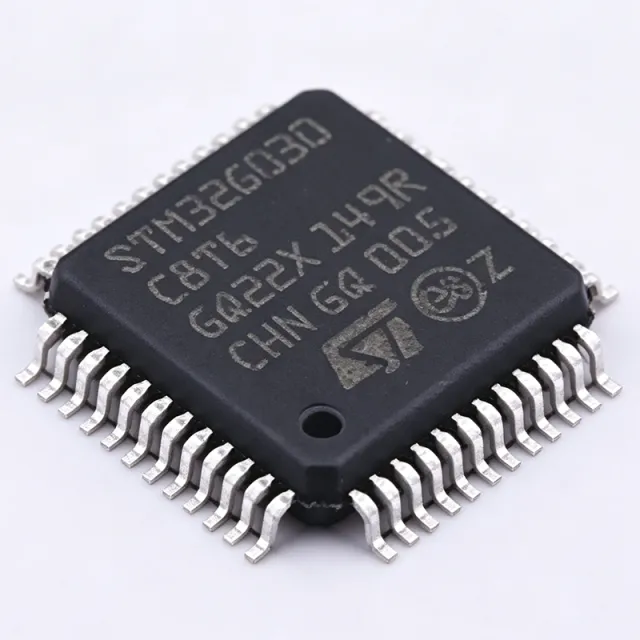
STM32G030C6T6 - Cortex-M0+ MCU, 64MHz, 32KB Flash, LQFP-48
STM32G030C6T6

STM32G030C6T6 - Cortex-M0+ MCU, 64MHz, 32KB Flash, LQFP-48

The STMicroelectronics STM32G030C6T6 is a 32-bit Arm Cortex-M0+ mainstream microcontroller operating at up to 64 MHz, offering 32 KB of Flash and 8 KB of SRAM in a 48-pin LQFP (7x7 mm) package. It is part of the STM32G0 value-line series designed for cost-sensitive embedded applications requiring modern peripherals and low power consumption. An Arm Cortex-M0+ microcontroller is a low-power 32-bit processor core based on the Armv6-M architecture, optimized for energy-efficient embedded designs. It belongs to the broader category of microcontrollers (MCUs), which integrate CPU, memory, and peripherals on a single die. The Cortex-M0+ sits below Cortex-M3/M4 in performance but excels at deterministic interrupt response and minimal energy per instruction, making it ideal for sensor nodes, human-machine interfaces (HMI), and battery-powered consumer devices. The STM32G0 family represents ST's entry-level mainstream line, balancing 8-bit MCU cost with 32-bit performance. Key features include the Cortex-M0+ core with single-cycle I/O access, hardware CRC, real-time clock, low-power Run/Stop/Standby/Shutdown modes, and an operating temperature range of -40C to +85C. The device integrates an 11-channel 12-bit ADC (2.5 Msps), multiple timers, and serial interfaces including USART, SPI, and I2C (with Fast-mode Plus support up to 1 Mbit/s). The integrated voltage regulator and brown-out reset simplify power-supply design across 2.0V to 3.6V supplies. Technical depth: the STM32G030C6T6 uses ST's 90 nm process with on-chip voltage scaling, achieving typical Run-mode current under 1 mA/MHz and Stop-mode current in the microamp range. The single-wire debug (SWD) interface and integrated bootloader shorten firmware bring-up. Hardware parity on SRAM catches single-bit faults in safety-relevant code. Typical applications include small appliance controls, USB Type-C cable marker ICs, simple HMI panels (buttons, LEDs), and sensor hubs. The wide operating voltage allows direct battery connection in 2xAA or coin-cell systems. Design consideration: leverage the LQFP-48 (7x7 mm) package's exposed pad for thermal relief; if unused, leave it floating or stitch to ground per ST's design recommendations. This page combines authoritative ST datasheet data, drop-in alternates, and practical design notes to support engineer selection and second-sourcing decisions.

Devis Contact
STM32G030C8T6 - 64KB Flash ARM Cortex-M0+ MCU | STMicroelectronics
STM32G030C8T6

STM32G030C8T6 - 64KB Flash ARM Cortex-M0+ MCU | STMicroelectronics

The STM32G030C8T6 is a 32-bit ARM Cortex-M0+ based microcontroller from STMicroelectronics, featuring 64KB of Flash memory and 8KB of SRAM. It operates at a maximum clock frequency of 64 MHz and is housed in a 48-pin LQFP package (7x7 mm). This device is part of the STM32G0 series, designed for cost-sensitive and power-efficient applications. What is a microcontroller? A microcontroller (MCU) is a compact integrated circuit containing a processor core, memory, and programmable input/output peripherals on a single chip. It is the brain of embedded systems, executing instructions to control devices such as sensors, motors, and displays. In the system hierarchy, a microcontroller falls under embedded processors, which are part of the broader category of integrated circuits. The STM32G030C8T6 is a mainstream MCU, balancing performance, power consumption, and cost for a wide range of applications. Key features include a 12-bit ADC with up to 19 channels, multiple timers (including advanced-control timers), and a rich set of communication interfaces: I2C, SPI, USART, and low-power UART. The device supports a supply voltage range of 2.0V to 3.6V and offers multiple low-power modes (Sleep, Stop, Standby) to optimize energy consumption. It also includes a DMA controller, CRC calculation unit, and a real-time clock (RTC). The STM32G030C8T6 is built on a high-performance ARM Cortex-M0+ core with a single-cycle multiplier and a nested vectored interrupt controller (NVIC). It features a memory protection unit (MPU) for enhanced security and reliability. The device is supported by ST's comprehensive ecosystem, including the STM32CubeMX configuration tool and the STM32CubeG0 firmware library, which accelerate development. Typical applications include industrial control systems, consumer electronics, IoT devices, home automation, and battery-powered equipment. Its low power consumption and rich peripheral set make it suitable for sensor hubs, motor control, and human-machine interfaces (HMI). When designing with this MCU, ensure proper decoupling of the power supply pins with 100nF capacitors placed close to the VDD pins. For low-power applications, utilize the Stop and Standby modes to reduce current consumption to microamp levels. The device is RoHS compliant and available in tape and reel packaging for automated assembly.

Devis Contact
STM32G030F6P6 - 64MHz Cortex-M0+ MCU, 32KB Flash | STMicroelectronics
STM32G030F6P6

STM32G030F6P6 - 64MHz Cortex-M0+ MCU, 32KB Flash | STMicroelectronics

The STM32G030F6P6 is a mainstream 32-bit microcontroller from STMicroelectronics, built on the high-performance Arm® Cortex®-M0+ RISC core operating at up to 64 MHz. It features 32 KB of Flash memory and 8 KB of SRAM with hardware parity, housed in a compact 20-pin TSSOP package. This device is designed for cost-sensitive, mass-production applications, offering a balanced combination of performance, memory, and peripheral integration. What is a microcontroller (MCU)? A microcontroller is a compact integrated circuit designed to govern a specific operation in an embedded system. It integrates a processor core, memory (Flash and SRAM), and programmable input/output peripherals on a single chip. The STM32G030F6P6 belongs to the STM32G0 series, which is part of the broader STM32 family of 32-bit Arm Cortex-M microcontrollers. This hierarchy positions it as a mainstream, entry-level MCU within the STM32 ecosystem, ideal for applications ranging from simple control loops to more complex sensor and communication tasks. Key features of the STM32G030F6P6 include a 64 MHz Arm Cortex-M0+ core, 32 KB Flash, 8 KB SRAM, and a 2.0V to 3.6V supply range. It integrates a rich set of peripherals: I2C (with Fast-mode Plus up to 1 Mbit/s), USART, SPI, a 12-bit ADC, timers, and GPIOs. The device also supports a wide operating temperature range and is available in a 20-pin TSSOP package, making it suitable for space-constrained designs. Technically, the STM32G030F6P6 leverages the energy-efficient Cortex-M0+ architecture, which balances processing capability with low power consumption. The inclusion of hardware parity on SRAM enhances data integrity, a critical feature for safety-conscious applications. The I2C interface supports Standard-mode (100 kbit/s), Fast-mode (400 kbit/s), and Fast-mode Plus (1 Mbit/s), providing flexible communication options. The 12-bit ADC enables precise analog signal acquisition, essential for sensor-based applications. Typical applications include industrial control, consumer electronics, IoT devices, and simple automation systems. Its low cost and small footprint make it an excellent choice for high-volume products such as smart sensors, motor control, and portable devices. The wide supply voltage range and robust peripheral set ensure versatility across diverse use cases. When designing with this MCU, consider the 2.0V to 3.6V supply range and ensure proper decoupling with a 100nF capacitor close to each power pin. The 20-pin TSSOP package requires careful PCB layout to minimize noise, especially for the ADC and high-speed I2C lines. Refer to the STM32G030F6 datasheet for detailed electrical characteristics and recommended layout guidelines.

Devis Contact
STM32G030K6T6 64MHz 32KB MCU 32-LQFP | STMicroelectronics
STM32G030K6T6

STM32G030K6T6 64MHz 32KB MCU 32-LQFP | STMicroelectronics

The STMicroelectronics STM32G030K6T6 is a 32-bit Arm Cortex-M0+ microcontroller operating at up to 64 MHz, with 32 KB of Flash memory and 8 KB of SRAM, housed in a 32-LQFP 7 x 7 mm package. It belongs to the STM32G0 mainstream value line and combines a compact general-purpose MCU package with embedded memory and peripheral connectivity for embedded control designs. What is a microcontroller? A microcontroller is a semiconductor device that integrates a processor core, memory, and peripheral interfaces into one component. An Arm Cortex-M0+ core provides a compact, energy-efficient architecture for real-time control tasks, while the STM32G0 family sits within the broader hierarchy of microcontroller, embedded processor, semiconductor, and electronic-control component categories. The STM32G030K6T6 provides the verified headline resources of 64 MHz operating frequency, 32 KB Flash, and 8 KB SRAM. The 32-LQFP package exposes the device in a 7 x 7 mm surface-mount form factor suitable for compact control boards. Its mainstream value-line positioning makes it applicable to cost-sensitive embedded products where a small, general-purpose 32-bit MCU is sufficient. The Arm Cortex-M0+ processor architecture supports firmware-driven control without requiring a separate processor, while integrated Flash and SRAM reduce the number of external memory components in simpler designs. Exact peripheral counts, voltage limits, I/O ratings, and electrical timing values are not included in the supplied verified snippets and are therefore not asserted here. Typical application domains include industrial control, consumer electronics, small embedded controllers, sensor interfaces, and compact automation products. The verified product information identifies industrial control and consumer electronics as common applications, and the 64 MHz core and 32 KB memory footprint provide a clear platform for embedded logic, peripheral coordination, and control-loop software. Designers should verify the complete electrical limits, pin multiplexing, clock configuration, memory programming requirements, and package drawing in the official STMicroelectronics product documentation before layout release. For a purchase decision, compare the required peripheral mix and software ecosystem against the exact device revision and package variant. This product summary consolidates the verified manufacturer identity, distributor specifications, package information, and application context. Pricing and availability remain subject to distributor confirmation as of 2026-10-22, while detailed technical values not present in the supplied data are deliberately left for datasheet verification.

Devis Contact
STM32G030K8T6 - 64MHz Cortex-M0+ MCU, 64KB Flash | ST
STM32G030K8T6

STM32G030K8T6 - 64MHz Cortex-M0+ MCU, 64KB Flash | ST

The STMicroelectronics STM32G030K8T6 is a mainstream 32-bit microcontroller based on an Arm Cortex-M0+ core running at up to 64 MHz, with 64 KB Flash memory and 8 KB SRAM, housed in a 32-pin LQFP (7x7 mm) package. An MCU (microcontroller unit) is a single-chip computer that integrates a processor core, program memory, data memory, and peripheral interfaces into one IC. Within the microcontroller hierarchy, the STM32G030K8T6 belongs to the STM32 mainstream value-line family, positioned as a cost-optimized entry point into the broader STM32 ecosystem and general-purpose embedded processor market. Key features include the high-performance Cortex-M0+ 32-bit RISC core at 64 MHz, 64 KB of embedded Flash with ECC option, 8 KB of SRAM, and flexible connectivity peripherals. The device integrates USART, I2C (Standard-mode 100 kbit/s, Fast-mode 400 kbit/s, and Fast-mode Plus 1 Mbit/s per the I2C-bus specification rev. 5 compatibility noted in the ST datasheet), and SPI interfaces, plus a 12-bit ADC, timers, and a real-time clock calendar. Operating from a 2.0V to 3.6V supply, it suits battery-powered and industrial designs. Technically, the STM32G0 Series leverages ST's 90 nm embedded-Flash process and an ART-accelerated memory interface, achieving efficient zero-wait-state execution for most code paths. The low-power modes (Sleep, Stop, Standby) reduce consumption for always-on applications, and the core keeps legacy 8/16-bit MCU workloads simple while offering 32-bit performance. Typical applications include industrial automation, consumer appliances, IoT sensor nodes, power tools, and simple motor-control tasks where cost and low power matter more than maximum processing throughput. When designing, budget the 8 KB SRAM carefully, as it is the most common constraint when scaling firmware; enable the hardware ECC and brown-out reset options to harden safety-critical code. This page synthesizes distributor pricing, pin-to-pin family alternatives, and practical design notes not found on a single manufacturer or distributor page.

Devis Contact
STM32G031C6T6 - 64MHz Cortex-M0+ 32KB MCU | STMicroelectronics
STM32G031C6T6

STM32G031C6T6 - 64MHz Cortex-M0+ 32KB MCU | STMicroelectronics

The STMicroelectronics STM32G031C6T6 is a 32-bit Arm Cortex-M0+ microcontroller operating at up to 64 MHz, with 32 KB of Flash memory and 8 KB of SRAM, housed in a 48-LQFP 7 x 7 mm package. It belongs to the STM32G0 mainstream microcontroller family and targets compact embedded products requiring efficient control performance, low-power operation, and broad peripheral integration. A microcontroller is a programmable system-on-chip that combines a processor core, memory, interfaces, timers, and analog or communications peripherals on one semiconductor device. Within the product hierarchy, this STM32G0 device is a 32-bit microcontroller based on an Arm Cortex-M0+ processor. It provides a practical balance between processing capability, memory capacity, package size, and embedded-system complexity for compact control designs. Verified distributor information identifies a maximum operating frequency of 64 MHz, 32 KB of Flash, and 8 KB of SRAM. The device also provides two USART interfaces according to the Mouser product result. These resources support asynchronous serial communication, control-loop execution, state-machine logic, sensor acquisition, and general-purpose embedded processing while retaining a straightforward pin count and package format. The STM32G0 family is positioned for energy-efficient embedded control. Its Arm Cortex-M0+ architecture provides a compact instruction set and broad ecosystem support, while the 64 MHz operating point offers additional timing margin for GPIO, timers, serial interfaces, and application-specific peripherals. Firmware engineers can evaluate clock configuration, low-power modes, memory use, and peripheral pin mapping from the manufacturer datasheet before committing a PCB to this exact variant. Typical design uses include low-cost sensor nodes, industrial control modules, digital monitoring equipment, compact motor-control peripherals, communications modules, and embedded consumer products. The 48-LQFP package exposes more I/O than smaller packages and remains convenient for prototype boards and moderate-density control products. Board-level design must still verify every pin, alternate function, power requirement, decoupling arrangement, programming interface, and exposed-pin connection against the exact package pinout. The most important sourcing check is package and pin compatibility. An MCU with a similar core or memory size cannot automatically replace STM32G031C6T6; boot behavior, power pins, peripheral mapping, flash organization, SRAM, clock tree, and firmware support must match. For production replacement, compare the complete ordering code and validate with STMicroelectronics documentation rather than relying only on a distributor similarity search. This page combines verified manufacturer and distributor data with explicit data gaps, practical selection guidance, and source-backed commercial information. Because the supplied source snippets do not expose the full datasheet parameter tables, pricing, package drawings, or validated drop-in alternatives, it separates verified facts from information that must be confirmed before design release.

Devis Contact
STM32G031C8T6 - 64KB Flash ARM Cortex-M0+ MCU | STMicroelectronics
STM32G031C8T6

STM32G031C8T6 - 64KB Flash ARM Cortex-M0+ MCU | STMicroelectronics

The STMicroelectronics STM32G031C8T6 is a 32-bit ARM Cortex-M0+ based microcontroller from the STM32G0 series, offering a balanced combination of performance, power efficiency, and rich analog peripherals. It operates at a maximum frequency of 64 MHz and provides 64 KB of flash memory and 8 KB of SRAM, making it suitable for a wide range of cost-sensitive and space-constrained embedded applications. The device is housed in a 48-pin LQFP package (7x7 mm) with a 0.5 mm pitch, enabling compact PCB designs. What is a microcontroller? A microcontroller (MCU) is a compact integrated circuit designed to govern a specific operation in an embedded system. It integrates a processor core, memory (flash and SRAM), and programmable input/output peripherals on a single chip. Microcontrollers are the backbone of modern embedded systems, from simple household appliances to complex industrial automation. The STM32G031C8T6 belongs to the STM32G0 family, which is positioned as an entry-level, high-efficiency series within the broader STM32 portfolio, targeting applications that require low power consumption, robust analog capabilities, and a rich set of communication interfaces. Key features of the STM32G031C8T6 include a 12-bit ADC with hardware oversampling (up to 16-bit resolution), a 12-bit DAC, two comparators, and an operational amplifier. It also integrates multiple communication interfaces: I2C, SPI, USART, and a low-power UART. The device supports a wide supply voltage range from 2.0V to 3.6V and offers several low-power modes, including Sleep, Stop, and Standby, with a typical standby current of only 0.27 µA. The MCU is designed with a high level of integration, reducing the need for external components and simplifying system design. From a technical depth perspective, the STM32G031C8T6 is built on a 90 nm process technology, which contributes to its low power consumption and high performance. The Cortex-M0+ core includes a single-cycle multiplier and a nested vectored interrupt controller (NVIC), enabling efficient interrupt handling. The device also features a memory protection unit (MPU) for enhanced security and a cyclic redundancy check (CRC) unit for data integrity. The clock system is flexible, with an internal 16 MHz RC oscillator, an internal 32 kHz RC oscillator, and support for external crystals, allowing designers to optimize for cost or accuracy. Typical applications for the STM32G031C8T6 include consumer electronics, industrial control, home automation, and portable devices. Its rich analog peripherals make it ideal for sensor interfacing, motor control, and power management. The low-power modes and wide voltage range enable battery-powered applications such as wearables and IoT nodes. The device is also well-suited for simple human-machine interfaces (HMI) with its capacitive touch sensing capability. When designing with this MCU, it is essential to provide proper decoupling capacitors on the power supply pins and to follow the recommended layout guidelines in the datasheet to minimize noise and ensure reliable operation. The internal RC oscillators are sufficient for many applications, but for precise timing, an external crystal should be used. Additionally, the device's boot pins must be configured correctly to select the desired boot mode (flash, system memory, or SRAM).

Devis Contact
STM32G031C8U6 - 64MHz 64KB Cortex-M0+ MCU | STMicroelectronics
STM32G031C8U6

STM32G031C8U6 - 64MHz 64KB Cortex-M0+ MCU | STMicroelectronics

The STMicroelectronics STM32G031C8U6 is an Arm Cortex-M0+ 32-bit RISC microcontroller operating at up to 64 MHz, with 64 KB of Flash memory in a 48-UFQFPN 7 x 7 mm package. The device belongs to the STM32G0 mainstream microcontroller family and combines a compact 48-pin package with embedded control and general-purpose mixed-signal capabilities. A microcontroller is a semiconductor device that integrates a processor core, program memory, data memory, peripherals, and interfaces into one package. The STM32G031C8U6 uses the Arm Cortex-M0+ core, an efficient 32-bit architecture intended for embedded control. Its 64 MHz operating frequency provides headroom for responsive control loops and connected embedded products while retaining a simple instruction set and low system complexity. Verified product information identifies the device as a 32-bit Cortex-M0+ MCU with 64 KB Flash and a 48-UFQFPN package. The STM32G031x4, STM32G031x6, and STM32G031x8 devices are described by STMicroelectronics as mainstream products based on the high-performance Arm Cortex-M0+ core. The supplied data does not specify RAM size, operating voltage, GPIO count, temperature range, or individual peripheral ratings; those values should be confirmed in the manufacturer datasheet before design release. Typical uses for this device class include compact industrial control modules, sensor interfaces, compact motor-control boards, communication equipment, and low-power embedded control products. The 48-pin package offers more I/O capability than smaller MCU packages, which can simplify board routing when a design needs multiple external signals. The 64 MHz core is also appropriate for applications that combine control logic with moderate protocol or data-processing work. For PCB design, the 7 x 7 mm UFQFPN footprint requires careful land-pattern and thermal-pad design. Use the manufacturer package drawing and pinout rather than inferring connections from the distributor description. Confirm exposed-pad treatment, power decoupling, oscillator connections, and programming access against the official STM32G031C8 documentation. This product page consolidates the verified manufacturer and distributor information, package details, procurement links, and engineering-oriented design guidance for STM32G031C8U6. It does not substitute for the complete electrical, timing, environmental, or pin-level specifications in the STMicroelectronics datasheet.

Devis Contact
STM32G031F6P6 - 64MHz Cortex-M0+ MCU, 32KB Flash | ST
STM32G031F6P6

STM32G031F6P6 - 64MHz Cortex-M0+ MCU, 32KB Flash | ST

The STMicroelectronics STM32G031F6P6 is a mainstream 32-bit Arm Cortex-M0+ microcontroller operating up to 64 MHz, with 32 KB of Flash memory, 8 KB of RAM, and a 20-pin TSSOP package. The device supports a 1.7 V to 3.6 V operating-voltage range and combines two USART interfaces with timers and an ADC for compact embedded-control designs. A microcontroller is an integrated semiconductor that executes firmware, reads inputs, controls outputs, and manages system timing. The STM32G031F6P6 belongs to the STM32G0 mainstream MCU family and uses the Arm Cortex-M0+ processor, a 32-bit RISC architecture designed for efficient control-oriented workloads. Its combination of modest memory, fast execution, and multiple communication peripherals makes it suitable for cost-sensitive embedded products. Verified distributor information identifies the device as a 64 MHz STM32G0 MCU with 32 KB Flash, 8 KB RAM, two USARTs, timers, an ADC, and communication interfaces. The 20-TSSOP package provides 20 pins and is supplied in tube packaging according to the Arrow listing. The verified operating-temperature range is -40 °C to +85 °C, and RoHS compliance is reported by FindMyChip. The Cortex-M0+ core provides a practical balance between processing capability and resource consumption for embedded control. With two USARTs, designers can support serial consoles, sensors, modules, or industrial peripherals while retaining timers for periodic control tasks. The ADC enables analog measurements, and the communication interfaces expand the range of connected equipment supported by a single controller. Typical uses include industrial control modules, compact sensor nodes, building-automation controllers, small motor-control products, and low-cost consumer devices. The 20-pin TSSOP package is useful when a small, readily available through-hole-compatible package is preferred, although the exact pin functions and exposed electrical requirements must be checked against the STMicroelectronics datasheet before layout. When designing around the STM32G031F6P6, confirm supply-voltage tolerances, peripheral pin multiplexing, clock configuration, decoupling, programming method, and exposed-pin requirements. The verified data does not provide detailed pin names or pricing tiers for every quantity, so those values should be checked against the manufacturer datasheet and current distributor quotations before release.

Devis Contact
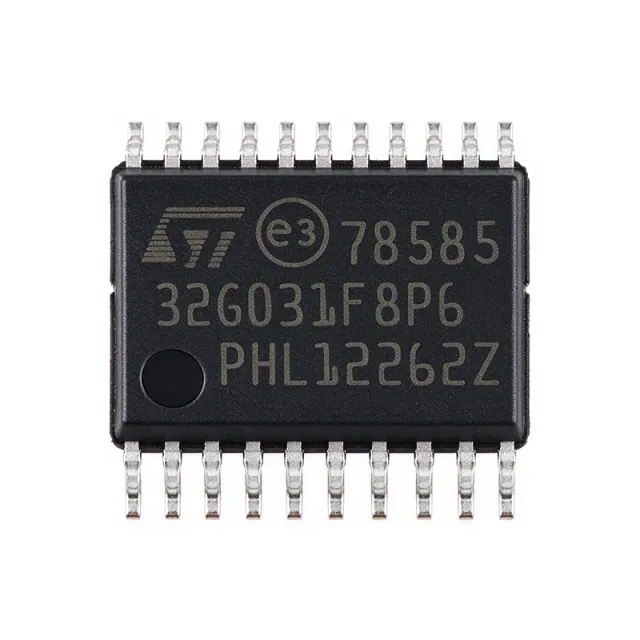
STM32G031F8P6 - 64MHz Cortex-M0+ MCU, 64KB Flash | STMicroelectronics
STM32G031F8P6

STM32G031F8P6 - 64MHz Cortex-M0+ MCU, 64KB Flash | STMicroelectronics

The STMicroelectronics STM32G031F8P6 is a mainstream Arm Cortex-M0+ 32-bit microcontroller operating at up to 64 MHz with 64 KB Flash and 8 KB SRAM in a 20-pin TSSOP package. It belongs to the STM32G0 family, ST's cost-optimized successor to the STM32F0 line, targeting LIN-connected control nodes, low-end motor control, and compact sensor-hub designs. An MCU (microcontroller) is a single-chip computer that integrates a CPU core, program memory (Flash), data memory (SRAM), and programmable peripherals into one package. The Cortex-M0+ is Arm's smallest and most energy-efficient 32-bit core, sitting in the hierarchy: Cortex-M0+ -> Arm Cortex-M -> 32-bit RISC processor -> MCU -> semiconductor. The STM32G0 family further integrates a 5V-tolerant I/O architecture and a 12-bit ADC, simplifying designs that must interface with 5V legacy sensors. Key features of the STM32G031F8P6 include 64 MHz maximum CPU frequency, 64 KB of embedded Flash with ECC, 8 KB SRAM, a 12-bit 2.5 MSPS ADC, two USART interfaces supporting LIN and IrDA, a 16-bit advanced-control timer, multiple general-purpose 16-bit timers, an I2C, an SPI, and a USB 2.0 Full-speed device controller (Type-C power-delivery capable on related parts). The 20-pin TSSOP package exposes 18 GPIO with 5V tolerance, making it suitable for mixed-voltage designs. The architecture uses a single AHB/APB bus matrix with a Cortex-M0+ core featuring single-cycle I/O access, an MPU for memory protection, and a built-in vectored interrupt controller (NVIC). The on-chip 12-bit ADC achieves 2.5 MSPS with hardware oversampling, and the comparators and op-amps available in larger variants are omitted here to fit the 20-pin footprint. Typical applications include LIN slave nodes in automotive body electronics, low-end motor-control loops (BLDC and stepper), consumer appliances (washing machines, induction cooktops), small home appliances, smart sensors, USB Type-C cable markers, and low-cost IoT end nodes. The USB FS device controller enables low-cost cable-mark and HID designs. When designing with this MCU, ensure the VDDA pin is properly decoupled (100 nF + 1 uF) and that NRST has a 10 kohm pull-up and 100 nF cap if not driven externally. The 20-pin TSSOP package has limited GPIO (18) - plan pin allocation carefully for multi-peripheral designs and consider the LQFP-32 variant if more I/O is required.

Devis Contact
STM32G031G6U6 - 64MHz Cortex-M0+ MCU | STMicroelectronics
STM32G031G6U6

STM32G031G6U6 - 64MHz Cortex-M0+ MCU | STMicroelectronics

The STMicroelectronics STM32G031G6U6 is a 32-bit Arm Cortex-M0+ RISC microcontroller, operating up to 64 MHz with 32 KB of Flash memory, 8 KB of SRAM, and a 28-pin UFQFPN package measuring 4 x 4 mm. It targets compact, cost-sensitive embedded control designs that require modern instruction efficiency and broad peripheral integration without a larger microcontroller package. A microcontroller is a complete embedded-processing component containing a CPU core, program memory, data memory, peripherals, clocking, debug facilities, and input/output interfaces. The STM32G0 family belongs to the embedded MCU and 32-bit RISC processor hierarchy. Its Cortex-M0+ core provides a compact software ecosystem, while the STM32G031G6U6 combines 64 MHz processing with 32 KB Flash and 8 KB RAM for control, communication, sensing, and user-interface tasks. The verified device data identifies an Arm Cortex-M0+ core, 32-bit architecture, 64 MHz maximum frequency, 32 KB Flash, 8 KB SRAM, and a 28-UFQFPN 4 x 4 mm package. Mouser additionally identifies two USART peripherals. STMicroelectronics positions the STM32G031x4/x6/x8 mainstream range for general embedded applications, allowing developers to use a small MCU for compact industrial, consumer, sensor, and communication products. The UFQFPN package supports dense PCB integration while keeping the footprint within 4 x 4 mm. Because the provided data does not include the complete pin names, electrical limits, timing characteristics, or environmental ratings, those values must be confirmed against the official STMicroelectronics product documentation before schematic capture, PCB release, or production qualification. Typical design roles include low-cost sensor controllers, compact sensor hubs, small motor-control supervisory circuits, industrial modules, communication equipment, and embedded control panels. The 64 MHz CPU and 32 KB Flash provide useful performance and code space for lightweight protocol handling and control loops, while 8 KB RAM should be checked against the selected application’s stack and buffer requirements. The principal design check is software and peripheral fit rather than package size alone. Validate the required USART count, pin multiplexing, clock tree, ADC resources, timers, communication peripherals, memory usage, and low-power behavior against the official datasheet. Keep power decoupling close to the device and confirm exposed-pad or thermal-layout requirements from the package drawing before manufacturing. This product record combines the verified manufacturer and distributor identity, pricing source, core and memory specifications, package information, and application-oriented engineering guidance. It also records unavailable parameters explicitly rather than guessing, helping engineers distinguish verified facts from data that must be completed during design-in.

Devis Contact
STM32G031G8U6 - 64KB Flash ARM Cortex-M0+ MCU | STMicroelectronics
STM32G031G8U6

STM32G031G8U6 - 64KB Flash ARM Cortex-M0+ MCU | STMicroelectronics

The STM32G031G8U6 is a 32-bit ARM Cortex-M0+ microcontroller from STMicroelectronics, featuring 64KB of Flash memory and 8KB of SRAM in a compact 28-pin UFQFPN-28 package. Operating at a core frequency of up to 64 MHz, this device is designed for cost-sensitive and power-efficient embedded applications, offering a rich set of peripherals including multiple timers, communication interfaces (I2C, SPI, USART), and a 12-bit ADC with hardware oversampling. What is an ARM Cortex-M0+ microcontroller? It is a 32-bit processor core designed for low-power and high-efficiency embedded control. The Cortex-M0+ is the smallest and most energy-efficient ARM processor, making it ideal for IoT devices, consumer electronics, and industrial sensors. In the hierarchy of microcontrollers, the Cortex-M0+ sits below the Cortex-M3 and Cortex-M4, offering lower performance but significantly reduced power consumption and cost. This makes it a popular choice for battery-powered and space-constrained applications. Key features of the STM32G031G8U6 include a 12-bit ADC with up to 2.5 MSPS, a 12-bit DAC, an operational amplifier, and a low-power RTC. It supports a wide supply voltage range of 1.7V to 3.6V, making it suitable for single-cell battery operation. The device also includes a flexible clock control, with an internal 16 MHz RC oscillator and an external crystal oscillator option. The UFQFPN-28 package measures 4x4 mm, offering a compact footprint for space-limited designs. From a technical depth perspective, the STM32G031G8U6 is built on a 90nm process technology, enabling low dynamic and static power consumption. It features multiple low-power modes, including Sleep, Stop, and Standby, with typical current consumption as low as 0.4 uA in Standby mode. The device also includes a memory protection unit (MPU) and a single-cycle hardware multiplier, enhancing both safety and performance for real-time control tasks. Typical applications include sensor hubs, smart home devices, portable medical monitors, and industrial automation controllers. Its rich analog peripherals make it particularly well-suited for signal conditioning and data acquisition systems. The device's low power consumption and wide operating temperature range (-40C to +85C) ensure reliable operation in harsh environments. When designing with this MCU, ensure proper decoupling of the VDD pins with 100nF capacitors placed close to the device. The VDDA pin should be connected to a clean analog supply, and the VREF+ pin can be tied to VDDA for full-scale ADC reference. For low-power applications, utilize the Stop mode with wake-up from external interrupts to minimize average current consumption.

Devis Contact
STM32G031K8U6 - 64MHz Cortex-M0+ 64KB MCU | STMicroelectronics
STM32G031K8U6

STM32G031K8U6 - 64MHz Cortex-M0+ 64KB MCU | STMicroelectronics

STMicroelectronics STM32G031K8U6 is an Arm Cortex-M0+ 32-bit STM32G0 series microcontroller operating up to 64 MHz, with 64 KB of Flash memory and 8 KB of SRAM, in a 32-pin UFQFPN package measuring 5 x 5 mm. It targets compact embedded-control designs requiring efficient processing, serial connectivity, timers, and analog peripherals without the resource demand of a larger microcontroller. A microcontroller is a programmable integrated circuit containing a processor core, memory, and peripherals on one device. STM32G0 belongs to the embedded processor and microcontroller hierarchy, where the Arm Cortex-M0+ core executes compact control firmware, Flash retains program code, SRAM supports working data, and integrated peripherals reduce the component count required for sensing, communication, timing, and actuator control. The verified product information identifies a 64 MHz Arm Cortex-M0+ core, 64 KB Flash organized as 64K x 8 bits, 8 KB SRAM, and a 32-pin UFQFPN package. The listed interface set includes two USART peripherals. Related family documentation also identifies I2C, SPI, IrDA, and LIN connectivity, DMA, brown-out detection and reset, PWM, a watchdog timer, and hardware SRAM parity checking, subject to the exact device variant and pin availability. STM32G031K8U6 is positioned for cost-sensitive embedded systems where a 64 MHz core provides useful performance headroom while retaining 64 KB of nonvolatile program storage. Its compact 5 x 5 mm land pattern supports space-constrained boards, and the mixture of serial interfaces, timing peripherals, and analog functions makes it suitable for sensor hubs, building controls, appliance controllers, and compact automation modules. Typical designs place the MCU beside sensors and power-conversion circuitry, using its serial interfaces for external converters, displays, or network modules. Firmware must be built and programmed through a supported Arm/ST development environment. Before hardware release, engineers should verify the exact pin multiplexing, peripheral limits, clock tree, and electrical constraints against the official STM32G031K8 documentation. The principal design consideration is not simply matching the 5 x 5 mm footprint but confirming device-level compatibility. Firmware, package pinout, supply voltage, peripheral configuration, and all used I/O assignments must align with the replacement. This page distinguishes verified STM32G0 family options from parts with different package, memory, or peripheral configurations. This page combines exact distributor and manufacturer identifiers, verified memory and core specifications, package information, commercial availability references, and application-focused engineering guidance. It also documents the shortage of independently verified, pin-compatible drop-in replacements rather than presenting electrically similar MCUs as drop-in substitutes.

Devis Contact
STM32G041C8T6 - 64MHz Cortex-M0+ 64KB MCU | STMicroelectronics
STM32G041C8T6

STM32G041C8T6 - 64MHz Cortex-M0+ 64KB MCU | STMicroelectronics

The STMicroelectronics STM32G041C8T6 is an Arm Cortex-M0+ 32-bit microcontroller operating up to 64 MHz, with 64 KB of Flash memory and 8 KB of RAM, housed in a 48-LQFP 7 x 7 mm package. It belongs to the STM32G0 mainstream MCU family and targets compact embedded-control, analog, communications, and security-assisted designs. The verified distributor listing also identifies 2 USART interfaces and a 1.7 V to 3.6 V supply range. A microcontroller is a programmable semiconductor that integrates a processor core, nonvolatile program memory, volatile data memory, peripherals, and communication interfaces on one integrated circuit. In the device hierarchy, an MCU is a semiconductor and embedded-control IC; the STM32G0 family combines general-purpose processing with analog and digital peripherals for compact control boards, sensors, actuators, and communication equipment. The STM32G041C8T6 combines a 64 MHz Cortex-M0+ core with 64 KB Flash and 8 KB RAM. Its 1.7 V to 3.6 V operating supply supports low-voltage embedded systems, while the listed 2 USARTs provide serial connectivity for debugging, module integration, or peripheral communication. The family description specifically associates STM32G041x6/x8 devices with mainstream embedded applications, making this part appropriate for compact control logic where performance and integration matter. The STM32G0 architecture uses a 32-bit RISC core designed for efficient embedded execution. Flash retains programmed firmware after power removal, while RAM supports working data and execution state. This division allows the MCU to operate as a self-contained controller without requiring external program memory. Exact peripheral inventories, pin multiplexing, clock limits under each voltage range, and performance figures beyond the verified values are not inferred here. Typical applications include low-voltage sensor nodes, compact motor-control peripherals, industrial control modules, communication bridges, and embedded instruments. Two USARTs can support a host interface and an external module, while the 64 KB Flash capacity provides room for application firmware and boot logic. The 48-LQFP package is appropriate for through-hole assembly and manual prototyping where a fine-pitch BGA would be inconvenient. Designers should use the manufacturer datasheet for the exact 48-pin map, alternate-function assignments, decoupling requirements, clock configuration, and programming procedure. Because the package is relatively large and exposed to handling and soldering challenges, verify PCB footprint, pin orientation, and assembly capability before committing to a board. Firmware migration should also be reviewed rather than assuming software compatibility from the family name alone. This page consolidates verified manufacturer and distributor facts, separates verified values from missing parameters, and emphasizes procurement, application, and design context. It does not invent unprovided electrical details, pricing tiers, pin assignments, lifecycle claims, or drop-in alternatives; those items remain explicitly qualified for engineering validation.

Devis Contact
STM32G041F8P6 - 64MHz ARM Cortex-M0+ MCU | STMicroelectronics
STM32G041F8P6

STM32G041F8P6 - 64MHz ARM Cortex-M0+ MCU | STMicroelectronics

The STM32G041F8P6 is a 32-bit ARM Cortex-M0+ microcontroller from STMicroelectronics, operating at up to 64 MHz with 32 KB of flash memory and 8 KB of SRAM. It is housed in a 20-pin TSSOP package, offering a compact solution for cost-sensitive and space-constrained applications. The device integrates a rich set of peripherals including a 12-bit ADC, multiple timers, I2C, SPI, USART, and a low-power RTC, making it suitable for a wide range of embedded control tasks. What is a microcontroller? A microcontroller (MCU) is a compact integrated circuit designed to govern a specific operation in an embedded system. It contains a processor core, memory (flash and SRAM), and programmable input/output peripherals on a single chip. Microcontrollers are the backbone of modern electronics, found in everything from automotive engine control units to consumer appliances and IoT devices. The STM32G0 series sits within the broader STM32 family, which is a leading ARM Cortex-M based MCU portfolio, and is positioned as an entry-level, high-efficiency option for applications requiring low power and high integration. Key features of the STM32G041F8P6 include a 64 MHz ARM Cortex-M0+ core with memory protection unit (MPU), 32 KB flash, 8 KB SRAM, and a comprehensive set of peripherals. It supports a supply voltage range of 1.7V to 3.6V, with an operating temperature range of -40°C to +85°C. The device includes a 12-bit ADC with up to 19 channels, a 12-bit DAC, multiple 16-bit timers, and a low-power UART. It also features a hardware random number generator (RNG) and a cyclic redundancy check (CRC) unit, enhancing security and data integrity for industrial and IoT applications. Technically, the STM32G041F8P6 is built on a 90nm process technology, offering a balance between performance and power consumption. It supports multiple low-power modes, including Sleep, Stop, and Standby, with a typical standby current of 0.3 µA, making it ideal for battery-powered devices. The device also includes a high-speed internal oscillator (HSI) that can be calibrated to achieve ±1% accuracy, reducing the need for external crystals in many applications. Typical applications include industrial sensors, smart home devices, portable medical monitors, and motor control systems. Its rich analog peripherals and low-power capabilities make it particularly well-suited for sensor interfacing and data acquisition. The compact TSSOP-20 package allows for minimal PCB footprint, enabling high-density designs. When designing with this MCU, ensure proper decoupling of the VDD pins with 100nF capacitors placed close to the device. For applications requiring precise timing, use the external crystal oscillator (HSE) or calibrate the internal HSI. The device supports in-circuit programming and debugging via SWD, simplifying firmware development.

Devis Contact
STM32G061C8T6 - 64MHz Cortex-M0+ MCU 64KB Flash LQFP-48 | STMicroelectronics
STM32G061C8T6

STM32G061C8T6 - 64MHz Cortex-M0+ MCU 64KB Flash LQFP-48 | STMicroelectronics

The STMicroelectronics STM32G061C8T6 is a mainstream 32-bit Arm Cortex-M0+ microcontroller (MCU) operating at up to 64 MHz with 64 KB of embedded Flash and 18 KB of SRAM, housed in a 48-pin LQFP (7x7 mm) package. It operates from a 1.7 V to 3.6 V supply, includes an integrated AES hardware block and a True Random Number Generator (TRNG), and targets cost-sensitive consumer and industrial embedded designs. What is an Arm Cortex-M0+ MCU? It is a 32-bit microcontroller built on the Arm Cortex-M0+ core - the smallest, most energy-efficient member of the Cortex-M family. MCUs in this class combine a RISC CPU, on-chip Flash memory, SRAM, and a rich peripheral set into a single chip, forming the foundation of modern embedded systems from IoT sensors to motor controllers. Within ST's portfolio, the Cortex-M0+ STM32G0 series sits at the entry of the mainstream 32-bit segment, balancing low power, low cost, and adequate compute for control loops, user interfaces, and connectivity bridging. Key features of the STM32G061C8T6 include 64 KB Flash, 18 KB SRAM, two USART interfaces, two I2C, two SPI, a 12-bit ADC, a 12-bit DAC, multiple general-purpose timers, an integrated hardware AES-128 block, and a hardware random number generator. A 1.7 V to 3.6 V supply range supports battery-powered operation, and the part is offered in commercial (C8T6 suffix, -40C to +85C ambient) and industrial/extended-temperature variants. Independent watchdog and system window watchdog, RTC, and a low-power RTC domain are all integrated. Architecture-wise, the STM32G061C8T6 uses the Cortex-M0+ core with single-cycle I/O access to GPIO, an internal voltage regulator for VCORE generation, and ST's standard peripheral library / STM32CubeMX toolchain support. The integrated AES-128 and TRNG make it well-suited to connected nodes that need on-chip crypto agility without an external secure element. Typical applications include consumer appliances, industrial sensor nodes, smart-metering peripherals, USB-C device controllers (using the USB Type-C/PD-friendly GPIOs), LED lighting controllers, and small home-automation bridges. When designing with this MCU, ensure the VDDA/VREF+ pins are properly decoupled - on the LQFP-48 package without an external VREF+ pin, VREF+ is internally tied to VDD and the internal VREF buffer must remain disabled. A 100 nF + 1 uF decoupling network close to each supply pin is recommended, and unused GPIOs must be configured as analog inputs or with internal pull-downs to minimize leakage. This page synthesizes manufacturer datasheet parameters, current distributor pricing, drop-in alternatives, and practical design notes into a single reference for engineers evaluating the STM32G061C8T6 for new designs and second-source qualification.

Devis Contact
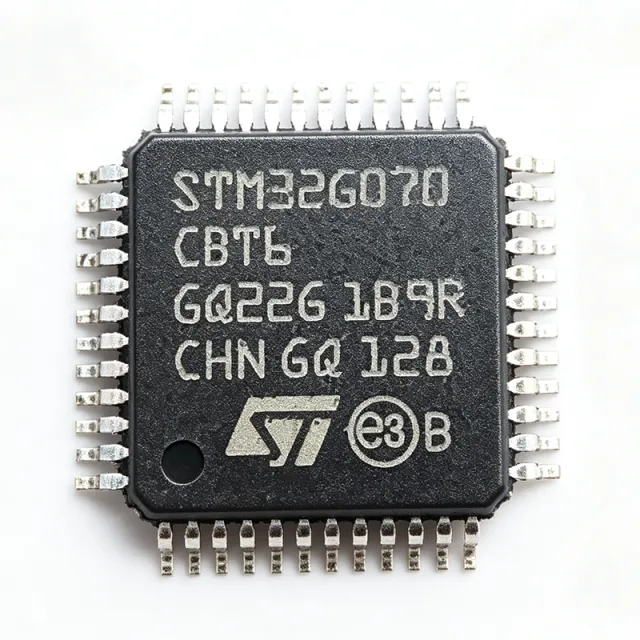
STM32G070CBT6 - 128KB Flash ARM Cortex-M0+ MCU | STMicroelectronics
STM32G070CBT6

STM32G070CBT6 - 128KB Flash ARM Cortex-M0+ MCU | STMicroelectronics

The STMicroelectronics STM32G070CBT6 is a 32-bit ARM Cortex-M0+ microcontroller with 128KB of flash memory and 36KB of SRAM, packaged in a 48-pin LQFP (LQFP48) package. It operates from 2.0V to 3.6V and supports a CPU frequency up to 64MHz. Data verified as of 2026-08-05. A microcontroller (MCU) is a compact integrated circuit designed to govern a specific operation in an embedded system. It contains a processor core, memory, and programmable input/output peripherals on a single chip. The STM32G070CBT6 belongs to the STM32G0 series, which is part of the broader STM32 family of 32-bit ARM Cortex-M microcontrollers. This hierarchy places it within the embedded processing domain, where it serves as the central control unit for a wide range of applications. Key features include a 12-bit ADC with up to 19 channels, multiple timers (including advanced-control timers), and a variety of communication interfaces such as I2C, SPI, USART, and a low-power UART. The device also includes a DMA controller, a CRC calculation unit, and a random number generator. Its low-power modes (Sleep, Stop, Standby) make it suitable for battery-powered applications. The STM32G070CBT6 is built on a high-performance ARM Cortex-M0+ core with a single-cycle multiplier and a nested vectored interrupt controller (NVIC). It supports a wide range of clock sources, including an internal 16MHz RC oscillator, an external crystal oscillator, and a PLL for higher frequencies. The device is designed for robust operation with brown-out reset, power-on reset, and a programmable voltage detector. Typical applications include industrial control, consumer electronics, IoT devices, and home automation. Its rich peripheral set and low power consumption make it ideal for sensor hubs, motor control, and smart home gateways. The 48-pin LQFP package provides a good balance between pin count and board space, enabling compact designs. When designing with this MCU, ensure proper decoupling of the power supply pins and a clean ground plane. The internal RC oscillator is sufficient for many applications, but an external crystal is recommended for precise timing requirements. The device supports in-circuit programming and debugging via SWD, simplifying firmware development.

Devis Contact
STM32G070KBT6 - 64MHz Cortex-M0+ MCU, 128KB Flash | STMicroelectronics
STM32G070KBT6

STM32G070KBT6 - 64MHz Cortex-M0+ MCU, 128KB Flash | STMicroelectronics

The STMicroelectronics STM32G070KBT6 is an Arm Cortex-M0+ 32-bit RISC microcontroller operating at up to 64 MHz, with 128 KB of Flash memory, 36 KB of SRAM, and a 32-LQFP 7 x 7 mm package. It belongs to the STM32G0 mainstream value line and is designed for embedded control applications requiring efficient processing, analog and digital peripherals, and flexible communications. An STM32G0-series microcontroller combines a low-power Arm Cortex-M0+ CPU core with embedded Flash and SRAM, peripheral interfaces, and power-management functions on one integrated device. This device family is used to consolidate control logic, communication, sensing, and timing tasks into compact embedded systems. The STM32G070KBT6 specifically provides 128 KB Flash, 36 KB RAM, four USART interfaces, timers, an ADC, and communication interfaces according to the verified distributor data. The key verified specifications are a maximum 64 MHz operating frequency, 128 KB Flash organized as 128K x 8, 36 KB SRAM, and a 2.0 V to 3.6 V operating-supply range. Its 32-LQFP package supports surface-mount assembly and provides a conventional leaded footprint for prototype and production boards. The exact peripheral details, pin names, electrical limits, and package dimensions must be confirmed against the manufacturer datasheet before hardware release. The Cortex-M0+ architecture provides a compact instruction set and efficient event-driven control for embedded products. Four USARTs support asynchronous serial communication, while timers and the ADC support timing, measurement, and control functions. These resources make the MCU suitable for industrial controllers, sensor nodes, communication equipment, and compact embedded products where a small package and broad peripheral integration reduce component count. Typical applications include low-cost industrial control boards, UART-based sensor gateways, simple motor or actuator controllers, instrument front ends, and connected embedded nodes. Because the verified data does not provide the complete pin-level electrical table, designs should use the official STMicroelectronics STM32G070KB product page and datasheet to confirm pin multiplexing, clock configuration, decoupling, programming, and peripheral limits. A key design consideration is to preserve the MCU’s 2.0 V to 3.6 V supply range and verify every external signal against the selected package pins. This page synthesizes verified distributor specifications, sourcing information, and engineering-selection guidance; unavailable electrical details are marked for datasheet confirmation rather than estimated.

Devis Contact
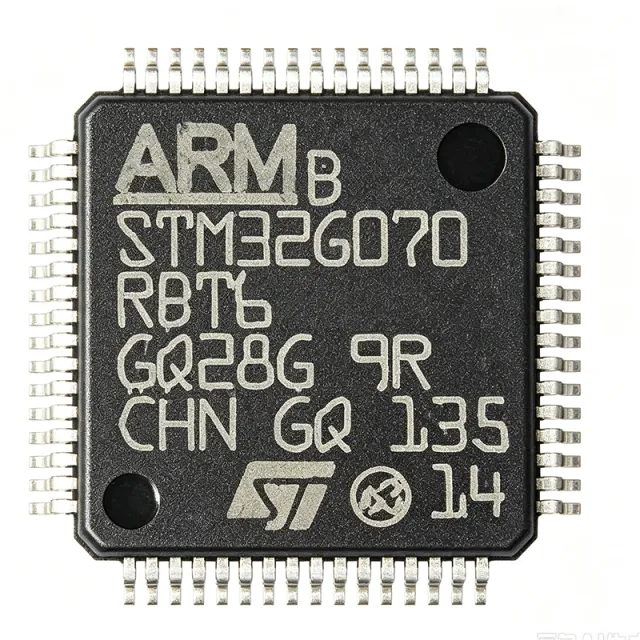
STM32G070RBT6 - 128KB Flash ARM Cortex-M0+ MCU | STMicroelectronics
STM32G070RBT6

STM32G070RBT6 - 128KB Flash ARM Cortex-M0+ MCU | STMicroelectronics

The STM32G070RBT6 is a 32-bit ARM Cortex-M0+ based microcontroller from STMicroelectronics, featuring 128KB of Flash memory and 36KB of SRAM in a 64-pin LQFP package. It operates at a maximum frequency of 64 MHz and supports a supply voltage range of 2.0V to 3.6V. Data verified as of 2026-08-05. A microcontroller (MCU) is a compact integrated circuit designed to govern a specific operation in an embedded system. It contains a processor core, memory, and programmable input/output peripherals on a single chip. The STM32G070RBT6 belongs to the STM32G0 series, which is part of the broader STM32 family of 32-bit ARM Cortex-M microcontrollers. This hierarchy places it within the embedded processing domain, where it serves as the central control unit for a wide range of applications. Key features include a 12-bit ADC with up to 19 channels, multiple timers (including advanced-control timers), and a rich set of communication interfaces such as I2C, SPI, USART, and CAN. The device also integrates a DMA controller, a real-time clock (RTC), and a variety of low-power modes, making it suitable for power-sensitive applications. The LQFP64 package provides a compact footprint with 51 GPIOs, enabling flexible system design. The STM32G070RBT6 is built on a high-performance ARM Cortex-M0+ core with a single-cycle multiplier and a nested vectored interrupt controller (NVIC). It includes a memory protection unit (MPU) for enhanced security and reliability. The device supports a wide operating temperature range of -40°C to +85°C, making it suitable for industrial environments. Its low-power design includes sleep, stop, and standby modes, with typical current consumption in the microampere range. Typical applications include industrial control systems, home automation, consumer electronics, and IoT devices. The rich peripheral set and low power consumption make it ideal for sensor hubs, motor control, and communication gateways. The CAN interface is particularly useful for automotive and industrial networking applications. When designing with this MCU, ensure proper decoupling of the power supply pins and consider the use of an external crystal for accurate timing. The device supports in-circuit programming and debugging via SWD, facilitating development and production programming. This page synthesizes distributor pricing, drop-in alternatives, and practical design notes not found in the STMicroelectronics datasheet, providing a comprehensive resource for engineers evaluating the STM32G070RBT6.

Devis Contact
STM32G071C8T6 - 64MHz Cortex-M0+ MCU, 64KB Flash | STMicroelectronics
STM32G071C8T6

STM32G071C8T6 - 64MHz Cortex-M0+ MCU, 64KB Flash | STMicroelectronics

The STM32G071C8T6 is a mainstream Arm Cortex-M0+ 32-bit RISC microcontroller from STMicroelectronics, operating at up to 64 MHz. It features 64 Kbytes of Flash memory and 36 Kbytes of RAM, packaged in a 48-pin LQFP (7x7 mm) with a tray delivery option. This MCU is designed for a wide range of embedded applications requiring efficient processing, rich analog peripherals, and robust communication interfaces. A microcontroller (MCU) is a compact integrated circuit designed to govern a specific operation in an embedded system. It contains a processor core, memory (Flash and RAM), and programmable input/output peripherals on a single chip. The STM32G0 series sits within the broader STM32 family, which is a leading 32-bit ARM Cortex-M microcontroller platform. As a Cortex-M0+ device, it offers a balance of low power consumption, cost-effectiveness, and sufficient performance for many control and sensing applications, making it a popular choice in industrial, consumer, and IoT designs. Key features of the STM32G071C8T6 include a 64 MHz Arm Cortex-M0+ core, 64 KB Flash, 36 KB SRAM, and a rich set of peripherals: multiple USARTs, I2C, SPI, a 12-bit ADC with hardware oversampling, a 12-bit DAC, comparators, op-amps, and a touch sensing controller. It also integrates a high-resolution timer, general-purpose timers, and a low-power RTC. The device supports a supply voltage range of 2.0V to 3.6V, with an operating temperature range of -40°C to +85°C, making it suitable for industrial environments. Technically, the STM32G071C8T6 is built on a high-performance Arm Cortex-M0+ core with a single-cycle multiplier and a nested vectored interrupt controller (NVIC). It includes a memory protection unit (MPU) for enhanced safety, and a DMA controller for efficient data transfer. The MCU also features a 12-bit ADC with up to 16 external channels, a 12-bit DAC, and two operational amplifiers, enabling analog signal conditioning without external components. The device supports various low-power modes, including Sleep, Stop, and Standby, with a typical power consumption in Stop mode of around 2.5 µA, which is critical for battery-powered applications. Typical applications include industrial control systems, home automation, sensor hubs, motor control, and portable medical devices. The rich analog peripherals and multiple communication interfaces make it ideal for building compact, cost-effective embedded systems. For example, in a smart sensor node, the STM32G071C8T6 can read analog sensors via its ADC, process data with its Cortex-M0+ core, and transmit results over UART or I2C to a gateway. When designing with this MCU, ensure proper decoupling of the VDD pins with 100 nF capacitors placed close to the device, and a bulk capacitor (e.g., 4.7 µF) on the main supply. For ADC accuracy, a clean analog supply (VDDA) and a stable reference voltage (VREF+) are essential. The device supports in-application programming (IAP) via its bootloader, allowing firmware updates over UART or USB, which is valuable for field maintenance.

Devis Contact
STM32G071CBT6 - 64MHz Cortex-M0+ 128KB MCU | STMicroelectronics
STM32G071CBT6

STM32G071CBT6 - 64MHz Cortex-M0+ 128KB MCU | STMicroelectronics

The STMicroelectronics STM32G071CBT6 is an Arm Cortex-M0+ 32-bit microcontroller operating at up to 64 MHz, with 128 KB of Flash memory and a 48-LQFP 7x7 mm package. Its combination of a compact footprint, mainstream embedded-control resources, and the STM32G0 product family makes it suitable for compact industrial controllers, sensing nodes, and communication equipment. A microcontroller is a programmable semiconductor that integrates a processor core, memory, and peripherals into one device used to read sensors, control outputs, execute embedded software, and manage system communications. The STM32G0 family belongs to the STM32 family and uses the Arm Cortex-M0+ processor architecture, a low-complexity 32-bit core designed for resource-constrained embedded systems. Verified product information identifies the STM32G071CBT6 as a 32-bit, 64 MHz device with 128 KB Flash organized as 128K x 8. The supplied data does not specify RAM size, voltage range, peripheral inventory, pin assignments, temperature range, or package dimensions beyond the stated 48-LQFP 7x7 mm format; those values must be confirmed in the manufacturer documentation before design release. The STM32G071CBT6 is positioned as a mainstream microcontroller for embedded control rather than a high-performance application processor. Its 64 MHz Cortex-M0+ core provides a defined timing basis for motor, control, sensor-processing, and communication-oriented firmware. Because the supplied source does not provide detailed peripheral specifications, engineers should verify ADC, timer, UART, SPI, I2C, USB, and GPIO resources directly against the official STM32G071x8/xB documentation. Typical design uses include small industrial automation modules, digital sensor controllers, building and access-control peripherals, low-speed communication gateways, and compact consumer equipment. The 48-LQFP package exposes more pins than a small QFN package and can simplify assembly where leaded soldering or inspection is preferred. A key engineering consideration is firmware and peripheral migration. Before replacing an existing STM32 design, verify startup files, memory organization, pin multiplexing, clock settings, peripheral instances, and package-specific land patterns. The part number and package must be treated as exact BOM identifiers, not inferred from a similar STM32G0 device. This product page combines the verified manufacturer identity, distributor listing, package information, source links, and practical design guidance. It does not invent missing electrical, pinout, pricing, or compliance values; those fields remain explicitly marked when the supplied evidence is incomplete.

Devis Contact
STM32G071CBU6 - 64MHz 128KB Cortex-M0+ MCU | STMicroelectronics
STM32G071CBU6

STM32G071CBU6 - 64MHz 128KB Cortex-M0+ MCU | STMicroelectronics

STMicroelectronics STM32G071CBU6 is a 32-bit Arm Cortex-M0+ microcontroller operating up to 64 MHz, with 128 KB of Flash memory and 36 KB of RAM, in a 48-pin UFQFPN package measuring 7 x 7 mm. The device belongs to the STM32G0 mainstream microcontroller family and combines a compact embedded-control footprint with integrated analog, communications, timing, and debug resources. A microcontroller is a programmable semiconductor that integrates a processor core, memory, and peripherals into one device. In the product hierarchy, the STM32G071CBU6 is a microcontroller, or MCU, built around the Arm Cortex-M0+ CPU core within the STM32G0 embedded-processing family. Its compact package and broad peripheral set make it suitable for small control boards, consumer accessories, and industrial equipment where space, cost, and deterministic real-time performance matter. Key features include a maximum 64 MHz operating frequency, 128 KB of Flash for firmware, and 36 KB of SRAM for working data. The verified distributor listing identifies four USART peripherals and the family documentation confirms 64 MHz operation. The part also integrates an ADC, DAC, timers, and communication interfaces, enabling a compact design without requiring separate external converters or interface devices. Its Cortex-M0+ architecture provides a straightforward 32-bit instruction set and efficient real-time control. The STM32G0 family is intended for mainstream embedded applications, where engineers value low system complexity alongside useful analog conversion and serial communications. At 64 MHz, the processor can execute control loops and manage multiple peripherals while retaining deterministic timing for motor, sensing, and communications tasks. Typical uses include compact motor-control modules, digital sensor controllers, connected home accessories, USB Type-C peripheral equipment, and general-purpose industrial control nodes. The 48-UFQFPN 7 x 7 mm package helps reduce PCB area, although its fine pitch requires careful assembly, land-pattern verification, and thermal-via planning. When designing around the STM32G071CBU6, verify every board-level pin assignment against the current STMicroelectronics datasheet and package drawing. Place decoupling capacitors close to supply pins, keep sensitive analog paths away from fast digital switching, and confirm firmware, bootloader, and peripheral requirements before committing to this exact orderable variant. This page consolidates verified manufacturer and distributor information, package constraints, practical design guidance, and candidate drop-in alternatives. It also identifies parameters that require datasheet confirmation, helping engineers distinguish confirmed STM32G071CBU6 facts from assumptions before PCB release or production sourcing.

Devis Contact
STM32G071G8U6 - 64MHz Cortex-M0+ MCU, 64KB Flash | STMicroelectronics
STM32G071G8U6

STM32G071G8U6 - 64MHz Cortex-M0+ MCU, 64KB Flash | STMicroelectronics

The STMicroelectronics STM32G071G8U6 is a mainstream 32-bit ARM Cortex-M0+ microcontroller in the STM32G0 family, integrating 64KB of Flash and 36KB of SRAM, operating at up to 64MHz from a 2.0V to 3.6V supply, and packaged in a compact 28-pin UFQFPN (4x4 mm) for space-constrained designs. According to STMicroelectronics product documentation, this part extends the STM32G0 series with USB Type-C Power Delivery (UCPD), 4 USART, and a 12-bit ADC with up to 19 channels. What is a Cortex-M0+ MCU? An ARM Cortex-M0+ microcontroller is a 32-bit RISC processor core designed by ARM for energy-efficient embedded applications. It sits at the entry level of the Cortex-M family, above 8-bit legacy MCUs in performance but below Cortex-M3/M4 in features. Within the broader taxonomy, it belongs to: microcontroller -> 32-bit MCU -> ARM Cortex-M -> Cortex-M0+ -> STM32G0 series -> STMicroelectronics. Key features include the M0+ core with single-cycle I/O access, an integrated USB Type-C and Power Delivery (UCPD) physical layer, multiple low-power modes (Sleep, Stop, Standby, Shutdown) with typical Stop current around 2 uA, a 12-bit 2.5 MSPS ADC, a 12-bit DAC, comparators, op-amps, and a real-time clock. The 28-pin UFQFPN exposes 4 USART/UART, 2 I2C, 2 SPI/I2S, USB 2.0 FS, and up to 23 GPIO, balancing cost and connectivity. Technically, the STM32G071G8U6 implements an ART Accelerator zero-wait-state Flash interface, hardware division, and a 4-channel DMA. The integrated UCPD PHY supports USB Type-C connector attach/detach and Power Delivery messaging up to 100W sink/source roles without an external TCPC. Its internal 64MHz HSI can supply the system clock, removing the need for an external crystal in many USB and consumer designs. Typical applications include USB Type-C power delivery sinks/sources, USB human-interface devices (HID), small appliances with capacitive touch, smart sensors, lighting controllers, and low-cost IoT edge nodes. The combination of USB, ADC, and small footprint suits replacement of USB bridge ICs with a programmable MCU. Design consideration: USB-C and UCPD applications require careful attention to the CC1/CC2 pin routing and the VBUS sensing divider. When migrating from UFQFPN28 STM32F0 designs, verify pin remapping because some peripherals have moved to alternate functions on the STM32G0. This page synthesizes distributor pricing, parametric alternatives in the same UFQFPN-28 footprint, and practical design notes not aggregated on a single manufacturer or distributor page.

Devis Contact