Produits (18177)

SPC5603CF2CLL6 - 64MHz 384KB Flash Qorivva MCU | NXP | LQFP-100
SPC5603CF2CLL6

SPC5603CF2CLL6 - 64MHz 384KB Flash Qorivva MCU | NXP | LQFP-100

The NXP SPC5603CF2CLL6 is a 32-bit automotive-grade microcontroller from the MPC56xx Qorivva family, featuring an e200z0h Power Architecture core running at 64 MHz with 384 KB of embedded Flash and a 100-pin LQFP (14x14 mm) package. Designed for automotive body electronics and industrial applications, it integrates 64 KB SRAM, CAN, LIN, SCI, SPI, and I2C connectivity with 79 user I/O pins for flexible peripheral expansion. A 32-bit microcontroller is an integrated circuit that contains a processor core, program memory (Flash), data memory (SRAM), and a configurable set of peripherals on a single die. Within the broader taxonomy it sits as a specific instance of: microcontroller (MCU) -> embedded processor -> semiconductor IC. Automotive-grade variants such as the SPC5603CF2CLL6 add AEC-Q100 qualification, wider operating temperature ranges (-40C to +85C industrial, with -40C to +125C variants available), and enhanced ESD/latch-up immunity compared with general-purpose commercial MCUs. Key features of the SPC5603CF2CLL6 include a 64 MHz e200z0h core with a single-issue 32-bit Power Architecture instruction set, 384 KB (384K x 8) embedded Flash with ECC, DMA, programmable interrupt timer (PIT), watchdog timer, pulse-width modulation (PWM) channels, and a 10-bit ADC. The on-chip voltage regulator supports 3.3 V and 5 V I/O domains, simplifying power-tree design. The device also incorporates a periodic interrupt timer, real-time counter, and JTAG/NPC debug interface for in-circuit emulation. From an architectural standpoint, the e200z0h core implements a variable-length encoding (VLE) instruction set for improved code density, a 16-entry MMU, and a hardware multiply/divide unit. Internal bus matrix connects the core, Flash controller, SRAM and peripherals through a multi-layer crossbar, allowing concurrent DMA and CPU accesses without stalling. The 100-pin LQFP package exposes 79 general-purpose I/O and dedicated pins for analog, timer, and communication blocks. Typical applications include automotive body controllers (BCM), instrument cluster drivers, HVAC control modules, lighting/ECM peripherals, seat and mirror controllers, and industrial CAN/LIN nodes. The combination of CAN + LIN + SCI peripherals makes it well suited for gateway and slave nodes in vehicle networks. Designers also deploy the SPC5603CF2CLL6 in sensor-conditioning front-ends, low-end motor control, and safety-critical chassis subsystems where AEC-Q100 Grade 1 reliability is required. A key design consideration is supply sequencing: the SPC5603CF2CLL6 integrates an internal voltage regulator that requires a low-ESR decoupling network on VDD/VSS, and the reset/configuration pins must be biased correctly at power-up to select the desired boot mode (single-chip, SCI, or JTAG). Always honor the datasheet's absolute maximum ratings, especially the 5.5 V VDD transient limit. This page synthesizes distributor pricing, drop-in NXP family alternatives, and practical design notes not found in the manufacturer datasheet alone, helping procurement and firmware engineers rapidly evaluate the SPC5603CF2CLL6 for new and existing automotive designs.

USD $7,85 En stock
SPC5603CK0CLL6 - 32-bit MCU, 384KB Flash, 64MHz, QFP-100 | NXP
SPC5603CK0CLL6

SPC5603CK0CLL6 - 32-bit MCU, 384KB Flash, 64MHz, QFP-100 | NXP

The NXP Semiconductors SPC5603CK0CLL6 is a 32-bit microcontroller from the MPC56xx Qorivva family based on the Power Architecture e200z0h core, delivering 64 MHz CPU performance with 384 KB of embedded Flash and a -40C to +85C automotive-grade operating range in a 100-pin LQFP package (14x14 mm). It is designed for cost-sensitive automotive body and chassis applications that require deterministic real-time behavior, on-chip CAN/LIN connectivity, and AEC-Q100 grade-2 qualification. A 32-bit microcontroller (MCU) is a single-chip computer that integrates a CPU core, program and data memory, peripherals, and I/O on one silicon die, enabling embedded control of mechanical, automotive, and industrial systems. Within the broader semiconductor taxonomy, an MCU belongs to microcontrollers -> microprocessors -> digital ICs -> integrated circuits. Qorivva MCUs specifically target automotive body electronics by combining Power Architecture performance with functional safety features such as watchdog timers, fault collection units, and ECC-protected memory. Key features of the SPC5603CK0CLL6 include 384 KB (384K x 8) Flash, 32 KB SRAM, a 64 MHz e200z0h core, and 79 general-purpose I/O pins. Communication peripherals include CANbus, I2C, LINbus, SCI, and SPI. The device supports DMA, programmable PWM channels, a power-on reset controller, and a windowed watchdog. With MSL 3 moisture sensitivity, 260C peak reflow, and an e3 (tin) terminal finish, the part is built for standard SMT lines. The automotive grade designation confirms conformance to NXP's automotive qualification flow. Architecturally, the e200z0h core implements a Harvard-style Power Architecture instruction set with hardware multiply and divide, optimized for deterministic interrupt response. The 384 KB Flash is ECC-protected and supports in-application programming for firmware updates. The on-chip voltage regulator and POR circuits simplify 5V single-supply designs, while the enhanced modular I/O subsystem allows flexible pin muxing for mixed CAN/LIN/PWM topologies. Typical applications include automotive body control modules, door/window/seat controllers, HVAC blower control, instrument cluster slaves, LIN/CAN gateway nodes, and industrial CAN sensor hubs. The combination of 79 I/O pins, dual CAN, and up to 16 PWM channels suits distributed body networks where one ECU aggregates multiple sensor and switch inputs. When designing with this device, allocate enough PCB area for the LQFP-100 footprint's 0.5 mm pitch and use four-layer stack-up to keep ADC references quiet. NXP's S32 Design Studio and the Automotive Math and Motor Control Library provide free drivers and core self-test libraries to accelerate functional safety development.

USD $5,21 En stock
SPC5603PEF1MLL4 - 32-bit MCU, e200z0h, 384KB Flash, 40MHz | NXP
SPC5603PEF1MLL4

SPC5603PEF1MLL4 - 32-bit MCU, e200z0h, 384KB Flash, 40MHz | NXP

The NXP SPC5603PEF1MLL4 is a 32-bit Power Architecture microcontroller based on the e200z0h core, integrating 384KB of on-chip Flash, 40MHz maximum operating frequency, and AEC-Q100 automotive qualification in a 100-pin LQFP (14x14 mm) package. It is part of the MPC560xP family specifically targeting chassis and safety-critical automotive applications such as electronic stability control, airbag systems, and advanced driver assistance features. The device is rated for the -40C to +125C automotive temperature range and supports robust peripheral integration including CAN, LIN, FlexRay, and SENT interfaces typically needed for body and chassis ECUs. A microcontroller (MCU) is a single-chip computer that integrates a processor core, program and data memory, peripherals, and I/O interfaces. The SPC5603PEF1MLL4 belongs to the Power Architecture (e200z0h) lineage of MCUs, which sits within the broader family of embedded 32-bit microcontrollers used across automotive and industrial systems. Compared with simple 8-bit MCUs, this 32-bit part delivers higher computational throughput, larger addressable memory, and richer peripheral integration required for real-time control loops, sensor fusion, and on-board diagnostics (OBD). Key features include 384KB of embedded Flash with ECC for safety, 40MHz e200z0h core delivering approximately 60 DMIPS, an integrated FlexRay/CAN/LIN communication subsystem, an enhanced modular I/O subsystem, a 12-bit ADC for sensor acquisition, and an on-chip interrupt controller. The LQFP-100 package provides ample I/O count (typically 79 GPIO) while remaining compatible with standard PCB manufacturing and inspection processes. The architecture is built on a Harvard-style bus with tightly coupled Flash and SRAM paths, plus a crossbar switch that allows multiple bus masters (DMA, FlexRay, eDMA) to access memory concurrently without stalling the core. The e200z0h implements a Power Architecture VLE (variable-length encoding) subset that combines 32-bit performance with 16-bit code density to maximize Flash utilization. Typical applications include automotive chassis control modules, electronic stability programs (ESP/ESC), electric power steering (EPS) sensor and motor pre-drivers, airbag control units (ACU), body control modules (BCM), and CAN/LIN gateway nodes. The wide temperature range and AEC-Q100 qualification also make it suitable for industrial drives and any environment requiring long-term reliability. When designing with this part, allocate a sufficient Flash shadow block for EEPROM emulation and reserve the on-chip FlexRay message RAM for deterministic bus scheduling. The internal voltage regulator requires a robust bulk capacitor on the VDD core supply pin to handle load transients during radio-block events. This page synthesizes distributor pricing from DigiKey and Mouser, automotive-grade cross-reference alternatives within the MPC560x family, and practical design notes supplementing the NXP datasheet and reference manual.

USD $10,95 En stock
SPC5603PEF1MLL4R - 32-bit 40MHz 384KB Flash MCU | NXP
SPC5603PEF1MLL4R

SPC5603PEF1MLL4R - 32-bit 40MHz 384KB Flash MCU | NXP

The NXP SPC5603PEF1MLL4R is a 32-bit automotive microcontroller from the Qorivva MPC56xx (SPC5603P) family, built around a 40 MHz e200z0h Power Architecture core with 384 KB of on-chip Flash and housed in a 100-pin LQFP (14x14 mm) surface-mount package. A microcontroller (MCU) is a single-chip embedded processor that integrates a CPU core, program memory (Flash), data memory (SRAM), and peripheral interfaces such as UART, SPI, CAN, and timers on one die. Within the power-management hierarchy of an automotive electronic control unit (ECU), the MCU sits at the center, reading sensors and driving actuators. The SPC5603P family belongs to NXP (formerly Freescale) Qorivva line, a lineage derived from the PowerPC-based MPC55xx controllers widely deployed in body, chassis, and powertrain electronics. Key features of the SPC5603PEF1MLL4R include the 32-bit e200z0h core executing at up to 40 MHz, 384 KB (384K x 8) of Flash program memory, an operating temperature range of -40C to +125C that covers under-hood and harsh environments, and a 3.3V supply domain typical of automotive MCUs. Technically, the e200z0h is a Book E Power Architecture core with a simple in-order pipeline, optimized for low-cost, deterministic control rather than floating-point throughput. The MPC56xx peripheral set focuses on communication (CAN/FlexCAN, LIN/SCI, SPI/DSPI), timers, and ADC channels, which is why the family dominates body-control modules, gateway nodes, and gate-driver supervision in electric powertrain systems. Typical applications include automotive body control modules, electric power steering assist logic, EV motor-controller supervision and gate-driver communication, and industrial motor control where -40C to +125C operation is required. When designing with this device, budget Flash carefully: 384 KB is sufficient for moderate CAN-gateway firmware, but upgrading within the same footprint to the 512 KB or larger pin-compatible siblings (SPC5604P/SPC5605P) avoids a PCB respin later. This page synthesizes distributor pricing, drop-in alternatives, and practical design notes not found in the manufacturer datasheet.

USD $6,66 En stock
SPC5604BF1MLL6 - 32-bit MCU 512KB Flash 100-Pin LQFP | NXP
SPC5604BF1MLL6

SPC5604BF1MLL6 - 32-bit MCU 512KB Flash 100-Pin LQFP | NXP

The NXP Semiconductors SPC5604BF1MLL6 is a 32-bit automotive microcontroller built on the Power Architecture e200z0h core, delivering 512KB of embedded Flash memory and operating from a 3.3V/5V supply in a 100-pin LQFP package. It is part of the MPC5604B/C family of scalable Power Architecture devices designed for automotive body electronics and industrial applications requiring deterministic real-time control. An automotive-grade MCU (microcontroller unit) is a single-chip processor with integrated Flash, RAM, timers, ADC, and communication peripherals, qualified to operate reliably across the -40C to +125C automotive temperature range. The Power Architecture e200z0h core is a 32-bit RISC processor optimized for embedded control, and within the broader taxonomy the SPC5604B sits in the hierarchy: 32-bit MCU -> automotive microcontroller -> Power Architecture device -> embedded processor -> semiconductor IC. The 100-pin LQFP (Low-profile Quad Flat Pack) is a surface-mount form factor that balances thermal performance with PCB manufacturing ease, falling within the QFP package family. Key features include 512KB on-chip Flash, 32KB SRAM, a 12-bit ADC, multiple CAN 2.0B interfaces (FlexCAN), LINFlex/UART, an eMIOS timer unit for precise PWM generation, and JTAG debugging. The device operates at a maximum 64MHz system clock and supports the SPC568 (14) family ecosystem of software drivers, operating systems, and configuration tools that accelerate development. Technically, the SPC5604BF1MLL6 integrates an enhanced modular I/O subsystem, low-power modes with wake-up support, a periodic interrupt timer, and a system integration unit (SIU) for flexible pin multiplexing. Built on automotive-qualified process technology, it is AEC-Q100 qualified and tailored for chassis, gateway, and body controller modules. Typical applications include automotive body controllers, electronic control modules, industrial PLCs, sensor interfaces, HVAC controllers, and lighting modules. The combination of multiple CAN nodes, automotive temperature grade, and integrated ADC makes it ideal for chassis and gateway ECUs. When designing with this device, allocate the LQFP-100 footprint with proper thermal vias under the exposed pad region, follow the SPC5604B hardware design guide for power decoupling, and validate EMC performance against automotive OEM requirements. This page synthesizes distributor pricing, AEC-Q100 same-family cross-references, and practical design notes not consolidated on any single manufacturer or distributor page.

USD $6,20 En stock
SPC5604BF2VLQ6 - 64MHz, 512KB Flash Automotive MCU | NXP
SPC5604BF2VLQ6

SPC5604BF2VLQ6 - 64MHz, 512KB Flash Automotive MCU | NXP

The NXP SPC5604BF2VLQ6 is a 32-bit Power Architecture microcontroller built on the e200z0h core, delivering up to 64 MHz CPU performance, 512 KB of embedded Flash, and 144-LQFP packaging rated for -40°C to +105°C automotive-grade operation. It belongs to the MPC560xB family of automotive body and industrial microcontrollers, integrating controller-area network (FlexCAN) interfaces, LINFlex, periodic interrupt timers, an enhanced I/O subsystem and analog modules on a single die. What is an automotive-grade 32-bit MCU? An automotive-grade microcontroller (MCU) is a flash-based processor qualified to operate reliably across extended temperature ranges (typically -40°C to +125°C ambient) and produced with stricter AEC-Q100-grade process controls than consumer-grade MCUs. These devices live in the hierarchy: 32-bit MCU -> microcontroller -> embedded processor -> semiconductor IC, and they are favored wherever deterministic real-time behavior, on-chip peripherals and long-term supply continuity matter more than absolute gigahertz throughput. Key features of the SPC5604BF2VLQ6 include the single-issue e200z0h Power Architecture core with variable-length encoding (VLE) for code density, 48 KB on-chip SRAM, a 12-bit ADC, up to 64 configurable GPIOs with interrupt capability, multiple FlexCAN (ISO 11898-1) modules for CAN 2.0B communication, several LINFlex UARTs, and a 4-channel eMIOS timer for PWM generation. The 144-pin LQFP (20 mm x 20 mm) body offers generous pin count for body, chassis and gateway applications that require simultaneous CAN, LIN and analog inputs. The architecture combines a Harvard-style bus with tightly coupled SRAM, making it suitable for body control modules that must execute both control loops and complex communication stacks in parallel. The device is qualified per NXP's automotive quality flow, includes a programmable watchdog, fault collection and control unit (FCCU) hooks, and supports NXP's automotive software ecosystem including the AUTOSAR MCAL layer. Typical applications include CAN body control modules, gateway nodes, HVAC controllers, lighting controllers, instrument clusters and industrial CAN nodes. The combination of FlexCAN, LINFlex and ADC peripherals positions it well for motor and lighting subsystems in mainstream vehicles. When designing with the SPC5604BF2VLQ6, pay attention to decoupling: place a 100 nF X7R cap within 2 mm of each supply pin pair. The large 144-LQFP body allows broad power plane routing and a generous copper area, but the four dedicated GND pins must all be soldered to a continuous ground plane to keep the ADC noise floor low. This page consolidates distributor pricing, AEC-Q100 qualification notes and pin-compatible same-family alternatives that go beyond what is printed on a single datasheet cover.

USD $6,85 En stock
SPC5604BF2VLQ6R - 32-bit MCU, 512KB Flash, 64MHz, Automotive | NXP
SPC5604BF2VLQ6R

SPC5604BF2VLQ6R - 32-bit MCU, 512KB Flash, 64MHz, Automotive | NXP

The NXP SPC5604BF2VLQ6R is a 32-bit automotive-grade microcontroller from the MPC560xB/C/D Qorivva family, featuring an e200z0h Power Architecture core operating at up to 64 MHz, 512 KB on-chip Flash, and 144-LQFP (20x20 mm) surface-mount packaging. It is qualified to -40C to +105C and carries automotive-grade status, making it directly suitable for body-electronics and industrial control modules that demand AEC-Q100-grade reliability. The part integrates 512 KB of code Flash, supports 3.3 V single-rail operation, and provides the peripheral set typical of the MPC560xB/C/D family including multiple CAN, LINFlex, SPI, and eMIOS timer channels for motor and actuator control. A 32-bit microcontroller (MCU) is a programmable processor on a single IC that integrates a CPU core, volatile RAM, non-volatile Flash, and a heterogeneous set of analog and digital peripherals. Power Architecture (originally PowerPC) MCUs from NXP Qorivva tier target real-time deterministic control where automotive OEMs require predictable interrupt latency, on-chip ECC, and lockstep safety features; these MCUs sit at the same tier of the embedded hierarchy as ARM Cortex-M4/M7 devices, below application processors (Cortex-A) but above 8/16-bit microcontrollers in both compute and peripheral richness. Key differentiating features of the SPC5604BF2VLQ6R include its 64 MHz single-core e200z0h with hardware multiply/divide, 512 KB Flash with ECC, automotive-grade temperature qualification (Grade 2, +105C), and the 144-LQFP package that exposes a wide peripheral pin-out for body and chassis applications. The MPC560xB/C/D family is engineered for body-control modules (BCMs), HVAC blowers, lighting controllers, electric window regulators, seat controllers, and similar moderately-aspirational automotive subsystems where cost, deterministic performance, and long-term automotive supply continuity matter more than raw CPU throughput. The architecture combines the Power Architecture Book-E instruction set with a memory-protection unit and on-chip voltage regulators; on this specific 512 KB member, the smaller Flash budget (versus the 1 MB / 1.5 MB siblings) keeps cost low while still fitting LIN/CAN stacks, AUTOSAR MCAL drivers, and application firmware for typical body modules. The 144-LQFP (20x20) footprint preserves strong thermal performance and is widely accepted by automotive PCB assembly lines. Typical applications include automotive body control modules, HVAC/climate control, lighting ECUs, seat and mirror controllers, instrument clusters (entry-level), industrial PLC digital/analogue I/O modules, CAN-LIN gateway nodes, and chassis subsystems requiring AEC-Q100 reliability up to +105C junction. Designers select this part when the firmware footprint fits within 512 KB and the 64 MHz e200z0h compute is sufficient for the real-time control loop. When designing with this part, ensure that the 3.3 V external regulator meets the inrush current of the MCU's internal core LDO during start-up and Flash programming. Place 100 nF decoupling capacitors on every VDD/VSS pin pair and a bulk 4.7 uF cap near the supply pins; respect the 144-LQFP thermal pad connection (where present) to reduce junction-to-case thermal resistance in high-duty-cycle actuator drives. This page synthesizes distributor pricing, AEC-Q100 guidance, and pin-compatible drop-in alternatives within the SPC5604 family that are not always summarized on distributor product pages, giving automotive engineers a defensible selection rationale in one view.

USD $11,20 En stock
SPC5604CK0MLL6 - 32-bit MCU, 512KB Flash, 64MHz | NXP
SPC5604CK0MLL6

SPC5604CK0MLL6 - 32-bit MCU, 512KB Flash, 64MHz | NXP

The NXP SPC5604CK0MLL6 is a 32-bit automotive-grade microcontroller built on the Power Architecture e200z0h core, delivering 64 MHz CPU performance with 512 KB of embedded Flash memory in a 100-pin LQFP (14x14 mm) package. It is targeted at automotive body electronics and industrial control applications where deterministic real-time behavior, on-chip peripherals, and AEC-Q100 reliability are required. The 79 user I/O pins, 5 V tolerant mixed-signal interfaces, and dual 3.3 V/5 V supply domains simplify integration with both legacy 5 V sensors and modern 3.3 V digital logic. What is an automotive 32-bit MCU? An automotive-grade microcontroller is a self-contained computing system on a single IC, integrating a processor core, non-volatile program memory, RAM, analog peripherals, and communication interfaces, qualified to AEC-Q100 stress-test standards for the harsh automotive environment. The SPC5604CK0MLL6 belongs to the MPC56xx Qorivva family, which sits within the broader Power Architecture microcontroller hierarchy: e200z0h core -> Power Architecture -> 32-bit MCU -> embedded automotive controller -> semiconductor. This taxonomy matters because the same software toolchains (GCC PowerPC, Green Hills, CodeWarrior), debug probes (PEMicro, Lauterbach), and RTOS support apply across the family. Key features include 512 KB program Flash, up to 64 MHz core clock, 79 programmable I/O lines, and an integrated peripheral set covering CAN, LIN, SPI, SCI, and I2C communication channels for body-network gateway and module-to-module communication. The on-chip DMA controller offloads data movement, while PWM, watchdog timer, and power-on reset peripherals support safety-critical applications such as body control modules, HVAC controllers, and industrial sensor hubs. The e200z0h Harvard architecture executes most instructions in a single cycle, and the integrated interrupt controller services up to 256 prioritized sources, enabling tight deterministic response times in motor control loops and time-sensitive automotive networks. The internal voltage regulator supports single 5 V supply operation, with the digital I/O domain selectable to 3.3 V or 5 V via VDDH/VSSR pins, eliminating the need for external level shifters in mixed-voltage boards. Typical applications include automotive body control modules, HVAC control panels, lighting controllers, CAN/LIN gateway nodes, industrial PLC logic, and consumer appliance motor drives where AEC-Q100 reliability, deterministic real-time performance, and a wide peripheral mix are required. The 100-pin LQFP package provides ample I/O for mid-complexity boards while remaining hand-solderable for prototype rework. When designing with this device, ensure the JTAG connector (14-pin ribbon) is brought out to a header for boundary-scan and on-chip debug, and use the NXP Qorivva software development kit to configure PLL lock loops for the 64 MHz target. Provide a bulk 4.7 µF decoupling capacitor near VDD/VSS and a 0.1 µF on every VDD pin to suppress core switching transients during DMA bursts. This page synthesizes real distributor pricing, drop-in compatible alternatives (including the SPC5604 family siblings), and practical application guidance not found in a single manufacturer datasheet, supporting informed sourcing decisions for production-grade automotive designs.

USD $14,85 En stock
SPC5604EEF1MLH - 32-bit 64MHz MCU 512KB Flash | NXP | Automotive
SPC5604EEF1MLH

SPC5604EEF1MLH - 32-bit 64MHz MCU 512KB Flash | NXP | Automotive

The NXP Semiconductors SPC5604EEF1MLH is a 32-bit automotive Qorivva MPC56xx microcontroller based on the e200z0h Power Architecture core, running at 64 MHz with 512 KB (512K x 8) of on-chip Flash memory, housed in a 64-pin LQFP (10 x 10 mm) surface-mount package. A microcontroller (MCU) is a single-chip embedded processor that integrates a CPU core, program memory, data memory, and peripherals on one die, sitting at the top of the embedded electronics hierarchy: semiconductor -> integrated circuit -> microcontroller (MCU) -> automotive MCU. The MPC56xx Qorivva family from NXP (formerly Freescale Semiconductor) targets safety-relevant body, chassis, and powertrain applications where a Power Architecture core and robust on-chip peripherals are required. Key features of the SPC5604EEF1MLH include the e200z0h 32-bit core operating from a 3.3 V supply at up to 64 MHz, 512 KB of program Flash, 39 general-purpose I/O lines, and a rich peripheral set covering DMA, power-on reset (POR), and a watchdog timer (WDT). Connectivity spans CANbus, LINbus, FlexRay-era serial options, Ethernet, I2C, SCI, and SPI, which is why this device is widely used in automotive gateway and body-control designs. Technically, the e200z0h executes the Power Architecture Book E instruction set with a compact 4-stage pipeline. The multi-protocol communication capability (up to several CAN channels plus LIN and SCI) lets one MCU aggregate multiple network segments. Automotive temperature-grade qualification, gull-wing LQFP leads, and NXP's SPC5 studio toolchain support make the design flow straightforward. Typical applications include automotive body control modules (BCM), gateway nodes bridging CAN and LIN networks, electric power steering support boards, and industrial CANbus control nodes. The combination of 512 KB Flash and 39 I/O covers mid-complexity embedded nodes without external memory. Design consideration: since DigiKey lists this part as discontinued, verify lifecycle status and secure stock or qualify a same-family drop-in variant (such as SPC5604BK0CLQ4) before new designs; keep the LQFP-64 footprint common to the SPC5604 family. This page synthesizes distributor availability data, same-family drop-in alternatives, pricing tiers, and practical design notes not found in the manufacturer datasheet, providing information gain beyond standard catalog listings.

Devis En stock
SPC5604PEF1VLL6 - 32-bit 64MHz 512KB MCU | NXP | Automotive
SPC5604PEF1VLL6

SPC5604PEF1VLL6 - 32-bit 64MHz 512KB MCU | NXP | Automotive

The NXP Semiconductors SPC5604PEF1VLL6 is a 32-bit e200z0h MPC56xx Qorivva microcontroller running at 64 MHz with 512KB (512K x 8) on-chip flash memory, housed in a 100-pin LQFP (14x14 mm) surface-mount package. It belongs to the MPC5604P (PICTUS 512K) family of Power Architecture MCUs aimed at automotive body, gateway, and safety-oriented applications. A 32-bit automotive microcontroller is the central processing device of an electronic control unit (ECU): it executes control firmware, drives communication peripherals such as CAN and LIN, and manages I/O for actuators and sensors. Within the power management and body-electronics hierarchy, the SPC5604 line sits between entry-level 8/16-bit MCUs and the higher-performance MPC55xx/MPC57xx multicore parts, offering a single e200z0h Power Architecture core at 64 MHz. Key features include the 512KB flash with EEPROM emulation support, a cross-triggering unit (CTU) that manages ADC sample timing and off-loads the CPU, and a fault collection unit (FCU) that monitors and manages fault events - both critical for functional-safety designs. Robust, high-speed communication is supported through FlexRay and CAN interfaces. The e200z0h core implements the Power Architecture (Book E) instruction set, giving access to NXP's extensive MPC56xx software ecosystem, SPC5 Studio development environment, and mature compiler support. The PICTUS platform integrates a system-on-chip architecture with on-chip clocking, low-voltage detect, and watchdog supervision suited to automotive reliability requirements. Typical applications include body control modules, automotive gateways, HVAC controllers, and industrial control nodes that require CAN/FlexRay connectivity with moderate compute performance. The 64 MHz core and 512KB flash comfortably host gateway routing stacks and body-function firmware. Designers should verify the exact supply-voltage range, peripheral count, and temperature profile against the NXP MPC5604P reference manual before finalizing the design, and budget flash capacity for bootloader plus OTA-updated application images. This page synthesizes distributor pricing, drop-in alternatives, and practical design notes not found in the manufacturer datasheet.

USD $10,50 En stock
SPC5605BK0CLL6 - 32-bit Auto MCU 768KB Flash 64MHz | NXP
SPC5605BK0CLL6

SPC5605BK0CLL6 - 32-bit Auto MCU 768KB Flash 64MHz | NXP

The NXP SPC5605BK0CLL6 is a 32-bit Power Architecture automotive microcontroller with an e200z0h core running up to 64 MHz, 768 KB of embedded Flash, and a 100-pin LQFP (14x14 mm) package designed for -40C to +85C operation. It belongs to the MPC56xx Qorivva family and targets automotive instrument cluster and gateway applications. The part is supplied in Tray packaging and is AEC-Q100 qualified for automotive use, with dual 3.3 V / 5 V I/O support. The Flash memory is organized as 768K x 8 and integrates the standard Qorivva peripheral set for body-electronics designs. A 32-bit automotive MCU is a microcontroller built around a 32-bit instruction set (here, Power Architecture technology) and qualified for the automotive temperature grade. In the system hierarchy, this places the SPC5605BK0CLL6 as a microcontroller -> embedded processor -> automotive semiconductor -> IC. The Qorivva MPC56xx family specifically addresses body-electronics, gateway, and instrument-cluster roles where deterministic interrupt latency and CAN/LIN connectivity matter more than raw MHz. Key differentiating features include the e200z0h core with VLE (variable-length encoding) APU for improved code density, an integrated FlexCAN module for CAN 2.0B communication, a 12-bit ADC, and enhanced motor-control timers. The device offers low-power run and stop modes suitable for always-on body controllers that must wake on CAN traffic. Compared with the higher-end SPC56xB/C/D variants, the SPC5605B family is the cost-optimized entry point while preserving the same peripheral IP. Technically, the SPC5605BK0CLL6 integrates 768 KB of Flash, up to 64 KB SRAM, and the standard Qorivva peripheral set. The 100-pin LQFP (14x14 mm) footprint provides ample GPIO for body-controller pin counts while remaining hand-solderable for prototype work. Power is supplied from a single 3.3 V or 5 V rail with on-chip voltage regulation for the core domain. Typical applications include automotive instrument clusters, central body controllers, gateway modules, and HVAC control units. The VLE APU and on-chip CAN make it a natural fit for LIN/CAN-based body networks. Design considerations include providing a 4.7 uF + 100 nF decoupling network near the supply pins, ensuring the RESET line is held low during power ramp, and verifying the JTAG/NPC pinout for production programming. This page synthesizes distributor pricing, drop-in Qorivva alternatives, and design notes not aggregated on any single manufacturer or distributor page.

USD $9,12 En stock
SPC5605BK0MLL6R - 32-bit 768KB Flash 64MHz MCU | NXP
SPC5605BK0MLL6R

SPC5605BK0MLL6R - 32-bit 768KB Flash 64MHz MCU | NXP

The NXP Semiconductors SPC5605BK0MLL6R is a 32-bit automotive microcontroller from the Qorivva MPC560xB family, built on a Power Architecture e200z0h core running at 64 MHz, with 768 KB of on-chip Flash memory, housed in a 100-pin LQFP (14x14 mm) surface-mount package rated from -40C to +125C for automotive-grade operation. A microcontroller unit (MCU) is a single integrated circuit that combines a processor core, program memory, data RAM, and a rich set of peripherals into one chip. MCUs sit at the lowest level of the embedded-computing hierarchy - below microprocessors and system-on-chip devices - and within the broader powertrain and body-electronics semiconductor category. Automotive MCUs like this one are qualified to operate across the harsh temperature, voltage, and EMC conditions found in vehicles. Key features include the 768 KB (768K x 8) Flash program memory, a 64 MHz e200z0h Power Architecture core, automotive-qualified AEC-grade operation from -40C to +125C, and flexible 3V to 5.5V supply operation. The device integrates CAN/FlexRay-oriented communication peripherals that make it suitable for in-vehicle networking nodes. The MPC560xB/C/D family represents NXP (formerly Freescale) integrated devices for automotive body electronics and industrial applications. The e200z0h core executes Power Architecture instructions, providing a mature tool ecosystem including NXP SPC5 Studio and third-party compilers. The 100-pin LQFP with 0.5 mm lead pitch offers a gull-wing, hand-solderable footprint that eases inspection and rework compared with BGA alternatives. Typical applications include automotive gateway modules, body control modules (BCM), lighting control, seat and door control units, HVAC controllers, and industrial nodes that require CAN/LIN connectivity with flash-rich firmware storage. For design, note that the 3V-5.5V supply range allows direct operation from automotive 5V rails, reducing the need for a dedicated 3.3V regulator; however, decoupling and EMC layout on the 100-pin LQFP must follow the manufacturer hardware design guidelines. This page synthesizes distributor pricing, drop-in alternatives within the SPC5605BK family, and practical design notes not found in the manufacturer datasheet, with data verified as of 2026-10-10.

USD $10,60 En stock
SPC5606BF1VLU6R - 32-Bit MCU, 1MB Flash, 64MHz, Automotive | NXP
SPC5606BF1VLU6R

SPC5606BF1VLU6R - 32-Bit MCU, 1MB Flash, 64MHz, Automotive | NXP

The NXP Semiconductors SPC5606BF1VLU6R is a 32-bit microcontroller from the MPC56xx Qorivva family, featuring an e200z0h Power Architecture core running at 64 MHz, 1 MB of on-chip Flash, and 80 KB SRAM, packaged in a 176-pin LQFP (24x24 mm). Designed for automotive body electronics and industrial applications, this MCU integrates peripherals for CAN, LIN, SPI, and timers while supporting an operating temperature range of -40 °C to +105 °C. An automotive-grade 32-bit MCU is a microcontroller engineered to meet the strict reliability, temperature, and EMC requirements of vehicle electronic systems. The MPC56xx Qorivva family sits within NXP's Power Architecture-based automotive portfolio, bridging the legacy Freescale MPC5500/5600 lines. Within the system hierarchy, the SPC5606B belongs to body-electronics controllers, an MCU class positioned between simple 8/16-bit body controllers and higher-performance chassis/powertrain MCUs, and is part of the broader category of embedded microcontrollers in automotive-grade electronics. Key features include an enhanced instruction set with Variable Length Encoding (VLE) for improved code density, hardware support for CAN 2.0B and LIN 2.1, an integrated interrupt controller, and on-chip debug. The 176-LQFP package supports both 5 V and 3.3 V I/O domains and provides ample GPIO for body and gateway applications. AEC-Q100 qualification makes it suitable for harsh underhood and cabin environments. The SPC5606B uses the e200z0h core, a cost-optimized Power Architecture vle-only implementation that delivers deterministic single-cycle execution for real-time body-control loops. With 1 MB Flash and 80 KB SRAM, designers can host AUTOSAR-style applications with moderate-sized calibration tables. The peripheral set includes FlexCAN, LINFlex, DSPI, eMIOS timers, and ADC channels, enabling direct sensor/actuator interfacing without external bridges. Typical applications include automotive body control modules (BCMs), gateway and CAN/LIN nodes, HVAC controllers, lighting modules, instrument clusters, and industrial PLCs. The combination of Power Architecture tooling, automotive qualification, and broad peripheral coverage makes it a workhorse for body-network ECUs. When designing with this device, ensure the operating voltage supply follows the 5 V ± 10 % NXP specification for VDD_HV and 3.3 V for VDD_LV domains. Decoupling and external ballast resistor sizing per the reference manual are critical for hot-plug reliability, and developers should use the SPC5Studio IDE for peripheral configuration. This page consolidates verified distributor pricing, drop-in compatible alternatives within the same LQFP-176 footprint, and design notes that go beyond the manufacturer datasheet for rapid sourcing and engineering evaluation.

USD $11,10 En stock
SPC5606BK0MLQ6 - 1MB Flash Automotive MCU | NXP | LQFP-144
SPC5606BK0MLQ6

SPC5606BK0MLQ6 - 1MB Flash Automotive MCU | NXP | LQFP-144

The NXP SPC5606BK0MLQ6 is a 32-bit automotive-grade microcontroller from the Qorivva MPC56xx family, featuring an e200z0h Power Architecture core running at 64 MHz, 1 MB of embedded Flash, and 96 KB of on-chip SRAM, packaged in a 144-pin LQFP (LQ package, 20x20 mm). The device is specified for the -40C to +125C automotive temperature range and integrates FlexCAN, LINFlex, SPI, and DSPI serial interfaces, plus a 12-bit ADC and a programmable eMIOS timer unit, addressing body-electronics and chassis applications. A 32-bit microcontroller (MCU) is a single-chip computer that integrates a 32-bit processor core, program and data memory, and a rich set of on-chip peripherals. Within the broader semiconductor taxonomy, an MCU is a member of the embedded processor class, which itself sits inside the larger microprocessor family. Automotive-grade MCUs such as the SPC5606BK0MLQ6 belong to the Power Architecture (PowerPC-book-E-derived) lineage and are positioned above 8/16-bit MCUs in performance, code density, and peripheral integration, while remaining below application processors in clock speed and memory. The e200z0h core is a variable-length encoding (VLE) superset of the original Power Architecture, allowing 16-bit and 32-bit instruction mix to optimize code density without sacrificing the 32-bit data path. The 1 MB Flash is organized as 1M x 8 and supports both program and EEPROM emulation, while the 96 KB SRAM is split into system RAM and auxiliary RAM for DMA-friendly buffering. The device also includes a 64-channel DMA controller, a 12-bit SAR ADC with up to 36 channels (depending on package), and a 4-channel FlexCAN module compliant with CAN 2.0B. Designed for automotive body-electronics modules, the SPC5606BK0MLQ6 is qualified per AEC-Q100 and supports operating voltages of 3.0 V to 5.5 V (3.3 V/5 V nominal). Its -40C to +125C operating range and integrated CAN/LIN communication make it suitable for in-vehicle networks, while the 144-pin LQFP package enables cost-effective PCB manufacturing with conventional SMT lines rather than requiring fine-pitch BGA assembly. Typical applications include body control modules (BCM), gateway ECUs, HVAC controllers, lighting modules, instrument clusters, and chassis-control ECUs where deterministic CAN communication and Flash/SRAM headroom for AUTOSAR-style stacks are required. The LQFP-144 footprint is also friendly to low-volume industrial control designs needing automotive-grade qualification. When laying out the PCB, ensure that VDDE_HV and VDDE_LV decoupling capacitors are placed within 5 mm of their respective pins, and that the analog VDDA rail is filtered with a ferrite bead or pi-filter to keep ADC SNR within the 12-bit budget. Use the OSCEXT pin to ground if the internal 16 MHz IRC is selected, and reserve a 4.7 kohm pull-up on the RESET pin to guarantee a clean cold-boot edge. This page synthesizes distributor pricing, same-family drop-in alternatives, application notes, and PCB-level design considerations not found in the manufacturer datasheet alone, giving procurement and embedded engineers a single consolidated reference for the SPC5606BK0MLQ6.

USD $9,35 En stock
SPC5606SF2CLU6 - 32-bit MCU, 1MB Flash, 64MHz, QFP-176 | NXP
SPC5606SF2CLU6

SPC5606SF2CLU6 - 32-bit MCU, 1MB Flash, 64MHz, QFP-176 | NXP

The NXP SPC5606SF2CLU6 is a 32-bit automotive-qualified microcontroller from the MPC560xS family, featuring a Power Architecture e200z0h core running up to 64 MHz, 1 MB of embedded Flash, and packaged in a 176-pin LQFP (24x24 mm). It is purpose-built for color thin-film transistor (TFT) display control in automotive instrument cluster and human-machine interface (HMI) applications where deterministic real-time response and a rich peripheral mix are required. An automotive microcontroller (MCU) is a microprocessor unit qualified to operate reliably in the harsh electrical, thermal, and vibration environment of a vehicle, integrating one or more CPU cores, non-volatile program memory (Flash), volatile working memory (SRAM), and a heterogeneous peripheral set on a single die. SPC5606SF2CLU6 sits in the wider NXP Power Architecture MCU hierarchy (PowerPC e200 -> Qorivva MPC56xx -> MPC560xS cluster family) and targets mid-range instrument clusters that balance cost, performance, and integrated graphics/display peripherals over general-purpose automotive MCUs such as the MPC5566. Key features include up to 64 MHz core frequency, 1 MB on-chip Flash program memory, an integrated TFT display controller (LCDC) and video DAC, enhanced modular I/O subsystem (eMIOS), multiple CAN 2.0B controllers (FlexCAN), SPI, I2C, UART/SCI, a 12-bit ADC and an enhanced queued analog-to-digital converter (eQADC) for precision sensor acquisition. The device integrates a stepper-motor driver interface for gauge movements and supports the SPC5Studio software ecosystem with AUTOSAR MCAL drivers, reference hardware platforms, and a hardware security module (HSE) for secure boot in production-grade deployments. The SPC5606SF2CLU6 is built on a 90-nm non-volatile memory (NVM) CMOS process with an on-chip voltage regulator (low-voltage detection, power-on reset, and standby modes). A PLL provides the system clock, while independent peripheral clocks can be gated for active-power management. Memory protection and error-correcting code support contribute to functional safety compliance under ISO 26262 up to ASIL-B for instrument-cluster applications. Typical applications are mid-range automotive instrument clusters with 5-inch to 7-inch TFT color panels, body control modules driving multiple stepper gauges, CAN-based gateway nodes, HVAC controllers with graphical displays, and aftermarket heads-up displays. The wide operating temperature range of -40C to +85C and AEC-Q100 qualification make it well-suited to cabin and engine-bay-adjacent locations. When designing with this MCU, ensure a 4.7uF or larger bulk decoupling capacitor is placed near each VDD/VSS pair and that the analog and digital grounds return to a single low-impedance ground plane. Crystal layout must follow the short-trace, guard-ring rules described in the NXP hardware design guide to keep the PLL within its jitter mask. Software engineers should select the documented oscillator frequency (40 MHz external crystal is recommended) and configure the PLL through the SPC5Studio clock tool rather than overriding registers manually.

USD $8,78 En stock
SPC5606SF2VLQ6 - 64MHz 1MB Flash Automotive MCU | NXP | 144-LQFP
SPC5606SF2VLQ6

SPC5606SF2VLQ6 - 64MHz 1MB Flash Automotive MCU | NXP | 144-LQFP

The NXP SPC5606SF2VLQ6 is a 32-bit Power Architecture microcontroller from the MPC560xS Qorivva family, featuring a 64 MHz e200z0h core, 1 MB of embedded Flash, 48 KB of SRAM, and housed in a 144-pin LQFP (20x20 mm) package. The part targets color thin-film transistor (TFT) automotive instrument cluster displays and is qualified to the -40C to +105C automotive temperature grade, with 105 general-purpose I/O pins and a 10-bit ADC. A microcontroller (MCU) is a single-chip computer that integrates a CPU core, program and data memory, peripherals, and I/O on one die. The SPC5606SF2VLQ6 belongs to the power-architecture microcontroller sub-category, which descends into the broader automotive-qualified MCU family and ultimately the semiconductor taxonomy. Qorivva devices specifically address body, chassis, and instrument-cluster applications where deterministic real-time behavior and a long-life supply window are mandatory. Key features of this part include 1 MB on-chip Flash, 48 KB SRAM, an e200z0h single-issue 32-bit Power Architecture core running at 64 MHz, integrated TFT display controller peripherals, two 12-bit / one 10-bit ADC subsystem, multiple timers (eMIOS, PIT, STM), and NXP's low-power dynamic power-management scheme. The integrated display controller enables direct driving of TFT panels for instrument clusters without an external graphics controller, which reduces BOM cost and PCB area. Technically, the SPC5606SF2VLQ6 is built on a 90 nm automotive-qualified process and supports 3.3 V single-supply operation, JTAG and Nexus debug interfaces, CAN, LINFlex, SPI, and I2C communication peripherals. Compared with general-purpose ARM Cortex-M microcontrollers, the Power Architecture e200z0h core provides a more deterministic interrupt response time for real-time cluster workloads and longer software legacy migration paths within the MPC5xxx family. Typical applications include automotive instrument clusters with color TFT displays, head-up displays, body controllers with CAN/LIN nodes, HVAC control modules, and lighting/ECM modules. The -40C to +105C automotive temperature grade and AEC-Q100 qualification make it a primary choice for under-dash and behind-cluster electronics. When designing with this device, ensure proper decoupling on VDD/VSS pairs (typically 100 nF per pair plus bulk capacitance) and follow NXP application note AN2865 for oscillator layout. Confirm the device revision with NXP's product change notices before committing to long-life automotive programs because the Qorivva roadmap has shifted toward S32K and S32K1 ARM Cortex-M migration. This page synthesizes distributor pricing, same-family drop-in NXP alternatives, application notes, and design considerations not found in the manufacturer datasheet, giving automotive embedded engineers a faster basis of decision than distributor product pages alone.

USD $10,55 En stock
SPC5606SF2VLU6 - 32-bit Power Arch MCU, 1MB Flash, 64MHz | NXP
SPC5606SF2VLU6

SPC5606SF2VLU6 - 32-bit Power Arch MCU, 1MB Flash, 64MHz | NXP

The NXP Semiconductors SPC5606SF2VLU6 is a 32-bit automotive-grade microcontroller from the MPC560xS Qorivva family, featuring a Power Architecture e200z0h core running at 64 MHz, with 1 MB of embedded Flash and 48 KB of SRAM, housed in a 176-pin LQFP (24x24 mm) package. The device integrates 133 I/O pins, 16 channels of 10-bit ADC, and operates from a 3.0V to 5.5V supply across an automotive-grade -40C to +105C temperature range. It is qualified to AEC-Q100 standards, making it suitable for safety-critical automotive environments. A microcontroller (MCU) is a single-chip computer that integrates a CPU core, program memory (Flash), working memory (SRAM), and a rich set of peripherals such as ADCs, timers, communication interfaces (CAN, SPI, UART), and GPIO. Within the broader taxonomy, an MCU is a member of the embedded processor class, sitting below application processors but above simple digital signal controllers. The Power Architecture e200z0h core in the SPC5606SF2VLU6 targets deterministic real-time control with low interrupt latency, which is essential for chassis, body, and instrument cluster applications. Key features of the SPC5606SF2VLU6 include 1 MB of Flash program memory organized as 1M x 8, 48 KB of SRAM, 64 KB of EEPROM emulation, a 64 MHz maximum core frequency, 16 channels of 10-bit ADC, integrated timers, and a peripheral set designed for automotive cluster and TFT display driving. The 176-LQFP package provides ample pin count for parallel display interfaces, multiple CAN nodes, and LIN transceivers, while the automotive qualification supports ISO 26262-friendly system designs. The device uses an internal oscillator with PLL-based clock generation, supports low-power modes with dynamic peripheral gating, and provides comprehensive development and software support through NXP's ecosystem. Its Power Architecture core delivers deterministic execution ideal for real-time instrument cluster rendering and motor control feedback loops. Typical applications include color TFT automotive instrument clusters, body control modules (BCM), HVAC controllers, gateway ECUs, and industrial HMI panels. The wide operating voltage (3V-5.5V) and AEC-Q100 qualification allow direct connection to automotive 12V battery rails via standard regulators. When designing with this device, ensure the LQFP-176 PCB footprint is laid out to expose adequate thermal copper and route the parallel display bus with controlled impedance. Use NXP's S32 Design Studio or legacy CodeWarrior toolchains for firmware development, and follow the errata sheet for any silicon revision-specific workarounds. This page synthesizes distributor pricing from DigiKey, Mouser and Octopart, identifies drop-in NXP and competitor alternatives, and consolidates practical design notes that go beyond the manufacturer datasheet.

USD $11,10 En stock
SPC5607BF1VLU6 - 32-bit Qorivva MCU, 1.5MB Flash, 64MHz | NXP (Tape & Reel)
SPC5607BF1VLU6

SPC5607BF1VLU6 - 32-bit Qorivva MCU, 1.5MB Flash, 64MHz | NXP (Tape & Reel)

The NXP SPC5607BF1VLU6 is a 32-bit automotive-grade microcontroller based on the Power Architecture e200z0h core, delivering 64 MHz operation with 1.5 MB of on-chip Flash and 80 KB SRAM, housed in a 176-pin LQFP package (24x24 mm) for automotive body electronics and industrial applications. The device integrates a single-issue core, enhanced Variable Length Encoding (VLE) instruction set, FlexCAN, LINFlex, SPI, UART, and ADC peripherals, and is qualified to AEC-Q100 Grade 1 with -40 to +105 C operation. What is an automotive MCU? An automotive microcontroller is a semiconductor device that integrates a CPU core, memory, peripherals, and interfaces on a single chip, designed and qualified for harsh under-hood and cabin environments per AEC-Q100. Within the broader taxonomy: microcontroller -> 32-bit MCU -> Power Architecture MCU -> NXP Qorivva MPC56xx family -> automotive body-comfort MCU. The SPC560xB/C/D family targets body-electronics subsystems (BCM, lighting, HVAC, door modules, instrument clusters) where deterministic performance, CAN/LIN connectivity, and automotive-grade reliability are required. Key features include 1.5 MB program Flash, 80 KB SRAM, up to 64 MHz core frequency, an e200z0h single-issue 32-bit core with VLE, 16-channel 10-bit ADC, multiple FlexCAN 2.0 channels, LINFlex/UART/SPI peripherals, on-chip debug (JTAG/Nexus), and a 5V-tolerant I/O ring optimized for 3.3V or 5V system rails. The 176-LQFP footprint provides ample GPIO count (up to 120 GPIO) for distributed body-control networks. Typical applications include automotive body control modules (BCM), HVAC controllers, instrument clusters, lighting modules, and industrial PLC-class controllers. The qualified -40 C to +105 C operating range and AEC-Q100 certification make it well suited for placement in cabin and under-hood environments, including dash-top clusters and engine-bay peripheral ECUs. When designing with this device, ensure the 5V supply rail is decoupled with bulk + ceramic capacitors near each VDD pin pair, and route the JTAG/Nexus debug traces with 50 ohm characteristic impedance and length matching for reliable in-circuit programming.

USD $17,52 En stock
SPC5607BF1VLU6R - 32-bit Qorivva MCU, 1.5MB Flash, 64MHz | NXP
SPC5607BF1VLU6R

SPC5607BF1VLU6R - 32-bit Qorivva MCU, 1.5MB Flash, 64MHz | NXP

The NXP SPC5607BF1VLU6R is a 32-bit automotive-grade microcontroller based on the Power Architecture e200z0h core, delivering 64 MHz operation with 1.5 MB of on-chip Flash and 80 KB SRAM, housed in a 176-pin LQFP package (24x24 mm) for automotive body electronics and industrial applications. The device integrates a single-issue core, enhanced Variable Length Encoding (VLE) instruction set, FlexCAN, LINFlex, SPI, UART, and ADC peripherals, and is qualified to AEC-Q100 Grade 1 with -40 to +105 C operation. What is an automotive MCU? An automotive microcontroller is a semiconductor device that integrates a CPU core, memory, peripherals, and interfaces on a single chip, designed and qualified for harsh under-hood and cabin environments per AEC-Q100. Within the broader taxonomy: microcontroller -> 32-bit MCU -> Power Architecture MCU -> NXP Qorivva MPC56xx family -> automotive body-comfort MCU. The SPC560xB/C/D family targets body-electronics subsystems (BCM, lighting, HVAC, door modules, instrument clusters) where deterministic performance, CAN/LIN connectivity, and automotive-grade reliability are required. Key features include 1.5 MB program Flash, 80 KB SRAM, up to 64 MHz core frequency, an e200z0h single-issue 32-bit core with VLE, 16-channel 10-bit ADC, multiple FlexCAN 2.0 channels, LINFlex/UART/SPI peripherals, on-chip debug (JTAG/Nexus), and a 5V-tolerant I/O ring optimized for 3.3V or 5V system rails. The 176-LQFP footprint provides ample GPIO count (up to 120 GPIO) for distributed body-control networks. Typical applications include automotive body control modules (BCM), HVAC controllers, instrument clusters, lighting modules, and industrial PLC-class controllers. The qualified -40 C to +105 C operating range and AEC-Q100 certification make it well suited for placement in cabin and under-hood environments, including dash-top clusters and engine-bay peripheral ECUs. When designing with this device, ensure the 5V supply rail is decoupled with bulk + ceramic capacitors near each VDD pin pair, and route the JTAG/Nexus debug traces with 50 ohm characteristic impedance and length matching for reliable in-circuit programming.

USD $12,05 En stock
SPC5607BK0MLQ6 - 32-bit MCU, 1.5MB Flash, 64MHz | NXP | Automotive
SPC5607BK0MLQ6

SPC5607BK0MLQ6 - 32-bit MCU, 1.5MB Flash, 64MHz | NXP | Automotive

The NXP SPC5607BK0MLQ6 is a 32-bit automotive microcontroller of the MPC560xB Qorivva family, built around an e200z0h Power Architecture core running at 64 MHz, with 1.5 MB of on-chip Flash memory, housed in a 144-pin LQFP (20x20 mm) package rated from -40C to +125C and qualified to AEC-Q100 for automotive grade applications. A microcontroller unit (MCU) is a single integrated circuit that combines a processor core, program memory, data RAM, and peripheral controllers such as CAN, LIN, SPI, and ADC modules into one chip. Within the semiconductor hierarchy, an MCU sits under the broader categories of embedded processor and system-on-chip, and the SPC5607BK0MLQ6 specifically targets the automotive-grade MCU segment governed by AEC-Q100 qualification. Key features include 1.5 MB (1.5M x 8) of Flash program memory for large application code, a 64 MHz e200z0h RISC core delivering deterministic real-time performance, and an operating temperature range of -40C to +125C suitable for under-hood and harsh environments. The gull-wing LQFP-144 package offers 20x20 mm surface-mount footprint with 0.5 mm lead pitch, easing inspection and rework compared with BGA alternatives. Technically, the device belongs to NXP's MPC560xB/C/D family of Power Architecture based MCUs, which NXP describes as the latest integrated devices for automotive body electronics and industrial applications. The family is supported by an enablement ecosystem including software drivers, operating systems (such as AUTOSAR stacks), and configuration tools that accelerate design execution. Supply voltage support spans 3.3 V to 5 V per distributor parametric data. Typical applications include automotive body control modules, gateway nodes, lighting control, window/door/seat management, and industrial control systems requiring AEC-Q100 reliability. The scalable family architecture allows designers to migrate across memory sizes without redesigning the software framework. A key design consideration is thermal budgeting: at 64 MHz in a 144-lead plastic package, verify junction temperature stays within the 125C rating using the PCB copper pour as heatsink. This page synthesizes distributor pricing, drop-in alternatives, and practical design notes not found in the manufacturer datasheet.

USD $9,55 En stock
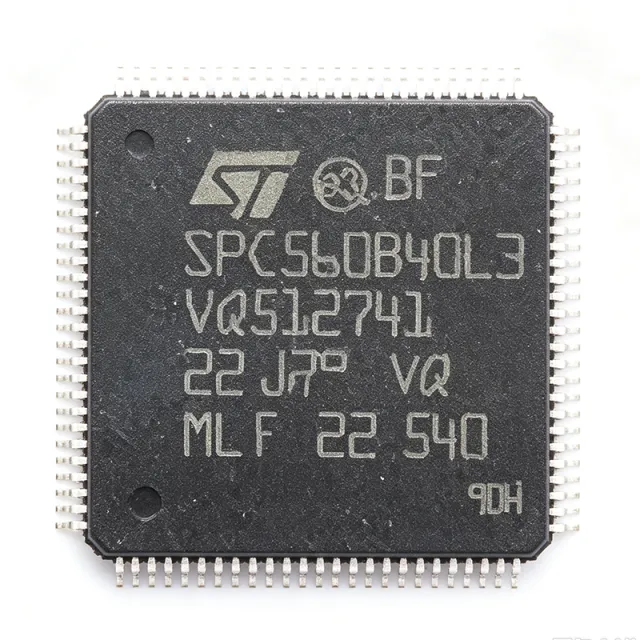
SPC560B40L3 - 32-bit MCU, 512KB Flash, 64MHz | STMicroelectronics
SPC560B40L3

SPC560B40L3 - 32-bit MCU, 512KB Flash, 64MHz | STMicroelectronics

The SPC560B40L3 is a 32-bit microcontroller from STMicroelectronics, part of the SPC560B family based on the Power Architecture® e200z0h core. It operates at a maximum frequency of 64 MHz and features 512 KB of flash memory and 48 KB of RAM, making it suitable for automotive body and gateway applications. The device is housed in a 100-pin LQFP package (LQFP-100) and supports a supply voltage range of 3.3V to 5V. A microcontroller (MCU) is a compact integrated circuit designed to govern a specific operation in an embedded system. It contains a processor core, memory, and programmable input/output peripherals. The SPC560B40L3 belongs to the family of 32-bit automotive microcontrollers, which are a subset of embedded controllers used in vehicle electronics. These MCUs are optimized for real-time control, low power consumption, and high reliability in harsh environments. Key features of the SPC560B40L3 include a 64 MHz e200z0h core, 512 KB flash memory, 48 KB RAM, and a rich set of peripherals such as multiple CAN interfaces, LIN, SPI, and ADC. It also includes a flexible timer module (FTM) and a crossbar switch for efficient data routing. The device is designed to meet AEC-Q100 automotive qualification standards, ensuring reliable operation in automotive temperature ranges from -40°C to +125°C. The SPC560B40L3 utilizes a single-issue, 32-bit Power Architecture core with variable-length encoding (VLE) for code density. It integrates a memory protection unit (MPU) and a cyclic redundancy check (CRC) unit for enhanced safety. The MCU supports low-power modes, including halt and stop modes, to reduce power consumption in battery-powered applications. Typical applications include automotive body control modules, gateway modules, and sensor fusion units. The multiple CAN interfaces make it ideal for in-vehicle networking, while the ADC and timer modules support motor control and signal conditioning. The device's robust design and automotive qualification make it a reliable choice for safety-critical systems. When designing with the SPC560B40L3, ensure proper decoupling of the power supply pins and consider the thermal performance of the LQFP-100 package. The device requires a stable clock source, typically a 4-40 MHz crystal, and supports an internal RC oscillator for cost-sensitive designs.

USD $5,89 En stock
SPC560B40L3B4E0X - 32-bit MCU, 64MHz, 256KB Flash | STMicroelectronics
SPC560B40L3B4E0X

SPC560B40L3B4E0X - 32-bit MCU, 64MHz, 256KB Flash | STMicroelectronics

The SPC560B40L3B4E0X is a 32-bit automotive microcontroller from STMicroelectronics, built on the Power Architecture embedded category. It features a high-performance e200z0h CPU core running at 64 MHz, with 256KB of Flash memory and 24KB of RAM. The device is housed in a 100-pin LQFP package (14x14 mm) and operates from a 3.3V supply (3.0V to 3.6V). It is designed for automotive body electronics and gateway applications, offering a rich set of peripherals including CAN, LIN, SPI, and ADC interfaces. A microcontroller (MCU) is a compact integrated circuit designed to govern a specific operation in an embedded system. It contains a processor core, memory, and programmable input/output peripherals. The SPC560B40L3B4E0X belongs to the SPC56 family, which is part of STMicroelectronics' automotive-grade microcontroller portfolio. These devices are built on the Power Architecture, a RISC-based instruction set architecture widely used in automotive and industrial applications. The MCU sits at the heart of electronic control units (ECUs), managing functions such as body control, gateway routing, and sensor interfacing. Key features of the SPC560B40L3B4E0X include a 64 MHz e200z0h core, 256KB Flash, 24KB RAM, and a comprehensive set of communication interfaces. It supports up to 45 I/O ports, making it suitable for a wide range of automotive body control applications. The device is AEC-Q100 qualified, ensuring reliability in harsh automotive environments. It also features a flexible clock generation unit, multiple timers, and a 12-bit ADC for analog signal acquisition. From a technical perspective, the SPC560B40L3B4E0X leverages the Power Architecture's efficient instruction set to deliver high performance at low power consumption. The e200z0h core includes a single-precision floating-point unit (FPU) and a memory protection unit (MPU), enhancing its capability for complex control algorithms. The device supports a wide operating temperature range of -40°C to +125°C, making it suitable for under-hood applications. Its 100-pin LQFP package provides a compact footprint while offering ample I/O for peripheral connectivity. Typical applications include automotive body control modules, gateway modules, and sensor fusion units. The SPC560B40L3B4E0X is also used in industrial automation and smart grid systems where robust communication and real-time processing are required. Its CAN and LIN interfaces enable seamless integration into vehicle networks, while its low-power modes help reduce overall system power consumption. When designing with this MCU, it is essential to provide a stable 3.3V power supply with adequate decoupling capacitors near the VDD pins. The device requires an external crystal or oscillator for precise timing, and the reset circuit must be properly configured to ensure reliable startup. Additionally, the ADC reference voltage should be filtered to minimize noise in analog measurements.

USD $8,10 En stock
SPC560B40L3C6E0X - 32-bit MCU 64MHz 256KB Flash | STMicroelectronics
SPC560B40L3C6E0X

SPC560B40L3C6E0X - 32-bit MCU 64MHz 256KB Flash | STMicroelectronics

The SPC560B40L3C6E0X is a 32-bit microcontroller from STMicroelectronics, built on the Power Architecture embedded category. It features a high-performance e200z0h core running at 64 MHz, with 256KB of Flash memory and 24KB of RAM. The device is housed in a 100-pin LQFP package (14x14 mm) and is designed for automotive body and gateway applications. A 32-bit microcontroller is a single-chip computer integrating a processor core, memory, and programmable I/O peripherals. The Power Architecture is a RISC-based instruction set architecture originally developed by IBM, Motorola, and Apple, now widely used in automotive and networking applications. This MCU belongs to the SPC56 family, which is optimized for body electronics, offering a balance of performance, low power, and robust communication interfaces. Key features include a 64 MHz e200z0h core, 256KB Flash, 24KB RAM, and a rich set of peripherals such as multiple CAN, LIN, and SPI interfaces. The device operates from 3.0V to 3.6V supply, with 45 I/O ports. It is AEC-Q100 qualified for automotive use, ensuring reliability in harsh environments. The LQFP-100 package provides a compact footprint with good thermal performance. The SPC560B40L3C6E0X integrates a single-core e200z0h processor with a 32-bit Power Architecture, delivering up to 64 MHz performance. It includes a memory protection unit, DMA controller, and a flexible timer module. The MCU supports a wide range of communication protocols, making it suitable for gateway applications that require multiple bus interfaces. Typical applications include automotive body control modules, gateway modules, and lighting control. Its robust CAN and LIN interfaces enable seamless integration into vehicle networks. The device's low power consumption and wide operating temperature range (-40°C to +125°C) make it ideal for under-hood and cabin electronics. When designing with this MCU, ensure proper decoupling of the power supply and careful layout of the crystal oscillator. The device supports in-circuit programming and debugging via JTAG, facilitating development. For automotive designs, follow AEC-Q100 guidelines and consider using the SPC560B40L3C6E0X for its proven reliability.

USD $8,10 En stock
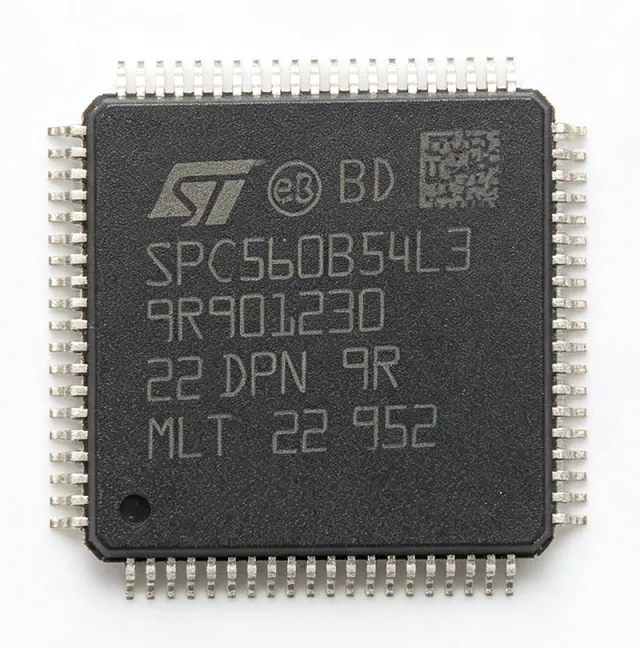
SPC560B54L3 - 32-bit MCU, 1.5MB Flash, 64MHz | STMicroelectronics
SPC560B54L3

SPC560B54L3 - 32-bit MCU, 1.5MB Flash, 64MHz | STMicroelectronics

The SPC560B54L3 is a 32-bit microcontroller from STMicroelectronics, based on the Power Architecture e200z0h core, operating at up to 64 MHz. It features 1.5 MB of embedded flash memory and 96 KB of RAM, making it suitable for automotive body electronics and industrial control applications. The device is housed in a 100-pin LQFP package (LQFP-100) and operates over a temperature range of -40°C to +125°C. A microcontroller (MCU) is a compact integrated circuit designed to govern a specific operation in an embedded system. It contains a processor core, memory, and programmable input/output peripherals. The SPC560B54L3 belongs to the SPC56 family of automotive microcontrollers, which are part of the broader Power Architecture portfolio. These MCUs are optimized for real-time control, with features like a 10-bit ADC, multiple CAN and LIN interfaces, and a flexible timer module (eTPU). Key features of the SPC560B54L3 include a 64 MHz e200z0h core with single-precision floating-point unit (FPU), 1.5 MB flash with ECC, 96 KB SRAM, and a rich set of communication interfaces: 3x FlexCAN, 3x LIN, and 2x SPI. It also integrates a 10-bit ADC with up to 16 channels, a 16-bit timer, and a watchdog timer. The device supports low-power modes and has a supply voltage range of 3.3V to 5V, making it flexible for various automotive and industrial power rails. The SPC560B54L3 is built on ST's advanced 90nm embedded flash process, providing high reliability and low power consumption. The e200z0h core is a cost-optimized version of the Power Architecture, delivering efficient code execution for control applications. The device includes a memory protection unit (MPU) and a cyclic redundancy check (CRC) unit for enhanced safety and data integrity, aligning with automotive safety standards. Typical applications include automotive body control modules (BCM), gateway modules, HVAC control, and industrial automation controllers. The multiple CAN and LIN interfaces make it ideal for in-vehicle networking, while the robust temperature range and AEC-Q100 qualification support harsh environments. When designing with the SPC560B54L3, ensure proper decoupling of the power supply pins and consider the thermal performance of the LQFP-100 package. The device requires a stable 3.3V or 5V supply and a crystal or oscillator for the system clock. Use the on-chip flash programming interface for firmware updates, and follow ST's application notes for optimal EMC performance.

USD $10,34 En stock