Produits (18688)

STM32F373RCT6 - Cortex-M4F 256KB Flash MCU | STMicroelectronics
STM32F373RCT6

STM32F373RCT6 - Cortex-M4F 256KB Flash MCU | STMicroelectronics

The STMicroelectronics STM32F373RCT6 is a high-performance 32-bit ARM Cortex-M4F microcontroller with FPU, operating at up to 72 MHz, integrating 256 KB of Flash and 32 KB of SRAM in a 64-pin LQFP package. It features a 16-bit Sigma-Delta ADC, three on-chip op-amps, two comparators, a 12-bit DAC, and a USB Full-Speed device interface, making it a mixed-signal MCU tailored for precision sensing. A microcontroller (MCU) is a single-chip computer containing a processor core, on-chip memory, programmable peripherals, and bus interfaces that govern an embedded system's real-time behavior. The STM32F3 series sits within ST's broader STM32 family, positioned between the mainstream STM32F0/F1/F4 lines and the high-performance STM32H7 line; it merges Cortex-M4F digital signal processing with analog front-end integration, reducing external signal-conditioning ICs in sensor-interface designs and shortening time-to-market for measurement products. Key features include three rail-to-rail operational amplifiers with programmable gain, a fast 12-bit ADC (1 MSPS) plus a high-precision 16-bit Sigma-Delta ADC, four 16-bit timers, USB 2.0 Full-Speed with on-chip PHY, and a Memory Protection Unit (MPU). Integrated op-amp + 16-bit Sigma-Delta architecture enables direct interfacing of bridge sensors, thermocouples, and shunt current sensors without external analog components. The Cortex-M4F core with single-precision FPU accelerates DSP routines such as digital filtering, FFT, and sensor fusion, while the Embedded Trace Macrocell (ETM) supports non-intrusive instruction tracing for firmware debug. Operating voltage range is 2.0V to 3.6V and the junction temperature range is -40C to +85C, supported by internal LDO voltage regulation and an 8 MHz HSI RC oscillator that enables crystal-less USB operation. Typical applications include industrial weigh scales, motor-control FOC platforms, smart-metering transducers, medical point-of-care instruments, and asset-tracking wearables. The Sigma-Delta ADC's 16 effective bits deliver direct weight-scale resolution without extra ADC ICs, while the integrated op-amps bias thermocouples and strain gauges. When designing with the STM32F373RCT6, decouple each VDD pin with a 100 nF ceramic capacitor placed within 2 mm, power VDDA from a clean LDO output, and add a 1 uF + 10 nF network on VREF+ to achieve the datasheet's ADC accuracy. The 64-pin LQFP package supports simple 4-layer PCB designs with routing under the exposed pad for ground stitch if the pad is present. This page synthesizes distributor pricing, drop-in same-family alternatives, and practical design notes covering analog front-end PCB layout that go beyond the manufacturer datasheet text, giving working engineers a faster path to a release-ready design.

USD $5,74 En stock
STM32F373V8H6 - 72MHz 64KB Cortex-M4 MCU | STMicroelectronics
STM32F373V8H6

STM32F373V8H6 - 72MHz 64KB Cortex-M4 MCU | STMicroelectronics

The STMicroelectronics STM32F373V8H6 is a 32-bit ARM Cortex-M4 microcontroller operating up to 72 MHz, with 64 KB of Flash memory and 16 KB of SRAM, housed in a 100-UFBGA 7 x 7 mm package. It combines a high-performance RISC core, integrated floating-point capability, extensive analog peripherals, and connectivity features for compact embedded systems. The verified product data identifies this part as part of the STM32F3 series and specifies a 2.5 V to 3.3 V operating supply range. An STM32 microcontroller is a programmable embedded controller used to monitor inputs, execute control algorithms, and manage sensors, communications, actuators, and human-interface systems. The STM32F3 family combines an ARM Cortex-M4 processor with hardware resources suited to real-time control, signal acquisition, communications, and low-power embedded designs. STM32 devices are broadly used as the central controller in industrial equipment, consumer products, medical devices, and communication equipment. The STM32F373V8H6 provides a 72 MHz operating frequency, 64 KB of Flash, 16 KB of SRAM, and a Cortex-M4 core according to the verified distributor and product-page data. Its 100-UFBGA package supports compact, high-density PCB layouts but requires careful assembly and layout planning because the fine-pitch ball array is not directly compatible with a standard large-lead package footprint. The device also includes floating-point hardware identified in the verified data. The verified listing does not provide a complete set of ADC, timer, communication, and operating-temperature values, so those parameters are not inferred here. For a new design, engineers should use the official STMicroelectronics product page and datasheet to confirm pin functions, peripheral multiplexing, electrical limits, clock requirements, and package-specific layout guidance. Firmware support and peripheral configuration should also be checked against the exact STM32F373 device revision. Typical uses include industrial monitoring, sensor acquisition, motor and motion control, embedded instrumentation, communications gateways, and compact consumer equipment. The 72 MHz Cortex-M4 core provides computational headroom for real-time control, while the 64 KB Flash and 16 KB SRAM suit moderate code and data requirements. The 100-UFBGA package is especially appropriate when board area is constrained and the assembly process supports fine-pitch BGAs. Designers should allocate decoupling close to the supply pins, follow the manufacturer’s recommended BGA land pattern, validate signal integrity for high-speed interfaces, and confirm the exact pin multiplexing before routing external peripherals. Because the target uses a 100-UFBGA package, inspect the official package drawing and PCB footprint rather than adapting a generic QFN or LQFP layout. This page combines verified distributor, manufacturer, and distributor-search information with practical procurement and design guidance. It distinguishes confirmed STM32F373V8H6 facts from parameters requiring official-datasheet confirmation, helping engineers evaluate the MCU without treating unverified compatibility claims as drop-in guarantees.

Devis En stock
STM32F373V8T6 - 72MHz Cortex-M4 64KB MCU | STMicroelectronics
STM32F373V8T6

STM32F373V8T6 - 72MHz Cortex-M4 64KB MCU | STMicroelectronics

The STMicroelectronics STM32F373V8T6 is a 32-bit ARM Cortex-M4 microcontroller with floating-point unit, operating up to 72 MHz, with 64 KB of Flash memory in a 100-pin LQFP package. It is designed for embedded applications requiring real-time control, mixed-signal acquisition, and extensive peripheral integration. An ARM Cortex-M4 microcontroller is a reduced-instruction-set computing core designed for embedded control. Its Cortex-M4 processor combines a 32-bit architecture with an optional floating-point unit, while STM32 devices add memory, communication peripherals, analog converters, timers, and GPIO. This places the STM32F373V8T6 within the microcontroller → embedded processor → semiconductor hierarchy. Key verified features include an ARM Cortex-M4 32-bit core, a maximum operating frequency of 72 MHz, 64 KB of Flash memory, and a 100-pin LQFP package measuring 14 mm by 14 mm. The STM32F373xx family is based on the Cortex-M4 core and is suitable for applications that need deterministic embedded processing alongside mixed-signal and communication resources. The target orderable suffix T6 identifies a temperature and packaging configuration within STMicroelectronics’ ordering system; exact temperature and electrical limits require the manufacturer datasheet. Distributor listings identify the device as a 32-bit, 72 MHz, 64 KB Flash MCU with an FPU. Mouser likewise describes the part as a 64 kB MCU with an ARM Cortex-M4 core. Typical uses include industrial automation, motor and motion control, sensor acquisition, embedded instrumentation, and connected industrial equipment. The 100-pin LQFP provides a larger lead-count package than lower-pin STM32 variants, allowing more external connections while retaining a standard surface-mount assembly process. Designers should verify the complete pin assignment, peripheral multiplexing, electrical limits, clock tree, and decoupling requirements against the official STM32F373xx datasheet before layout. For sourcing, DigiKey lists STM32F373V8T6 as an orderable part, while LCSC reports in-stock status and a starting price of $3.25 in the retrieved data. This page consolidates verified distributor and manufacturer information, technical comparison context, and engineering-oriented selection guidance. It does not infer unverified electrical limits, pin names, converter performance, or compliance claims.

USD $3,25 En stock
STM32F373VBT6 - 72MHz Cortex-M4 128KB MCU | STMicroelectronics
STM32F373VBT6

STM32F373VBT6 - 72MHz Cortex-M4 128KB MCU | STMicroelectronics

The STMicroelectronics STM32F373VBT6 is a 32-bit ARM Cortex-M4 microcontroller with a floating-point unit, a maximum operating frequency of 72 MHz, 128 KB of Flash memory, and a 100-LQFP package measuring 14 x 14 mm. It belongs to the STM32F3 microcontroller family and is designed for embedded control applications requiring high processing performance, mixed-signal peripherals, and compact surface-mount packaging. A microcontroller is a programmable integrated circuit that combines a processor core, memory, peripherals, and communication interfaces on one device. The STM32F3 family is positioned within the broader embedded semiconductor hierarchy: microcontroller -> ARM Cortex-M4 microcontroller -> STM32F3 series -> STM32F373xx device. Its floating-point unit supports efficient single-precision arithmetic, while its 72 MHz operating frequency provides a substantial performance increase over typical Cortex-M3 designs. Verified distributor information identifies the target as an ARM Cortex-M4 32-bit microcontroller with 128 KB Flash storage and a 100-LQFP 14 x 14 mm package. The manufacturer product page also identifies the STM32F373xx family as using the high-performance ARM Cortex-M4 core with a maximum frequency of 72 MHz. Detailed RAM, voltage, temperature, ADC, timer, communication, and electrical limits were not included in the supplied verified excerpts and are therefore not asserted here. Typical embedded uses include industrial control equipment, sensor acquisition systems, motor-control platforms, communication equipment, and compact consumer products. The controller can coordinate digital inputs and outputs while leveraging its processing core for control logic, data conditioning, and supervisory functions. Firmware selection must use the exact STM32F373 device support files, startup code, reference manual, and errata applicable to the selected package and order code. For PCB design, the LQFP-100 footprint requires adequate pin escape routing, a controlled power distribution network, and decoupling close to supply pins. External programming and debugging access should be preserved according to the manufacturer reference documentation. Because the provided data does not include the complete electrical table or pin definitions, engineers should verify every pin and operating limit against the official STM32F373 documentation before release. This page consolidates the verified manufacturer and distributor identifiers, procurement links, package information, and application guidance. It intentionally separates confirmed facts from unavailable parameters so engineers can make sourcing and design decisions without assuming unverified specifications.

Devis En stock
STM32F373VCH6 - 72MHz Cortex-M4 MCU, 256KB Flash | ST
STM32F373VCH6

STM32F373VCH6 - 72MHz Cortex-M4 MCU, 256KB Flash | ST

The STMicroelectronics STM32F373VCH6 is an ARM Cortex-M4 32-bit microcontroller operating at up to 72 MHz, with 256 KB of Flash memory and a 100-UFBGA (7x7 mm) package. According to the verified distributor data, it also provides a 16-bit Sigma-Delta ADC and a 3.3 V supply classification. The STM32F3 family combines a real-time control-oriented MCU platform with integrated analog and communication peripherals for compact embedded systems. A microcontroller is a programmable integrated circuit containing a processor core, memory, and peripherals that execute firmware and control external hardware. The STM32F373 belongs to the STM32F3 family, uses the ARM Cortex-M4 core, and sits within the broader hierarchy of embedded MCU, semiconductor, and embedded-control devices. Its 72 MHz operating speed supports responsive digital control while retaining deterministic real-time behavior. The verified product listing identifies a 32-bit ARM Cortex-M4 processor, 256 KB Flash, and 72 MHz maximum frequency. The 16-bit Sigma-Delta ADC is relevant for designs that need high-resolution measurement alongside digital control. Other detailed specifications, including SRAM size, GPIO count, ADC resolution for every converter, communication peripherals, operating-temperature limits, and electrical maximums, were not supplied in the verified data and are therefore marked as data-needed where applicable. The 100-UFBGA package supports compact PCB layouts but requires careful escape routing and assembly process control. Because the supplied search results do not provide the complete manufacturer pin table, the pinout is set to null rather than guessing pin numbers or signal names. The STM32F373VCH6 is therefore best selected by comparing verified electrical limits and firmware peripheral requirements with the complete official STMicroelectronics documentation before layout release. Typical embedded applications include industrial sensor acquisition, compact motor-control platforms, industrial communication gateways, low-noise measurement systems, consumer equipment, and IoT controllers. Its Cortex-M4F platform and analog conversion resources make it relevant where control logic, data acquisition, and local communication must coexist in one MCU. The main design consideration is package and documentation verification. Confirm the exact STMicroelectronics datasheet, pin assignments, exposed-pad requirements, power-supply sequencing, decoupling, and programming interface before manufacturing. This page combines verified distributor specifications, manufacturer documentation links, sourcing information, and engineering selection guidance rather than inventing unverified electrical details. This information is intended to support early design selection and sourcing. For production release, engineers should compare the complete STM32F373 documentation, package drawing, reference manual, errata, and board-level power and signal-integrity requirements.

USD $12,58 En stock
STM32F373VCT6 - ARM Cortex-M4 256KB Flash MCU | STMicroelectronics
STM32F373VCT6

STM32F373VCT6 - ARM Cortex-M4 256KB Flash MCU | STMicroelectronics

The STMicroelectronics STM32F373VCT6 is a high-performance 32-bit microcontroller based on the ARM Cortex-M4 core with FPU, operating at up to 72 MHz. It integrates 256 KB of Flash memory and 32 KB of SRAM, along with a rich set of analog and digital peripherals, making it ideal for industrial control, motor control, and precision measurement applications. The device is housed in a 100-pin LQFP package (14x14 mm) and operates over a supply voltage range of 2.0V to 3.6V. What is an ARM Cortex-M4 microcontroller? It is a 32-bit processor core designed for embedded systems, featuring a single-cycle multiply-accumulate (MAC) unit, hardware divide, and optional single-precision floating-point unit (FPU). The Cortex-M4 is part of the ARM Cortex-M family, which includes the M0, M0+, M3, M4, and M7 cores, each offering different performance and power trade-offs. In the hierarchy of embedded processing, the Cortex-M4 sits above the M3 in DSP capability and below the M7 in raw performance, making it a popular choice for applications requiring both control and signal processing. Key features of the STM32F373VCT6 include a 16-bit advanced motor-control timer, two 12-bit DACs, three 16-bit sigma-delta ADCs (with up to 21 channels), and a 12-bit ADC with up to 16 channels. It also provides multiple communication interfaces: two I2C, three USARTs, two SPIs, one CAN, and one USB 2.0 full-speed device. The device supports a wide range of clock sources, including an internal 8 MHz RC oscillator, an external 4-32 MHz crystal, and a 32 kHz RTC oscillator. The STM32F373VCT6 is built on ST's advanced 90nm process technology, offering low power consumption with multiple low-power modes (Sleep, Stop, Standby). The integrated FPU accelerates floating-point arithmetic, which is beneficial for control algorithms and sensor data processing. The sigma-delta ADCs provide high-resolution measurement capabilities, making the device suitable for precision instrumentation and energy metering. Typical applications include motor control (e.g., field-oriented control of brushless DC motors), industrial automation (PLC, sensors), medical devices (patient monitoring), and smart grid (energy metering). The combination of high-resolution ADCs, DACs, and advanced timers enables precise analog signal generation and measurement. When designing with this device, ensure proper decoupling of the VDD and VDDA pins with 100nF capacitors placed close to the pins. The VDDA pin must be connected to a clean analog supply to achieve the specified ADC performance. Also, consider the use of the internal voltage regulator and the recommended external capacitor on VCAP pins for stable core voltage.

USD $5,25 En stock
STM32F378RCT6 - ARM Cortex-M4F MCU 256KB Flash | STMicroelectronics
STM32F378RCT6

STM32F378RCT6 - ARM Cortex-M4F MCU 256KB Flash | STMicroelectronics

The STM32F378RCT6 is a 32-bit ARM Cortex-M4F microcontroller from STMicroelectronics, featuring a floating-point unit (FPU) and running at up to 72 MHz. It integrates 256 KB of flash memory and 32 KB of SRAM, along with a rich set of analog peripherals including a 16-bit ADC, a 12-bit DAC, and multiple comparators and operational amplifiers. The device is housed in a 64-pin LQFP package (LQFP64) and operates over a supply voltage range of 2.0V to 3.6V, with an extended temperature range of -40°C to +85°C. A microcontroller (MCU) is a compact integrated circuit designed to govern a specific operation in an embedded system. It contains a processor core, memory (flash and SRAM), and programmable input/output peripherals on a single chip. The STM32F378RCT6 belongs to the STM32F3 series, which is optimized for mixed-signal applications requiring high-performance analog capabilities alongside digital control. As a member of the ARM Cortex-M4F family, it provides DSP instructions and a hardware FPU, making it suitable for real-time control and signal processing tasks. Key features of the STM32F378RCT6 include a 16-bit ADC with up to 5 MSPS sampling rate, a 12-bit DAC with two channels, and an advanced 16-bit timer with dead-time generation for motor control. The device also supports multiple communication interfaces: USART, SPI, I2C, CAN, and USB 2.0 full-speed. With its high-resolution analog peripherals and flexible timing, it is ideal for applications such as industrial control, motor drives, and smart sensors. The STM32F378RCT6 is built on a 90nm process technology, offering a balance between performance and power consumption. It includes a nested vectored interrupt controller (NVIC) for efficient interrupt handling and a memory protection unit (MPU) for enhanced system reliability. The device supports a wide range of clock sources, including an internal 8 MHz RC oscillator, an external crystal, and a PLL for frequency multiplication. Typical applications include industrial automation, motor control, power conversion, and medical monitoring devices. The high-resolution ADC and DAC make it particularly well-suited for precision measurement and control loops. The device also supports a comprehensive set of development tools, including the STM32CubeMX configuration tool and the STM32CubeF3 firmware library. When designing with the STM32F378RCT6, ensure proper decoupling of the power supply pins with 100nF capacitors placed close to each VDD pin. The VDDA pin should be connected to a clean analog supply, and the VREF+ pin should be bypassed with a 1uF capacitor for stable ADC reference. For optimal performance, use the internal voltage regulator in the recommended configuration and follow the layout guidelines in the datasheet.

USD $5,25 En stock
STM32F400RBT6 - 128KB Flash Cortex-M4 MCU 64-LQFP | STMicroelectronics
STM32F400RBT6

STM32F400RBT6 - 128KB Flash Cortex-M4 MCU 64-LQFP | STMicroelectronics

The STMicroelectronics STM32F400RBT6 is a 32-bit Arm Cortex-M4 microcontroller with FPU, offering up to 128 KB of Flash memory and 64 KB of SRAM in a 64-pin LQFP package. It operates at up to 100 MHz (with some variants capable of higher speeds) and integrates rich peripherals for mixed-signal embedded designs, targeting the mainstream STM32F4 access line with DSP and FPU support. An Arm Cortex-M4 microcontroller is a 32-bit RISC processor core designed by Arm Holdings, featuring a Thumb-2 instruction set, hardware single-precision floating-point unit (FPU), and DSP extensions. It belongs to the broader MCU (microcontroller unit) hierarchy: Cortex-M4 -> ARM Cortex-M -> 32-bit MCU -> microcontroller -> embedded processor -> semiconductor IC. The STM32F4 series specifically targets high-performance embedded applications requiring DSP and floating-point math, sitting between the lower-cost STM32F0/F1 lines and the higher-end STM32F7/H7 lines. Key features include 128 KB Flash, 64 KB SRAM, a flexible static memory controller supporting Compact Flash, SRAM, PSRAM, NOR and NAND memories, an LCD-TFT controller for display applications up to XGA resolution, and a Crypt/Hash processor for hardware-accelerated AES, DES, 3DES, SHA-1, MD5, and HMAC. The device provides multiple connectivity options including USB 2.0 OTG full-speed, CAN 2.0B, I2C, SPI, USART/UART, and SDIO interfaces. An integrated 12-bit ADC, 12-bit DAC, and multiple timers support mixed-signal designs. The STM32F400RBT6 is built on a 90 nm CMOS process and operates from a 1.8 V to 3.6 V supply. It includes a real-time clock, watchdog timers, and a 4 KB backup SRAM with optional battery supply. The part is rated for the -40 C to +85 C industrial temperature range (suffix 6 = industrial grade), making it suitable for harsh-environment applications. Typical applications include human-machine interface (HMI) panels with TFT LCD, motor drives, industrial control, point-of-sale terminals, GPS platforms, medical equipment, and audio processing. The LCD-TFT controller makes it a particularly strong fit for GUI-rich products requiring direct display driving without an external graphics controller. When designing with this part, ensure adequate decoupling (100 nF + 4.7 uF) close to the VDD pins and consider using the LQFP SRAM within the 64-pin budget for simpler routing. Boot mode selection via BOOT0 pin determines whether the device boots from Flash, System SRAM, or embedded SRAM - verify boot configuration during bring-up to avoid programming surprises. This page synthesizes distributor pricing as of 2026-10-10, drop-in alternatives within the STM32F4 family, and practical design notes for engineers evaluating the STM32F400RBT6 for new designs or replacements.

USD $0,72 En stock
STM32F401CDU6 - ARM Cortex-M4F MCU 84MHz 384KB Flash | STMicroelectronics
STM32F401CDU6

STM32F401CDU6 - ARM Cortex-M4F MCU 84MHz 384KB Flash | STMicroelectronics

The STM32F401CDU6 is a high-performance ARM Cortex-M4F based microcontroller from STMicroelectronics, operating at up to 84 MHz with 384 KB of Flash memory and 96 KB of SRAM. It is housed in a 48-pin UFQFPN package (7x7 mm) and is part of the STM32F4 series, which is renowned for its balance of performance, power efficiency, and rich peripheral set. This MCU is designed for a wide range of applications, including industrial control, consumer electronics, IoT devices, and motor control, where a compact footprint and low power consumption are critical. An ARM Cortex-M4F microcontroller is a 32-bit processor core that includes a floating-point unit (FPU) and DSP instructions, making it suitable for applications requiring real-time signal processing and mathematical computations. The Cortex-M4F is part of the ARM Cortex-M family, which is widely used in embedded systems due to its energy efficiency and ease of development. The STM32F401CDU6 integrates this core with a comprehensive set of peripherals, including multiple USARTs, SPIs, I2Cs, ADCs, timers, and GPIOs, enabling it to serve as the central processing unit in complex embedded designs. Key features of the STM32F401CDU6 include a maximum CPU frequency of 84 MHz, 384 KB of Flash memory, 96 KB of SRAM, and a rich set of communication interfaces: 3 USARTs, 4 SPIs, 3 I2Cs, and a USB 2.0 OTG FS. It also features a 12-bit ADC with up to 16 channels, 11 timers, and a random number generator (RNG). The device operates from a 1.7V to 3.6V power supply and supports a temperature range of -40°C to +85°C. The UFQFPN-48 package offers a compact solution with excellent thermal performance, making it ideal for space-constrained designs. From a technical depth perspective, the STM32F401CDU6 is built on a 90nm process technology, which contributes to its low power consumption and high performance. The Cortex-M4F core includes a single-precision FPU and DSP instructions, enabling efficient execution of complex algorithms. The device also features a memory protection unit (MPU) for enhanced security and reliability. The STM32F401CDU6 supports a wide range of clock sources, including an external crystal, internal RC oscillators, and a PLL, allowing designers to optimize the clock configuration for their specific application. Typical applications for the STM32F401CDU6 include industrial automation, where its robust communication interfaces and timers are used for motor control and process monitoring; consumer electronics, such as smart home devices and wearables, where its low power modes and compact package are advantageous; and IoT edge nodes, where its connectivity options and processing power enable data acquisition and local decision-making. The device is also well-suited for audio processing, thanks to its FPU and DSP capabilities. When designing with the STM32F401CDU6, it is essential to provide adequate decoupling capacitors on the power supply pins and to follow the recommended PCB layout guidelines in the datasheet to ensure stable operation. The device supports multiple low-power modes, including Sleep, Stop, and Standby, which can be leveraged to minimize power consumption in battery-powered applications. Additionally, the STM32F401CDU6 is supported by the STM32Cube ecosystem, including HAL libraries and development tools, which accelerates firmware development and reduces time-to-market.

USD $2,70 En stock
STM32F401CEU6 - 256KB Flash ARM Cortex-M4 MCU | STMicroelectronics
STM32F401CEU6

STM32F401CEU6 - 256KB Flash ARM Cortex-M4 MCU | STMicroelectronics

The STM32F401CEU6 is a high-performance ARM Cortex-M4 32-bit microcontroller from STMicroelectronics, featuring a floating-point unit (FPU) running at up to 84 MHz. It integrates 256 KB of Flash memory and 64 KB of SRAM, making it suitable for a wide range of embedded applications. The device is housed in a 48-pin UFQFPN package (7x7 mm) and operates over a supply voltage range of 1.7V to 3.6V. An ARM Cortex-M4 microcontroller is a 32-bit processor core designed for embedded systems, offering a balance of performance, power efficiency, and advanced features such as a single-cycle multiply-accumulate (MAC) instruction and a hardware floating-point unit. The Cortex-M4 core is part of the ARM Cortex-M family, which includes the M0, M0+, M3, M4, and M7 variants, each targeting different performance and power requirements. The STM32F401CEU6 leverages the Cortex-M4's DSP instructions and FPU to accelerate signal processing tasks, making it ideal for applications requiring real-time computation. Key features of the STM32F401CEU6 include an 84 MHz maximum CPU frequency, 256 KB Flash, 64 KB SRAM, and a rich set of peripherals: 3 USARTs, 4 I2Cs, 3 SPIs, 1 SDIO, 1 USB 2.0 OTG FS, 1 CAN, 12-bit ADC with 16 channels, and multiple timers including advanced-control timers. The device also supports a comprehensive set of low-power modes (Sleep, Stop, Standby) and features a true random number generator (RNG) and a real-time clock (RTC). The STM32F401CEU6 is built on ST's advanced 90nm process technology, offering a good balance between performance and power consumption. The Cortex-M4 core with FPU enables efficient execution of complex algorithms, while the ART Accelerator™ allows zero-wait-state execution from Flash, maximizing throughput. The device also includes a memory protection unit (MPU) for enhanced safety and security. Typical applications include industrial control, motor drives, consumer electronics, IoT devices, and portable medical equipment. Its combination of processing power, memory, and peripheral integration makes it a versatile choice for many embedded designs. When designing with this device, ensure proper decoupling of the power supply pins and consider the thermal characteristics of the UFQFPN package. The device supports in-circuit programming and debugging via SWD, and a comprehensive ecosystem of development tools and libraries is available from STMicroelectronics.

USD $2,88 En stock
STM32F401RBT6 - ARM Cortex-M4 84MHz MCU | STMicroelectronics
STM32F401RBT6

STM32F401RBT6 - ARM Cortex-M4 84MHz MCU | STMicroelectronics

The STMicroelectronics STM32F401RBT6 is a high-performance ARM Cortex-M4 32-bit microcontroller with floating-point unit (FPU) operating at up to 84 MHz. It is part of the STM32F4 series, designed for embedded applications requiring efficient processing, rich connectivity, and low power consumption. The device is housed in a 64-pin LQFP package (10x10 mm) and provides 128 KB of Flash memory and 64 KB of SRAM. What is a microcontroller (MCU)? A microcontroller is a compact integrated circuit designed to govern a specific operation in an embedded system. It integrates a processor core, memory (Flash and SRAM), and programmable input/output peripherals on a single chip. In the system hierarchy, an MCU is a type of embedded processor, which falls under the broader category of integrated circuits. The STM32F401RBT6 is a mid-range MCU in the STM32F4 family, positioned between the entry-level STM32F0 and the high-performance STM32F7 series, offering a balance of performance, power efficiency, and cost. Key features of the STM32F401RBT6 include an ARM Cortex-M4 core with FPU, 84 MHz maximum clock speed, 128 KB Flash, 64 KB SRAM, and a rich set of peripherals: 3 USARTs, 4 SPIs, 3 I2Cs, 1 USB 2.0 OTG FS, 1 SDIO, 1 ADC (12-bit, 16 channels), and multiple timers. It operates from a 1.7V to 3.6V power supply and supports a temperature range of -40°C to +85°C. The device includes a 12-bit ADC with up to 16 channels, enabling precise analog signal acquisition. It also features a true random number generator (RNG) and a CRC calculation unit for data integrity. Technically, the STM32F401RBT6 is built on a 90nm process technology, offering a good balance of performance and power consumption. The Cortex-M4 core with FPU accelerates mathematical computations, making it suitable for DSP and control applications. The device supports multiple low-power modes (Sleep, Stop, Standby) to optimize energy consumption in battery-powered designs. The LQFP64 package provides 50 GPIOs, with many pins multiplexed to support various peripheral functions, offering design flexibility. Typical applications include industrial control systems, motor drives, consumer electronics, IoT devices, and medical monitoring equipment. Its combination of processing power, peripheral set, and low-power modes makes it ideal for applications requiring real-time control and connectivity. For example, in a smart home gateway, the STM32F401RBT6 can manage sensor data acquisition, run communication protocols (e.g., Zigbee, Bluetooth), and control actuators. When designing with this MCU, ensure proper decoupling of the power supply pins with 100nF capacitors placed close to each VDD pin, and a 4.7uF bulk capacitor. The VDDA pin should be filtered with a ferrite bead and capacitor to reduce analog noise. Also, configure the clock source (HSE or HSI) appropriately and use the PLL to achieve the desired system clock. For low-power applications, utilize the Stop and Standby modes with wake-up sources like RTC or external interrupts.

USD $4,16 En stock
STM32F401RCT6 - 84MHz Cortex-M4 MCU 256KB Flash | ST
STM32F401RCT6

STM32F401RCT6 - 84MHz Cortex-M4 MCU 256KB Flash | ST

The STMicroelectronics STM32F401RCT6 is a 32-bit ARM Cortex-M4 microcontroller with single-precision FPU, running at up to 84 MHz, with 256 KB Flash and 64 KB SRAM, housed in a 64-pin LQFP package (10 x 10 mm). A microcontroller unit (MCU) is a single-chip computer that integrates a processor core, memory, and peripherals into one IC, sitting at the heart of embedded systems. Within the hierarchy, the STM32F401RCT6 belongs to the STM32F4 Series (Access Line), part of the broader STM32 microcontroller family, the ARM Cortex-M ecosystem, and the general class of embedded processors. Key features include the Dynamic Efficiency line with Batch Acquisition Mode (BAM) for low-power data handling, a 1.7 V to 3.6 V supply range, an operating temperature range of -40C to +85C, 11 timers, one 12-bit ADC, and 11 communication interfaces (USART, SPI, I2C, I2S, SDIO, USB OTG). The Cortex-M4 core with FPU delivers 105 DMIPS and supports all ARM single-precision data-processing instructions, making DSP tasks such as filtering and FFTs practical without an external DSP. Architecturally, the device uses an ART Accelerator for zero-wait-state execution from Flash and a multi-advanced-bus matrix, balancing the 84 MHz core bandwidth against peripheral and memory accesses. The static memory controller-free design keeps cost down while USB OTG full-speed and SDIO cover most connectivity needs. Typical applications include motor control and digital power conversion, consumer appliances, IoT sensor nodes, industrial automation, and portable medical devices where the FPU and low active power (Dynamic Efficiency technology) provide concrete value. Design consideration: the STM32F401 Access Line has no Crypto/CAN peripherals and 64 KB SRAM, so verify RAM budget before porting from STM32F407-class parts. This page synthesizes distributor availability data, pin-compatible alternatives, and practical design notes not consolidated in the ST datasheet.

USD $2,65 En stock
STM32F401RDT6 - 84MHz ARM Cortex-M4F MCU, 512KB Flash | STMicroelectronics
STM32F401RDT6

STM32F401RDT6 - 84MHz ARM Cortex-M4F MCU, 512KB Flash | STMicroelectronics

The STM32F401RDT6 is a high-performance ARM Cortex-M4F based microcontroller from STMicroelectronics, operating at up to 84 MHz with 512 KB of Flash memory and 96 KB of SRAM. It is housed in a 64-pin LQFP package (LQFP64, 10x10 mm) and is part of the STM32F4 series, which is renowned for its balance of performance, power efficiency, and rich peripheral set. The device integrates a floating-point unit (FPU) for DSP and math-intensive tasks, making it suitable for a wide range of embedded applications. What is a microcontroller? A microcontroller (MCU) is a compact integrated circuit designed to govern a specific operation in an embedded system. It contains a processor core, memory (Flash and SRAM), and programmable input/output peripherals on a single chip. The STM32F401RDT6 belongs to the STM32F4 family, which is part of the broader STM32 32-bit ARM Cortex-M microcontroller portfolio. This hierarchy places it within the ARM Cortex-M4F category, known for its DSP instructions and single-precision floating-point unit, enabling efficient signal processing and control tasks. Key features of the STM32F401RDT6 include an ARM Cortex-M4F core with FPU, 512 KB of Flash memory, 96 KB of SRAM, and a comprehensive set of peripherals: multiple USARTs, SPIs, I2Cs, ADCs, timers, and a USB 2.0 OTG FS interface. It supports a wide supply voltage range of 1.7V to 3.6V and operates over a temperature range of -40°C to +85°C. The device also features a rich set of low-power modes, including Sleep, Stop, and Standby, making it suitable for battery-powered applications. Technically, the STM32F401RDT6 is built on a 90nm process technology, offering a good balance between performance and power consumption. The Cortex-M4F core with FPU accelerates mathematical computations, while the ART Accelerator™ enables zero-wait-state execution from Flash memory, improving real-time performance. The device includes a 12-bit ADC with up to 16 channels, advanced timers for PWM generation, and a DMA controller for efficient data transfer without CPU intervention. Typical applications include industrial control systems, motor drives, consumer electronics, IoT devices, and medical monitoring equipment. Its rich peripheral set and FPU make it ideal for applications requiring real-time signal processing, such as audio processing, sensor fusion, and closed-loop control. The USB OTG interface enables direct connectivity to hosts or peripherals, simplifying system design. When designing with this MCU, ensure proper decoupling of the power supply pins with 100nF capacitors placed close to each VDD pin, and a 4.7uF bulk capacitor. The VDDA pin should be connected to a clean analog supply, and the VREF+ pin to a stable reference voltage for accurate ADC conversions. Also, consider the crystal oscillator layout for the HSE to minimize noise and ensure reliable startup.

USD $4,16 En stock
STM32F401RET6 - 84MHz ARM Cortex-M4 MCU, 512KB Flash | STMicroelectronics
STM32F401RET6

STM32F401RET6 - 84MHz ARM Cortex-M4 MCU, 512KB Flash | STMicroelectronics

The STMicroelectronics STM32F401RET6 is a high-performance ARM Cortex-M4 32-bit microcontroller with floating-point unit (FPU), operating at up to 84 MHz. It features 512 KB of flash memory and 96 KB of SRAM, making it suitable for a wide range of embedded applications. The device is housed in a 64-pin LQFP package (LQFP64) with a 10x10 mm body and 0.5 mm pitch, providing a compact footprint for space-constrained designs. What is a microcontroller? A microcontroller (MCU) is a compact integrated circuit designed to govern a specific operation in an embedded system. It integrates a processor core, memory (flash and SRAM), and programmable input/output peripherals on a single chip. In the system hierarchy, an MCU sits between a microprocessor (which typically requires external memory and peripherals) and a system-on-chip (SoC) that may include more complex subsystems. The STM32F401RET6 belongs to the STM32F4 series, which is part of the broader STM32 family of 32-bit ARM Cortex-M microcontrollers, known for their balance of performance, power efficiency, and peripheral richness. Key features of the STM32F401RET6 include an ARM Cortex-M4 core with FPU, 84 MHz maximum clock speed, 512 KB flash, 96 KB SRAM, and a rich set of peripherals: 3 USARTs, 4 SPIs, 3 I2Cs, 1 SDIO, 1 USB 2.0 OTG FS, 1 CAN, 12-bit ADC with 16 channels, and multiple timers including advanced-control timers. The device operates from a 1.7V to 3.6V power supply and supports a temperature range of -40°C to +85°C (T suffix). It includes a variety of low-power modes (Sleep, Stop, Standby) for battery-powered applications. Technically, the STM32F401RET6 is built on a 90nm process technology, offering a good balance of performance and power consumption. The Cortex-M4 core with FPU accelerates mathematical computations, making it ideal for digital signal processing (DSP) tasks. The device supports a comprehensive set of development tools, including STM32CubeMX, STM32CubeIDE, and the HAL library, which streamline firmware development. The memory architecture includes a flexible external memory controller (FMC) for expanding memory beyond the internal flash and SRAM. Typical applications include industrial control systems, motor drives, consumer electronics, IoT devices, and medical equipment. The combination of high clock speed, ample memory, and rich peripherals makes it a versatile choice for applications requiring real-time processing and connectivity. For example, in an IoT gateway, the STM32F401RET6 can manage sensor data acquisition, process it with the FPU, and communicate via USB or CAN. When designing with this device, ensure proper decoupling of the power supply pins with 100nF capacitors placed close to each VDD pin, and a 4.7uF bulk capacitor. The VDDA pin should be connected to a clean analog supply, and the VREF+ pin to a stable reference voltage for accurate ADC conversions. The BOOT0 pin configuration determines the boot source; a 10kΩ pull-down resistor is recommended for booting from flash. Also, consider the thermal performance: the LQFP64 package has a thermal resistance (theta_JA) of approximately 45°C/W, so for high-current applications, adequate PCB copper area is needed.

USD $9,85 En stock
STM32F401VCH6 - ARM Cortex-M4 84MHz 256KB Flash MCU | STMicroelectronics
STM32F401VCH6

STM32F401VCH6 - ARM Cortex-M4 84MHz 256KB Flash MCU | STMicroelectronics

The STMicroelectronics STM32F401VCH6 is a high-performance 32-bit ARM Cortex-M4 microcontroller with FPU, 256 KB of Flash, 64 KB of SRAM, and an 84 MHz maximum clock speed, housed in a 100-ball UFBGA (7x7 mm) package. Per the ST datasheet, the device integrates a single-precision floating-point unit, 105 DMIPS performance, 11 timers, one 12-bit ADC, and 11 communication interfaces including USB OTG FS, USART, SPI, I2C, and SDIO. The 100-UFBGA package and 81 GPIO count place it in the STM32F401 'access line' family targeting cost-sensitive motor control, consumer, and industrial applications. Background: A microcontroller (MCU) is a single-chip computer that integrates a CPU core, memory (Flash for code, SRAM for data), peripherals, and I/O on one die. The ARM Cortex-M4 core adds DSP extensions and a single-precision FPU for floating-point math, and it sits inside the broader STM32F4 family — Cortex-M4 → ARM Cortex-M → 32-bit MCU → microcontroller → semiconductor — so engineers reach for STM32F4 when they need more performance than Cortex-M0/M3 parts but less cost than Cortex-M7 applications processors. Key features include 84 MHz core speed, 256 KB single-bank Flash, 64 KB SRAM, 1.7 V to 3.6 V supply, integrated USB 2.0 FS OTG with on-chip PHY, an SDIO interface for removable storage, and an operating temperature window of −40 °C to +85 °C. The UFBGA-100 footprint is well suited to high-density designs where LQFP-100 pad spacing is too coarse. Architecturally, the STM32F401VCH6 uses a 3-stage pipeline Cortex-M4 with branch speculation and single-cycle MAC instructions. The on-chip ART Accelerator reduces Flash wait states at full 84 MHz, delivering benchmark 1.25 DMIPS/MHz (about 1.0 CoreMark/MHz) real-world throughput. Brown-out reset, watchdog timers, and a low-power RTC backup domain are integrated, simplifying battery-backed designs. Typical applications include wearable sensor hubs, drone flight controllers, USB HID peripherals, motor control (FOC for 1-2 axes), and IoT edge nodes. The 84 MHz + FPU combination is fast enough for lightweight DSP such as FFT-based vibration analysis or audio processing. Design tip: maintain VDD ≥ 1.7 V during ADC conversions; add a 100 nF + 4.7 µF decoupling pair close to each VDDA pin to meet the 12-bit ENOB target. The UFBGA requires NSMD pads and 0.4 mm pitch — verify your assembly house can handle it. This page synthesizes distributor pricing, drop-in alternatives, and practical design notes not found in the manufacturer datasheet, offering information gain beyond raw spec sheets.

USD $2,74 En stock
STM32F405OEY6BTR - 168MHz Cortex-M4 MCU | STMicroelectronics
STM32F405OEY6BTR

STM32F405OEY6BTR - 168MHz Cortex-M4 MCU | STMicroelectronics

The STMicroelectronics STM32F405OEY6BTR is a 32-bit Arm Cortex-M4 microcontroller operating up to 168 MHz, with 512 KB of Flash memory and a 90-WLCSP package. It combines an FPU, DSP instructions, connectivity, and embedded peripherals for industrial control, IoT, automation, motor control, metering, and low-power embedded systems. A microcontroller is a programmable system-on-chip that integrates a CPU core, memory, communication interfaces, timers, and control peripherals. The STM32F405OE belongs to the STM32F4 high-performance embedded family, where the Cortex-M4 core executes control logic while DMA and hardware peripherals move data with limited CPU intervention. This hierarchy places the device between a basic processor and a complete embedded control platform. Verified features include a 32-bit Arm Cortex-M4 processor, an FPU, DSP instructions, 210 DMIPS, adaptive real-time acceleration, a memory protection unit, and operation up to 168 MHz. The 512 KB Flash configuration provides room for application code and constants. Listed connectivity includes CANbus, I2C, SPI, I2S, UART/USART, USB OTG, IrDA, LINbus, and EBI/EMI, while listed peripherals include DMA, PWM, LCD support, watchdog, brown-out detection, and power-on reset. The target order code identifies a 90-WLCSP package and an active device. Its high-performance core is appropriate for real-time motor and industrial control, while the broad interface set supports sensors, communications, data acquisition, and external memories. The exact pinout, electrical limits, clock configuration, and memory-map details should be confirmed from the STMicroelectronics STM32F405 family documentation before layout or firmware deployment. Typical application roles include industrial controllers, connected metering equipment, motor-control boards, embedded automation modules, and IoT edge devices. Designers should plan decoupling and exposed-ball connectivity carefully in the WLCSP footprint, and should use STM32Cube or the supported toolchain to configure clocks, pins, memory, and peripherals. The most important sourcing consideration is package-specific validation. The available verified data identifies 90-WLCSP, but it does not provide a complete verified list of pin-compatible alternatives or pricing tiers. This page therefore distinguishes confirmed data from missing engineering fields rather than inventing replacement parts or commercial values. This product record synthesizes the verified STMicroelectronics family information, distributor references, application guidance, and design cautions. It is intended to support engineering selection and procurement review while directing engineers to the manufacturer datasheet for final electrical, pinout, and qualification decisions.

Devis En stock
STM32F405OEY6TR - 168MHz Cortex-M4 512KB MCU | STMicroelectronics
STM32F405OEY6TR

STM32F405OEY6TR - 168MHz Cortex-M4 512KB MCU | STMicroelectronics

The STMicroelectronics STM32F405OEY6TR is a 32-bit Arm Cortex-M4 microcontroller with floating-point unit and DSP instructions, operating up to 168 MHz and packaged in a 90-WLCSP measuring 4.22 mm by 3.97 mm. It provides 512 KB of Flash memory and integrates the ART Accelerator for zero-wait-state execution from Flash. The device targets compact embedded systems requiring real-time control, high processing throughput, and extensive peripheral connectivity. A microcontroller is a programmable semiconductor that integrates a processor core, memory, and peripherals into one system-on-chip. The STM32F405 belongs to the STM32F4 high-performance microcontroller family, combining an Arm Cortex-M4 core with real-time control capabilities, communications peripherals, and low-power design options. Its architecture is suitable for industrial equipment, audio and signal processing, communications, consumer products, and embedded control platforms. Key features include a 168 MHz maximum operating frequency, single-precision floating-point support, DSP instructions, a memory protection unit, and the ART Accelerator. The verified distributor data identifies 512 KB of Flash memory and a 90-WLCSP package. The Arm Cortex-M4 core also supports a full set of DSP instructions, making the device suitable for applications that combine control logic with numerical signal processing. The STM32F405OEY6TR is part of the STM32F405xx and STM32F407xx family described in the STMicroelectronics datasheet. Its high-performance architecture is useful when processing speed and deterministic embedded execution matter, while integrated peripherals reduce the need for external components. The exact RAM, voltage, temperature, and peripheral configuration should be confirmed from the complete manufacturer documentation for the selected package and orderable variant. Typical applications include industrial automation and factory equipment, networked embedded controllers, audio and DSP modules, communications equipment, and consumer electronics. Designers should verify board-level pin availability, power requirements, memory mapping, and startup configuration before production use. The WLCSP format also requires careful PCB layout and assembly capability. The most important design consideration is to follow STMicroelectronics reference layout, recommended decoupling, exposed-pad thermal requirements, and package-specific assembly guidelines. Firmware should use the STM32CubeMX or STM32CubeIDE-generated startup and peripheral configuration appropriate to the exact device variant. This page consolidates verified distributor data, manufacturer documentation references, application guidance, and replacement limitations for engineering evaluation.

Devis En stock
STM32F405OGY6TR - 168MHz Cortex-M4 1MB MCU | STMicroelectronics
STM32F405OGY6TR

STM32F405OGY6TR - 168MHz Cortex-M4 1MB MCU | STMicroelectronics

The STMicroelectronics STM32F405OGY6TR is a 32-bit Arm Cortex-M4 microcontroller with floating-point unit, operating up to 168 MHz and providing 1 MB of Flash memory in a 90-WLCSP package measuring 4.22 mm by 3.97 mm. According to the STM32F405OG family information, it reaches 210 DMIPS and 1.25 DMIPS/MHz while adding an adaptive real-time accelerator for zero-wait-state execution from Flash. A microcontroller is a programmable semiconductor that integrates a processor core, memory, peripherals, and communication interfaces into one device. The STM32F4 family belongs to the hierarchy of embedded microcontroller, RISC processor, semiconductor, and connected-control product categories. It combines general-purpose control with DSP-oriented processing and extensive serial connectivity, allowing one device to supervise sensors, motors, communications, data acquisition, and human-machine interfaces. The supplied family data identifies an Arm Cortex-M4 core with FPU, an ART Accelerator, a memory protection unit, and operation up to 168 MHz. One search result reports 210 DMIPS at 1.25 DMIPS/MHz. The device also provides 1 MB of Flash, 192 KB plus 4 KB of RAM, USB OTG high-speed and full-speed support, Ethernet, 17 timers, three ADCs, and 15 communication interfaces including camera-related connectivity. Its 90-WLCSP format supports compact assemblies where conventional leaded packages would be difficult to route. The package places a large number of contacts on a small area, so escape routing, via density, assembly capability, inspection, and rework become important manufacturing constraints. The exact electrical limits and pin functions must be checked against the manufacturer datasheet before release because they were not supplied in the verified excerpts. Typical uses include industrial data acquisition, Ethernet-connected equipment, audio and real-time signal processing, USB peripherals, camera modules, and motor-control platforms. The Cortex-M4F core is useful when an application benefits from floating-point calculations and DSP instructions. Its 168 MHz ceiling provides scheduling margin, although real-time performance still depends on clock configuration, Flash wait states, memory contention, peripheral timing, and firmware design. A critical design step is decoupling every supported supply rail at its pins and respecting the WLCSP layout rules for exposed contacts and thermal or assembly requirements. Designers should also confirm startup, clock, reset, bootloader, and peripheral assignments in the complete STMicroelectronics documentation rather than inferring behavior from the orderable MPN alone. This page consolidates the verified manufacturer and distributor facts, separates documented parameters from missing data, and highlights package and sourcing constraints that are not obvious from the MPN alone. It does not infer unverified pricing, pin assignments, compliance claims, or cross-device compatibility.

Devis En stock
STM32F405OGY6VTR - 168MHz Cortex-M4 MCU | STMicroelectronics
STM32F405OGY6VTR

STM32F405OGY6VTR - 168MHz Cortex-M4 MCU | STMicroelectronics

The STMicroelectronics STM32F405OGY6VTR is a 32-bit Arm Cortex-M4 microcontroller with a maximum operating frequency of 168 MHz, 1 MB of embedded Flash memory, and a 90-ball WLCSP package. The device is intended for compact embedded systems requiring high-performance control, substantial local code storage, and integrated connectivity-oriented peripherals. A microcontroller is a programmable system-on-chip containing a processor core, memory, and peripherals. Within the semiconductor hierarchy, the STM32F405OGY6VTR belongs to the STM32F4 family of 32-bit RISC microcontrollers. Its Cortex-M4 core supports single-precision floating-point operations and DSP instructions, making it more suitable than a basic general-purpose core for real-time control, signal processing, and connected embedded equipment. Verified information identifies a 168 MHz operating frequency, 1 MB Flash configuration, 32-bit Arm Cortex-M4 architecture, and 90-pin WLCSP implementation. The WLCSP format supports a compact land pattern, but its fine pitch, exposed-ball construction, and assembly requirements demand careful PCB design, inspection, and soldering controls. The Y6VTR order code also requires exact procurement and lifecycle checks because suffix interpretation can affect temperature grade, package form, and shipment format. The STM32F405 family provides the processor platform and peripheral resources needed for industrial, communications, audio, robotics, and embedded-control designs. A design should not be released until pin multiplexing, clock-tree limits, power sequencing, decoupling, boot configuration, firmware support, and the exact package pin map are checked against the manufacturer datasheet. This is particularly important for a dense 90-ball WLCSP design where routing errors can prevent assembly or reliable operation. Typical uses include industrial controllers, motor-control equipment, communication modules, data acquisition units, robotics, and embedded gateways. The 168 MHz Cortex-M4 core provides computational headroom for concurrent real-time tasks, while 1 MB Flash can reduce dependence on external program memory when the application remains within that capacity. The principal design trade-off is package density. WLCSP saves board area but complicates prototype assembly, inspection, repair, and sourcing. Before layout release, allocate local bypass capacitance, route sensitive interfaces away from high-current switching nodes, confirm assembly capability, and validate thermal performance under worst-case clock, peripheral, and I/O activity. This product record consolidates the verified manufacturer and distributor information, separates exact facts from missing data, and avoids treating generic cross-reference tools as proof of drop-in compatibility. It also provides selection, application, and procurement context beyond a raw manufacturer specification table.

Devis En stock
STM32F405OGY6WTR - 168MHz Cortex-M4 1MB MCU | STMicroelectronics
STM32F405OGY6WTR

STM32F405OGY6WTR - 168MHz Cortex-M4 1MB MCU | STMicroelectronics

STMicroelectronics STM32F405OGY6WTR is a 32-bit Arm Cortex-M4 microcontroller with FPU, operating at up to 168 MHz, integrating 1 MB of Flash memory and up to 192 KB of SRAM plus 4 KB of backup SRAM. The device is supplied in a 90-ball WLCSP package measuring approximately 4.22 mm by 3.97 mm and supports a 3.3 V operating class. According to the STMicroelectronics STM32F405 product page, the STM32F405xx family targets high-performance embedded applications requiring substantial processing throughput, communications peripherals, and compact package density. A microcontroller is a programmable semiconductor system that combines a CPU core, memory, timers, communication controllers, and dedicated peripherals on one integrated circuit. The Arm Cortex-M4 core in this device is a 32-bit RISC processor with a floating-point unit. In the product hierarchy, STM32F405OGY6WTR belongs to the STM32F4 high-performance microcontroller family and ultimately to the broader embedded processor and semiconductor category. Verified device features include an Arm Cortex-M4 core, a maximum operating frequency of 168 MHz, 1 MB of Flash organized as 1M x 8 bits, and up to 192 KB of SRAM plus 4 KB of backup SRAM. Search results also identify USB full-speed and high-speed OTG, Ethernet connectivity, three analog-to-digital converters, numerous timers, and extensive communication interfaces. The integrated FPU accelerates floating-point workloads, while the high clock rate supports responsive control, communications, and signal-processing tasks. Typical uses include connected industrial equipment, audio and communications systems, USB-connected embedded products, Ethernet-enabled controllers, motor and motion-control platforms, and high-density sensor-processing designs. The 90-ball WLCSP format is particularly useful when minimizing board area is important. Its dense interconnect requirement also makes careful PCB layout, clean power delivery, and package-aware assembly essential. Designers should confirm all 90-ball assignments, exposed-ball requirements, voltage limits, decoupling values, and board-layout constraints against the official manufacturer documentation before release. Because the provided source snippets do not expose complete timing, pin-level, environmental, pricing, or lifecycle tables, those details are retained as data-needed items rather than inferred. This page combines verified manufacturer and distributor facts with application guidance for compact STM32F405-based designs.

Devis En stock
STM32F405RGT6 - 168MHz Cortex-M4F, 1MB Flash MCU | STMicroelectronics
STM32F405RGT6

STM32F405RGT6 - 168MHz Cortex-M4F, 1MB Flash MCU | STMicroelectronics

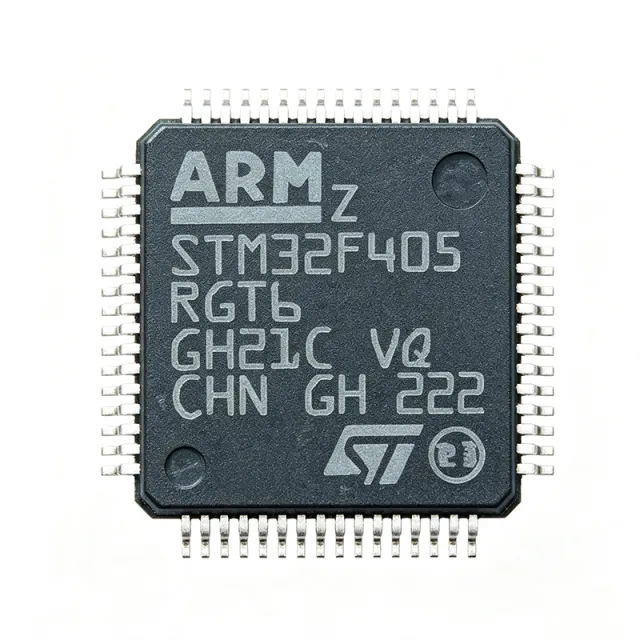
The STMicroelectronics STM32F405RGT6 is a high-performance 32-bit ARM Cortex-M4 microcontroller with single-precision FPU and DSP instructions, operating at up to 168 MHz and delivering 210 DMIPS (1.25 DMIPS/MHz), housed in a 64-pin LQFP (10x10 mm) surface-mount package. It integrates 1 MB of Flash memory and 192 KB of SRAM with 4 KB of battery-backed backup SRAM. A microcontroller (MCU) is a compact integrated circuit that combines a processor core, volatile and non-volatile memory, and programmable peripherals on a single silicon die to govern specific operations in embedded systems. The STM32F405RGT6 belongs to the STM32F4 mainstream performance line, which sits within the broader STM32 family of 32-bit Flash microcontrollers. The category hierarchy is MCU -> 32-bit MCU -> ARM Cortex-M MCU -> Cortex-M4 MCU -> STM32F4 MCU. MCUs are the central control element in industrial, consumer, medical, and IoT electronics. Key features include 3x 12-bit ADCs (2.4 MSPS), 2x 12-bit DACs, 12x 16-bit timers plus 2x 32-bit timers, 51 GPIOs, and rich connectivity: 3x I2C, 4x USART plus 2x UART, 3x SPI, 2x CAN, USB 2.0 OTG Full-Speed and High-Speed with on-chip PHY, 100Mbit Ethernet, SDIO, and a DCMI camera interface. The device operates from 1.8V to 3.6V and includes a true random-number generator, hardware CRC unit, and a 96-bit unique device ID. Technically, the chip uses a 90 nm CMOS process with an ART Accelerator enabling zero-wait-state execution from Flash, maximizing effective Cortex-M4 throughput. A memory protection unit supports robust firmware isolation, while multiple low-power modes (Sleep, Stop, Standby with RTC) allow energy optimization for battery-powered designs. The integrated USB OTG HS PHY and Ethernet MAC eliminate external PHY BOM cost for many designs. Typical applications include field-oriented-control motor drives (FOC servo drives leveraging the FPU and DSP instructions), digital power conversion and PFC stages, industrial PLC and automation controllers, USB peripherals and audio devices, and consumer/medical products requiring real-time signal processing. The open-source STM32CubeIDE and STM32CubeMX ecosystem with HAL/LL libraries significantly shortens development cycles. Design consideration: provide adequate 100 nF decoupling on every VDD/VSS pin pair, route USB HS D+/D- as a 90-ohm differential pair, and keep SDIO traces length-matched. Also note that Flash wait states apply above 168 MHz if the ART accelerator configuration is altered. This page synthesizes distributor pricing, verified drop-in alternatives, and practical design notes not consolidated in the manufacturer datasheet.

USD $6,75 En stock
STM32F405RGT6TR - 168MHz Cortex-M4F MCU 1MB Flash | STMicroelectronics
STM32F405RGT6TR

STM32F405RGT6TR - 168MHz Cortex-M4F MCU 1MB Flash | STMicroelectronics

The STMicroelectronics STM32F405RGT6TR is a high-performance ARM Cortex-M4F microcontroller with FPU operating up to 168 MHz, delivering 210 DMIPS / 1.25 DMIPS/MHz (Dhrystone 2.1), packed into a 64-pin LQFP (10x10 mm) package with 1 MB of Flash and 192 KB + 4 KB of SRAM. A microcontroller (MCU) is a single-chip computer that integrates a CPU core, program memory (Flash), data memory (SRAM), and a rich set of peripherals into one package. The Cortex-M4F class sits in the middle of the ARM microcontroller hierarchy (Cortex-M0/M0+ -> M3 -> M4F -> M7), gaining a single-precision floating-point unit and full DSP instruction set while retaining deterministic interrupt response and ultra-low-power modes. The STM32F405xx family is therefore aimed at applications that need high-throughput signal processing and connectivity without sacrificing real-time determinism, sitting between Cortex-M3 general-purpose MCUs and Cortex-M7 high-end parts in ST's STM32 family tree. Key features of the STM32F405RGT6TR include an Adaptive Real-Time (ART) accelerator that allows 0-wait-state execution from Flash memory, a memory protection unit (MPU), 17 timers, three 12-bit ADCs (up to 2.4 MSPS), two 12-bit DACs, USB OTG Full-Speed and High-Speed, an internal Ethernet MAC with hardware IEEE 1588v2 support, a CAN 2.0B interface, SDIO, FSMC, and a CMOS-camera interface. DSP instructions and the single-precision FPU allow efficient audio, motor-control, and signal-chain math at clock speeds well above most Cortex-M3 competitors. The architecture combines a 3-stage pipeline Cortex-M4F core with a multi-AHB bus matrix and an ART accelerator prefetch buffer, eliminating the Flash wait-state penalty that historically bottlenecked MCU throughput. The integrated PHY on selected packages and the hardware cryptography-ready subsystem (F405 variant) make this part suitable for industrial Ethernet and networked sensor nodes where determinism and bandwidth coexist. Typical applications include industrial motor drives (FOC for 3-phase PMSM/BLDC), UAV flight controllers and quadcopters, audio processing and effects units, multi-axis robotics controllers, USB peripherals and HID devices, and Ethernet-connected IoT gateways. The 168 MHz core plus FPU makes real-time DSP tasks such as FFT, Kalman filtering, and audio sample-rate conversion straightforward without offloading to a companion DSP. When designing with this part, allocate at least 4 decoupling capacitors (100 nF + 4.7 µF) within 5 mm of the VDD/VBAT/VDDA pins, keep the HSE crystal traces short and symmetric, and provide a solid ground pour under the LQFP-64 thermal pad to keep theta_JA within datasheet limits. This page synthesizes distributor pricing, drop-in same-package alternatives (including GD32F405RGT6 and STM32F415RGT6), and practical design notes not found in the manufacturer datasheet alone.

USD $7,65 En stock
STM32F405RGT6V - 168MHz Cortex-M4 MCU | STMicroelectronics
STM32F405RGT6V

STM32F405RGT6V - 168MHz Cortex-M4 MCU | STMicroelectronics

The STMicroelectronics STM32F405RGT6V is a 32-bit ARM Cortex-M4 microcontroller operating up to 168 MHz, with 1 MB of flash memory and a 64-pin LQFP package. It is designed for high-performance embedded control, connectivity, signal processing, and real-time control applications. A microcontroller is a compact embedded-computing device that integrates a processor core, memory, peripherals, and communication interfaces into one semiconductor package. The STM32F405RG belongs to the STM32F4 series, combining an ARM Cortex-M4 core with single-precision floating-point support, DSP instructions, and extensive peripheral connectivity. This makes it suitable for systems that require deterministic control alongside higher-level embedded processing. The verified manufacturer and distributor data identifies a 32-bit Cortex-M4 processor, 168 MHz maximum operating frequency, 1 MB flash, and a 64-LQFP 10 x 10 mm package for the STM32F405RGT6. The supplied V suffix and TR6-style ordering information should be confirmed against the manufacturer product documentation and distributor inventory before procurement. The family also supports high-performance connectivity-oriented applications, although individual peripheral availability must be checked against the exact package variant. Typical designs include industrial automation controllers, motor-control systems, communication equipment, audio and digital signal-processing products, instrumentation, and connected embedded platforms. Its 168 MHz Cortex-M4 architecture allows efficient control-loop execution and accelerates floating-point and DSP-oriented workloads compared with a basic Cortex-M microcontroller. The large 1 MB flash capacity also provides room for larger firmware images, boot code, protocol stacks, and application logic. The STM32F405RGT6V is not a power semiconductor, so SOA data is not applicable. Before replacement, verify the complete pinout, electrical limits, clock configuration, memory requirements, peripheral mapping, package dimensions, and temperature-grade markings. For design work, use the manufacturer STM32F405xx/STM32F407xx datasheet and the exact product page rather than relying only on distributor search snippets. This page consolidates verified manufacturer and distributor references, package information, application context, and replacement considerations for engineers evaluating the STM32F405RGT6V. It is intended to support component selection, PCB planning, firmware development, and supply-chain review rather than substitute for the complete manufacturer datasheet.

Devis En stock
STM32F405RGT6W - 168MHz Cortex-M4 MCU | STMicroelectronics
STM32F405RGT6W

STM32F405RGT6W - 168MHz Cortex-M4 MCU | STMicroelectronics

The STMicroelectronics STM32F405RGT6W is a 32-bit ARM Cortex-M4 microcontroller operating up to 168 MHz, with 1 MB of Flash memory, 64-LQFP packaging, and advanced connectivity and encryption features. It is designed for high-performance embedded applications that require substantial processing speed, memory, and peripheral integration. A microcontroller such as the STM32F405RGT6W combines a processor core, memory, communication peripherals, timers, analog interfaces, and GPIO into one device. The STM32F4 family is positioned within the hierarchy MCU, embedded processor, microcontroller, and semiconductor. Its ARM Cortex-M4 core supports single-precision floating-point instructions and DSP operations, making it suitable for control, signal-processing, communications, and connected-system designs. The verified product information identifies a maximum operating frequency of 168 MHz and 1 MB of Flash memory. The STM32F405RG device family also provides extensive STM32 peripherals for serial communication, timing, debugging, and external connectivity. Because the exact STM32F405RGT6W pin names, voltage limits, memory-map details, and electrical characteristics were not included in the supplied snippets, those values are intentionally not inferred here. Typical design uses include industrial automation, network-connected control equipment, audio and communications platforms, motor-control systems, and embedded gateways. The device can serve as the central controller in a real-time system where firmware coordinates sensors, communications, timing, and actuators. Its 168 MHz Cortex-M4 execution capability provides a useful balance between control-loop responsiveness and integrated low-power embedded design. When selecting a replacement, engineers should verify the exact package pinout, electrical limits, peripheral mapping, firmware expectations, temperature grade, and qualification requirements. The suffix W may denote a specific orderable variant or packaging condition, so it must not be assumed equivalent to every STM32F405RGT6 variant without checking the manufacturer ordering information. This page combines the verified manufacturer and distributor references with cautious alternative screening, comparison fields, and design guidance. It is intended to support component identification and engineering review, while incomplete electrical or package details remain marked for verification rather than guessed.

Devis En stock