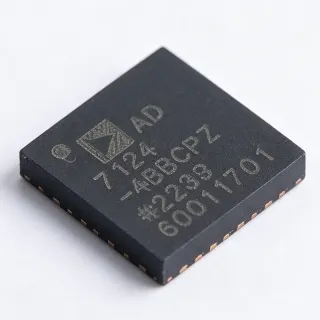
AD70001Z - 16-Bit Mono ADC | Analog Devices | Data Acquisition
Référence : AD70001Z ✓ ActifAD70001Z Présentation
An analog-to-digital converter is an integrated circuit that samples an analog voltage and represents it as a numeric code. Within the broader semiconductor hierarchy, an ADC is a data-converter IC, which is part of the wider analog and mixed-signal signal-processing family. A mono converter handles one independent input channel, making it suitable for single-sensor monitoring, industrial control, instrumentation, communications, and embedded measurement systems.
The principal confirmed feature of the AD70001Z is its 16-bit conversion resolution. A 16-bit ADC represents each sampled input with up to 65,536 quantization levels. This increased code density can improve measurement granularity compared with lower-resolution converters, particularly when the front-end architecture, reference voltage, input signal range, and signal-to-noise ratio are designed as a complete measurement chain.
AD70001Z operation requires attention to the analog input range, analog and digital power supplies, clocking, grounding, and digital data interface. Designers should establish the required input span before selecting external gain, filtering, and protection components. The reference voltage and conversion architecture also determine how the 16-bit code maps to the measured input voltage, so nominal resolution alone does not establish practical accuracy.
Typical uses include industrial process monitoring, laboratory instrumentation, sensor-interface modules, communications equipment, and embedded data-acquisition platforms. In each case, the ADC is placed between a conditioned analog front end and a digital controller or processor. Front-end filtering limits out-of-band noise, while careful grounding helps prevent converter performance from being degraded by shared return paths.
For PCB implementation, place the analog input path and its support components close to the converter and keep high-current digital return currents away from sensitive analog nodes. Validate the complete signal chain with the intended source impedance, gain, sampling rate, reference, and digital interface rather than evaluating resolution in isolation. The manufacturer datasheet and its pin-description table should be used as the authoritative references for voltage limits, interface timing, and package connections.
This product page combines the confirmed AD70001Z device identity with practical selection, PCB-layout, and signal-integrity guidance. It also distinguishes verified device attributes from parameters that require confirmation in the manufacturer documentation, helping engineers plan an appropriate conversion circuit before committing to a layout.
Alternatives de remplacement direct pour AD70001Z — même boîtier, compatible broche à broche. Les références à boîtier différent nécessitant une retouche du PCB sont exclues.
Aucune alternative de remplacement direct disponible pour ce produit.
Demander des alternativesAD70001Z Valeurs maximales et caractéristiques électriques
| Device Type | Analog-to-digital converter (ADC) |
| Résolution | 16 bit |
| Channel Count | 1 channel |
Guide de configuration des broches du AD70001Z standard
Configuration des broches du AD70001Z (boîtier standard). Ce composant analogique comporte des broches d'entrée, de sortie et d'alimentation. Consultez la fiche technique du fabricant pour les configurations des broches d'annulation d'offset, de compensation et d'activation. Idéal pour le conditionnement de signaux et les circuits amplificateurs.

Aucune donnée de brochage détaillée disponible pour AD70001Z.
Consultez la fiche technique pour la configuration complète des broches.
Applications typiques
AD70001Z convient pour 6 applications: Industrial Sensor Measurement, Laboratory Instrumentation, Communications Equipment, Embedded Data Acquisition, Process Control Monitoring, Audio-Cue Monitoring.
Industrial Sensor Measurement
The AD70001Z fits single-channel industrial sensor monitoring when the selected sensor produces an analog voltage within the converter's input range. Its mono 16-bit architecture provides a 65,536-level digital representation, which is useful when slow or moderate-bandwidth measurements require better granularity than a lower-resolution converter. Place a protected input network, RC filter, and optional gain stage ahead of the ADC, then keep those components close to the analog pins. Validate source impedance, settling time, reference stability, and acquisition timing together because 16-bit resolution alone does not guarantee 16-bit system accuracy.
Recommandé
Laboratory Instrumentation
The AD70001Z is suitable for laboratory instruments that digitize one conditioned analog measurement channel at a controlled rate. A 16-bit mono converter supports detailed numerical representation for instrument displays, test records, and downstream analysis. The analog input should normally pass through a low-pass anti-alias filter and a stable gain stage before reaching the converter. Use a quiet reference arrangement and independent analog and digital supply decoupling. For instrument-grade results, characterize offset, gain error, noise, and linearity across the actual input bandwidth rather than treating nominal resolution as the complete accuracy specification.
Recommandé
Communications Equipment
The AD70001Z can support a communications equipment control or monitoring path where a single analog quantity must be converted for digital processing. Its mono 16-bit conversion is appropriate when the monitored level does not require simultaneous-channel multiplexing. Place filtering close to the analog input to limit high-frequency content, and maintain separation from switching supplies, clock lines, and digital return currents. The interface timing and permitted input frequency must be checked in the manufacturer documentation so that the downstream controller samples stable, valid data during each conversion cycle.
Recommandé
Embedded Data Acquisition
The AD70001Z suits embedded acquisition modules that monitor one analog channel and transfer the resulting 16-bit code to a microcontroller or digital controller. A low-power design should include a settling front end, local reference or reference conditioning, and decoupling placed directly beside the appropriate supply pins. Avoid long traces between the sensor, protection network, and ADC because leakage and parasitic capacitance can degrade measurement behavior. Firmware should also account for the converter's output latency and data-valid timing rather than treating every digital transition as a completed conversion.
Recommandé
Process Control Monitoring
The AD70001Z can be used in process-control monitoring for a pressure, temperature, position, or current signal after suitable conditioning. The mono 16-bit format is valuable for slow process variables where the measurement must retain fine numerical granularity over a restricted range. Use an input filter with a bandwidth appropriate to the process, protect the node from industrial transients, and isolate analog and digital return paths. Confirm the converter's operating-temperature limits and environmental qualification before deploying it in industrial equipment, then verify long-term behavior with the actual sensor and source impedance.
Recommandé
Audio-Cue Monitoring
The AD70001Z can monitor a mono analog audio-cue level in equipment that needs amplitude measurement rather than full-band audio playback. Its 16-bit resolution allows a control system to distinguish smaller changes in the conditioned level, provided the front end limits noise and keeps the signal within the input range. Use an anti-alias or smoothing filter with the required bandwidth, maintain a clean analog ground, and avoid routing digital switching paths beneath sensitive input nodes. Verify gain and distortion performance over the audio frequencies of interest because the ADC's nominal bit depth does not characterize the complete analog signal chain.
Recommandé
Récapitulatif des produits recommandés
Données de référence d'ingénierie pour AD70001Z — comparaison, recommandations de conception et informations de conformité.
Guide de sélection
Comparaison avec les alternatives
| Paramètre | Ce produit |
|---|---|
| Device Type | Analog-to-digital converter (ADC) |
| Brand | Analog Devices |
| Resolution | 16 bit |
| Channel Count | 1 channel |
Principaux différenciateurs
- Single-channel conversion architecture (vs Multichannel or muxed ADC families)
- Fine digital code granularity (vs Lower-resolution general-purpose ADCs)
- Focused Analog Devices data-acquisition positioning (vs General-purpose converters with different clock and interface architectures)
Notes de conception
Keep the analog input trace short and place the input protection or filter network close to the AD70001Z. Avoid routing this trace beneath digital clock lines, switching-node copper, or high-current return paths. Confirm the maximum source impedance and acquisition timing in the manufacturer documentation so that the analog front end settles fully before conversion.
Decouple each applicable supply rail directly beside its package pins with the capacitance and placement specified in the manufacturer datasheet. Use a low-impedance ground-plane strategy and separate noisy digital return currents from sensitive analog returns. Check the package drawing for exposed-pad requirements before finalizing copper pours and assembly drawings.
Do not infer full 16-bit accuracy from the nominal resolution alone. Reference noise, input noise, offset error, gain error, source impedance, filter design, grounding, and acquisition timing all affect the result. Evaluate the complete signal chain with the intended sensor or source, and use the manufacturer timing diagrams when writing the data-acquisition control sequence.
Informations de conformité
Compliance declarations require confirmation from the current Analog Devices product documentation or the relevant declaration associated with the exact AD70001Z orderable configuration.