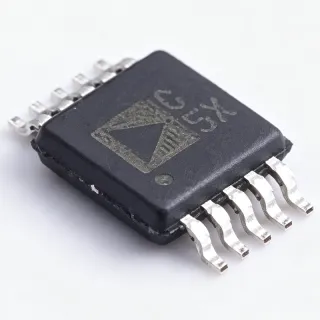
AD976ACN - 16-Bit 200 kSPS ADC | Analog Devices | DIP-28
Référence : AD976ACN ✓ ActifAD976ACN Présentation
An ADC converts an analog input voltage into a numeric code suitable for processing by a microprocessor, DSP, FPGA, or other digital system. The AD976 family uses a switched-capacitor, BiCMOS implementation that combines bipolar input circuitry with CMOS logic. This architecture supports the AD976A variant at 200 kSPS while retaining the resolution and sampling rate needed for instrumentation, industrial control, communications, and embedded measurement systems.
Key characteristics include 16-bit resolution, 200 kSPS throughput for the AD976A, single 5 V operation, and a parallel data interface. The converter also includes an on-chip clock and allows the 2.5 V reference to be selected from internal or external sources. An external reference can support repeatable measurement systems that require independent reference control or tighter calibration across multiple converters.
The parallel interface exposes conversion results directly as digital bits rather than routing each sample through a serial link. This architecture can simplify connection to older digital buses and parallel FPGA logic, although the 28-pin package requires adequate PCB routing space and careful treatment of analog and digital return paths. The converter’s 100 mW maximum power dissipation figure is particularly relevant when designing compact systems with limited thermal capacity.
Typical uses include process monitoring, waveform capture, instrumentation, communications receivers, and industrial data-acquisition systems. For these applications, the key design trade-off is interface flexibility versus board area: parallel output supports high-rate data transfer but requires more traces and pins than a serial ADC. The AD976ACN is therefore most appropriate when existing digital logic is parallel and the 28-pin through-hole footprint is available.
For layout, place input, reference, and decoupling connections according to the pin-description and typical-application diagrams in the manufacturer datasheet. A stable supply and reference arrangement are essential because gain, offset, and code accuracy depend on those nodes remaining quiet. This page also organizes sourcing, replacement, and application guidance so engineers can evaluate the AD976ACN against same-package conversion options before committing a board layout.
Alternatives de remplacement direct pour AD976ACN — même boîtier, compatible broche à broche. Les références à boîtier différent nécessitant une retouche du PCB sont exclues.
Variantes de cette série
Modèles de la même série directement compatibles avec AD976ACN (même facteur de forme et même empreinte) — différant par Architecture, Internal Reference, Package, Supply Voltage.
AD976ABN
✅ Remplacement directContactez-nous pour le prix
Voir la fiche technique →AD976ABN
✅ Remplacement directContactez-nous pour le prix
Voir la fiche technique →AD976ACN-ND
✅ Remplacement direct📋 Alternative de référence (hors catalogue)
AD976AJPZ
✅ Remplacement direct ⚠️ Spécifications non vérifiées📋 Alternative de référence (hors catalogue)
AD976ACN-REEL
✅ Remplacement direct ⚠️ Spécifications non vérifiées📋 Alternative de référence (hors catalogue)
AD976ACN Valeurs maximales et caractéristiques électriques
| Converter Type | Successive-approximation ADC |
| Résolution | 16 bit |
| Throughput Rate | 200 kSPS for AD976A |
| Tension d'alimentation | 5 V |
| Architecture | BiCMOS switched-capacitor |
| Internal Reference | 2.5 V |
| Reference Selection | Internal or external 2.5 V reference |
| Output Interface | High-speed parallel |
| Clock | On-chip clock |
| Maximum Power Dissipation | 100 mW |
| Boîtier | 28-lead DIP |
| Nombre de broches | 28 pins |
| Type de montage | Through-hole |
Guide de configuration des broches du AD976ACN 28-lead dip
Configuration des broches du AD976ACN (boîtier 28-lead dip). Ce composant analogique comporte des broches d'entrée, de sortie et d'alimentation. Consultez la fiche technique du fabricant pour les configurations des broches d'annulation d'offset, de compensation et d'activation. Idéal pour le conditionnement de signaux et les circuits amplificateurs.

Aucune donnée de brochage détaillée disponible pour AD976ACN.
Consultez la fiche technique pour la configuration complète des broches.
Applications typiques
AD976ACN convient pour 6 applications: Industrial Process Monitoring, Precision Waveform Capture, Communications Receiver, Test and Measurement Instrumentation, Embedded Data Acquisition, Audio and Vibration Analysis.
Industrial Process Monitoring
The AD976ACN is suitable for digitizing slow and moderate-speed process signals in industrial measurement systems because it combines 16-bit resolution with a 200 kSPS throughput rate and a 5 V supply. It can sample pressure, temperature, level, or position transducer outputs while transferring each result over a parallel bus into a PLC, DSP, or FPGA. The parallel interface avoids serial deserialization overhead, although the 28-lead DIP requires more board area than a surface-mount ADC. Source impedance, input range, and acquisition time must be matched to the transducer and conditioning circuitry, while bypassing and reference layout must follow the manufacturer application guidance.
Recommandé
Precision Waveform Capture
The AD976ACN fits waveform-capture and signal-characterization systems that need 16-bit amplitude resolution at up to 200 kSPS. A conditioning front end can scale and filter the input before the switched-capacitor ADC performs successive-approximation conversion. The resulting 16-bit parallel words can be captured by FPGA logic or a digital signal processor without a serial protocol converter. Engineers should verify input bandwidth, settling time, and acquisition timing against the measured signal, because sample-rate headroom does not by itself guarantee accurate capture of high-frequency content.
Recommandé
Communications Receiver
The AD976ACN can serve as the sampling element in a communications receiver or demodulation front end when the required conversion rate is no higher than 200 kSPS. Its 16-bit resolution supports fine quantization of recovered analog waveforms, while the on-chip clock simplifies synchronization between the converter and receiver logic. The single 5 V operating rail is convenient for mixed-signal communications equipment, but the reference and analog supply must remain sufficiently quiet to protect code stability. Layout should separate sensitive input and reference routing from digital output paths that switch at high rates.
Recommandé
Test and Measurement Instrumentation
The AD976ACN is appropriate for laboratory and field instrumentation that acquires moderate-rate analog measurements and presents them to parallel digital hardware. Its 200 kSPS throughput supports faster sampling than the 100 kSPS AD976 speed grade, while 16-bit resolution improves representation of small signal changes. A practical instrument would pair the converter with input conditioning, an external precision reference when calibration demands require it, and logic for range control or buffering. Because the converter uses a parallel output, designers should budget connector and PCB-routing space and ensure the receiving device can capture or latch the full bus without timing errors.
Recommandé
Embedded Data Acquisition
The AD976ACN can convert multiple conditioned channels sequentially in an embedded acquisition system when 200 kSPS throughput and 16-bit resolution are sufficient. Its parallel output can connect to an FPGA or directly sampled data register, while the on-chip clock supports deterministic sampling. The single 5 V operation reduces the number of supply rails required around the converter, and the 28-lead DIP can simplify prototyping where through-hole assembly is acceptable. For multi-channel designs, multiplexer settling time and source impedance must be included in the timing budget so that every selected channel reaches the accuracy required by the application.
Recommandé
Audio and Vibration Analysis
The AD976ACN is usable in specialized audio and vibration analysis equipment when the highest required sample rate remains within its 200 kSPS capability. Its 16-bit conversion resolution can retain fine changes in an analog transducer output, and the parallel interface permits direct transfer into digital processing logic. Anti-alias filtering is essential: the input filter must suppress energy above the converter’s usable bandwidth before switching-capacitor sampling creates aliases. Engineers should also consider whether the system requires a faster, dedicated audio ADC with a serial interface; AD976ACN is better suited to flexible parallel-data architectures than high-rate, low-latency audio conversion.
Recommandé
Récapitulatif des produits recommandés
Données de référence d'ingénierie pour AD976ACN — comparaison, recommandations de conception et informations de conformité.
Guide de sélection
Comparaison avec les alternatives
| Paramètre | Ce produit | AD976A | AD976 | AD976ACN-ND | AD976AJPZ | AD976ACN-REEL |
|---|---|---|---|---|---|---|
| Brand | Analog Devices | Analog Devices | Analog Devices | Analog Devices | Analog Devices | Analog Devices |
| Package | 28-lead DIP | 28-lead DIP | 28-lead DIP | 28-lead DIP | 28-lead DIP | 28-lead DIP |
| Resolution | 16 bit | 16 bit | 16 bit | 16 bit | 16 bit | 16 bit |
| Throughput Rate | 200 kSPS | 200 kSPS | 100 kSPS | 200 kSPS | 200 kSPS | 200 kSPS |
| Supply Voltage | 5 V single supply | 5 V single supply | 5 V single supply | 5 V single supply | 5 V single supply | 5 V single supply |
| Architecture | Switched-capacitor BiCMOS ADC | Switched-capacitor BiCMOS ADC | Switched-caporitor BiCMOS ADC | Switched-capacitor BiCMOS ADC | Switched-capacitor BiCMOS ADC | Switched-capacitor BiCMOS ADC |
| Reference | Selectable internal or external 2.5 V | Selectable internal or external 2.5 V | Selectable internal or external 2.5 V | Selectable internal or external 2.5 V | Selectable internal or external 2.5 V | Selectable internal or external 2.5 V |
| Digital Interface | High-speed parallel | High-speed parallel | High-speed parallel | High-speed parallel | High-speed parallel | High-speed parallel |
| Clock Source | On-chip clock | On-chip clock | On-chip clock | On-chip clock | On-chip clock | On-chip clock |
Principaux différenciateurs
- Higher conversion throughput than the AD976 speed grade (vs AD976)
- Parallel data output avoids a serial deserialization stage (vs ADS774KU)
- Single-supply operation with selectable 2.5 V reference (vs AD976)
Notes de conception
Route the analog input and reference nets away from the parallel data outputs and clock traces. Keep the converter, input-conditioning components, and reference bypass components close to their associated pins; long loops increase susceptibility to capacitive coupling and ground noise. Use the pin-description table and typical application diagram in the Analog Devices AD976 datasheet to establish the exact connections before laying out the 28-lead DIP footprint.
Estimated: the converter is rated for a maximum power dissipation of 100 mW. At a 5 V supply, this corresponds to about 20 mA if the full rating were reached at the device rails, although actual current depends on clock rate and output activity. Provide low-impedance bypass capacitance at the supply pins and verify the worst-case supply current, temperature rise, and adjacent-component loading in the finished design.
Do not treat the AD976 and AD976A speed grades as interchangeable without checking throughput: AD976ACN is associated with the 200 kSPS AD976A grade, while AD976 is rated for 100 kSPS. Likewise, the 28-lead DIP package must not be confused with the surface-mount and SSOP options in the same family. Confirm the complete ordering code, pinout, and digital timing before substituting a component or modifying an existing PCB.
Informations de conformité
Compliance status was not stated in the manufacturer-page and distributor information. Request current environmental and material-compliance documentation during sourcing.