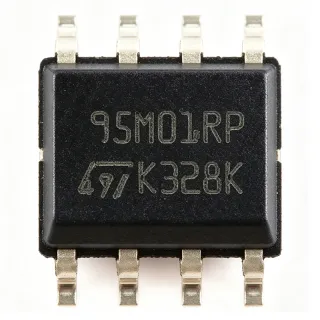
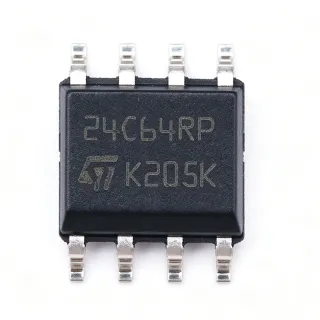
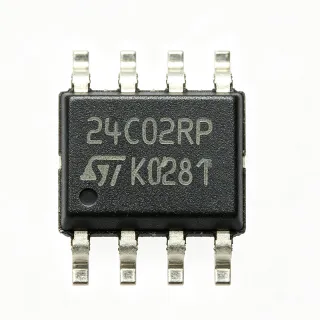
AT24C02D-SSHM-T - 2Kb I2C EEPROM, 1MHz, 1.7V-5.5V, 8-SOIC | Microchip
Référence : AT24C02D-SSHM-T ✓ Actif| Qté | Prix unitaire | Total |
|---|---|---|
| 1 | $0.3 | $0,30 |
| 10 | $0.27 | $2,70 |
| 100 | $0.22 | $22,00 |
| 500 | $0.19 | $95,00 |
| 1 000 | $0.17 | $170,00 |
AT24C02D-SSHM-T Présentation
What is a serial EEPROM? A serial EEPROM (Electrically Erasable Programmable Read-Only Memory) is a type of non-volatile memory that stores small amounts of configuration or calibration data and communicates over a low-pin-count serial bus. Within the broader memory hierarchy, EEPROM sits between battery-backed SRAM (fast but volatile) and flash (high density but block-erasable); the EEPROM excels at byte-level write endurance, typically one million write cycles per byte. The AT24C02D belongs to Microchip's AT24C series of I2C EEPROMs, which dominate industrial, automotive accessory, and consumer configuration-storage applications.
The D-version adds a Schmitt-trigger input stage on the SCL/SDA lines and supports Fast-mode Plus I2C at up to 1 MHz clock frequency with 450 ns access time, while operating from a single 1.7V to 5.5V supply. The 8-bit word address and hard-wired A0/A1/A2 pins allow up to eight devices to share a common two-wire bus. Additional features include hardware write-protect (WP) input, 1 million erase/write cycles endurance, and more than 200-year data retention per the manufacturer datasheet.
Architecturally, the AT24C02D integrates a CMOS EEPROM array with an I2C slave controller, on-chip charge pump for high-voltage generation during programming, and a page-write buffer that allows up to 8 bytes to be written per I2C transaction. The Schmitt-trigger inputs eliminate the external RC components that older EEPROM generations required for noise filtering on industrial buses.
Typical applications include industrial sensor calibration storage, asset tracking device parameters, consumer appliance user settings, medical device patient-data logs, automotive accessory configuration (infotainment, dash-cam), and IoT node identity/secret storage. The wide 1.7V-5.5V supply range makes it ideal for battery-powered devices operating from a single Li-ion cell.
When designing with this part, place a 0.1 uF decoupling capacitor adjacent to VCC and ensure SCL/SDA pull-ups sized for the bus capacitance; pull-ups of 2.2 kohm to 10 kohm are typical at 1 MHz. Observe the write-cycle time (tWR, typically 5 ms) between successive write operations or use the polling ACK method.
This page synthesizes distributor pricing, drop-in alternatives, application guidance, and design notes that complement the manufacturer datasheet and enable faster component selection.
Alternatives de remplacement direct pour AT24C02D-SSHM-T — même boîtier, compatible broche à broche. Les références à boîtier différent nécessitant une retouche du PCB sont exclues.
Variantes de cette série
Modèles de la même série directement compatibles avec AT24C02D-SSHM-T (même facteur de forme et même empreinte) — différant par MSL Level, Memory Type, RoHS Status, Access Time, Interface.
Outil de comparaison rapide — sélectionnez des références alternatives pour une comparaison côte à côte :
AT24C02D-SSHM-B
✅ Remplacement direct📋 Alternative de référence (hors catalogue)
AT24C02D-SSHM
✅ Remplacement direct📋 Alternative de référence (hors catalogue)
AT24C02C-SSHM-T
✅ Remplacement direct📋 Alternative de référence (hors catalogue)
AT24C02D-MAHM-T
✅ Remplacement direct✓ En stock
$0.21 / unité
Voir la fiche technique →AT24C02D-PU
✅ Remplacement direct ⚠️ Spécifications non vérifiées📋 Alternative de référence (hors catalogue)
24C02-I/SN
✅ Remplacement direct📋 Alternative de référence (hors catalogue)
AT24C02D-SSHM-T Spécifications
| Type de mémoire | Non-volatile EEPROM (Serial) |
| Taille de mémoire | 2 Kbit |
| Memory Organization | 256 x 8 bits |
| Interface | I2C (2-Wire Serial) |
| Fréquence d'horloge maximale | 1 MHz (Fast-mode Plus) |
| Access Time | 450 ns |
| Supply Voltage (VCC) | 1.7 V to 5.5 V |
| Plage de température de fonctionnement | -40 C to +85 C |
| Boîtier / Format | 8-SOIC (0.154" / 3.90 mm) |
| Type de montage | Surface Mount |
| Write Cycle Time (max) | 5 ms (typical) |
| Endurance (Write/Erase Cycles) | 1,000,000 cycles |
| Data Retention | >200 years |
| Device Address Pins | A0, A1, A2 (hardware-selectable, up to 8 devices per bus) |
| Write Protect Pin | Yes (WP, active-high) |
| Input Type (SCL/SDA) | Schmitt-trigger |
| Statut RoHS | Compliant (Pb/HALO-free, NiPdAu lead finish) |
| Niveau MSL | 1 (unlimited floor life at <30 C / 85% RH) |
Configuration des broches de AT24C02D-SSHM-T
| Broche 1 | A0 — Device address input 0 (hard-wired to VCC or GND) |
| Broche 2 | A1 — Device address input 1 (hard-wired to VCC or GND) |
| Broche 3 | A2 — Device address input 2 (hard-wired to VCC or GND) |
| Broche 4 | GND — Ground reference |
| Broche 5 | SDA — Serial data I/O (Schmitt-trigger input, open-drain output) |
| Broche 6 | SCL — Serial clock input (Schmitt-trigger) |
| Broche 7 | WP — Write protect (active-high; tie to GND for normal read/write operation) |
| Broche 8 | VCC — Power supply, 1.7 V to 5.5 V |
Applications typiques
AT24C02D-SSHM-T convient pour 6 applications: Industrial Sensor Calibration Storage, Consumer Appliance User Settings Memory, IoT Node Identity and Secret Storage, Automotive Accessory Configuration Memory, Medical Device Patient Log Retention, Test & Measurement Calibration Tables.
Industrial Sensor Calibration Storage
The AT24C02D-SSHM-T stores per-unit calibration coefficients, linearity trim, and serial numbers for industrial sensors such as pressure transducers, flow meters, and load cells. The 256-byte capacity holds multiple 32-byte calibration tables per sensor, while the 1,000,000-cycle endurance handles frequent factory re-calibration. Operating from 1.7 V to 5.5 V, it connects directly to the I2C peripheral of MCUs such as the PIC16F or STM32 families without level shifters, even on a 1.8 V rail. The 8-SOIC footprint enables hand-rework in the field and the wide -40 C to +85 C range covers most outdoor and factory environments.
Recommandé
Consumer Appliance User Settings Memory
The AT24C02D-SSHM-T retains user-configurable settings (mode preferences, last-used state, timer values) in white goods, HVAC thermostats, and small kitchen appliances. The 2 Kbit capacity is sufficient for several hundred bytes of structured preferences, and the >200-year data retention ensures settings survive long product lifetimes. Low 1 uA standby current keeps idle power negligible, while the 1 MHz I2C interface lets the host MCU fetch settings quickly during boot. Three address pins allow multiple EEPROMs (settings, logs, calibration) on a single bus, simplifying board layout.
Recommandé
IoT Node Identity and Secret Storage
The AT24C02D-SSHM-T provides non-volatile storage for device identity, X.509 certificates, and provisioning secrets in Wi-Fi/BLE IoT nodes. The byte-level write endurance of 1,000,000 cycles supports frequent key rotation, while the I2C interface integrates easily with any wireless MCU (ESP32, nRF52, SAM R34). Operating from a single Li-ion cell (3.0-4.2 V) or a coin-cell, the part fits battery-powered deployments; its 450 ns access time keeps network join times low. The 8-SOIC form factor is hand-solderable for prototype nodes and reflow-compatible for high-volume production.
Recommandé
Automotive Accessory Configuration Memory
The AT24C02D-SSHM-T stores user preferences (radio presets, seat/mirror positions, climate settings) in automotive infotainment and body-electronics modules. While the standard -SSHM-T is rated to +85 C, the part is widely used in cabin-mounted accessories where the +85 C ceiling is sufficient. The 1 MHz Fast-mode Plus I2C speed lets the host access memory quickly during CAN wake-up events. The 8-SOIC footprint accepts standard PCB land patterns used by automotive Tier-1 suppliers, simplifying second-source qualification. For under-hood or AEC-Q100 mandated designs, the equivalent automotive part number should be requested from Microchip.
Recommandé
Medical Device Patient Log Retention
The AT24C02D-SSHM-T stores small patient logs (therapy sessions, measurement history, device identifiers) in portable medical devices such as glucose meters, CPAP machines, and TENS units. The >200-year data retention is well beyond the device service life, and the 1,000,000 write endurance handles daily log writes for decades. The 1.7 V minimum supply supports operation from a single coin-cell during battery replacement intervals. The 8-SOIC package is small enough to fit compact handheld enclosures and is drop-in compatible with the I2C footprint used across most portable medical electronics.
Recommandé
Test & Measurement Calibration Tables
The AT24C02D-SSHM-T stores factory calibration coefficients and linearity correction tables in bench-top instruments, data loggers, and handheld DMMs. The 256-byte capacity is sufficient for multi-range temperature or voltage compensation curves, and the 1,000,000-cycle endurance supports repeated factory re-calibration. The 1 MHz Fast-mode Plus I2C keeps system boot time short during instrument self-test, while the wide -40 C to +85 C range handles lab and field conditions. The 8-SOIC package is easy to place on multi-layer instrumentation PCBs and is widely second-sourced, easing BOM management.
Recommandé
Récapitulatif des produits recommandés
Données de référence d'ingénierie pour AT24C02D-SSHM-T — comparaison, recommandations de conception et informations de conformité.
Guide de sélection
Comparaison avec les alternatives
| Paramètre | Ce produit | AT24C02D-SSHM-B | AT24C02D-SSHM | AT24C02C-SSHM-T | AT24C02D-MAHM-T | AT24C02D-PU | 24C02-I/SN |
|---|---|---|---|---|---|---|---|
| Package | 8-SOIC (SSHM) | 8-SOIC - same | 8-SOIC - same | 8-SOIC - same | 8-SOIC - same | 8-SOIC - same | 8-SOIC - same |
| Brand | Microchip Technology | Microchip Technology | Microchip Technology | Microchip Technology | Microchip Technology | Microchip Technology | Microchip Technology |
| Memory Size | 2 Kbit | 2 Kbit | 2 Kbit | 2 Kbit | 2 Kbit | 2 Kbit | 2 Kbit |
| Maximum I2C Clock | 1 MHz | 1 MHz | 1 MHz | 400 kHz | 1 MHz | 1 MHz | 400 kHz |
| Supply Voltage Range | 1.7 V to 5.5 V | 1.7 V to 5.5 V | 1.7 V to 5.5 V | 1.8 V to 5.5 V | 1.7 V to 5.5 V | 1.7 V to 5.5 V | 2.5 V to 5.5 V |
| Operating Temperature | -40 C to +85 C | -40 C to +85 C | -40 C to +85 C | -40 C to +85 C | -40 C to +85 C | -40 C to +85 C | -40 C to +85 C |
| Write Endurance | 1,000,000 cycles | 1,000,000 cycles | 1,000,000 cycles | 1,000,000 cycles | 1,000,000 cycles | 1,000,000 cycles | 1,000,000 cycles |
| Schmitt-trigger Inputs | Yes | Yes | Yes | No (legacy input stage) | Yes | Yes | No (legacy input stage) |
Principaux différenciateurs
- 1 MHz Fast-mode Plus I2C interface with Schmitt-trigger inputs (vs AT24C02C-SSHM-T)
- Wide 1.7 V minimum supply supports single-cell Li/coin-cell designs (vs 24C02-I/SN)
- Tape-and-reel packaging supports high-volume SMT assembly (vs AT24C02D-SSHM-B (tube))
Notes de conception
Place a 0.1 uF X7R decoupling capacitor as close as possible to the VCC pin (pin 8) and the GND pin (pin 4) to suppress high-frequency noise that could corrupt I2C transactions. For buses longer than 100 mm or with multiple devices, place a bulk 1 uF to 10 uF ceramic or tantalum capacitor near the EEPROM in addition to the 0.1 uF. Ground return paths should be short and direct, ideally sharing the same reference plane as the I2C pull-ups.
SDA and SCL are open-drain and REQUIRE external pull-up resistors to VCC; the AT24C02D does not have internal pull-ups. Typical pull-up values are 2.2 kohm at 1 MHz with 5 V VCC and 100 pF bus capacitance, rising to 10 kohm at 100 kHz. Exceeding 5.5 V on any pin or operating below 1.7 V may cause unreliable writes or data corruption. WP (pin 7) MUST be tied to GND for normal read/write operation; floating this pin can leave the EEPROM in write-protected state intermittently.
After initiating a write operation, the EEPROM enters an internal write cycle (tWR, typically 5 ms maximum) during which it ignores all I2C commands. The host must either wait 5 ms or poll the EEPROM with a current-address read until ACK is received before issuing the next command. Failing to observe this timing results in lost writes. The D-revision Schmitt-trigger inputs tolerate slow rise times down to 1 us; if the rise time exceeds this, add a 4.7 kohm or stronger pull-up to keep edges sharp.
The AT24C02D draws approximately 1 mA during active reads and 1 uA in standby per the datasheet. For battery-powered applications, take advantage of the 1 uA standby by keeping the WP pin high when the host is not actively reading/writing; this protects against unintended writes during MCU sleep and minimizes current draw. Avoid clock stretching on SCL beyond 1 us at 1 MHz operation to prevent the EEPROM from missing the next byte. Estimated: active-write current may reach 3 mA during the 5 ms write cycle - budget for this in low-power designs.
Informations de conformité
Pb/HALO-free NiPdAu lead finish per Microchip product page. Industrial-grade temperature range (-40 C to +85 C); not AEC-Q100 qualified - use AT24C02D automotive-grade ordering code for under-hood designs.