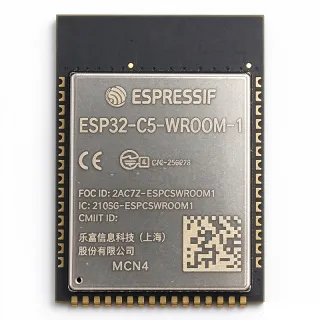
ESP32-C5-WROOM-1U-N8R8 - Dual-Band Wi-Fi 6 BLE Module | Espressif
Référence : ESP32-C5-WROOM-1U-N8R8 ✓ Actif| Qté | Prix unitaire | Total |
|---|---|---|
| 1 | $3.9 | $3,90 |
| 10 | $3.51 | $35,10 |
| 100 | $3.12 | $312,00 |
| 500 | $2.81 | $1 405,00 |
| 1 000 | $2.53 | $2 530,00 |
ESP32-C5-WROOM-1U-N8R8 Présentation
A wireless module is a pre-certified, self-contained circuit board that integrates a microcontroller SoC, RF front end, crystal, flash memory, and antenna interface into a single castellated-edge surface-mount unit. Modules sit above bare SoCs in the electronics hierarchy - embedded system, wireless connectivity module, SoC, silicon - and let designers add certified radio connectivity without in-house RF design or regulatory re-certification.
Key features include simultaneous dual-band Wi-Fi 6 support in the 2.412-2.484 GHz and 5.18-5.885 GHz bands, which reduces congestion in dense IoT deployments; 802.15.4 radio for Zigbee and Thread, enabling native Matter and Thread mesh networks; Bluetooth 5 LE for phone provisioning and beacons; and a low-power coprocessor that can monitor peripherals while the main CPU is powered off.
At the core is the ESP32-C5 SoC, a single-core 32-bit RISC-V processor clocked up to 240 MHz with a rich peripheral set including SPI, I2C, UART, I2S, PWM, and ADC. The N8R8 variant pairs 8 MB flash with 8 MB PSRAM, providing ample headroom for TLS stacks, display buffers, and Matter applications.
Typical applications include smart home hubs that must bridge Wi-Fi, Thread, Zigbee, and BLE simultaneously; industrial automation gateways using the 5 GHz band to avoid 2.4 GHz factory interference; and healthcare or consumer electronics requiring dual-stack wireless provisioning.
For design, keep the IPEX antenna feedline at 50 ohms impedance and follow Espressif hardware design guidelines for module keep-out zones. Note that the 1U variant has no onboard PCB antenna, so an external antenna is mandatory.
This page synthesizes verified datasheet specifications, drop-in same-family alternatives, and practical design notes not found on distributor listing pages.
Alternatives de remplacement direct pour ESP32-C5-WROOM-1U-N8R8 — même boîtier, compatible broche à broche. Les références à boîtier différent nécessitant une retouche du PCB sont exclues.
Outil de comparaison rapide — sélectionnez des références alternatives pour une comparaison côte à côte :
ESP32-C5-WROOM-1-N8R8
✅ Remplacement direct📋 Alternative de référence (hors catalogue)
ESP32-C5-WROOM-1U-N16R8
✅ Remplacement direct📋 Alternative de référence (hors catalogue)
ESP32-C5-WROOM-1U-N32R8
✅ Remplacement direct📋 Alternative de référence (hors catalogue)
ESP32-C5-WROOM-1U-N4
✅ Remplacement direct📋 Alternative de référence (hors catalogue)
ESP32-C5-WROOM-1U-N8R8T2
✅ Remplacement direct📋 Alternative de référence (hors catalogue)
ESP32-C5-WROOM-1U-N8R8 Spécifications (publiées par le fabricant)
| Wireless Standard | Wi-Fi 6 (802.11b/g/n/ac/ax), Bluetooth 5 (LE), Zigbee, Thread (802.15.4) |
| Frequency Bands | 2.412 GHz - 2.484 GHz and 5.18 GHz - 5.885 GHz |
| CPU Core | 32-bit RISC-V single core |
| CPU Clock | Up to 240 MHz |
| Flash Memory | 8 MB (Quad SPI) |
| PSRAM | 8 MB (Quad SPI) |
| Antenna | External via IPEX connector (antenna not included) |
| Ambient Temperature | -40 C to +85 C |
| Dimensions | 18.0 x 21.2 x 3.3 mm |
| Type de montage | Surface Mount (SMD) |
| Low-Power Coprocessor | Yes, monitors peripherals with CPU powered off |
| Application Domains | Smart home, industrial automation, health care, consumer electronics |
| Statut RoHS | Compliant (per JLCPCB listing) |
| Custom Antenna Variant | T2 suffix supported (e.g., ESP32-C5-WROOM-1U-N8R8T2) |
Interfaces et connecteurs du ESP32-C5-WROOM-1U-N8R8
Le ESP32-C5-WROOM-1U-N8R8 expose les interfaces et connecteurs suivants tels que publiés par le fabricant : Sans fil. Le brochage de l'embase d'extension, la numérotation des broches des connecteurs et les limites électriques sont définis dans la documentation du fabricant.
| Sans fil | Wi-Fi 6 (802.11b/g/n/ac/ax), Bluetooth 5 (LE), Zigbee, Thread (802.15.4) |
Consultez la documentation du fabricant pour le brochage complet du connecteur d'extension et la numérotation des broches du connecteur.
Caractéristiques de puissance et thermiques
| Température de fonctionnement | -40 C to +85 C |
Paramètres d'alimentation et thermiques pour ESP32-C5-WROOM-1U-N8R8 tels que publiés par le fabricant.
Applications typiques
ESP32-C5-WROOM-1U-N8R8 convient pour 6 applications: Smart Home Hubs and Matter Controllers, Industrial Automation Gateways, Healthcare and Medical Monitoring Devices, High-Density Consumer Electronics, Video Doorbells and Security Cameras, Smart Lighting and Zigbee/Thread Networks.
Smart Home Hubs and Matter Controllers
The ESP32-C5-WROOM-1U is uniquely positioned for smart home hubs because it is one of the few modules that combines dual-band Wi-Fi 6, Bluetooth 5 LE, Zigbee, and Thread in a single package. A Matter controller or Thread Border Router built on the N8R8 variant can bridge Thread devices to a 2.4 or 5 GHz backhaul while using BLE for phone-based commissioning. The 8 MB PSRAM handles the Matter SDK, TLS sessions, and multiple concurrent protocol stacks comfortably. Placed on a main board with a 5 dBi external antenna via the IPEX connector, the 5 GHz band provides clean throughput even in homes with dozens of 2.4 GHz devices. The -40 C to +85 C range allows installation in garages and outdoor-rated enclosures with secondary protection.
Recommandé
Industrial Automation Gateways
Industrial plants routinely saturate the 2.4 GHz band with legacy Wi-Fi, wireless PLC links, and worker devices. The ESP32-C5-WROOM-1U solves this by using the 5.18-5.885 GHz band for the plant IT backhaul while its 2.4 GHz 802.15.4 radio runs Zigbee or Thread sensor meshes on the factory floor. The 240 MHz RISC-V core handles Modbus-to-MQTT translation, and the low-power coprocessor monitors machine sensors and crosses thresholds without waking the main CPU, saving energy in battery-backed nodes. With an operating range of -40 C to +85 C and an external high-gain antenna connected via the IPEX port mounted outside a metal control cabinet, the module maintains reliable links where PCB-antenna modules fail. Espressif lists industrial automation as a primary datasheet application.
Recommandé
Healthcare and Medical Monitoring Devices
Health care is explicitly listed by Espressif as a target application for the ESP32-C5-WROOM-1 series. Patient-monitoring peripherals benefit from BLE 5 for phone pairing, Thread mesh for multi-room sensor networks that self-heal, and 5 GHz Wi-Fi for uploading encrypted data to hospital networks where the 2.4 GHz band is congested by infusion pumps and telemetry equipment. The low-power coprocessor can watch sensor thresholds - heart rate, SpO2, temperature - while the 240 MHz main CPU sleeps, extending battery life in wearable form factors. The 8 MB PSRAM of the N8R8 variant buffers sensor data during network outages. An external antenna via the IPEX connector lets designers place the radiating element away from body-blocking enclosures, improving link margin versus integrated PCB antennas.
Recommandé
High-Density Consumer Electronics
Consumer electronics - streaming accessories, smart displays, robot vacuums, appliances - need dependable Wi-Fi in homes with 30+ competing devices. The dual-band 2.412-2.484 GHz plus 5.18-5.885 GHz coverage of the ESP32-C5-WROOM-1U lets the product connect to the less congested band, directly reducing support calls caused by Wi-Fi congestion. Wi-Fi 6 (802.11ax) OFDMA and TWT features improve coexistence in dense deployments and cut idle power. The 8 MB flash plus 8 MB PSRAM of the N8R8 variant accommodates OTA update images and UI graphics buffers with the 240 MHz RISC-V core. The castellated SMD pads allow automated assembly alongside other components, and the IPEX antenna port simplifies FCC/CE testing with a standardized external antenna.
Recommandé
Video Doorbells and Security Cameras
Security cameras and video doorbells are the classic dual-band use case: they need high, sustained uplink throughput for video streaming, which the 5 GHz band provides with far less interference than 2.4 GHz. The ESP32-C5-WROOM-1U combines that bandwidth with BLE 5 for fast, phone-based setup and provisioning. The N8R8's 8 MB PSRAM can hold frame buffers for camera pipelines, and the RISC-V core runs H.264 bitstream handling and cloud MQTT signaling. The IPEX connector allows a high-gain directional antenna aimed at the router, noticeably extending range at the edge of a property compared to an internal PCB antenna. Operating temperature of -40 C to +85 C covers outdoor enclosures in both hot and freezing climates per the datasheet ambient rating.
Recommandé
Smart Lighting and Zigbee/Thread Networks
For lighting products sold into ecosystems such as Amazon, Google Home, and Apple Home, the ESP32-C5-WROOM-1U can act as either an 802.15.4 end device or a border-router-grade hub. Its single 2.4 GHz radio handles Zigbee and Thread stacks via ESP-IDF, and when deployed as a hub it simultaneously bridges those meshes to Wi-Fi 6 backhaul and BLE commissioning. Lighting networks with hundreds of nodes stress router tables and memory - the 8 MB flash and 8 MB PSRAM of the N8R8 variant provide the headroom that smaller ESP32-C3 designs lack. The low-power coprocessor enables battery-powered sensors that wake only on threshold events. With an external antenna on the IPEX connector, a centrally placed hub covers a whole home's Thread or Zigbee mesh.
Recommandé
Récapitulatif des produits recommandés
Données de référence d'ingénierie pour ESP32-C5-WROOM-1U-N8R8 — comparaison, recommandations de conception et informations de conformité.
Guide de sélection
Comparaison avec les alternatives
| Paramètre | Ce produit | ESP32-C5-WROOM-1-N8R8 | ESP32-C5-WROOM-1U-N16R8 | ESP32-C5-WROOM-1U-N32R8 | ESP32-C5-WROOM-1U-N4 |
|---|---|---|---|---|---|
| Package | 18.0 x 21.2 x 3.3 mm SMD, IPEX antenna connector | 18.0 x 21.2 x 3.3 mm SMD - same footprint, PCB antenna | 18.0 x 21.2 x 3.3 mm SMD - same | 18.0 x 21.2 x 3.3 mm SMD - same | 18.0 x 21.2 x 3.3 mm SMD - same |
| Brand | Espressif Systems | Espressif Systems | Espressif Systems | Espressif Systems | Espressif Systems |
| Wireless Protocols | Wi-Fi 6 dual-band, BLE 5, Zigbee, Thread | Identical protocol set | Identical protocol set | Identical protocol set | Identical protocol set |
| Flash Memory | 8 MB (Quad SPI) | 8 MB (Quad SPI) | 16 MB (Quad SPI) | 32 MB (Quad SPI) | 4 MB (Quad SPI) |
| PSRAM | 8 MB (Quad SPI) | 8 MB (Quad SPI) | 8 MB (Quad SPI) | 8 MB (Quad SPI) | None |
| CPU | 32-bit RISC-V single core, up to 240 MHz | 32-bit RISC-V single core, up to 240 MHz | 32-bit RISC-V single core, up to 240 MHz | 32-bit RISC-V single core, up to 240 MHz | 32-bit RISC-V single core, up to 240 MHz |
| Antenna | External via IPEX connector (not included) | Integrated PCB antenna | External via IPEX connector | External via IPEX connector | External via IPEX connector |
| Operating Temperature | -40 C to +85 C | -40 C to +85 C | -40 C to +85 C | -40 C to +85 C | -40 C to +85 C |
| Relative Cost | Mid (8 MB flash + PSRAM) | Mid, similar to 1U | Higher (larger flash) | Highest in family | Lowest (no PSRAM) |
Principaux différenciateurs
- Dual-band Wi-Fi 6 coverage (vs ESP32-C6-WROOM-1)
- External antenna flexibility (vs ESP32-C5-WROOM-1-N8R8)
- 8 MB PSRAM for application headroom (vs ESP32-C5-WROOM-1U-N4)
- Upgrade path within same footprint (vs ESP32-C5-WROOM-1U-N32R8)
Notes de conception
Because the 1U variant has no PCB antenna, the IPEX-to-antenna feed is part of your design. Keep the IPEX receptacle within 20 mm of the module edge, route any microstrip section at 50 ohms, and select a dual-band (2.4/5 GHz) antenna rated for both Wi-Fi bands plus 802.15.4. Never power the radio without an antenna or dummy load attached - transmitter operation into an open connector can stress the RF front end. Keep-out and clearance rules are detailed in the ESP Hardware Design Guidelines for ESP32-C5 on docs.espressif.com.
Dual-band Wi-Fi 6 TX bursts draw significantly higher peak current than 2.4 GHz-only ESP32-C3 modules, especially in 5 GHz modes. Use a low-ESR bulk capacitor (at least 22 uF) close to the module supply pin plus 0.1 uF high-frequency decoupling, and size the 3.3 V regulator with margin above datasheet peak TX current. Supply sag during TX bursts is the most common cause of brownout resets reported on ESP32-family modules, so verify with an oscilloscope during 5 GHz transmission, not just at idle.
The module uses castellated edge pads for reflow assembly; extend each pad outward on the carrier PCB by at least 0.5 mm for reliable fillets. Do not place batteries, metal enclosures, or high-speed switching circuits directly beneath the module body since RF energy radiates downward from the internal shield. Follow the keep-out zone in Espressif's hardware design guidelines, and provide test points for UART0 boot/log signals to enable firmware flashing in-circuit without unplugging the module.
Do not confuse the WROOM-1 (PCB antenna) with the WROOM-1U (IPEX connector) when generating BOMs - the suffix matters and an antenna-less layout using a 1 variant footprint keep-out can pass DRC yet fail certification. Also verify the memory variant code (N4/N8/N8R8/N16R8/N32R8) against the partition table and PSRAM settings in your ESP-IDF configuration; flashing N8R8 firmware with wrong PSRAM settings causes silent memory corruption.
Informations de conformité
RoHS compliance stated on JLCPCB part listing (C48533540). Other compliance statuses not stated in provided data.