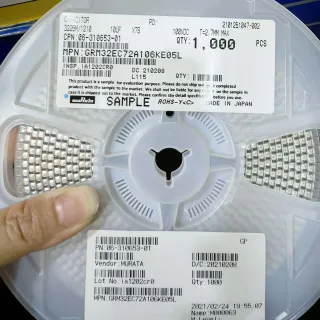
GRM31CR61A476KE15L - 47uF 10V X5R MLCC 1206 | Murata
Référence : GRM31CR61A476KE15L ✓ Actif| Qté | Prix unitaire | Total |
|---|---|---|
| 1 | $0.13 | $0,13 |
| 10 | $0.1 | $1,00 |
| 100 | $0.085 | $8,50 |
| 500 | $0.072 | $36,00 |
| 1 000 | $0.063 | $63,00 |
| 4 000 | $0.0584 | $233,60 |
GRM31CR61A476KE15L Présentation
An MLCC (multilayer ceramic capacitor) is a passive SMD component manufactured by co-firing alternating layers of ceramic dielectric and metal inner electrodes into a monolithic chip, then terminating the two opposing end faces with nickel-barrier solderable metallization. In the passive-component taxonomy it sits at MLCC -> ceramic capacitor -> capacitor -> passive component. MLCCs dominate decoupling, bypassing, filtering, coupling, and bulk energy storage because of their very low equivalent series resistance (ESR), non-polarized construction, no wear-out mechanism, and extreme volumetric efficiency compared with aluminum or tantalum electrolytics.
Key features include 47 µF nominal capacitance in a compact 1206 footprint, 10 V DC rated working voltage, ±10% capacitance tolerance, and X5R dielectric per EIA RS-198 classification. The 1206 case size provides thermal and mechanical robustness for hand-solder rework, screw-fastener mounting, and depanelization processes used in mass production. Operating temperature range spans -55 °C to +85 °C, and the part is halogen-free and RoHS compliant per the latest Murata product declaration.
The part uses a high-capacitance X5R dielectric stack optimized for moderate-voltage rails. X5R delivers superior volumetric efficiency versus X7R but pays for it with reduced temperature stability and stronger DC-bias derating: effective capacitance under 5 V bias can drop significantly versus the 1 Vrms small-signal measurement condition used to specify the 47 µF rating. Engineers must verify in-circuit capacitance under actual operating bias rather than relying on the nominal number alone, especially for bulk decoupling in 3.3 V and 5 V rails.
Typical applications include smartphone PMIC input/output decoupling, 3.3 V and 5 V rail bulk capacitance in tablets, wearables, and USB-C port bypass networks, plus industrial sensor-module power conditioning and IoT endpoint devices operating at 10 V or below. Per the Murata product specification, mechanical board flex beyond 1 mm should be avoided to prevent chip cracking during depanelization or screw-fastener mounting.
When designing with this part, evaluate in-circuit effective capacitance under your actual DC bias, because X5R class-II MLCCs lose a substantial fraction of nominal capacitance at high bias. Pair this part with a smaller X7R or C0G capacitor in parallel for high-frequency decoupling when the bulk capacitor's bias derating leaves insufficient low-frequency energy storage.
This page synthesizes distributor pricing, drop-in equivalents, and practical design notes not found in the manufacturer datasheet alone.
Alternatives de remplacement direct pour GRM31CR61A476KE15L — même boîtier, compatible broche à broche. Les références à boîtier différent nécessitant une retouche du PCB sont exclues.
Outil de comparaison rapide — sélectionnez des références alternatives pour une comparaison côte à côte :
GRM31CR61A476KE15#
✅ Remplacement direct📋 Alternative de référence (hors catalogue)
GRM31CR61A476KE15K
✅ Remplacement direct📋 Alternative de référence (hors catalogue)
GCM31CR61A476KE02L
✅ Remplacement direct📋 Alternative de référence (hors catalogue)
CL31A476KOHNNNE
✅ Remplacement direct📋 Alternative de référence (hors catalogue)
CGA5L2X5R1A476K
✅ Remplacement direct📋 Alternative de référence (hors catalogue)
GRM31CR61A476KE15L Valeurs maximales et caractéristiques électriques
| Capacitance | 47 µF |
| Capacitance Tolerance | ±10% |
| Rated Voltage (DC) | 10 V |
| Dielectric Characteristic | X5R (EIA RS-198 class-II) |
| Case Size (Imperial) | 1206 |
| Case Size (Metric) | 3216 |
| Length | 3.20 mm ±0.20 mm |
| Width | 1.60 mm ±0.20 mm |
| Plage de température de fonctionnement | -55 °C to +85 °C |
| Type de montage | Surface Mount (SMD/SMT) |
| Termination Style | Nickel-barrier solderable (lead-free reflow compatible) |
| Packaging | 7-inch paper tape and reel (EIA-481) |
| Standard Reel Quantity | 4,000 pieces |
| Peak Reflow Temperature | 260 °C (lead-free profile, JEDEC J-STD-020) |
| Sans halogène | Yes (per Murata product declaration) |
| RoHS Compliance | Compliant |
| Series | GRM (Murata general-purpose MLCC) |
Guide de configuration des broches du GRM31CR61A476KE15L 3216
Configuration des broches du GRM31CR61A476KE15L (boîtier 3216). La numérotation des broches, les fonctions et les schémas de connexion sont définis dans la fiche technique du fabricant. Consultez-la pour l'empreinte exacte et les directives de soudage.

Aucune donnée de brochage détaillée disponible pour GRM31CR61A476KE15L.
Consultez la fiche technique pour la configuration complète des broches.
Applications typiques
GRM31CR61A476KE15L convient pour 7 applications: Smartphone PMIC Bulk Decoupling, USB-C VBUS Bypass and Hot-Plug Protection, Tablet Main Rail Bulk Capacitance, Wearable Device Power Conditioning, Industrial IoT Sensor Module Decoupling, Audio Codec Power Supply Filtering, PMIC and Buck Converter Output Filtering.
Smartphone PMIC Bulk Decoupling
The GRM31CR61A476KE15L provides bulk energy storage at the PMIC input and output rails in smartphone designs, where its 47 µF nominal at 10 V rating handles transient current demands during LTE/5G PA ramp events. Per the Murata datasheet, designers should evaluate DC-bias derating at 3.7-4.5 V battery rails — typical in-circuit effective capacitance falls to 60-75% of nominal, yielding 28-35 µF usable. The 1206 footprint offers superior thermal dissipation over smaller 0805 parts during high-ripple PMIC switching, and the lead-free nickel-barrier termination supports 260 °C peak reflow per JEDEC J-STD-020. Pair this part with a smaller 0.1 µF X7R bypass cap for high-frequency decoupling.
Recommandé
USB-C VBUS Bypass and Hot-Plug Protection
The GRM31CR61A476KE15L serves as a primary VBUS bulk capacitor in USB-C receptacle designs, where its 47 µF rating handles the inrush current during cable attach and PD negotiation events. The 10 V working voltage comfortably exceeds the USB-C 5 V default bus voltage with margin for transient overshoot, while the X5R dielectric provides low ESR at the 100 kHz-1 MHz switching frequencies typical of USB-PD controllers. Designers must verify in-circuit capacitance at 5 V bias — DC-bias derating on this X5R stack typically retains 50-70% nominal, giving 24-33 µF effective — and may want to parallel two of these parts for designs requiring 50+ µF effective at 5 V.
Recommandé
Tablet Main Rail Bulk Capacitance
In tablet main-board designs, the GRM31CR61A476KE15L provides bulk decoupling on the 3.3 V and 5 V rails feeding application processors, display drivers, and wireless modules. Its 1206 case size offers high volumetric efficiency while maintaining mechanical robustness during depanelization and screw-fastener mounting of the tablet chassis. Per the Murata reliability documentation, board flex should be limited to under 1 mm to prevent chip cracking. The X5R dielectric tradeoff — superior volumetric efficiency but weaker DC-bias derating versus X7R — is acceptable in tablet applications where the rail voltage is well below the 10 V rating and effective C remains above 30 µF in-circuit.
Recommandé
Wearable Device Power Conditioning
The GRM31CR61A476KE15L is used in wearable fitness bands and smartwatches for power-rail conditioning at the Li-ion battery output (typically 3.7-4.2 V). The 1206 footprint fits within compact wearable PCBs while delivering enough bulk capacitance for sensor readout bursts and BLE radio TX events. Designers should note that the 85 °C upper temperature limit is well-suited for skin-adjacent wearable electronics, and the halogen-free, RoHS-compliant construction meets consumer wearable regulatory requirements. The X5R DC-bias derating is acceptable because battery voltage remains below 5 V, keeping effective capacitance above 30 µF for most operating conditions.
Recommandé
Industrial IoT Sensor Module Decoupling
Industrial IoT sensor modules operating from 5 V or 10 V supply rails use the GRM31CR61A476KE15L for bulk decoupling at the regulator input and output. The 10 V voltage rating matches industrial 12 V bus systems (with adequate derating margin) while the 1206 case withstands industrial temperature cycling from -55 °C to +85 °C. For harsh-environment deployments, the AEC-Q200-qualified GCM31CR61A476KE02L is preferred — it shares the same 1206 footprint but adds automotive-grade reliability. The MLCC's non-polarized construction and lack of wear-out mechanism deliver long service life suitable for field-deployed sensor nodes.
Recommandé
Audio Codec Power Supply Filtering
Audio codec and headphone-amplifier power rails benefit from the GRM31CR61A476KE15L's low ESR at audio frequencies (20 Hz-20 kHz). The 1206 MLCC delivers cleaner power than electrolytic alternatives, with no piezo-electric microphony effect at typical PCB vibration frequencies. The X5R dielectric is acceptable for audio applications because the rail voltage is far below the 10 V rating, so DC-bias derating has minimal impact on effective capacitance. Designers should still verify in-circuit C at the actual rail voltage and pair this bulk cap with a smaller X7R or C0G capacitor for high-frequency noise rejection on the analog supply pin.
Recommandé
PMIC and Buck Converter Output Filtering
The GRM31CR61A476KE15L is placed at switching-converter output nodes where its low ESR reduces output ripple and improves load-transient response. At the typical 500 kHz-2 MHz switching frequencies of modern buck converters, the X5R dielectric retains adequate capacitance to filter the ripple component. Per the Murata datasheet, the 1206 case provides higher ripple-current handling than smaller MLCCs, with self-heating kept under safe limits at moderate converter loads. For multi-phase converters, designers typically place one GRM31CR61A476KE15L per phase output, paralleled with a 0.1 µF X7R for high-frequency noise suppression.
Recommandé
Récapitulatif des produits recommandés
Données de référence d'ingénierie pour GRM31CR61A476KE15L — comparaison, recommandations de conception et informations de conformité.
Guide de sélection
Comparaison avec les alternatives
| Paramètre | Ce produit | GRM31CR61A476KE15# | GCM31CR61A476KE02L | CL31A476KOHNNNE | CGA5L2X5R1A476K |
|---|---|---|---|---|---|
| Brand | Murata Manufacturing | Murata Manufacturing | Murata Manufacturing | Samsung Electro-Mechanics | TDK |
| Package | 1206 (3216 Metric) | 1206 (3216 Metric) - same | 1206 (3216 Metric) - same | 1206 (3216 Metric) - same | 1206 (3216 Metric) - same |
| Capacitance | 47 µF | 47 µF | 47 µF | 47 µF | 47 µF |
| Rated Voltage | 10 V DC | 10 V DC | 10 V DC | 10 V DC | 10 V DC |
| Capacitance Tolerance | ±10% | ±10% | ±10% | ±10% | ±10% |
| Dielectric | X5R | X5R | X5R | X5R | X5R |
| Automotive Grade | No (GRM = commercial) | No (same GRM series) | Yes (AEC-Q200) | No | Yes (CGA = TDK automotive series) |
| Operating Temperature | -55 °C to +85 °C | -55 °C to +85 °C | -55 °C to +125 °C (AEC-Q200) | -55 °C to +85 °C | -55 °C to +125 °C (automotive) |
| Packaging | 4,000-piece paper tape & reel | Tape & reel (specification code varies) | Tape & reel | Tape & reel | Tape & reel |
Principaux différenciateurs
- Widest distributor availability in 47 µF 1206 X5R 10V class (vs CL31A476KOHNNNE (Samsung) and CGA5L2X5R1A476K (TDK))
- Commercial-grade pricing versus automotive-grade upcharge (vs GCM31CR61A476KE02L)
- Drop-in second-source compatibility with Samsung and TDK equivalents (vs CL31A476KOHNNNE and CGA5L2X5R1A476K)
Notes de conception
X5R MLCCs exhibit significant DC-bias derating. The GRM31CR61A476KE15L's 47 µF nominal is measured at 1 Vrms with no DC bias; under a 5 V bias effective capacitance typically drops to 50-70% nominal. Always consult the Murata GRM series DC-bias characteristic curves and verify in-circuit effective capacitance at your actual operating rail voltage before relying on the nominal value for bulk-decoupling or hold-up time calculations.
Mechanical board flex beyond 1 mm during depanelization or screw-fastener mounting can crack the 1206 ceramic body. Per Murata's reliability guidelines, provide adequate mechanical support near the part and use a depanelization method that minimizes flex (V-cut or routing). Avoid placing the GRM31CR61A476KE15L directly adjacent to board-edge mounting screws or connectors that apply mechanical stress to the PCB.
Estimated: at full 10 V DC across a 47 µF X5R part with negligible load, leakage current dissipation is sub-milliwatt and self-heating is not a concern. However, when the part carries high-frequency ripple current (e.g., at a buck-converter output), estimate I_ripple^2 × ESR. For typical MLCC ESR of 5-10 mΩ at 1 MHz and ripple currents of 200-500 mA, dissipation is 0.2-2.5 mW — well within thermal limits. Place capacitors as close as possible to the IC supply pins to minimize parasitic inductance.
For high-frequency decoupling above 1 MHz, pair the GRM31CR61A476KE15L with a smaller 0.1 µF X7R or C0G capacitor placed within 2 mm of the IC supply pin. The X5R bulk cap loses effective capacitance at high frequency due to dielectric relaxation, while the smaller X7R/C0G cap maintains stable C across the 1 kHz-100 MHz range. This two-cap approach is the standard bulk + bypass topology for switching-converter and high-speed digital designs.
Informations de conformité
Per Murata product declaration: RoHS compliant, halogen-free, lead-free reflow compatible to 260 °C per JEDEC J-STD-020. Not AEC-Q100 qualified — for AEC-Q200 automotive-grade equivalent use GCM31CR61A476KE02L in the same 1206 footprint.