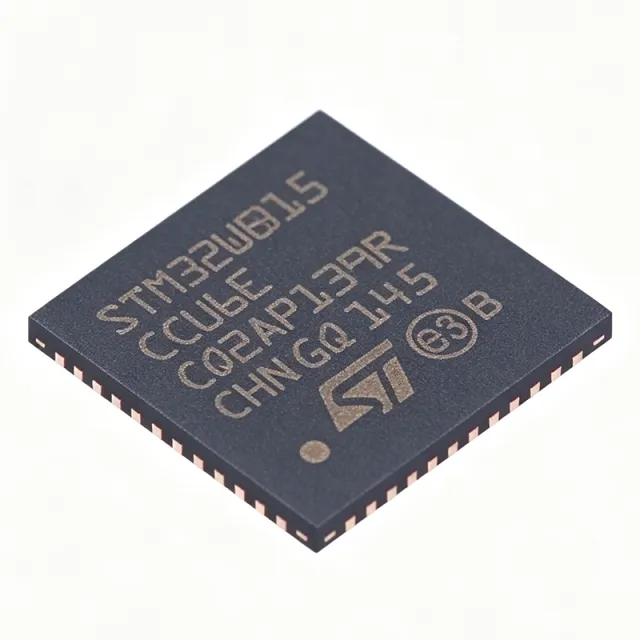
STM32WB15CCU6 - 2.4GHz BLE 5.2 Wireless MCU, 320KB Flash | STMicroelectronics
Référence : STM32WB15CCU6 ✓ Actif| Qté | Prix unitaire | Total |
|---|---|---|
| 1 | $7.0909 | $7,09 |
| 10 | $5.1212 | $51,21 |
| 100 | $4.5303 | $453,03 |
| 500 | $4.3333 | $2 166,65 |
| 1 000 | $4.1364 | $4 136,40 |
STM32WB15CCU6 Présentation
A wireless microcontroller (MCU) is a system-on-chip that integrates a general-purpose microcontroller core with a radio transceiver, enabling wireless communication protocols such as Bluetooth Low Energy, Zigbee, or proprietary sub-GHz protocols. In the system hierarchy, a wireless MCU sits above a standalone MCU and below a full application processor, providing a balance of processing capability, low power consumption, and wireless connectivity. The STM32WB15CCU6 specifically targets Bluetooth Low Energy 5.2, offering a complete solution for connected devices without requiring an external radio chip.
Key features of the STM32WB15CCU6 include a 2.4 GHz radio supporting Bluetooth Low Energy 5.2 with a transmit power of up to +6 dBm and a receiver sensitivity of -96 dBm, ensuring robust wireless links. The dual-core architecture allows the Cortex-M0+ to handle the radio stack independently, freeing the Cortex-M4 for application tasks, which improves real-time performance and reduces power consumption. The device also includes a rich set of peripherals, including multiple UART, SPI, I2C interfaces, a 12-bit ADC, and a random number generator, providing flexibility for various sensor and control applications.
From a technical depth perspective, the STM32WB15CCU6 leverages ST's advanced 40nm process technology, enabling low power consumption with multiple low-power modes, including a standby mode with a current consumption of only 1.6 µA. The radio architecture includes a dedicated hardware encryption engine supporting AES-128, AES-256, and other algorithms, ensuring secure wireless communication. The device also features a true random number generator (TRNG) and a unique 96-bit ID, enhancing security for IoT applications.
Typical applications include smart home devices such as smart locks, sensors, and lighting controls, as well as healthcare wearables, industrial wireless sensor networks, and asset tracking systems. The STM32WB15CCU6's low power consumption and robust wireless performance make it ideal for battery-powered devices that require long operational lifetimes.
When designing with this device, ensure proper antenna matching and PCB layout for the 2.4 GHz radio to achieve optimal range and reliability. The device requires a 32.768 kHz crystal for the low-power RTC and a 32 MHz crystal for the radio, and careful attention to power supply decoupling is essential to minimize noise and ensure stable operation.
Alternatives de remplacement direct pour STM32WB15CCU6 — même boîtier, compatible broche à broche. Les références à boîtier différent nécessitant une retouche du PCB sont exclues.
Outil de comparaison rapide — sélectionnez des références alternatives pour une comparaison côte à côte :
STM32WB15CCU7
📋 Alternative de référence (hors catalogue)
STM32WB55CCU6
📋 Alternative de référence (hors catalogue)
STM32WB55CCU7
📋 Alternative de référence (hors catalogue)
nRF52832
📋 Alternative de référence (hors catalogue)
nRF52840
📋 Alternative de référence (hors catalogue)
STM32WB15CCU6 Valeurs maximales et caractéristiques électriques
| Core | Arm Cortex-M4 + Cortex-M0+ |
| Max Core Frequency | 64 MHz (M4) / 32 MHz (M0+) |
| Flash Memory | 320 KB |
| SRAM | 48 KB |
| Bluetooth Version | Bluetooth Low Energy 5.2 |
| Radio Frequency | 2.4 GHz |
| Max Transmit Power | +6 dBm |
| Receiver Sensitivity | -96 dBm |
| Supply Voltage Range | 1.71 V to 3.6 V |
| Plage de température de fonctionnement | -40°C to +105°C |
| Boîtier | UFQFPN-48 (7x7 mm) |
| Type de montage | Surface Mount |
| Standby Current | 1.6 µA |
| ADC Resolution | 12-bit |
| Security | AES-128, AES-256, TRNG, 96-bit unique ID |
| Statut RoHS | Compliant |
Configuration des broches de STM32WB15CCU6
| Broche 1 | VDD — Power supply (1.71V-3.6V) |
| Broche 2 | PA0 — GPIO / ADC input |
| Broche 3 | PA1 — GPIO / ADC input |
| Broche 4 | PA2 — GPIO / USART2_TX |
| Broche 5 | PA3 — GPIO / USART2_RX |
| Broche 6 | PA4 — GPIO / SPI1_NSS |
| Broche 7 | PA5 — GPIO / SPI1_SCK |
| Broche 8 | PA6 — GPIO / SPI1_MISO |
| Broche 9 | PA7 — GPIO / SPI1_MOSI |
| Broche 10 | PA8 — GPIO / I2C1_SCL |
| Broche 11 | PA9 — GPIO / I2C1_SDA |
| Broche 12 | PA10 — GPIO / USART1_TX |
| Broche 13 | PA11 — GPIO / USART1_RX |
| Broche 14 | PA12 — GPIO / USB_DM |
| Broche 15 | PA13 — GPIO / SWDIO |
| Broche 16 | PA14 — GPIO / SWCLK |
| Broche 17 | PA15 — GPIO / JTDI |
| Broche 18 | PB0 — GPIO / ADC input |
| Broche 19 | PB1 — GPIO / ADC input |
| Broche 20 | PB2 — GPIO / BOOT1 |
| Broche 21 | PB3 — GPIO / JTDO |
| Broche 22 | PB4 — GPIO / JNTRST |
| Broche 23 | PB5 — GPIO / I2C1_SMBA |
| Broche 24 | PB6 — GPIO / I2C1_SCL |
| Broche 25 | PB7 — GPIO / I2C1_SDA |
| Broche 26 | PB8 — GPIO / I2C1_SCL |
| Broche 27 | PB9 — GPIO / I2C1_SDA |
| Broche 28 | PB10 — GPIO / I2C2_SCL |
| Broche 29 | PB11 — GPIO / I2C2_SDA |
| Broche 30 | PB12 — GPIO / SPI2_NSS |
| Broche 31 | PB13 — GPIO / SPI2_SCK |
| Broche 32 | PB14 — GPIO / SPI2_MISO |
| Broche 33 | PB15 — GPIO / SPI2_MOSI |
| Broche 34 | VDD — Power supply |
| Broche 35 | VSS — Ground |
| Broche 36 | PC14 — GPIO / OSC32_IN |
| Broche 37 | PC15 — GPIO / OSC32_OUT |
| Broche 38 | PH0 — OSC_IN (32 MHz crystal) |
| Broche 39 | PH1 — OSC_OUT (32 MHz crystal) |
| Broche 40 | NRST — Reset (active low) |
| Broche 41 | VDDA — Analog power supply |
| Broche 42 | VSSA — Analog ground |
| Broche 43 | VREF+ — ADC reference voltage |
| Broche 44 | VREF- — ADC reference ground |
| Broche 45 | PC0 — GPIO / ADC input |
| Broche 46 | PC1 — GPIO / ADC input |
| Broche 47 | PC2 — GPIO / ADC input |
| Broche 48 | PC3 — GPIO / ADC input |
Applications typiques
STM32WB15CCU6 convient pour 6 applications: Smart Home Devices, Healthcare Wearables, Industrial Wireless Sensor Networks, Asset Tracking, Beacons and Proximity Marketing, Connected Lighting.
Smart Home Devices
The STM32WB15CCU6 is ideal for smart home devices such as smart locks, sensors, and lighting controls. Its low power consumption (1.6 µA standby) and robust BLE 5.2 radio enable battery-powered operation for years. The dual-core architecture allows the Cortex-M0+ to handle the BLE stack while the Cortex-M4 runs application logic, ensuring responsive control. With a transmit power of +6 dBm and receiver sensitivity of -96 dBm, it provides reliable connectivity throughout a typical home. The 320 KB flash supports complex firmware including Over-The-Air (OTA) updates, while the 48 KB SRAM handles real-time data processing. The wide supply voltage range (1.71V-3.6V) allows direct battery connection, simplifying power design. Security features like AES-128/256 encryption and a true random number generator protect smart home communications.
Recommandé
Healthcare Wearables
The STM32WB15CCU6 is well-suited for healthcare wearables like fitness trackers and heart rate monitors. Its ultra-low power consumption (1.6 µA standby) extends battery life, critical for continuous health monitoring. The BLE 5.2 radio efficiently transmits health data to smartphones, with +6 dBm TX power ensuring reliable data transfer. The dual-core architecture enables simultaneous sensor data processing and wireless communication without performance degradation. The 12-bit ADC accurately reads analog sensor outputs, while the 320 KB flash stores firmware and health logs. The -40°C to +105°C operating range ensures reliable operation in various environmental conditions. Security features like AES encryption protect sensitive health data during transmission. The compact UFQFPN-48 package (7x7 mm) fits into small wearable form factors.
Recommandé
Industrial Wireless Sensor Networks
The STM32WB15CCU6 excels in industrial wireless sensor networks, monitoring temperature, vibration, and pressure in factories. Its wide operating temperature range (-40°C to +105°C) suits harsh industrial environments. The robust BLE 5.2 radio with -96 dBm sensitivity ensures reliable data transmission in noisy RF environments. The dual-core architecture allows real-time sensor data processing on the Cortex-M4 while the Cortex-M0+ manages the wireless stack, ensuring deterministic performance. The 12-bit ADC interfaces with various industrial sensors, and the multiple UART/SPI/I2C interfaces connect to external sensors and actuators. The 1.6 µA standby current enables long battery life for remote sensors. Security features like AES-256 encryption protect industrial data from unauthorized access. The 320 KB flash supports complex industrial protocols and data logging.
Recommandé
Asset Tracking
The STM32WB15CCU6 is perfect for asset tracking applications, providing real-time location and status monitoring. Its low power consumption (1.6 µA standby) allows battery-powered trackers to operate for months or years. The BLE 5.2 radio with +6 dBm TX power enables communication with gateways or smartphones over significant distances. The dual-core architecture efficiently handles location algorithms on the Cortex-M4 while the Cortex-M0+ manages BLE advertising and connections. The 320 KB flash stores tracking data and firmware, while the 48 KB SRAM buffers real-time location updates. The wide supply voltage range (1.71V-3.6V) supports various battery chemistries. Security features like AES encryption protect location data from unauthorized access. The compact UFQFPN-48 package enables small, unobtrusive tracker designs.
Recommandé
Beacons and Proximity Marketing
The STM32WB15CCU6 is an excellent choice for BLE beacons used in proximity marketing and indoor navigation. Its BLE 5.2 radio supports advertising extensions, enabling longer-range beacon broadcasts. The +6 dBm TX power provides configurable range from a few meters to over 100 meters, allowing precise proximity detection. The ultra-low power consumption (1.6 µA standby) ensures beacon batteries last for years. The dual-core architecture allows the Cortex-M0+ to handle advertising while the Cortex-M4 manages sensor data or configuration. The 320 KB flash stores beacon configuration and firmware updates. The wide supply voltage range supports coin cell batteries (1.71V-3.6V). Security features prevent unauthorized beacon configuration changes. The compact UFQFPN-48 package fits into small beacon housings.
Recommandé
Connected Lighting
The STM32WB15CCU6 is ideal for connected lighting systems, enabling smart control of LED lights via BLE. Its BLE 5.2 radio supports mesh networking, allowing lights to relay commands and create large-scale lighting networks. The +6 dBm TX power ensures reliable communication between lights and controllers. The dual-core architecture handles lighting control algorithms on the Cortex-M4 while the Cortex-M0+ manages the wireless stack. The 12-bit ADC can monitor current and voltage for diagnostics. The 320 KB flash supports complex lighting scenes and firmware updates. The wide supply voltage range (1.71V-3.6V) allows direct connection to lighting power supplies. Security features like AES encryption prevent unauthorized control. The -40°C to +105°C operating range suits various lighting environments.
Recommandé
Récapitulatif des produits recommandés
Données de référence d'ingénierie pour STM32WB15CCU6 — comparaison, recommandations de conception et informations de conformité.
Guide de sélection
Comparaison avec les alternatives
| Paramètre | Ce produit | STM32WB15CCU7 | STM32WB55CCU6 | nRF52832 |
|---|---|---|---|---|
| Package | UFQFPN-48 (7x7 mm) | UFQFPN-48 (7x7 mm) - same | UFQFPN-48 (7x7 mm) - same | QFN-48 (6x6 mm) - different |
| Brand | STMicroelectronics | STMicroelectronics | STMicroelectronics | Nordic Semiconductor |
| Flash Memory | 320 KB | 512 KB | 1 MB | 512 KB |
| SRAM | 48 KB | 64 KB | 256 KB | 64 KB |
| Max Core Frequency | 64 MHz (M4) / 32 MHz (M0+) | 64 MHz (M4) / 32 MHz (M0+) | 64 MHz (M4) / 32 MHz (M0+) | 64 MHz (M4) |
| Bluetooth Version | BLE 5.2 | BLE 5.2 | BLE 5.2 | BLE 5.2 |
| Max Transmit Power | +6 dBm | +6 dBm | +6 dBm | +4 dBm |
| Receiver Sensitivity | -96 dBm | -96 dBm | -96 dBm | -96 dBm |
| Standby Current | 1.6 µA | 1.6 µA | 1.6 µA | 1.9 µA |
| Supply Voltage Range | 1.71V - 3.6V | 1.71V - 3.6V | 1.71V - 3.6V | 1.7V - 3.6V |
Principaux différenciateurs
- Dual-core architecture with dedicated radio processor (vs nRF52832)
- Higher transmit power (vs nRF52832)
- Lower standby current (vs nRF52832)
Notes de conception
For optimal RF performance, place the 2.4 GHz antenna on the edge of the PCB with a 50-ohm impedance-controlled trace. Keep the antenna away from ground planes and other components. Use a ground plane on the layer below the antenna for proper radiation. Follow ST's application note AN5129 for detailed antenna design guidelines.
Decouple the VDD pins with a 100 nF ceramic capacitor placed as close as possible to each pin, and a 4.7 µF bulk capacitor for the main supply. For the VDDA pin, use a 1 µF capacitor and a ferrite bead to isolate analog noise. Ensure the supply voltage stays within 1.71V-3.6V, including during BLE transmission current spikes.
Place the 32 MHz crystal and its load capacitors close to the PH0/PH1 pins, with short traces to minimize parasitic capacitance. Similarly, place the 32.768 kHz crystal near PC14/PC15. Keep these traces away from high-speed digital signals to avoid interference. Use ground vias around the crystal area to shield it.
Informations de conformité
RoHS compliant per STMicroelectronics product page. Not AEC-Q100 qualified - this is a consumer/industrial grade device.







