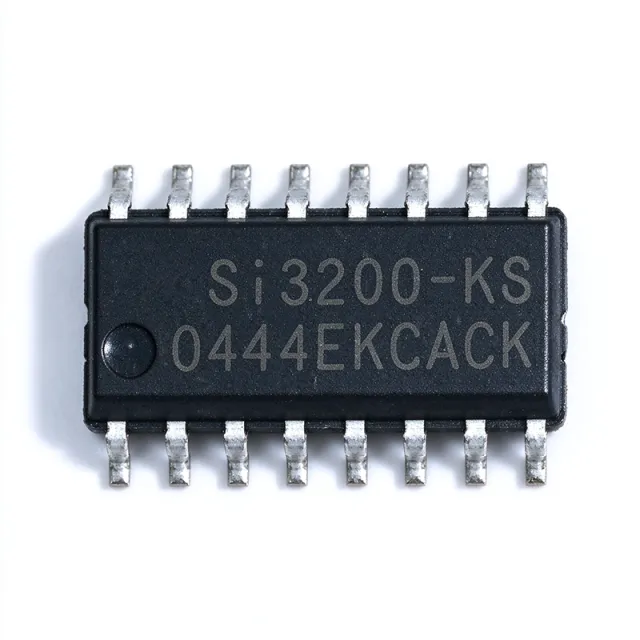
SI3056-KS
SI3056-KS - Global Serial Interface DAA | Silicon Labs
The Silicon Labs SI3056-KS is an integrated global serial interface direct access arrangement (DAA) with a programmable telephone line interface, integrated codec, and support for global telephone-line requirements in a 16-pin small-outline package. The device is designed to replace a conventional analog front end, isolation transformer, relays, optoisolators, and a two-wire to four-wire hybrid, reducing board area and external component count. Published descriptions identify 80 dB dynamic range in the transmit and receive paths, programmable AC and DC termination, a programmable ringer impedance, and a ring-detect threshold. According to the manufacturer datasheet, the SI3056 also supports Type I and Type II caller ID signaling.
A direct access arrangement is a telephone-interface IC that places the analog line-coupling, codec, isolation, and control functions into one programmable device. In the broader hierarchy, a DAA belongs to the interface-IC family and is used with a host processor or serial communications controller. Instead of using discrete telephone-interface components, a system can configure line termination, transmit and receive gains, ring detection, and codec behavior through registers. This integration is particularly useful in voice-over-data equipment, VoIP terminals, embedded telephony systems, and caller-ID products.
The SI3056’s principal engineering benefit is reduced implementation complexity. The integrated codec and four-wire-hybrid support, patented isolation technology, and programmable line interface can remove several external circuit blocks. The 80 dB TX/RX dynamic range supports voice-band operation while giving the designer a defined signal-chain range. Programmable AC termination and DC termination accommodate different line conditions, while programmable ring detection and ringer impedance make the same device adaptable across multiple telephone-network requirements.
The SI3056 family uses a serial host interface for configuration and control. Firmware must correctly initialize line impedance, gain, termination, ring-detection thresholds, and codec settings before enabling the line path. Host-side software should also handle Type I and Type II caller ID if that feature is required. Because the device is intended to bridge a digital system to an analog telephone line, PCB isolation, grounding, creepage, surge exposure, and regulatory testing remain important system-level considerations even though the component integrates isolation circuitry.
Typical uses include Voice over IP endpoint hardware, analog telephone adapters, fax and multifunction-printer line interfaces, caller-ID equipment, and embedded voice gateways. The SI3056 is also suitable when an existing product needs a programmable replacement for several discrete line-interface blocks. Integration can shorten assembly time and reduce component count, but engineers must still validate line-side protection, ringing behavior, codec quality, and regional network requirements in the complete product.
The principal design consideration is to treat the SI3056-KS as a controlled line-side subsystem rather than a generic codec. Follow the manufacturer datasheet for pin connections, isolation boundaries, termination settings, ring-detection configuration, and external protection components. Avoid adding unverified network-interface protection between the device and the telephone line because it can alter impedance and signaling behavior. Validate the assembled design across line lengths, off-hook states, ring voltage conditions, and caller-ID modes.
RFQ
צור קשר