מוצרים (44,000+)

STM32F446ZEH6TR - 180MHz Cortex-M4 MCU | STMicroelectronics (Tape & Reel)
STM32F446ZEH6TR

STM32F446ZEH6TR - 180MHz Cortex-M4 MCU | STMicroelectronics (Tape & Reel)

The STMicroelectronics STM32F446ZEH6TR is a high-performance 32-bit ARM Cortex-M4 microcontroller with FPU and DSP instructions, operating up to 180 MHz, with 512 KB flash memory, in a 144-UFBGA 7 x 7 mm package. What is a Cortex-M4 microcontroller? A microcontroller combines a processor core, embedded flash, SRAM, memory-mapped peripherals, and communication interfaces into one integrated circuit. The STM32F4 family uses an ARM Cortex-M4 core with an integrated floating-point unit and DSP instruction support, positioning it between basic control MCUs and higher-performance embedded processors. The STM32F446 adds high-speed connectivity and multimedia-oriented peripherals for demanding embedded systems. Key verified features include 180 MHz operation, 512 KB flash, 225 DMIPS, DSP instructions, an ART Accelerator, SDRAM support, audio interfaces, and dual Quad-SPI capability according to the STMicroelectronics product-page snippets. The STM32F446ZEH6TR is specified in a 144-UFBGA package measuring 7 x 7 mm. The exact RAM size, GPIO count, supply range, and detailed peripheral configuration were not supplied in the verified data and must be confirmed from the manufacturer datasheet before design release. The Cortex-M4 architecture supports deterministic embedded control while the FPU accelerates floating-point workloads and DSP instructions support signal-processing routines. The ART Accelerator is intended to improve execution from flash memory, while the 180 MHz operating point provides substantial processing headroom for protocol handling, control loops, and connected peripherals. Typical uses include industrial automation, audio and signal-processing equipment, communications infrastructure, medical instruments, and connected embedded controllers. Its 512 KB flash capacity supports larger firmware, bootloaders, protocol stacks, and application logic. The 144-UFBGA footprint is appropriate for compact, high-pin-count designs but requires careful PCB layout and assembly planning. For a new layout, verify every ball assignment, exposed-pad connection, decoupling requirement, and supported supply configuration against the official STM32F446 datasheet. Do not treat distributor cross-reference listings as proof of drop-in compatibility, especially for different packages or pin counts. This page consolidates the verified manufacturer and distributor data, separates confirmed specifications from missing datasheet details, and provides engineering-focused selection and design guidance beyond a basic distributor listing.

RFQ צור קשר
STM32F446ZEH7 - 180MHz Cortex-M4 512KB MCU | STMicroelectronics
STM32F446ZEH7

STM32F446ZEH7 - 180MHz Cortex-M4 512KB MCU | STMicroelectronics

The STMicroelectronics STM32F446ZEH7 is a 32-bit Arm Cortex-M4 microcontroller with DSP and FPU support, operating up to 180 MHz and containing 512 KB of Flash memory. It is supplied in a 144-ball UFBGA package measuring 10 x 10 mm. The device combines 128 KB of SRAM, 4 KB of backup SRAM, and a broad set of peripherals including three ADCs, 17 timers, communication interfaces, USB, and audio support. A microcontroller is a programmable embedded controller that integrates a processor core, memory, and peripherals on one semiconductor device. The STM32F446 belongs to the STM32F4 high-performance family, combining Arm Cortex-M4 real-time processing with floating-point and digital signal processing acceleration. Its position in the hierarchy is Arm Cortex-M4 processor -> 32-bit RISC microcontroller -> embedded processor -> semiconductor. The Cortex-M4 core operates at up to 180 MHz and delivers 225 DMIPS, making the MCU suitable for demanding control loops and signal-processing workloads. The integrated DSP instructions and FPU accelerate transforms, filters, and other floating-point operations. Dual Quad-SPI and SDRAM support extend external data throughput, while USB OTG HS/FS and multiple communication peripherals reduce the need for discrete interface devices. Three ADCs support analog measurement, and the large timer set supports timing, motor-control, and waveform-generation tasks. The STM32F446 device family includes audio interfaces and USB connectivity, enabling designs that collect analog data, process it locally, store results externally, and communicate through USB or industrial networks. The 512 KB Flash capacity supports substantially more firmware than small entry-level MCUs while retaining deterministic embedded execution. Typical uses include industrial controllers, audio processors, communications equipment, motor-control systems, data acquisition units, and USB-connected embedded products. Designers should verify package-ball assignments, power sequencing, clock configuration, and peripheral pin multiplexing against the official documentation before PCB release. For high-speed layouts, maintain short, controlled-return clock and differential-signal paths, provide clean power and ground planes, and decouple supply pins according to the manufacturer guidance. Firmware changes also require STM32CubeMX or equivalent configuration support and validation on the intended board. This page consolidates official product facts, distributor pricing references, documented same-family alternatives, and engineering selection guidance. It separates verified attributes from missing data so procurement and design teams can identify what requires confirmation before release.

RFQ צור קשר
STM32F446ZEH7TR - 180MHz Cortex-M4 512KB MCU | STMicroelectronics (Tape & Reel)
STM32F446ZEH7TR

STM32F446ZEH7TR - 180MHz Cortex-M4 512KB MCU | STMicroelectronics (Tape & Reel)

The STMicroelectronics STM32F446ZEH7TR is a 32-bit Arm Cortex-M4 microcontroller with DSP and FPU support, operating up to 180 MHz and containing 512 KB of Flash memory. It is supplied in a 144-ball UFBGA package measuring 10 x 10 mm. The device combines 128 KB of SRAM, 4 KB of backup SRAM, and a broad set of peripherals including three ADCs, 17 timers, communication interfaces, USB, and audio support. A microcontroller is a programmable embedded controller that integrates a processor core, memory, and peripherals on one semiconductor device. The STM32F446 belongs to the STM32F4 high-performance family, combining Arm Cortex-M4 real-time processing with floating-point and digital signal processing acceleration. Its position in the hierarchy is Arm Cortex-M4 processor -> 32-bit RISC microcontroller -> embedded processor -> semiconductor. The Cortex-M4 core operates at up to 180 MHz and delivers 225 DMIPS, making the MCU suitable for demanding control loops and signal-processing workloads. The integrated DSP instructions and FPU accelerate transforms, filters, and other floating-point operations. Dual Quad-SPI and SDRAM support extend external data throughput, while USB OTG HS/FS and multiple communication peripherals reduce the need for discrete interface devices. Three ADCs support analog measurement, and the large timer set supports timing, motor-control, and waveform-generation tasks. The STM32F446 device family includes audio interfaces and USB connectivity, enabling designs that collect analog data, process it locally, store results externally, and communicate through USB or industrial networks. The 512 KB Flash capacity supports substantially more firmware than small entry-level MCUs while retaining deterministic embedded execution. Typical uses include industrial controllers, audio processors, communications equipment, motor-control systems, data acquisition units, and USB-connected embedded products. Designers should verify package-ball assignments, power sequencing, clock configuration, and peripheral pin multiplexing against the official documentation before PCB release. For high-speed layouts, maintain short, controlled-return clock and differential-signal paths, provide clean power and ground planes, and decouple supply pins according to the manufacturer guidance. Firmware changes also require STM32CubeMX or equivalent configuration support and validation on the intended board. This page consolidates official product facts, distributor pricing references, documented same-family alternatives, and engineering selection guidance. It separates verified attributes from missing data so procurement and design teams can identify what requires confirmation before release.

RFQ צור קשר
STM32F446ZEJ6 - 180MHz Cortex-M4 512KB MCU | STMicroelectronics
STM32F446ZEJ6

STM32F446ZEJ6 - 180MHz Cortex-M4 512KB MCU | STMicroelectronics

STMicroelectronics STM32F446ZEJ6 is a 32-bit ARM Cortex-M4 microcontroller operating up to 180 MHz, with 512 KB of flash memory and a 144-UFBGA (10 x 10 mm) package. It includes a Cortex-M4 processor with DSP and FPU capabilities, providing 225 DMIPS according to the STMicroelectronics product-family information. The device is designed for connected embedded systems requiring substantial processing performance, memory, and communication peripherals. A microcontroller is a programmable semiconductor that integrates a CPU core, memory, and peripherals into one compact component. STM32 devices belong to the embedded microcontroller hierarchy and provide real-time control alongside communications, analog conversion, timing, and connectivity functions. The Cortex-M4 architecture combines deterministic instruction execution with digital signal processing and floating-point support, making the STM32F446 suitable for control-intensive and signal-processing workloads. The verified source data identifies 512 KB of flash, 128 KB plus 4 KB of RAM in the STM32F446 family, dual Quad-SPI interfaces, SDRAM support, audio interfaces, and a broad peripheral set. The STM32F446 line also supports USB OTG high-speed and full-speed operation according to the family datasheet search result. The 144-UFBGA package provides a compact land pattern for space-constrained equipment. Typical applications include industrial automation, communications equipment, audio processing, data acquisition, motor control, and connected consumer products. Its 180 MHz Cortex-M4 core can manage protocol stacks, real-time control, user interfaces, and signal processing without requiring a separate high-performance processor. The integrated DSP and FPU features are useful for filtering, control loops, audio handling, and other mathematically intensive tasks. Designers should verify the exact pin multiplexing, power requirements, clock configuration, and memory map in the STM32F446 datasheet before layout release. A 10 x 10 mm UFBGA requires careful escape routing and thermal-aware PCB design. This page consolidates the verified manufacturer and distributor information while clearly separating specifications that still require confirmation from an engineering reference design. This data page is intended to support MCU selection, distributor comparison, and initial hardware planning. It should not replace the complete STMicroelectronics datasheet, reference manual, errata documents, or board-level validation.

RFQ צור קשר
STM32F446ZEJ6TR - 180MHz Cortex-M4 MCU 512KB Flash UFBGA-144 | STMicroelectronics
STM32F446ZEJ6TR

STM32F446ZEJ6TR - 180MHz Cortex-M4 MCU 512KB Flash UFBGA-144 | STMicroelectronics

The STMicroelectronics STM32F446ZEJ6TR is a high-performance 32-bit ARM Cortex-M4 microcontroller with FPU and DSP extensions, operating at up to 180 MHz and delivering 225 DMIPS / 608 CoreMark, packaged in a 144-ball UFBGA (10x10 mm) and shipped on 1000-piece Tape & Reel. It integrates 512 KB of Flash and 128 KB of SRAM, dual-bank memory with on-the-fly write/erase, and a 1.7 V to 3.6 V VDD supply range. A microcontroller (MCU) is a single-chip computer that integrates a CPU core, program memory, data memory, and programmable peripherals. The STM32 family is built on the ARM Cortex-M architecture; the Cortex-M4 specifically adds single-precision floating-point unit (FPU) and DSP instructions, making it suitable for signal-processing tasks. The STM32F4 line sits at the high-performance tier of the STM32 portfolio, above Cortex-M0/M0+ entry parts and below Cortex-M7 lines, and is widely used as a system controller in industrial, audio, motor, and consumer designs. Key features of the STM32F446ZEJ6TR include: a Chrom-ART Accelerator for fast 2D graphics, two dedicated audio PLLs (I2S / SAI), a 12-bit ADC (2.4 MSPS), two 12-bit DACs, three I2C, four USART/UART, three SPI, two CAN 2.0B, USB 2.0 Full-Speed and USB 2.0 High-Speed with on-chip PHY, SDMMC, Quad-SPI, FMC for external SDRAM/NOR/NAND, and an integrated RTC with calendar. The UFBGA-144 package exposes 114 GPIO, three 16-bit timers plus one 32-bit timer, and 12-channel DMA. Architecturally, the part uses a multi-AHB bus matrix with separate bridges for SRAM and Flash, giving it the throughput to drive external SDRAM and TFT displays without wait states. The on-chip PHY for USB HS removes the need for an external ULPI transceiver, shrinking BOM cost. Typical applications: digital audio systems, USB audio interfaces, motor control (FOC / six-step), industrial PLCs, point-of-sale terminals, and high-speed USB peripherals. For designs requiring flexible audio and USB with deterministic real-time performance, the STM32F446ZEJ6TR provides a strong balance of peripherals, memory, and MHz. When laying out the UFBGA-144, use 0.8 mm-pitch escape routing and at least 4-layer stack-up with a continuous ground plane. Decouple each VDD pin with 100 nF + 4.7 uF ceramic capacitors placed within 1-2 mm of the ball, and reserve an optional ferrite bead on VDDA. This page synthesizes distributor pricing, drop-in alternatives, and practical design notes not found in the manufacturer datasheet.

RFQ צור קשר
STM32F446ZEJ7 - 180MHz 512KB Cortex-M4 MCU | STMicroelectronics
STM32F446ZEJ7

STM32F446ZEJ7 - 180MHz 512KB Cortex-M4 MCU | STMicroelectronics

The STMicroelectronics STM32F446ZEJ7 is an Arm Cortex-M4 32-bit microcontroller operating at up to 180 MHz, with 512 KB of Flash memory and a 144-UFBGA package measuring 10 x 10 mm. The device is positioned for high-performance embedded applications requiring DSP and floating-point-unit capability, extensive connectivity, and substantial on-chip integration. A microcontroller is a programmable system-on-chip that combines a processor core, memory, peripherals, and communication interfaces. The STM32F4 series belongs to the embedded-microcontroller hierarchy, where the Cortex-M4 core executes real-time control and signal-processing software while dedicated peripherals handle data acquisition, communications, timing, and external interfaces. This product is therefore suitable for systems that need more processing capability than a basic control MCU without moving every function to an external processor. The verified manufacturer data identifies the STM32F446 family as supporting 180 MHz operation, 225 DMIPS, 512 KB Flash, DSP, an FPU, dual Quad-SPI, SDRAM, and audio interfaces. These features make the STM32F446ZEJ7 appropriate for connected industrial equipment, audio systems, instrumentation, data acquisition, and embedded control platforms. The exact RAM, peripheral complement, voltage range, and temperature limits are not provided in the supplied verified data and therefore require manufacturer-datasheet confirmation before design release. The Cortex-M4 architecture is important because it combines a conventional processor core with instruction-level support useful for digital signal processing. The floating-point unit can accelerate arithmetic-heavy control and audio workloads, while the high clock rate supports responsive multitasking and peripheral data movement. The dual Quad-SPI and SDRAM interfaces expand options for high-speed external memory, display subsystems, storage, and other bandwidth-oriented peripherals, subject to the device's verified electrical and pin-level requirements. Typical applications include industrial monitoring, medical instrumentation, audio processing, communications infrastructure, robotics, and compact embedded gateways. In each case, the MCU can consolidate control logic and peripheral management into one device, reducing system complexity compared with a discrete processor plus multiple supporting ICs. The principal design tradeoff is that the compact UFBGA package requires careful PCB layout, fine-pitch assembly, thermal planning, and validated firmware support. For a new design, begin with the STMicroelectronics STM32F446 product page and verify the exact electrical characteristics, pin multiplexing, memory map, package dimensions, and programming requirements in the official datasheet. Use the device within the confirmed supply voltage and temperature limits, preserve decoupling and power-sequence requirements, and validate all high-speed interfaces in the target PCB stack-up. This page combines verified manufacturer capabilities, distributor availability context, package information, and practical design guidance. It is intended to accelerate component selection while preserving the distinction between confirmed technical facts and parameters that still require datasheet verification.

RFQ צור קשר
STM32F446ZEJ7TR - 180MHz 512KB Cortex-M4 MCU | STMicroelectronics (Tape & Reel)
STM32F446ZEJ7TR

STM32F446ZEJ7TR - 180MHz 512KB Cortex-M4 MCU | STMicroelectronics (Tape & Reel)

The STMicroelectronics STM32F446ZEJ7TR is an Arm Cortex-M4 32-bit microcontroller operating at up to 180 MHz, with 512 KB of Flash memory and a 144-UFBGA package measuring 10 x 10 mm. The device is positioned for high-performance embedded applications requiring DSP and floating-point-unit capability, extensive connectivity, and substantial on-chip integration. A microcontroller is a programmable system-on-chip that combines a processor core, memory, peripherals, and communication interfaces. The STM32F4 series belongs to the embedded-microcontroller hierarchy, where the Cortex-M4 core executes real-time control and signal-processing software while dedicated peripherals handle data acquisition, communications, timing, and external interfaces. This product is therefore suitable for systems that need more processing capability than a basic control MCU without moving every function to an external processor. The verified manufacturer data identifies the STM32F446 family as supporting 180 MHz operation, 225 DMIPS, 512 KB Flash, DSP, an FPU, dual Quad-SPI, SDRAM, and audio interfaces. These features make the STM32F446ZEJ7TR appropriate for connected industrial equipment, audio systems, instrumentation, data acquisition, and embedded control platforms. The exact RAM, peripheral complement, voltage range, and temperature limits are not provided in the supplied verified data and therefore require manufacturer-datasheet confirmation before design release. The Cortex-M4 architecture is important because it combines a conventional processor core with instruction-level support useful for digital signal processing. The floating-point unit can accelerate arithmetic-heavy control and audio workloads, while the high clock rate supports responsive multitasking and peripheral data movement. The dual Quad-SPI and SDRAM interfaces expand options for high-speed external memory, display subsystems, storage, and other bandwidth-oriented peripherals, subject to the device's verified electrical and pin-level requirements. Typical applications include industrial monitoring, medical instrumentation, audio processing, communications infrastructure, robotics, and compact embedded gateways. In each case, the MCU can consolidate control logic and peripheral management into one device, reducing system complexity compared with a discrete processor plus multiple supporting ICs. The principal design tradeoff is that the compact UFBGA package requires careful PCB layout, fine-pitch assembly, thermal planning, and validated firmware support. For a new design, begin with the STMicroelectronics STM32F446 product page and verify the exact electrical characteristics, pin multiplexing, memory map, package dimensions, and programming requirements in the official datasheet. Use the device within the confirmed supply voltage and temperature limits, preserve decoupling and power-sequence requirements, and validate all high-speed interfaces in the target PCB stack-up. This page combines verified manufacturer capabilities, distributor availability context, package information, and practical design guidance. It is intended to accelerate component selection while preserving the distinction between confirmed technical facts and parameters that still require datasheet verification.

RFQ צור קשר
STM32F446ZET6 - 180MHz ARM Cortex-M4F MCU | STMicroelectronics
STM32F446ZET6

STM32F446ZET6 - 180MHz ARM Cortex-M4F MCU | STMicroelectronics

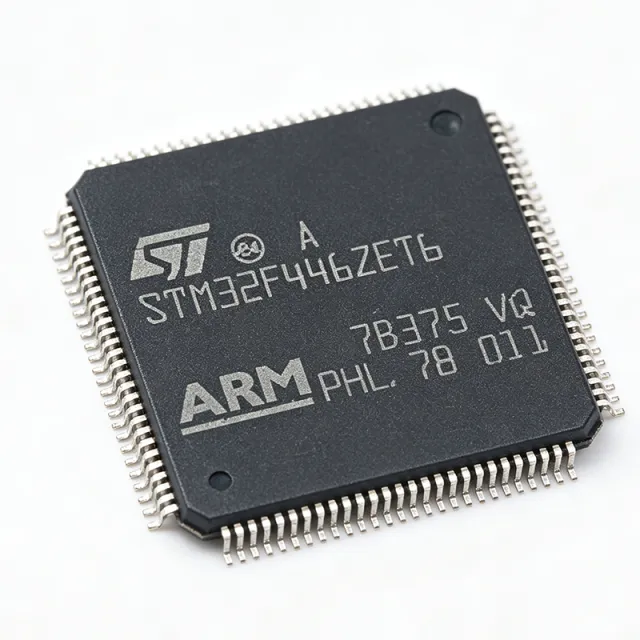
The STMicroelectronics STM32F446ZET6 is a high-performance 32-bit microcontroller based on the ARM Cortex-M4F core with floating-point unit (FPU), operating at up to 180 MHz. It is part of the STM32F4 series, offering a rich set of peripherals and connectivity options. The device is housed in a 144-pin LQFP package (LQFP144) and provides 512 KB of flash memory and 128 KB of SRAM, making it suitable for a wide range of applications including motor control, industrial automation, and consumer electronics. What is a microcontroller? A microcontroller (MCU) is a compact integrated circuit designed to govern a specific operation in an embedded system. It integrates a processor core, memory (flash and SRAM), and programmable input/output peripherals on a single chip. Microcontrollers are the backbone of embedded systems, enabling control, monitoring, and communication in devices ranging from automotive engine control units to smart home sensors. The STM32F446ZET6 is a high-end MCU within the STM32 family, positioned above entry-level Cortex-M0/M3 parts and offering superior performance and peripheral integration. Key features of the STM32F446ZET6 include a 180 MHz ARM Cortex-M4F core with FPU, 512 KB flash memory, 128 KB SRAM, and a comprehensive set of peripherals: multiple 12-bit ADCs, DACs, timers, USARTs, SPIs, I2Cs, USB OTG, CAN, and an FMC (Flexible Memory Controller) for external memory expansion. The device supports a wide supply voltage range of 1.8V to 3.6V and operates over a temperature range of -40°C to +85°C. It also features a true random number generator (RNG), a cryptographic acceleration cell, and a real-time clock (RTC). The STM32F446ZET6 is built on ST's advanced 90nm process technology, delivering a balance of performance and power efficiency. The Cortex-M4F core with FPU accelerates mathematical computations, making it ideal for DSP and control algorithms. The device includes a memory protection unit (MPU) and a nested vectored interrupt controller (NVIC) for robust real-time operation. The FMC supports external SDRAM, NOR, and NAND flash, enabling large data buffers and code expansion. Typical applications include motor control (e.g., field-oriented control of brushless DC motors), industrial automation (PLCs, robotics), medical devices (patient monitors, infusion pumps), and consumer electronics (smart appliances, audio systems). The rich connectivity options (USB, CAN, UART, SPI, I2C) make it a versatile choice for IoT gateways and human-machine interfaces (HMI). When designing with the STM32F446ZET6, ensure proper decoupling of the power supply pins with 100nF capacitors placed close to each VDD pin, and a 4.7uF bulk capacitor. The VDDA pin should be filtered with a ferrite bead and capacitor to reduce analog noise. The device supports multiple low-power modes (Sleep, Stop, Standby) to optimize battery life in portable applications.

USD $6.05 צור קשר
STM32F446ZET7 - 180MHz Cortex-M4 512KB MCU | STMicroelectronics
STM32F446ZET7

STM32F446ZET7 - 180MHz Cortex-M4 512KB MCU | STMicroelectronics

The STMicroelectronics STM32F446ZET7 is a 32-bit ARM Cortex-M4 microcontroller operating at 180 MHz, with 512 KB of Flash memory and DSP and floating-point capabilities, housed in a 144-LQFP 20 x 20 mm package. It belongs to the STM32F4 high-performance microcontroller family and combines a 32-bit processor, memory, communication peripherals, and timing resources in one integrated device. What is an ARM Cortex-M4 microcontroller? An ARM Cortex-M4 MCU is a microcontroller built around the ARM Cortex-M processor core, combining executable processing, memory, and peripherals on a single chip. The STM32F4 family uses this architecture for control-oriented embedded systems, while the Cortex-M4 core adds DSP instructions and an FPU for control, signal-processing, and communications workloads. STM32F446ZET7 is intended for embedded systems requiring substantial Flash storage and a broad peripheral set. The verified manufacturer and distributor information identifies the STM32F446 line with 180 MHz operation, 225 DMIPS, 512 KB Flash, DSP and FPU support, dual Quad SPI, SDRAM, and audio interfaces. The target part is specified in a 144-LQFP package with a 20 x 20 mm body size. These features make it suitable for industrial control, communications equipment, audio and signal-processing systems, and connected embedded products. The Cortex-M4 core supports real-time control workloads while the STM32F446 peripheral set expands system integration beyond basic GPIO. The dual Quad SPI interface can support multiple serial peripherals, while SDRAM and audio interfaces enable higher-memory or audio-capable designs. The STM32F446ZET7 combines these functions with 512 KB Flash for application code, constants, and embedded firmware assets. Typical applications include industrial automation, motor and motion control, communications gateways, audio equipment, data acquisition, and embedded control platforms. The part can also serve as a development-platform MCU when firmware and peripheral requirements align with its 180 MHz performance and 144-LQFP footprint. Firmware portability should be verified because peripheral availability, pin multiplexing, clock configuration, and software support vary across STM32 variants. A key design consideration is package and pin planning. The 144-LQFP footprint provides many external pins but requires careful PCB routing, decoupling, exposed-ground connectivity, and signal-integrity review. Designers should use the STMicroelectronics STM32F446 datasheet and reference manual for authoritative pin assignments, electrical limits, startup requirements, and peripheral configuration. This page consolidates verified distributor and manufacturer information with package-level guidance, application context, and procurement-oriented metadata. Distributor pricing and availability can change, so compare current offers, stock status, lifecycle information, and authorized sourcing before placing production orders.

RFQ צור קשר
STM32F469AGH6 - 2MB Flash ARM Cortex-M4F MCU | STMicroelectronics
STM32F469AGH6

STM32F469AGH6 - 2MB Flash ARM Cortex-M4F MCU | STMicroelectronics

The STMicroelectronics STM32F469AGH6 is a high-performance ARM Cortex-M4F based microcontroller with DSP and FPU instructions, operating at up to 180 MHz. It features 2 MB of Flash memory and 384 KB of SRAM, making it suitable for complex applications requiring substantial code and data storage. The device is housed in a 169-ball TFBGA package (7x7 mm) with a 0.5 mm pitch, offering a compact footprint for space-constrained designs. What is an ARM Cortex-M4F microcontroller? It is a 32-bit processor core designed for embedded systems, combining the ARM Cortex-M4 core with a hardware floating-point unit (FPU) that accelerates single-precision floating-point arithmetic. This makes it ideal for digital signal processing (DSP) tasks, such as audio processing, motor control, and sensor fusion. The Cortex-M4F sits within the broader hierarchy of microcontrollers -> embedded processors -> integrated circuits, and is widely used in industrial, consumer, and IoT applications due to its balance of performance, power efficiency, and peripheral integration. Key features of the STM32F469AGH6 include a Chrom-ART Accelerator for enhanced graphical user interface (GUI) performance, a TFT-LCD controller supporting up to 1024x768 resolution, and a true random number generator (TRNG) for security applications. It also integrates a camera interface, multiple communication interfaces (USART, SPI, I2C, CAN, USB OTG, Ethernet MAC), and advanced analog peripherals including three 12-bit ADCs, two DACs, and operational amplifiers. The device supports a wide supply voltage range of 1.7V to 3.6V and operates over a temperature range of -40°C to +85°C. Technically, the STM32F469AGH6 is built on STMicroelectronics' advanced 90nm process technology, enabling high integration and low power consumption. It features a memory protection unit (MPU) for enhanced reliability, and supports external memory interfaces for SDRAM, SRAM, and NOR/NAND Flash. The Chrom-ART Accelerator offloads 2D graphics operations from the CPU, improving GUI responsiveness while reducing power consumption. The device also includes a flexible power management scheme with multiple low-power modes (Sleep, Stop, Standby) to optimize energy efficiency in battery-powered applications. Typical applications include high-end consumer electronics (smartwatches, fitness trackers), industrial control systems (PLCs, motor drives), medical devices (patient monitors, infusion pumps), and IoT gateways. The TFT-LCD controller and Chrom-ART Accelerator make it particularly well-suited for graphical user interfaces in smart home displays and point-of-sale terminals. The Ethernet MAC and USB OTG support enable connectivity in networked embedded systems. When designing with this device, ensure adequate decoupling of the power supply pins with 100nF ceramic capacitors placed close to each VDD pin, and a 4.7uF bulk capacitor on the main supply. The TFBGA package requires careful PCB layout with via-in-pad techniques for thermal management and signal integrity. Refer to the STM32F469 datasheet (DocID028350) for detailed pinout and electrical characteristics.

RFQ צור קשר
STM32F469AIH6 - 180MHz Cortex-M4 MCU, 2MB Flash | STMicroelectronics
STM32F469AIH6

STM32F469AIH6 - 180MHz Cortex-M4 MCU, 2MB Flash | STMicroelectronics

The STMicroelectronics STM32F469AIH6 is a high-performance 32-bit Arm Cortex-M4 microcontroller operating up to 180 MHz, with 2 MB of Flash memory and a single-precision floating-point unit in a 169-ball UFBGA package measuring 7 x 7 mm. It belongs to the STM32F4 series and combines a RISC processor core, digital signal processing instructions, a memory protection unit, and extensive embedded peripherals in a compact package. A microcontroller is a programmable system-on-chip that integrates a CPU core, nonvolatile program memory, working memory, and interfaces such as serial communications, timers, analog inputs, and general-purpose I/O. Within the product hierarchy, the STM32F469AIH6 is an Arm Cortex-M4 MCU, part of the STM32 family, and ultimately belongs to the broader embedded-processor and semiconductor categories. Its 32-bit architecture supports efficient control, communications, signal-processing, and human-interface applications. The Cortex-M4 core includes a single-precision FPU for accelerated floating-point calculations and a complete DSP instruction set. These features distinguish the device from basic Cortex-M-class controllers when an application requires greater arithmetic throughput, efficient digital filtering, audio processing, or control-loop performance. The 2 MB embedded Flash provides substantially more program space than entry-level STM32 devices, allowing larger firmware images, protocol stacks, and application logic to be consolidated on one MCU. The STM32F469AIH6 also provides an STM32F4-series combination of high processing speed, sophisticated peripherals, and low-power operating modes. Its 169-UFBGA land pattern is intended for compact, multilayer PCB designs, but its 0.4 mm-class ball pitch requires careful escape routing and manufacturing capability. The official STM32F469AE datasheet applies to the STM32F469xx device family, including the STM32F469AIH6 ordering variant. Typical uses include industrial automation, connected industrial equipment, audio and digital signal processing, industrial networking, motor and motion control, human-machine interfaces, and embedded gateways. In each case, the 180 MHz Cortex-M4 execution rate and DSP/FPU support help consolidate real-time processing that might otherwise require a separate processor. Designers should assign all 169 balls according to the official pin-definition and package tables rather than relying on generic BGA conventions. Power, decoupling, clock, reset, boot, and high-speed interface layouts must follow STMicroelectronics guidance, while exposed thermal and assembly constraints require qualification through the selected PCB process. Firmware migration should also be reviewed against the exact STM32F469xx device revision and ST peripheral library configuration. This product page combines the official family documentation with verified distributor references, same-package family alternatives, application guidance, comparison parameters, and practical PCB considerations. It is intended to help engineers evaluate processing capacity, memory, package complexity, lifecycle suitability, and firmware compatibility before committing the device to a new board design.

RFQ צור קשר
STM32F469BET6 - 180MHz Cortex-M4 MCU 512KB Flash | STMicroelectronics
STM32F469BET6

STM32F469BET6 - 180MHz Cortex-M4 MCU 512KB Flash | STMicroelectronics

The STMicroelectronics STM32F469BET6 is a high-performance 32-bit ARM Cortex-M4 microcontroller with FPU and DSP instructions running at up to 180 MHz, featuring 512 KB of Flash memory and 384 KB of SRAM in a 208-pin LQFP (28x28 mm) package. It integrates a Chrom-ART Accelerator, an LCD-TFT controller, and a MIPI DSI host controller for advanced graphical user interfaces. A microcontroller (MCU) is a self-contained computer on a single integrated circuit, combining a processor core, memory, and programmable peripherals. The STM32F469BET6 belongs to the STM32F4 high-performance family, which sits above the mainstream STM32F0/F1/F3 lines and below the STM32F7/H7 application processors in ST's Cortex-M hierarchy. It targets embedded systems requiring rich graphics, audio, and real-time control. Key features include 2 MB of dual-bank Flash with read-while-write capability, 384 KB SRAM (including 64 KB CCM), a 12-bit ADC with 16 channels, two 12-bit DACs, and a flexible memory controller supporting SDRAM and SRAM. The Chrom-ART Accelerator offloads 2D graphics operations, while the LCD-TFT controller drives displays up to XGA resolution. The MIPI DSI interface enables high-speed serial display connectivity. The device operates from 1.7 V to 3.6 V and includes a comprehensive set of communication peripherals: USB OTG HS/FS, Ethernet MAC, CAN, SPI, I2C, UART/USART, and SDIO. The ART Accelerator and adaptive real-time memory accelerator achieve 225 DMIPS at 180 MHz, delivering 1.25 DMIPS/MHz. Typical applications include industrial HMI panels, medical imaging displays, point-of-sale terminals, home automation gateways, and audio equipment. The integrated graphics accelerators reduce CPU load, enabling smooth animations and responsive touch interfaces without an external GPU. When designing with this MCU, pay attention to power supply decoupling, the 208-pin LQFP thermal pad, and the external SDRAM interface timing. The device supports multiple low-power modes down to 2.4 uA in standby, making it suitable for battery-backed systems. This page synthesizes distributor pricing, drop-in alternatives, and practical design notes not found in the manufacturer datasheet, providing engineers with a single reference for selection and second-sourcing decisions.

RFQ צור קשר
STM32F469BIT6 - ARM Cortex-M4 MCU 180MHz 2MB Flash LQFP-208 | STMicroelectronics
STM32F469BIT6

STM32F469BIT6 - ARM Cortex-M4 MCU 180MHz 2MB Flash LQFP-208 | STMicroelectronics

The STMicroelectronics STM32F469BIT6 is a high-performance ARM Cortex-M4 microcontroller with FPU and DSP instructions, running up to 180 MHz and delivering 225 DMIPS / 608 CoreMark performance, housed in an LQFP-208 package. The device integrates 2 MB of Flash, 384 KB of SRAM plus 4 KB of backup SRAM, plus an on-chip Chrom-ART graphics accelerator and MIPI-DSI / LCD-TFT display controller for advanced HMI designs. An MCU (microcontroller unit) is a single-chip computer that integrates a CPU core, program and data memory, and a rich set of peripherals. Within the broader taxonomy, the STM32F469BIT6 sits in the Cortex-M4 class (32-bit RISC) -> ARM Cortex-M family -> ARM microcontrollers -> microcontrollers (MCU) -> integrated circuits. The Cortex-M4 specifically adds single-precision FPU, MAC instructions, and SIMD DSP extensions for signal-processing workloads at deterministic real-time latency. Key features include a 12-bit ADC (up to 2.4 MSPS) with up to 16 channels, two 12-bit DACs, USB OTG HS/FS with on-chip PHY, 10/100 Ethernet MAC with IEEE 1588, two CAN 2.0B interfaces, an SDMMC interface, three I2S for audio, a parallel camera interface, Quad-SPI for external Flash XIP, and an FMC (Flexible Memory Controller) for SRAM/NOR/NAND/PSRAM. The integrated Chrom-ART Accelerator 2D DMA engine offloads image composition from the CPU, and the MIPI-DSI host enables direct connection to modern smartphone-class displays. Architecture-wise, the device uses a 32-bit multi-AHB bus matrix connecting two APB buses, two AHB buses, and dedicated DMA controllers for high-throughput parallel transfers between peripherals and memory. Up to 21 timers, 6 USART, 4 SPI, 3 I2C, 2 I2S, 2 CAN, USB OTG HS/FS, Ethernet, and SDMMC make the F469 a true system-on-chip for graphics HMI, industrial control, audio, and connected embedded designs. Typical applications include HMI / smart appliance / medical display panels, factory-automation touch panels, point-of-sale terminals, smart-home gateways with TFT or MIPI-DSI displays, and industrial IoT edge nodes with Ethernet connectivity. Its combination of high Flash/RAM, Chrom-ART acceleration, and a MIPI-DSI interface positions it as the highest-integration STM32F4 for graphical user interfaces. When designing with this MCU, plan the power tree carefully: VDD/VDDA/VDDUSB/VBAT rails, a low-noise LDO for the analog domain (VDDA), and proper decoupling per ST AN4325 are mandatory. Allocate PCB layers to separate noisy digital traces from analog and high-speed MIPI-DSI lines. Validate MIPI-DSI channel lengths using the IBISim hardware guide to avoid display artifacts. This page consolidates distributor pricing, LQFP-208 same-package drop-in alternatives, and engineering design notes not found in the datasheet alone.

RFQ צור קשר
STM32F469IIT6 - 180MHz Cortex-M4 MCU | STMicroelectronics
STM32F469IIT6

STM32F469IIT6 - 180MHz Cortex-M4 MCU | STMicroelectronics

STMicroelectronics STM32F469IIT6 is a high-performance 32-bit Arm Cortex-M4 microcontroller rated up to 180 MHz, with 2 MB of Flash memory and a 176-pin LQFP package. The device also includes 384 KB of SRAM, a single-precision floating-point unit, DSP instructions, a memory protection unit, and integrated peripherals for USB, Ethernet, graphics, camera, and display systems. An Arm Cortex-M4 microcontroller is a compact real-time processor used to control embedded equipment. It belongs to the MCU, embedded processor, and semiconductor hierarchy. Unlike a general-purpose application processor, an MCU combines instruction execution, memory, communications, timers, analog interfaces, and direct peripheral control in one package. This integration makes the STM32F4 family suitable for systems that require deterministic control alongside network connectivity and graphical or imaging functions. The STM32F469IIT6 combines a 180 MHz Cortex-M4 core with up to 225 DMIPS, a single-precision FPU, and a full DSP instruction set. Its 2 MB Flash supports a larger embedded program and a 384 KB SRAM accommodates working data and display or network buffers. Dual Quad-SPI, USB OTG HS/FS, Ethernet, FMC, an LCD-TFT controller, MIPI DSI, a camera interface, and a graphical accelerator extend the device beyond basic real-time control. The 176-LQFP package provides a large pin count for high-speed communications, external memory, display connections, and parallel peripherals. Operating voltage information includes 2.5 V and 3.3 V configurations. The industrial-grade ordering suffix supports designs expected to operate across a commercial industrial temperature range, subject to the limits and test conditions in the manufacturer datasheet. Typical applications include industrial HMIs and PLCs, network-connected data acquisition equipment, medical monitoring systems, camera-based inspection, industrial gateways, and high-resolution embedded displays. USB and Ethernet connectivity simplify service interfaces and networked control, while the graphical accelerator and display interfaces reduce the demand on the CPU for graphical output. PCB design should preserve the power, ground, decoupling, clock, and high-speed signal requirements defined by the manufacturer reference design. Place bypass capacitors adjacent to supply pins, route sensitive analog and communications lines away from fast switching nodes, and maintain controlled clock and differential-pair geometry. Firmware and peripheral validation must also confirm startup, memory access, USB, Ethernet, and display timing before production release. This page combines the manufacturer specifications with a practical comparison of same-package STM32F4 options, application guidance, pin-package constraints, and sourcing information for engineers evaluating the STM32F469IIT6.

RFQ צור קשר
STM32F469NIH6 - 2MB Flash, 180MHz ARM Cortex-M4F MCU TFBGA-216 | STMicroelectronics
STM32F469NIH6

STM32F469NIH6 - 2MB Flash, 180MHz ARM Cortex-M4F MCU TFBGA-216 | STMicroelectronics

The STMicroelectronics STM32F469NIH6 is a high-performance ARM Cortex-M4F microcontroller with single-precision FPU and DSP instructions, operating at up to 180 MHz, integrating 2 MB of Flash and 384 KB of SRAM in a 216-ball TFBGA (13x13 mm) package. The Cortex-M4 core delivers 225 DMIPS / 608 CoreMark and includes a Chrom-ART Accelerator for graphics offload, a TFT LCD controller up to XGA, and a MIPI-DSI host for direct-display connection. On-board crypto acceleration (AES 128/192/256, DES, 3DES, SHA-1, MD5) and a true random number generator (TRNG) enable secure connectivity. The 216-ball TFBGA is the largest pin-count variant in the STM32F469 line, exposing the full set of peripherals and bus interfaces for industrial HMI designs. A microcontroller (MCU) is a compact integrated circuit that combines a processor core (here, an ARM Cortex-M4F), program memory (Flash), working memory (SRAM), and programmable peripherals to govern an embedded system. The STM32F469NIH6 sits within the STM32F4 family of 32-bit ARM Cortex-M microcontrollers, which occupies the high-performance tier of the broader STM32 portfolio - above Cortex-M0/M0+ entry devices but below Cortex-M7 lines such as STM32H7 in raw DMIPS. Key features distinguishing this device include the integrated LCD-TFT controller with MIPI-DSI support, dedicated hardware JPEG codec, USB 2.0 OTG full- and high-speed with on-chip PHY, two CAN 2.0B interfaces, and a camera interface for parallel CMOS sensors. The 2 MB dual-bank Flash allows field firmware updates with rollback, while 384 KB of SRAM (including 64 KB of CCM SRAM) accommodates graphics frame buffers and audio sample buffers without external memory. Architecturally, the part is built on a 90 nm CMOS process with an adaptive real-time ART Accelerator achieving equivalent 0 wait-state execution from Flash. The supply range of 1.7 V to 3.6 V covers battery and 3.3 V-rail designs; four low-power modes (Sleep, Stop, Standby, VBAT) allow deep current reduction when the display and peripherals are idle. Typical applications include industrial human-machine interfaces (HMIs), point-of-sale terminals, smart appliances with GUI, portable medical instrumentation, and IoT gateways requiring both display and TLS-class security. The cryptographic accelerators and TRNG also suit payment terminals and secure connectivity modules. Designers should note that the 216-ball TFBGA requires a 4-layer or thicker PCB with via-in-pad or dog-bone fan-out, plus four decoupling caps (100 nF X7R) within 2 mm of each VDD/VSS pair. For timing accuracy, use the on-chip 16 MHz HSI trimmed via the 32 kHz LSE crystal - or supply an external HSE crystal up to 26 MHz that the PLL multiplies to 180 MHz. This page synthesizes distributor pricing, drop-in alternatives, and practical design notes not found in the manufacturer datasheet alone - including 1:1 board-level migration paths to the pin-compatible STM32F479 and STM32F769 variants.

RFQ צור קשר
STM32F469VIT6 - 180MHz Cortex-M4 MCU, 2MB Flash | STMicroelectronics
STM32F469VIT6

STM32F469VIT6 - 180MHz Cortex-M4 MCU, 2MB Flash | STMicroelectronics

The STMicroelectronics STM32F469VIT6 is a 32-bit ARM Cortex-M4 microcontroller with an operating frequency of up to 180 MHz, 2 MB of Flash memory, and 384 KB of RAM in a 100-pin LQFP package measuring 14 mm by 14 mm. It combines a single-precision floating-point unit and DSP instructions with a memory protection unit, making it suitable for embedded control, graphics, communications, audio, and industrial applications. An ARM Cortex-M4 microcontroller is a reduced-instruction-set processor designed for embedded systems. It sits within the hierarchy of 32-bit ARM microprocessors, embedded processors, and application-specific system controllers. Compared with a microcontroller based on a higher-performance application processor, the STM32F469 family emphasizes deterministic real-time control, efficient peripheral integration, and compact embedded-system implementation. The STM32F469VIT6 provides 2 MB of Flash for firmware and nonvolatile data, together with 384 KB of SRAM for working memory. Its Cortex-M4 core can operate at up to 180 MHz and supports single-precision floating-point calculations, hardware DSP instructions, and an MPU. These features allow the device to combine control-loop processing with computationally intensive tasks without requiring a separate digital signal processor. The 100-LQFP package exposes the device's embedded resources through a 14 mm by 14 mm surface-mount footprint. This package provides substantially more I/O than smaller MCU packages, making the STM32F469VIT6 suitable for boards requiring multiple communications interfaces, external memory connections, human-machine interfaces, and mixed analog or digital control functions. Exact peripheral assignments and alternate-function mappings must be checked against the manufacturer pinout and datasheet before PCB routing. Typical uses include industrial control equipment, connected sensors, industrial networking, audio processing, human-machine interfaces, and high-performance embedded systems. The 180 MHz Cortex-M4 core is useful where graphics or display workloads must be coordinated with real-time peripheral handling. The large memory configuration also provides room for complex protocol stacks, image buffers, and application firmware. PCB implementation should preserve clean power and ground distribution around every supply pin, place decoupling capacitors close to their associated pins, route high-speed signals with controlled return paths, and program unused pins according to the manufacturer recommendations. Firmware development should use the STM32CubeIDE or STM32CubeMX environment and the STM32F4 HAL or LL drivers selected for the target board. This product page consolidates the verified device specifications, package details, application guidance, and drop-in alternatives into one engineering-focused reference. It also distinguishes directly interchangeable STM32F4 family options from comparisons requiring different packages or redesigned firmware.

RFQ צור קשר
STM32F469ZIT6 - 180MHz Cortex-M4 MCU 2MB Flash | ST
STM32F469ZIT6

STM32F469ZIT6 - 180MHz Cortex-M4 MCU 2MB Flash | ST

The STMicroelectronics STM32F469ZIT6 is a high-performance 32-bit ARM Cortex-M4 microcontroller with FPU running at up to 180 MHz, featuring 2 MB of Flash memory and 384 KB of SRAM in a 144-pin LQFP (20x20 mm) package. An MCU (microcontroller unit) is a single integrated circuit that combines a processor core, memory, and peripherals into one chip, forming the lowest complete computing tier in the embedded hierarchy: microcontroller -> embedded processor -> system-on-chip. The STM32 family is STMicroelectronics' mainstream 32-bit MCU platform built on the ARM Cortex-M architecture, one of the most widely adopted embedded ecosystems in industry. Key features of the STM32F469 line include the ART Accelerator and Chrom-ART graphical hardware accelerator for high-resolution GUI performance, an integrated TFT LCD controller and MIPI DSI host controller, and ST's adaptive real-time memory accelerator that enables zero-wait-state execution from Flash at 180 MHz. The Cortex-M4 core includes single-cycle multiply-accumulate DSP instructions and a hardware floating-point unit (FPU), making it efficient for signal processing alongside control tasks. Technically, the STM32F469 series is based on the proven STM32F429 platform with enhanced graphics and display capabilities, operating from a 3.3V supply. According to the ST product page, the STM32F469xx devices are based on the high-performance Arm Cortex-M4 32-bit RISC core operating at up to 180 MHz. The 144-LQFP package offers abundant GPIO and peripheral interfaces for complex designs while remaining hand-solderable relative to ball-grid packages. Typical applications include industrial HMI panels and TFT displays, consumer appliances with GUIs, medical monitoring devices, building automation, and motor control systems requiring a blend of graphics, connectivity, and real-time control. A key design consideration is power integrity: the device requires decoupling capacitors on all VDD pins and careful PCB layout of the VCAP pins for the internal 1.2V core regulator. Firmware development is supported by STM32CubeMX and STM32CubeIDE free tooling. This page synthesizes distributor pricing, verified drop-in alternatives within the STM32F4 family, and practical design notes not found in a single manufacturer document.

RFQ צור קשר
STM32F479BGT6 - 32-bit ARM Cortex-M4F MCU, 2MB Flash, 180MHz | STMicroelectronics
STM32F479BGT6

STM32F479BGT6 - 32-bit ARM Cortex-M4F MCU, 2MB Flash, 180MHz | STMicroelectronics

The STMicroelectronics STM32F479BGT6 is a high-performance 32-bit microcontroller based on the ARM Cortex-M4F core with floating-point unit (FPU), operating at up to 180 MHz. It integrates 2 MB of flash memory and 384 KB of SRAM, making it suitable for complex applications requiring substantial code and data storage. The device is housed in a 208-pin LQFP package (LQFP208) with a 28x28 mm body, offering extensive I/O and connectivity options. A microcontroller (MCU) is a compact integrated circuit designed to govern a specific operation in an embedded system. It contains a processor core, memory, and programmable input/output peripherals. The STM32F479BGT6 belongs to the STM32F4 series, which is part of the broader STM32 family of 32-bit flash microcontrollers. These devices are based on the ARM Cortex-M processor architecture, providing a balance of performance, power efficiency, and rich peripheral integration for applications ranging from industrial control to consumer electronics. Key features of the STM32F479BGT6 include a 180 MHz ARM Cortex-M4F core with DSP instructions and a single-precision FPU, 2 MB of dual-bank flash memory, 384 KB of SRAM, and a flexible memory controller (FMC) supporting external memory. It offers a comprehensive set of peripherals: multiple 12-bit ADCs, DACs, timers, communication interfaces (USART, SPI, I2C, CAN, USB OTG, Ethernet MAC), and a camera interface. The device also includes a cryptographic acceleration unit and a true random number generator (TRNG) for security applications. The STM32F479BGT6 leverages ST's advanced 90nm process technology, enabling high clock speeds with low power consumption. The ART Accelerator™ allows zero-wait-state execution from flash memory, maximizing performance. The device supports a wide operating voltage range (1.7V to 3.6V) and temperature range (-40°C to +85°C), making it robust for industrial environments. Typical applications include industrial automation, motor control, medical devices, consumer electronics, IoT gateways, and audio processing. The rich connectivity and high-speed ADC make it ideal for data acquisition systems and real-time control loops. When designing with this MCU, ensure proper decoupling of the power supply pins and a stable clock source. The device supports multiple low-power modes, which can be leveraged to optimize energy consumption in battery-powered applications. Careful PCB layout is essential to minimize noise and ensure reliable operation at 180 MHz.

RFQ צור קשר
STM32F479IIT6 - 180MHz Cortex-M4 MCU, 2MB Flash | STMicroelectronics
STM32F479IIT6

STM32F479IIT6 - 180MHz Cortex-M4 MCU, 2MB Flash | STMicroelectronics

STMicroelectronics STM32F479IIT6 is a high-performance 32-bit Arm Cortex-M4 microcontroller with DSP and floating-point capabilities, operating at up to 180 MHz. It integrates 2 MB of Flash memory and 384 KB of SRAM in a 176-lead LQFP package measuring 24 mm by 24 mm. The device is designed for embedded systems that require substantial local code storage, real-time signal processing, extensive connectivity, and a broad peripheral set within one microcontroller package. A microcontroller is a complete programmable control platform containing a processor core, memory, communication interfaces, timers, analog converters, and other peripherals. The STM32F4 series belongs to the hierarchy of embedded-system controllers: microcontroller, 32-bit RISC processor, Arm Cortex-M4 core, and high-performance embedded microcontroller. This integration reduces the component count required for industrial control, audio processing, communications, data acquisition, and human-interface equipment. The STM32F479IIT6's principal strengths include its 180 MHz Cortex-M4 core, 2 MB Flash memory, and 384 KB SRAM. The Cortex-M4 architecture supports efficient real-time workloads and includes DSP instructions and single-precision floating-point hardware. Its Flash capacity accommodates larger firmware, bootloaders, protocol stacks, graphics or control code, and application logic, while the SRAM supports buffering, network stacks, audio samples, and real-time data processing. The 176-LQFP package exposes the device's high pin count for external connectivity. Its feature set includes communication peripherals and advanced analog functions such as analog-to-digital and digital-to-analog conversion. The STM32F479IIT6 is therefore suited to industrial controllers, motor-control equipment, audio interfaces, PLC modules, communications equipment, and data-acquisition systems where a high-performance MCU and substantial memory are needed in one component. The exact pin assignments, electrical limits, peripheral configurations, clock tree, and package dimensions should be taken from the STMicroelectronics STM32F479xx datasheet and reference manual. Before schematic or PCB release, verify each power pin, decoupling requirement, boot configuration, debug connection, clock source, and analog reference against the applicable device variant. This page combines the core device characteristics with replacement guidance, application-fit analysis, comparison parameters, and practical design considerations. It is intended to help engineers identify whether the STM32F479IIT6 provides the required processing, memory, package, and peripheral mix before committing to a design. For development, STMicroelectronics provides the STM32Cube ecosystem and Arm Cortex-M debugging tools, but the exact debugger, programmer, and accessory choices should follow the board design and current tool support. Use the manufacturer pin-description table and reference manual when assigning PCB tracks, particularly for power, ground, analog inputs, and high-current communication interfaces.

RFQ צור קשר
STM32F479NIH6 - 180MHz ARM Cortex-M4F MCU with TFT-LCD & Crypto | STMicroelectronics
STM32F479NIH6

STM32F479NIH6 - 180MHz ARM Cortex-M4F MCU with TFT-LCD & Crypto | STMicroelectronics

The STMicroelectronics STM32F479NIH6 is a high-performance ARM Cortex-M4F based microcontroller with DSP and FPU instructions, operating at up to 180 MHz. It is housed in a 216-ball TFBGA package (NIH) and provides a rich set of peripherals including a TFT-LCD controller, hardware cryptographic accelerator, and a camera interface. The device integrates up to 2 MB of Flash memory and 384 KB of SRAM, making it suitable for advanced embedded applications requiring high processing power and graphics capabilities. An ARM Cortex-M4F microcontroller is a 32-bit processor core designed for embedded systems that require efficient digital signal processing (DSP) and floating-point arithmetic. The 'F' suffix indicates the presence of a hardware floating-point unit (FPU), which accelerates mathematical operations. In the STM32F4 series, the Cortex-M4F core is complemented by a rich set of peripherals, making it a popular choice for industrial control, consumer electronics, and IoT devices. The STM32F479NIH6 sits at the top of the STM32F4 family, offering the highest performance and memory capacity. Key features include a 180 MHz CPU with 225 DMIPS/1.25 DMIPS/MHz, a Chrom-ART Accelerator for 2D graphics, a TFT-LCD controller supporting up to XGA resolution, and a hardware cryptographic processor supporting AES, DES, 3DES, and hash functions. The device also includes a true random number generator (TRNG), a camera interface, and multiple communication interfaces including Ethernet, USB OTG HS/FS, CAN, SPI, I2C, USART, and SDIO. The operating voltage range is 1.7V to 3.6V, and the temperature range is -40°C to +85°C (industrial grade). The STM32F479NIH6 is built on ST's advanced 90nm process technology, balancing performance and power consumption. The Cortex-M4F core with FPU enables efficient execution of complex algorithms, while the Chrom-ART Accelerator offloads 2D graphics operations from the CPU, improving overall system performance. The hardware cryptographic accelerator provides secure data encryption without burdening the CPU, making it ideal for secure communication applications. Typical applications include high-end human-machine interfaces (HMI), industrial automation, medical devices, smart home gateways, and IoT edge nodes. The TFT-LCD controller and graphics accelerator make it particularly well-suited for graphical user interfaces, while the cryptographic features enable secure data transmission in connected devices. When designing with this device, ensure adequate decoupling on all power supply pins and follow the recommended layout guidelines in the datasheet for the TFBGA package. The device supports multiple low-power modes, allowing designers to optimize power consumption for battery-powered applications.

RFQ צור קשר
STM32F722RET6 - 216MHz ARM Cortex-M7 MCU | STMicroelectronics
STM32F722RET6

STM32F722RET6 - 216MHz ARM Cortex-M7 MCU | STMicroelectronics

The STMicroelectronics STM32F722RET6 is a high-performance 32-bit microcontroller based on the ARM Cortex-M7 core, operating at up to 216 MHz. It features 512 KB of flash memory and 256 KB of SRAM, making it suitable for demanding applications such as motor control, industrial automation, and advanced IoT devices. The device is housed in a 64-pin LQFP package (LQFP64) with a 10x10 mm body and 0.5 mm pitch, offering a compact footprint for space-constrained designs. What is a microcontroller? A microcontroller (MCU) is a compact integrated circuit designed to govern a specific operation in an embedded system. It integrates a processor core, memory (flash and SRAM), and programmable input/output peripherals on a single chip. Microcontrollers are the backbone of embedded systems, ranging from simple 8-bit devices to high-performance 32-bit and 64-bit cores. The STM32F722RET6 belongs to the STM32F7 series, which is part of the broader STM32 family of 32-bit ARM Cortex-M microcontrollers. This hierarchy places it within the embedded processing domain, specifically as a high-performance MCU for real-time control and signal processing. Key features of the STM32F722RET6 include a 216 MHz Cortex-M7 core with double-precision floating-point unit (FPU), 512 KB flash, 256 KB SRAM, and a comprehensive set of peripherals. It supports a wide range of communication interfaces including USART, SPI, I2C, CAN, USB OTG HS/FS, and Ethernet MAC. The device also includes advanced analog peripherals such as 12-bit ADCs, DACs, and comparators, along with a camera interface and a true random number generator (TRNG). These features enable high-speed data processing and connectivity in complex embedded systems. From a technical depth perspective, the STM32F722RET6 leverages the ARM Cortex-M7 architecture with a 6-stage pipeline and a branch prediction unit, delivering 7 CoreMark/MHz performance. The inclusion of a double-precision FPU accelerates mathematical computations, making it ideal for audio processing, motor control algorithms, and digital signal processing. The device also features an instruction cache and data cache to optimize memory access, reducing latency and improving overall system throughput. Typical applications include industrial motor control, robotics, advanced human-machine interfaces (HMI), audio processing, and high-end IoT gateways. The combination of high clock speed, ample memory, and rich peripherals allows designers to implement complex algorithms and connectivity stacks without external components. For instance, in motor control, the 216 MHz core can execute field-oriented control (FOC) algorithms with high precision, while the integrated timers and ADCs provide accurate feedback. When designing with this device, ensure proper power supply decoupling with 100 nF capacitors close to each VDD pin and a 4.7 uF bulk capacitor. The device supports a supply voltage range of 1.7V to 3.6V, and the internal regulator requires a 1 uF capacitor on VCAP pins. Pay attention to the boot configuration pins to select the correct boot source, and use the internal or external oscillator as per the application requirements.

RFQ צור קשר
STM32F722ZET6 - 512KB Flash, 216MHz ARM Cortex-M7 MCU | STMicroelectronics
STM32F722ZET6

STM32F722ZET6 - 512KB Flash, 216MHz ARM Cortex-M7 MCU | STMicroelectronics

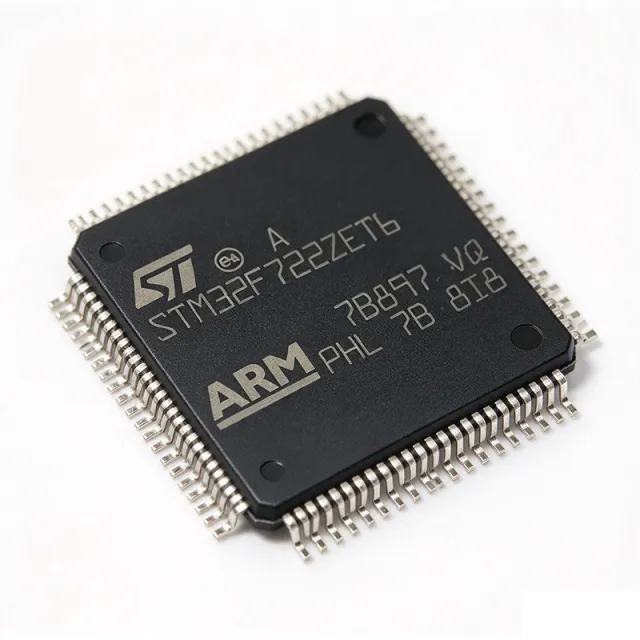
The STMicroelectronics STM32F722ZET6 is a high-performance ARM Cortex-M7 based microcontroller with a maximum clock speed of 216 MHz, delivering 462 DMIPS and 1082 CoreMark. It features 512 KB of flash memory and 256 KB of SRAM, making it suitable for complex embedded applications requiring substantial processing power and memory. The device is housed in a 144-pin LQFP package (LQFP144) with a 20x20 mm body, offering a rich set of peripherals including multiple USARTs, SPIs, I2Cs, ADCs, DACs, timers, and advanced connectivity options like USB OTG HS/FS, Ethernet MAC, and camera interface. An ARM Cortex-M7 microcontroller is a high-performance 32-bit processor core designed for embedded systems that demand intensive computation, such as digital signal processing, motor control, and graphical user interfaces. The Cortex-M7 core features a 6-stage pipeline, branch prediction, and optional double-precision floating-point unit (FPU), enabling efficient execution of complex algorithms. In the system hierarchy, the STM32F722ZET6 sits at the application processor level, interfacing with memory, peripherals, and external devices to control and process data in real-time. Key features of the STM32F722ZET6 include a 216 MHz CPU with a single-precision FPU, 512 KB flash, 256 KB SRAM, and a comprehensive set of peripherals. It supports a wide supply voltage range of 1.7V to 3.6V, operates over a temperature range of -40°C to +85°C, and includes advanced security features such as a true random number generator (TRNG) and a cryptographic acceleration cell. The device also features a Chrom-ART Accelerator for enhanced graphical performance, making it ideal for human-machine interface (HMI) applications. Technically, the STM32F722ZET6 is built on a 90nm process technology, offering a balance between performance and power consumption. It includes a memory protection unit (MPU) for enhanced reliability, a direct memory access (DMA) controller with up to 16 channels, and a flexible memory controller (FMC) supporting external memory interfaces. The device also integrates a 12-bit ADC with up to 24 channels, two 12-bit DACs, and multiple 16-bit and 32-bit timers, providing precise analog and timing control. Typical applications include industrial control systems, motor drives, advanced human-machine interfaces, IoT gateways, audio processing, and high-end consumer electronics. The combination of high clock speed, ample memory, and rich peripherals makes it a versatile choice for designers requiring a powerful MCU in a compact package. When designing with the STM32F722ZET6, ensure proper decoupling of the power supply pins with 100nF capacitors placed close to each VDD pin, and a 4.7uF bulk capacitor on the main supply. The device supports multiple low-power modes, including Sleep, Stop, and Standby, which can be leveraged to optimize energy consumption in battery-powered applications.

USD $6.23 במלאי
STM32F723IEK6 - 216MHz Cortex-M7 512KB MCU | STMicroelectronics
STM32F723IEK6

STM32F723IEK6 - 216MHz Cortex-M7 512KB MCU | STMicroelectronics

The STMicroelectronics STM32F723IEK6 is a 32-bit ARM Cortex-M7 microcontroller operating up to 216 MHz, with 512 KB of Flash memory and a 176-pin UFBGA package measuring 10 mm by 10 mm. It combines high-performance DSP capability with an FPU, Art Accelerator, L1 cache, SDRAM support, and extensive serial peripherals for demanding embedded control, communications, and signal-processing systems. A microcontroller is a compact embedded-computing semiconductor that integrates a processor core, memory, peripherals, and interfaces into one device. The STM32F7 family belongs to the ARM Cortex-M microcontroller hierarchy, combining real-time control capability with programmable logic, data storage, and communication channels. This makes the STM32F723IEK6 suitable as the central controller in industrial, consumer, communications, audio, and embedded systems. The verified data identifies a 216 MHz ARM Cortex-M7 core, 32-bit architecture, 512 KB Flash memory, Art Accelerator, L1 cache, and SDRAM support. The 176-UFBGA package provides a dense surface-mount footprint for compact PCB designs, although its fine pitch requires careful PCB layout and inspection. The high operating frequency supports compute-intensive control loops and real-time signal processing, while the FPU accelerates suitable floating-point workloads. STMicroelectronics positions the STM32F722xx and STM32F723xx devices as high-performance ARM Cortex-M7 products. The STM32F723IEK6 is identified as a 512 Kbyte Flash device with a 216 MHz CPU. Exact RAM capacity, peripheral configuration, voltage limits, temperature ratings, pin functions, and electrical limits were not provided in the verified sources and must be confirmed from the manufacturer datasheet before design release. Typical design roles include industrial automation, motor and motion control, communications equipment, audio processing, data acquisition, and connected embedded products. In these applications, the MCU can execute control algorithms, manage external memory through supported peripherals, and interface with sensors, actuators, transceivers, and display or communication modules. The exact peripheral set and I/O availability should be checked against the selected package pinout. For PCB implementation, use a multilayer board with a short ground plane, controlled high-speed routing, and careful decoupling near the supply pins. Because the UFBGA package is not visually leaded, verify pad geometry, assembly process capability, and stencil design against STMicroelectronics package documentation. Do not substitute pin-compatible claims based only on a similar STM32 device name; verify package dimensions, exposed pads, power requirements, pin multiplexing, and firmware support. This page consolidates the verified STM32F723IEK6 identity, package, memory, processor, and sourcing information with practical design guidance. For a production decision, confirm lifecycle status, current inventory, pricing, and complete electrical and pin-level data through STMicroelectronics and authorized distributors.

RFQ צור קשר
STM32F723IET6 - 216MHz Cortex-M7 512KB MCU | STMicroelectronics
STM32F723IET6

STM32F723IET6 - 216MHz Cortex-M7 512KB MCU | STMicroelectronics

The STMicroelectronics STM32F723IET6 is a 32-bit Arm Cortex-M7 microcontroller with a 216 MHz CPU, 512 KB of embedded Flash memory, 256 KB of RAM, and a 176-pin LQFP package measuring 24 mm by 24 mm. It combines high-performance DSP and floating-point processing with 138 I/O pins, an Art Accelerator, L1 cache, and SDRAM support for demanding embedded-control and connected-equipment designs. A microcontroller is an integrated semiconductor that combines a processor core, memory, peripherals, and communication interfaces on one device. The STM32F723 belongs to the STM32F7 family of 32-bit embedded microcontrollers and sits above general-purpose STM32F0 devices in processing capability. Its Arm Cortex-M7 core provides deterministic real-time execution for industrial control, motor control, metering, automation, and IoT equipment, while the large pin count supports numerous external interfaces and mixed-signal connections. The principal features include a 216 MHz operating frequency, 512 KB of Flash, 256 KB of SRAM, 138 I/O pins, and an integrated 12-bit ADC identified in the verified product data. The device also supports SDRAM operation, DSP-oriented processing, and an Art Accelerator for graphics acceleration. Its 1.7 V to 3.6 V operating range makes it suitable for conventional embedded supply rails, while its -40 °C to +85 °C temperature range supports industrial equipment. Technically, the Cortex-M7 architecture provides the processing headroom needed for complex control algorithms, protocol stacks, and signal processing. The L1 cache can improve execution efficiency in code-intensive workloads, while SDRAM support allows applications to use external memory when internal SRAM is insufficient. The 176-pin LQFP-176 package also exposes a broad peripheral complement compared with smaller 32-, 64-, or 100-pin MCU packages. Typical uses include industrial automation controllers, motor-control systems, connected IoT gateways, data-acquisition equipment, and metering products. Its 138 I/O pins are especially useful when a design must connect multiple sensors, communication transceivers, human-interface interfaces, and power-management components without relying on external I/O expanders. The primary design consideration is PCB density. A 24 mm by 24 mm LQFP-176 footprint requires careful escape routing, adequate ground-plane continuity, and decoupling close to the supply pins. Because this MCU combines 216 MHz processing with 138 I/O, signal-integrity and power-integrity planning are essential in designs using long traces, high-speed interfaces, or external SDRAM. This page consolidates the verified manufacturer and distributor information for STM32F723IET6 and adds application-oriented design guidance, package-aware alternatives, procurement context, and an explicit comparison framework that is not presented as a substitute for the complete manufacturer datasheet.

RFQ צור קשר