מוצרים (49,000+)

TS954IYDT - Quad 3MHz R-R I/O Op Amp | STMicroelectronics
TS954IYDT

TS954IYDT - Quad 3MHz R-R I/O Op Amp | STMicroelectronics

The STMicroelectronics TS954IYDT is a quad, rail-to-rail input and output BiCMOS operational amplifier optimized for 3 V and 5 V operation. It provides four amplifier channels, 3 MHz gain-bandwidth product, 1 V/us slew rate, 35 nA input bias current, and operation from 2.7 V to 12 V in a 14-pin SOIC tape-and-reel package. The low-distortion design supports general-purpose signal conditioning where input and output signals can approach the supply rails. An operational amplifier is an analog signal-conditioning IC that uses negative feedback to amplify voltage differences with high open-loop gain. Rail-to-rail input and output operation expands the usable input and output range beyond the traditional mid-supply restrictions of conventional amplifier architectures. Within the amplifier hierarchy, the TS954 belongs to the general-purpose operational amplifier class and provides four independent channels in one package. The TS954 family's BiCMOS construction combines bipolar input characteristics with CMOS power efficiency. Its 3 MHz gain-bandwidth product and 1 V/us slew rate suit low-frequency audio, sensor, interface, and control loops. Low input bias current of 35 nA reduces DC loading on high-impedance sources, while the low-distortion architecture is suitable for precision signal paths operating near the lower or upper supply limits. Four independent amplifiers in one 14-pin SOIC reduce board area and simplify multi-channel designs. Typical uses include sensor conditioning, current measurement, audio preamplification, active filtering, voltage buffering, and industrial control interfaces. The wide 2.7 V to 12 V supply range accommodates 3.3 V, 5 V, and higher-voltage analog systems where rail-to-rail signal swing is beneficial. The principal design consideration is stability when driving capacitive loads. Output isolation resistors, compensation networks, and careful return-path layout may be required depending on load capacitance, frequency, and channel gain. The low-power architecture also makes thermal management straightforward, although total supply dissipation should still be checked when all four channels operate continuously at high output voltage and current. This page combines electrical specifications, practical replacement guidance, application-oriented circuit roles, and design notes for engineers evaluating the TS954IYDT. It also distinguishes the exact industrial temperature and tape-and-reel ordering configuration from related TS954 variants to support accurate component selection and PCB sourcing decisions.

RFQ צור קשר
TS954IYPT - 3MHz Quad Rail-to-Rail Op Amp | ST
TS954IYPT

TS954IYPT - 3MHz Quad Rail-to-Rail Op Amp | ST

The STMicroelectronics TS954IYPT is a quad, input/output rail-to-rail BiCMOS operational amplifier optimized for 3 V and 5 V systems, with a 3 MHz gain-bandwidth product, 1 V/µs slew rate, and operation from 2.7 V to 12 V in a 14-pin TSSOP package. Its four channels support rail-to-rail input common-mode range and rail-to-rail output swing, making it suitable for low-voltage systems where input and output signals must operate close to the supply rails. The TS954 family combines low-noise operation with low distortion of 0.01%. A rail-to-rail operational amplifier is an amplifier whose input common-mode range and output voltage swing extend toward the positive and negative supply rails. This capability places the TS954IYPT in the operational-amplifier hierarchy alongside general-purpose amplifiers, instrumentation amplifiers, and power-management ICs used for analog signal conditioning. Rail-to-rail behavior is especially useful when sensing battery voltages, transducer outputs, or sensor signals that occupy most of the available supply range. Key characteristics include a 35 nA input bias current, 6 mV input offset voltage, 80 dB supply-voltage rejection ratio, and latch-up immunity. The BiCMOS construction supports both field-effect-transistor inputs and bipolar output stages. The 3 MHz bandwidth provides useful closed-loop performance for audio, communications, sensor interfaces, and active filtering, while the 1 V/µs slew rate enables accurate reproduction of moderately fast waveforms. The four independent channels can be configured as voltage followers, noninverting amplifiers, or inverting amplifiers. Each amplifier operates from the same supply and shares a common ground arrangement, allowing simultaneous analog processing in compact systems. Because the TS954 is a BiCMOS rail-to-rail device, it is particularly useful in portable instrumentation, industrial sensing, low-voltage audio, and embedded control systems operating from 3 V or 5 V rails. Typical uses include battery-powered sensor acquisition, audio input conditioning, analog-to-digital converter driver circuits, active filters, and general-purpose signal buffers. The 14-TSSOP package offers a practical density for four analog channels, although exposed-pad thermal options are not specified for this ordering code. Design with adequate input and output headroom, check capacitive-load stability before driving long cables, and use the manufacturer pin-description table when assigning PCB tracks. Decoupling capacitors should be placed close to the supply pins, and unused amplifier inputs should be tied to a defined potential rather than left floating. This page organizes the TS954IYPT specifications, verified drop-in replacement options, application guidance, and design considerations into one engineering-focused reference. It also distinguishes the TSSOP ordering variants that can be considered when maintaining an existing PCB layout.

RFQ צור קשר
TS971ID - 12MHz Low-Noise Rail-to-Rail Op Amp | STMicroelectronics
TS971ID

TS971ID - 12MHz Low-Noise Rail-to-Rail Op Amp | STMicroelectronics

The STMicroelectronics TS971ID is a single, rail-to-rail output operational amplifier with 12 MHz gain-bandwidth product, 4 V/µs slew rate, 4 nV/√Hz input-noise density, and 0.003% ultra-low distortion. The device operates from 2.7 V to 10 V and is supplied in an 8-pin SOIC package. Its combination of low noise, high gain bandwidth, rail-to-rail output swing, and wide supply range makes it suitable for portable audio, instrumentation, sensor conditioning, and general-purpose signal-processing circuits. An operational amplifier is an analog integrated circuit that amplifies the difference between two input voltages. The TS971ID belongs to the operational-amplifier hierarchy within analog and mixed-signal ICs. Rail-to-rail output means the output can swing close to either supply rail, improving usable output range in low-voltage systems. The single-amplifier configuration also keeps the package compact for cost-sensitive designs requiring one precision analog channel. The principal performance features include 12 MHz gain bandwidth and a 4 V/µs slew rate, allowing the amplifier to process relatively fast signals without excessive settling limitations. Input-noise density is specified at 4 nV/√Hz, and the listed distortion is 0.003%. According to the STMicroelectronics product family information, TS97x devices can operate with supply voltages as low as ±1.35 V and are intended for portable and battery-powered equipment. The TS971ID combines rail-to-rail output operation with low-noise and low-distortion behavior. ESD protection is listed at 2 kV, while latch-up immunity is identified as Class A. These characteristics are particularly useful when a circuit must preserve small-signal information while operating from a constrained supply. The amplifier's 2.7 V to 10 V operating range supports conventional 3.3 V, 5 V, and up-to-10 V system rails. Typical uses include microphone and line-level audio preamplification, portable measurement equipment, low-level sensor interfaces, active filters, and buffered sensor outputs. In an audio preamplifier, the 4 nV/√Hz noise density helps limit the amplifier's contribution to the system noise floor. In instrumentation, the 12 MHz bandwidth provides useful signal range, while the 0.003% distortion specification supports high-fidelity signal paths. When designing a TS971ID circuit, verify the input and output common-mode limits, operating-voltage range, output-current capability, and stability requirements against the manufacturer datasheet. Place input, output, and compensation-network components close to the device, and use a suitable output-load arrangement. Because the verified search results do not provide a public price or a complete manufacturer pin table, those details are not inferred here.

RFQ צור קשר
TS971IDT - 12 MHz Rail-to-Rail Low-Noise Op Amp, SOIC-8 | STMicroelectronics
TS971IDT

TS971IDT - 12 MHz Rail-to-Rail Low-Noise Op Amp, SOIC-8 | STMicroelectronics

The STMicroelectronics TS971IDT is a single rail-to-rail output, very low-noise operational amplifier with a 12 MHz gain-bandwidth product and a 4 V/us slew rate, operating from 2.7 V to 10 V in an 8-pin SOIC package. It is a standard general-purpose amplifier in the TS9xx family, built for single-supply and dual-supply analog signal chains where the output must swing close to both rails. An operational amplifier, commonly shortened to op amp, is an analog differential-input amplifier whose closed-loop behavior is set by external feedback components. Within the electronic component hierarchy an op amp sits in the analog amplifier class, alongside instrumentation and buffer amplifiers, all of which fall under the broader category of amplifier integrated circuits used for conditioning, scaling and buffering low-level signals. The TS971IDT occupies the high-speed end of that spectrum, offering enough bandwidth for video, filter and fast sensor interfaces rather than the slow precision of micropower parts. Key characteristics of this device include a single amplifier per package, rail-to-rail output operation, and a very low-noise architecture. Because the output stage swings to the positive and negative supply rails, the amplifier can drive downstream circuitry without leaving a headroom-limited region, which matters in single 3.3 V or 5 V systems where the usable signal range is already narrow. The 12 MHz gain-bandwidth product pairs with the 4 V/us slew rate so that full-scale swings are reproduced without the soft edges typical of low-bandwidth amplifiers. The TS97x family is offered in several packages to suit different board constraints. As noted in the manufacturer documentation, space-critical designs can use the SOT23-5 (2.8 x 2.9 mm) or DFN8 (3 x 3 mm) versions of the TS97x devices, while the TS971IDT itself ships in the industry-standard 8-pin SOIC outline that most assembly houses and prototype boards already support. Supply options run from 2.7 V to 10 V in total, or from 1.35 V to 5 V for single-supply operation. Typical uses include sensor signal conditioning in industrial and IoT equipment, active filtering and audio path amplification, and general-purpose buffering ahead of analog-to-digital converters. In these roles the rail-to-rail output recovers maximum signal swing from a low supply, while the wide bandwidth preserves fast transients rather than rounding them off. When laying out a design around the TS971IDT, place the bypass capacitors close to the supply pins and keep the feedback network short, since long traces add parasitic capacitance that can affect stability in high-gain configurations. Confirm that the required output swing, load current and supply noise budget match the application before fixing the gain structure in place. This page consolidates manufacturer documentation, distributor availability information, drop-in alternatives drawn from the TS9xx family, and practical design guidance that a single distributor listing does not provide on its own, giving engineers the context needed to select and land the part correctly.

RFQ צור קשר
TS971ILT - 12 MHz Low-Noise R-R Operational Amplifier | STMicroelectronics
TS971ILT

TS971ILT - 12 MHz Low-Noise R-R Operational Amplifier | STMicroelectronics

The STMicroelectronics TS971ILT is a single, very low-noise operational amplifier with rail-to-rail output swing, 12 MHz gain-bandwidth product, and 4 V/us slew rate, supplied in a 5-pin SOT-23 package. It operates from 2.7 V to 10 V and is intended for compact battery-powered and portable signal-conditioning circuits. An operational amplifier is an analog active component that uses high-gain feedback to amplify voltage differences. The TS971 belongs to the operational-amplifier hierarchy, which includes general-purpose amplifiers, rail-to-rail input/output amplifiers, low-noise amplifiers, and precision signal-chain devices. Its rail-to-rail output allows the output voltage to approach the supply rails, improving utilization of available supply voltage in portable equipment. The TS971ILT combines low-noise operation with a 12 MHz gain-bandwidth product and 4 V/us slew rate. These characteristics make it useful for audio preamplification, sensor conditioning, active filtering, and low-level signal amplification where bandwidth and noise must be balanced. The single-amplifier configuration also reduces board area compared with dual or quad devices. The device supports supply voltages as low as 2.7 V and is characterized for operation up to 10 V. Its SOT-23-5 package is suitable for surface-mount construction, although the exposed thermal limitations of the small package require attention when driving capacitive loads or operating continuously at high output swing. The input common-mode behavior and output swing should be checked against the system supply rails in the manufacturer datasheet. Typical uses include portable audio signal paths, microphone and sensor interfaces, low-frequency filters, and general instrumentation. For battery-powered systems, the low-voltage operation can simplify power architecture and reduce the need for a higher-voltage analog rail. In signal-chain designs, the low-noise characteristics help preserve weak signals before conversion or measurement. Place input and output decoupling capacitors close to the device pins, keep analog traces short, and provide adequate return-current paths. Verify stability with the source and load impedances used in the final circuit, especially when driving long capacitive loads. This page combines manufacturer-family details, package information, pricing structure, replacement guidance, and practical design notes for faster component selection.

RFQ צור קשר
TS971IYLT - 12MHz R-R Op Amp | STMicroelectronics
TS971IYLT

TS971IYLT - 12MHz R-R Op Amp | STMicroelectronics

STMicroelectronics TS971IYLT is a single-circuit, rail-to-rail operational amplifier with a 12 MHz gain-bandwidth product, 4 V/us slew rate, and operating supply range of 2.7 V to 10 V. The device is offered in the 5-pin SOT-23-5 package and is identified for automotive temperature-grade applications. An operational amplifier is an analog integrated circuit that provides high open-loop gain and is commonly configured with external feedback to amplify, buffer, filter, or compare signals. The TS97x family operates with voltages as low as ±1.35 V and supports rail-to-rail output swing, placing it in the signal-conditioning hierarchy of amplifier ICs, analog ICs, and semiconductor devices. These characteristics suit portable, battery-powered, audio, sensor, and industrial signal-chain equipment. The TS971IYLT combines 12 MHz bandwidth with a 4 V/us slew rate and approximately 200 nA input bias current. Rail-to-rail output operation improves usable signal range near the supply rails, while the low-bias-current architecture supports higher-impedance sensing paths. The 2.7 V to 10 V supply range accommodates single-cell, 3.3 V, and 5 V systems as well as higher-voltage analog rails. Its very low noise and low distortion characteristics make the device particularly appropriate for audio preamplification. The device uses a single-amplifier configuration in SOT-23-5, or SOT-753, surface-mount packaging. Its compact footprint supports high-density analog layouts, but board designers must provide stable bypassing, maintain appropriate input common-mode conditions, and observe the datasheet limits for output current and capacitive loading. The automotive-grade ordering code distinguishes this version from related TS971 family members. Typical applications include microphone and audio preamplifier stages, low-current sensor interfaces, portable instrumentation, active filters, and general-purpose signal conditioning. In audio systems, the 12 MHz bandwidth provides more bandwidth than required for many audible frequencies, which supports low distortion and useful loop-gain headroom. For precision sensor paths, the approximately 200 nA bias current can minimize loading of high-source-impedance sensors. For a new design, verify the complete pin assignment and absolute maximum ratings in the manufacturer datasheet before routing the PCB. Place the input and output traces away from high-current switching paths, connect the supply bypass capacitor close to the device, and test stability with the intended source impedance and load. The SOT-23-5 package also requires careful consideration of copper area and temperature rise when driving low-impedance loads. This product summary combines the functional characteristics, package information, application guidance, qualification context, and practical circuit considerations needed to evaluate the TS971IYLT before implementation.

RFQ צור קשר
TS972ID - 12 MHz Dual Rail-to-Rail Low-Noise Op Amp | STMicroelectronics
TS972ID

TS972ID - 12 MHz Dual Rail-to-Rail Low-Noise Op Amp | STMicroelectronics

STMicroelectronics TS972ID is a dual, output rail-to-rail, very-low-noise operational amplifier with 12 MHz gain-bandwidth product, 4 V/us slew rate, and operation from 2.7 V to 10 V in an 8-pin SOIC package. Its principal characteristics are 4 nV/Hz noise density, 0.003% distortion, and the ability to operate with supply voltages as low as ±1.35 V. These ratings position the TS972ID as a precision amplifier for portable, battery-powered, audio-preamplifier, and low-noise signal-conditioning systems. An operational amplifier, or op amp, is a high-gain differential amplifier whose feedback network determines its closed-loop behavior. Within the integrated-circuit hierarchy, the TS972ID belongs to the operational-amplifier class, amplifier IC category, and broader analog and mixed-signal semiconductor family. Rail-to-rail output capability lets its output approach the supply rails more closely than a conventional amplifier, improving usable output swing in compact low-voltage systems. The TS972ID combines three defining benefits: 12 MHz gain-bandwidth product for moderate-frequency amplification, 4 V/us slew rate for faster signal transitions, and 4 nV/Hz input-voltage noise for low-noise operation. A 0.003% distortion figure further supports high-fidelity signal paths. The dual configuration provides two amplifiers in one 8-pin SOIC, reducing board area compared with two separate single-channel packages. Its low-voltage operating range and rail-to-rail output architecture suit systems that cannot tolerate the headroom required by conventional amplifiers. The 2.7 V to 10 V supply specification permits operation from a single 3.3 V rail, dual ±2.5 V rails, or other compatible supplies. The manufacturer description specifically identifies portable and battery-powered equipment as suitable markets, while the noise and distortion specifications make audio preamplification a natural fit. Typical uses include portable audio preamplifiers, low-noise sensor conditioning, microphone stages, active filters, and buffered sensor outputs. Two amplifiers in one package can implement dual signal channels, instrumentation front ends, or complementary gain stages when their independent inputs and outputs are required. Care is still necessary when driving capacitive loads, observing output-current limits, and controlling stability around the amplifier and feedback network. The primary design consideration is stable implementation of the intended gain. Input and feedback resistances should be selected consistently with the 12 MHz bandwidth and noise target, while board layout should minimize parasitic capacitance and feedback-loop coupling. Decoupling capacitors should be placed close to the supply pins, and unused amplifier channels should be configured according to the manufacturer guidance rather than left floating. This page consolidates the verified TS972ID operating limits, source references, and same-family alternatives with practical selection and layout guidance. It distinguishes documented facts from parameters requiring confirmation, making the result more useful for PCB compatibility reviews, sourcing, and amplifier design decisions.

RFQ צור קשר
TS972IN - Dual Low-Noise R2R Op Amp | STMicroelectronics
TS972IN

TS972IN - Dual Low-Noise R2R Op Amp | STMicroelectronics

STMicroelectronics TS972IN is a dual operational amplifier with rail-to-rail output swing, very low noise of 4 nV/Hz, 12 MHz gain-bandwidth product, and 4 V/us slew rate. The device operates from dual supplies as low as ±1.35 V and is packaged for through-hole assembly in an 8-DIP package with 7.62 mm pin spacing. It is designed for signal conditioning applications where low-noise amplification, low distortion, and rail-to-rail output swing are important. An operational amplifier is an analog semiconductor that amplifies the voltage difference between its two inputs while using negative feedback to establish gain and bandwidth. The TS972IN belongs to the operational-amplifier hierarchy within analog ICs and interface signal-conditioning components. Its dual-circuit configuration provides two independent amplifiers in one package, reducing board area in audio, instrumentation, sensor, and portable-equipment designs. The TS972IN combines several performance characteristics suited to precision signal chains. Its 4 nV/Hz noise density supports low-noise preamplification, while its maximum distortion of 0.003% is useful in audio and measurement paths. A 12 MHz gain-bandwidth product supports wider-band signal amplification, and the 4 V/us slew rate improves large-signal response. Rail-to-rail output swing allows the output to approach the supply rails more closely than a conventional non-rail-to-rail amplifier. The TS97x family supports operation from voltages as low as ±1.35 V, making the TS972IN suitable for battery-powered and portable systems. Its specified operating range extends to 10 V. The device also includes 2 kV ESD protection and Class A latch-up immunity, helping improve interface robustness in sensitive applications. The dual amplifier uses an 8-DIP package for conventional PCB through-hole assembly. Typical uses include audio preamplification, portable instrumentation, low-level sensor conditioning, active filtering, and general-purpose analog signal conditioning. Two amplifiers in one package are especially useful for balanced differential stages, buffer stages, or paired gain blocks where matching and board-space efficiency are beneficial. Its rail-to-rail output also makes it suitable for systems whose signal range approaches the available supply voltage. When designing a circuit, verify input and output common-mode limits, output-current demand, output swing, and stability with the selected feedback network. Place input and output decoupling close to the relevant pins, route sensitive input traces away from switching nodes, and use short ground paths to minimize parasitic feedback. The 8-DIP package is convenient for prototype and legacy through-hole assemblies but requires more board area than an equivalent surface-mount package. This product page combines the TS972IN electrical characteristics, application guidance, drop-in alternatives, and design considerations needed to evaluate the amplifier for a new analog circuit. It also highlights the trade-offs among verified same-footprint alternatives without confusing package compatibility with merely similar functionality.

RFQ צור קשר
TS972IPT - Dual Low-Noise Rail-to-Rail Op Amp | STMicroelectronics
TS972IPT

TS972IPT - Dual Low-Noise Rail-to-Rail Op Amp | STMicroelectronics

STMicroelectronics TS972IPT is a dual general-purpose operational amplifier with rail-to-rail output swing, 12 MHz gain-bandwidth product, 4 V/us slew rate, and operation from ±1.35 V, making it suitable for portable and battery-powered equipment. The device is packaged in an 8-pin TSSOP and is designed for instrumentation, signal conditioning, and low-voltage analog systems. Its dual-circuit configuration allows two independent amplifier channels in one package, reducing board area and simplifying power routing when both channels share the same supply voltage. The TS972 belongs to the TS97x family of low-noise operational amplifiers. An operational amplifier is an analog signal-processing IC that uses high open-loop gain to amplify differences between two input voltages. The TS97x family is designed for low-voltage operation, rail-to-rail output signal swing, and portable applications where supply voltage, power consumption, and signal headroom are important design constraints. Key characteristics include a 12 MHz gain-bandwidth product, 4 V/us slew rate, dual amplifier channels, and an 8-pin TSSOP package. The rail-to-rail output stage allows the output to approach the supply rails more closely than a conventional non-rail-to-rail output stage. This is valuable in low-voltage systems where usable output range is limited and improves the effective signal range available to downstream analog and digital circuits. The TS97x family operates with voltages as low as ±1.35 V, according to STMicroelectronics product information, and the TS972IPT is identified as a 2.7 V to 10 V supply-range device in the listed technical data. The combination of low-noise operation and moderate bandwidth supports applications such as sensor interfaces, buffer stages, audio signal paths, and general-purpose analog amplification. The dual package is particularly useful when a design requires two similar channels with matching supply and ground connections. Typical uses include battery-powered instrumentation, portable measurement systems, active filtering, signal conditioning, and low-voltage sensor interfaces. The 12 MHz bandwidth provides useful speed for signals beyond static or very-low-frequency operation, while the 4 V/us slew rate helps preserve large-signal response. In designs using the rail-to-rail output, the output still requires adequate output-current capability and suitable load conditions for the selected operating point. When laying out a TS972IPT circuit, place input and output components close to their associated pins and keep sensitive input traces short and away from switching-current paths. Check the required common-mode input range, output swing, load, supply voltage, and stability conditions against the manufacturer datasheet before finalizing the application. The TSSOP package also requires careful thermal planning when both amplifier channels dissipate significant power.

RFQ צור קשר
TS972IQT - Dual 12MHz Low-Noise Op Amp | STMicroelectronics
TS972IQT

TS972IQT - Dual 12MHz Low-Noise Op Amp | STMicroelectronics

The STMicroelectronics TS972IQT is a dual, general-purpose operational amplifier designed for low-noise, rail-to-rail signal processing. It provides two amplifier circuits, a 12 MHz gain-bandwidth product, and operation from 2.7 V to 10 V in an 8-pin DFN package measuring 3 x 3 mm. Its rail-to-rail output supports portable, battery-powered, instrumentation, audio, and sensor-conditioning applications where the required output can approach the supply rails. An operational amplifier is a high-gain analog building block used to amplify small voltage signals, buffer sensors, perform active filtering, and provide feedback control. The TS972 belongs to the operational-amplifier hierarchy, which includes general-purpose amplifiers, rail-to-rail input/output amplifiers, and low-noise instrumentation amplifiers. Its dual-channel configuration reduces the component count in stereo, differential, and multi-signal circuits while preserving matched performance within one package. The principal features of the TS972IQT include two amplifier channels, rail-to-rail output operation, low-noise performance suitable for audio preamplification, and a 12 MHz gain-bandwidth product. The 2.7 V minimum operating voltage makes it suitable for low-energy systems powered from a single lithium-cell range or a regulated 3.3 V rail. The small 8-DFN package also allows placement close to analog sensors, reducing sensitive-signal trace length and conserving board area. Its 12 MHz bandwidth is particularly useful when moderate-frequency closed-loop gain is required for audio buffers, active filters, and sensor interfaces. Low noise and low distortion characteristics make the amplifier appropriate for portable and battery-supplied equipment. Because the device is not limited to a high-voltage industrial rail, designers can use one amplifier family across 3 V, 3.3 V, and 5 V systems without changing the package footprint. Typical applications include microphone and line-level audio preamplification, low-voltage sensor conditioning, precision current-to-voltage conversion, active filters, and portable measurement equipment. Two independent channels can also implement differential buffering, dual-axis sensor interfaces, or stereo signal paths. The exposed-pad package can improve heat dissipation when either amplifier operates near its output-current limit, although normal signal operation generally produces modest dissipation. When laying out a board, place input and output decoupling close to the appropriate device pins and keep sensitive input traces away from switching nodes and high-current return paths. Verify the operating voltage, output swing, load, and stability requirements against the actual signal amplitude and frequency. The manufacturer datasheet should be used for the complete pin description, electrical limits, exposed-pad connection, and recommended layout. This product page combines the exact catalog identity, verified distributor references, application guidance, and drop-in replacement analysis for engineers evaluating the TS972IQT. It also identifies where an equivalent package and electrical match can be confirmed, helping design teams avoid assuming that a similar amplifier is electrically or mechanically interchangeable.

RFQ צור קשר
TS972IYD - Dual 12MHz Rail-to-Rail Op Amp | STMicroelectronics
TS972IYD

TS972IYD - Dual 12MHz Rail-to-Rail Op Amp | STMicroelectronics

The STMicroelectronics TS972IYD is a dual-circuit, general-purpose operational amplifier with rail-to-rail output swing, very low noise, and a 12 MHz gain-bandwidth product in an 8-pin SOIC package. The device supports operation from voltages as low as ±1.35 V, making it suitable for portable, battery-powered, audio, sensor, and low-voltage signal-processing equipment. An operational amplifier, or op amp, is a voltage-gain building block within analog and mixed-signal electronics. Its feedback network can create stable gain, filtering, buffering, summing, and current-control functions. The TS972IYD belongs to the operational-amplifier hierarchy, which includes rail-to-rail amplifiers, low-noise amplifiers, and low-voltage general-purpose devices used in analog signal chains. Key features of the TS972IYD include two amplifiers per package, rail-to-rail output operation, a 12 MHz gain-bandwidth product, and very low-noise characteristics. Rail-to-rail output allows the output stage to approach the supply limits, which helps maximize signal range in low-voltage systems. The dual configuration reduces board area by integrating two amplifier channels into one 8-pin SOIC package. The TS97x family operates from voltages as low as ±1.35 V and is designed for portable and battery-supplied equipment. Its combination of low-noise, low-distortion behavior, wide output swing, and moderate bandwidth supports audio preamplification, sensor conditioning, active filtering, and general analog signal processing. Engineers should account for input common-mode range, output swing, capacitive-load stability, and supply-voltage limits when selecting operating points. Typical uses include audio preamplifiers, microphone and sensor interfaces, battery-powered instrumentation, active filters, buffer stages, and low-voltage control systems. In each case, the dual channel arrangement can support paired signal paths or provide an unused amplifier for filtering, level shifting, or test functions while keeping the footprint compact. For a new layout, route the bypass capacitor directly to the supply and ground pins, keep feedback traces short, and verify stability with the intended source impedance and load. Component substitutions require confirmation of the SOIC footprint, pin functions, supply range, common-mode behavior, output swing, bandwidth, and noise performance rather than package similarity alone. This product page combines the device identity, package information, documented operating characteristics, sourcing workflow, and engineering guidance. It also distinguishes confirmed TS97x-family options from unsupported substitute claims and focuses replacement analysis on genuine pin-compatible, same-package possibilities rather than merely similar amplifier functions.

RFQ צור קשר
TS972IYDT - Dual Rail-to-Rail Low-Noise Op Amp | STMicroelectronics
TS972IYDT

TS972IYDT - Dual Rail-to-Rail Low-Noise Op Amp | STMicroelectronics

The STMicroelectronics TS972IYDT is a dual, general-purpose operational amplifier with rail-to-rail output swing, very low noise, and a supply capability extending to ±5 V or ±10 V. The device is offered in an 8-SOIC package and is specified for 12 MHz gain-bandwidth operation. Its dual architecture provides two amplifiers in one package, reducing component count and board area in audio, instrumentation, filtering, and portable-equipment designs. An operational amplifier is a voltage-amplifying building block used to buffer sensors, amplify small signals, implement active filters, and drive analog stages. Within the analog-IC hierarchy, the TS972IYDT belongs to the amplifier-IC category and combines rail-to-rail output operation with a low-noise design. STMicroelectronics specifically positions the TS97x family for portable and battery-powered equipment, where low supply voltage, low distortion, and low noise are important operating requirements. Key characteristics of the TS972IYDT include two amplifier circuits, rail-to-rail output swing, 12 MHz gain-bandwidth product, and operation from voltages as low as ±1.35 V. The device is identified as a very-low-noise, low-distortion amplifier in the manufacturer family description. These characteristics make it suitable for audio preamplification, small-signal conditioning, active filters, sensor interfaces, and low-voltage instrumentation. The TS972 family combines low-noise operation with a wide output-voltage range. Rail-to-rail output swing is useful when the signal must remain close to the supply limits, especially in compact systems where the available signal headroom is limited. The 12 MHz gain-bandwidth product provides additional bandwidth for small-signal and filtering applications, while the dual configuration permits two independent amplifier sections in one package. Typical applications include microphone and audio preamplifier stages, active low-pass filters, portable sensor interfaces, buffered measurement inputs, and general dual-amplifier signal-conditioning circuits. In battery-powered products, operation from supply voltages as low as ±1.35 V helps reduce the required supply headroom. The 8-SOIC outline also supports conventional surface-mount assembly and is compatible with standard 8-pin SOIC land patterns. When laying out this device, connect each amplifier's supply pins to the appropriate positive and ground rails, and place input and output decoupling capacitors close to their corresponding pins. Check the pin-description table in the manufacturer datasheet before assigning tracks, because the 8-SOIC footprint contains two independent amplifier sections rather than a single amplifier channel. This page consolidates the verified TS972IYDT product information, family-level operating characteristics, sourcing guidance, and practical design considerations to support faster component selection and PCB planning. It also identifies related TS97x family members that can help engineers evaluate temperature-grade, packaging, and ordering options for the same dual-amplifier platform.

RFQ צור קשר
TS972IYPT - Dual 12 MHz Rail-to-Rail Op Amp | STMicroelectronics
TS972IYPT

TS972IYPT - Dual 12 MHz Rail-to-Rail Op Amp | STMicroelectronics

The STMicroelectronics TS972IYPT is a dual, general-purpose operational amplifier featuring rail-to-rail output swing, very low noise, and low distortion. The device operates from supplies as low as ±1.35 V, offers a listed gain-bandwidth product of 12 MHz, and is packaged in an 8-pin TSSOP for compact surface-mount signal-conditioning and audio-preamplifier designs. Its automotive qualification makes the TS972IYPT suitable for low-voltage electronic control, sensor-conditioning, and vehicle infotainment circuits. An operational amplifier is an active analog building block that amplifies the voltage difference between its two inputs while providing high input impedance and low output impedance. Within the broader semiconductor hierarchy, the TS972IYPT belongs to the amplifier IC category, specifically dual voltage-feedback operational amplifiers used for linear signal amplification, buffering, filtering, and active gain control. The TS972IYPT combines two amplifiers in one package. Rail-to-rail output operation permits the output voltage to approach the positive and negative supply limits under suitable load conditions, improving output-voltage range in low-voltage systems. The 12 MHz bandwidth supports higher-frequency signal paths, while the family's very low-noise and low-distortion characteristics are particularly useful when processing low-amplitude audio and sensor signals. The dual architecture can implement independent signal paths, a differential amplifier, an instrumentation-style circuit, or a comparator configuration when operated outside its linear region. Designers should account for input common-mode range, output swing, slew rate, noise, stability, and supply-current requirements when selecting external compensation or feedback networks. Decoupling capacitors should be placed close to the supply pins to control high-frequency impedance. Typical uses include portable audio preamplification, microphone conditioning, active filters, sensor interfaces, battery-powered instrumentation, and automotive low-voltage signal processing. The 8-pin TSSOP package supports compact designs, although its narrow lead pitch requires careful PCB layout and adequate assembly clearance. For a new design, confirm that the circuit remains stable with the selected feedback network and that signal amplitudes do not exceed the amplifier's input and output ranges. Use the manufacturer pinout and application information when assigning PCB tracks, and check operating-temperature requirements against the automotive-grade ordering code before release. This page combines the manufacturer family characteristics, package and qualification information, structured sourcing guidance, and practical design considerations to help engineers evaluate the TS972IYPT for compact, low-voltage analog systems.

RFQ צור קשר
TS972IYQT - Dual 12MHz R-R Op Amp | STMicroelectronics
TS972IYQT

TS972IYQT - Dual 12MHz R-R Op Amp | STMicroelectronics

The STMicroelectronics TS972IYQT is a dual general-purpose operational amplifier with rail-to-rail output swing, a 12 MHz gain-bandwidth product, and low-noise operation in an 8-pin DFN package with an exposed pad. It supports supply voltages as low as ±1.35 V, making it suitable for compact, low-voltage signal-conditioning systems. Its 4 nV/√Hz typical equivalent input noise and 0.003% total harmonic distortion support accurate audio, sensor, and instrumentation signal chains. An operational amplifier is an analog integrated circuit that amplifies the voltage difference between its inverting and non-inverting inputs. The TS972 belongs to the operational-amplifier hierarchy within linear and instrumentation amplifiers, providing signal conditioning, buffering, filtering, and gain stages for electronic systems. Rail-to-rail operation allows its output to approach the supply rails, improving dynamic range in applications where conventional non-rail-to-rail amplifiers would clip early. The TS972IYQT combines two amplifiers, a 12 MHz gain-bandwidth product, 4 nV/√Hz typical equivalent input noise, and 0.003% typical THD. Operation from ±1.35 V supports both ±5 V and single-supply designs with appropriate input and output common-mode analysis. The automotive-qualified suffix also supports applications requiring AEC-Q100-grade components, while the DFN package limits board area and provides an exposed thermal pad for heat spreading. Each amplifier can be configured for noninverting gain, inverting gain, summing, differential amplification, filtering, or active buffering. The 12 MHz gain-bandwidth product provides useful bandwidth for gain stages operating below the amplifier's unity-gain frequency. Rail-to-rail output swing preserves signal amplitude near the usable supply limits, while low input noise is particularly valuable when amplifying weak sensor signals before conversion or sampling. Typical uses include automotive sensor interfaces, low-noise audio signal chains, battery-powered instrumentation, industrial control modules, data-acquisition front ends, and precision filter networks. In an audio path, the device can buffer source signals or provide gain before an ADC. In instrumentation, its low noise reduces the amplifier's contribution to the measurement noise floor. The exposed-pad package also makes thermal design and PCB copper placement important at elevated operating temperatures. When laying out the TS972IYQT, use a continuous ground reference and place input, feedback, and decoupling components close to their associated pins. Confirm output-current limits, common-mode range, load capacitance, and stability requirements against the operating conditions. The exposed pad should be connected to the ground plane using the manufacturer land-pattern and thermal-via recommendations, rather than relying on a single narrow thermal path. This product page combines exact catalog characteristics with package guidance, practical signal-chain applications, lifecycle context, and a conservative drop-in assessment. It also separates verified part identity from incomplete pin-level information, helping engineers make a faster component decision while still checking the official TS972 documentation before final schematic release.

RFQ צור קשר
TS974ID - 12 MHz Low-Noise Rail-to-Rail Op Amp | STMicroelectronics
TS974ID

TS974ID - 12 MHz Low-Noise Rail-to-Rail Op Amp | STMicroelectronics

The STMicroelectronics TS974ID is a quad operational amplifier with four rail-to-rail output stages, 12 MHz gain-bandwidth product, 4 V/µs slew rate, and 4 nV/√Hz noise density in a 14-pin SOIC package. It operates from 2.7 V to 10 V, including split-supply operation as low as ±1.35 V, and is intended for portable, battery-powered, audio, sensor, and general-purpose signal-conditioning systems. An operational amplifier is an analog integrated circuit that uses high-gain differential feedback to amplify small voltage signals. The TS974ID belongs to the TS97x family of low-noise, low-distortion amplifiers. Within the broader semiconductor hierarchy, an operational amplifier is an analog amplifier IC, a linear signal-processing component, and ultimately part of a power-management and signal-chain ecosystem. Its four amplifiers combine rail-to-rail output swing with a 12 MHz bandwidth and 4 V/µs slew rate. The stated 4 nV/√Hz noise density supports low-noise signal acquisition, while the specified 0.003% distortion improves linearity in audio and precision analog circuits. A supply range of 2.7 V to 10 V permits operation from a single 3.3 V or 5 V rail or from a split supply as low as ±1.35 V. The TS97x architecture is designed for low-noise and low-distortion performance, with particular suitability for portable and battery-supplied equipment. The quad configuration provides four amplifiers in one 14-pin SOIC package, reducing board area when multiple analog channels require similar electrical performance. Its 12 MHz bandwidth is substantially higher than that required for many slow sensor-conditioning channels, allowing designers to preserve signal fidelity over a wider frequency range. Typical applications include audio preamplification, microphone and sensor conditioning, portable instrumentation, active filtering, data acquisition, and low-voltage embedded systems. The TS974ID is especially useful when several channels must process signals without adding a separate amplifier package for every stage. In audio systems, its low noise and low distortion support cleaner preamplifier operation; in sensors, the rail-to-rail output can improve usable dynamic range on low-voltage supplies. When designing around the TS974ID, account for input common-mode range, output swing, stability with the selected feedback network, and noise bandwidth. Decoupling capacitors should be placed close to the supply pins, while analog input and feedback paths should be kept short and away from switching nodes. Stable feedback components and suitable output loading are important when exploiting the device's 12 MHz bandwidth. This product record consolidates verified manufacturer-family characteristics, distributor availability, package information, and practical application guidance. It also identifies the missing pricing, pin-level, environmental, and qualification details explicitly rather than estimating them, allowing engineers to compare the TS974ID against other low-noise rail-to-rail quad amplifiers before committing to a design.

USD $1.23 במלאי
TS974IDT - 12 MHz Quad Rail-to-Rail Op Amp | ST
TS974IDT

TS974IDT - 12 MHz Quad Rail-to-Rail Op Amp | ST

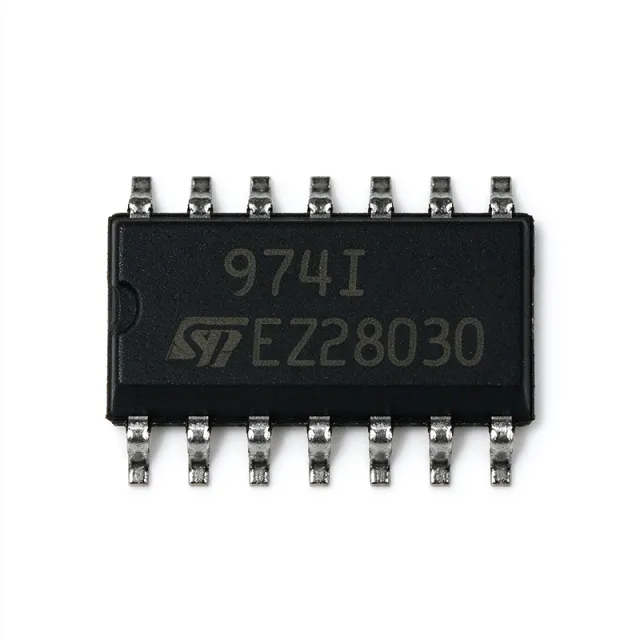
The STMicroelectronics TS974IDT is a four-circuit rail-to-rail operational amplifier featuring a 12 MHz gain-bandwidth product, 4 V/us slew rate, and 4 nV/Hz noise density in a 14-pin SO package. Its rail-to-rail output swing and operating capability from voltages as low as ±1.35 V make it suitable for compact analog signal chains that require low noise, high dynamic performance, and flexible supply-voltage operation. An operational amplifier is an analog integrated circuit that uses high-gain feedback to amplify voltage differences. The TS974 belongs to the operational-amplifier hierarchy, which sits within amplifier ICs and analog signal-processing semiconductors. Rail-to-rail output operation allows the output to approach the available supply rails, while low-noise amplification preserves small signals in audio, instrumentation, sensor, and control systems. The TS974IDT combines four amplifiers in one package. Key characteristics include 4 nV/Hz noise density, 0.003% distortion, 12 MHz bandwidth, and 4 V/us slew rate. These figures support high-frequency signal amplification with relatively low added noise. The device also includes 2 kV ESD protection and Class A latch-up immunity, improving practical robustness in sensitive analog applications. Its architecture is optimized for low-noise and low-distortion operation. The 12 MHz bandwidth provides adequate response for audio preamplification and general instrumentation, while the 4 V/us slew rate helps preserve large-signal fidelity. The rail-to-rail output topology reduces output-voltage headroom concerns, although designers must still evaluate input common-mode range, output swing, supply voltage, stability, and output loading against the manufacturer specifications. Typical uses include low-noise audio preamplification, portable and battery-powered instrumentation, sensor signal conditioning, industrial measurement systems, and general-purpose analog signal processing. The four-amplifier configuration reduces board area when several independent channels are required. It is particularly useful where four similar low-noise channels must operate within one compact package. Designers should place input and output compensation or decoupling components according to the recommended application circuit, maintain the required input and output common-mode range, and verify stability with the intended source and load impedances. The low-noise performance does not remove the need for careful grounding, short PCB traces, and clean supply routing. This page combines the principal TS974IDT operating characteristics, practical application guidance, package information, and verified replacement relationships. It also highlights design constraints and selection trade-offs that help engineers determine whether the device is appropriate before committing it to a new PCB layout.

RFQ צור קשר
TS974IN - 4-Channel Low-Noise Rail-to-Rail Op Amp | STMicroelectronics
TS974IN

TS974IN - 4-Channel Low-Noise Rail-to-Rail Op Amp | STMicroelectronics

The STMicroelectronics TS974IN is a four-circuit, rail-to-rail operational amplifier with a very low noise density of 4 nV/Hz, a 12 MHz gain-bandwidth product, and a 4 V/us slew rate, packaged in a 14-pin DIP. It is designed for applications that require low-noise signal amplification across multiple independent channels. An operational amplifier is an analog integrated circuit that amplifies the voltage difference between its non-inverting and inverting inputs. Within the amplifier hierarchy, the TS974IN is a general-purpose precision operational amplifier and a member of the rail-to-rail low-noise amplifier family. Rail-to-rail input and output operation allows the signal to approach the supply rails, improving usable dynamic range in low-voltage and single-supply systems. The TS974IN provides four amplifier channels in one package, reducing board area and simplifying multi-channel signal-conditioning layouts. Its 4 nV/Hz noise density supports high-resolution analog measurement, while the 12 MHz gain-bandwidth product and 4 V/us slew rate preserve signal fidelity in faster signal paths. The listed ultra-low distortion of 0.003% makes the device suitable for audio preamplification, filtering, buffering, and instrumentation. The device operates over a supply range extending to 10 V and includes ESD protection rated at 2 kV. The listed latch-up immunity is Class A. Each amplifier is configured as a standard voltage-feedback operational amplifier, allowing the same component to implement inverting, non-inverting, summing, comparator-style, and active-filter circuits. Operating and electrical limits should always be confirmed in the manufacturer datasheet. Typical uses include four-channel audio preamplification, sensor signal conditioning, active audio filters, low-level instrumentation, data acquisition front ends, and general-purpose analog buffering. Because all four channels share one package, matching and thermal tracking are convenient when several related analog signals are processed under similar conditions. For low-noise layouts, keep the input and feedback resistors short, place input compensation and decoupling capacitors close to the relevant pins, and avoid routing high-impedance input traces beside digital clock or switching nodes. Select the bypass capacitance and compensation values with the datasheet's stability and noise guidance in mind, particularly when driving capacitive loads. This page combines the verified TS974IN product characteristics with application guidance, drop-in replacement analysis, and engineering design notes. It is intended to help designers evaluate the TS974IN quickly while completing the mandatory signal-integrity, noise, and stability checks against the full manufacturer documentation.

RFQ צור קשר
TS974IYD - 12MHz Quad Rail-to-Rail Op Amp | STMicroelectronics
TS974IYD

TS974IYD - 12MHz Quad Rail-to-Rail Op Amp | STMicroelectronics

The STMicroelectronics TS974IYD is a four-circuit, general-purpose operational amplifier with rail-to-rail output swing, 12 MHz gain-bandwidth product, 60 dB common-mode rejection, and a 14-SOIC package. It accepts a 2.7 V to 10 V single-supply range or dual-supply operation from ±1.35 V to ±5 V, with a nominal 5 V single-supply configuration identified for the device. An operational amplifier is an analog signal-conditioning IC that compares an input voltage with a feedback-defined reference and amplifies the resulting error voltage. The TS974 belongs to the rail-to-rail operational amplifier hierarchy, where the output can approach the supply rails. This characteristic is useful when the available signal range is small, while its low-noise and low-distortion behavior make the TS97x family suitable for audio preamplification and portable instrumentation. The TS974IYD combines four amplifiers in one 14-SOIC package. Each channel has a gain-bandwidth product of 12 MHz and supports up to 100 mA of output current. Its 60 dB common-mode rejection ratio improves immunity to common-mode voltage on the input pair, while the 200 nA input bias current and 1 µA quiescent current per channel suit low-power circuitry. These characteristics support portable and battery-powered equipment operating from low supply voltages. The device supports both single- and dual-supply arrangements. In a single-supply system, the input and output signal range requires attention near the rails even though the output stage has rail-to-rail swing. In a dual-supply circuit, the stated operating range extends from ±1.35 V to ±5 V. Because the TS974 is intended for low-noise amplification, resistor selection, decoupling, grounding, and output-load compatibility remain central to achieving the intended signal quality. Typical uses include portable audio preamplification, low-level sensor conditioning, battery-powered measurement equipment, active filters, and general-purpose analog signal processing. Four channels in one package also reduce board area when a system needs several similar gain stages. The package pin arrangement and electrical characteristics must be checked against the manufacturer datasheet before applying it to a new board or using it as a replacement. For a new design, begin with the required signal bandwidth, output swing, supply voltage, and load current. Place the bypass capacitor near the power pins, keep feedback loops compact, and verify that input common-mode and output swing requirements remain valid at the chosen gain. For an existing PCB, confirm the 14-SOIC footprint, pin functions, and electrical limits before substituting another amplifier. This page consolidates the available manufacturer-family information, distributor listing details, ordering guidance, and drop-in comparison considerations. It is designed to help engineers identify whether the TS974IYD fits a low-voltage, low-noise quad-op-amp design before moving to detailed circuit review and datasheet verification.

RFQ צור קשר
TS974IYDT - 12 MHz Quad Rail-to-Rail Op Amp | STMicroelectronics
TS974IYDT

TS974IYDT - 12 MHz Quad Rail-to-Rail Op Amp | STMicroelectronics

The STMicroelectronics TS974IYDT is a quad general-purpose operational amplifier with a 12 MHz gain-bandwidth product, rail-to-rail output swing, and very low noise and distortion. It is packaged in a 14-pin SOIC package and operates from single or dual supplies as low as ±1.35 V, making it suitable for portable and battery-powered equipment. An operational amplifier, or op amp, is a high-gain analog building block used to amplify voltage differences, buffer signals, drive analog-to-digital converters, and implement active filters. The TS974IYDT belongs to the amplifier IC category within analog and mixed-signal semiconductors, combining four amplifiers in one package to reduce board area and simplify multi-channel signal conditioning. The key features of this device include four amplifier circuits in one 14-SOIC package, a 12 MHz gain-bandwidth product, and rail-to-rail output operation. Its low-noise characteristics make it suitable for audio preamplification, while its low distortion benefits instrumentation and general signal-processing circuits. The ability to operate from ±1.35 V supports low-voltage analog systems where headroom is limited. The TS974 family combines rail-to-rail output swing with low-noise, low-distortion operation. This architecture is useful when an input signal must be amplified close to the available supply range without sacrificing output linearity. Because four matched amplifier channels share one package, designers can use the device for stereo or four-channel analog paths, reducing component count and simplifying power routing. Typical uses include portable audio preamplification, sensor-signal conditioning, low-voltage instrumentation, active filters, and analog interface circuits. In each application, the 12 MHz bandwidth provides useful signal-processing headroom, while the rail-to-rail output increases usable signal range. The package is also appropriate for designs requiring four amplifiers but where a discrete quad-op-amp package would occupy additional board area. When laying out the TS974IYDT, place input and feedback components close to their associated pins and keep sensitive input traces away from output and supply-return paths. Check input and output common-mode limits, output swing, supply current, and stability requirements against the circuit operating conditions. Stable feedback-network placement is particularly important in precision filters and high-gain stages. This product page combines manufacturer-family characteristics, verified component and package information, sourcing guidance, and practical design considerations. It helps engineers compare the TS974IYDT with pin-compatible family alternatives for portable audio, industrial instrumentation, and low-voltage analog systems while focusing on the electrical and mechanical details needed for an informed design decision.

RFQ צור קשר
TS974IYPT - Quad Low-Noise Rail-to-Rail Op Amp | ST
TS974IYPT

TS974IYPT - Quad Low-Noise Rail-to-Rail Op Amp | ST

The STMicroelectronics TS974IYPT is a four-circuit, rail-to-rail output operational amplifier designed for low-noise signal conditioning. The device operates from dual supplies as low as ±1.35 V, supports an automotive temperature range of −40°C to +125°C, and is packaged in a 14-pin TSSOP. Its four amplifiers share a common supply architecture while operating independently in the package. An operational amplifier is an analog signal-processing IC that uses high-gain feedback to amplify voltage differences between its non-inverting and inverting inputs. The TS974 belongs to the operational-amplifier hierarchy, where it combines precision analog amplification, buffering, filtering, and rail-to-rail output capability. Rail-to-rail output allows the output voltage to approach the supply rails more closely than a conventional amplifier, which is valuable in compact, low-voltage systems. The TS974 family is characterized as a very-low-noise operational-amplifier family with low distortion characteristics. Its four-circuit configuration reduces board area when a design needs several matched amplifier functions. The TS974IYPT is identified as the automotive-qualified industrial temperature option and is listed for 14-pin TSSOP surface-mount assembly. Because the suffix denotes a specific ordering code, designers should confirm electrical limits, pin assignments, and qualification details against the manufacturer datasheet before release. The TS97x family operates at voltages as low as ±1.35 V, making it suitable for portable and battery-powered equipment. Its rail-to-rail signal swing supports low-voltage sensor interfaces, audio preamplifiers, and analog measurement blocks where the usable output range must remain wide. The four amplifiers in one package can also be configured for noninverting gain, inverting gain, voltage followers, active filters, difference amplifiers, and cross-coupled analog stages, depending on system requirements. Typical applications include low-voltage audio preamplification, buffered sensor acquisition, precision current sensing, active filtering, and general-purpose analog control. Rail-to-rail outputs are especially useful when driving ADC inputs or subsequent analog stages from a low-voltage supply. Designers should account for input common-mode range, output swing, noise, distortion, stability, and capacitive-load behavior separately because the product family description does not establish suitability for every external load or operating point. For layout, keep sensitive input traces short, separate high-impedance input nodes from switching and digital return currents, and place input and output compensation or bypass components according to the recommended application circuit. Decoupling capacitors should be positioned close to the supply pins. Stability with capacitive loads must be checked against the manufacturer’s guidance, especially when the amplifier drives long PCB traces, cables, or ADC sampling inputs. This product page organizes the exact ordering information, package format, technical distinctions, direct family alternatives, application guidance, and engineering considerations into one engineering reference. It helps engineers distinguish package and temperature-code variants before deciding whether a candidate is a true drop-in replacement or requires footprint and qualification review.

RFQ צור קשר
TS982IDW - Dual 200mA R-R Op Amp | STMicroelectronics
TS982IDW

TS982IDW - Dual 200mA R-R Op Amp | STMicroelectronics

STMicroelectronics TS982IDW is a dual operational amplifier with rail-to-rail output capability, 200 mA output-current drive, and operation from voltages as low as 2.7 V. The device is housed in an 8-pin SO package and is stable at unity gain. Its combination of low supply voltage, broad output-current capability, and dual-channel integration makes it suitable for industrial and automotive signal-conditioning systems. An operational amplifier is an analog integrated circuit that amplifies the voltage difference between its inverting and non-inverting inputs. The TS982 belongs to the operational-amplifier hierarchy within analog and mixed-signal semiconductors. Its dual architecture provides two amplifier channels in one package, reducing component count when a board needs matched signal conditioning, buffering, or gain stages. The TS982's rail-to-rail output stage can approach the supply rails, increasing usable output-voltage range in low-voltage systems. Its ability to drive 200 mA makes it stronger than many general-purpose dual amplifiers and allows the device to feed higher-capacitance loads or drive downstream stages. Operation down to 2.7 V supports modern low-power electronics, while unity-gain stability simplifies buffer and fixed-gain implementations. The SO-8 package provides a compact footprint for industrial, automotive, and embedded systems. The exposed-pad construction supports heat transfer when the amplifier operates at elevated output current, although board layout and thermal design remain important. Two amplifiers in one package also simplify dual-channel designs where both channels perform related functions. Typical uses include sensor-signal conditioning, active filtering, audio and communications interfaces, data acquisition, and general-purpose analog buffers. The 200 mA drive capability is particularly useful when the op-amp must charge a downstream capacitance, interface with another analog circuit, or support a load beyond the range of a lightweight low-power amplifier. Designers should verify the exact input common-mode range, output swing, bandwidth, slew rate, noise, offset, and thermal limits for the operating conditions. Input and output stability must be evaluated with the intended feedback network and load because capacitive loading can affect op-amp behavior even when unity-gain stable. This page combines manufacturer-device facts, package details, sourcing guidance, and practical analog-design considerations to help engineers evaluate TS982IDW for low-voltage, dual-channel signal-processing designs.

RFQ צור קשר
TS982IDWT - Dual 200mA Rail-to-Rail Op Amp | STMicroelectronics
TS982IDWT

TS982IDWT - Dual 200mA Rail-to-Rail Op Amp | STMicroelectronics

STMicroelectronics TS982IDWT is a dual bipolar operational amplifier with rail-to-rail outputs, a 2.2 MHz gain-bandwidth product, a 0.7 V/µs slew rate, and output-current capability up to 200 mA. The device operates from single or dual supplies down to 2.7 V and is housed in an 8-pin SO-8 exposed-pad package for improved thermal performance. An operational amplifier, or op amp, is an analog integrated circuit that amplifies the difference between two input voltages. The TS982 belongs to the amplifier IC hierarchy as a dual general-purpose voltage-feedback amplifier. Its two channels support signal conditioning, buffering, filtering, and level-shifting tasks while its high-output-current design allows it to drive heavier capacitive or finite-resistance loads than a conventional low-power amplifier. The TS982IDWT provides a 2.2 MHz gain-bandwidth product and a 0.7 V/µs slew rate. Its rail-to-rail output stage can approach the supply rails under specified load conditions, while the bipolar implementation supports a 200 mA output-current capability down to supply voltages as low as 2.7 V. Unity-gain stability simplifies direct voltage-buffer and gain-stage layouts when the surrounding feedback network remains appropriate. The 200 mA output capability is the primary technical distinction of the TS982 family. Compared with general-purpose dual amplifiers designed mainly for low-current analog signals, this device offers substantially more drive for capacitive loads, transducer interfaces, and low-impedance drive networks. The exposed pad improves heat dissipation, although a complete thermal design must still account for copper area, adjacent heat sources, and the actual dissipation at the selected supply voltage and output current. Typical uses include industrial sensor conditioning, automotive interface circuits, audio signal buffers, current-loop receivers, and general low-frequency analog signal chains. Two amplifiers in one package reduce board area and can simplify dual-channel instrumentation. For precision measurement, input bias current, input offset voltage, noise, and gain error remain important; for load driving, stability into capacitive loads and output-current limits should be evaluated before layout is finalized. Place input, feedback, and decoupling connections to minimize parasitic capacitance and loop area. Connect the exposed pad to the ground-plane structure using an appropriate thermal-via pattern, and verify stability with the intended load, cable, or sensor capacitance. Avoid placing high-current return paths beneath the sensitive input nodes because shared ground impedance can degrade input-referred accuracy. This page combines the verified device identity, package information, application guidance, pinout availability, comparison criteria, and drop-in replacement analysis in one engineering reference. It also separates confirmed characteristics from parameters that require confirmation with the manufacturer datasheet before production release.

RFQ צור קשר
TS985IJT - 14uA, 300ns Comparator | STMicroelectronics
TS985IJT

TS985IJT - 14uA, 300ns Comparator | STMicroelectronics

The STMicroelectronics TS985IJT is a single micropower, low-voltage rail-to-rail comparator operating from 1.8 V to 5 V, with typical current consumption as low as 14 uA, a typical propagation delay of 300 ns, and a 6-bump chip-scale package measuring 1.2 mm by 0.8 mm. It is designed for compact, low-power systems in which every supply current and board-area reduction can improve portability. A comparator is an analog integrated circuit that compares two input voltages and produces a digital output indicating which input is higher. The TS985 belongs to the comparator hierarchy within analog signal-chain ICs and power-management systems. Its rail-to-rail input behavior allows the common-mode input range to approach the supply rails, making it useful when valid sensor or signal levels do not remain centered around mid-supply. Key characteristics include a 1.8 V to 5 V supply range, 14 uA typical current consumption, and 300 ns typical propagation delay. The push-pull output supports direct connection to digital logic, while the small 6-CSP footprint minimizes PCB area. These features suit battery-powered sensing, compact instrumentation, industrial monitoring, and consumer devices where a traditional larger comparator package would consume excessive space. The TS985 combines low-voltage operation with a short response time. A 300 ns delay is suitable for many digital decision and threshold-detection tasks, although applications requiring nanosecond-scale edge evaluation or automotive temperature-range operation should verify the complete device ratings. Rail-to-rail inputs reduce the need to restrict common-mode signals, but input and output timing still require attention near the supply limits. Typical uses include monitoring a divided sensor signal, detecting an overvoltage or undervoltage condition, converting an analog threshold into a logic event, and waking or inhibiting a low-power subsystem. The 14 uA operating current is particularly valuable in portable equipment where the comparator itself must remain efficient during continuous monitoring. Place the comparator input pins close to the protected signal source and keep input traces short to reduce susceptibility to injected noise. Confirm logic-level compatibility with the receiving device, account for propagation delay in feedback loops, and follow the manufacturer datasheet for exposed-pad, soldering, and layout recommendations. The tiny package also requires careful assembly and adequate PCB thermal pathways where relevant.

RFQ צור קשר
TSA1005-40IFT - 10-Bit 40MSPS Dual ADC | STMicroelectronics
TSA1005-40IFT

TSA1005-40IFT - 10-Bit 40MSPS Dual ADC | STMicroelectronics

The STMicroelectronics TSA1005-40IFT is a dual-channel, 10-bit resolution analog-to-digital converter (ADC) based on a pipelined architecture, sampling up to 40 MSPS in a 48-pin TQFP (7x7 mm) package. It uses a 0.25 µm deep sub-micron CMOS process, operates from a single 2.5 V analog supply, and supports an independent 2.5 V or 3.3 V CMOS output supply. A pipelined ADC is a high-speed converter architecture that resolves an analog input across multiple cascaded low-resolution stages, each driving a sample-and-hold amplifier and a flash sub-ADC. The pipeline allows new conversions to begin every clock cycle, achieving sample rates well above 100 MSPS while keeping per-stage hardware compact. Pipelined ADCs sit within the broader taxonomy: data converter -> ADC -> high-speed ADC -> pipelined ADC -> integrated circuit -> semiconductor. The TSA1005 belongs to a category often called "baseband IF sampling ADCs," used when analog signals need to be digitized near the antenna or sensor for downstream DSP. Key specifications include 1 GHz analog input bandwidth, an integrated track-and-hold amplifier per channel, common clocking for synchronous dual-channel sampling, and a multiplexed digital output mode. The device targets applications needing a low noise floor and high SFDR; SFDR (Spurious-Free Dynamic Range) measures how far the largest spurious tone sits below the fundamental when digitizing a pure sine wave, with higher values meaning cleaner spectra. The TSA1005 is engineered for very low noise floor, high SFDR, and good channel-to-channel isolation. Typical applications include medical ultrasound imaging, professional video processing, IF (intermediate frequency) sampling for communications receivers, instrumentation, and industrial non-destructive testing. Each application relies on the part's combination of 10-bit resolution at video-grade sample rates and dual-channel synchronous capture. When designing with this part, decouple both the 2.5 V analog and 2.5/3.3 V digital rails with 100 nF ceramic capacitors placed as close as possible to each supply pin. Route the analog inputs as 50 Ω controlled-impedance traces with the analog ground plane isolated from the digital return to minimize coupling. This page synthesizes distributor pricing, drop-in same-package alternatives, and practical PCB layout notes not found in the manufacturer datasheet alone. Information current as of 2026-10-15.

RFQ צור קשר