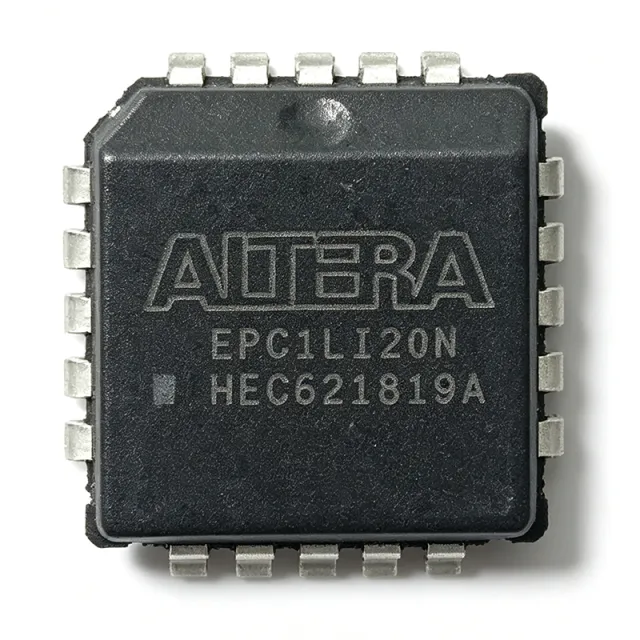
EPC1LI20
EPC1LI20 - 1Mb OTP FPGA Config PROM 20-PLCC | Altera / Intel
The Altera (now Intel) EPC1LI20 is a 1-megabit One-Time-Programmable (OTP) configuration memory device designed to configure SRAM-based Altera FPGAs such as the FLEX 8000, FLEX 10K, ACEX 1K, APEX 20K, and Mercury families. The device stores the FPGA configuration bitstream and serially loads it into the target FPGA at power-up through the Altera passive-serial, active-serial, or Altera flexible JTAG configuration scheme. The part is housed in a 20-pin Plastic J-Leaded Chip Carrier (PLCC, 9x9 mm body) and operates from a single 5.0 V supply (3.3 V-compatible I/O on EPC2 family).
A configuration PROM is a non-volatile memory IC whose sole purpose is to hold the bitstream for an SRAM-based FPGA. Because SRAM FPGAs lose their configuration when power is removed, a configuration device such as the EPC1LI20 is required in every standalone board design. The EPC1 family belongs to the broader category of FPGA configuration memory (FPGA > Configuration Memory > Configuration PROM > Non-volatile Memory > Memory IC), and is typically selected over parallel PROMs or microcontrollers because it provides a purpose-built FPGA configuration interface, eliminating firmware development and reducing board area.
Key features of the EPC1LI20 include 1 Mb of OTP storage, a serial configuration clock of up to 8 MHz (per Altera datasheet Table 1), simple four-wire interface (nCS, DCLK, DATA, OE), 5.0 V single-supply operation, low-power CMOS process, and a 1000-erase-equivalent PROM endurance rating. Programming is performed in-system through the standard JTAG (IEEE 1149.1) chain, allowing board-level programming without removing the device. The 20-pin PLCC package offers socket compatibility for prototyping and field-replacement scenarios.
Architecturally, the EPC1LI20 contains an oscillator, address counter, programming voltage generator, and a UV-erasable EPROM-style memory array. The internal state machine sequences through the array on each rising DCLK edge, presenting the next data byte on the DATA output. An optional cascading mode allows multiple EPC1 devices to be daisy-chained to configure large FPGAs (e.g., APEX 20K) or multi-FPGAs systems, using the nCASC pin for handshaking.
Typical applications include single-FPGA standalone configuration, multi-FPGA board configuration with daisy-chained PROMs, FPGA development platforms, factory programming stations, industrial control and factory automation boards, and military/aerospace SRAM-FPGA systems requiring legacy 5V logic compatibility. Designers choose EPC1LI20 over flash-based EPC2 when the bitstream is finalized and cost-effective OTP storage is preferred.
When designing with the EPC1LI20, ensure that the FPGA's configuration mode pins MSEL[1:0] are correctly set for the Altera serial configuration scheme. Decoupling: place a 0.1 uF ceramic capacitor close to VCC and another close to the VPP pin. The JTAG chain should include proper TMS/TCK pull-ups as recommended in IEEE 1149.1 boundary-scan practice. For multi-device cascading, verify timing against the FPGA's CONF_DONE and nSTATUS handshakes.
This page synthesizes distributor pricing, cross-reference data from FindChips, and practical JTAG-programming notes not found in a single Altera datasheet, giving engineers a complete view of the EPC1LI20 lifecycle, drop-in alternatives, and design trade-offs.
RFQ
צור קשר