מוצרים (19,000+)

STM32F429IEH6 - 180MHz Cortex-M4 MCU 512KB Flash | STMicroelectronics
STM32F429IEH6

STM32F429IEH6 - 180MHz Cortex-M4 MCU 512KB Flash | STMicroelectronics

The STMicroelectronics STM32F429IEH6 is a high-performance 32-bit ARM Cortex-M4 microcontroller with FPU and DSP instructions, delivering 180 MHz / 225 DMIPS core performance with 512 KB of embedded Flash and 256 KB of SRAM in a 176-ball UFBGA (10x10 mm) package. According to the STMicroelectronics datasheet, the device integrates an Adaptive Real-Time (ART) Accelerator that allows 0-wait-state execution from Flash, plus a Chrom-ART graphics accelerator and an integrated TFT-LCD controller supporting resolutions up to XGA. An ARM Cortex-M4 microcontroller (MCU) is a 32-bit RISC processor core featuring a single-precision floating-point unit (FPU), DSP extensions, and a Nested Vectored Interrupt Controller (NVIC). Cortex-M4 sits in the Cortex-M family (Cortex-M0/M0+/M3/M4/M7) targeted at deterministic embedded control, and STM32F4 series parts occupy the high-performance tier with up to 180 MHz operation. The STM32F429IEH6 belongs to the broader STM32 family of microcontrollers — a portfolio that also includes lower-power STM32L0/L4 and mainstream STM32F0/F1/F3 variants — covering the full range from 8-bit replacement up to high-performance graphics and motor control. Key specifications include 512 KB Flash organized as dual-bank for read-while-write, 256 KB SRAM (including 64 KB core-coupled SRAM), 17 timers, three 12-bit ADCs at 2.4 MSPS, two 12-bit DACs, USB 2.0 OTG full-speed and high-speed with on-chip PHY, 10/100 Ethernet MAC, CAN 2.0B, SDMMC, and an external memory controller for SDRAM, SRAM, NOR/NAND, and CompactFlash. Operating voltage is 1.8-3.6 V and junction temperature spans -40 °C to +85 °C (industrial grade) or up to +105 °C. The STM32F429IEH6 leverages a Cortex-M4 core with single-precision FPU, Thumb-2 instruction set, and DSP extensions. The ART Accelerator prefetches and caches instructions to deliver true 0-wait-state performance at 180 MHz even from Flash — equivalent to 225 DMIPS / 1.25 DMIPS/MHz (Dhrystone 2.1). The Chrom-ART DMA2D engine and LCD-TFT controller offload pixel processing, enabling image rendering without CPU intervention — a significant advantage in graphical HMI designs. Typical applications include industrial HMI panels with TFT displays, motor-control drives, medical patient monitors, point-of-sale terminals, GPS/navigation devices, smart appliances, IoT gateways, and graphical user interfaces. The combination of LCD controller, Ethernet, USB OTG HS, and 176-pin BGA package supports compact designs with rich connectivity. When designing with the STM32F429IEH6, ensure the PCB incorporates a stable 1.8-3.6 V supply with adequate decoupling (typically 100 nF + 4.7 µF bulk) near each VDD pin group. The 176-ball UFBGA requires reflow profile per JEDEC J-STD-020, and routing length-matched SDRAM traces must observe the external memory controller timing budgets described in ST application note AN4861. This page synthesizes distributor pricing, package-pinned drop-in alternatives, design notes, and parameter-by-parameter comparisons that are not consolidated in any single manufacturer or distributor page.

RFQ צור קשר
STM32F429IET6 - 180MHz Cortex-M4 512KB MCU | STMicroelectronics
STM32F429IET6

STM32F429IET6 - 180MHz Cortex-M4 512KB MCU | STMicroelectronics

The STMicroelectronics STM32F429IET6 is a 32-bit ARM Cortex-M4 microcontroller with FPU and DSP instructions, operating up to 180 MHz and integrating 512 KB of Flash memory in a 176-pin LQFP package measuring 24 x 24 mm. According to the verified product listing, the device belongs to the STM32F4 high-performance microcontroller family and combines an adaptive real-time accelerator, memory protection capability, extensive connectivity, and mixed-signal peripherals. A microcontroller is a programmable system-on-chip that executes firmware, coordinates digital interfaces, samples analog signals, and controls external hardware. The STM32F4 family sits within the hierarchy microcontroller, embedded processor, semiconductor, and electronic component. Its Cortex-M4 core is designed for real-time embedded workloads where efficient instruction execution, deterministic peripherals, and integrated connectivity are more important than a host operating system. Key verified features include a 32-bit Cortex-M4 core with FPU, DSP instructions, operation up to 180 MHz, 512 KB of Flash, 225 DMIPS, an MPU, and zero-wait-state Flash execution using the ART Accelerator. The family datasheet also identifies USB high-speed and full-speed support, Ethernet, 17 timers, three ADCs, up to 20 communication interfaces, camera capability, and an LCD-TFT controller. These resources support demanding industrial controls, communications equipment, graphical instruments, and connected embedded systems. The core can execute 225 DMIPS according to the verified family data, while the FPU accelerates floating-point calculations and DSP instructions support signal-processing workloads. The 512 KB target variant offers substantial firmware space for networking stacks, control algorithms, and application logic. Exact SRAM capacity, voltage limits, GPIO count, and detailed timing values are not provided in the supplied excerpts and therefore are not inferred here. Typical uses include EtherCAT or industrial automation controllers, Ethernet-connected equipment, USB peripherals, camera-based inspection, TFT human-interface panels, and high-performance sensor-processing modules. The combination of Ethernet, USB, camera, LCD-TFT, and multiple serial interfaces allows consolidation of functions that might otherwise require several discrete components. Designers must use the manufacturer pinout and electrical data before PCB layout because all 176 package pins must be assigned correctly and unused interfaces need suitable termination. Power, decoupling, clock, reset, boot, and signal-integrity decisions should follow the STM32F427xx and STM32F429xx family datasheet rather than generic MCU assumptions. This product record consolidates verified distributor specifications, the official family datasheet, sourcing information, and practical integration guidance. It also distinguishes true same-package drop-in alternatives from merely similar MCUs, helping engineers avoid replacements that require firmware, board, or pin-function changes.

RFQ צור קשר

STM32F429IGH6 - 180MHz 1MB Cortex-M4 MCU | STMicroelectronics
STM32F429IGH6

STM32F429IGH6 - 180MHz 1MB Cortex-M4 MCU | STMicroelectronics

The STMicroelectronics STM32F429IGH6 is a 32-bit ARM Cortex-M4 microcontroller with an FPU, up to 180 MHz operating frequency, 1 MB flash memory, and 176-ball UFBGA package. It combines high processing performance with extensive connectivity and peripheral resources for embedded control, communications, industrial, and consumer applications. An ARM Cortex-M4 microcontroller is a 32-bit reduced-instruction-set processor core integrated with memory, communication interfaces, timers, analog peripherals, and GPIO. STM32F4 devices belong to the microcontroller hierarchy: ARM Cortex-M core -> STM32 family -> STM32F4 series -> STM32F429 device. The integrated FPU accelerates floating-point calculations, while DSP instructions support digital signal-processing workloads. The verified listing identifies an ARM Cortex-M4 core, 180 MHz maximum frequency, 1 MB flash, and a 176-ball UFBGA package. The STM32F429IGH6 is suitable for applications requiring substantial embedded processing, connected peripherals, and compact surface-mount construction. The supplied distributor results also identify a 32-bit data width and SMD/SMT mounting style. Typical uses include industrial automation, communications gateways, motor and motion-control systems, instrumentation, audio and signal processing, and connected embedded products. The microcontroller family is designed for designs that need more compute and memory than entry-level Cortex-M devices while retaining the software ecosystem and peripheral integration typical of STM32 platforms. A key design consideration is package and pin verification. The STM32F429IGH6 uses a 176-ball UFBGA package, so PCB land patterns, ball assignments, power routing, decoupling, and exposed thermal-management requirements must match the manufacturer package information. Software migration also requires checking peripheral availability, interrupt assignments, clock configuration, memory map, and board-level power requirements. This page combines verified distributor specifications, datasheet links, cross-reference findings, and engineering design guidance for engineers evaluating the STM32F429IGH6. Parameters not explicitly present in the supplied verified data remain explicitly marked for engineering review rather than estimated.

RFQ צור קשר
STM32F429IGT6 - 180MHz Cortex-M4 MCU | STMicroelectronics
STM32F429IGT6

STM32F429IGT6 - 180MHz Cortex-M4 MCU | STMicroelectronics

The STMicroelectronics STM32F429IGT6 is a 32-bit Arm Cortex-M4 microcontroller operating up to 180 MHz, with 1 MB of Flash memory, 256 KB of system SRAM, 4 KB of backup SRAM, and 17 timers in a 176-pin LQFP package. The Cortex-M4 core includes a single-precision FPU and DSP instructions, while the ART Accelerator supports zero-wait-state execution from Flash. Its integrated connectivity includes USB OTG HS/FS, Ethernet, and numerous serial and display interfaces. A microcontroller is an integrated semiconductor that executes firmware, controls peripherals, and provides the central processing element for embedded equipment. The STM32F4 family belongs to the MCU hierarchy and combines a RISC processor core, embedded nonvolatile Flash, SRAM, timers, analog converters, communication controllers, and GPIO into one device. This integration reduces component count and supports deterministic control for industrial, communications, audio, and human-machine-interface equipment. Key features include 225 DMIPS at up to 180 MHz, an adaptive real-time accelerator, three ADCs, LCD-TFT controller, full-speed USB interfaces, Ethernet connectivity, and 17 timers. The snippet identifies USB OTG HS/FS, Ethernet, 3 ADCs, and 20 communication interfaces as major capabilities. Depending on the exact ordering code and device variant, exposed memory and peripheral resources must be reconciled with the manufacturer datasheet before PCB release. The Cortex-M4 architecture combines a 32-bit RISC instruction set, single-precision floating-point hardware, DSP instructions, an MPU, and adaptive Flash acceleration. This supports high-throughput control and signal-processing workloads without requiring a separate processor. The IGT6 ordering code specifically provides 1 MB of Flash rather than the upper 2 MB capacity available across the broader STM32F427xx and STM32F429xx family. Typical applications include industrial HMIs, connected industrial equipment, data acquisition, USB- or Ethernet-connected controllers, audio processing, and high-performance embedded control. Parallel LCD support is particularly relevant to human-machine interfaces, while Ethernet and USB permit network management, firmware updating, and host connectivity when the board design supplies the required clocks, transceiver connections, protection, and routing. Designers should allocate the complete 176-pin LQFP footprint, follow the manufacturer package and pin definitions, and preserve adequate decoupling near every supply pin. Firmware must be validated for clock-tree limits, peripheral pin multiplexing, external memory requirements, and unused-pin treatment. A hardware drop-in replacement should be approved only after comparing the exact pinout, memory size, electrical limits, peripheral population, and firmware assumptions.

RFQ צור קשר
STM32F429IIH6 - 180MHz Cortex-M4 2MB MCU | STMicroelectronics
STM32F429IIH6

STM32F429IIH6 - 180MHz Cortex-M4 2MB MCU | STMicroelectronics

The STMicroelectronics STM32F429IIH6 is an ARM Cortex-M4 32-bit microcontroller with FPU and DSP instructions, operating up to 180 MHz and containing 2 MB of Flash memory in a 176+25 UFBGA (10 x 10 mm) package. It targets high-performance embedded control, connectivity, multimedia, industrial, and communications systems. A Cortex-M4 microcontroller is a reduced-instruction-set controller within the ARM processor family. The STM32F429II combines a 32-bit core, floating-point hardware, DSP instructions, extensive memory, GPIO, timers, communication peripherals, and analog resources in one device. Its hierarchy is microcontroller -> embedded processor -> ARM Cortex-M -> Cortex-M4 microcontroller. The verified core specifications include an Arm Cortex-M4 CPU with FPU, ART Accelerator capability, operation up to 180 MHz, and 225 DMIPS at 1.25 DMIPS/MHz. The device also provides 2 MB of Flash configured as 2M x 8. DSP instructions support audio, signal-processing, and control workloads where floating-point or fixed-point arithmetic is useful. The STM32F429II family is positioned for applications requiring greater processing capability and memory than smaller Cortex-M devices. Its integrated resources can reduce external component count, while the 10 x 10 mm UFBGA package supports compact high-density designs. Exact peripheral availability, pin assignments, electrical limits, and memory-map details should be checked against the manufacturer documentation for the selected ordering code. Typical applications include industrial automation, communications equipment, audio and digital signal processing, motor and motion control, human-machine interfaces, networked embedded systems, and consumer electronics. The Cortex-M4 DSP and FPU features are particularly relevant when the control loop must process sampled signals or perform filtering without relying solely on an external processor. A critical design consideration is that the 176+25 UFBGA package requires a PCB land pattern, solder-mask design, and manufacturing process capable of handling fine-pitch balls. Designers should also confirm power sequencing, decoupling, clock configuration, boot settings, pin multiplexing, and peripheral-specific electrical constraints before schematic release. This product page consolidates verified source specifications, package information, application guidance, and explicit data gaps. It does not invent electrical values or pin names that were absent from the supplied web data, and it separates confirmed facts from parameters requiring datasheet review.

RFQ צור קשר
STM32F429IIH6TR - 180MHz Cortex-M4 2MB MCU | STMicroelectronics (Tape & Reel)
STM32F429IIH6TR

STM32F429IIH6TR - 180MHz Cortex-M4 2MB MCU | STMicroelectronics (Tape & Reel)

The STMicroelectronics STM32F429IIH6TR is an ARM Cortex-M4 32-bit microcontroller with FPU and DSP instructions, operating up to 180 MHz and containing 2 MB of Flash memory in a 176+25 UFBGA (10 x 10 mm) package. It targets high-performance embedded control, connectivity, multimedia, industrial, and communications systems. A Cortex-M4 microcontroller is a reduced-instruction-set controller within the ARM processor family. The STM32F429II combines a 32-bit core, floating-point hardware, DSP instructions, extensive memory, GPIO, timers, communication peripherals, and analog resources in one device. Its hierarchy is microcontroller -> embedded processor -> ARM Cortex-M -> Cortex-M4 microcontroller. The verified core specifications include an Arm Cortex-M4 CPU with FPU, ART Accelerator capability, operation up to 180 MHz, and 225 DMIPS at 1.25 DMIPS/MHz. The device also provides 2 MB of Flash configured as 2M x 8. DSP instructions support audio, signal-processing, and control workloads where floating-point or fixed-point arithmetic is useful. The STM32F429II family is positioned for applications requiring greater processing capability and memory than smaller Cortex-M devices. Its integrated resources can reduce external component count, while the 10 x 10 mm UFBGA package supports compact high-density designs. Exact peripheral availability, pin assignments, electrical limits, and memory-map details should be checked against the manufacturer documentation for the selected ordering code. Typical applications include industrial automation, communications equipment, audio and digital signal processing, motor and motion control, human-machine interfaces, networked embedded systems, and consumer electronics. The Cortex-M4 DSP and FPU features are particularly relevant when the control loop must process sampled signals or perform filtering without relying solely on an external processor. A critical design consideration is that the 176+25 UFBGA package requires a PCB land pattern, solder-mask design, and manufacturing process capable of handling fine-pitch balls. Designers should also confirm power sequencing, decoupling, clock configuration, boot settings, pin multiplexing, and peripheral-specific electrical constraints before schematic release. This product page consolidates verified source specifications, package information, application guidance, and explicit data gaps. It does not invent electrical values or pin names that were absent from the supplied web data, and it separates confirmed facts from parameters requiring datasheet review.

RFQ צור קשר
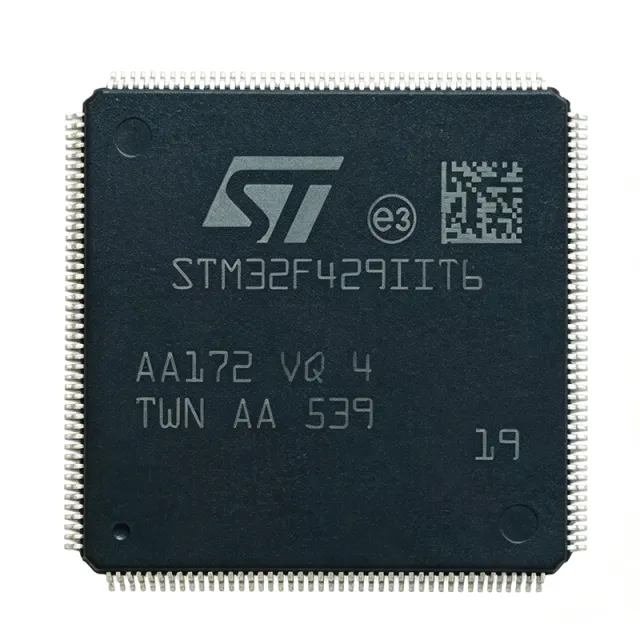
STM32F429IIT6 - 180MHz ARM Cortex-M4 MCU with 2MB Flash | STMicroelectronics
STM32F429IIT6

STM32F429IIT6 - 180MHz ARM Cortex-M4 MCU with 2MB Flash | STMicroelectronics

The STM32F429IIT6 is a high-performance 32-bit microcontroller from STMicroelectronics, featuring an ARM Cortex-M4 core with floating-point unit (FPU) running at up to 180 MHz. It integrates 2 MB of Flash memory and 256 KB of SRAM, making it suitable for complex applications requiring substantial code and data storage. The device is housed in a 176-pin LQFP package (LQFP176) and operates over a supply voltage range of 1.8V to 3.6V. A microcontroller (MCU) is a compact integrated circuit designed to govern a specific operation in an embedded system. It contains a processor core, memory, and programmable input/output peripherals. The STM32F429IIT6 belongs to the STM32F4 series, which is part of the broader STM32 family of 32-bit Flash microcontrollers based on the ARM Cortex-M processor. These MCUs are widely used in industrial control, consumer electronics, and Internet of Things (IoT) devices due to their balance of performance, power efficiency, and peripheral integration. Key features of the STM32F429IIT6 include a rich set of peripherals: multiple 12-bit ADCs, DACs, timers, USARTs, SPIs, I2Cs, USB OTG, CAN, and an LCD-TFT controller. It also supports external memory interfaces (FSMC) for expanding memory beyond the on-chip resources. The device includes a cryptographic acceleration cell and a true random number generator, enhancing security for applications requiring data protection. With a comprehensive set of development tools and middleware from STMicroelectronics, the STM32F429IIT6 accelerates time-to-market for embedded designs. Technically, the STM32F429IIT6 leverages the ARM Cortex-M4 core with DSP instructions and a single-precision FPU, enabling efficient execution of complex algorithms such as digital signal processing and motor control. The memory architecture includes an 8-KB instruction cache and a 4-KB data cache to optimize performance when accessing external memory. The device supports a wide range of clock sources, including internal RC oscillators, external crystals, and PLLs, allowing designers to balance performance and power consumption. Typical applications include industrial automation, motor drives, medical devices, audio processing, and human-machine interfaces (HMI) with graphical displays. The integrated LCD-TFT controller simplifies the design of color displays, while the advanced timer peripherals provide precise PWM generation for motor control. The device's low-power modes, including Sleep, Stop, and Standby, enable battery-powered applications to extend operational life. When designing with the STM32F429IIT6, ensure proper decoupling of the power supply pins with 100 nF capacitors placed close to each VDD pin. The VDDA analog supply should be filtered with a ferrite bead and a 1 uF capacitor to reduce noise for ADC accuracy. Additionally, the BOOT0 pin configuration must be set correctly to select the boot source, and the NRST pin should have an external pull-up resistor and a capacitor for reliable reset operation.

USD $8.35 צור קשר
STM32F429IIT6E - 180MHz Cortex-M4 MCU | STMicroelectronics
STM32F429IIT6E

STM32F429IIT6E - 180MHz Cortex-M4 MCU | STMicroelectronics

The STMicroelectronics STM32F429IIT6E is a 32-bit ARM Cortex-M4 microcontroller operating up to 180 MHz, with 2 MB of Flash memory, in a 176-LQFP package measuring 24 x 24 mm. What is an ARM Cortex-M4 microcontroller? An MCU is a semiconductor that combines a processor core, memory, peripherals, and communication interfaces on one IC. The Cortex-M4 core belongs to the ARM Cortex-M family of 32-bit RISC processors and is designed for embedded control, signal processing, communications, and real-time applications. In the STM32F4 family, the STM32F429 combines high performance with extensive external connectivity and is commonly used where a high pin count is valuable. Key verified features include a 32-bit RISC core, operation up to 180 MHz, and 2 MB of Flash organized as 2M x 8. The DigiKey listing identifies the device as a 176-LQFP package with a 24 x 24 mm body. The STMicroelectronics product page identifies STM32F427xx and STM32F429xx devices as members of the STM32F4 family based on the high-performance Arm Cortex-M4 core. The STM32F429IIT6E is positioned between simple control MCUs and higher-end application processors. Its broad peripheral and I/O capability makes it relevant for industrial equipment, human-interface systems, communications equipment, audio and control platforms, and test or measurement products. Firmware selection must use the exact STM32F429IIT6E device identity rather than relying only on the STM32F4 family name. The 176-LQFP package exposes substantially more I/O than small-package MCUs, which is useful for parallel buses, display interfaces, communication peripherals, control signals, and multi-channel sensing. Because no verified pin table was supplied, the pinout is marked as unavailable rather than inferred. Likewise, electrical limits, memory beyond the verified 2 MB Flash figure, operating temperature, and compliance claims should be checked in the manufacturer documentation before design release. For PCB design, confirm the exact land pattern, pin assignments, power requirements, decoupling, clocking, and exposed thermal strategy from the official STM32F429 documentation. Do not substitute a similarly named STM32F429IIT6G without confirming package, temperature, qualification, and order-code differences. This product record consolidates verified distributor and manufacturer information, while separating confirmed data from parameters requiring datasheet review. It supports faster sourcing and engineering triage without treating unverified specifications as guaranteed design facts.

RFQ צור קשר
STM32F429IIT6G - 180MHz Cortex-M4 MCU | STMicroelectronics
STM32F429IIT6G

STM32F429IIT6G - 180MHz Cortex-M4 MCU | STMicroelectronics

The STMicroelectronics STM32F429IIT6G is a 32-bit Arm Cortex-M4 microcontroller with an FPU operating up to 180 MHz, up to 2 MB of Flash memory, and up to 256+4 KB of RAM in a 176-LQFP 24 x 24 mm package. According to the verified distributor and manufacturer data, the device is associated with high-performance embedded control, USB OTG HS/FS, Ethernet, 17 timers, 3 ADCs, up to 20 communication interfaces, camera support, and LCD-TFT support. A microcontroller is an integrated semiconductor device that combines a processor core, memory, peripherals, and communication interfaces on one package. The Cortex-M4 architecture places the STM32F429IIT6G in the embedded-processor hierarchy: Arm Cortex-M4 core → STM32F4 family → 32-bit microcontroller → embedded processor → semiconductor. Its combination of compute performance, memory, and peripheral integration makes it suitable for applications requiring more capability than a basic control MCU while retaining a single-chip implementation. The principal verified characteristics are a 32-bit Arm Cortex-M4 core, 180 MHz maximum frequency, 2 MB Flash, 256+4 KB RAM, and a 176-LQFP package. The verified family description also identifies 225 DMIPS, USB OTG HS/FS, Ethernet, 17 timers, 3 ADCs, up to 20 communication interfaces, camera, and LCD-TFT functions. These peripherals support control loops, data acquisition, communications, human-machine interfaces, and connected embedded equipment. The STM32F4 family is designed for embedded systems where a single MCU must coordinate real-time processing and multiple peripherals. The Cortex-M4 FPU supports digital control and signal-processing workloads that benefit from single-precision floating-point calculations. USB and Ethernet connectivity can reduce the need for separate interface components, while the ADC and timer resources support sensor acquisition, motor control, industrial automation, communications, and display systems. Typical applications include industrial automation equipment, motor-control systems, networked embedded controllers, USB-connected instruments, camera or vision modules, and LCD-TFT human-machine interfaces. The 176-LQFP package exposes a large pin count, which can provide broad peripheral connectivity while remaining suitable for leaded surface-mount assembly. The design must follow the manufacturer’s pinout, electrical limits, decoupling recommendations, and PCB-layout guidance. A key design consideration is to validate the complete peripheral allocation, pin multiplexing, power requirements, and startup configuration in the manufacturer datasheet before layout release. The STM32F429IIT6G is suitable when a design needs a high-performance Cortex-M4 MCU, substantial Flash, RAM, and integrated communications in a 176-LQFP package. This page combines verified sourcing information, technical context, application guidance, and data-needed markers without inventing unavailable electrical details.

RFQ צור קשר
STM32F429IIT6J - 180MHz 2MB Cortex-M4 MCU | STMicroelectronics
STM32F429IIT6J

STM32F429IIT6J - 180MHz 2MB Cortex-M4 MCU | STMicroelectronics

The STMicroelectronics STM32F429IIT6J is an Arm Cortex-M4 32-bit microcontroller operating up to 180 MHz, with 2 MB of Flash memory and a 176-LQFP package measuring 24 x 24 mm. The device is positioned for high-performance embedded control requiring substantial program memory, broad peripheral connectivity and real-time processing. Verified distributor data identifies it as the STM32F429 series member with a 2M x 8 Flash configuration. A microcontroller is a programmable semiconductor system that integrates a processor core, memory and peripherals into one device. In the product hierarchy, the STM32F429 belongs to STM32F4 microcontrollers, then 32-bit embedded MCUs, then integrated circuits and semiconductors. Its Cortex-M4 core combines general-purpose control with floating-point-oriented workloads, while the larger Flash capacity supports application code, protocol stacks, firmware updates and graphics or control logic. The verified product information establishes a maximum core frequency of 180 MHz and 2 MB of Flash. The STM32F429 family also supports devices in the STM32F427xx and STM32F429xx families based on the same high-performance Arm Cortex-M4 architecture, as stated on the official STMicroelectronics product page. Exact RAM size, GPIO count, supply range, peripheral list and operating-temperature limits were not included in the supplied evidence and therefore are not asserted here. A 176-LQFP package provides a large lead count for designs requiring extensive external connectivity. Such packages are mechanically suited to leaded through-hole assembly and are common in industrial control equipment where a higher pin count is preferable to a very small fine-pitch package. The verified 24 x 24 mm body size enables the PCB footprint to be planned with adequate spacing for assembly and inspection. Typical uses include industrial automation, communications equipment, motor control, data acquisition, human-interface systems and embedded gateways. Firmware selection depends on the exact peripheral set, memory requirements and operating conditions, which should be confirmed against the manufacturer documentation for the ordered device. The STM32F429IIT6J is therefore most appropriate when a design specifically targets the STM32F429 platform and its 180 MHz Cortex-M4 processing capability. The key procurement check is package and firmware continuity. Because the orderable suffix J distinguishes this MPN, engineers should confirm package, grade, temperature range and software-support requirements before substitution. The available evidence identifies STM32F429IIT6J as obsolete in one cross-reference result, so lifecycle status should be reconfirmed with STMicroelectronics or an authorized distributor before a production release. This page consolidates the verified manufacturer identification, distributor package information, availability context and replacement research. It also distinguishes confirmed data from missing technical fields rather than estimating unverified electrical specifications.

RFQ צור קשר
STM32F429NEH6 - 180MHz Cortex-M4 MCU with 512KB Flash | STMicroelectronics
STM32F429NEH6

STM32F429NEH6 - 180MHz Cortex-M4 MCU with 512KB Flash | STMicroelectronics

The STMicroelectronics STM32F429NEH6 is a 32-bit ARM Cortex-M4 microcontroller with an FPU, DSP instructions, and a maximum frequency of 180 MHz, paired with 512 KB of Flash memory and a 216-pin TFBGA package measuring 13 mm by 13 mm. It targets high-performance embedded systems that require substantial processing speed, memory, and mixed peripheral connectivity in one compact package. A microcontroller such as the STM32F429NEH6 is the central processing element of an embedded control system. Its core executes application code, interrupts, signal-processing routines, and communication protocols, while integrated memories store firmware and working data. The Cortex-M4 architecture provides a 32-bit processing platform with hardware floating-point and DSP support, reducing the implementation burden for control, signal-processing, and floating-point workloads compared with software-only emulation. Verified listing data identifies 225 DMIPS at 1.25 DMIPS/MHz with Dhrystone 2.1, plus the ART Accelerator for zero-wait-state Flash execution. Available memory resources include 512 KB of Flash, 256 KB of system SRAM, and 4 KB of backup SRAM. The device also provides an LCD parallel interface, 8080/6800-style display connectivity, and broad I/O capability for industrial, display, networking, and embedded-control equipment. The STM32F429 family combines an STM32F4-class high-performance MCU core with extensive serial and parallel interfaces. Source material specifically mentions 2-channel I2C, while the verified product data confirms 216 pins and the 13 mm × 13 mm TFBGA package. This pin count supports broad access to communication, display, control, and general-purpose I/O functions, but the dense BGA also demands careful PCB layout and assembly planning. Typical applications include industrial automation equipment, TFT-LCD human-interface panels, communications controllers, data-acquisition systems, and embedded control platforms. The 180 MHz Cortex-M4 core is well suited to responsive multitasking, while DSP instructions and the FPU support real-time mathematical operations. Hardware choices should still be validated against the complete peripheral mapping, voltage requirements, memory organization, and package details in the manufacturer documentation. The main design consideration is board implementation. A 216-pin TFBGA requires adequate escape routing, via geometry, thermal design, and assembly capability; pin names and the exact electrical net mapping must be taken from the official package documentation rather than inferred from distributor descriptions. The official STMicroelectronics product page and datasheet should be used to confirm lifecycle status, pinout, alternate functions, and programming support before layout release. This page consolidates verified distributor specifications, sourcing information, application context, and engineering-oriented selection guidance. It also identifies where the supplied data is incomplete, preventing unverified pin names, prices, lifecycle claims, or compliance assumptions from being presented as manufacturer facts.

RFQ צור קשר
STM32F429NGH6 - 180MHz ARM Cortex-M4 MCU with 1MB Flash | STMicroelectronics
STM32F429NGH6

STM32F429NGH6 - 180MHz ARM Cortex-M4 MCU with 1MB Flash | STMicroelectronics

The STM32F429NGH6 is a high-performance 32-bit microcontroller from STMicroelectronics, based on the ARM Cortex-M4 core with floating-point unit (FPU) running at up to 180 MHz. It integrates 1 MB of Flash memory and 256 KB of SRAM, making it suitable for complex applications requiring substantial code and data storage. The device is housed in a 176-pin BGA package (TFBGA176) with a 14x14 mm footprint, offering a compact solution for space-constrained designs. What is a microcontroller? A microcontroller (MCU) is a compact integrated circuit designed to govern a specific operation in an embedded system. It contains a processor core, memory (Flash and SRAM), and programmable input/output peripherals on a single chip. In the system hierarchy, the STM32F429NGH6 is a high-end MCU, positioned above basic 8-bit and 16-bit microcontrollers, and it competes with other 32-bit ARM Cortex-M based MCUs. Its role is to execute application firmware, interface with sensors and actuators, and manage communication protocols, serving as the 'brain' of embedded systems. Key features include a 180 MHz ARM Cortex-M4 core with FPU, 1 MB Flash, 256 KB SRAM, and a comprehensive set of peripherals: multiple 12-bit ADCs, DACs, timers, USARTs, SPIs, I2Cs, USB OTG, CAN, and an LCD-TFT controller. The device also supports external memory interfaces (FMC) for SDRAM, NOR, and NAND Flash, and includes a cryptographic acceleration unit for secure applications. These features enable advanced user interfaces, real-time control, and connectivity. Technically, the STM32F429NGH6 leverages the ARM Cortex-M4 architecture with DSP instructions and a single-precision FPU, providing efficient signal processing capabilities. The 180 MHz clock speed, combined with a 256 KB SRAM, allows for complex algorithms and multitasking. The device operates from 1.7V to 3.6V, with a wide temperature range of -40°C to +85°C, and includes power-saving modes for low-power applications. Typical applications include industrial control systems, motor drives, medical devices, consumer electronics, and IoT gateways. The LCD-TFT controller and rich connectivity make it ideal for human-machine interfaces (HMIs) and smart appliances. The cryptographic unit supports secure communication in IoT and payment terminals. When designing with this MCU, ensure adequate decoupling on all power pins and follow the layout guidelines in the datasheet for the BGA package. The 176-pin BGA requires careful PCB design for routing and thermal management. Use the STM32CubeMX tool for pin configuration and code generation to accelerate development.

RFQ צור קשר
STM32F429NIH6 - 180MHz ARM Cortex-M4 MCU 2MB Flash | STMicroelectronics
STM32F429NIH6

STM32F429NIH6 - 180MHz ARM Cortex-M4 MCU 2MB Flash | STMicroelectronics

The STMicroelectronics STM32F429NIH6 is a high-performance ARM Cortex-M4 microcontroller with FPU operating at up to 180 MHz, integrating 2 MB of dual-bank Flash memory and 256 KB of SRAM in a 216-pin TFBGA (13x13 mm) package. It belongs to the STM32F4 high-performance advanced line and delivers 225 DMIPS/1.25 DMIPS/MHz (Dhrystone 2.1) with DSP instructions and a single-precision floating-point unit. What is a microcontroller (MCU)? A microcontroller is a compact integrated circuit that integrates a processor core, non-volatile Flash memory, volatile SRAM, and programmable input/output peripherals on a single die. Microcontrollers are the backbone of embedded systems, ranging from simple household appliances to complex industrial automation. The STM32F429NIH6 sits in the STM32F4 series of the broader STM32 family of 32-bit ARM Cortex-M MCUs; within that hierarchy it is a Cortex-M4 device with DSP and FPU, enabling efficient signal processing and floating-point math for real-time applications. Key features include the ARM 32-bit Cortex-M4 core with adaptive real-time (ART) accelerator that enables 0-wait state execution from Flash at 180 MHz, a TFT-LCD controller with Chrom-ART, a parallel camera interface, a cryptographic/hash processor, a true random number generator (TRNG), and an external memory controller (FMC) that supports SDRAM. Communication interfaces include USB OTG HS/FS, 10/100 Ethernet MAC, multiple USART/UART, SPI, I2C, CAN, and SDIO instances. Three 12-bit ADCs and two 12-bit DACs support mixed-signal designs, and 17 timers plus an RTC cover nearly any timing requirement. From a technical depth perspective, the dual-bank Flash architecture allows read-while-write, enabling in-field firmware upgrades without halting the application. The ART accelerator prefetches and caches instructions to remove the Flash wait-state penalty at full CPU speed, so the device can sustain 225 DMIPS without external memory. The integrated TFT-LCD controller drives up to 24-bit parallel RGB interfaces without an external controller, while the FMC permits glueless external SDRAM/NOR/NAND expansion for buffer-rich graphics or data-logging designs. Typical applications include high-end industrial control systems, human-machine interfaces (HMIs) with rich graphical user interfaces, point-of-sale terminals, medical devices, consumer electronics with TFT displays, IoT gateways requiring Ethernet/USB, and building automation. The combination of 2 MB code room and 256 KB SRAM lets designers run large graphical stacks (TouchGFX, emWin, LVGL) plus real-time control loops on a single chip. When designing with this device, ensure proper decoupling on every supply pin, a continuous low-impedance ground plane beneath the TFBGA, and at least a 4-layer PCB to fan out the 0.8 mm pitch. Verify thermal performance since the 216-ball TFBGA exposes most of the heat through the inner balls and vias; a thermal pad or copper-in-paste array on the center balls is recommended for high-utilization designs. Take advantage of Sleep, Stop, and Standby modes to minimize power in battery-backed applications.

USD $8.63 צור קשר
STM32F429NIH6E - 180MHz Cortex-M4 MCU, 2MB Flash | STMicroelectronics
STM32F429NIH6E

STM32F429NIH6E - 180MHz Cortex-M4 MCU, 2MB Flash | STMicroelectronics

The STMicroelectronics STM32F429NIH6E is a high-performance 32-bit ARM Cortex-M4 microcontroller with FPU and DSP instructions, operating up to 180 MHz and integrating 2 MB of Flash memory plus 256 KB of SRAM in a 216-pin TFBGA (13x13 mm) package. A Cortex-M4 microcontroller (MCU) is the highest-tier member of the ARM Cortex-M family, adding single-precision floating-point and DSP extensions to a deterministic RISC core. Within the broader taxonomy it sits under ARM Cortex-M -> 32-bit microcontroller -> embedded MCU -> semiconductor device. The STM32F429NIH6E further extends the family with ST's ART Accelerator (allowing 0-wait-state execution from Flash), a Chrom-ART graphics accelerator for offloading pixel operations, an external memory controller (FMC) supporting SDRAM, and a TFT-LCD controller targeting human-machine interface (HMI) applications. Key specifications include: 180 MHz core frequency delivering 225 DMIPS (1.25 DMIPS/MHz, Dhrystone 2.1), 2 MB Flash, 256 KB SRAM, three 12-bit ADCs (2.4 MSPS), two 12-bit DACs, USB 2.0 OTG full-speed and high-speed, CAN 2.0B, an SDIO interface, and up to 168 I/O pins. The integrated TFT-LCD controller can drive displays up to SVGA resolution, while the on-chip crypto/hash hardware accelerators accelerate AES, SHA, MD5, and HMAC for secure applications. Architecturally, the device uses a multi-AHB bus matrix connecting the Cortex-M4 core, DMA controllers, and on-chip peripherals for parallel data movement without CPU stalls. The ART Accelerator prefetches and caches instructions to keep the core saturated at 180 MHz even when executing from Flash; the Chrom-ART engine provides hardware-accelerated 2D bitmap operations for graphics UI. Typical applications include industrial HMI panels with TFT-LCD graphics, motor control inverters, PLC controllers, medical instrumentation with data logging, point-of-sale terminals, home automation gateways, and embedded IoT edge nodes requiring secure connectivity. A key design consideration is the 216-TFBGA package's 0.8 mm pitch, which demands 4-layer or higher PCB stack-ups with microvia or laser-drilled vias on the escape routing. The internal voltage regulator requires a 4.7 µF decoupling capacitor on VCAP pins; the SDRAM controller can reach 90 MHz on a 32-bit external bus. This page synthesizes distributor pricing, drop-in same-package alternatives from ST's STM32F4 family, and PCB-level design notes not consolidated in the manufacturer datasheet, providing a single reference for engineers and procurement teams evaluating the STM32F429NIH6E.

RFQ צור קשר
STM32F429NIH6G - 180MHz Cortex-M4 MCU 2MB Flash | ST | TFBGA-216
STM32F429NIH6G

STM32F429NIH6G - 180MHz Cortex-M4 MCU 2MB Flash | ST | TFBGA-216

The STMicroelectronics STM32F429NIH6G is a high-performance 32-bit ARM Cortex-M4 microcontroller with FPU, operating at frequencies up to 180 MHz in a 216-ball TFBGA (13x13 mm) package. The device integrates 2 MB of Flash memory with the ART Accelerator enabling 0-wait-state execution, 256 KB of SRAM, and the Chrom-ART Accelerator for enhanced graphics on the TFT-LCD controller. What is a Cortex-M4 microcontroller? An ARM Cortex-M4 microcontroller is a 32-bit RISC processor core with single-precision FPU, DSP instructions, and optional MPU, designed for deterministic real-time control. It sits in the wider hierarchy: microcontroller -> embedded processor -> semiconductor IC, balancing cost, power, and performance for embedded systems. The STM32F429 family is ST's high-performance line within the STM32 portfolio, optimized for graphics, connectivity, and DSP workloads. Key features include 225 DMIPS / 1.25 DMIPS/MHz (Dhrystone 2.1), an integrated TFT-LCD controller (up to XGA resolution), USB 2.0 OTG full-speed and high-speed, two CAN 2.0B interfaces, an Ethernet MAC, three 12-bit ADCs (2.4 MSPS), two 12-bit DACs, plus cryptographic accelerators (AES, Hash, TRNG). The 216-ball TFBGA exposes up to 168 I/O ports across multiple 5V-tolerant banks, supporting SDRAM and SRAM parallel interfaces. Architecturally, the device pairs the Cortex-M4 core with a multi-layer AHB/APB bus matrix, the Adaptive Real-Time (ART) accelerator that prefetches instructions into a 64-bit-wide path, and dedicated DMA controllers (two 8-stream DMA + one MDMA). The optional crypto/hash block accelerates TLS handshakes and secure boot, while the FSMC and Chrom-ART engine drive displays with minimal CPU overhead. Typical applications include industrial HMI panels with TFT touchscreens, point-of-sale terminals, medical patient monitors, building automation controllers, smart-grid metering, GPS/navigation handhelds, and high-end consumer appliances that demand both DSP audio processing and graphical feedback. Designers should provide a low-ESR 100 nF decoupling cap on each VDD pin and a 4.7 µF bulk capacitor on VDDA, and ensure the VCAP pins each have a 1 µF capacitor. The TFBGA's 0.8 mm pitch requires careful PCB layout, micro-via-in-pad may be advisable for high-speed SDRAM traces, and unused balls should be left floating per ST's PCB design guidelines. This page synthesizes distributor pricing (as of 2026-10-21), drop-in alternatives within the STM32F429 family and broader STM32 portfolio, and practical hardware design notes that go beyond the data brief.

RFQ צור קשר
STM32F429NIH6J - 180MHz Cortex-M4 MCU | STMicroelectronics
STM32F429NIH6J

STM32F429NIH6J - 180MHz Cortex-M4 MCU | STMicroelectronics

The STMicroelectronics STM32F429NIH6J is a 32-bit Arm Cortex-M4 microcontroller with an operating frequency up to 180 MHz, 2 MB of Flash memory, and a 216-TFBGA package measuring 13 mm by 13 mm. It is designed for high-performance embedded applications requiring extensive memory, mixed-signal acquisition, and broad connectivity in a compact surface-mount package. According to the verified distributor listing, the device also provides 260 KB of RAM and integrates a floating-point unit and DSP instructions. A microcontroller is a programmable integrated circuit that executes embedded control, signal-processing, communications, and data-acquisition software. The STM32F4 series belongs to the hierarchy microcontroller, embedded processor, 32-bit RISC processor, and Arm Cortex-M microcontroller. STM32F429NIH6J is positioned for applications that need greater performance and memory than entry-level Cortex-M devices while retaining a single-chip integrated architecture. Key verified features include the 180 MHz Cortex-M4 core, 2 MB Flash, 260 KB RAM, DSP and FPU support, and a 216-TFBGA package. The Arm Cortex-M4 core can accelerate digital filtering, fixed-point processing, control loops, communications, and user-interface logic. Its 2 MB Flash capacity permits substantially larger firmware than many general-purpose MCUs, while the integrated DSP and FPU functions reduce the need for external accelerators in suitable workloads. The STM32F429NI family is based on the high-performance STM32F427xx and STM32F429xx architecture. This places it in applications such as industrial acquisition, communications equipment, audio and control systems, test and measurement instruments, and embedded signal-processing platforms. Exact peripheral configurations, electrical limits, pin functions, and operating-temperature details must be confirmed against the manufacturer datasheet before hardware release. The package and pin assignment are critical because the verified listing identifies a 216-TFBGA device rather than a leaded or QFN package. A PCB redesign or footprint substitution must therefore compare ball assignments, power rails, ground connections, high-speed interfaces, and exposed thermal requirements. The manufacturer product page is the appropriate starting point for current lifecycle and ordering information. For new designs, use the STM32F429NIH6J when software size, 180 MHz processing, and compact high-pin-count integration are more important than the simplicity of a lower-pin-count MCU. Evaluate clocking, memory, peripherals, package routing, thermal performance, toolchain support, and long-term availability against the complete system requirements. The supplied distributor information is current as of 2026-10-21, while pricing and stock must be checked at order time. This page consolidates verified manufacturer and distributor identifiers, package information, core and memory specifications, application guidance, and cross-reference limitations. It does not invent electrical ratings or substitute parts that were not verified as pin-compatible.

RFQ צור קשר
STM32F429NIH6TR - 180MHz ARM Cortex-M4 MCU 2MB Flash | STMicroelectronics (Tape & Reel)
STM32F429NIH6TR

STM32F429NIH6TR - 180MHz ARM Cortex-M4 MCU 2MB Flash | STMicroelectronics (Tape & Reel)

The STMicroelectronics STM32F429NIH6TR is a high-performance ARM Cortex-M4 microcontroller with FPU operating at up to 180 MHz, integrating 2 MB of dual-bank Flash memory and 256 KB of SRAM in a 216-pin TFBGA (13x13 mm) package. It belongs to the STM32F4 high-performance advanced line and delivers 225 DMIPS/1.25 DMIPS/MHz (Dhrystone 2.1) with DSP instructions and a single-precision floating-point unit. What is a microcontroller (MCU)? A microcontroller is a compact integrated circuit that integrates a processor core, non-volatile Flash memory, volatile SRAM, and programmable input/output peripherals on a single die. Microcontrollers are the backbone of embedded systems, ranging from simple household appliances to complex industrial automation. The STM32F429NIH6TR sits in the STM32F4 series of the broader STM32 family of 32-bit ARM Cortex-M MCUs; within that hierarchy it is a Cortex-M4 device with DSP and FPU, enabling efficient signal processing and floating-point math for real-time applications. Key features include the ARM 32-bit Cortex-M4 core with adaptive real-time (ART) accelerator that enables 0-wait state execution from Flash at 180 MHz, a TFT-LCD controller with Chrom-ART, a parallel camera interface, a cryptographic/hash processor, a true random number generator (TRNG), and an external memory controller (FMC) that supports SDRAM. Communication interfaces include USB OTG HS/FS, 10/100 Ethernet MAC, multiple USART/UART, SPI, I2C, CAN, and SDIO instances. Three 12-bit ADCs and two 12-bit DACs support mixed-signal designs, and 17 timers plus an RTC cover nearly any timing requirement. From a technical depth perspective, the dual-bank Flash architecture allows read-while-write, enabling in-field firmware upgrades without halting the application. The ART accelerator prefetches and caches instructions to remove the Flash wait-state penalty at full CPU speed, so the device can sustain 225 DMIPS without external memory. The integrated TFT-LCD controller drives up to 24-bit parallel RGB interfaces without an external controller, while the FMC permits glueless external SDRAM/NOR/NAND expansion for buffer-rich graphics or data-logging designs. Typical applications include high-end industrial control systems, human-machine interfaces (HMIs) with rich graphical user interfaces, point-of-sale terminals, medical devices, consumer electronics with TFT displays, IoT gateways requiring Ethernet/USB, and building automation. The combination of 2 MB code room and 256 KB SRAM lets designers run large graphical stacks (TouchGFX, emWin, LVGL) plus real-time control loops on a single chip. When designing with this device, ensure proper decoupling on every supply pin, a continuous low-impedance ground plane beneath the TFBGA, and at least a 4-layer PCB to fan out the 0.8 mm pitch. Verify thermal performance since the 216-ball TFBGA exposes most of the heat through the inner balls and vias; a thermal pad or copper-in-paste array on the center balls is recommended for high-utilization designs. Take advantage of Sleep, Stop, and Standby modes to minimize power in battery-backed applications.

USD $8.70 צור קשר
STM32F429NIH7 - 180MHz Cortex-M4 2MB MCU | STMicroelectronics
STM32F429NIH7

STM32F429NIH7 - 180MHz Cortex-M4 2MB MCU | STMicroelectronics

The STMicroelectronics STM32F429NIH7 is a 32-bit ARM Cortex-M4 microcontroller with FPU, DSP instructions, up to 180 MHz operating frequency, 2 MB of Flash memory, and a 216-TFBGA package measuring 13 mm by 13 mm. It is designed for high-performance embedded systems requiring substantial processing speed, memory capacity, and advanced peripherals. A microcontroller is a compact embedded-computing semiconductor that integrates a CPU core, Flash program memory, RAM, peripherals, and interface controllers on one package. The STM32F4 family belongs to the embedded processor hierarchy of ARM Cortex-M MCUs, where the Cortex-M4 core combines deterministic real-time execution with floating-point and digital signal-processing support. This makes the STM32F429NIH7 suitable for control, communications, multimedia, and industrial automation systems. The device provides 225 DMIPS at 180 MHz according to the cited technical features, along with an ART Accelerator that supports 0-wait-state execution from Flash memory. Its ARM Cortex-M4 core includes an FPU, memory protection capability, and DSP instructions. The verified product data identifies 2 MB of Flash memory organized as 2M x 8, while detailed RAM organization, voltage range, and peripheral assignments were not included in the supplied excerpts. The STM32F429NIH7 is suitable for industrial control systems, networking equipment, audio and multimedia controllers, motor-control platforms, and high-speed data acquisition. Its 180 MHz processing capability can reduce control-loop latency and support more demanding protocol handling than lower-frequency general-purpose microcontrollers. The 2 MB Flash capacity also provides room for firmware, boot code, configuration data, and embedded assets. Designers should verify the exact pin functions, exposed-ball assignments, power rails, decoupling requirements, and startup behavior against the manufacturer datasheet before layout. Because this is a 216-ball BGA package, PCB design requires careful ball assignment, via-in-pad or compatible escape-routing strategy, and assembly-process verification. Differential pairs and high-speed interfaces should follow the manufacturer’s recommended layout and impedance guidance. This page consolidates verified distributor pricing, manufacturer product information, package identity, and engineering-focused application guidance. It also distinguishes confirmed specifications from unavailable data so engineers can make sourcing and design decisions without assuming unverified electrical details.

RFQ צור קשר
STM32F429VET6 - 180MHz Cortex-M4 MCU, 512KB Flash, LQFP-100 | STMicroelectronics
STM32F429VET6

STM32F429VET6 - 180MHz Cortex-M4 MCU, 512KB Flash, LQFP-100 | STMicroelectronics

The STMicroelectronics STM32F429VET6 is a high-performance 32-bit Arm Cortex-M4 microcontroller with FPU and DSP instructions, operating at up to 180 MHz and delivering 225 DMIPS / 1.25 DMIPS/MHz. It integrates 512 KB of Flash, 256+4 KB of SRAM, and is housed in a 100-pin LQFP (14x14 mm) package. The high-performance advanced line STM32F429 series adds a TFT-LCD controller and a camera interface versus the closely-related STM32F407 family, making it suited for HMI and graphics applications. What is an MCU? A microcontroller (MCU) is a single-chip computer that integrates a CPU core, program and data memory, peripherals, and I/O. The Cortex-M4 family from Arm is optimized for deterministic real-time embedded workloads with a single-precision FPU and a subset of DSP instructions (MAC, SIMD), making it the mid-tier workhorse for motor control, audio, connectivity, and graphical HMIs. The STM32F4 series specifically targets high clock frequencies (180 MHz), large SRAM, and rich connectivity (USB OTG HS/FS, Ethernet, CAN, SDIO, FMC) at mainstream cost points. Key features include an Adaptive Real-Time (ART) Accelerator allowing 0-wait-state execution from Flash, a Cryptographic hash / AES-128 / RNG suite on the F429 line, Chrom-ART Accelerator for 2D graphics, and a TFT-LCD controller with SVGA support. The device offers USB OTG Full-Speed and High-Speed (with on-chip PHY on HS), 10/100 Ethernet MAC, 17 timers, three 12-bit ADCs (2.4 MSPS), two 12-bit DACs, and up to 20 communication interfaces including USART, SPI, I2C, CAN, and SAI. The Cortex-M4 core uses a 3-stage pipeline with branch speculation, and the on-chip ART accelerator uses a 64-bit-wide Flash interface and user-configurable prefetch buffers, allowing the F429 to execute code from Flash at full 180 MHz without stalls. The Chrom-ART accelerator offloads 2D block transfers and pixel-format conversions from the CPU, freeing MIPS for application logic; the integrated TFT-LCD controller can drive displays up to SVGA resolution (800x600) over an 8080/6800 or HDMI-CEC/parallel-DSI bridge path. Typical applications include graphical HMI panels (appliance, HVAC, medical, industrial), USB-connected test instruments, motor-control inverter boards, Ethernet-connected PLCs, and small-form-factor camera devices. The 1.8V core with on-chip regulator + integrated SDIO simplifies SD-card data logging. Design considerations: route the USB DP/DM pair as 90 ohm differential, place decoupling within 5 mm of each VDD pin, and use the on-chip LDO (PWR_REG) with a 1uF + 100nF capacitor network. The 100-pin LQFP has a thermal resistance of approximately 50 C/W (typical, per package), so at 180 MHz the device is comfortably within thermal limits below 70 C ambient. This page synthesizes distributor pricing, drop-in pin-compatible alternatives, and practical design notes beyond what the manufacturer datasheet alone provides.

RFQ צור קשר
STM32F429VET6TR - 180MHz Cortex-M4 MCU, 512KB Flash, LQFP-100 | STMicroelectronics (Tape & Reel)
STM32F429VET6TR

STM32F429VET6TR - 180MHz Cortex-M4 MCU, 512KB Flash, LQFP-100 | STMicroelectronics (Tape & Reel)

The STMicroelectronics STM32F429VET6TR is a high-performance 32-bit Arm Cortex-M4 microcontroller with FPU and DSP instructions, operating at up to 180 MHz and delivering 225 DMIPS / 1.25 DMIPS/MHz. It integrates 512 KB of Flash, 256+4 KB of SRAM, and is housed in a 100-pin LQFP (14x14 mm) package. The high-performance advanced line STM32F429 series adds a TFT-LCD controller and a camera interface versus the closely-related STM32F407 family, making it suited for HMI and graphics applications. What is an MCU? A microcontroller (MCU) is a single-chip computer that integrates a CPU core, program and data memory, peripherals, and I/O. The Cortex-M4 family from Arm is optimized for deterministic real-time embedded workloads with a single-precision FPU and a subset of DSP instructions (MAC, SIMD), making it the mid-tier workhorse for motor control, audio, connectivity, and graphical HMIs. The STM32F4 series specifically targets high clock frequencies (180 MHz), large SRAM, and rich connectivity (USB OTG HS/FS, Ethernet, CAN, SDIO, FMC) at mainstream cost points. Key features include an Adaptive Real-Time (ART) Accelerator allowing 0-wait-state execution from Flash, a Cryptographic hash / AES-128 / RNG suite on the F429 line, Chrom-ART Accelerator for 2D graphics, and a TFT-LCD controller with SVGA support. The device offers USB OTG Full-Speed and High-Speed (with on-chip PHY on HS), 10/100 Ethernet MAC, 17 timers, three 12-bit ADCs (2.4 MSPS), two 12-bit DACs, and up to 20 communication interfaces including USART, SPI, I2C, CAN, and SAI. The Cortex-M4 core uses a 3-stage pipeline with branch speculation, and the on-chip ART accelerator uses a 64-bit-wide Flash interface and user-configurable prefetch buffers, allowing the F429 to execute code from Flash at full 180 MHz without stalls. The Chrom-ART accelerator offloads 2D block transfers and pixel-format conversions from the CPU, freeing MIPS for application logic; the integrated TFT-LCD controller can drive displays up to SVGA resolution (800x600) over an 8080/6800 or HDMI-CEC/parallel-DSI bridge path. Typical applications include graphical HMI panels (appliance, HVAC, medical, industrial), USB-connected test instruments, motor-control inverter boards, Ethernet-connected PLCs, and small-form-factor camera devices. The 1.8V core with on-chip regulator + integrated SDIO simplifies SD-card data logging. Design considerations: route the USB DP/DM pair as 90 ohm differential, place decoupling within 5 mm of each VDD pin, and use the on-chip LDO (PWR_REG) with a 1uF + 100nF capacitor network. The 100-pin LQFP has a thermal resistance of approximately 50 C/W (typical, per package), so at 180 MHz the device is comfortably within thermal limits below 70 C ambient. This page synthesizes distributor pricing, drop-in pin-compatible alternatives, and practical design notes beyond what the manufacturer datasheet alone provides.

RFQ צור קשר
STM32F429VGT6 - 180MHz Cortex-M4 MCU 1MB Flash LQFP-100 | ST (Tape & Reel)
STM32F429VGT6

STM32F429VGT6 - 180MHz Cortex-M4 MCU 1MB Flash LQFP-100 | ST (Tape & Reel)

The STMicroelectronics STM32F429VGT6 is a high-performance ARM Cortex-M4 32-bit microcontroller with FPU and DSP instructions, featuring 1 MB of Flash and 180 MHz CPU clock speed in a 100-pin LQFP package, supplied on Tape & Reel. The Cortex-M4 core is augmented by ST's Adaptive Real-Time (ART) Accelerator, which enables 0-wait-state execution from Flash and delivers up to 225 DMIPS / 1.25 DMIPS/MHz (Dhrystone 2.1). The device integrates 192+4 KB of SRAM including 4 KB backup SRAM retained in VBAT mode, and embeds a TFT LCD controller, crypto/hash peripherals, USB OTG HS/FS, Ethernet MAC, two CAN 2.0B controllers, an SDMMC interface, and a CMOS image sensor pipeline. An ARM Cortex-M4 microcontroller is a 32-bit RISC core with hardware floating-point unit, single-cycle MAC, and SIMD instructions widely adopted for deterministic real-time embedded designs. Within ST's portfolio, the STM32F4 family targets applications where the Cortex-M3 lacks DSP performance, while remaining compatible with the Cortex-M software ecosystem. The ART Accelerator is a flash-front-end IP block that prefetches instructions and data into a tightly-coupled instruction cache, eliminating flash wait states so the core can execute from flash at its full 180 MHz rating without throughput penalty - a meaningful advantage over older flash-stalled designs. Key features of the STM32F429VGT6 include: 1 MB Flash, 192 KB SRAM, 4 KB backup SRAM, TFT LCD controller, USB OTG HS/FS with dedicated PHY, 10/100 Ethernet MAC with IEEE 1588v2 support, two CAN 2.0B active controllers, three 12-bit ADCs at 2.4 MSPS, two 12-bit DACs, 17 timers, up to 82 fast GPIOs, and the Crypto/hash hardware accelerator (AES, SHA-1, MD5). The integrated TFT controller supports up to XGA resolution and includes a Chrom-ART (DMA2D) graphics accelerator for efficient image blending without CPU load. Typical applications driving STM32F429VGT6 selection are: HMI panels with TFT displays, industrial control units, PLCs, motor drives, point-of-sale terminals, smart-grid metering, medical instrumentation with TFT readouts, and IoT gateways requiring Ethernet + TLS. The on-chip Crypto/hash block accelerates TLS handshakes and secure boot, while the TFT controller and DMA2D engine remove the need for an external graphics controller in mid-resolution panels. The wide connectivity mix (USB HS, Ethernet, CAN, SDMMC) lets a single chip replace multi-IC designs. When designing with this device, allocate sufficient decoupling (100 nF per VDD pin pair) and keep the LQFP-100 ground paddle (when present on the die flag) stitched with vias to inner ground planes. For TFT clock rates above 40 MHz, follow ST application note AN4861 on LCD-TFT PCB routing to control EMI. The VBAT domain allows RTC retention and 4 KB backup SRAM to survive VDD loss when supplied by a coin cell. This page synthesizes distributor pricing, verified drop-in alternatives, application-specific guidance, and practical design notes not found in the manufacturer datasheet alone, providing actionable information for procurement and hardware engineers.

RFQ צור קשר
STM32F429VGT6TR - 180MHz Cortex-M4 MCU 1MB Flash LQFP-100 | ST
STM32F429VGT6TR

STM32F429VGT6TR - 180MHz Cortex-M4 MCU 1MB Flash LQFP-100 | ST

The STMicroelectronics STM32F429VGT6TR is a high-performance ARM Cortex-M4 32-bit microcontroller with FPU and DSP instructions, featuring 1 MB of Flash and 180 MHz CPU clock speed in a 100-pin LQFP package, supplied on Tape & Reel. The Cortex-M4 core is augmented by ST's Adaptive Real-Time (ART) Accelerator, which enables 0-wait-state execution from Flash and delivers up to 225 DMIPS / 1.25 DMIPS/MHz (Dhrystone 2.1). The device integrates 192+4 KB of SRAM including 4 KB backup SRAM retained in VBAT mode, and embeds a TFT LCD controller, crypto/hash peripherals, USB OTG HS/FS, Ethernet MAC, two CAN 2.0B controllers, an SDMMC interface, and a CMOS image sensor pipeline. An ARM Cortex-M4 microcontroller is a 32-bit RISC core with hardware floating-point unit, single-cycle MAC, and SIMD instructions widely adopted for deterministic real-time embedded designs. Within ST's portfolio, the STM32F4 family targets applications where the Cortex-M3 lacks DSP performance, while remaining compatible with the Cortex-M software ecosystem. The ART Accelerator is a flash-front-end IP block that prefetches instructions and data into a tightly-coupled instruction cache, eliminating flash wait states so the core can execute from flash at its full 180 MHz rating without throughput penalty - a meaningful advantage over older flash-stalled designs. Key features of the STM32F429VGT6TR include: 1 MB Flash, 192 KB SRAM, 4 KB backup SRAM, TFT LCD controller, USB OTG HS/FS with dedicated PHY, 10/100 Ethernet MAC with IEEE 1588v2 support, two CAN 2.0B active controllers, three 12-bit ADCs at 2.4 MSPS, two 12-bit DACs, 17 timers, up to 82 fast GPIOs, and the Crypto/hash hardware accelerator (AES, SHA-1, MD5). The integrated TFT controller supports up to XGA resolution and includes a Chrom-ART (DMA2D) graphics accelerator for efficient image blending without CPU load. Typical applications driving STM32F429VGT6TR selection are: HMI panels with TFT displays, industrial control units, PLCs, motor drives, point-of-sale terminals, smart-grid metering, medical instrumentation with TFT readouts, and IoT gateways requiring Ethernet + TLS. The on-chip Crypto/hash block accelerates TLS handshakes and secure boot, while the TFT controller and DMA2D engine remove the need for an external graphics controller in mid-resolution panels. The wide connectivity mix (USB HS, Ethernet, CAN, SDMMC) lets a single chip replace multi-IC designs. When designing with this device, allocate sufficient decoupling (100 nF per VDD pin pair) and keep the LQFP-100 ground paddle (when present on the die flag) stitched with vias to inner ground planes. For TFT clock rates above 40 MHz, follow ST application note AN4861 on LCD-TFT PCB routing to control EMI. The VBAT domain allows RTC retention and 4 KB backup SRAM to survive VDD loss when supplied by a coin cell. This page synthesizes distributor pricing, verified drop-in alternatives, application-specific guidance, and practical design notes not found in the manufacturer datasheet alone, providing actionable information for procurement and hardware engineers.

RFQ צור קשר
STM32F429VIT6 - 180MHz Cortex-M4 2MB MCU | STMicroelectronics
STM32F429VIT6

STM32F429VIT6 - 180MHz Cortex-M4 2MB MCU | STMicroelectronics

The STMicroelectronics STM32F429VIT6 is a 32-bit ARM Cortex-M4 microcontroller with FPU, operating up to 180 MHz, and offering 2 MB of Flash memory in a 100-pin LQFP package. It combines 256 KB of system SRAM, 4 KB of backup SRAM, and 225 DMIPS according to the retrieved STM32F429VIT6 technical listing. A microcontroller is a programmable semiconductor that integrates a CPU core, memory, peripherals, and communication interfaces into one device. The STM32F429 belongs to the STM32F4 high-performance MCU family, where the ARM Cortex-M4 core provides deterministic embedded-control processing with single-precision floating-point hardware and DSP instructions. Its system hierarchy is ARM Cortex-M processor -> STM32 family -> STM32F4 series -> 32-bit Flash MCU. The Cortex-M4F core provides up to 225 DMIPS and 1.25 DMIPS/MHz, while the ART Accelerator enables zero-wait-state execution from Flash. The device supports operation at up to 180 MHz and includes 2 MB of Flash plus 256 KB of SRAM. The supplied comparison data also identifies 3.3 V and 2.5 V device variants, but the exact STM32F429VIT6 supply-voltage range and detailed electrical limits require confirmation from the manufacturer datasheet. Its feature set targets demanding embedded systems requiring substantial memory and graphical connectivity. The retrieved sources identify an LCD parallel interface, along with communication and control peripherals suitable for industrial automation, human-machine interfaces, communications equipment, test and measurement, and connected embedded products. The 100-pin LQFP package provides a conventional leaded footprint that is easier to inspect and solder than fine-pitch alternatives. When designing around STM32F429VIT6, validate pin multiplexing, clock limits, memory-mapped peripheral addresses, and package-specific alternate functions before committing a PCB. Power, decoupling, boot configuration, programming access, and thermal performance should follow the STMicroelectronics datasheet and hardware-design guidance. Verify the complete pinout against the exact 100-pin package rather than relying on another STM32F4 variant.

RFQ צור קשר
STM32F429VIT6E - 180MHz Cortex-M4 2MB MCU | STMicroelectronics
STM32F429VIT6E

STM32F429VIT6E - 180MHz Cortex-M4 2MB MCU | STMicroelectronics

The STMicroelectronics STM32F429VIT6E is a 32-bit Arm Cortex-M4 microcontroller operating at up to 180 MHz, with 2 MB of Flash memory and a 100-pin LQFP package. The STM32F429VIT6E is identified in the verified distributor results as a high-performance embedded MCU, while the manufacturer product page confirms that the STM32F427xx and STM32F429xx families use the Cortex-M4 core and support frequencies up to 180 MHz. What is a Cortex-M4 microcontroller? A microcontroller is an integrated circuit containing a processor core, memory, peripherals, and communication interfaces on one semiconductor device. The Cortex-M4 is a 32-bit RISC processor core suitable for real-time control, industrial automation, communications, instrumentation, and human-machine-interface applications. The STM32F429 family combines that processor architecture with embedded Flash, SRAM, GPIO, timers, serial interfaces, and analog or connectivity peripherals, depending on the exact device variant. The verified STM32F429VIT6E listing confirms a 32-bit MCU, 180 MHz maximum operating frequency, 2 MB Flash, and a 100-LQFP package identified as 14 x 14 mm in the related STM32F429VIT6 listing. The suffix E indicates the specific STMicroelectronics ordering variant, but the supplied data does not independently document its temperature grade, pin-level electrical limits, or package marking. Those details must be checked against the official STM32F429VIT6E datasheet before production release. The part is suited to designs requiring substantial firmware storage and a high-performance Cortex-M4 platform, including industrial controllers, networked equipment, data acquisition modules, and embedded control platforms. Its 2 MB Flash capacity can accommodate networking stacks, protocol handlers, application firmware, and update mechanisms, subject to the final firmware size and linker-memory map. Compared with smaller Cortex-M devices, the STM32F429VI family offers more storage headroom while retaining a familiar embedded software model. A key design consideration is verifying the complete peripheral set, pin multiplexing, power requirements, clock configuration, and package-level land pattern on the manufacturer documentation. Do not substitute the STM32F429VIT6 without confirming whether the target design requires the E suffix or another temperature, qualification, or ordering option. For procurement, compare the exact MPN and package rather than relying only on the STM32F429 family name. This page consolidates the verified manufacturer and distributor references, distinguishes confirmed specifications from missing data, and emphasizes package-level sourcing and design verification for the STM32F429VIT6E.

RFQ צור קשר