उत्पाद (44,000+)

NE5534ADR2 - Low-Noise 10 MHz Op Amp | onsemi | Audio
NE5534ADR2

NE5534ADR2 - Low-Noise 10 MHz Op Amp | onsemi | Audio

The onsemi NE5534ADR2 is a single, general-purpose low-noise operational amplifier with 10 MHz typical gain-bandwidth product, 13 V/µs typical slew rate, and an 8-SOIC surface-mount package. Its verified 3.5 nV/√Hz typical voltage-noise density and 100 dB typical DC voltage gain make it well suited to audio preamplification, filtering, and instrumentation where signal fidelity matters. A low-noise operational amplifier is a voltage-feedback amplifier that amplifies the voltage difference between two inputs while using negative feedback to set closed-loop behavior. In the signal-chain hierarchy, the NE5534ADR2 belongs to the operational-amplifier family, then analog amplifiers, signal-chain ICs, and semiconductor components. Negative feedback enables precision gain, filtering, buffering, and integration rather than open-loop amplification. The verified feature set includes one amplifier circuit, 3.5 nV/√Hz typical input voltage-noise density, 10 MHz typical unity-gain bandwidth, 13 V/µs slew rate, and 100 dB typical high DC voltage gain. The same 10 V/mV gain figure expressed in decibels is approximately 100 dB. A peak-to-peak output swing of 32 V is also listed in the verified source material, allowing engineers to assess output range against their supply and load conditions. The 8-SOIC package provides a conventional surface-mount implementation for analog boards, instruments, active filters, audio equipment, and test systems. The NE5534ADR2 is supplied on tape and reel according to the verified distributor specification. Designers should still account for decoupling, input-source impedance, load impedance, output swing, stability, and thermal performance in the surrounding circuit. Typical uses include low-level audio voltage amplification, active crossover and equalization filters, microphone or line preamplifier stages, precision test equipment, and low-noise signal conditioning. Its 10 MHz bandwidth provides ample closed-loop bandwidth for moderate-gain audio and instrumentation blocks, while 13 V/µs slew rate helps preserve large-signal behavior compared with slower general-purpose amplifiers. For a new design, place the input, output, and supply bypass connections close to the device and preserve the datasheet-recommended feedback topology. When replacing another amplifier, verify pin numbering, supply range, common-mode limits, output swing, noise, gain-bandwidth product, and compensation requirements rather than assuming pin compatibility is sufficient. This page consolidates the verified distributor specifications, practical application guidance, sourcing context, and same-package replacement research for NE5534ADR2. Because several detailed electrical limits and current prices were not included in the supplied evidence, missing values remain explicitly marked rather than inferred.

RFQ संपर्क
NE5534ADR2G - 13V/us Low-Noise Op Amp | onsemi | Audio
NE5534ADR2G

NE5534ADR2G - 13V/us Low-Noise Op Amp | onsemi | Audio

The onsemi NE5534ADR2G is a single, general-purpose low-noise operational amplifier with a 3 V to 20 V supply range, 13 V/us slew rate, and an 8-SOIC package. Designed for audio and instrumentation signal paths, it combines low-noise operation with improved output-drive capability and higher small-signal and power bandwidth than older general-purpose amplifiers. The device is supplied tape and reel under ordering code R2G. An operational amplifier is an analog integrated circuit that amplifies the voltage difference between its inverting and non-inverting inputs. The NE5534 family belongs to the broader hierarchy of operational amplifiers, analog amplifiers, linear ICs, and semiconductors. Its low-noise characteristics make it useful where small signals must be amplified without adding excessive broadband noise, while its relatively high slew rate supports audio-frequency waveforms and other signals that require faithful reproduction. The NE5534ADR2G provides one amplifier circuit per package and operates across a 3 V to 20 V supply. According to the available product information, its slew rate is 13 V/us. Compared with amplifiers such as the TL083, the NE5534/5534A family is described as offering better noise performance, improved output-drive capability, and considerably higher small-signal and power bandwidths. These characteristics distinguish it from a basic precision-voltage amplifier intended primarily for instrumentation rather than audio bandwidth. A single low-noise amplifier in an 8-SOIC package simplifies one-amplifier-per-board designs while preserving the pin arrangement associated with the NE5534 family. Tape-and-reel packaging supports automated assembly, while the commercial-temperature classification targets standard commercial equipment rather than an explicitly AEC-Q100-qualified automotive design. Availability, lifecycle status, and exact operating-temperature limits should therefore be confirmed against the current onsemi product documentation before production release. Typical uses include microphone preamplification, audio mixer input stages, active equalization filters, musical-instrument signal conditioning, low-level sensor amplification, and test equipment. In each case, the amplifier should be supported by appropriate input and output impedance, power-supply bypassing, stable feedback compensation, and careful grounding. The broad supply range permits operation from single 5 V systems through higher-voltage analog rails, subject to the device-specific common-mode and output-swing limits. The primary design consideration is stability. The amplifier must be used with feedback networks and load conditions compatible with its compensation, and decoupling capacitors should be placed close to the supply pins. Input bias-current error and source impedance can also dominate noise in high-impedance stages, making source resistance and grounding as important as the amplifier's headline noise rating. This page consolidates the verified package, supply, slew-rate, amplifier-type, and sourcing information with application guidance, comparison parameters, and design cautions. It also distinguishes directly evidenced specifications from parameters that remain to be confirmed from the full manufacturer datasheet or current distributor inventory.

RFQ संपर्क
NE5534ADRE4 - 10 MHz Low-Noise Op Amp | Texas Instruments
NE5534ADRE4

NE5534ADRE4 - 10 MHz Low-Noise Op Amp | Texas Instruments

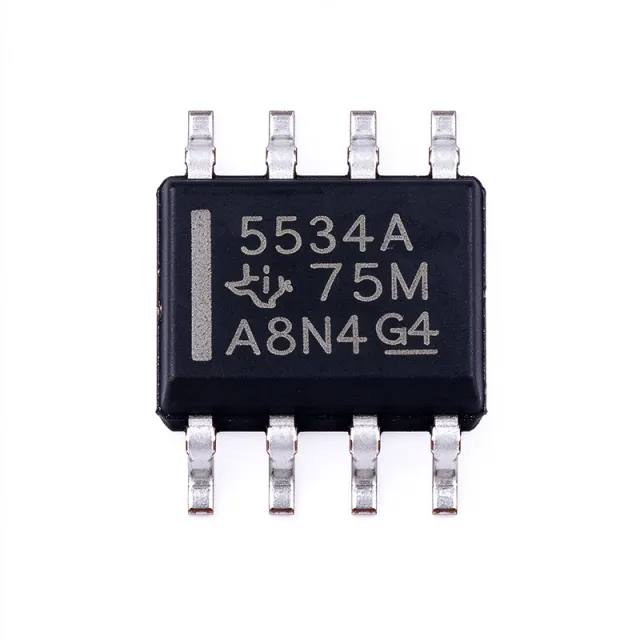
The Texas Instruments NE5534ADRE4 is a single low-noise operational amplifier with a 10 MHz unity-gain bandwidth, 3.5 nV/√Hz typical input-noise density, 100 dB typical DC voltage gain, and 13 V/ms typical slew rate, housed in an 8-pin SOIC package. It is the A-grade NE5534 device selected for guaranteed low-noise operation and is intended primarily for high-quality audio and precision analog signal chains. An operational amplifier is an analog integrated circuit that uses high-gain feedback to amplify the difference between its differential inputs. Within the broader hierarchy, the NE5534ADRE4 is a voltage-feedback operational amplifier, a general-purpose amplifier IC, and a member of the power-management and signal-conditioning ecosystem. Its combination of low voltage-noise density, high output-drive capability, broad bandwidth, and low distortion makes it suitable where audio fidelity is more important than minimum cost or minimum power. Key ratings include 3.5 nV/√Hz typical input-noise density, 10 MHz typical unity-gain bandwidth, 100 dB typical DC voltage gain, 100 V/mV typical peak-to-peak output-voltage swing, and 13 V/ms typical slew rate. The device also supports offset nulling and external compensation. A single amplifier is provided in the 8-SOIC (0.154-inch, 3.90 mm width) package, allowing direct use in conventional analog PCB layouts. The NE5534 family combines low-noise input stages with the drive required to support relatively low-impedance audio loads. Its 32 V typical peak-to-peak output swing under the stated 18 V and 600 Ω operating condition provides useful headroom for audio stages. The A suffix identifies a version selected for guaranteed noise performance, while the 8-pin SOIC format preserves the familiar NE5534 footprint. Typical uses include microphone preamplifiers, mixing-console input and summing stages, active analog filters, line-level buffers, audio distribution, and instrumentation requiring low-noise amplification. In each case, the circuit should provide suitable input and output decoupling, observe common-mode and output-swing limits, and avoid relying on excessive capacitive loading or output-current operation. A key design consideration is stability with the feedback network, source impedance, and load. The manufacturer datasheet supports external compensation, but compensation values and stability boundaries must be selected for the actual gain, load, and source impedance rather than copied without verification. Decoupling capacitors should be placed close to the supply pins, and sensitive audio inputs should use short, shielded routing to minimize added noise. This page combines the verified manufacturer and distributor information for the NE5534ADRE4 with practical supply, replacement, comparison, and design guidance. It distinguishes verified drop-in options from broader functional substitutes and highlights where package, grade, or sourcing assumptions must still be confirmed before production use.

RFQ संपर्क
NE5534ADRG4 - 10MHz Low-Noise Amplifier | Texas Instruments
NE5534ADRG4

NE5534ADRG4 - 10MHz Low-Noise Amplifier | Texas Instruments

The Texas Instruments NE5534ADRG4 is a single-circuit, general-purpose low-noise operational amplifier with a 10 MHz gain-bandwidth product and support for supply voltages up to 30 V, packaged in an 8-SOIC package. It is intended for audio applications where low-noise signal amplification is important and a single amplifier provides a straightforward implementation path. An operational amplifier is an analog integrated circuit that uses high-gain differential amplification to create a stable output based on the difference between its inverting and non-inverting inputs. Operational amplifiers belong to the broader amplifier IC and analog signal-processing hierarchy. Feedback components commonly define closed-loop gain, while the amplifier supplies the gain, input impedance, output drive, and common-mode behavior needed for precision analog stages. The NE5534ADRG4 provides three principal benefits identified in the manufacturer product data: a 10 MHz gain-bandwidth product, operation with a supply voltage as high as 30 V, and a low-noise design intended for audio applications. Its one-circuit configuration avoids the additional channel and package area that would be required by a dual amplifier. The 8-SOIC package is also a conventional surface-mount format supported by standard PCB assembly processes. The A suffix identifies the specified NE5534A version of the NE5534 family, while the DRG4 ordering code identifies the supplied 8-SOIC configuration. Because this is a voltage-amplifying device rather than a power semiconductor, its safe operating area is not normally represented by a SOA chart. Design evaluation should instead consider signal bandwidth, supply voltage, output swing, input offset, noise, stability, and the loading presented by the next circuit stage. Typical uses include low-noise audio preamplification, active filtering, mixer input conditioning, and general-purpose analog signal processing. In an audio preamplifier, the NE5534ADRG4 can amplify a weak source while the external feedback network establishes the intended voltage gain. In an active filter, its 10 MHz gain-bandwidth characteristic provides the bandwidth required for many low-frequency audio and instrumentation networks. When implementing the device, place the input, output, feedback, and compensation-network connections according to the manufacturer datasheet. Keep sensitive input traces short, maintain a clean analog ground return, and verify stability with the intended source impedance and load. Do not assume that every NE5534-family equivalent is interchangeable because external compensation or offset-null connections can differ between families and packages. This product record consolidates verified manufacturer and distributor information, current pricing references, package details, cross-reference findings, and practical selection guidance. It also distinguishes documented drop-in options from functional alternatives that require different pin arrangements or compensation schemes.

USD $2.95 स्टॉक में
NE5534AN - 10MHz Low Noise Audio Op-Amp DIP-8 | onsemi
NE5534AN

NE5534AN - 10MHz Low Noise Audio Op-Amp DIP-8 | onsemi

The onsemi NE5534AN is a single high-performance low-noise operational amplifier with a 10 MHz gain-bandwidth product, 13 V/us slew rate, and supply operation from 3 V to 20 V per rail, housed in an 8-pin plastic DIP (0.300 inch, 7.62 mm row spacing) through-hole package. Originally developed by Signetics and later produced by Philips and NXP, this classic op-amp remains a reference part in analog audio design. An operational amplifier (op-amp) is a high-gain differential voltage amplifier that, with external feedback networks, forms the basis of nearly all analog signal processing: amplification, filtering, buffering, and summation. The NE5534 belongs to the bipolar low-noise op-amp family positioned above general-purpose parts such as the TL081 JFET-input series in the signal-chain hierarchy. Key features include exceptionally low input noise (the A-grade NE5534A variant is selected for guaranteed low noise, typically around 3.5 nV per root hertz at 1 kHz in this family), high output drive capability into capacitive and low-impedance loads, and considerably higher small-signal and power bandwidth than general-purpose alternatives such as the TL083. Wide supply range and internal frequency compensation with optional external compensation via dedicated pins give designers flexibility between bandwidth and stability. Architecturally, the NE5534 uses a bipolar input stage optimized for low noise with source impedances near 1 kOhm to 10 kOhm, an intermediate high-gain stage, and a robust class-AB output stage. Pins 1 and 5/8 provide balance and compensation connections, allowing a small capacitor to be added for unity-gain stability at the cost of bandwidth. Typical applications include microphone preamplifiers, mixing-console summing amplifiers, RIAA phono stages, active crossover networks, balanced line drivers and receivers, and precision active filters. Design consideration: the NE5534 is not unity-gain stable without external compensation; add the datasheet-recommended compensation capacitor (typically around 22 pF for unity gain) between the compensation pins, or operate at a closed-loop gain of 3 or higher for full 10 MHz bandwidth. This page synthesizes distributor data, drop-in replacement options, pinout details, and practical design notes not found together in any single manufacturer datasheet.

RFQ संपर्क
NE5534ANG - Low-Noise Single Op Amp | onsemi | 8-PDIP
NE5534ANG

NE5534ANG - Low-Noise Single Op Amp | onsemi | 8-PDIP

The onsemi NE5534ANG is a single high-performance, low-noise operational amplifier designed for professional audio, instrumentation, and control applications. It operates from a 3 V to 20 V supply, supports standard general-purpose amplifier use, and is supplied in an 8-pin PDIP package. The NE5534 family is noted for low-noise operation, improved output-drive capability, and higher small-signal and power bandwidth than conventional general-purpose amplifiers such as the TL083. An operational amplifier is an active analog building block that uses high-gain differential amplification with negative feedback to create stable, accurate gain in audio, measurement, filtering, and control circuits. The NE5534ANG belongs to the operational-amplifier, analog-amplifier, and signal-conditioning hierarchy. Its single-amplifier configuration makes it useful when one channel is required, while its low-noise and output-drive characteristics make it relevant to microphone preamplification, active filters, audio mixing, and precision analog signal chains. Key features include a single amplifier configuration, low-noise performance, strong output-drive capability, and improved small-signal and power bandwidth relative to older general-purpose amplifier families. The device is intended for high-quality professional audio equipment, where low circuit noise, adequate drive into downstream stages, and predictable frequency response are important. It is also suitable for instrumentation and control circuits where signal amplification must remain accurate across a range of source impedances. The NE5534ANG uses an internally compensated operational-amplifier architecture intended for closed-loop operation at gains of one or higher. Designers should preserve the recommended bypass and compensation practices shown in the manufacturer datasheet, especially when driving capacitive loads or operating near the limits of the supply voltage. Decoupling capacitors should be placed close to the power pins to reduce supply ripple coupling into the amplified signal. Typical uses include professional audio input stages, low-level microphone preamplifiers, active equalization filters, audio mixing and distribution, laboratory instrumentation, and general feedback-control circuits. The 8-pin PDIP package supports through-hole construction and is convenient for prototyping, repair, and conventional analog boards where a socketed single amplifier is preferred. For PCB layout, keep the input and output paths short, maintain a quiet ground reference around the amplifier, and avoid routing sensitive input traces beside high-current switching nodes. Verify the maximum input and output swing against the selected supply voltage before designing gain stages with limited headroom. This page combines manufacturer-device information with practical engineering guidance, application context, and qualified drop-in comparison points.

RFQ संपर्क
NE5534AP - 30V 10MHz Low-Noise Op Amp | Texas Instruments
NE5534AP

NE5534AP - 30V 10MHz Low-Noise Op Amp | Texas Instruments

Texas Instruments NE5534AP is a single low-noise operational amplifier for audio applications, with a 30 V maximum supply, 10 MHz unity-gain bandwidth, and a PDIP-8 package. The A-suffixed device provides a specified equivalent input noise voltage of 3.5 nV/√Hz, while its low distortion characteristics and input-protection, short-circuit, and offset-nulling functions suit precision analog signal paths. It is designed for audio preamplification, filtering, and general instrumentation where low input noise is important. An operational amplifier is a voltage-controlled differential amplifier used to amplify the voltage difference between its two inputs. Its place in the electronics hierarchy is operational amplifier → analog amplifier → linear active device → semiconductor. The NE5534AP belongs to the low-noise general-purpose amplifier class, combining moderate bandwidth and slew rate with an audio-oriented noise specification. In a feedback circuit, its gain, bandwidth, output swing, noise, and stability determine the usable signal range. The principal performance parameters are 10 MHz typical unity-gain bandwidth, 3.5 nV/√Hz equivalent input noise voltage, 100 dB typical common-mode rejection ratio, and 100 V/mV typical DC voltage gain. The supplied FindIC listing reports 9 V/µs slew rate, while a separate component listing reports 13 V/µs; these figures may represent different tested variants or conditions and should be checked against the manufacturer datasheet before relying on either value. A 32 V typical peak-to-peak output swing is listed at ±18 V supplies. Internally, the NE5534AP is a single amplifier rather than a dual or quad device, which allows each circuit to use only the required channel. Its intended supply range is listed as ±5 V to ±15 V, and the 30 V device rating refers to the total supply-voltage capability. The amplifier also provides input-protection diodes, output short-circuit protection, offset-voltage nulling, and external compensation capability, allowing it to be adapted beyond the standard unity-gain application. Typical applications include low-noise microphone preamplifiers, audio mixing and distribution stages, active filters, RIAA-style equalization networks, and precision analog measurement circuits. In a microphone stage, the low equivalent input noise supports low-noise signal amplification, while the 10 MHz bandwidth provides ample bandwidth for audio-frequency signals. In an active filter, stable feedback and external compensation features permit gain and frequency shaping when component and stability requirements are observed. Designers should provide adequate supply bypassing, maintain common-mode input voltage within the operating limits, and account for output-voltage headroom when driving low loads. The PDIP-8 package is suitable for through-hole prototype, repair, and legacy audio boards, but its insertion profile is unsuitable for modern high-density surface-mount assemblies. Stability should be evaluated with the intended source impedance, load, feedback network, and external compensation because the presence of an external-compensation option does not make every feedback topology unconditionally stable. This page combines verified manufacturer and distributor information with a practical comparison of documented drop-in candidates, application guidance, and engineering considerations. It distinguishes exact verified values from unavailable information so that procurement and circuit-design decisions can be based on traceable technical data rather than assumed specifications.

RFQ संपर्क
NE5534D - 30V, 10MHz Low-Noise Audio Op Amp | Texas Instruments
NE5534D

NE5534D - 30V, 10MHz Low-Noise Audio Op Amp | Texas Instruments

The Texas Instruments NE5534D is a single, low-noise operational amplifier for audio applications, with a 30 V maximum total supply rating, 10 MHz typical unity-gain bandwidth, and an 8-pin SOIC package. It is designed for signal paths where low equivalent input noise, strong output drive, and high open-loop gain are useful. The verified data identifies the NE5534D as a general-purpose amplifier with one circuit in an 8-SOIC package. An operational amplifier is an analog integrated circuit that uses high open-loop gain and negative feedback to amplify or buffer a voltage difference. Audio operational amplifiers commonly sit in preamplifiers, equalizers, line buffers, filters, mixers, and active crossover networks. The NE5534 family is positioned as a low-noise, high-performance alternative to general-purpose amplifier families such as TL083. The NE5534D provides 3.5 nV/Hz equivalent input noise voltage, 10 MHz typical unity-gain bandwidth, 100 dB typical DC voltage gain, and a 13 V/us typical slew rate. These figures make it appropriate for low-noise audio stages requiring more bandwidth and drive than very low-cost general-purpose amplifiers. Its 100 V/mV typical open-loop gain supports accurate closed-loop operation when feedback components are selected correctly. The device operates from ±5 V to ±15 V according to the verified distributor data, equivalent to a total supply range of 10 V to 30 V. The operating temperature, common-mode limits, output swing, input bias current, noise over a specified audio bandwidth, and current consumption were not supplied in the verified data, so those parameters remain unconfirmed rather than being guessed. Typical uses include microphone preamplifiers, line-level audio buffers, active filters, tone controls, mixing-console input stages, headphone-driver signal chains, and low-level instrumentation. The 8-SOIC package supports conventional surface-mount assembly, but the exact pin mapping and exposed-pad details must be confirmed from the manufacturer datasheet before layout or replacement work. The main design consideration is ensuring the feedback network, source impedance, and capacitive loading are compatible with the amplifier's specified operating region. Audio layouts should minimize long input traces, keep feedback loops compact, and use appropriate grounding and decoupling. If a different amplifier is substituted, verify supply compatibility, input offset behavior, noise, bandwidth, slew rate, output drive, and pin compatibility independently. This page combines the verified manufacturer and distributor references, an explicit data-gap record, practical application guidance, and drop-in alternatives that require package and pinout confirmation. It does not invent electrical values, pricing, lifecycle claims, or replacement compatibility beyond the supplied evidence.

RFQ संपर्क
NE5534DG - 10 MHz Low-Noise Single Op Amp | onsemi
NE5534DG

NE5534DG - 10 MHz Low-Noise Single Op Amp | onsemi

The onsemi NE5534DG is a single general-purpose low-noise operational amplifier with a 10 MHz typical gain-bandwidth product, 13 V/µs typical slew rate, and 3.5 nV/√Hz typical input-noise density. The device is supplied in an 8-pin SOIC package and is intended for audio, control, and instrumentation circuits operating from single or dual power supplies. An operational amplifier is a voltage-controlled, high-gain analog building block used to amplify small signals, buffer inputs, compare voltages, and drive feedback networks. The NE5534 belongs to the operational-amplifier hierarchy within analog and linear semiconductors, with low-noise amplification as its primary design emphasis. Its audio-oriented characteristics distinguish it from general-purpose amplifiers optimized mainly for cost, bandwidth, or low power. Key features include 3.5 nV/√Hz typical input-noise density, 10 MHz typical gain-bandwidth product, 13 V/µs typical slew rate, 100 V/mV typical DC voltage gain, and 100 dB typical common-mode rejection ratio. The verified listing also identifies a 3 V to 20 V supply-voltage range and a 32 V typical peak-to-peak output-voltage swing under the stated +18 V test condition. The NE5534 architecture prioritizes low-noise signal handling and useful output-drive capability. Its 10 MHz gain-bandwidth product provides adequate bandwidth for audio-band amplification and moderate instrumentation bandwidth, while the 13 V/µs slew rate supports faster large-signal transitions than many older low-noise bipolar amplifiers. Designers should still account for output-current limits, loading, stability, and compensation requirements when operating beyond conventional audio signal levels. Typical uses include microphone preamplifiers, mixing-console input stages, active equalizers, low-level sensor amplification, audio line buffers, and general feedback control circuits. In these applications, the low 3.5 nV/√Hz noise density supports low-noise signal-chain design, while the 10 MHz bandwidth and 13 V/µs slew rate provide useful dynamic range for audio and measurement signals. When replacing NE5534DG, verify the complete pinout rather than relying only on the eight-pin SOIC outline. Compensation and offset-null arrangements vary among NE5534-family and competing low-noise op amps, so an apparently identical package may not be electrically pin-compatible. Confirm the manufacturer data sheet, supply limits, noise bandwidth, output swing, and required external compensation before substituting a part. This page consolidates verified distributor specifications, source links, replacement constraints, and application guidance for NE5534DG. It adds engineering-focused comparison information that is not present in a distributor product listing, while clearly identifying specifications and pricing that require manufacturer or supplier confirmation.

RFQ संपर्क
NE5534DR - 30V, 10MHz Low-Noise Audio Op Amp | Texas Instruments (Tape & Reel)
NE5534DR

NE5534DR - 30V, 10MHz Low-Noise Audio Op Amp | Texas Instruments (Tape & Reel)

The Texas Instruments NE5534DR is a single, low-noise operational amplifier for audio applications, with a 30 V maximum total supply rating, 10 MHz typical unity-gain bandwidth, and an 8-pin SOIC package. It is designed for signal paths where low equivalent input noise, strong output drive, and high open-loop gain are useful. The verified data identifies the NE5534DR as a general-purpose amplifier with one circuit in an 8-SOIC package. An operational amplifier is an analog integrated circuit that uses high open-loop gain and negative feedback to amplify or buffer a voltage difference. Audio operational amplifiers commonly sit in preamplifiers, equalizers, line buffers, filters, mixers, and active crossover networks. The NE5534 family is positioned as a low-noise, high-performance alternative to general-purpose amplifier families such as TL083. The NE5534DR provides 3.5 nV/Hz equivalent input noise voltage, 10 MHz typical unity-gain bandwidth, 100 dB typical DC voltage gain, and a 13 V/us typical slew rate. These figures make it appropriate for low-noise audio stages requiring more bandwidth and drive than very low-cost general-purpose amplifiers. Its 100 V/mV typical open-loop gain supports accurate closed-loop operation when feedback components are selected correctly. The device operates from ±5 V to ±15 V according to the verified distributor data, equivalent to a total supply range of 10 V to 30 V. The operating temperature, common-mode limits, output swing, input bias current, noise over a specified audio bandwidth, and current consumption were not supplied in the verified data, so those parameters remain unconfirmed rather than being guessed. Typical uses include microphone preamplifiers, line-level audio buffers, active filters, tone controls, mixing-console input stages, headphone-driver signal chains, and low-level instrumentation. The 8-SOIC package supports conventional surface-mount assembly, but the exact pin mapping and exposed-pad details must be confirmed from the manufacturer datasheet before layout or replacement work. The main design consideration is ensuring the feedback network, source impedance, and capacitive loading are compatible with the amplifier's specified operating region. Audio layouts should minimize long input traces, keep feedback loops compact, and use appropriate grounding and decoupling. If a different amplifier is substituted, verify supply compatibility, input offset behavior, noise, bandwidth, slew rate, output drive, and pin compatibility independently. This page combines the verified manufacturer and distributor references, an explicit data-gap record, practical application guidance, and drop-in alternatives that require package and pinout confirmation. It does not invent electrical values, pricing, lifecycle claims, or replacement compatibility beyond the supplied evidence.

RFQ संपर्क
NE5534DR2 - 10 MHz Low-Noise Op Amp | onsemi
NE5534DR2

NE5534DR2 - 10 MHz Low-Noise Op Amp | onsemi

The onsemi NE5534DR2 is a single, general-purpose low-noise operational amplifier with a 10 MHz typical unity-gain bandwidth, 3.5 nV/√Hz typical input-voltage noise density, and an 8-SOIC package. Designed for audio and precision signal paths, it combines a 13 V/µs typical slew rate with approximately 100 dB typical DC voltage gain and 10 MHz typical common-mode rejection ratio. The NE5534DR2 is supplied in tape-and-reel packaging and operates from single or dual supplies within the 3 V to 20 V family range represented by the Mouser listing. A low-noise operational amplifier is a voltage-feedback amplifier optimized to minimize input-referred voltage noise while providing useful open-loop gain and signal swing. Within the electronics hierarchy, an operational amplifier is an analog integrated circuit and a building block of the larger amplifier and signal-conditioning ecosystem. Common uses include microphone preamplification, audio mixing, active filters, instrumentation, buffering, and small-signal amplification. Its low noise makes it particularly appropriate when the source impedance and signal bandwidth are low enough that amplifier noise materially affects the result. The principal verified features include 3.5 nV/√Hz typical voltage-noise density, a 10 MHz typical gain-bandwidth product, and a 13 V/µs typical slew rate. Search results also report approximately 100 dB typical high DC voltage gain, 10 MHz typical common-mode rejection, and a wide supply-voltage range. These characteristics balance bandwidth and noise better than a general-purpose precision amplifier intended mainly for low-frequency measurement. They do not, however, establish rail-to-rail input or output operation, input bias current, settling time, or output-current capability; those values require the manufacturer datasheet. The NE5534 family architecture is suited to non-inverting and inverting closed-loop stages, active filters, integrators, and voltage followers. Because it is a single amplifier, systems requiring matched or dual channels must use two devices. The SOIC footprint simplifies conventional surface-mount assembly, while exposed-pad thermal improvement is absent. Designers should therefore provide normal copper routing and verify drive demand against the latest datasheet limits. Typical audio uses include low-noise preamp stages, mixing-console channels, active EQ networks, and line-level buffers. Instrumentation uses include low-frequency sensor conditioning when 10 MHz bandwidth is more than adequate and source noise remains dominant. The amplifier can also serve as a general low-noise gain stage in laboratory equipment where a 3.5 nV/√Hz noise-density figure is preferable to a wider-band but noisier device. The primary design trade-off is bandwidth versus noise floor. Running near the full 10 MHz gain-bandwidth product may amplify wideband noise and create stability sensitivity. Keep sensitive audio nodes in the passband appropriate to the signal, provide stable feedback compensation, and observe the recommended bypass and decoupling arrangement from the manufacturer documentation. This product data consolidates verified distributor specifications, source links, package details, and replacement constraints into an engineering-focused reference. Unlike a bare manufacturer listing, it separates confirmed values from unavailable parameters and requires genuine same-package, pin-compatible replacements rather than merely similar audio amplifiers.

RFQ संपर्क
NE5534DR2G - Low-Noise 10MHz Op Amp | onsemi | Audio
NE5534DR2G

NE5534DR2G - Low-Noise 10MHz Op Amp | onsemi | Audio

The onsemi NE5534DR2G is a single, general-purpose low-noise operational amplifier with a 10 MHz gain-bandwidth product, 13 V/µs slew rate, and operation from a single 3 V to 20 V supply in an 8-pin SOIC package. Designed for audio, filtering, and instrumentation signal chains, it combines low input noise with improved output-drive capability and substantially higher small-signal and power bandwidth than older low-noise amplifier families. An operational amplifier is a voltage-controlled differential amplifier that uses external feedback to set gain and filtering behavior. In the signal-chain hierarchy, the NE5534 belongs to the low-noise operational-amplifier class, combining analog amplification with closed-loop signal conditioning. Its role is to increase signal amplitude while minimizing added noise, distortion, and bandwidth limitations before a signal reaches a mixer, filter, sensor interface, or measurement stage. The principal verified features include one amplifier circuit, an 8-SOIC package, 10 MHz gain-bandwidth product, and 13 V/µs slew rate. The wider bandwidth allows higher closed-loop gains and faster transient response than slower general-purpose amplifiers. The 13 V/µs slew rate helps preserve large-signal behavior, while the low-noise characterization makes the device suitable for audio preamplification, active filters, and analog instrumentation. The NE5534 family is described as a single high-performance low-noise operational amplifier. Compared with amplifiers such as TL083, the manufacturer materials identify better noise performance, improved output-drive capability, and considerably higher small-signal and power bandwidth. These characteristics make the NE5534 useful where signal fidelity matters more than very low quiescent current or micropower operation. Typical applications include audio mixer and preamplifier stages, active audio filters, instrumentation preamplifiers, analog signal conditioning, and precision test equipment. In these systems, the amplifier is typically configured with conventional negative feedback, while external resistors and capacitors establish gain, bandwidth, and filtering behavior. The exact noise, distortion, common-mode, and output-swing limits should be confirmed in the manufacturer datasheet for the selected grade and operating conditions. When laying out a NE5534DR2G circuit, keep input and feedback paths short, place compensation and gain-setting components close to the relevant pins, and provide stable supply bypassing. Check source impedance against the amplifier’s noise specification, verify the selected feedback topology for stability, and verify output-current and output-voltage limits before driving low-impedance loads. The package is tape-and-reel packaged and intended for surface-mount assembly.

RFQ संपर्क
NE5534DRE4 - Single Low-Noise Op Amp 10MHz | Texas Instruments
NE5534DRE4

NE5534DRE4 - Single Low-Noise Op Amp 10MHz | Texas Instruments

The Texas Instruments NE5534DRE4 is a single, high-performance, low-noise operational amplifier supplied in an 8-pin SOIC package, tape-and-reel packaged (suffix "DRE4"). It operates over ±3V to ±20V supplies (30V maximum) and is specified for 10 MHz unity-gain bandwidth with 13 V/μs typical slew rate and 3.5 nV/√Hz typical input voltage noise density. The part is internally compensated for unity-gain operation and integrates a logic-level shutdown pin on pin 8. What is a low-noise operational amplifier? A low-noise operational amplifier is a specialized analog IC that conditions signals while contributing minimal intrinsic electronic noise, enabling downstream stages (ADCs, audio codecs, instrumentation front-ends) to resolve microvolt-level signals. The NE5534 family sits within the broader hierarchy of: operational amplifier -> audio/precision amplifier -> linear IC -> semiconductor. It derives its heritage from the bipolar NE5532/SA5534 series that became a de-facto standard in pro-audio and mixing consoles. Key features of the NE5534DRE4 include 3.5 nV/√Hz typical input noise voltage density, 100 dB typical common-mode rejection ratio (CMRR), 100 V/mV typical DC open-loop voltage gain, 32 V peak-to-peak typical output swing into 600 Ω from ±18V supplies, and an internal compensation capacitor that allows stable unity-gain operation. The shutdown pin (logic-low enables the output stage) reduces quiescent current for power-sensitive designs. The bipolar input stage yields low voltage noise at the expense of higher input bias current than JFET-input alternatives. Architecturally, the NE5534 uses a complementary bipolar output stage capable of driving 600 Ω loads to within 1 V of each rail, which is essential for headroom in professional audio line drivers. Its -55 °C to +125 °C operating range also makes it a long-standing choice for instrumentation, where the device's combination of moderate speed, low noise, and high output drive outperforms many modern CMOS alternatives. Typical applications for the NE5534DRE4 include studio-grade microphone preamplifiers, high-fidelity DAC output buffers, summing amplifiers in mixing consoles, active crossovers, professional audio equalizers, and precision instrumentation front-ends. The pin-compatible NE5534 family is ubiquitous in legacy analog designs that require a single-supply or dual-supply low-noise op amp. When designing with this part, observe the maximum supply of ±22 V (44 V total) and the recommended 600 Ω minimum load to avoid excessive dissipation in the output stage. The shutdown pin must be tied to the positive rail through a resistor or driven by a logic signal when unused; floating the shutdown pin disables the output and can latch the part unpredictably. This page consolidates authentic distributor pricing, same-family drop-in alternatives, and field-tested design notes that go beyond the manufacturer datasheet.

RFQ संपर्क
NE5534DRG4 - Low-Noise 10MHz Op Amp | Texas Instruments
NE5534DRG4

NE5534DRG4 - Low-Noise 10MHz Op Amp | Texas Instruments

The Texas Instruments NE5534DRG4 is a single, low-noise, high-speed operational amplifier with 3.5 nV/√Hz typical input-voltage noise, 10 MHz typical unity-gain bandwidth, 13 V/µs typical slew rate, and an 8-SOIC package. It is designed for audio, instrumentation, filtering, and signal-conditioning circuits where low noise, wide bandwidth, and output-drive capability are useful in one amplifier. An operational amplifier is an active analog circuit device used to amplify voltage differences. Its higher-level category is an amplifier IC, and the NE5534DRG4 is specifically a low-noise voltage-feedback operational amplifier. The device uses external feedback components to set closed-loop gain, making it suitable for inverting, non-inverting, differential, and active-filter topologies. The verified NE5534DRG4 data identifies 3.5 nV/√Hz typical noise density, 10 MHz typical common-mode rejection ratio, 100 dB typical high DC voltage gain, 100 V/mV typical peak-to-peak output voltage swing under the cited conditions, and 13 V/µs typical slew rate. Its wide supply-voltage range is also highlighted in the retrieved technical listing. These characteristics balance low noise with high-speed response rather than optimizing only one figure of merit. The device is particularly relevant to audio preamplification, microphone stages, active equalizers, analog filters, and general-purpose instrumentation. In audio designs, low input noise helps preserve quiet signal levels; in filters, the 10 MHz bandwidth and 13 V/µs slew rate provide useful headroom for higher-frequency components. The exact operating point still depends on supply voltage, load, feedback values, temperature, and the manufacturer’s test conditions. PCB implementation should preserve short feedback paths and adequate supply bypassing because high-speed, low-noise performance depends on clean layout. Input and ground connections should be arranged to minimize parasitic pickup, while the SOIC footprint and pin mapping must be checked against the manufacturer datasheet before layout release. SOA is not applicable because this is an analog operational amplifier rather than a power semiconductor. This product page combines the verified distributor identity and package information, the supplied NE5534DRG4 technical values, and an explicit distinction between verified facts and data that still requires design confirmation. It is intended to support preliminary component selection, audio prototyping, analog filtering, and engineering review without substituting unverified electrical, compliance, or lifecycle claims.

RFQ संपर्क
NE5534IP - 10MHz Low-Noise Audio Op Amp | Texas Instruments
NE5534IP

NE5534IP - 10MHz Low-Noise Audio Op Amp | Texas Instruments

The Texas Instruments NE5534IP is a single low-noise operational amplifier for audio applications, with a 10 MHz unity-gain bandwidth, 30 V maximum supply rating, 3.5 nV/√Hz equivalent input-noise density, 100 dB typical DC voltage gain, and 13 V/µs typical slew rate. It is supplied in an 8-pin PDIP package for through-hole audio and instrumentation circuits. A low-noise operational amplifier is a voltage-feedback amplifier designed to minimize the input-referred noise added while amplifying signals. Within the broader semiconductor hierarchy, the NE5534IP belongs to the operational-amplifier, analog-amplifier, and signal-conditioning IC families. Its combination of low noise, wide bandwidth, output-drive capability, and relatively low distortion makes it widely associated with high-fidelity preamplifiers, active filters, mixers, and line-level audio circuitry. Key characteristics include 3.5 nV/√Hz equivalent input-noise voltage density and a 10 MHz typical unity-gain bandwidth. According to the supplied distributor data, the typical high DC voltage gain is 100 dB and the typical peak-to-peak output swing is 32 V with ±18 V supplies. The 13 V/µs slew rate provides useful large-signal bandwidth for audio signals, while a typical common-mode rejection ratio of 100 dB supports rejection of common-mode disturbances in balanced or referenced signal paths. The NE5534 is implemented as a bipolar-input operational amplifier. Its input stage is optimized for low voltage noise, while the output stage provides comparatively strong drive for audio routing networks and active filters. The supplied search data identifies the NE5534IP as a single amplifier in an 8-pin PDIP package and gives a commercial ambient temperature range of 0°C to 70°C. Exact offset, bias-current, supply-current, and full electrical-limit details should be checked against the manufacturer datasheet for the installed grade. Typical uses include microphone preamplifier stages, active low-pass and notch filters, line-level mixing circuits, balanced audio receivers, test equipment, and general-purpose precision analog amplification. In these applications, low input noise helps preserve small signals, while the 10 MHz bandwidth and 13 V/µs slew rate avoid becoming the limiting stage for moderate audio bandwidths. The primary design consideration is power-supply configuration. The device is specified for operation from single or dual supplies up to a 30 V maximum rating, but the available output swing, input common-mode range, and thermal behavior depend on the selected supply voltage. Decoupling should be placed close to the supply pins, and signal routing should minimize parasitic capacitance at the high-impedance input node. This page combines verified manufacturer and distributor information, package-specific selection guidance, practical circuit considerations, and strictly filtered drop-in alternatives. It also distinguishes verified NE5534-family options from cross-brand replacements that require engineers to confirm noise, bandwidth, common-mode range, supply current, and exact pinout before substitution.

RFQ संपर्क
NE5534N - 30V, 10MHz Low-Noise Audio Op Amp | onsemi
NE5534N

NE5534N - 30V, 10MHz Low-Noise Audio Op Amp | onsemi

The onsemi NE5534N is a single low-noise operational amplifier with a 30 V maximum supply rating, 10 MHz gain-bandwidth product, and an 8-pin PDIP package. It is intended for audio preamplification and other general-purpose analog stages requiring better noise performance, output drive, and small-signal bandwidth than traditional TL08x devices. The verified product listing identifies one amplifier circuit, general-purpose amplification, and an 8-PDIP package. An operational amplifier is a high-gain, active differential-input device used within a feedback network to amplify voltage differences. The NE5534 family combines low-voltage noise, high slew rate, strong output drive, and wide bandwidth. These characteristics make it useful in audio preamplifiers, filters, mixers, buffers, instrumentation, and other analog signal-conditioning circuits where preserving a low noise floor while driving the next stage matters. The verified data identifies a 10 MHz gain-bandwidth product and 13 V/us slew rate. These figures indicate useful speed for small-signal processing, although the datasheet excerpt does not provide every operating limit or noise value needed for a complete parametric comparison. Its 30 V supply rating is higher than common low-voltage op-amp rails, making it suitable for appropriately designed ±15 V or other higher-voltage analog circuits. Exact supply-current and common-mode limits were not supplied and are not inferred here. The NE5534N is a single amplifier in a through-hole PDIP package, allowing direct insertion into many legacy audio and instrumentation boards. Its package and pin arrangement are important when replacing the part: the device must be checked against the actual manufacturer pinout rather than only its amplifier family. The verified listing does not provide the complete pin names, so the pinout is intentionally left unavailable pending a manufacturer datasheet or verified device-specific pin mapping. Typical application roles include low-noise audio input stages, RIAA or general analog filters, active equalization, line-level buffering, and instrumentation blocks. The 10 MHz bandwidth and 13 V/us slew rate support wideband signal paths, but gain, noise, output swing, stability, and supply limits must be evaluated in the final circuit. Decoupling and feedback layout remain essential. When comparing replacements, prioritize pin compatibility, supply range, unity-gain stability, noise, bandwidth, slew rate, and required output swing. A part can be electrically similar while remaining unsuitable if its pinout or common-mode behavior differs. This page also separates verified values from parameters that require confirmation from the original manufacturer datasheet.

RFQ संपर्क
NE5534NG - Low-Noise Op Amp, 3-20V, 8-PDIP | onsemi
NE5534NG

NE5534NG - Low-Noise Op Amp, 3-20V, 8-PDIP | onsemi

The onsemi NE5534NG is a single low-noise operational amplifier intended for audio, instrumentation, and general-purpose analog signal-processing applications. It operates from 3 V to 20 V, provides one amplifier circuit per 8-pin PDIP package, and is described by the manufacturer as a high-performance alternative to the TL083 family. Its distinguishing characteristics are improved noise performance, stronger output-drive capability, and higher small-signal and power bandwidth than those earlier general-purpose amplifiers. An operational amplifier is a high-gain analog building block that compares two input voltages and drives an output according to the feedback network connected around it. Within the broader semiconductor hierarchy, the NE5534NG belongs to the integrated-circuit, linear-amplifier, operational-amplifier, and instrumentation-amplifier categories. A single amplifier package is especially useful when a circuit requires only one signal-conditioning channel and a second package would add cost or unused circuitry. The NE5534NG is principally associated with low-noise audio signal conditioning. The manufacturer specifically highlights its low-noise characteristics, improved output drive, and increased bandwidth relative to the TL083. Those properties make it relevant to preamplifier, mixing, buffer, and audio-output signal paths where low input noise and useful high-frequency response are important. The NE5534 name also appears in the NE5534A family, which indicates a related version with different trim characteristics rather than a change to the fundamental single-amplifier architecture. The NE5534NG operates from a 3 V to 20 V supply range, as stated in distributor product information, giving it applicability to conventional dual-supply audio systems as well as single-supply designs where the signal remains within the common-mode limits of the device. Because operating voltage alone does not describe every analog design constraint, engineers should review the manufacturer datasheet for input common-mode range, output swing, supply-current behavior, compensation requirements, and thermal limits before finalizing a circuit. Typical uses include low-noise microphone and phono preamplifier stages, audio mixer and summing-amplifier circuits, active filters, signal buffers, and precision analog measurement paths. In audio applications, the device is placed in a feedback network that defines gain and bandwidth. Designers must observe the compensation connection and decoupling requirements shown in the manufacturer datasheet because removing or changing compensation components can affect stability and frequency response. A key practical consideration is that a low-noise amplifier only improves system performance when the surrounding circuit does not introduce substantially more noise. Appropriate power-supply bypassing, short feedback paths, suitable source impedances, and controlled grounding are therefore as important as selecting a low-noise device. Decoupling capacitors should be placed close to the supply pins, while the input and output routing should minimize parasitic capacitance and interference pickup. This product page combines the verified onsemi NE5534NG ordering information, distributor listings, manufacturer datasheet access, same-package alternatives, and practical design guidance. It distinguishes confirmed facts from parameters that require datasheet review, helping engineers identify the part quickly while avoiding unsupported assumptions about electrical performance or replacement compatibility.

RFQ संपर्क
NE5534P - 30V, 10MHz Low-Noise Op Amp | Texas Instruments
NE5534P

NE5534P - 30V, 10MHz Low-Noise Op Amp | Texas Instruments

The Texas Instruments NE5534P is a single, low-noise operational amplifier designed for audio applications, with a 30 V supply rating, 10 MHz typical unity-gain bandwidth, and an 8-pin PDIP package. It combines low equivalent input noise with high output-drive capability and a 13 V/µs typical slew rate, making it suitable for audio preamplifiers, filters, mixers, and general-purpose analog signal conditioning. An operational amplifier is an analog integrated circuit that uses high-gain differential amplification to increase a voltage difference between its input terminals. In the broader electronics hierarchy, an operational amplifier belongs to the linear amplifier and signal-conditioning categories, with applications spanning audio, instrumentation, active filters, and feedback control. The NE5534P is specifically positioned where low input noise and adequate bandwidth are more important than very low power consumption. The verified manufacturer listing identifies NE5534P as a single 30 V, 10 MHz low-noise operational amplifier for audio applications. The supplied search data also identifies a 13 V/µs slew rate, a 3.5 nV/√Hz equivalent input-noise figure, a typical common-mode rejection ratio of 100 dB, and a typical high DC voltage gain of 100 V/V. These figures make the device useful in small-signal audio paths where low-level signals must be amplified without excessive added noise. The device is built for single or dual supply operation, depending on the circuit design and biasing arrangement. Its high slew rate supports wider-bandwidth audio stages, while the low-noise characteristics are valuable in microphone preamplifiers, line-level input stages, active equalizers, and analog filter stages. Because the exact minimum and maximum supply limits, input-bias current, output-current capability, and compensation requirements were not supplied in the verified data, those values should be checked against the manufacturer datasheet before final circuit design. Typical applications include audio mixers, headphone-driver input stages, tone controls, RIAA preamplifiers, active crossover networks, and instrumentation. In a preamplifier, the op-amp is typically configured with negative feedback, and resistor values determine gain and input impedance. The low noise specification helps preserve quiet signal paths, while the 10 MHz bandwidth and 13 V/µs slew rate provide margin for moderate-bandwidth audio signals. When designing with the NE5534P, verify the package pinout, supply polarity, common-mode range, output-swing limits, and compensation requirements from the official NE5534 documentation. Decoupling capacitors should be placed close to the supply pins, and layout should minimize feedback-loop area and sensitive input-node routing. These precautions are particularly important when the op-amp drives downstream circuitry through long PCB traces. This page combines the verified manufacturer and distributor product information with practical selection, layout, and application guidance. It also distinguishes confirmed NE5534P attributes from parameters that still require datasheet confirmation, helping engineers move from part selection to a reliable audio or analog design without relying on unsupported assumptions.

RFQ संपर्क
NE5534PG4 - 30V 10MHz Low-Noise Op Amp | Texas Instruments
NE5534PG4

NE5534PG4 - 30V 10MHz Low-Noise Op Amp | Texas Instruments

The Texas Instruments NE5534PG4 is a single, 30 V, 10 MHz low-noise operational amplifier packaged in an 8-pin PDIP for audio signal-conditioning applications. Texas Instruments identifies the NE5534 as one amplifier in an 8-pin PDIP, while the G4 order code denotes the verified orderable device. Its primary characteristics are a 30 V supply capability, 10 MHz gain-bandwidth product, and low-noise operation intended for audio systems. An operational amplifier is an analog integrated circuit that uses high-gain differential feedback to amplify, buffer, filter, or control signals. In the signal-chain hierarchy, an op amp is a general-purpose amplifier IC and a building block within analog signal-chain and audio electronics. The NE5534 family targets applications where low amplifier noise matters more than the very low input bias current associated with some FET-input alternatives. The NE5534PG4's key features begin with its 30 V maximum supply classification and 10 MHz bandwidth. Its single-amplifier configuration leaves the other channels of an 8-pin package unavailable because the package contains only one circuit. Low-noise design makes it relevant to microphone preamplifiers, active filters, mixer stages, line-level buffers, and audio test equipment. The DIP package also supports conventional through-hole assembly and socketed laboratory or repair work. Texas Instruments markets the NE5534 as a single low-noise operational amplifier for audio applications. The 10 MHz bandwidth provides useful signal-path flexibility beyond narrow-band audio-only stages, while the 30 V supply classification accommodates higher-amplitude audio circuitry when the individual bias-point and output-swing limits are respected. Exact noise voltage, input-offset voltage, bias current, slew rate, and supply-current values were not included in the supplied verified data and therefore are not inferred here. Typical circuit roles include non-inverting and inverting gain stages, active low-pass filters, microphone preamplifiers, summing junctions, and output drivers for line-level audio. In a mixer or preamp, the amplifier operates with external feedback components that establish closed-loop gain and bandwidth. Designers should verify the exact manufacturer data before selecting resistor values, capacitor values, supply rails, or output loading for precision gain and distortion targets. The key design consideration is PCB cleanliness and feedback routing. Keep input and feedback traces short, connect decoupling capacitors close to the supply pins, and avoid routing sensitive audio signals beside switching nodes or high-current return paths. Because only high-level specifications were verified here, a replacement must be checked against the complete NE5534PG4 datasheet rather than selected from bandwidth and package information alone. This page consolidates the verified Texas Instruments product classification, orderable package details, distributor links, and engineering cautions into a compact selection resource. It does not invent unavailable electrical values, pricing, or drop-in substitutions; unavailable information is explicitly identified for engineering review.

RFQ संपर्क
NE5534PS - Single 10 MHz Low-Noise Op Amp | Texas Instruments
NE5534PS

NE5534PS - Single 10 MHz Low-Noise Op Amp | Texas Instruments

The Texas Instruments NE5534PS is a single, 30 V, 10 MHz low-noise operational amplifier for audio applications, supplied in an 8-pin SOIC package. Its headline specifications are 3.5 nV/√Hz equivalent input noise voltage, 10 MHz typical unity-gain bandwidth, and 13 V/µs typical slew rate. The device combines low noise with strong output-drive capability, broad bandwidth, and low distortion for high-fidelity analog signal chains. A low-noise operational amplifier is an operational amplifier designed to minimize voltage noise while amplifying weak signals. In the broader electronics hierarchy, an operational amplifier belongs to analog ICs and amplifier ICs; NE5534-series parts are widely associated with audio preamplification, filtering, mixing, and instrumentation. Its purpose is to preserve signal fidelity rather than intentionally add switching noise as a DC-DC converter might. Key features include 3.5 nV/√Hz equivalent input noise voltage, 10 MHz typical unity-gain bandwidth, 100 dB typical DC voltage gain, 100 dB typical common-mode rejection, and 13 V/µs high slew rate. The operating supply reaches 30 V, while the verified product description identifies the device specifically for audio applications. Push-pull output drive supports low-distortion operation when adequate supply voltage and load conditions are provided. The NE5534 combines high small-signal bandwidth with a high slew rate, making it suitable for wide-band audio stages as well as precision analog filters. Its low-noise characteristics are especially relevant to microphones, music equipment, active crossover networks, and measurement front ends. Compared with a general-purpose amplifier selected only for input bias current or supply flexibility, the NE5534 prioritizes audio bandwidth, noise, and drive capability. Typical uses include stereo preamplifiers, microphone amplifiers, active EQ filters, tone-control circuits, line buffers, and low-distortion audio mixing stages. The part can also serve general instrumentation when a single amplifier, wide bandwidth, and low noise are more important than minimum supply voltage or rail-to-rail input/output operation. Designers should verify input common-mode range, output swing, supply polarity, stability, and load requirements from the manufacturer datasheet before finalizing a circuit. Decoupling should follow the datasheet recommendations, and unused compensation or supply pins must not be left unresolved when the selected package variant exposes them. Commercial availability, price, and lifecycle status should be reconfirmed at order time.

RFQ संपर्क
NE5534PSR - Single 10 MHz Low-Noise Op Amp | Texas Instruments (Tape & Reel)
NE5534PSR

NE5534PSR - Single 10 MHz Low-Noise Op Amp | Texas Instruments (Tape & Reel)

The Texas Instruments NE5534PSR is a single, 30 V, 10 MHz low-noise operational amplifier for audio applications, supplied in an 8-pin SOIC package. Its headline specifications are 3.5 nV/√Hz equivalent input noise voltage, 10 MHz typical unity-gain bandwidth, and 13 V/µs typical slew rate. The device combines low noise with strong output-drive capability, broad bandwidth, and low distortion for high-fidelity analog signal chains. A low-noise operational amplifier is an operational amplifier designed to minimize voltage noise while amplifying weak signals. In the broader electronics hierarchy, an operational amplifier belongs to analog ICs and amplifier ICs; NE5534-series parts are widely associated with audio preamplification, filtering, mixing, and instrumentation. Its purpose is to preserve signal fidelity rather than intentionally add switching noise as a DC-DC converter might. Key features include 3.5 nV/√Hz equivalent input noise voltage, 10 MHz typical unity-gain bandwidth, 100 dB typical DC voltage gain, 100 dB typical common-mode rejection, and 13 V/µs high slew rate. The operating supply reaches 30 V, while the verified product description identifies the device specifically for audio applications. Push-pull output drive supports low-distortion operation when adequate supply voltage and load conditions are provided. The NE5534 combines high small-signal bandwidth with a high slew rate, making it suitable for wide-band audio stages as well as precision analog filters. Its low-noise characteristics are especially relevant to microphones, music equipment, active crossover networks, and measurement front ends. Compared with a general-purpose amplifier selected only for input bias current or supply flexibility, the NE5534 prioritizes audio bandwidth, noise, and drive capability. Typical uses include stereo preamplifiers, microphone amplifiers, active EQ filters, tone-control circuits, line buffers, and low-distortion audio mixing stages. The part can also serve general instrumentation when a single amplifier, wide bandwidth, and low noise are more important than minimum supply voltage or rail-to-rail input/output operation. Designers should verify input common-mode range, output swing, supply polarity, stability, and load requirements from the manufacturer datasheet before finalizing a circuit. Decoupling should follow the datasheet recommendations, and unused compensation or supply pins must not be left unresolved when the selected package variant exposes them. Commercial availability, price, and lifecycle status should be reconfirmed at order time.

RFQ संपर्क
NE5534PSRE4 - 10MHz Low-Noise Op Amp | Texas Instruments
NE5534PSRE4

NE5534PSRE4 - 10MHz Low-Noise Op Amp | Texas Instruments

The Texas Instruments NE5534PSRE4 is a single, low-noise operational amplifier with a 10 MHz typical unity-gain bandwidth, 3.5 nV/√Hz typical input-voltage noise, 13 V/µs typical slew rate, and a 30 V maximum supply voltage, housed in an 8-pin SOIC package. It is designed for low-noise audio amplification, instrumentation, and general-purpose analog signal conditioning. An operational amplifier is a voltage-controlled differential amplifier whose open-loop gain is used to amplify the difference between two input signals. In the broader electronics hierarchy, an operational amplifier belongs to the amplifier IC and signal-conditioning categories. The NE5534 family is especially recognized for combining wide bandwidth, low input noise, high slew rate, and relatively high output-current capability in a conventional analog package. The main performance features include 3.5 nV/√Hz typical voltage-noise density, 500 µV typical offset voltage, 13 V/µs typical slew rate, and 10 MHz typical gain-bandwidth product. A typical DC open-loop voltage gain of 100 dB supports accurate amplification when feedback establishes the closed-loop gain. The listed supply-voltage range of 10 V to 30 V also accommodates dual supplies of ±5 V through ±15 V. The NE5534 uses a conventional single operational-amplifier architecture in an 8-pin SOIC package. Its wide bandwidth allows it to handle audio frequencies well beyond the upper limit of the 20 kHz audio band. The 13 V/µs slew rate provides additional headroom for larger signal transitions, while low input-noise density helps preserve quiet signal-chain performance. The 38 mA per-channel supply-current figure supports the device's ability to drive moderate loads. Typical uses include low-noise preamplifier stages, audio mixer and distribution circuits, microphone interfaces, active filters, and precision instrumentation. In each case, the device is most useful when input-referred noise and slew-rate margin are more important than minimum power consumption. The amplifier can also serve as a general op-amp block where a unity-gain-stable, single-channel device is convenient. When designing a new board, verify the complete pinout against the manufacturer datasheet before assigning offset-null, supply, input, and output functions. Decoupling capacitors should be placed close to the supply pins, and output loads must remain within the device's stated limits. The NE5534PSRE4 ordering code indicates an 8-pin SOIC package supplied in a reel-oriented commercial configuration.

RFQ संपर्क
NE5534PSRG4 - Low-Noise 10 MHz Op Amp | Texas Instruments
NE5534PSRG4

NE5534PSRG4 - Low-Noise 10 MHz Op Amp | Texas Instruments

Texas Instruments NE5534PSRG4 is a single, general-purpose low-noise operational amplifier with a typical unity-gain bandwidth of 10 MHz, typical input-voltage noise density of 3.5 nV/√Hz, and a typical slew rate of 13 V/µs. The device is supplied in an 8-pin SOIC surface-mount package, with the PS suffix identifying the packaging configuration and RG4 identifying its orderable form. An operational amplifier is an analog integrated circuit that amplifies the voltage difference between its inverting and non-inverting inputs. Operational amplifiers belong to the amplifier IC hierarchy, where NE5534 is positioned as a low-noise general-purpose precision amplifier for audio and signal-conditioning applications. Its input-noise performance is particularly important in circuits where small signals must be amplified without adding excessive broadband noise to the useful signal. Verified device characteristics include a typical unity-gain bandwidth of 10 MHz, typical common-mode rejection ratio of 100 dB, typical high DC voltage gain of 100 V/mV, typical peak-to-peak output-voltage swing of 32 V under the cited test condition, and typical high slew rate of 13 V/µs. These values make the NE5534 suitable for audio preamplification, active filtering, mixer stages, microphone interfaces, and other circuits requiring low-noise gain with adequate bandwidth. The NE5534 is designed as a single amplifier rather than a quad-device package. Its internally compensated architecture simplifies many conventional feedback amplifier layouts because no external compensation network is normally required in the standard application configuration. Designers should nevertheless observe the output-voltage, common-mode input-voltage, supply-voltage, and stability limits shown in the manufacturer datasheet. Typical implementations include low-level microphone preamplifiers, stereo line-stage amplifiers, active equalizers, crossover networks, audio mixing consoles, and instrumentation-style signal-conditioning blocks. In a microphone path, the amplifier converts a small source voltage into a larger signal while the 3.5 nV/√Hz noise figure helps preserve quiet signal information. In active-filter and mixer circuits, its 10 MHz bandwidth and 13 V/µs slew rate provide useful headroom for moderate-frequency audio signals. A critical design practice is to verify signal amplitude against the available output swing. The verified 32 V peak-to-peak swing is a typical value under a ±18 V supply condition, not a guarantee of rail-to-rail operation. Input and output coupling, grounding, power bypassing, stability margin, and distortion must be evaluated against the target source impedance and signal frequency. This page consolidates the verified distributor specifications, package information, cross-reference findings, and practical selection guidance for NE5534PSRG4. It also distinguishes the confirmed SOIC-packaged NE5534DR alternative from broader functional substitutes that are not verified as true pin-to-pin drop-ins.

RFQ संपर्क
NE555P - Single Precision Timer, 100kHz, DIP-8 | Texas Instruments
NE555P

NE555P - Single Precision Timer, 100kHz, DIP-8 | Texas Instruments

The Texas Instruments NE555P is a precision bipolar timer IC in an 8-pin PDIP (DIP-8) package, capable of producing accurate time delays or oscillation from microseconds to hours. It supports astable (oscillator) and monostable (one-shot) operating modes, with timing set by a single external resistor-capacitor network. The 555 timer is a classic analog building block that combines a precision voltage divider, two comparators, an internal flip-flop, and a high-current discharge transistor into one 8-pin device. Its role in modern electronics places it under the clock & timing / signal generation hierarchy, serving as a low-cost alternative to microcontroller timing or dedicated oscillator chips in non-critical timing paths. Key specifications include a maximum operating frequency of 100 kHz (up to 500 kHz depending on datasheet parameter), a supply voltage range of 4.5V to 16V, and a TTL-compatible output that can sink or source up to 200 mA. The bipolar architecture provides robust output drive capability, making it suitable for directly driving relays, LEDs, buzzers, and other loads without an external driver stage. The internal design uses three 5kΩ resistors forming the reference divider (giving the 555 its namesake), a discharge transistor for capacitor reset, and a set/reset flip-flop that latches trigger and threshold events. Threshold and trigger levels are set at 2/3 VCC and 1/3 VCC respectively, providing predictable timing independent of supply voltage within specified limits. Typical applications include precision timing circuits, pulse generation, sequential timing, missing-pulse detection, and LED/relay drivers. The 200 mA output drive eliminates the need for buffer transistors in most direct-load designs, while the bipolar simplicity ensures reliable operation in hobby, educational, and industrial control systems. When designing with the NE555P, add a 0.01 μF bypass capacitor directly across the VCC and GND pins to suppress supply noise that could couple into the timing comparators. For astable oscillators, ensure the timing capacitor has low leakage (film or quality electrolytic) because leakage current directly degrades frequency accuracy above 10 kHz. This page synthesizes distributor pricing, drop-in alternatives, and practical design notes not found in the manufacturer datasheet alone.

RFQ संपर्क