उत्पाद (20,000+)

C8051F061 - 25MHz Mixed-Signal MCU | Silicon Labs
C8051F061

C8051F061 - 25MHz Mixed-Signal MCU | Silicon Labs

Silicon Labs C8051F061 is an 8-bit mixed-signal microcontroller operating up to 25 MHz, with 64 KB of flash memory and 24 digital I/O lines in a 64-TQFP 10 x 10 mm package. The device combines a 25 MIPS 8051 core with a 16-bit, single-channel, 1 Msps ADC, a 12-bit, two-channel DAC, and three analog comparators. Its supply-voltage range is 2.7 V to 3.6 V. A mixed-signal microcontroller is an embedded semiconductor that integrates digital processing with analog conversion and comparison functions. The C8051F061 belongs to the C8051F06x family and combines an 8051-compatible embedded processing core with on-chip ADC, DAC, comparator, timer, serial-interface, and communication resources. This mixed-signal MCU category reduces the need for separate analog and digital ICs when a product must measure, generate, or monitor analog signals. Key features include 64 KB of in-system-programmable flash, 4.25K x 8 RAM, five timers, a watchdog timer, and the Programmable Counter Array. Communication and peripheral resources include SPI, SMBus, I2C, two UARTs, and CAN 2.0B. The analog subsystem includes a 16-bit, one-channel ADC operating at 1 Msps, an eight-channel 10-bit ADC, a 12-bit, two-channel DAC, and three analog comparators. An on-chip temperature sensor is also listed for the device. The 25 MHz implementation delivers up to 25 MIPS while retaining the established 8051 instruction set and mixed-signal integration characteristic of the C8051F06x family. The 24 available digital I/O lines make the device appropriate for compact embedded controllers that need several serial interfaces and analog measurements without relying on a large external component count. The 64-pin TQFP package exposes the mixed-signal resources and digital interfaces on a surface-mount footprint. Typical uses include industrial sensor acquisition, process-control equipment, CAN-connected embedded instrumentation, data acquisition modules, and compact control panels. In these systems, the ADC can sample analog inputs, the DAC can generate reference or control voltages, and the UART, SPI, I2C, SMBus, and CAN interfaces can connect local sensors, actuators, and supervisory electronics. The integrated temperature sensor can also support local thermal monitoring where its accuracy is appropriate for the application. Designers should treat the 2.7 V to 3.6 V supply range as a hard design constraint and provide decoupling close to the device pins. Analog and digital grounds, analog inputs, and high-impedance nodes require careful layout to limit noise and offset errors. Firmware migration should also verify peripheral availability and pin multiplexing for the selected C8051F06x variant rather than assuming that every family member has identical resources. This page combines verified distributor specifications, availability information, same-family drop-in candidates, package details, and practical design guidance. It adds engineering-focused comparisons that are not normally presented together on a distributor product page, helping designers evaluate the C8051F061 for embedded control, analog measurement, and communication applications.

USD $37.73 स्टॉक में
C8051F061R - 25MHz Mixed-Signal MCU | Silicon Labs (Tape & Reel)
C8051F061R

C8051F061R - 25MHz Mixed-Signal MCU | Silicon Labs (Tape & Reel)

Silicon Labs C8051F061R is an 8-bit mixed-signal microcontroller operating up to 25 MHz, with 64 KB of flash memory and 24 digital I/O lines in a 64-TQFP 10 x 10 mm package. The device combines a 25 MIPS 8051 core with a 16-bit, single-channel, 1 Msps ADC, a 12-bit, two-channel DAC, and three analog comparators. Its supply-voltage range is 2.7 V to 3.6 V. A mixed-signal microcontroller is an embedded semiconductor that integrates digital processing with analog conversion and comparison functions. The C8051F061R belongs to the C8051F06x family and combines an 8051-compatible embedded processing core with on-chip ADC, DAC, comparator, timer, serial-interface, and communication resources. This mixed-signal MCU category reduces the need for separate analog and digital ICs when a product must measure, generate, or monitor analog signals. Key features include 64 KB of in-system-programmable flash, 4.25K x 8 RAM, five timers, a watchdog timer, and the Programmable Counter Array. Communication and peripheral resources include SPI, SMBus, I2C, two UARTs, and CAN 2.0B. The analog subsystem includes a 16-bit, one-channel ADC operating at 1 Msps, an eight-channel 10-bit ADC, a 12-bit, two-channel DAC, and three analog comparators. An on-chip temperature sensor is also listed for the device. The 25 MHz implementation delivers up to 25 MIPS while retaining the established 8051 instruction set and mixed-signal integration characteristic of the C8051F06x family. The 24 available digital I/O lines make the device appropriate for compact embedded controllers that need several serial interfaces and analog measurements without relying on a large external component count. The 64-pin TQFP package exposes the mixed-signal resources and digital interfaces on a surface-mount footprint. Typical uses include industrial sensor acquisition, process-control equipment, CAN-connected embedded instrumentation, data acquisition modules, and compact control panels. In these systems, the ADC can sample analog inputs, the DAC can generate reference or control voltages, and the UART, SPI, I2C, SMBus, and CAN interfaces can connect local sensors, actuators, and supervisory electronics. The integrated temperature sensor can also support local thermal monitoring where its accuracy is appropriate for the application. Designers should treat the 2.7 V to 3.6 V supply range as a hard design constraint and provide decoupling close to the device pins. Analog and digital grounds, analog inputs, and high-impedance nodes require careful layout to limit noise and offset errors. Firmware migration should also verify peripheral availability and pin multiplexing for the selected C8051F06x variant rather than assuming that every family member has identical resources. This page combines verified distributor specifications, availability information, same-family drop-in candidates, package details, and practical design guidance. It adds engineering-focused comparisons that are not normally presented together on a distributor product page, helping designers evaluate the C8051F061R for embedded control, analog measurement, and communication applications.

USD $37.73 स्टॉक में
C8051F062 - 25MHz Mixed-Signal 8051 MCU | Silicon Labs
C8051F062

C8051F062 - 25MHz Mixed-Signal 8051 MCU | Silicon Labs

The Silicon Labs C8051F062 is an 8-bit mixed-signal microcontroller with a 25 MHz 8051 core, 64 KB of flash program memory, 4.25 KB of RAM, and 59 digital I/O pins in a 100-pin TQFP package. Its integrated analog resources include a 16-bit 1 Msps ADC, a 12-bit two-channel DAC, and three comparators, while the C8051F06x family also supports two integrated 16-bit 1 Msps ADCs according to the retrieved family documentation. A mixed-signal microcontroller is an embedded controller that combines a digital processor with analog-to-digital converters, digital-to-analog converters, comparators, and communication peripherals on one silicon device. This MCU belongs to the hierarchy 8051 microcontroller, embedded processor, mixed-signal MCU, and system-on-chip. Integrating these functions reduces component count and lets a single controller acquire analog measurements, execute control logic, and communicate with external equipment. The C8051F062 operates at 25 MHz and includes 64 KB of flash memory for firmware storage, 4.25 KB of internal RAM, and 59 digital I/O pins. Its 16-bit ADC supports 1 Msps conversion performance, while the 12-bit two-channel DAC provides controlled analog output. Three integrated comparators support thresholding and fast signal conditioning. CAN connectivity expands the device beyond basic serial communications for industrial and embedded control systems. Technically, the C8051F062 combines a C8051F06x-compatible 8051 architecture with analog peripherals intended to reduce external signal-chain complexity. The 64 KB flash capacity permits larger embedded applications than smaller MCU variants, while the 4.25 KB RAM supports working data and stack requirements. Its 2.7 V to 3.6 V supply range is consistent with 3.3 V systems, although system-level design must account for signal-level compatibility at every peripheral. Typical uses include industrial monitoring, sensor acquisition, process-control equipment, communications modules, data-acquisition systems, and compact embedded controllers. The ADC and comparators suit mixed sensor inputs, the DAC supports control or reference signals, and CAN is useful where deterministic field-bus communication is required. Designers should verify the exact package pinout, exposed-pad requirements, clock configuration, analog-input limits, and decoupling requirements in the manufacturer datasheet before layout. Because this MCU combines high-speed conversion and digital switching, careful grounding, local analog bypassing, and separation of sensitive analog traces from digital return currents are essential. This page consolidates verified distributor pricing, family-level alternatives, package information, comparison parameters, and practical mixed-signal design guidance into one engineering-focused reference while explicitly identifying values that still require confirmation from the official datasheet.

RFQ संपर्क
C8051F062R - 25MHz Mixed-Signal 8051 MCU | Silicon Labs (Tape & Reel)
C8051F062R

C8051F062R - 25MHz Mixed-Signal 8051 MCU | Silicon Labs (Tape & Reel)

The Silicon Labs C8051F062R is an 8-bit mixed-signal microcontroller with a 25 MHz 8051 core, 64 KB of flash program memory, 4.25 KB of RAM, and 59 digital I/O pins in a 100-pin TQFP package. Its integrated analog resources include a 16-bit 1 Msps ADC, a 12-bit two-channel DAC, and three comparators, while the C8051F06x family also supports two integrated 16-bit 1 Msps ADCs according to the retrieved family documentation. A mixed-signal microcontroller is an embedded controller that combines a digital processor with analog-to-digital converters, digital-to-analog converters, comparators, and communication peripherals on one silicon device. This MCU belongs to the hierarchy 8051 microcontroller, embedded processor, mixed-signal MCU, and system-on-chip. Integrating these functions reduces component count and lets a single controller acquire analog measurements, execute control logic, and communicate with external equipment. The C8051F062R operates at 25 MHz and includes 64 KB of flash memory for firmware storage, 4.25 KB of internal RAM, and 59 digital I/O pins. Its 16-bit ADC supports 1 Msps conversion performance, while the 12-bit two-channel DAC provides controlled analog output. Three integrated comparators support thresholding and fast signal conditioning. CAN connectivity expands the device beyond basic serial communications for industrial and embedded control systems. Technically, the C8051F062R combines a C8051F06x-compatible 8051 architecture with analog peripherals intended to reduce external signal-chain complexity. The 64 KB flash capacity permits larger embedded applications than smaller MCU variants, while the 4.25 KB RAM supports working data and stack requirements. Its 2.7 V to 3.6 V supply range is consistent with 3.3 V systems, although system-level design must account for signal-level compatibility at every peripheral. Typical uses include industrial monitoring, sensor acquisition, process-control equipment, communications modules, data-acquisition systems, and compact embedded controllers. The ADC and comparators suit mixed sensor inputs, the DAC supports control or reference signals, and CAN is useful where deterministic field-bus communication is required. Designers should verify the exact package pinout, exposed-pad requirements, clock configuration, analog-input limits, and decoupling requirements in the manufacturer datasheet before layout. Because this MCU combines high-speed conversion and digital switching, careful grounding, local analog bypassing, and separation of sensitive analog traces from digital return currents are essential. This page consolidates verified distributor pricing, family-level alternatives, package information, comparison parameters, and practical mixed-signal design guidance into one engineering-focused reference while explicitly identifying values that still require confirmation from the official datasheet.

RFQ संपर्क
C8051F063 - 25MHz 64KB Mixed-Signal MCU | Silicon Labs
C8051F063

C8051F063 - 25MHz 64KB Mixed-Signal MCU | Silicon Labs

The Silicon Labs C8051F063 is an 8-bit mixed-signal microcontroller with a 25 MHz CIP-51 8051 core, 64 KB of Flash program memory, 4.25 KB of RAM, and a 64-pin TQFP package measuring 10 mm by 10 mm. It delivers 25 MIPS while integrating a 16-bit, single-channel, 1 Msps ADC, a 12-bit, two-channel DAC, three comparators, and 24 general-purpose I/O pins. An 8-bit microcontroller is a programmable semiconductor that combines a central processing unit, memory, and peripherals on one integrated circuit. The C8051F06x family is designed for mixed-signal control systems, where a controller must process digital logic while measuring analog inputs and generating analog outputs. Within the product hierarchy, the C8051F063 is an MCU, an embedded controller, and a semiconductor integrating computation, communication, and analog-conversion functions. The 64 KB of Flash provides substantially more program capacity than a small 8-bit control device with legacy mask-program or limited memory options. The 4.25 KB data-RAM allocation supports working variables, stacks, buffers, and peripheral state. Its 25 MIPS processing capability enables time-sensitive control tasks, while the 24 I/O pins provide interfaces for sensors, actuators, logic signals, and external peripherals. The mixed-signal peripherals reduce the need for separate conversion hardware. The 16-bit, one-channel ADC operates at up to 1 Msps for analog measurements, while the 12-bit, two-channel DAC provides two analog output paths. Three integrated comparators support threshold detection, overvoltage monitoring, and fast response functions. The verified distributor data also identifies the device as an 8-bit 8051 C8051F06x MCU with CAN capability. Typical uses include industrial monitoring and control, laboratory instrumentation, sensor acquisition, process-control equipment, embedded communications, and compact control panels. The combination of CAN capability, analog conversion, comparators, and a relatively high I/O count makes the C8051F063 appropriate for designs requiring local analog measurement and digital communication without relying on a separate converter. Designers should verify the complete electrical limits, clock configuration, pin multiplexing, and peripheral-resource arrangement in the manufacturer datasheet before layout or firmware release. Adequate decoupling, careful analog grounding, and controlled routing between the analog and digital sections are essential in a mixed-signal design. The supplied verified data does not expose the complete pin names, so no unverified pinout mapping is presented here. This page consolidates the verified distributor specifications, mixed-signal feature summary, sourcing links, family-level replacement guidance, and practical design considerations. It distinguishes confirmed C8051F063 characteristics from fields that require confirmation in the manufacturer datasheet, helping engineers evaluate the MCU without relying on incomplete catalog summaries.

RFQ संपर्क
C8051F063R - 25MHz 64KB Mixed-Signal MCU | Silicon Labs (Tape & Reel)
C8051F063R

C8051F063R - 25MHz 64KB Mixed-Signal MCU | Silicon Labs (Tape & Reel)

The Silicon Labs C8051F063R is an 8-bit mixed-signal microcontroller with a 25 MHz CIP-51 8051 core, 64 KB of Flash program memory, 4.25 KB of RAM, and a 64-pin TQFP package measuring 10 mm by 10 mm. It delivers 25 MIPS while integrating a 16-bit, single-channel, 1 Msps ADC, a 12-bit, two-channel DAC, three comparators, and 24 general-purpose I/O pins. An 8-bit microcontroller is a programmable semiconductor that combines a central processing unit, memory, and peripherals on one integrated circuit. The C8051F06x family is designed for mixed-signal control systems, where a controller must process digital logic while measuring analog inputs and generating analog outputs. Within the product hierarchy, the C8051F063R is an MCU, an embedded controller, and a semiconductor integrating computation, communication, and analog-conversion functions. The 64 KB of Flash provides substantially more program capacity than a small 8-bit control device with legacy mask-program or limited memory options. The 4.25 KB data-RAM allocation supports working variables, stacks, buffers, and peripheral state. Its 25 MIPS processing capability enables time-sensitive control tasks, while the 24 I/O pins provide interfaces for sensors, actuators, logic signals, and external peripherals. The mixed-signal peripherals reduce the need for separate conversion hardware. The 16-bit, one-channel ADC operates at up to 1 Msps for analog measurements, while the 12-bit, two-channel DAC provides two analog output paths. Three integrated comparators support threshold detection, overvoltage monitoring, and fast response functions. The verified distributor data also identifies the device as an 8-bit 8051 C8051F06x MCU with CAN capability. Typical uses include industrial monitoring and control, laboratory instrumentation, sensor acquisition, process-control equipment, embedded communications, and compact control panels. The combination of CAN capability, analog conversion, comparators, and a relatively high I/O count makes the C8051F063R appropriate for designs requiring local analog measurement and digital communication without relying on a separate converter. Designers should verify the complete electrical limits, clock configuration, pin multiplexing, and peripheral-resource arrangement in the manufacturer datasheet before layout or firmware release. Adequate decoupling, careful analog grounding, and controlled routing between the analog and digital sections are essential in a mixed-signal design. The supplied verified data does not expose the complete pin names, so no unverified pinout mapping is presented here. This page consolidates the verified distributor specifications, mixed-signal feature summary, sourcing links, family-level replacement guidance, and practical design considerations. It distinguishes confirmed C8051F063R characteristics from fields that require confirmation in the manufacturer datasheet, helping engineers evaluate the MCU without relying on incomplete catalog summaries.

RFQ संपर्क
C8051F064 - 25MHz 8051 Mixed-Signal MCU | Silicon Labs
C8051F064

C8051F064 - 25MHz 8051 Mixed-Signal MCU | Silicon Labs

The Silicon Labs C8051F064 is an 8-bit mixed-signal 8051 microcontroller operating at 25 MHz, with 64 KB of Flash memory in a 100-pin TQFP package measuring 14 mm by 14 mm. It integrates a 16-bit, single-channel, 1 Msps ADC, a 12-bit DAC, and three comparators, giving embedded designers mixed-signal acquisition and output capability without requiring separate converters. A microcontroller is a programmable system-on-chip combining a processor core, nonvolatile memory, digital I/O, timers, serial interfaces, and analog peripherals. The C8051F06x family combines the legacy-compatible 8051 instruction set with mixed-signal resources. Within the broader hierarchy, it is a microcontroller, then an embedded processor, then an integrated circuit and semiconductor. Its analog integration is particularly useful for compact industrial-control and measurement designs that need sampling, threshold comparison, and voltage generation in one package. Key features include 25 MHz processing, 64 KB of Flash program memory, 59 digital I/O pins, two integrated 16-bit 1 Msps ADCs according to the family description, a 12-bit DAC, and three integrated comparators. The 100-pin TQFP provides 59 digital I/O pins for the C8051F060, C8051F062, C8051F064, and C8051F066 members of the family. The combination of flash storage, mixed-signal conversion, and abundant I/O supports control-loop, acquisition, and communications functions on a single PCB. The C8051F06x architecture is designed around the powerful 8051 core with 25 MHz performance. Its two 16-bit, 1 Msps ADCs support sampled analog measurements, while the 12-bit DAC provides an analog output derived from software-defined data. Three comparators support threshold detection and monitoring functions. This mixed-signal arrangement allows a single device to collect sensor information, evaluate comparator thresholds, generate an analog reference or control voltage, and manage external equipment through digital interfaces. Typical uses include industrial sensor acquisition, process-control panels, laboratory instrumentation, environmental monitoring, embedded analog control, and communication-oriented control modules. For a 16-bit, 1 Msps conversion stage, the firmware can sample rapidly enough for many measurement and monitoring tasks, although the overall system timing also depends on the selected pins, peripherals, firmware execution, and front-end conditioning. Designers should follow the manufacturer datasheet for the exact 100-pin assignments, oscillator requirements, analog-pin recommendations, and decoupling configuration. The complete pin map is not present in the supplied verified text, so this page does not infer individual pin names. PCB planning should reserve clean analog routing, solid ground distribution, suitable input impedance, and appropriate filtering between external sensors and the integrated ADC inputs. This page consolidates the verified distributor listing, family-level mixed-signal specifications, package information, and same-package alternatives into an engineering-focused selection guide. It also distinguishes confirmed C8051F06x family options from cross-brand replacements, helping designers identify candidates without mistaking a broadly similar microcontroller for a verified pin-compatible substitute.

RFQ संपर्क
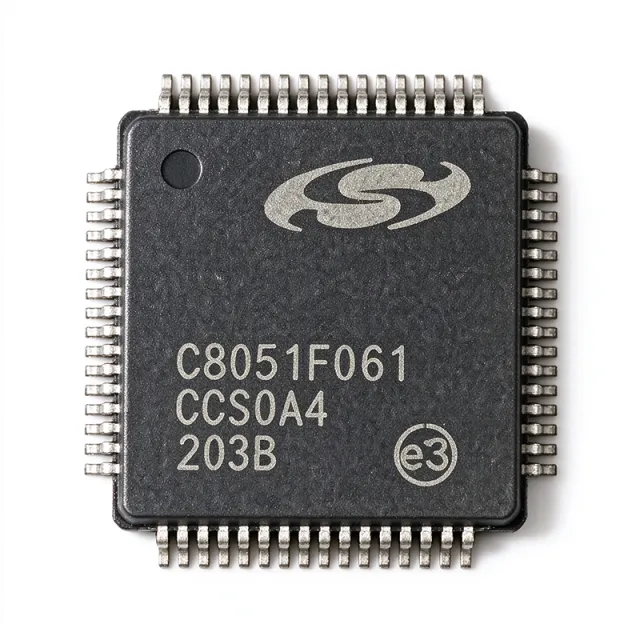
C8051F064R - 25MHz 8051 Mixed-Signal MCU | Silicon Labs (Tape & Reel)
C8051F064R

C8051F064R - 25MHz 8051 Mixed-Signal MCU | Silicon Labs (Tape & Reel)

The Silicon Labs C8051F064R is an 8-bit mixed-signal 8051 microcontroller operating at 25 MHz, with 64 KB of Flash memory in a 100-pin TQFP package measuring 14 mm by 14 mm. It integrates a 16-bit, single-channel, 1 Msps ADC, a 12-bit DAC, and three comparators, giving embedded designers mixed-signal acquisition and output capability without requiring separate converters. A microcontroller is a programmable system-on-chip combining a processor core, nonvolatile memory, digital I/O, timers, serial interfaces, and analog peripherals. The C8051F06x family combines the legacy-compatible 8051 instruction set with mixed-signal resources. Within the broader hierarchy, it is a microcontroller, then an embedded processor, then an integrated circuit and semiconductor. Its analog integration is particularly useful for compact industrial-control and measurement designs that need sampling, threshold comparison, and voltage generation in one package. Key features include 25 MHz processing, 64 KB of Flash program memory, 59 digital I/O pins, two integrated 16-bit 1 Msps ADCs according to the family description, a 12-bit DAC, and three integrated comparators. The 100-pin TQFP provides 59 digital I/O pins for the C8051F060, C8051F062, C8051F064R, and C8051F066 members of the family. The combination of flash storage, mixed-signal conversion, and abundant I/O supports control-loop, acquisition, and communications functions on a single PCB. The C8051F06x architecture is designed around the powerful 8051 core with 25 MHz performance. Its two 16-bit, 1 Msps ADCs support sampled analog measurements, while the 12-bit DAC provides an analog output derived from software-defined data. Three comparators support threshold detection and monitoring functions. This mixed-signal arrangement allows a single device to collect sensor information, evaluate comparator thresholds, generate an analog reference or control voltage, and manage external equipment through digital interfaces. Typical uses include industrial sensor acquisition, process-control panels, laboratory instrumentation, environmental monitoring, embedded analog control, and communication-oriented control modules. For a 16-bit, 1 Msps conversion stage, the firmware can sample rapidly enough for many measurement and monitoring tasks, although the overall system timing also depends on the selected pins, peripherals, firmware execution, and front-end conditioning. Designers should follow the manufacturer datasheet for the exact 100-pin assignments, oscillator requirements, analog-pin recommendations, and decoupling configuration. The complete pin map is not present in the supplied verified text, so this page does not infer individual pin names. PCB planning should reserve clean analog routing, solid ground distribution, suitable input impedance, and appropriate filtering between external sensors and the integrated ADC inputs. This page consolidates the verified distributor listing, family-level mixed-signal specifications, package information, and same-package alternatives into an engineering-focused selection guide. It also distinguishes confirmed C8051F06x family options from cross-brand replacements, helping designers identify candidates without mistaking a broadly similar microcontroller for a verified pin-compatible substitute.

RFQ संपर्क
C8051F065 - 25MHz 8-Bit Mixed-Signal MCU | Silicon Labs
C8051F065

C8051F065 - 25MHz 8-Bit Mixed-Signal MCU | Silicon Labs

Silicon Labs C8051F065 is a highly integrated mixed-signal 8-bit microcontroller with a 25 MHz 8051 core, 64 KB of embedded flash memory, and a 64-pin TQFP package measuring 10 mm by 10 mm. The device combines digital control with two 16-bit 1 Msps ADCs, a 12-bit DAC, and three comparators in one package. Its supply-voltage range is 2.7 V to 3.6 V, and the C8051F065 variant provides 24 digital I/O pins. A mixed-signal microcontroller is an embedded system-on-chip that combines a processor core with analog and digital peripherals. In the product hierarchy, the C8051F065 is a microcontroller, also called an MCU, within the broader semiconductor and embedded-control category. Integrating the ADC, DAC, and comparators with the CPU reduces the number of external components needed for compact instrumentation, industrial monitoring, and control designs while keeping analog measurements and control outputs within one embedded platform. Key features include 25 MHz processing performance, 64 KB flash for firmware, two 16-bit ADCs operating at up to 1 Msps, a 12-bit DAC, three analog comparators, and 24 digital I/O pins. The 2.7 V to 3.6 V operating range supports low-voltage embedded systems. These resources make the MCU suitable for applications requiring both continuous signal acquisition and programmable analog output without adding separate data-conversion devices. The C8051F06x family uses the enhanced CIP-51 core architecture and mixed-signal peripherals. Two ADCs provide independent or sampled analog channels for sensors, transducers, and control loops, while the DAC supports programmable reference or output generation. The three comparators support threshold detection and fast digital events. Detailed ADC acquisition timing, DAC accuracy, memory organization, and peripheral register behavior should be confirmed in the manufacturer datasheet before firmware and PCB sign-off. Typical applications include industrial process measurement, sensor instrumentation, motor or actuator control, data acquisition modules, and compact embedded control systems. The 1 Msps ADC throughput supports signal capture when paired with suitable front-end conditioning, while the DAC allows output voltage generation for calibration or test systems. The 24 I/O pins can connect digital controls, status indicators, and external interface signals where the total pin count is sufficient. PCB design should account for the 64-pin TQFP footprint, 10 mm by 10 mm body size, and the device's low-voltage analog supply requirements. Place decoupling capacitors close to the supply pins, route analog inputs away from switching nodes, and provide a clean return path for reference and measurement circuits. Firmware must also configure unused pins and analog channels appropriately to avoid unintended analog behavior or excess current consumption. This page consolidates verified distributor specifications, the mixed-signal feature set, practical application guidance, and the search for genuine drop-in replacements. The supplied data identifies the C8051F065-GQ and C8051F065-GQR orderable variants, but it does not substantiate five pin-compatible substitute devices, so no unverified alternatives are presented as drop-in replacements.

RFQ संपर्क
C8051F065R - 25MHz 8-Bit Mixed-Signal MCU | Silicon Labs (Tape & Reel)
C8051F065R

C8051F065R - 25MHz 8-Bit Mixed-Signal MCU | Silicon Labs (Tape & Reel)

Silicon Labs C8051F065R is a highly integrated mixed-signal 8-bit microcontroller with a 25 MHz 8051 core, 64 KB of embedded flash memory, and a 64-pin TQFP package measuring 10 mm by 10 mm. The device combines digital control with two 16-bit 1 Msps ADCs, a 12-bit DAC, and three comparators in one package. Its supply-voltage range is 2.7 V to 3.6 V, and the C8051F065R variant provides 24 digital I/O pins. A mixed-signal microcontroller is an embedded system-on-chip that combines a processor core with analog and digital peripherals. In the product hierarchy, the C8051F065R is a microcontroller, also called an MCU, within the broader semiconductor and embedded-control category. Integrating the ADC, DAC, and comparators with the CPU reduces the number of external components needed for compact instrumentation, industrial monitoring, and control designs while keeping analog measurements and control outputs within one embedded platform. Key features include 25 MHz processing performance, 64 KB flash for firmware, two 16-bit ADCs operating at up to 1 Msps, a 12-bit DAC, three analog comparators, and 24 digital I/O pins. The 2.7 V to 3.6 V operating range supports low-voltage embedded systems. These resources make the MCU suitable for applications requiring both continuous signal acquisition and programmable analog output without adding separate data-conversion devices. The C8051F06x family uses the enhanced CIP-51 core architecture and mixed-signal peripherals. Two ADCs provide independent or sampled analog channels for sensors, transducers, and control loops, while the DAC supports programmable reference or output generation. The three comparators support threshold detection and fast digital events. Detailed ADC acquisition timing, DAC accuracy, memory organization, and peripheral register behavior should be confirmed in the manufacturer datasheet before firmware and PCB sign-off. Typical applications include industrial process measurement, sensor instrumentation, motor or actuator control, data acquisition modules, and compact embedded control systems. The 1 Msps ADC throughput supports signal capture when paired with suitable front-end conditioning, while the DAC allows output voltage generation for calibration or test systems. The 24 I/O pins can connect digital controls, status indicators, and external interface signals where the total pin count is sufficient. PCB design should account for the 64-pin TQFP footprint, 10 mm by 10 mm body size, and the device's low-voltage analog supply requirements. Place decoupling capacitors close to the supply pins, route analog inputs away from switching nodes, and provide a clean return path for reference and measurement circuits. Firmware must also configure unused pins and analog channels appropriately to avoid unintended analog behavior or excess current consumption. This page consolidates verified distributor specifications, the mixed-signal feature set, practical application guidance, and the search for genuine drop-in replacements. The supplied data identifies the C8051F065R-GQ and C8051F065R-GQR orderable variants, but it does not substantiate five pin-compatible substitute devices, so no unverified alternatives are presented as drop-in replacements.

RFQ संपर्क
C8051F066 - 25MHz 8-Bit Mixed-Signal MCU, 32KB Flash | Silicon Labs
C8051F066

C8051F066 - 25MHz 8-Bit Mixed-Signal MCU, 32KB Flash | Silicon Labs

The Silicon Labs C8051F066 is a highly integrated mixed-signal 8-bit microcontroller built on the enhanced CIP-51 core, delivering 25 MIPS of throughput at 25 MHz in a 100-lead TQFP (14 x 14 mm) package. It combines 32 KB of on-chip Flash program memory with a 16-bit, 1 Msps, single-channel successive-approximation ADC, a 12-bit DAC, and three analog comparators. An MCU (microcontroller unit) is a single-chip computer that integrates a CPU core, program memory, data memory, and peripherals. The C8051F06x family belongs to the broader 8051 lineage of 8-bit microcontrollers, itself part of the embedded processor and embedded systems hierarchy. Because the analog conversion, DAC output, and comparator functions are integrated on the same die, a C8051F066 board needs far fewer external components than a discrete 8051 design, shortening layout time and reducing board area. Key features of this device include 25 MIPS instruction throughput, 32 KB of Flash for in-circuit programming, a 16-bit ADC sampling at 1 Msps, a 12-bit DAC for analog output, three high-speed comparators with programmable hysteresis, an internal oscillator, machine-code USB bootloader support, and a 100-pin TQFP package with 10 analog inputs, four analog outputs, and up to 38 digital I/O. Two internal memory spaces, program Flash and internal RAM, keep firmware and working data on-chip. Technically, the C8051F066 sits in Silicon Labs' C8051F06x line, which extends the classic 8051 architecture with higher clock rates, faster 16-bit ADC hardware, and a more capable peripheral set than the original Intel-era 8051 devices. The CIP-51 core retains full 8051 instruction-set compatibility while adding a four-cycle pipeline, so existing 8051 code ports with minimal effort while gaining a substantial speed increase over 12 MHz original parts. Typical applications include industrial sensor acquisition and control panels, mixed-signal measurement instruments, low-cost USB-connected data loggers, power supply monitoring, motor and actuator control boards, and building-automation nodes where analog front-ends and digital control share one microcontroller. The 100-pin package exposes enough pins for simultaneous analog inputs, comparator outputs, and dense digital I/O in one design. When designing around the C8051F066, budget careful attention to analog front-end design: bypass the analog supply pins directly, keep ADC traces short and away from switching nodes, and reference the datasheet recommended layout for the analog ground connection. Also confirm that your firmware budget fits 32 KB of Flash and that the debugger/flashing toolchain matches the Silicon Labs C8051 platform. This page consolidates distributor listings, package and pinout references, and practical drop-in alternatives for the C8051F066, together with design notes and comparison data that go beyond the basics found in a bare manufacturer datasheet.

RFQ संपर्क
C8051F067 - 25MHz 8-Bit MCU, 32KB Flash | Silicon Labs
C8051F067

C8051F067 - 25MHz 8-Bit MCU, 32KB Flash | Silicon Labs

The Silicon Labs C8051F067 is an 8-bit mixed-signal microcontroller operating at up to 25 MHz, with 32 KB of Flash memory and a 64-pin TQFP package measuring 10 mm by 10 mm. It belongs to the C8051F06x family and combines a 8051-compatible core with mixed-signal peripherals for embedded control applications. The device is identified in distributor records as C8051F067-GQ when supplied in the 64-pin TQFP configuration. An 8-bit microcontroller is a programmable semiconductor that executes embedded control logic from a small internal program memory. The C8051F067 combines the 8051 instruction-set family with an enhanced silicon-laboratories core architecture and integrated analog functions. This places it in the broader hierarchy of embedded processor, microcontroller, mixed-signal MCU, and semiconductor product categories. Its architecture is intended for compact embedded systems that require deterministic control, serial communications, and analog measurement without requiring a high-performance 32-bit processor. The C8051F067 operates at up to 25 MHz, and an associated manufacturer-datasheet reference identifies the family as delivering up to 25 MIPS. Its 32 KB Flash program memory provides substantially more code storage than the smaller devices in the C8051F06x family. The mixed-signal feature set includes a 16-bit ADC according to the manufacturer-datasheet references, allowing the MCU to process measured analog signals in firmware and reducing the need for external analog-to-digital converters. The C8051F067 is identified in a 64-pin TQFP package measuring 10 mm by 10 mm. Its higher pin count provides access to the mixed-signal and digital resources required by industrial controls, instrumentation, communications equipment, and embedded measurement systems. The package is a surface-mount technology format, and its exposed perimeter construction supports compact PCB layouts while retaining a pin count high enough for extensive peripheral access. Typical applications include sensor-acquisition and condition-monitoring equipment, industrial control panels, communications modules, programmable instrumentation, and embedded data-acquisition systems. The 16-bit ADC is especially relevant when the design must digitize analog inputs while executing control and communication firmware on the same 8-bit core. The 25 MHz operating rate supports more responsive control loops than slower 8051-class devices, provided that the application timing is checked against the required instruction cycle. When designing around the C8051F067, begin with the complete pin-description table in the Silicon Labs manufacturer datasheet before assigning analog inputs, supply pins, programming interfaces, and ground connections. Decoupling requirements, reference voltages, reset behavior, oscillator configuration, and exposed-pin functions must follow that document. Firmware development also requires the appropriate Silicon Labs programming and debug configuration for the selected package and device revision. This product page combines the confirmed C8051F067 operating, memory, package, and analog specifications with focused design guidance, package-aware alternatives, and application-oriented engineering context. It is intended to help engineers identify the correct device, plan the PCB, and determine whether a C8051F06x family member can serve as a drop-in replacement without changing the 64-pin footprint.

RFQ संपर्क
C8051F124R - 50MHz 8-Bit Flash MCU | Silicon Labs
C8051F124R

C8051F124R - 50MHz 8-Bit Flash MCU | Silicon Labs

The Silicon Labs C8051F124R is an 8-bit mixed-signal system-on-chip microcontroller with a 50 MHz C8051F12x processor core, 128 KB of Flash program memory, 8.25 KB of RAM, and 64 digital I/O pins in a 100-pin TQFP package. It combines a high-performance 8051-compatible architecture with analog peripherals for embedded control applications. A microcontroller is a programmable semiconductor system containing a CPU core, memory, I/O, and peripherals in one integrated device. The C8051F12x family combines an 8-bit microcontroller core with ADC, DAC, timers, serial interfaces, oscillators, and other mixed-signal resources. This integrated approach reduces component count and allows embedded products to perform control, measurement, communication, and signal processing within a single device. Key features include up to 128 KB of on-chip Flash, 8.25K x 8 RAM, 64 digital I/O pins, and operation up to 50 MHz. The device also provides a 10-bit or 12-bit SAR ADC with programmable throughput up to 100 ksps, programmable amplifier gains from 0.5 to 16, and support for single-ended or differential inputs. Additional analog and timing resources make it suitable for precision acquisition, motor control, instrumentation, and industrial monitoring. The C8051F12x architecture provides a pipelined 8051-compatible core capable of reaching 100 MIPS according to the product family datasheet information. On-chip Flash supports in-system programming-oriented designs, while the integrated RAM and large I/O count reduce the need for external memory in moderate-complexity embedded systems. The 100-pin TQFP package exposes substantially more I/O than smaller 64-pin members of the same family. Typical applications include industrial data acquisition, sensor conditioning, process monitoring, motor and motion control, embedded instrumentation, communications equipment, and consumer products requiring both digital control and analog measurement. The 12-bit ADC and differential-input capability are especially useful for measurements where signal amplitude and noise performance matter. For PCB design, route analog inputs away from high-current switching paths, provide stable decoupling close to the supply pins, and preserve the manufacturer-recommended clock and programming connections. Confirm the complete pin assignment and peripheral multiplexing against the C8051F124 datasheet before finalizing routing, especially for alternate digital and analog functions. This product page combines manufacturer-family specifications, distributor listing details, application guidance, and replacement analysis to support faster component selection and PCB engineering.

RFQ संपर्क
C8051F125R - 50MHz 8-Bit Flash MCU | Silicon Labs
C8051F125R

C8051F125R - 50MHz 8-Bit Flash MCU | Silicon Labs

The Silicon Labs C8051F125R is an 8-bit C8051F12x mixed-signal microcontroller operating up to 50 MHz, with 128 KB of Flash program memory, 8.25 KB of internal RAM, and 32 digital I/O pins in a 64-TQFP 10 x 10 mm package. Its operating supply range is 2.7 V to 3.6 V. The C8051F125R combines an 8051-compatible core with on-chip Flash memory and mixed-signal peripherals for embedded control applications. A microcontroller is a programmable semiconductor that integrates a processor core, memory, and peripherals into one device. The C8051 family belongs to the 8-bit MCU hierarchy within embedded processors and system-on-chip devices. Its integrated Flash memory supports firmware storage and in-system programming, while internal RAM provides working memory for real-time control tasks. The C8051F12x family is positioned for compact embedded systems that require deterministic control and mixed-signal measurement. The C8051F125R operates at up to 50 MHz and includes 128 KB of Flash memory organized as 128K x 8. Its internal RAM is 8.25K x 8, providing 8.25 kB for variables, stacks, and data buffers. The 64-pin TQFP device exposes 32 digital I/O pins and supports interfaces identified for the C8051F125 family, including I2C, SMBus, SPI, and UART. A 12-bit ADC is also identified for this family. The mixed-signal architecture allows digital control and analog measurement to share one device. The 12-bit ADC supports applications that require measurements more precise than a simple 8-bit input while avoiding a separate converter in cost-sensitive designs. Flash firmware storage, an operating supply range of 2.7 V to 3.6 V, and a maximum clock speed of 50 MHz make the device suitable for compact embedded-control and communication-oriented equipment. Typical uses include industrial sensor controllers, building automation modules, motor and relay control systems, data-acquisition equipment, and serial-interface products. UART connectivity is useful for configuration links and external controllers, while SPI and I2C or SMBus support peripheral expansion and sensor interfaces. The 32 available digital I/O pins also make the part appropriate for keypad, display, alarm, and discrete actuator interfaces. The principal design consideration is power and signal implementation around a high-speed mixed-signal MCU. Use the manufacturer pin-description table to assign all 64 TQFP connections, keep analog and digital return-current paths controlled, and provide local decoupling at the supply pins. Because the complete pin assignment is not established on this page, use the manufacturer datasheet before laying out the PCB or assigning port functions. This page combines the verified C8051F125R specifications, family-level interface information, drop-in upgrade options, and application-focused design guidance. It is intended to help engineers evaluate the C8051F125R for embedded control, analog measurement, and serial communications while preserving the same 64-TQFP board footprint.

RFQ संपर्क
C8051F126 - 50MHz 8051 MCU, 128KB Flash, 100-TQFP | Silicon Labs
C8051F126

C8051F126 - 50MHz 8051 MCU, 128KB Flash, 100-TQFP | Silicon Labs

The Silicon Labs C8051F126 is a highly integrated mixed-signal 8-bit microcontroller (MCU) featuring a high-performance 8051 core running at 50 MHz peak instruction throughput. This analog-intensive MCU integrates a 10-bit, 8-channel, 100 ksps successive-approximation ADC, a 12-bit, 2-channel DAC, and two on-chip comparators, making it well-suited to closed-loop control and precision sensing applications. The device ships with 128 kB of in-system programmable Flash and 8 kB of RAM, plus five 16-bit timers and multiple serial interfaces, all housed in a 14x14 mm, 100-pin TQFP package. An 8-bit microcontroller (MCU) is a single-chip computer built around an 8-bit data path; it is widely used for embedded control tasks where deterministic real-time behavior, low power, and rich analog/mixed-signal integration outweigh the need for high-end DSP or MPU performance. The C8051F126 belongs to the mixed-signal MCU category, which extends a baseline 8051 core with precision analog peripherals - placing it in the hierarchy: 8051 core -> 8-bit MCU -> mixed-signal MCU -> microcontroller -> embedded processor -> semiconductor. Key features include the 50 MHz pipelined 8051-compatible core delivering up to 50 MIPS, a true 12-bit (or 10-bit mode) ADC with programmable amplifier gain of 0.5/1/2/4/8/16, two 12-bit DACs, and an internal 2% accurate 24.5 MHz oscillator that can drive the system clock without an external crystal. The part supports up to 64 digital I/O pins (the lower pin-count 64-pin package variants expose 32), tolerates 2.7 V to 3.6 V supply, and operates across the -40 C to +85 C industrial temperature range. Typical applications include industrial process control, optical networking modules, point-of-sale terminals, motor control, smart sensors, and portable instrumentation. The wide operating voltage and rich analog integration allow direct interfacing with sensors, bridge circuits, and actuators without a separate analog front-end IC. When designing with this device, ensure the decoupling network follows the datasheet's recommended 1 nF plus bulk capacitor arrangement and that JTAG/programming pins are reserved for in-system programming. Boundary-scan is not supported - functional test coverage must be designed in.

RFQ संपर्क
C8051F126-GQR - 50MHz 8051 MCU, 128KB Flash, 100-TQFP | Silicon Labs
C8051F126-GQR

C8051F126-GQR - 50MHz 8051 MCU, 128KB Flash, 100-TQFP | Silicon Labs

The Silicon Labs C8051F126-GQR is a highly integrated mixed-signal 8-bit microcontroller built on the legacy 8051 core, delivering 50 MHz (100 MIPS peak) performance in a 100-pin TQFP (14x14 mm) package. It integrates 128 KB of in-system programmable flash, 8.25 KB RAM, a 10-bit 8-channel 100 ksps ADC, two 12-bit DACs, two comparators, and 64 digital I/O pins, making it a true System-on-a-Chip for embedded analog and control designs. What is a mixed-signal 8051 microcontroller? An 8051 MCU is a single-chip computer based on Intel's classic MCS-51 instruction set, extended over decades with on-chip peripherals, flash, and RAM. Mixed-signal devices add analog peripherals (ADC, DAC, comparators, voltage reference) directly to the digital core, eliminating the need for external converters and shrinking BOM cost. The C8051F126 sits in the broader hierarchy: 8-bit MCU -> 8051 family -> mixed-signal SoC -> embedded controller. It is commonly used as a step-up from discrete analog signal conditioning plus external ADC designs in industrial and instrumentation applications. Compared with a Cortex-M0/M3 device, an 8051 core is slower code-favored only for low-cost portability; the F126's value comes from analog silicon density. Key features include a pipelined 8051 core that executes 70% of instructions in 1-2 system clocks, a 2-cycle 16x16 MAC engine for DSP-style math, programmable gain amplifier (PGA) gain settings of 0.5/1/2/4/8/16 on the ADC inputs, and a data-dependent windowed interrupt for adaptive sampling. Communication interfaces typically span two UARTs, an SMBus-compatible I2C bus, and an SPI bus for external peripherals and controllers. The -GQR suffix indicates a lead-free, RoHS-compliant 100-pin TQFP reel-packaged grade. The original device's supply range is 2.7 V to 3.6 V, and the operating range is -40 C to +85 C. The C8051F2 architecture centers on an analog-friendly pipeline, an on-chip 2.2 V reference, and programmable throughput. The optional on-chip PLL supports up to 480 MHz - higher throughput without speed loss. A 2-cycle 16x16 MAC engine accelerates DSP-style math. These specifications highlight durability for high-throughput DSP-style industrial control. Typical applications span precision data acquisition, process control loops, motor control feedback, optical networking modules, instrumentation front-ends, and embedded control systems. The 64 I/O plus device pins and memory density also enable mid-tier designs with adequate peripheral headroom. When designing with this device, ensure adequate decoupling at the supply pin (10uF bulk) per the digital core. The original code's flash legacy ensures portable migration from discrete silicon designs.

RFQ संपर्क
C8051F126R - 50MHz 8051 MCU, 128KB Flash, 100-TQFP | Silicon Labs (Tape & Reel)
C8051F126R

C8051F126R - 50MHz 8051 MCU, 128KB Flash, 100-TQFP | Silicon Labs (Tape & Reel)

The Silicon Labs C8051F126R is a highly integrated mixed-signal 8-bit microcontroller (MCU) featuring a high-performance 8051 core running at 50 MHz peak instruction throughput. This analog-intensive MCU integrates a 10-bit, 8-channel, 100 ksps successive-approximation ADC, a 12-bit, 2-channel DAC, and two on-chip comparators, making it well-suited to closed-loop control and precision sensing applications. The device ships with 128 kB of in-system programmable Flash and 8 kB of RAM, plus five 16-bit timers and multiple serial interfaces, all housed in a 14x14 mm, 100-pin TQFP package. An 8-bit microcontroller (MCU) is a single-chip computer built around an 8-bit data path; it is widely used for embedded control tasks where deterministic real-time behavior, low power, and rich analog/mixed-signal integration outweigh the need for high-end DSP or MPU performance. The C8051F126R belongs to the mixed-signal MCU category, which extends a baseline 8051 core with precision analog peripherals - placing it in the hierarchy: 8051 core -> 8-bit MCU -> mixed-signal MCU -> microcontroller -> embedded processor -> semiconductor. Key features include the 50 MHz pipelined 8051-compatible core delivering up to 50 MIPS, a true 12-bit (or 10-bit mode) ADC with programmable amplifier gain of 0.5/1/2/4/8/16, two 12-bit DACs, and an internal 2% accurate 24.5 MHz oscillator that can drive the system clock without an external crystal. The part supports up to 64 digital I/O pins (the lower pin-count 64-pin package variants expose 32), tolerates 2.7 V to 3.6 V supply, and operates across the -40 C to +85 C industrial temperature range. Typical applications include industrial process control, optical networking modules, point-of-sale terminals, motor control, smart sensors, and portable instrumentation. The wide operating voltage and rich analog integration allow direct interfacing with sensors, bridge circuits, and actuators without a separate analog front-end IC. When designing with this device, ensure the decoupling network follows the datasheet's recommended 1 nF plus bulk capacitor arrangement and that JTAG/programming pins are reserved for in-system programming. Boundary-scan is not supported - functional test coverage must be designed in.

RFQ संपर्क
C8051F127R - 50MHz 8-Bit Flash MCU | Silicon Labs
C8051F127R

C8051F127R - 50MHz 8-Bit Flash MCU | Silicon Labs

The Silicon Labs C8051F127R is an 8-bit mixed-signal microcontroller in the C8051F12x family, operating at up to 50 MHz with 128 KB of embedded Flash memory, 8.25 KB of RAM, and a 64-pin TQFP package measuring 10 mm x 10 mm. It is designed for embedded systems that require fast 8051-compatible processing, flexible serial connectivity, mixed-signal measurement capability, and a broad set of digital I/O resources. The C8051F127R combines a high-performance 8051 core with integrated Flash memory, making it suitable for control, monitoring, communication, and embedded data-acquisition products. A microcontroller is a programmable system-on-chip that integrates a CPU, memory, peripherals, and I/O into one device. The C8051F12x family belongs to the mixed-signal MCU category, combining digital control with analog and timing resources. The C8051F127R operates from a 2.7 V to 3.6 V supply, providing compatibility with low-voltage embedded systems. Its 32 digital I/O pins and 10-bit ADC support designs requiring multiple inputs, sensor conditioning, actuator control, and communication links in a single package. The C8051F12x family includes an integrated mixed-signal MCU platform with programmable analog and digital peripherals, Flash program memory, and an 8051-compatible instruction set. The 50 MHz operating speed provides a responsive platform for protocol handling, control loops, and general-purpose embedded logic. The 128 KB Flash configuration supports larger firmware than many small 8-bit controllers, while 8.25 KB of RAM supports working buffers and interrupt-driven routines. Typical applications include industrial control panels, building and environmental monitoring systems, consumer appliances, communication equipment, instrumentation, and compact embedded products. The 64-TQFP package exposes substantially more pins than smaller MCU packages, making the device useful when a design requires numerous digital connections or analog inputs without using a fine-pitch BGA package. The in-system programming capability also supports development, manufacturing programming, and field upgrades when paired with the appropriate programming hardware and software. Designers should confirm the exact peripheral configuration, pin multiplexing, clock requirements, and programming interface against the manufacturer datasheet before releasing a PCB. The 2.7 V to 3.6 V operating range requires a power rail designed for the selected load and peripheral configuration. Decoupling, grounding, analog input conditioning, and signal routing remain important because mixed-signal performance depends on both the device and the surrounding PCB implementation.

RFQ संपर्क
C8051F206 - 25MHz 8KB Flash Mixed-Signal MCU | Silicon Labs
C8051F206

C8051F206 - 25MHz 8KB Flash Mixed-Signal MCU | Silicon Labs

The Silicon Labs C8051F206 is an 8-bit C8051 mixed-signal microcontroller operating at 25 MHz, with 8 KB of program Flash, 1.25 KB of RAM, a 12-bit ADC, 32 I/O pins, and a 48-pin TQFP package measuring 7 mm by 7 mm. It combines an 8051-compatible processing core with mixed-signal acquisition resources and multiple communication interfaces for compact embedded-control designs. A microcontroller is a programmable integrated circuit that executes embedded software, reads inputs, controls outputs, and manages system timing. The C8051F206 belongs to the C8051F2xx family of 8-bit MCUs and occupies the MCU hierarchy above the processor core while integrating Flash memory, RAM, analog-to-digital conversion, timers, and serial communications on one package. The supplied data identifies 25 MIPS performance, 8 kB Flash, 1.25 kB RAM, a 12-bit ADC, 32 I/O pins, three 16-bit timers, and a 2.7 V to 3.6 V supply range. Its 48-TQFP package provides more external connections than smaller 32-pin devices, supporting projects that need parallel digital I/O alongside analog measurement and serial communications. The package is surface-mount technology, but dimensions, pin assignments, and thermal details beyond the supplied 7 mm by 7 mm indication remain to be confirmed from the manufacturer documentation. Technically, the part combines an 8051 core with mixed-signal peripherals. The 12-bit ADC suits sensor acquisition, while the three 16-bit timers support timing, pulse measurement, and periodic control tasks. The 8 KB Flash limits firmware complexity, so code size, boot code, library size, and update requirements should be checked early. The 25 MHz maximum clock supports faster control-loop and communication handling than lower-speed members of the same family, provided the firmware and peripherals remain within documented timing limits. Typical uses include industrial sensor controllers, compact data-acquisition modules, embedded instrumentation, communications equipment, and general mixed-signal control boards. A design can place analog sensing and digital control in one device, reducing the need for a separate ADC or controller when the 32 available I/O pins and specified RAM are sufficient. Design planning should begin with the manufacturer's datasheet rather than distributor summaries. Confirm the exact 48-pin assignments, exposed versus non-exposed thermal arrangements, oscillator requirements, reset behavior, ADC reference limits, and peripheral multiplexing. Because Flash and RAM are modest for many contemporary workloads, prototype firmware should be compiled early and measured for code and data-memory margins. This page combines verified distributor specifications, source links, application guidance, and replacement-screening criteria. It also distinguishes confirmed values from missing parameters, avoiding unsupported electrical claims while highlighting where a PCB or firmware revision may be required before substitution.

RFQ संपर्क
C8051F206R - 25MHz 8KB Flash Mixed-Signal MCU | Silicon Labs (Tape & Reel)
C8051F206R

C8051F206R - 25MHz 8KB Flash Mixed-Signal MCU | Silicon Labs (Tape & Reel)

The Silicon Labs C8051F206R is an 8-bit C8051 mixed-signal microcontroller operating at 25 MHz, with 8 KB of program Flash, 1.25 KB of RAM, a 12-bit ADC, 32 I/O pins, and a 48-pin TQFP package measuring 7 mm by 7 mm. It combines an 8051-compatible processing core with mixed-signal acquisition resources and multiple communication interfaces for compact embedded-control designs. A microcontroller is a programmable integrated circuit that executes embedded software, reads inputs, controls outputs, and manages system timing. The C8051F206R belongs to the C8051F2xx family of 8-bit MCUs and occupies the MCU hierarchy above the processor core while integrating Flash memory, RAM, analog-to-digital conversion, timers, and serial communications on one package. The supplied data identifies 25 MIPS performance, 8 kB Flash, 1.25 kB RAM, a 12-bit ADC, 32 I/O pins, three 16-bit timers, and a 2.7 V to 3.6 V supply range. Its 48-TQFP package provides more external connections than smaller 32-pin devices, supporting projects that need parallel digital I/O alongside analog measurement and serial communications. The package is surface-mount technology, but dimensions, pin assignments, and thermal details beyond the supplied 7 mm by 7 mm indication remain to be confirmed from the manufacturer documentation. Technically, the part combines an 8051 core with mixed-signal peripherals. The 12-bit ADC suits sensor acquisition, while the three 16-bit timers support timing, pulse measurement, and periodic control tasks. The 8 KB Flash limits firmware complexity, so code size, boot code, library size, and update requirements should be checked early. The 25 MHz maximum clock supports faster control-loop and communication handling than lower-speed members of the same family, provided the firmware and peripherals remain within documented timing limits. Typical uses include industrial sensor controllers, compact data-acquisition modules, embedded instrumentation, communications equipment, and general mixed-signal control boards. A design can place analog sensing and digital control in one device, reducing the need for a separate ADC or controller when the 32 available I/O pins and specified RAM are sufficient. Design planning should begin with the manufacturer's datasheet rather than distributor summaries. Confirm the exact 48-pin assignments, exposed versus non-exposed thermal arrangements, oscillator requirements, reset behavior, ADC reference limits, and peripheral multiplexing. Because Flash and RAM are modest for many contemporary workloads, prototype firmware should be compiled early and measured for code and data-memory margins. This page combines verified distributor specifications, source links, application guidance, and replacement-screening criteria. It also distinguishes confirmed values from missing parameters, avoiding unsupported electrical claims while highlighting where a PCB or firmware revision may be required before substitution.

RFQ संपर्क
C8051F220 - 25MHz 8KB Flash 8051 MCU | Silicon Labs
C8051F220

C8051F220 - 25MHz 8KB Flash 8051 MCU | Silicon Labs

The Silicon Labs C8051F220 is an 8-bit C8051F2xx mixed-signal microcontroller with a 25 MHz maximum clock, 8 KB of ISP flash memory, and a 48-pin TQFP package. It combines an 8-bit 8051-compatible core with an integrated 8-bit ADC, programmable analog gain, multiple timers, UART, and mixed-signal peripherals for embedded control and measurement designs. A microcontroller is a programmable integrated circuit that executes firmware, reads inputs, controls outputs, and manages embedded-system timing. The C8051F2xx family belongs to the broader 8-bit MCU hierarchy and is intended for applications requiring mixed-signal measurement, serial communication, and compact control functions without a larger external processor. Verified device features include 8 KB flash organized as 8K x 8, 32 external ADC inputs, programmable ADC throughput up to 100 ksps, and programmable amplifier gains of 0.5, 1, 2, 4, 8, and 16. The ADC has a reported ±1/2 LSB integral nonlinearity figure and no missing codes in the supplied product description. The C8051F220 is identified as an 8051 C8051F2xx MCU with an 8-bit data bus and a maximum clock of 25 MHz in the distributor records. Its 48-TQFP package provides a surface-mount implementation with 7 x 7 mm dimensions as listed by DigiKey. The supplied sources do not provide a verified manufacturer ordering-code suffix or complete pin-level electrical table. Typical applications include industrial sensor acquisition, temperature and process measurement, digital control panels, low-speed serial equipment, embedded instrumentation, and compact mixed-signal control systems. The ADC and programmable gain make the device useful for analog front ends where multiple inputs must be scanned rapidly. When designing around the C8051F220, confirm the exact package variant, oscillator requirements, supply voltage, programming interface, and ADC reference arrangement against the selected ordering code and manufacturer documentation. Do not infer missing specifications from similarly named C8051F2xx devices.

RFQ संपर्क
C8051F220R - 25MHz 8KB Flash 8051 MCU | Silicon Labs (Tape & Reel)
C8051F220R

C8051F220R - 25MHz 8KB Flash 8051 MCU | Silicon Labs (Tape & Reel)

The Silicon Labs C8051F220R is an 8-bit C8051F2xx mixed-signal microcontroller with a 25 MHz maximum clock, 8 KB of ISP flash memory, and a 48-pin TQFP package. It combines an 8-bit 8051-compatible core with an integrated 8-bit ADC, programmable analog gain, multiple timers, UART, and mixed-signal peripherals for embedded control and measurement designs. A microcontroller is a programmable integrated circuit that executes firmware, reads inputs, controls outputs, and manages embedded-system timing. The C8051F2xx family belongs to the broader 8-bit MCU hierarchy and is intended for applications requiring mixed-signal measurement, serial communication, and compact control functions without a larger external processor. Verified device features include 8 KB flash organized as 8K x 8, 32 external ADC inputs, programmable ADC throughput up to 100 ksps, and programmable amplifier gains of 0.5, 1, 2, 4, 8, and 16. The ADC has a reported ±1/2 LSB integral nonlinearity figure and no missing codes in the supplied product description. The C8051F220R is identified as an 8051 C8051F2xx MCU with an 8-bit data bus and a maximum clock of 25 MHz in the distributor records. Its 48-TQFP package provides a surface-mount implementation with 7 x 7 mm dimensions as listed by DigiKey. The supplied sources do not provide a verified manufacturer ordering-code suffix or complete pin-level electrical table. Typical applications include industrial sensor acquisition, temperature and process measurement, digital control panels, low-speed serial equipment, embedded instrumentation, and compact mixed-signal control systems. The ADC and programmable gain make the device useful for analog front ends where multiple inputs must be scanned rapidly. When designing around the C8051F220R, confirm the exact package variant, oscillator requirements, supply voltage, programming interface, and ADC reference arrangement against the selected ordering code and manufacturer documentation. Do not infer missing specifications from similarly named C8051F2xx devices.

RFQ संपर्क
C8051F221 - 8-Bit 25MHz Mixed-Signal MCU | Silicon Labs
C8051F221

C8051F221 - 8-Bit 25MHz Mixed-Signal MCU | Silicon Labs

Silicon Labs C8051F221 is an 8-bit C8051F2xx mixed-signal microcontroller operating up to 25 MHz, with 8 KB of Flash memory, 256 bytes of RAM, and analog conversion and comparator resources integrated in a 32-LQFP 7 x 7 mm package. Its 2.7 V to 3.6 V supply range makes it suitable for low-voltage embedded control systems that require more capability than a basic 8-bit controller. A microcontroller is a programmable semiconductor that integrates a CPU, memory, digital I/O, and peripherals on one chip. The 8051 instruction set and embedded-control architecture place this device within the microcontroller hierarchy: C8051F2xx family -> 8051-compatible MCU -> mixed-signal microcontroller -> embedded processor -> semiconductor. Mixed-signal MCUs combine digital control with analog measurement or comparison functions, reducing the number of discrete components required in instrumentation and control products. The C8051F221 provides an 8-bit ADC with a 22-channel input multiplexer. Port I/O can be assigned as ADC inputs during operation, while the analog section supports throughput up to 100 ksps. The integrated analog peripherals make the MCU useful for sensor acquisition, threshold detection, process monitoring, and compact industrial control panels. The supplied search data identifies 25 MIPS performance, 8 kB of ISP Flash, and an 8-bit ADC, while another result lists 256 x 8 RAM organization. Communication and programming are supported through the C8051F2xx mixed-signal platform and ISP-oriented Flash. ISP capability lets a production or field-update workflow program Flash without a separate programming socket, provided the board exposes the required programming interface and supports the associated operating procedure. Designers should consult the manufacturer datasheet for exact ISP pin requirements, clock limits, and reset behavior before laying out a programming connector. The 32-LQFP package exposes digital I/O and analog inputs while supporting compact surface-mount assembly. Its 7 x 7 mm body is larger than the smallest leadless packages but easier to inspect and solder than a very fine-pitch BGA. Adequate soldermask-defined land patterns, thermal vias where appropriate, and clean supply decoupling are necessary for reliable production assembly. Typical applications include industrial process measurement, environmental sensor interfaces, digital potentiometer and threshold-control systems, panel controls, and compact embedded instruments. When selecting the MCU, verify that the required I/O count, ADC input assignment, programming method, memory footprint, and 2.7 V to 3.6 V power supply match the complete board architecture. This page consolidates verified distributor specifications, package information, analog-feature details, application guidance, and drop-in comparison data. It also distinguishes confirmed values from specifications that require confirmation in the manufacturer datasheet, helping engineers make faster sourcing and design decisions without relying on generic microcontroller assumptions.

RFQ संपर्क
C8051F221R - 8-Bit 25MHz Mixed-Signal MCU | Silicon Labs (Tape & Reel)
C8051F221R

C8051F221R - 8-Bit 25MHz Mixed-Signal MCU | Silicon Labs (Tape & Reel)

Silicon Labs C8051F221R is an 8-bit C8051F2xx mixed-signal microcontroller operating up to 25 MHz, with 8 KB of Flash memory, 256 bytes of RAM, and analog conversion and comparator resources integrated in a 32-LQFP 7 x 7 mm package. Its 2.7 V to 3.6 V supply range makes it suitable for low-voltage embedded control systems that require more capability than a basic 8-bit controller. A microcontroller is a programmable semiconductor that integrates a CPU, memory, digital I/O, and peripherals on one chip. The 8051 instruction set and embedded-control architecture place this device within the microcontroller hierarchy: C8051F2xx family -> 8051-compatible MCU -> mixed-signal microcontroller -> embedded processor -> semiconductor. Mixed-signal MCUs combine digital control with analog measurement or comparison functions, reducing the number of discrete components required in instrumentation and control products. The C8051F221R provides an 8-bit ADC with a 22-channel input multiplexer. Port I/O can be assigned as ADC inputs during operation, while the analog section supports throughput up to 100 ksps. The integrated analog peripherals make the MCU useful for sensor acquisition, threshold detection, process monitoring, and compact industrial control panels. The supplied search data identifies 25 MIPS performance, 8 kB of ISP Flash, and an 8-bit ADC, while another result lists 256 x 8 RAM organization. Communication and programming are supported through the C8051F2xx mixed-signal platform and ISP-oriented Flash. ISP capability lets a production or field-update workflow program Flash without a separate programming socket, provided the board exposes the required programming interface and supports the associated operating procedure. Designers should consult the manufacturer datasheet for exact ISP pin requirements, clock limits, and reset behavior before laying out a programming connector. The 32-LQFP package exposes digital I/O and analog inputs while supporting compact surface-mount assembly. Its 7 x 7 mm body is larger than the smallest leadless packages but easier to inspect and solder than a very fine-pitch BGA. Adequate soldermask-defined land patterns, thermal vias where appropriate, and clean supply decoupling are necessary for reliable production assembly. Typical applications include industrial process measurement, environmental sensor interfaces, digital potentiometer and threshold-control systems, panel controls, and compact embedded instruments. When selecting the MCU, verify that the required I/O count, ADC input assignment, programming method, memory footprint, and 2.7 V to 3.6 V power supply match the complete board architecture. This page consolidates verified distributor specifications, package information, analog-feature details, application guidance, and drop-in comparison data. It also distinguishes confirmed values from specifications that require confirmation in the manufacturer datasheet, helping engineers make faster sourcing and design decisions without relying on generic microcontroller assumptions.

RFQ संपर्क