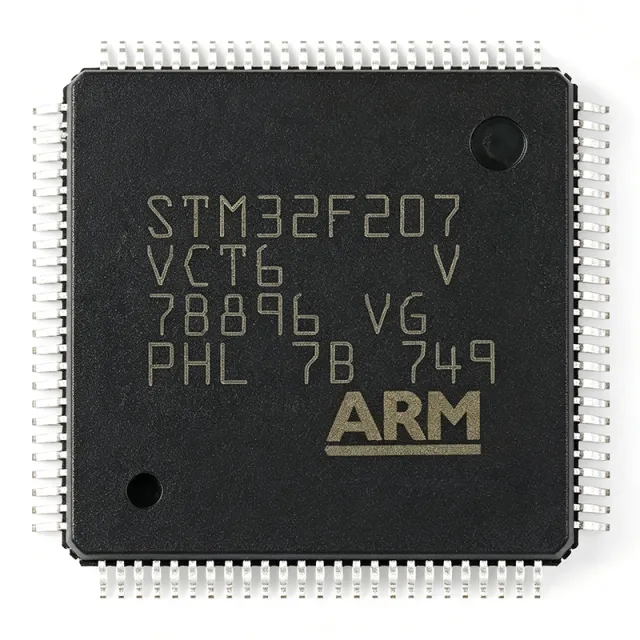
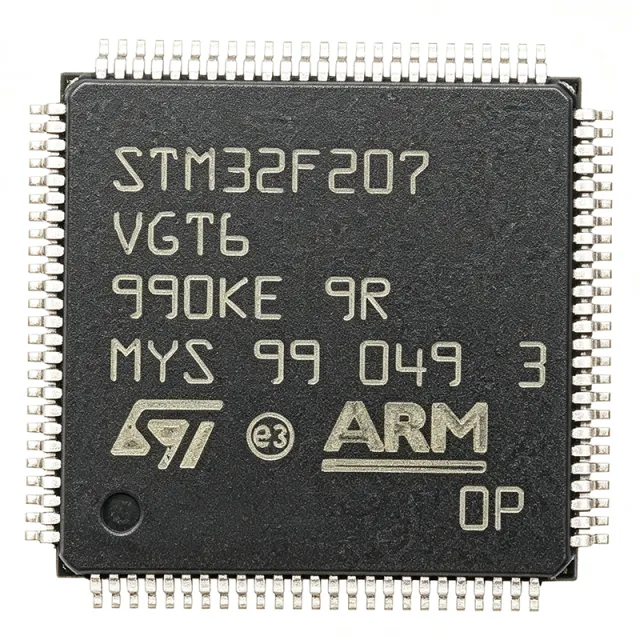
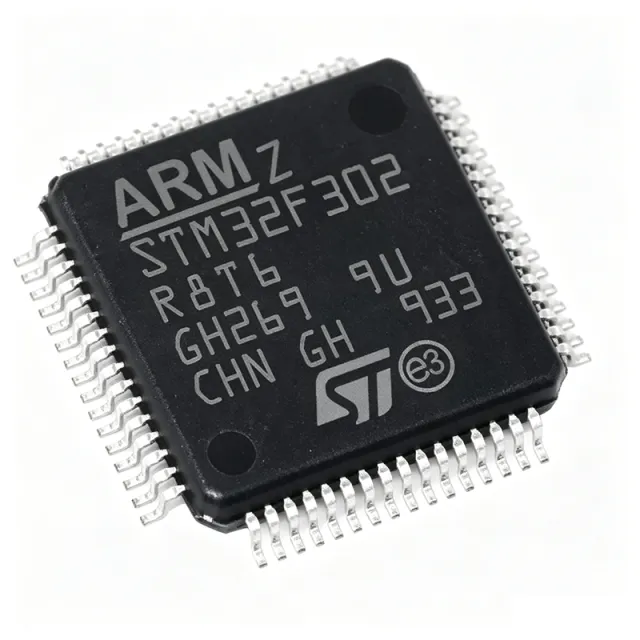
STM32F217ZET6
STM32F217ZET6 - 120MHz Cortex-M3 MCU | STMicroelectronics
The STMicroelectronics STM32F217ZET6 is a 32-bit ARM Cortex-M3 microcontroller operating up to 120 MHz, with 512 KB of embedded Flash memory and a 144-LQFP package measuring 20 mm by 20 mm. It combines an adaptive real-time accelerator, memory-protection capability, extensive connectivity, and mixed-signal peripherals for demanding embedded systems.
A microcontroller, or MCU, integrates a processor core, nonvolatile program memory, working memory, peripherals, and communication interfaces on one semiconductor device. The STM32F2 series belongs to the hierarchy of 32-bit microcontroller, embedded processor, embedded controller, and semiconductor categories. Its ARM Cortex-M3 architecture provides a compact platform for real-time control, communications, data acquisition, human-interface equipment, and connected industrial equipment.
Key features include execution up to 120 MHz, 512 KB of Flash memory, 128 KB of SRAM plus 4 KB of backup SRAM, and an ART Accelerator designed for zero-wait-state Flash execution. The device also provides three 12-bit ADCs, 17 timers, Ethernet MAC, USB OTG HS/FS, camera interface, cryptographic capability, and 15 communication interfaces. These resources support simultaneous control, sensing, networking, and peripheral management without requiring separate interface devices.
The Cortex-M3 processor uses a reduced-instruction-set architecture with hardware bit-manipulation instructions and a memory-protection unit. At its maximum 120 MHz frequency, the core can deliver up to 150 DMIPS according to the manufacturer datasheet. The large Flash and SRAM capacities accommodate network stacks, bootloader code, graphics or camera functions, control algorithms, and field-upgradeable application logic while retaining sufficient working space for real-time processing.
Typical applications include industrial automation controllers, Ethernet-connected equipment, camera and vision systems, USB peripherals, audio equipment, building-control panels, and industrial communications gateways. The 144-pin LQFP package exposes substantially more I/O than smaller MCU packages, making the STM32F217ZET6 suitable for designs requiring parallel interfaces, multiple communications channels, mixed-signal conversion, and deterministic peripheral expansion.
Designers should pay particular attention to clock, reset, power, decoupling, and signal-routing requirements. Place decoupling capacitors beside the appropriate supply pins, route high-speed signals away from switching nodes, and validate unused-pin termination against the manufacturer pin and package guidance. Firmware qualification should also include voltage-level, timing, peripheral-mapping, and errata checks before replacing an existing STM32F2 design.
This page combines the key architecture, memory, connectivity, and package characteristics with application guidance, verified drop-in alternatives, comparison parameters, and practical PCB considerations. It is designed to help engineers evaluate the STM32F217ZET6 for new designs and structured replacement projects without relying on a raw distributor listing alone.
RFQ
संपर्क