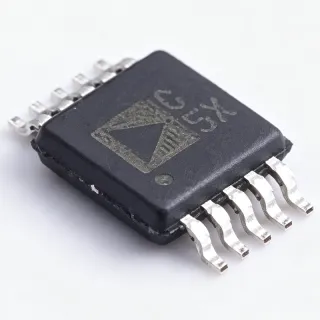
MCP3553T-E/SN - 22-Bit 60 SPS Sigma-Delta ADC | Microchip
MPN: MCP3553T-E/SN ✓ सक्रियMCP3553T-E/SN अवलोकन
A delta-sigma ADC is a voltage-to-digital converter that uses oversampling and digital filtering to convert an analog input into a high-resolution digital code. Within the broader hierarchy, the MCP3553T-E/SN is a sigma-delta ADC, a precision data-converter IC, and a member of the power-management and analog semiconductor category. Its differential input architecture supports sensor, bridge, and low-level voltage measurements.
Key characteristics include 22-bit resolution, 60 SPS throughput, 2.5 µVRMS output noise, and 21.9-bit effective resolution. The device also provides automatic internal offset and gain calibration, which helps reduce errors in low-level sensor measurements. Its SPI-compatible serial interface keeps the connection to a microcontroller compact while supporting deterministic data transfer.
The MCP3553 family uses a sigma-delta conversion architecture that trades conversion speed for resolution and noise performance. The 60 SPS rate is suitable for slow-changing measurements such as temperature, pressure, load, and strain, where the priority is repeatable readings rather than high-speed waveform capture. Digital filtering further reduces high-frequency noise at the cost of a defined conversion and settling interval.
Typical applications include industrial process monitoring, portable instrumentation, precision weigh systems, battery-powered measurement nodes, and sensor interfaces where analog signals remain close to the converter's internal noise floor. The fully differential input arrangement helps reject common-mode noise when the source is connected differentially.
Designers should place input filtering and reference components close to the device, keep the analog input path compact, and allow the digital interface to remain isolated from sensitive analog traces. Stable supply and reference voltages are essential because supply and reference variation appear directly as measurement error even when the converter itself performs correctly.
This page combines the manufacturer family information with package, interface, resolution, throughput, noise, and application guidance. It also identifies same-package family alternatives, explains their functional differences, and provides engineering notes for PCB layout, calibration, and analog signal conditioning that engineers can apply before schematic release.
के लिए ड्रॉप-इन विकल्प MCP3553T-E/SN — समान पैकेज, पिन-टू-पिन संगत। PCB रीवर्क आवश्यक करने वाले भिन्न-पैकेज पार्ट्स शामिल नहीं हैं।
इस सीरीज़ के वेरिएंट
समान श्रृंखला के मॉडल जो ड्रॉप-इन संगत हैं MCP3553T-E/SN (समान फॉर्म फैक्टर और फुटप्रिंट) — इसमें भिन्न Package, Resolution.
MCP3553-E/SN
✅ ड्रॉप-इनकीमत के लिए संपर्क करें
डेटाशीट देखें →MCP3550T-E/SN
✅ ड्रॉप-इन📋 संदर्भ विकल्प (कैटलॉग में नहीं)
MCP3551T-E/SN
✅ ड्रॉप-इनकीमत के लिए संपर्क करें
डेटाशीट देखें →MCP3553T-E/SN Maximum Ratings और Electrical Characteristics
| रेज़ोल्यूशन | 22 bits |
| Effective Resolution | 21.9 bits |
| Conversion Rate | 60 samples/s |
| आउटपुट नॉइज़ | 2.5 µVRMS |
| ADC Architecture | Single-channel sigma-delta |
| Analog Input | Fully differential |
| Number of Inputs | 1 |
| Data Interface | SPI serial interface |
| पैकेज | 8-pin SOIC, 3.00 mm width |
| माउंटिंग प्रकार | Surface mount |
| ऑपरेटिंग तापमान रेंज | -40°C to +125°C |
| Calibration | Automatic internal offset and gain calibration |
MCP3553T-E/SN 8-pin soic, 3.00 mm width पिन कॉन्फ़िगरेशन गाइड
MCP3553T-E/SN (8-pin soic, 3.00 mm width पैकेज) के लिए पिन कॉन्फ़िगरेशन। इस एनालॉग कंपोनेंट में इनपुट, आउटपुट और पावर सप्लाई पिन हैं। ऑफ़सेट नल, कम्पनसेशन और एनेबल पिन कॉन्फ़िगरेशन के लिए निर्माता डेटाशीट देखें। सिग्नल कंडीशनिंग और एम्प्लीफ़ायर सर्किट के लिए आदर्श।

इसके लिए कोई विस्तृत pinout data उपलब्ध नहीं: MCP3553T-E/SN.
देखें डेटाशीट पूर्ण पिन कॉन्फ़िगरेशन के लिए।
सामान्य अनुप्रयोग
MCP3553T-E/SN के लिए उपयुक्त है 6 अनुप्रयोगs: Industrial Process Measurement, Precision Temperature Sensing, Load-Cell and Strain Measurement, Battery-Powered Environmental Sensors, Portable Precision Instrumentation, Digital Scale and Force Measurement.
Industrial Process Measurement
The MCP3553T-E/SN suits industrial process monitoring because it combines 22-bit nominal resolution, 21.9-bit effective resolution, and a 60 SPS conversion rate in an 8-pin SOIC package. It can digitize slowly changing pressure, level, or flow signals without the component count of a higher-resolution discrete converter. The fully differential input helps reject common-mode noise present on industrial sensor wiring. Automatic internal offset and gain calibration improves consistency between measurements, while the SPI interface connects directly to a low-power embedded controller. Use a differential input filter close to the converter and verify the input range, reference accuracy, and calibration timing against the manufacturer data sheet.
अनुशंसित
Precision Temperature Sensing
The MCP3553T-E/SN is appropriate for high-resolution temperature acquisition from RTD, thermistor, or low-level bridge sensors. A 60 SPS rate provides enough data for thermal control loops while avoiding unnecessary conversion activity, and the 2.5 µVRMS output noise helps preserve fine temperature changes after conversion. The differential analog architecture supports a balanced sensor connection and improves rejection of common-mode disturbances. Automatic internal offset and gain calibration helps stabilize readings in compact industrial controllers. The analog filter and reference components should be placed close to the ADC, and the SPI traces routed away from the sensor input to avoid coupling digital switching noise into the measurement.
अनुशंसित
Load-Cell and Strain Measurement
The MCP3553T-E/SN fits load-cell, strain-gauge, and pressure-transducer front ends that produce small differential signals. Its 22-bit resolution and 21.9-bit effective resolution improve the visibility of small mechanical changes, while 60 SPS is sufficient for weighing and force monitoring systems that update continuously rather than capture transient waveforms. Differential input wiring helps suppress shared sensor noise, and automatic offset and gain calibration assists with long-term drift. Confirm that the transducer excitation and signal level remain inside the converter's differential and common-mode limits. Use low-noise reference components and a compact analog layout because external reference drift can otherwise dominate the system error.
अनुशंसित
Battery-Powered Environmental Sensors
The MCP3553T-E/SN is suitable for battery-powered environmental monitoring nodes measuring humidity, gas, or pressure signals that change slowly. The low-power single-channel architecture avoids the energy cost of continuous high-rate conversion, while the 60 SPS rate still allows frequent readings for local control or radio updates. The 8-pin SOIC package supports compact sensor boards, and the SPI interface requires only a small number of signal connections. Duty-cycle the converter according to the manufacturer's operating guidance and use the calibration features when stable baseline readings are important. Because portable nodes often share ground paths with wireless or switching circuitry, isolate sensitive analog traces and keep the input filter close to the converter.
अनुशंसित
Portable Precision Instrumentation
The MCP3553T-E/SN supports portable meters and field instrumentation that must resolve small analog changes from low-level sensors. Its 2.5 µVRMS output noise and 21.9-bit effective resolution improve the useful dynamic range of a 22-bit conversion, while the relatively low 60 SPS throughput suits a meter that records stable values instead of waveforms. The differential input provides a practical interface for resistive bridges and transducer front ends, and the SPI output simplifies connection to an embedded controller. Automatic offset and gain calibration can simplify production alignment, but calibration intervals and startup behavior should be followed from the family data sheet. Avoid long analog traces and place the reference network adjacent to the device.
अनुशंसित
Digital Scale and Force Measurement
The MCP3553T-E/SN is well matched to digital scales and force-measurement products that use a differential load-cell or strain bridge. The 22-bit conversion resolution captures small weight increments, and the 60 SPS update rate supports responsive display updates without excessive conversion activity. Differential input wiring reduces susceptibility to common-mode noise in long sensor cables, while automatic internal offset and gain calibration helps compensate for mechanical and electrical drift. Keep excitation and measurement routing separated, terminate cables in a manner consistent with the sensor, and use the manufacturer's recommended input filter. Verify the common-mode range at startup because bridge outputs may sit at a nonzero midpoint relative to the converter supply.
अनुशंसित
अनुशंसित उत्पादों का सारांश
के लिए इंजीनियरिंग संदर्भ डेटा MCP3553T-E/SN — तुलना, डिज़ाइन मार्गदर्शन और अनुपालन जानकारी।
चयन गाइड
विकल्पों के साथ तुलना
| पैरामीटर | यह उत्पाद | MCP3553-E/SN | MCP3550T-E/SN | MCP3551T-E/SN |
|---|---|---|---|---|
| Brand | Microchip Technology | Microchip Technology | Microchip Technology | Microchip Technology |
| Package | 8-pin SOIC, 3.00 mm width | 8-pin SOIC, 3.00 mm width | 8-pin SOIC | 8-pin SOIC |
| Resolution | 22 bits | 22 bits | 22 bits | 22 bits |
| Conversion Rate | 60 samples/s | 60 samples/s | 60 samples/s | 60 samples/s |
| Data Interface | SPI serial interface | SPI serial interface | SPI serial interface | SPI serial interface |
| Analog Input Configuration | Fully differential, single channel | Fully differential, single channel | Fully differential, single channel | Fully differential, single channel |
| Calibration | Automatic internal offset and gain calibration | Automatic internal offset and gain calibration | Automatic internal offset and gain calibration | Automatic internal offset and gain calibration |
मुख्य विशेषताएँ
- High nominal and effective resolution in a compact converter (बनामMCP3550T-E/SN)
- Direct same-package ordering option (बनामMCP3553-E/SN)
- Single-channel precision with integrated calibration (बनामMCP3551T-E/SN)
डिज़ाइन नोट्स
Place the MCP3553T-E/SN differential-input filter and reference components close to the device pins. Route the analog inputs as a compact differential pair and keep them away from SPI clock and data traces. The manufacturer identifies a fully differential input architecture, so symmetrical routing helps maintain signal integrity and common-mode rejection. Connect the exposed analog and digital return paths according to the recommended application circuit in the family data sheet.
Do not treat the 22-bit nominal resolution as 22 useful bits without accounting for noise, reference accuracy, analog conditioning, and calibration. The MCP3553T-E/SN provides 21.9-bit effective resolution and 2.5 µVRMS output noise, so a low-level sensor signal close to the noise floor may require additional gain, averaging, or a lower-reference design. Confirm the differential input and common-mode limits before connecting a bridge sensor.
Design the supply and reference network for low noise because both appear directly in the measurement result. Use the decoupling and reference-component arrangement recommended in the MCP3550, MCP3551, and MCP3553 family data sheet, and keep the reference return path separate from high-current digital returns where possible. In battery-powered equipment, select the operating mode and duty cycle from the manufacturer current-consumption data to control energy use.
Allow the digital filter and calibration sequence to settle before treating a conversion as a final measurement. SPI transactions can inject coupling into nearby analog circuitry, particularly when the input impedance is high. Use a ground guard or keep-out region beneath sensitive analog traces where the recommended layout permits it, and inspect the assembled board with an oscilloscope to verify that converter activity does not appear on the sensor input.
अनुपालन जानकारी
Compliance declarations were not identified in the manufacturer page or distributor listings. Confirm the current declarations for the exact ordering code with Microchip Technology before using the device in a regulated end product.