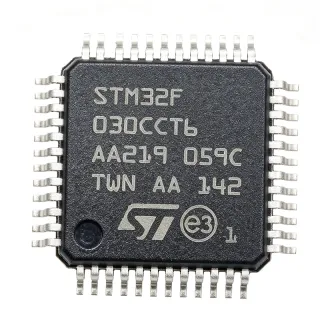
MIMXRT685SFAWBR - 300MHz Dual-Core MCU with HiFi4 DSP | NXP
MPN: MIMXRT685SFAWBR ✓ सक्रियMIMXRT685SFAWBR अवलोकन
A crossover MCU is a microcontroller that combines the real-time control strengths of an Arm Cortex-M core with the high-throughput signal-processing capabilities of a dedicated digital signal processor. The MIMXRT685SFAWBR places the Cortex-M33 and HiFi4 cores in one device, allowing firmware, connectivity, user-interface control, and audio workloads to be coordinated without using two separate processors.
Integrated features include a FlexSPI interface with cache and dynamic decryption, a high-speed USB device and host controller with USB PHY, a 12-bit ADC capable of 1 Msamples per second, an analog comparator, and audio-focused processing resources. The HiFi4 core operates up to 600 MHz, while the Cortex-M33 core operates up to 300 MHz, supporting parallel execution of real-time control and audio-processing tasks.
The device's combination of 4.5 MB of internal SRAM, high-speed serial interfaces, and hardware-assisted memory features helps reduce external-memory pressure in embedded audio systems. FlexSPI cache and dynamic decryption are particularly relevant to systems that must execute code or media-related data from external nonvolatile memory while maintaining responsive peripheral operation.
Typical applications include smart speakers, voice-controlled consumer equipment, audio hubs, soundbars, connected speakers, industrial voice panels, and compact audio interfaces. The integrated ADC and analog comparator support input monitoring and signal conditioning, while USB device and host operation enables direct connectivity with storage, peripherals, and host systems.
Hardware design should account for the WLCSP assembly requirements, high-speed signal integrity, power sequencing, and thermal performance of the dual-core device. The manufacturer datasheet pin-description table should be used directly when assigning the 114 package balls, and the boot configuration pins must be constrained correctly during power-on.
This product overview combines the exact ordering information, core architecture, memory capacity, analog features, connectivity, and package details with practical sourcing guidance. It also distinguishes the reel-order MPN from the base device and identifies the limited availability of verified pin-to-pin alternatives.
के लिए ड्रॉप-इन विकल्प MIMXRT685SFAWBR — समान पैकेज, पिन-टू-पिन संगत। PCB रीवर्क आवश्यक करने वाले भिन्न-पैकेज पार्ट्स शामिल नहीं हैं।
MIMXRT685SFAWB
✅ ड्रॉप-इन📋 संदर्भ विकल्प (कैटलॉग में नहीं)
MIMXRT685SFAWBR Maximum Ratings और Electrical Characteristics
| Product Type | Dual-core crossover microcontroller with Arm Cortex-M33 and Cadence Xtensa HiFi4 audio DSP |
| Arm Cortex-M33 Operating Frequency | Up to 300 MHz |
| Cadence Xtensa HiFi4 DSP Operating Frequency | Up to 600 MHz |
| Internal SRAM | Up to 4.5 MB |
| Processor Architecture | 32-bit Arm Cortex-M33 and Xtensa HiFi4 |
| ADC Resolution | 12 bit |
| ADC Sampling Rate | Up to 1 Msamples/s |
| Analog Comparator | Integrated |
| USB Capability | High-speed USB device and host controller with PHY |
| Serial Interface | FlexSPI with cache and dynamic decryption |
| पैकेज | 114-ball WLCSP, 4.24 mm x 4.24 mm |
| माउंटिंग प्रकार | Surface mount |
| Primary Application | Immersive audio playback and voice user-interface applications |
| Product Family | i.MX RT600 crossover MCU |
MIMXRT685SFAWBR 114-ball wlcsp, 4.24 mm x 4.24 mm पिन कॉन्फ़िगरेशन गाइड
MIMXRT685SFAWBR (114-ball wlcsp, 4.24 mm x 4.24 mm पैकेज) के लिए पिन कॉन्फ़िगरेशन। इस डिजिटल IC में GPIO, संचार इंटरफ़ेस (UART, SPI, I2C) और पावर पिन शामिल हैं। वैकल्पिक पिन फ़ंक्शन और कॉन्फ़िगरेशन विकल्पों के लिए निर्माता डेटाशीट देखें। एम्बेडेड सिस्टम डिज़ाइन और PCB लेआउट के लिए आवश्यक।

इसके लिए कोई विस्तृत pinout data उपलब्ध नहीं: MIMXRT685SFAWBR.
देखें डेटाशीट पूर्ण पिन कॉन्फ़िगरेशन के लिए।
सामान्य अनुप्रयोग
MIMXRT685SFAWBR के लिए उपयुक्त है 6 अनुप्रयोगs: Smart Speaker, Voice User Interface, USB Audio Interface, Connected Audio Hub, Industrial Voice Panel, Compact Embedded Audio Controller.
Smart Speaker
The MIMXRT685SFAWBR fits smart-speaker architectures because the 600 MHz HiFi4 DSP can handle intensive audio processing while the 300 MHz Cortex-M33 manages networking, controls, user input, and USB tasks. Up to 4.5 MB of internal SRAM reduces pressure on external storage during boot and runtime. A system designer can place voice capture, playback, and peripheral control on one device, but the final signal chain still requires validated microphone conditioning, amplifier selection, thermal analysis, and boot-strapping checks.
अनुशंसित
Voice User Interface
For a voice user interface, the MIMXRT685SFAWBR combines a general-purpose Cortex-M33 core with a dedicated HiFi4 DSP. The M33 can supervise system state, controls, and communications, while the HiFi4 handles voice-audio workloads at up to 600 MHz. The integrated 12-bit ADC rated to 1 Msamples/s and analog comparator support input monitoring, while the manufacturer datasheet's signal-integrity and grounding guidance should guide microphone and audio-clock implementation.
अनुशंसित
USB Audio Interface
The MIMXRT685SFAWBR is suitable for a USB audio interface because it combines high-speed USB device and host capability with PHY, a high-performance HiFi4 DSP, and 4.5 MB of SRAM. Audio data can be processed locally while the Cortex-M33 manages USB enumeration, control requests, and device configuration. Designers should follow the manufacturer reference layout for USB differential routing and provide tested input/output conditioning where the external codec cannot be placed close to the device.
अनुशंसित
Connected Audio Hub
A connected audio hub benefits from the MIMXRT685SFAWBR's combination of high-speed USB, FlexSPI with cache and dynamic decryption, dual-core processing, and substantial internal SRAM. The Cortex-M33 can manage device control and connectivity while the HiFi4 performs format conversion or signal processing. FlexSPI cache and dynamic decryption can support code or data access from external memory, although the final memory device, timing configuration, cache policy, and DMA architecture must be validated together.
अनुशंसित
Industrial Voice Panel
The MIMXRT685SFAWBR can support an industrial voice panel that combines local audio processing with deterministic control and monitoring. Its HiFi4 DSP handles audio at up to 600 MHz, while the Cortex-M33 manages panel logic, communications, and system control. The integrated 12-bit ADC and analog comparator can support sensor monitoring, but calibration, isolation, EMC protection, and environmental requirements must be addressed at the analog front end rather than assumed from the MCU specifications.
अनुशंसित
Compact Embedded Audio Controller
The MIMXRT685SFAWBR suits compact embedded audio controllers where space, processing parallelism, and connectivity matter. Its 4.24 mm by 4.24 mm 114-ball WLCSP keeps the component footprint small, while the Cortex-M33 and HiFi4 cores divide control and DSP workloads between dedicated processing engines. The WLCSP requires careful assembly planning, via-in-pad-compatible layout review, controlled soldering, and thermal validation before large-scale production.
अनुशंसित
अनुशंसित उत्पादों का सारांश
के लिए इंजीनियरिंग संदर्भ डेटा MIMXRT685SFAWBR — तुलना, डिज़ाइन मार्गदर्शन और अनुपालन जानकारी।
चयन गाइड
विकल्पों के साथ तुलना
| पैरामीटर | यह उत्पाद | MIMXRT685SFAWB |
|---|---|---|
| Package | 114-ball WLCSP (4.24 mm x 4.24 mm) | 114-ball WLCSP (4.24 mm x 4.24 mm) |
| Brand | NXP Semiconductors | NXP Semiconductors |
| Product Family | i.MX RT600 crossover MCU | i.MX RT600 crossover MCU |
| Arm Cortex-M33 Frequency | Up to 300 MHz | Up to 300 MHz |
| Xtensa HiFi4 DSP Frequency | Up to 600 MHz | Up to 600 MHz |
| Internal SRAM | Up to 4.5 MB | Up to 4.5 MB |
| USB | High-speed device and host with PHY | High-speed device and host with PHY |
| ADC | 12-bit, up to 1 Msamples/s | 12-bit, up to 1 Msamples/s |
| Serial Interface | FlexSPI with cache and dynamic decryption | FlexSPI with cache and dynamic decryption |
| Ordering Suffix | R reel-order suffix | Base ordering variant |
मुख्य विशेषताएँ
- Integrated real-time control and dedicated DSP processing (बनामGeneral-purpose single-core crossover MCUs)
- Substantial integrated memory for embedded audio workloads (बनामMCU variants with smaller internal SRAM)
- USB and cache-assisted serial storage integration (बनामAudio controllers requiring separate USB or storage interface resources)
- Compact package for space-constrained connected products (बनामLarger-package microcontroller options)
डिज़ाइन नोट्स
Use the manufacturer's 114-ball WLCSP land pattern and reference layout without relocating ball assignments to simplify assembly. In particular, keep high-speed USB pairs, FlexSPI signals, and audio interfaces away from noisy switching nodes and maintain the specified return-path continuity. Confirm the exact exposed-pad and thermal-via arrangement for the ordering variant before releasing artwork; the manufacturer package drawing remains the controlling reference.
Do not treat boot-capable I/O pins as unrestricted general-purpose signals without reviewing the boot-configuration requirements. The NXP community information for the MIMXRT685SFAW device specifically notes that PIO1_17 can have a PDM function while also being sampled as a boot configuration pin. Use the current manufacturer datasheet boot table to determine required pull resistors, valid logic levels, and whether the selected signal must be disabled during startup.
Budget the supply rails for simultaneous Cortex-M33 and HiFi4 activity rather than using an idle-state estimate. Include startup current, USB activity, memory traffic, external peripherals, and worst-case temperature in the regulator and capacitor selection. Place local bulk and high-frequency decoupling at the package power balls using the manufacturer layout, and verify the final assembly's voltage-drop and thermal performance across production process variation.
Evaluate the WLCSP assembly using the manufacturer's thermal data and the final PCB construction. The dual-core workload can raise device temperature above idle conditions, so calculate junction temperature from worst-case power, ambient temperature, and the applicable board-level thermal resistance. WLCSP packages also require careful solder-joint inspection because solder voids and poor wetting can increase local thermal resistance and accelerate package failure.
Preserve the reference layout for USB and FlexSPI because trace length, reference planes, return paths, and decoupling strongly influence interface reliability. Route differential USB pairs as a controlled impedance pair and avoid stubs or layer transitions that are not represented in the manufacturer reference design. For external memory, verify cache, dynamic-decryption, DMA, and memory-controller timing configurations as one system rather than enabling cache independently of the firmware access pattern.
अनुपालन जानकारी
The related MIMXRT685SFAWB product page lists environmental quality information, but explicit RoHS, REACH, lead-free, halogen-free, conflict-minerals, and AEC-Q100 conclusions were not available in the indexed product details. Automotive qualification is not indicated for the standard MIMXRT685SFAWBR ordering form.