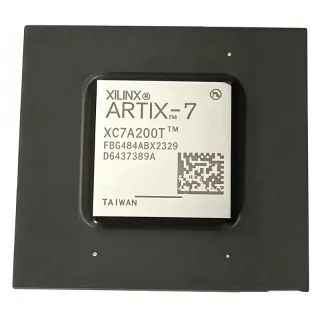
XC95108-20PQ160C - 66.7MHz 108-Macrocell CPLD | AMD
MPN: XC95108-20PQ160C ✓ सक्रियXC95108-20PQ160C अवलोकन
A complex programmable logic device, or CPLD, is a user-programmable logic device that combines a nonvolatile configuration memory with an array of programmable AND/OR logic and macro cells. Within the programmable-logic hierarchy, a CPLD sits between simple programmable logic devices and FPGAs. Unlike mask-programmed logic or SRAM-only FPGA fabrics, this XC9500-series device stores its configuration in flash memory and supports in-system programming, allowing logic updates without removing the package from the circuit board.
The XC95108 provides 2.4K gates organized into 108 macro cells and supports clock rates up to 66.7 MHz. Its 160-lead surface-mount PQFP package provides 28 mm by 28 mm gull-wing terminals, making it suitable for designs that require many I/O sites and a through-hole-compatible lead pitch. The device uses a 0.5 µm fabrication technology and operates from a 4.75 V to 5.25 V internal supply.
Typical uses include legacy control-plane logic, peripheral interfacing, industrial automation, embedded system glue logic, and board-level bus arbitration. The in-system programming capability supports configuration updates in assembled equipment and reduces the need for socketed devices when the logic design evolves after prototype verification.
Design work should begin with the XC95108 In-system Programmable CPLD Data Sheet, Document ID DS066, for the authoritative pinout, I/O characteristics, configuration pin requirements, and programming recommendations. Verify the clock and timing budget against the target system because the 66.7 MHz figure represents the device performance class rather than a guarantee for every implemented logic path.
This page combines the verified device specifications with family-level drop-in candidates, package-compatibility guidance, and practical design notes. It also distinguishes speed-grade and temperature-grade substitutions that require timing or environmental review before being treated as production replacements.
के लिए ड्रॉप-इन विकल्प XC95108-20PQ160C — समान पैकेज, पिन-टू-पिन संगत। PCB रीवर्क आवश्यक करने वाले भिन्न-पैकेज पार्ट्स शामिल नहीं हैं।
इस सीरीज़ के वेरिएंट
समान श्रृंखला के मॉडल जो ड्रॉप-इन संगत हैं XC95108-20PQ160C (समान फॉर्म फैक्टर और फुटप्रिंट) — इसमें भिन्न Configuration Memory, Device Type, Temperature Grade, Logic Family, Macro Cells.
XC95108-20PQG160C
✅ ड्रॉप-इन📋 संदर्भ विकल्प (कैटलॉग में नहीं)
XC95108-15PQ160C
✅ ड्रॉप-इनकीमत के लिए संपर्क करें
डेटाशीट देखें →XC95108-10PQ160C
✅ ड्रॉप-इनकीमत के लिए संपर्क करें
डेटाशीट देखें →XC95108-10PQ160I
✅ ड्रॉप-इन📋 संदर्भ विकल्प (कैटलॉग में नहीं)
XC95108-7PQ160C
✅ ड्रॉप-इन📋 संदर्भ विकल्प (कैटलॉग में नहीं)
XC95108-20PQ160C Maximum Ratings और Electrical Characteristics
| Device Type | In-system programmable complex programmable logic device |
| Programmable Logic Gates | 2.4K gates |
| Macro Cells | 108 macro cells |
| Maximum Operating Frequency | 66.7 MHz |
| Technology | 0.5 µm |
| Core Supply Voltage | 5 V |
| Internal Supply Voltage Range | 4.75 V to 5.25 V |
| Configuration Memory | Flash PLD |
| Programming Method | In-system programmable |
| Package Type | PQFP |
| Package Code | HQFP |
| Package Dimensions | 28 mm x 28 mm |
| Number of Terminals | 160 terminals |
| Terminal Form | Gull wing |
| माउंटिंग स्टाइल | Surface mount |
| Temperature Grade | Commercial |
| ऑपरेटिंग तापमान रेंज | 0 °C to 70 °C |
| Logic Family | XC9500 series |
XC95108-20PQ160C 28 mm x 28 mm पिन कॉन्फ़िगरेशन गाइड
XC95108-20PQ160C (28 mm x 28 mm पैकेज) के लिए पिन कॉन्फ़िगरेशन। इस डिजिटल IC में GPIO, संचार इंटरफ़ेस (UART, SPI, I2C) और पावर पिन शामिल हैं। वैकल्पिक पिन फ़ंक्शन और कॉन्फ़िगरेशन विकल्पों के लिए निर्माता डेटाशीट देखें। एम्बेडेड सिस्टम डिज़ाइन और PCB लेआउट के लिए आवश्यक।

इसके लिए कोई विस्तृत pinout data उपलब्ध नहीं: XC95108-20PQ160C.
देखें डेटाशीट पूर्ण पिन कॉन्फ़िगरेशन के लिए।
सामान्य अनुप्रयोग
XC95108-20PQ160C के लिए उपयुक्त है 6 अनुप्रयोगs: Industrial Control and Automation, Peripheral Interfacing and Bus Arbitration, Embedded System Glue Logic, Consumer and Communication Equipment, Legacy Board Revisions and Obsolescence Mitigation, Programmable Test and Measurement Front Ends.
Industrial Control and Automation
The XC95108-20PQ160C fits legacy industrial control boards that require dense board-level logic without a large FPGA. Its 108 macro cells and 2.4K gates can implement state machines, interlocks, sequencing, and I/O mapping, while the 160-pin PQFP package exposes enough connection sites for discrete sensors and actuator drivers. The 66.7 MHz performance class provides margin for common control and communication-interface logic. Because the commercial rating is 0 °C to 70 °C, select a wider-temperature grade when the enclosure operates beyond that range. Place the device away from high-dissipation regulators and switching nodes to preserve signal and configuration reliability.
अनुशंसित
Peripheral Interfacing and Bus Arbitration
The XC95108-20PQ160C is useful for consolidating legacy peripheral control, address decoding, interrupt routing, and bus arbitration around a processor or microcontroller. Its 108 macro cells and 66.7 MHz performance class suit multi-cycle bus control and asynchronous state machines, while the large 160-lead package reduces the need for external glue logic. Configure the design for the board's 5 V environment and verify every I/O against the electrical tables in AMD Document DS066. In-system programming allows a production board to receive a corrected arbitration or peripheral map without a socketed device, reducing field-service complexity and simplifying configuration revision control.
अनुशंसित
Embedded System Glue Logic
The XC95108-20PQ160C can implement the fixed control logic between a microprocessor, memory, and peripheral chips in mature embedded systems. Typical assignments include chip-select generation, reset sequencing, watchdog handling, interrupt combining, and power-state coordination. Its 2.4K gates and 108 macro cells allow several independent logic blocks to be consolidated, while flash-based in-system programming supports deterministic configuration storage. Use the manufacturer's pin-description table to assign configuration and clock pins before laying out the PCB. The 66.7 MHz class is useful for synchronous control paths, but timing closure must be evaluated against actual routing delays and the external device timing specifications.
अनुशंसित
Consumer and Communication Equipment
The XC95108-20PQ160C is suitable for legacy consumer and communication products that need moderate logic density, abundant I/O, and nonvolatile configuration. It can implement display-control sequencing, keypad scanning, indicator drivers, interface timing, and supervisory functions. The 160-pin PQFP package provides 160 terminal sites in a 28 mm by 28 mm body, accommodating the many point-to-point connections common in older control-heavy products. The 5 V supply range of 4.75 V to 5.25 V suits established 5 V board architectures. In-system programming is especially useful for final-stage product differentiation because a finished unit can be configured or revised without replacing a socketed device.
अनुशंसित
Legacy Board Revisions and Obsolescence Mitigation
The XC95108-20PQ160C is practical for maintaining a legacy PCB where changing the device would require a new layout. Its 160-terminal PQFP footprint can be retained when a replacement shares the same lead pattern, while the 108 macro cells and 2.4K gates make it a natural match for designs that already used the XC9500 architecture. Verify the exact pinout and device revision before substituting a differently suffixed family member. Program and test the complete configuration file in-system after replacement, and inspect unused I/O behavior for clamp, pull, or signal-state differences. This approach minimizes board-rewrite risk while retaining an established control-logic platform.
अनुशंसित
Programmable Test and Measurement Front Ends
The XC95108-20PQ160C can implement sequencers, pattern generators, relay-control logic, and instrument-interface state machines in a 5 V test system. The 66.7 MHz performance class supports timed control sequences, while 108 macro cells provide room for multiple counters, timing encoders, and communication translators. The 160-pin PQFP package is useful when a fixture or instrument requires numerous individual control lines rather than a narrow serial interface. Treat unused pins according to the DS066 recommendations and validate every connected signal against the device's I/O ratings. In-system programming makes it practical to store different test profiles and update them during controlled production or service operations.
अनुशंसित
अनुशंसित उत्पादों का सारांश
के लिए इंजीनियरिंग संदर्भ डेटा XC95108-20PQ160C — तुलना, डिज़ाइन मार्गदर्शन और अनुपालन जानकारी।
चयन गाइड
विकल्पों के साथ तुलना
| पैरामीटर | यह उत्पाद | XC95108-20PQG160C | XC95108-15PQ160C | XC95108-10PQ160C | XC95108-10PQ160I | XC95108-7PQ160C |
|---|---|---|---|---|---|---|
| Brand | AMD | AMD | AMD | AMD | AMD | AMD |
| Package | PQFP-160 (28 mm x 28 mm) | PQFP-160 | PQFP-160 | PQFP-160 | PQFP-160 | PQFP-160 |
| Speed Designation | -20 | -20 | -15 | -10 | -10 | -7 |
| Programmable Logic Gates | 2.4K gates | 2.4K gates | 2.4K gates | 2.4K gates | 2.4K gates | 2.4K gates |
| Macro Cells | 108 macro cells | 108 macro cells | 108 macro cells | 108 macro cells | 108 macro cells | 108 macro cells |
| Number of Terminals | 160 terminals | 160 terminals | 160 terminals | 160 terminals | 160 terminals | 160 terminals |
मुख्य विशेषताएँ
- Matches the 66.7 MHz performance class while retaining a 160-pin PQFP footprint (बनामXC95108-15PQ160C)
- Provides 108 macro cells and 2.4K gates for consolidated control logic (बनामXC95108-10PQ160I)
- Commercial-temperature target with explicit 0 °C to 70 °C rating (बनामXC95108-10PQ160I)
- Uses a high-I/O 160-terminal surface-mount package (बनामXC95108-20PQG160C)
डिज़ाइन नोट्स
Route configuration, clock, power, and ground pins using the 160-lead drawing in AMD Document DS066. The PQFP body is 28 mm by 28 mm, so confirm courtyard clearance, lead pitch, solder-mask geometry, and assembly tooling before fabrication. Avoid placing high-speed signals beneath the device unless the stackup and return-path design have been reviewed.
The internal supply range is 4.75 V to 5.25 V, so terminate and decouple the supply rails in accordance with the DS066 pin and recommended-circuit guidance. Keep high-current switching nodes and inductors away from the device's clock and configuration inputs. Confirm the external load current, connector voltage tolerances, and state of every unused I/O before the first board revision is released.
Do not treat every XC95108 suffix as automatically interchangeable. The -20, -15, -10, and -7 designations identify different speed classes, while I and C identify different environmental intentions. A replacement can retain the package yet alter timing margin or temperature capability. Recompile or reanalyze the CPLD design, verify the pinout, and run configuration and timing tests on the exact replacement part before production approval.
Although the device is a flash PLD with in-system programming, treat the programming interface as a normal layout subsystem: keep the associated traces away from noisy analog or switching nets, observe any documented clock requirements, and provide accessible programming access for manufacturing and field updates. Test the same configuration sequence used in production so programming behavior is validated under realistic board loading.
अनुपालन जानकारी
The commercial temperature grade is specified as 0 °C to 70 °C. RoHS, REACH, lead-free, halogen-free, and conflict-minerals declarations require confirmation from the manufacturer or the supplier for the exact production lot.