Codec Audio
Produk (49)

CS4223-BS - 24-Bit 105dB Stereo Audio Codec | Cirrus Logic
The Cirrus Logic CS4223-BS is a 24-bit, 105 dB dynamic-range stereo audio codec with integrated analog-to-digital and digital-to-analog converters, operating from a single +5 V supply in a 28-pin SSOP package. The converter uses delta-sigma conversion techniques, and the CS4223-BS configuration is identified by distributor data as a stereo codec without volume control. An audio codec is an interface IC that converts analog sound signals into digital data and reconstructs digital audio into analog signals. A codec belongs to the broader interface IC and signal-conversion hierarchy, combining an ADC, DAC, digital audio interface, clocking, and associated analog support functions. This integration reduces the number of external converters required in CD players, DVD systems, automotive audio equipment, consumer electronics, and other stereo-audio systems. Key features include 24-bit audio resolution, a specified signal-to-noise ratio of 105 dB, stereo ADC and DAC channels, delta-sigma conversion, and single +5 V operation. The 105 dB rating provides a concrete measure of the converter noise floor relative to the full-scale signal, while 24-bit words provide sufficient numerical resolution for professional and consumer audio paths. The 28-pin SSOP surface-mount package supports compact, board-level implementations. The device accepts digital audio through its serial audio interface and uses external clocking and synchronization signals for deterministic conversion. Delta-sigma architectures reduce the need for high-precision conversion components inside the signal path, although board layout, grounding, supply decoupling, and clock signal integrity remain important. Analog and digital sections should be routed to minimize coupling from switching nodes and high-current return paths. Typical applications include stereo CD and DVD audio, home-theater equipment, automotive sound systems, digital mixing consoles, multimedia appliances, and other systems requiring simultaneous analog-to-digital and digital-to-analog conversion. The CS4223-BS is appropriate where a 24-bit stereo codec and 105 dB dynamic range are required from one +5 V supply. Because the verified listing identifies this -BS option as lacking volume control, systems requiring an internal volume-control function should verify that requirement before design-in. For a new PCB, place all decoupling capacitors close to their supply pins, use a low-inductance ground reference, and route clock and data traces away from analog inputs. The +5 V rail should be filtered if nearby switching converters create ripple or high-frequency noise. Legacy-product risk should also be evaluated because the available cross-reference data labels the CS4223 family as obsolete and recommends consulting manufacturer lifecycle information before committing to a production run.
CS4223-KS - 24-Bit 105dB Stereo Audio Codec | Cirrus Logic
Cirrus Logic CS4223-KS is a 24-bit, 105 dB stereo audio codec with integrated analog-to-digital and digital-to-analog converters, supplied in a 28-pin SSOP package. The device uses delta-sigma conversion, operates from a single +5 V power supply, and provides a 24-bit serial audio interface. It combines bidirectional stereo audio conversion in one package, reducing the number of separate converters required in a digital audio system. An audio codec is an interface integrated circuit that converts between analog audio signals and digital audio data. The CS4223 belongs to the broader codec hierarchy, which includes digital-to-analog converters, analog-to-digital converters, audio interface ICs, and signal-conversion semiconductors. In this device, stereo delta-sigma ADC and DAC sections share the same integrated package and serial digital audio connection. The primary verified performance features are 24-bit resolution, 105 dB dynamic range, stereo conversion, a 24-bit serial interface, operation from one +5 V supply, and low power consumption. These characteristics suit professional audio equipment, multichannel sound systems, consumer audio electronics, industrial monitoring, and embedded audio platforms where analog audio must be captured or reproduced using a digital signal path. The CS4223/4 family uses delta-sigma conversion techniques, allowing analog stereo signals and digital audio data to share a compact mixed-signal package. The CS4223-KS distributor description identifies this specific option as a 24-bit audio codec without volume control. That distinction is important because volume-control functionality must be verified in the manufacturer documentation before assuming equivalent behavior between CS4223 and CS4224 variants. Typical circuit roles include receiving digital audio data for conversion to stereo analog outputs and accepting stereo analog inputs for conversion to digital data. System designers must provide suitable input and output filtering, stable analog supply and ground distribution, correct serial-interface timing, and signal routing appropriate to the codec's application. The single +5 V supply simplifies rail planning, although analog and digital return-current paths still require careful PCB partitioning. Before layout, compare the exact CS4223-KS pinout and electrical limits against the selected schematic revision. The public search results identify the package as 28-pin SSOP, but they do not provide a complete verified pin table in the supplied data; no pin names are therefore inferred here. Likewise, sample rate, clock range, analog input and output range, and recommended external component values require confirmation in the manufacturer datasheet. This product page consolidates the verified distributor descriptions, manufacturer-family data, package information, and practical selection considerations for the CS4223-KS. It separates confirmed specifications from unavailable parameters and focuses comparison on genuine same-package family options rather than presenting unrelated codecs as drop-in replacements.
CS4224-BS - 24-Bit 105dB Stereo Audio Codec | Cirrus Logic
Cirrus Logic CS4224-BS is a 24-bit, 105 dB stereo audio codec with integrated analog-to-digital and digital-to-analog converters and volume control in a 28-pin SSOP package. The device combines a stereo 24-bit ADC and stereo 24-bit DAC, uses delta-sigma conversion techniques, and operates from a single +5 V power supply. An audio codec is a mixed-signal semiconductor that converts signals between the analog and digital domains. The CS4224 family belongs to the codec hierarchy, which includes audio codecs, interface ICs, data converters, and broader signal-processing semiconductors. Its integrated ADC and DAC reduce the number of external conversion components needed in professional audio, communications, and digital audio equipment. Key features include 24-bit conversion resolution, a stated 105 dB signal-to-noise characteristic, integrated volume control, stereo conversion channels, and operation from one +5 V supply. These characteristics make the device appropriate for audio capture and playback systems where a compact, dedicated codec is preferable to discrete converters. Its integrated volume function can simplify analog-level control, although system-level gain planning must prevent overload and preserve headroom. The CS4224-BS uses delta-sigma conversion to implement the analog-to-digital and digital-to-analog functions. According to the Cirrus Logic CS4224 family datasheet, the architecture is designed for high-performance 24-bit audio operation in a single integrated device. Exact interface timing, clock requirements, analog performance, input and output topology, and recommended external component values must be confirmed against the manufacturer datasheet before layout or firmware is finalized. Typical uses include digital audio consoles, multimedia and communications equipment, sound-card signal paths, and other stereo audio systems requiring simultaneous analog capture and playback. In such systems, the codec can sit between analog microphones or line-level sources and a digital audio processor, while digital program audio is converted back to analog for monitoring or amplification. Designers should follow the manufacturer pinout and reference connection exactly, paying particular attention to analog grounding, supply decoupling, clock routing, and the treatment of unused inputs and outputs. Because the verified product listing identifies the CS4224-BS as a 28-SSOP and describes it as a 24-bit, 105 dB codec with volume control, those details can be cited confidently; additional electrical values remain subject to the datasheet. This page consolidates the verified distributor identity, pricing reference, package information, family-level description, drop-in evidence, and practical design guidance. It also distinguishes confirmed specifications from parameters that still require verification, providing a more useful engineering record than an uncontextualized distributor listing.

CS4226-BQ 6-Channel Surround Sound Codec | Cirrus Logic
The Cirrus Logic CS4226-BQ is a six-channel surround-sound audio codec with stereo analog-to-digital conversion, six digital-to-analog channels, and independent volume control, supplied in a 44-pin TQFP package measuring 10 mm by 10 mm. It operates from a 4.75 V to 5.25 V supply and is specified across a -40 °C to +85 °C temperature range. The supported digital interfaces include I2C and SPI, while the verified device data identifies a sampling-frequency range of 4 kHz to 50 kHz. An audio codec is a mixed-signal integrated circuit that converts between analog audio signals and digital audio data. Within the semiconductor hierarchy, it is an interface IC and audio codec rather than a conventional amplifier or standalone converter. The CS4226 combines delta-sigma conversion stages, a stereo ADC path, six DAC channels, independent channel-volume functions, and digital control into one device for multichannel audio systems. The principal feature of the CS4226-BQ is its six-channel DAC architecture with independently selectable volume control for each output. This allows a multichannel system to balance individual speaker or surround channels in software. The device also provides a stereo ADC, an I2C/SPI control interface, and a frequency range suitable for conventional digital audio streams. Its single 5 V operating region simplifies analog and digital supply planning when the rest of the system uses a compatible rail. The CS4226 family uses delta-sigma conversion techniques rather than the R-2R ladder architecture associated with some high-end audio converters. Delta-sigma converters integrate a noise-shaping and digital-filtering process into the conversion path. The CS4226 datasheet identifies the component as a surround-sound codec, and its control-port listings include SCL/CCLK, SDA/CDOUT, AD1/CDIN, AD0/CS, LRCK, SCLK, and the six DAC data inputs and outputs. Typical uses include surround-sound decoding in home theater equipment, multichannel amplifier systems, active speaker electronics, AV receivers, and other equipment requiring several independently controlled digital audio outputs. A stereo source can be routed into the codec's digital conversion and processing architecture, while separate digital streams or channels can be assigned to the six DAC outputs. The device can also be paired with external amplifiers when the required output power exceeds the codec's signal-routing role. Designers should treat the CS4226-BQ as a mixed-signal device and preserve clean separation between analog and digital return currents. The 5 V supply must remain within the specified 4.75 V to 5.25 V range, and unused analog, digital, and control resources should be terminated according to the manufacturer datasheet. PCB layout, grounding, clocking, and supported data-format details must be confirmed from the complete CS4226 documentation before a production design is released. This page consolidates verified distributor and datasheet information, organizes the commercial and technical selection questions engineers commonly need, and explicitly identifies parameters that require confirmation from the manufacturer documentation. That distinction is important because the public search results verify the core codec identity, package, supply range, temperature range, interface types, and sampling range but do not expose every electrical, timing, pin-level, and lifecycle detail.

CS4280-CM Audio Volume Control IC | Cirrus Logic | PCI
Cirrus Logic CS4280-CM is a one-channel audio volume-control and power-management IC for PCI audio systems, supplied in a 100-pin MQFP package measuring 20 mm by 14 mm. The verified operating-temperature range is 0°C to +70°C, while the listed supply ranges are 3 V to 3.6 V and 4.75 V to 5.25 V. Its documented features include an integrated phase-locked loop, on-chip digital gain, an asynchronous digital serial interface, and power-management functions. The CS4280 is associated with CrystalClear PCI audio implementations and is commonly paired with the CS4297 audio codec. An audio volume-control IC is a specialized interface-circuit category that controls signal level and coordinates an audio subsystem with its digital host. Within the broader hierarchy, the CS4280-CM belongs to the audio special-purpose interface IC class, which falls under interface ICs and ultimately integrated circuits. Its role differs from a general-purpose audio codec: the volume-control device manages gain and supporting control functions, while the companion codec performs much of the audio conversion and signal processing. This division of responsibilities was common in PCI-based sound-card architectures. The CS4280-CM combines digital gain control with internal synchronization support. The integrated phase-locked loop can provide the timing reference required for coordinated digital audio operations, while the asynchronous digital serial interface allows the host controller to exchange control information with the device. On-chip digital gain provides software-addressable level adjustment without relying exclusively on an external passive attenuator. Together, these features support centralized volume control, mute-related system management, and coordinated operation with a companion audio codec. The CS4280 belongs to a family of legacy Crystal Semiconductor and Cirrus Logic audio devices designed for personal-computer sound-card implementations. Verified cross-reference information identifies CS4281-CM as an alternative, and the CS4280 is documented as pin-compatible with the earlier CS4614 and CS4622/CS4624 families. These relationships are useful for repair and legacy-platform work, although board-level compatibility must include verification of supply rails, clocking, software registers, and companion codec requirements. The MQFP package is intended for surface-mount assembly and provides a large, inspectable footprint compared with modern compact audio IC packages. Typical uses include CrystalClear PCI sound cards, DOS-era and Windows 98-era multimedia computers, multi-function audio adapters, and legacy industrial or retrocomputing systems that retain support for the CS4280 and its associated drivers. The CS4297-JQ is a relevant companion because verified sources specifically describe the CS4280 as commonly used with the CS4297 codec. The CS4216-KL represents another nearby audio-interface family that may be relevant when comparing platform architectures, although it is not presented as a direct substitute for the CS4280-CM. When repairing or repurposing a board, verify the complete 100-pin footprint, 3.3 V and 5 V rail requirements, clock connections, serial interface topology, and codec handshake before ordering. The documented 0°C to +70°C range limits deployment to commercial-temperature environments unless the surrounding system and the actual sourced component provide wider qualification. Because the verified material identifies the CS4280 family as an obsolete or end-of-life product, procurement planning should emphasize authorized inventory, traceable sourcing, and a full functional test after replacement.

CS4297-JQ AC'97 Stereo Audio Codec | Cirrus Logic | PC
Cirrus Logic CS4297-JQ is a 2-channel, AC'97 1.03-compatible stereo audio codec designed for PC multimedia systems and housed in a 48-TQFP 7 x 7 mm package. The device uses CrystalClear delta-sigma and mixed-signal technology to support high-quality audio in desktop, portable, and entertainment PCs. It integrates stereo modulation and a 48-kHz audio interface for legacy multimedia designs. An audio codec is a mixed-signal semiconductor that converts digital audio data into analog signals and accepts analog inputs for digital processing. In the product hierarchy, the CS4297-JQ is an audio codec and audio modulator, belonging to the broader interface IC and semiconductor categories. Its legacy AC'97 interface connects a host audio controller to external codec and speaker circuitry in PC sound-card architectures. The verified product data identifies the CS4297-JQ as an AC'97 1.03-compatible stereo codec with two channels. Its package is specified as 48-TQFP at 7 x 7 mm by DigiKey, while related Cirrus Logic records identify the package as LQFP. The compact surface-mount package supports compact desktop and portable multimedia layouts, although the large 48-pin footprint requires careful fanout and layout planning. Technical documentation describes the analog line inputs as internally biased at the Vrefout voltage reference and requiring AC coupling. The maximum allowable line input is 1 V RMS. These details make external coupling, input attenuation, and analog-ground return paths central to achieving predictable signal amplitude and reduced distortion in a legacy sound-card implementation. Typical applications include PC sound cards, desktop multimedia systems, portable entertainment computers, legacy AC'97 audio subsystems, and retro computer restorations. The device is particularly relevant when preserving an original SoundFusion architecture is more important than selecting a current USB or HD Audio codec. Designers should verify the complete pinout and electrical limits against the manufacturer datasheet before layout or repair work. AC-coupled line inputs require suitable passive components, while mixed-signal placement and grounding must keep switching and digital return currents away from sensitive audio paths. The listed alternatives should also be checked for exact interface, voltage, clocking, and pin compatibility rather than package alone. This page consolidates verified distributor descriptions, cross-reference findings, practical application context, and design cautions for engineers sourcing or restoring systems that depend on this discontinued stereo AC'97 codec.
CS4630-CM - CrystalClear PCI Audio Accelerator | Cirrus Logic
Cirrus Logic CS4630-CM is a CrystalClear SoundFusion PCI audio accelerator offered in a 128-pin MQFP surface-mount package measuring 14 mm by 20 mm by 2.85 mm. The device is described as a high-performance upgrade to the CS4624 PCI audio accelerator and supports legacy compatibility modes that enable real-mode DOS compatibility within PCI-only audio subsystems. It also operates from multiple supply rails, including 3.3 V, 2.5 V, and 5 V conditions documented in the manufacturer datasheet. A PCI audio accelerator is an interface integrated circuit that manages audio data movement between a host computer's PCI bus and audio codecs or other audio peripherals. Its role within the broader hierarchy is an interface IC and, more specifically, an audio interface device. Legacy compatibility support distinguishes the CS4630-CM from basic modern audio controllers by allowing older operating environments to interact with PCI-based audio hardware. The verified electrical information includes operating test conditions of 0°C to 70°C, with PCIVDD and CRYVDD at 3.3 V, CVDD at 2.5 V, and VDD5REF at 5 V. The datasheet identifies PCI signal characteristics with a 3.3 V logic-high level, a 0 V logic-low level, and a 1.4 V reference level. It also documents dedicated second AC'97 data-input, bit-clock, and link-clock functions. The CS4630-CM supports a primary and secondary AC'97 audio-link arrangement, with dedicated pins for second AC'97 data input, bit clock, and serial audio traffic. This architecture is appropriate for legacy PCI multimedia adapters, industrial computers, and specialized embedded systems that retain AC'97 codec connections while requiring the CS4630's documented compatibility capabilities. Typical engineering uses include DOS-compatible PCI sound cards, industrial PCI audio subsystems, legacy embedded-computer upgrades, and audio adapters requiring a dedicated hardware accelerator. Because the part is reported as obsolete or end-of-life, procurement should emphasize authorized inventory, traceability, and functional validation rather than treating new design adoption as the default. A critical design consideration is package verification. The part is documented as a 128-MQFP, also identified as a 128-BFQFP in MS-022, rather than a modern QFN package. PCB footprints, pin numbering, and soldering process requirements must therefore be checked against the original package drawing before assembly or replacement. This product page consolidates the verified manufacturer and distributor information, observed pricing, lifecycle evidence, package data, technical operating conditions, and application guidance for engineers evaluating the obsolete CS4630-CM PCI audio accelerator.
CS8406-IS - 192kHz Digital Audio Transmitter | Cirrus Logic
Cirrus Logic CS8406-IS is a monolithic CMOS digital audio interface transmitter supporting up to 192 kHz, one-channel transmission, and configurable three-wire audio input in a 28-lead TSSOP-class package. The device accepts audio and digital data, multiplexes and encodes the signal, and drives the result onto a cable using AES3, IEC60958, S/PDIF, or EIAJ CP1201 formats. A digital audio interface transmitter is a signal-conditioning device within the broader digital audio IC hierarchy. It converts a parallel or serial source stream into a standardized digital-audio signal for transmission between consumer, professional, automotive, and industrial audio equipment. The CS8406 occupies the interface level between an audio codec, DAC, or digital audio source and a physical S/PDIF output. Its monolithic CMOS implementation combines the configurable input interface, channel-status handling, multiplexing, encoding, and output stage in one device. The primary verified features of the CS8406 include operation up to 192 kHz, support for one transmitted channel, AES3, IEC60958, S/PDIF, and EIAJ CP1201 standards, and a configurable three-wire input port. The transmitter architecture allows digital audio and related data to be multiplexed, encoded, and placed onto the output cable. This integration reduces the number of separate interface components required in equipment that must exchange digital audio over a standardized digital connection. The CS8406 family is designed for digital-audio source equipment requiring an industry-compatible transmitter output. Its configurable input port supports systems in which the source device presents audio through a three-wire interface rather than requiring a fixed external signal arrangement. The device separates the digital-audio transmission function from the source conversion function, allowing an existing ADC, DAC, audio codec, or digital audio engine to drive the transmitter. Typical applications include professional audio equipment, consumer audio receivers, recording-system clock and data paths, digital mixers, home-theater components, and industrial audio interfaces. The 192 kHz capability is relevant to high-resolution audio architectures, while the S/PDIF-compatible output provides a conventional link to compatible receivers and processors. System designers must still verify the source format, channel-status handling, electrical output implementation, and intended operating grade against the manufacturer datasheet. When laying out a CS8406-IS design, place the device close to the digital-audio source and minimize routing around the input and output pins. The manufacturer documentation recommends mounting decoupling capacitors on the same side of the board as the CS8406 and placing them close to the device to minimize inductance effects. Check output-interface implementation, grounding, cable termination, and any external filtering against the exact package variant before release to production. This page consolidates the verified manufacturer and distributor information for the CS8406-IS with package caveats, drop-in-family comparisons, procurement guidance, and practical layout guidance. It distinguishes confirmed CS8406 capabilities from electrical details that still require confirmation from the exact ordering code and its datasheet.

CS8427-CS - 96 kHz Stereo Digital Audio Transceiver | Cirrus Logic
The Cirrus Logic CS8427-CS is a 96 kHz stereo digital audio interface transceiver with AES3 and serial digital audio inputs, AES3 and serial digital audio outputs, and comprehensive control through a 4-wire microcontroller port. It is identified in distributor data as a one-channel audio transceiver in a 28-pin SOIC package, making it suitable for digital audio routing, format conversion, and embedded audio systems. A digital audio transceiver is an interface IC that accepts digital audio signals, manages the associated clock and control information, and provides corresponding digital outputs. In the broader signal-chain hierarchy, the CS8427-CS belongs to the digital audio interface family within audio and communications ICs, rather than to analog amplifiers or conventional power-management devices. The verified manufacturer information identifies AES3 inputs and outputs, serial digital audio input and output paths, and a 4-wire microcontroller control interface. The control port supports communication with an external controller, while the digital audio paths provide the core conversion and routing function. The CS8427 family is documented in 28-pin SOIC and TSSOP packages, with commercial and automotive temperature-grade variants listed in the manufacturer datasheet listing. The CS8427-CS is particularly relevant to professional audio, consumer audio, and digital-audio equipment designs that require transparent handling of digital audio streams. Its 96 kHz designation identifies the intended digital audio operating class, while the combination of AES3 and serial audio connections allows the device to sit between source and destination interfaces. The 4-wire control port also supports configuration and status monitoring by a host microcontroller. When designing a board around the CS8427-CS, verify the exact pin function, supply requirements, clock topology, and control-port implementation against the manufacturer datasheet before layout release. The verified distributor result confirms the 28-SOIC package, but the supplied snippets do not expose a complete pin table, so individual pin assignments should be taken directly from the CS8427 datasheet rather than inferred from the package designation. This page combines verified distributor and manufacturer-datasheet references, same-family replacement data, package information, and practical selection guidance. It is intended to help engineers identify the correct CS8427-CS ordering code and assess whether a same-family CS8427 variant is appropriate for a production redesign.
ISD17240SYI - 240s Multi-Message Voice Record/Playback IC | Nuvoton
The Nuvoton ISD17240SYI is a single-chip, multi-message voice record and playback IC providing 160 to 480 seconds of audio storage with 4 kHz/5.3 kHz/6.4 kHz/8 kHz selectable sampling rates, housed in a 28-pin SOIC package rated for industrial temperature operation. A multi-message voice record and playback IC (often abbreviated "voice recorder IC" or "ChipCorder") is a self-contained digital audio subsystem that integrates non-volatile storage, an analog microphone preamplifier with Automatic Gain Control, an anti-aliasing filter, a sigma-delta codec, smoothing output filter, and a Class-D-compatible PWM/speaker driver on a single silicon die. In the broader component taxonomy, the ISD1700 family belongs to the audio processor / audio DSP IC category, which itself sits under interface ICs and signal-chain semiconductors used in embedded systems. Because storage is on-chip (no external SPI/I2C EEPROM required), designers eliminate BOM cost and PCB area. Key features include 2.4 V to 5.5 V single-supply operation, on-chip 160 kΩ microphone bias resistor, pushbutton and SPI control interfaces, selectable sampling rates, and message management that supports up to 8 segments. The device supports both standalone pushbutton operation (no MCU required) and SPI-driven operation for microcontroller-managed playback sequencing. Power-down current is sub-microamp, enabling battery-friendly operation in always-on voice prompt designs. The ISD17240SYI uses Nuvoton's proprietary zero-power-on multilevel storage technology, which stores audio samples directly in on-chip non-volatile cells rather than converting to a compressed digital stream. This eliminates codec delay and provides instant-on playback in less than 25 ms from trigger, with no software audio stack. The architecture trades bit-depth and noise floor for ultra-low quiescent power and BOM simplification. Typical applications include industrial voice prompt modules, elevator floor announcers, security alarm voice warnings, medical device audio prompts, vending machine announcements, and consumer appliance voice feedback. The wide 2.4 V to 5.5 V supply range lets the same part serve 3.3 V MCU rails or 5 V industrial buses. When designing with this device, include a decoupling capacitor of at least 0.1 µF directly across VCC and VSSA pins placed within 5 mm, route the analog ground (VSSA) separately back to the regulator, and ensure speaker traces are short and balanced to minimize click/pop artifacts on playback start. This page synthesizes distributor pricing, pin-compatible Nuvoton alternatives in the ISD1700 family, and practical design notes not consolidated in the manufacturer datasheet alone.
MAX98090AEWJ+T Ultra-Low-Power Stereo Audio Codec | ADI
The Analog Devices MAX98090AEWJ+T is an ultra-low-power stereo audio codec with a 24-bit I2S interface, six configurable input pins, and integrated audio signal processing, packaged in a 49-WLP measuring 3.15 mm by 3.15 mm. The device combines microphone, line, headphone, and speaker signal-path functions in a compact package for portable audio equipment. According to the manufacturer product page, its high-performance, low-power design and flexible input scheme make it suitable for portable applications. An audio codec is an integrated signal-processing semiconductor that converts between digital audio data and analog microphone, line, or headphone signals. The MAX98090 belongs to the broader codec hierarchy: audio codec → mixed-signal interface IC → digital and analog signal conversion → portable audio electronics. Its integrated architecture can reduce the number of external components needed for a compact audio subsystem while supporting configurable analog and digital microphone inputs. The MAX98090 provides a 24-bit audio interface and an I2S-oriented digital audio connection, while its six input pins can be configured for analog or digital microphones, differential or single-ended line inputs, or full-scale differential inputs. The manufacturer identifies the MAX98090 as an ultra-low-power stereo audio codec designed for portable systems. Its WLP package provides a small physical footprint, but the package requires careful PCB layout, exposed-pad thermal management, and assembly controls. Typical signal paths include digital microphones feeding an I2S-compatible processor, analog microphone or line sources feeding the codec inputs, and headphone or speaker-related audio functions. The flexible input configuration allows one codec family to address portable recording, communication, and multimedia designs. The exact input sensitivity, sample-rate limits, headphone-output capability, and speaker-output current should be confirmed from the manufacturer datasheet for the final application. The main design consideration is ensuring that microphone and line inputs are correctly configured, bypassed, and referenced. I2S clocking, digital microphone power sequencing, analog grounding, and WLP assembly must be validated together rather than treated as independent blocks. Use the manufacturer datasheet and recommended application information for the complete pin mapping, electrical limits, and PCB land pattern. This product page synthesizes verified manufacturer descriptions, distributor availability, package information, pricing references, and practical design guidance. Because the supplied data does not include a complete verified pin table or all electrical limits, missing values are explicitly marked rather than inferred. Engineers should consult the Analog Devices MAX98090 datasheet before finalizing a high-volume or safety-critical portable-audio design.
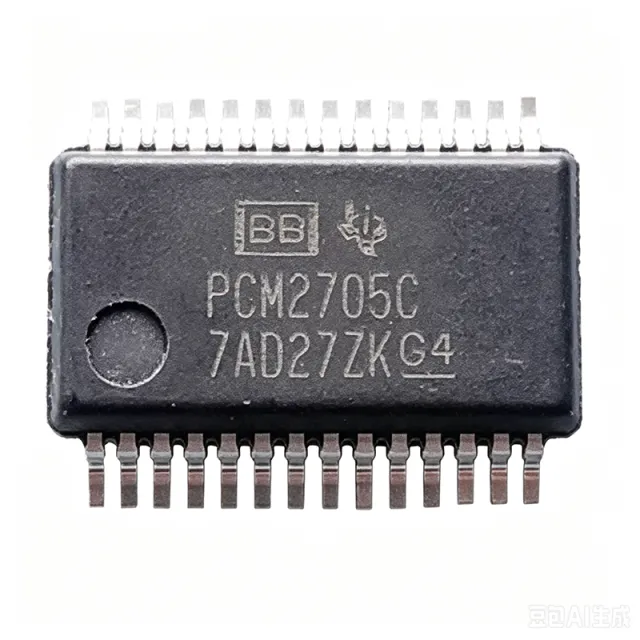
PCM2705C - 98dB SNR Stereo USB DAC with S/PDIF | Texas Instruments
The Texas Instruments PCM2705C is a single-chip stereo audio digital-to-analog converter (DAC) with an integrated USB 2.0 full-speed protocol controller and S/PDIF output. It delivers 98dB SNR and supports both bus-powered and self-powered operation with software control. The device is fully compliant with USB 2.0 specifications and USB Audio Class, requiring no dedicated device driver. It comes in a 28-pin SSOP package, making it ideal for compact audio applications. A USB audio DAC is a digital-to-analog converter that receives digital audio data from a USB host and converts it to analog audio signals. It integrates the USB interface, protocol controller, and DAC core into a single chip, simplifying system design. The PCM2705C sits in the hierarchy of audio converters, specifically as a USB audio interface IC, which is a subset of audio data converters within the broader category of mixed-signal ICs. Key features include a 98dB SNR stereo DAC, S/PDIF output, and support for both bus-powered and self-powered modes. The device also features partially programmable USB descriptors, allowing customization of vendor ID and product ID via an external SPI host. The integrated USB transceiver eliminates the need for external PHY, reducing BOM cost and board space. Technically, the PCM2705C uses adaptive isochronous transfer for audio data, ensuring synchronized playback. The S/PDIF output supports digital audio transmission to external decoders or amplifiers. The device operates from a 3.3V supply and includes an internal PLL for clock generation, minimizing external components. The SSOP-28 package provides a compact footprint suitable for portable and space-constrained designs. Typical applications include USB sound cards, docking stations, gaming headsets, and portable audio interfaces. The device's plug-and-play capability makes it ideal for consumer audio products where driver installation is undesirable. Its low power consumption and small size also suit battery-powered devices. When designing with the PCM2705C, ensure proper decoupling of the 3.3V supply and careful layout of the USB differential pair to maintain signal integrity. The SPI interface for descriptor programming should be configured during initial setup, and the PSEL and HOST pins must be set correctly for the desired operating mode.

SI3000-KS - 16-Bit Voice Codec | Skyworks Solutions
Skyworks Solutions SI3000-KS is a 16-bit voice-band interface codec with one ADC channel and one DAC channel, supporting sample rates from 4 kHz to 12 kHz in a 16-pin SOIC package. The verified listing identifies 84 dB ADC dynamic range, 84 dB DAC dynamic range, a 30 dB microphone preamplifier, programmable input gain or attenuation, and programmable output gain or attenuation. It is intended for voice-band audio systems requiring integrated conversion and microphone or speaker drive functions. The distributor data also identifies the SI3000-KS as a leaded interface codec and reports that Skyworks recommends the Si3000-C-FS datasheet for current design work. This means lifecycle status should be confirmed before new production commitments, although the SI3000-KS remains listed by distributors. A voice-band codec is an audio interface integrated circuit that converts analog microphone or line-level signals into digital PCM data and converts digital audio back into an analog output. In the broader device hierarchy, the SI3000-KS belongs to audio codecs, interface ICs, signal-conversion devices, and semiconductor components. Its one-ADC and one-DAC architecture is suitable for compact telephony, communications, embedded voice, and audio-assistance designs where a dedicated low-bandwidth audio path is required. The 4 kHz to 12 kHz sample-rate range targets narrow voice bandwidth rather than full-spectrum hi-fi audio. The main engineering benefits are the stated 84 dB conversion dynamic range, integrated microphone and speaker-drive support, and programmable analog gain controls. Input gain or attenuation helps match microphone levels to the converter, while output gain or attenuation helps condition the playback signal before the speaker amplifier. The 30 dB microphone preamplifier provides additional headroom for weak microphone sources. Because the verified data does not provide supply voltage, clock requirements, control-interface details, absolute maximum ratings, or thermal data, those values must be obtained from the manufacturer datasheet before final schematic or PCB approval. Use the SI3000-KS when the design specifically needs a narrowband voice codec with integrated ADC, DAC, microphone preamplification, and programmable gain. Suitable application directions include telephone handsets, intercom systems, industrial voice terminals, automotive voice interfaces, and embedded communication modules. The automotive positioning appears in distributor descriptions, but qualification status and exact environmental requirements are not independently established by the supplied data and therefore remain unknown. A design must also verify that the required sample rate, serial interface, audio levels, power rails, and external components match the device datasheet. The principal design consideration is lifecycle risk. Mouser states “Leaded - Not recommended for new designs, see Si3000-C-FS datasheet,” while DigiKey lists SI3000-KS for purchase. Engineers should therefore treat the SI3000-KS as a potentially legacy or transition-related device and compare it with the recommended current family before committing a new design. The exact pinout is not reproduced in the supplied verified snippets, so pin-level wiring must be confirmed from the official manufacturer datasheet. This page combines the verified distributor classification and specifications with procurement context and design guidance without inventing missing electrical parameters. This page synthesizes distributor listings, lifecycle notices, codec specifications, replacement guidance, and practical application considerations. It distinguishes verified facts from unavailable parameters, highlights the Skyworks recommendation concerning Si3000-C-FS, and avoids treating a distributor availability statement as proof of long-term design support.

TLV320AC37CN - 3V Voice-Band Audio Processor | Texas Instruments
The TLV320AC37CN is a voice-band audio processor (VBAP) from Texas Instruments, designed for single 3-V operation with low power consumption. It integrates a combined A/D, D/A converter and filters, supporting sample rates up to 16 kHz and a pass-band to 7.2 kHz. The device is housed in a 20-pin PDIP package, making it suitable for through-hole assembly in telecommunication and audio applications. A voice-band audio processor (VBAP) is a specialized mixed-signal IC that combines analog-to-digital and digital-to-analog conversion with filtering and signal processing optimized for the 300 Hz to 3.4 kHz voice band. It sits within the broader category of audio codecs, which are essential in telephony, intercoms, and voice-controlled systems. The TLV320AC37CN specifically targets low-power, battery-operated voice applications, offering a complete analog front-end and codec in a single package. Key features include a low operating power of 20 mW typical, standby mode at 5 mW, and power-down mode at 2 mW. The device supports extended variable-frequency operation with sample rates up to 16 kHz and a pass-band to 7.2 kHz. It includes an electret microphone interface, making it ideal for direct connection to electret condenser microphones. The combined A/D, D/A, and filters simplify system design by reducing external components. Technically, the TLV320AC37CN employs a CMOS process and operates from a single 3-V supply, which is critical for portable and battery-powered equipment. The device features a PCM codec interface with A-law companding, suitable for digital telephony standards. The through-hole PDIP-20 package ensures easy prototyping and manual assembly, though it limits high-density applications compared to surface-mount alternatives. Typical applications include digital telephone answering machines, speakerphones, intercom systems, and voice recorders. The low power consumption and 3-V operation make it particularly suited for battery-powered devices where efficiency is paramount. The integrated filters and codec reduce BOM cost and board space. When designing with this device, ensure proper decoupling of the 3-V supply and careful layout of the analog and digital sections to minimize noise coupling. The device is now obsolete, so consider pin-compatible alternatives for new designs.

TLV320AIC3110IRHBT - Low-Power Audio Codec with Class-D Amp | TI
The TLV320AIC3110IRHBT is a low-power, highly integrated audio codec from Texas Instruments, featuring a stereo audio DAC and a mono audio ADC, along with a 1.3W stereo Class-D speaker amplifier. It supports 32-bit audio data and communicates via I2C or serial interface. The device is housed in a 32-pin VQFN (5x5 mm) package, making it suitable for space-constrained portable applications. An audio codec is a device that encodes and decodes digital audio data, converting between analog and digital domains. It typically includes ADCs and DACs, along with signal processing and amplification stages. In a system hierarchy, an audio codec sits between the digital audio processor (e.g., DSP or SoC) and the analog audio output (speakers, headphones) or input (microphones). It is a critical component in portable electronics, automotive infotainment, and IoT devices. Key features of the TLV320AIC3110 include a 1.3W stereo Class-D speaker amplifier, which provides high efficiency for battery-powered devices. The device supports a wide analog supply range of 2.7V to 3.6V, a digital core supply of 1.525V to 1.95V, and a digital I/O supply of 1.1V to 3.6V. It also includes a programmable digital sine-wave generator and extensive register-based power control for optimizing power consumption. Technically, the TLV320AIC3110 integrates a low-power stereo DAC with 32-bit resolution and a mono ADC, supporting sample rates up to 96 kHz. The Class-D amplifier delivers 1.3W per channel into 8 ohms with low distortion. The device features a 5x5 mm VQFN package with exposed thermal pad for improved heat dissipation. It operates over the industrial temperature range of -40°C to +85°C. Typical applications include portable audio players, smartphones, tablets, and IoT devices requiring high-quality audio playback and recording. The integrated Class-D amplifier eliminates the need for an external amplifier, reducing BOM cost and board space. The I2C control interface allows easy integration with microcontrollers and DSPs. When designing with this device, ensure proper decoupling of the analog and digital supplies, and place the Class-D amplifier output filters close to the device to minimize EMI. The thermal pad should be soldered to a copper pour for effective heat dissipation.
WM8044CFN Audio Channel IC | Texas Instruments
The Texas Instruments WM8044CFN is a programmable audio-channel integrated circuit offered in a package identified by the “CFN” ordering suffix. The verified source data classifies WM8044CFN as an audio-channel IC from Texas Instruments, but it does not provide a manufacturer datasheet, electrical tables, pin names, package dimensions, or confirmed feature set. Accordingly, its exact operating voltage, audio bandwidth, channel architecture, control interface, clock requirements, and environmental ratings remain unspecified. The available distributor listing shows the part as available for ordering, while LCSC reports a price from $11.4948 as of 2026-10-23. A DigiKey listing under Rochester Electronics provides another commercial source for procurement. What is a programmable audio-channel IC? It is an audio signal-processing semiconductor that receives, routes, filters, mixes, converts, or otherwise conditions audio signals under digital or analog control. Within the electronics hierarchy, an audio-channel IC belongs to audio signal-processing ICs, a specialized type of interface or logic-adjacent integrated circuit. Its exact architecture cannot be inferred safely from the generic distributor classification alone, so engineers should consult the original Wolfson or Texas Instruments documentation before schematic capture. The most decision-relevant verified features are the MPN, manufacturer association, and device category. Search results identify WM8044CFN as a Texas Instruments audio-channel device and also describe it as a WOLFSON programmable logic IC in one marketplace listing. That historical WOLFSON association may help locate archived documentation, but it is not sufficient proof that any similarly named part is electrically or pin-for-pin replaceable. Typical uses cannot be assigned safely without the datasheet. Audio-channel ICs may serve portable audio, digital home audio, communications, or interface systems, but those possibilities are not verified WM8044CFN applications. Likewise, no performance claim regarding signal-to-noise ratio, total harmonic distortion, sample rate, channel count, or power consumption is supported by the supplied evidence. For design-in work, the critical first step is to obtain the authoritative WM8044 family datasheet, register map, application circuit, and pin description. Do not infer connections from the CFN suffix or from distributor board-layout references. Check the exact pin count and exposed-pad requirements before PCB layout because neither value appears in the verified data. This page combines verified distributor availability, the $11.4948 LCSC starting price, category information, sourcing links, and explicit data gaps. It avoids fabricating electrical specifications or offering unverified drop-in substitutes, thereby supporting component identification and procurement while reserving engineering approval until the original manufacturer documentation is available.
WM8144CCPT Audio Channel IC | Texas Instruments
The Texas Instruments WM8144CCPT is an audio-channel integrated circuit listed by DigiKey Marketplace and Octopart, with the product categorized as an Audio Special Purpose device in the Audio ICs family. The verified distributor information identifies WM8144CCPT as an active part available for sourcing, but the supplied records do not provide a verified package, pin count, electrical ratings, or detailed functional specifications. The searchable part number and category indicate a dedicated audio signal-processing role rather than a general-purpose logic or power component. Engineers should obtain the manufacturer datasheet and confirm the exact land pattern before committing a replacement to an existing PCB. An audio-channel IC is a specialized integrated circuit that handles one or more functions within an audio signal chain, such as conditioning, conversion, channel selection, or control. These devices sit between audio sources and downstream amplifiers, converters, microphones, speakers, or digital audio processors. Their performance requirements commonly include low signal distortion, stable channel behavior, compatible logic levels, and electrical characteristics matched to the intended audio architecture. Because the verified WM8144CCPT records provide only the part identity and broad category, device-specific claims should not be inferred without the original Wolfson Microelectronics or Texas Instruments documentation. The visible sourcing records support three practical points about WM8144CCPT. DigiKey Marketplace labels it as an audio channel from Texas Instruments, Octopart lists it as an integrated circuit for audio special purposes, and Rochester Electronics distribution data reports active production status. The supplied pricing excerpt gives a starting unit price of $4.07 at one-unit quantity and mentions volume discounts at 10, 100, 500, and 1,000 units. Availability language differs among marketplaces, so a purchase decision should use a current authorized-distributor quote and manufacturer inventory confirmation. WM8144CCPT is most relevant to legacy or industrial audio platforms in which the original circuit was designed around this exact device. In such systems, preserving the original device is generally safer than selecting a generic audio IC with similar nominal functionality. Any substitute must be checked for exact package dimensions, lead pitch, exposed-pad requirements, pin assignments, supply voltage, clocking, control interface, analog performance, and lifecycle status. The verified information identifies Rochester Electronics as the source of the distributed WM8144CCPT offer, so procurement documentation should also confirm the original manufacturer and authorized sourcing chain. The key engineering constraint is that the available verified data is incomplete. Mounting type, operating-temperature range, package case, absolute maximum ratings, supply voltage, channel count, resolution, interface type, and pin assignments are not stated in the supplied records. These values must be read from the applicable manufacturer datasheet before schematic capture, footprint selection, or production release. This prevents the mistake of treating a distributor category label as a substitute for full electrical and mechanical documentation. A sound sourcing workflow is to compare the distributor listing, Rochester Electronics product record, and Octopart cross-reference data against the original system documentation. Confirm that the ordered suffix CCPT matches the required package and ordering configuration, then request current stock and traceable shipment details. For repair and redesign programs, also inspect the board assembly records for markings or bill-of-material entries that may reveal the original manufacturer designation. This page consolidates the verified sourcing status, pricing basis, category placement, and data gaps for WM8144CCPT while avoiding unsupported electrical claims. It is intended to support initial part identification and procurement research, not to replace the manufacturer datasheet, reference schematic, or board-level compatibility checklist.
WM8281ECS/R - Low-Power Smart Audio Codec | Cirrus Logic
The Cirrus Logic WM8281ECS/R is a low-power smart audio codec with programmable DSP processing, acoustic echo cancellation, and ambient noise cancellation in a 138-W-CSP package measuring 5.86 mm by 4.56 mm. It provides a 24-bit audio interface using SLIMbus and is identified by distributor data as integrating 6 ADC and 8 DAC channels. An audio codec is an integrated circuit that converts analog microphone or line-level signals into digital audio data while converting digital playback streams back into analog audio outputs. The WM8281 belongs to the broader smart-codec hierarchy, combining a conventional audio codec with embedded DSP functions. This integration allows a host processor to handle system control while dedicated hardware executes noise reduction, echo cancellation, speech enhancement, and advanced media processing. Key product features include programmable DSP cores supporting multi-microphone wideband noise reduction, acoustic echo cancellation, speech enhancement, and advanced media enhancement. The 24-bit SLIMbus interface supports connected audio systems, while the integrated ADC and DAC channels reduce the external analog circuitry required for voice and multimedia products. Its low-power design is intended to benefit always-listening and portable audio equipment where continuous processing must remain energy efficient. The WM8281 architecture separates audio conversion from programmable signal processing. SLIMbus provides a shared serial link between the codec and a host or audio processor, while the DSP feature set performs real-time voice enhancement. This combination can shorten signal paths and reduce system complexity in applications requiring microphone capture, voice processing, and audio playback through a common codec package. Typical uses include smartphone and tablet voice-calling systems, headset and wearable audio platforms, smart speakers, teleconferencing equipment, voice-user-interface products, and connected consumer devices. Cirrus Logic markets the device as a low-power smart codec with echo cancellation, making it especially relevant to designs handling near-field or far-field speech where acoustic feedback and ambient noise reduce intelligibility. Designers should treat the 138-ball wafer-level chip-scale package as a layout-intensive component and follow the manufacturer's recommended land pattern, exposed-pad, power, ground, and high-speed routing guidance. The analog and digital power domains, microphone inputs, codec outputs, and SLIMbus signals must be planned together because power sequencing, decoupling, and acoustic layout can materially affect performance. This page consolidates verified manufacturer and distributor information about the WM8281ECS/R, identifies the missing technical fields explicitly, and provides application-focused selection guidance without presenting unverified electrical values, pin assignments, pricing, or drop-in replacements as confirmed facts.

WM8350GEB/V 12-Bit Audio Codec | Cirrus Logic | Power Management
Cirrus Logic WM8350GEB/V is a 12-bit stereo audio interface with integrated power management, operating at 48 kHz and supplied in a 129-BGA package measuring 7 x 7 mm. The device combines two ADC and two DAC channels, according to the verified distributor and cross-reference records, making it suitable for compact audio subsystems that need conversion and regulated power support in one package. Its BGA construction supports dense PCB layouts but requires careful ball-layout inspection, assembly-process control, and thermal verification. An audio codec is a mixed-signal semiconductor that converts digital audio samples into analog signals and analog sound signals into digital data. A stereo codec therefore normally handles left and right playback and recording paths. As an integrated circuit combining audio conversion with power management, the WM8350GEB/V belongs to the broader semiconductor and audio-interface hierarchy rather than being a simple analog amplifier or passive audio component. The verified product information identifies the WM8350GEB/V as a 12-bit audio interface operating at 48 kHz. Its 129-BGA, 7 x 7 mm package is a principal selection constraint because pin-compatible alternatives must reproduce the same ball layout, exposed features, and board-level connectivity. The listed package also requires land-pattern and assembly inspection that cannot be completed from a distributor category listing alone. Detailed electrical limits, clock requirements, analog performance, power-rail values, and ball functions must be confirmed in the manufacturer datasheet before schematic or PCB release. The integrated power-management function can simplify the architecture of portable and embedded audio products by placing conversion and rail support in one device. This integration may reduce the number of external supporting components when the application uses the complete WM8350 audio subsystem. The tradeoff is that its 129-ball package is less straightforward to hand-solder and more dependent on advanced assembly capability than a leaded or small-outline package. Designers should also validate startup sequencing, analog grounding, clocking, and codec-to-host interface timing against the intended system architecture. Typical uses include portable media devices, smart displays, connected audio products, communication terminals, and embedded systems requiring stereo recording and playback. In these applications, the 48 kHz sampling rate supports conventional digital-audio workflows, while the 12-bit resolution defines the converter word length represented by the verified listing. System-level audio quality still depends on microphone conditioning, amplifier selection, clock jitter, analog layout, grounding, and power-supply implementation; the codec alone does not determine the final acoustic performance. Before design-in, engineers should obtain the official WM8350 datasheet and verify the complete 129-ball pin map, recommended decoupling, supported clock modes, host interface, analog input and output limits, and absolute maximum ratings. The verified distributor record labels the part as an audio interface and 12-bit codec, but it does not provide those implementation details. PCB designers should use the manufacturer land pattern rather than deriving it from package dimensions, and assemblers should confirm whether the selected BGA assembly process supports the device's ball pitch and thermal requirements. This page consolidates verified distributor identification, package constraints, cross-reference evidence, procurement questions, and application guidance that a basic catalog result does not provide. It also distinguishes verified facts from parameters requiring datasheet confirmation, helping engineers decide whether the WM8350GEB/V fits their PCB before committing to a 129-BGA design.

WM8759GED/V - 24-Bit 192kHz Stereo DAC | Wolfson
Wolfson Microelectronics WM8759GED/V is a 24-bit, 192kHz stereo digital-to-analog converter with an integrated headphone buffer. It provides line-level and headphone output connections for portable DVD players, MP3 players, and other consumer audio equipment. The converter combines digital audio playback, stereo DAC conversion, and headphone amplification in one integrated circuit, reducing the need for separate output-driver stages in compact products. A stereo DAC is an audio signal-chain component that converts digital PCM audio samples into analog left and right channel voltages. It belongs to the broader digital-to-analog converter and audio interface hierarchy. An integrated headphone buffer further conditions those analog signals for headphone loads, allowing the WM8759GED/V to serve both fixed-line and variable-headphone outputs within portable consumer-audio designs. The verified manufacturer-datasheet description identifies the principal audio capabilities as 24-bit resolution, operation up to 192kHz, stereo conversion, an integrated headphone driver, line output, and headphone output. These specifications make the device relevant to digital media players and other systems that reproduce CD-quality or higher-resolution digital audio and require both line-level and headphone connections. The WM8759GED/V's architecture combines a stereo DAC section with a headphone-output stage rather than treating headphone drive as a completely separate function. Integrating those blocks can simplify system partitioning and reduce board area. The precise digital interface format, analog performance figures, clocking requirements, output topology, and supported sample-rate details require confirmation from the complete manufacturer datasheet and must not be inferred from the available distributor summary. Typical uses include portable DVD players, MP3 players, and consumer equipment featuring line and headphone outputs. Its 24-bit, 192kHz capability supports high-resolution digital-audio paths, while the integrated headphone buffer is especially useful where a product needs both an external line connection and a direct headphone connection without adding another discrete output buffer. Designers should verify the exact 32-lead QFN footprint, exposed-pad requirements, decoupling, analog routing, and digital interface timing before layout release. Headphone and line outputs should also be checked for load compatibility, startup behavior, and channel alignment. Because the verified web results provide only a functional summary, unavailable electrical, environmental, and package details are marked separately rather than estimated. This page consolidates the verified WM8759GED/V function, distributor availability information, qualified same-family references, and practical selection guidance. It distinguishes documented capabilities from parameters that still require confirmation, helping engineers locate the datasheet, assess replacement risk, and plan a portable-audio design without presenting unverified specifications as facts.

WM8804GEDS/V - 1:1 S/PDIF Transceiver | Cirrus Logic
Cirrus Logic WM8804GEDS/V is a high-performance consumer-mode S/PDIF audio transceiver with one received channel and one transmitted channel, supplied in a 20-lead Pb-free SSOP package. It supports a 2.7 V to 3.6 V supply range, an industrial temperature grade of -40°C to +85°C, a 1:1 digital audio interface, and an internal PLL for generating common audio clocks. An S/PDIF transceiver is an interface IC that converts digital audio signals between consumer Sony/Philips digital audio format and a parallel digital audio interface. Within the broader semiconductor hierarchy, the WM8804 is a digital audio interface IC, an interface IC, and a signal-processing semiconductor used to connect audio converters, receivers, and digital playback systems. The WM8804 can use either a crystal-derived clock or an externally supplied high-quality master clock. Its clock-recovery architecture provides low-jitter recovery of the master clock carried by an S/PDIF stream, while the internal PLL can generate commonly used audio clocks. A dedicated CLKOUT pin provides access to a generated or recovered clock for associated audio-processing circuitry. The 1:1 digital interface supports integration between S/PDIF-capable audio hardware and a digital audio bus. A clock derived from the incoming S/PDIF signal can support system synchronization, while the transmit path provides S/PDIF output from a compatible digital audio source. The combination of integrated PLL functions and clock output reduces the amount of external clock-generation circuitry required in consumer audio products. Typical applications include digital home-theater equipment, CD and DVD player subsystems, digital audio receiver boards, active speaker interfaces, consumer home-audio products, and industrial digital audio equipment. The 20-lead SSOP package supports compact circuit layouts, although its larger lead pitch and body dimensions should be considered against smaller surface-mount alternatives when space is constrained. Designers should provide a clean and stable 2.7 V to 3.6 V supply, route the S/PDIF data and clock signals away from noisy switching nodes, and ensure the selected master-clock source has adequate low-jitter performance. Decoupling and exposed-ground layout should follow the manufacturer datasheet recommendations, particularly when the transceiver is adjacent to a switching power supply or a high-speed digital processor. This product summary consolidates the verified distributor specifications, manufacturer-oriented datasheet references, package information, and design considerations into one engineering-focused guide. It also distinguishes documented electrical facts from unavailable pricing, lifecycle, pin-level, and equivalent-part information so engineers can assess fit without relying on unverified substitutions.
WM8958ECS/R - 24-Bit Stereo Audio Codec | Cirrus Logic
Cirrus Logic WM8958ECS/R is a 24-bit stereo audio codec with 2 ADC channels, 4 DAC channels, I2S and PCM digital audio interfaces, and integrated stereo Class D/AB speaker plus Class W headphone drivers, housed in a 72-pin W-CSP package measuring 4.5 mm by 4.3 mm. An audio codec is a mixed-signal semiconductor that converts between digital audio data and analog microphone, speaker, and headphone signals. It belongs to the codec and audio-interface hierarchy, combines an audio codec, integrated analog-to-digital converters and digital-to-analog converters, and ultimately falls under mixed-signal and signal-processing semiconductors. This integration reduces external components and board area in portable multimedia systems. The WM8958 is designed for smartphones and other portable multimedia devices. Key features include ultra-low-power operation, 24-bit audio conversion, stereo full-duplex asynchronous sample-rate conversion, multiple digital audio channels, integrated Class D/AB speaker amplification, and integrated Class W headphone amplification. It requires two external voltage supplies, while other internal supply rails are generated by integrated low-dropout regulators. Its architecture places an audio hub, converters, digital interfaces, and output-driver functions in one device. The digital side supports I2S and PCM formats, while the analog conversion section supports two ADC inputs and four DAC outputs. The integrated speaker and headphone drivers reduce the need for separate output amplifiers, although external passive filtering, routing, and decoupling networks may still be required by the final circuit design. Typical uses include smartphone and tablet audio hubs, portable media-player headsets, Bluetooth and wireless audio accessories, compact consumer-audio systems, and portable multimedia products. The device is especially relevant where low power, compactness, high-fidelity conversion, integrated headphone drive, and integrated stereo speaker drive are important design priorities. Designers must verify the exact pin assignments, supported audio rates, clocking scheme, speaker-load limits, analog biasing, and decoupling requirements against the manufacturer datasheet before layout. The 4.5 mm by 4.3 mm W-CSP also demands careful escape routing, acoustic inspection, and assembly-process control; trace geometry, component placement, and thermal or power-distribution planning can materially affect audio performance. This product record combines verified manufacturer and distributor information with package-level comparison, application guidance, and engineering-oriented design notes. It also distinguishes documented integrated features from unverified details, avoiding unsupported claims while helping engineers evaluate the WM8958ECS/R for portable audio designs.
WM8960CGEFL/RV Stereo Codec with 1W Drivers | Cirrus Logic
The Cirrus Logic WM8960CGEFL/RV is a stereo audio codec with integrated Class-D speaker drivers, headphone drivers, and a microphone interface, designed for portable digital audio applications. The device is identified as a 24-bit stereo audio interface in a 32-QFN package measuring 5 x 5 mm, and the verified manufacturer-related data states that it provides 1 W per channel into 8-ohm loads with a 5 V supply. Its combination of digital audio conversion, analog input, headphone output, and integrated speaker amplification allows portable equipment to use one compact audio subsystem instead of separate codec and amplifier packages. A stereo audio codec is an interface IC that converts digital audio data into analog signals and converts analog microphone or line-level inputs back into digital audio data. The WM8960CGEFL/RV belongs to the broader audio interface and power-management hierarchy: audio codec, mixed-signal interface IC, semiconductor, and portable-audio signal-chain component. Its integrated Class-D speaker drivers target compact speaker solutions where PCB area, component count, and low power are important. The headphone drivers support personal-audio outputs, while the microphone interface supports portable voice and communication functions. Verified source data identifies the part as a stereo CODEC with 1 W stereo Class-D speaker drivers and headphone drivers for portable audio applications. The supplied DigiKey result identifies it as a 24-bit stereo audio interface in a 32-QFN 5 x 5 mm package. The WM8960CGEFL/RV is therefore suited to portable audio systems where the digital host interface, analog audio paths, and speaker amplification must coexist in one package. The exact sample rate, voltage range, control interface, and full pin-level electrical limits are not included in the supplied verified data and must be confirmed from the manufacturer datasheet before design release. A key design consideration is analog and power-supply layout. Digital audio clocks and control signals should be kept away from sensitive microphone and headphone paths, while the integrated speaker outputs require careful return-current routing and adequate power delivery. Decoupling must follow the manufacturer’s recommended values and placement because the codec combines digital, analog, headphone, and Class-D output functions in one package. Designers should also verify speaker impedance, load current, thermal conditions, and supply sequencing against the official datasheet before connecting external transducers. Typical uses include portable media players, compact audio accessories, personal-audio products, voice-enabled devices, and small speaker systems. This page consolidates the verified distributor descriptions, package information, identified audio functions, source links, and engineering guidance; it does not substitute unavailable electrical details with assumptions.
WM8998ECS/R - 24-Bit Hi-Fi Audio Hub | Cirrus Logic
Cirrus Logic WM8998ECS/R is a 24-bit HD audio hub and SLIMbus audio interface housed in a 117-WCSP package measuring 5.35 mm by 4.09 mm. The verified distributor records identify the device as a Hi-Fi coding-switch solution intended for compact digital audio systems. Its interface orientation makes it suitable for products that require a low-power, highly integrated audio front end while retaining a digital audio link to a host processor. An audio codec is an integrated circuit that converts digital audio data into an analog output and converts analog microphone or line inputs back into digital data. In the product hierarchy, a codec is an audio interface IC within the broader class of interface ICs. The WM8998ECS/R is positioned for portable and embedded audio functions where component count, board area, and host connectivity are important design constraints. The verified product listing specifically identifies a 24-bit HD audio interface, SLIMbus connectivity, and a 117-WCSP package. These confirmed attributes make the part relevant to smartphone, tablet, portable-media, headset, and embedded-audio designs. The 5.35 mm by 4.09 mm package reduces board footprint, although its 117-ball construction requires careful assembly, inspection, and PCB-layout planning. Technical evaluation must be completed against the manufacturer datasheet because the supplied distributor results do not expose the complete electrical tables. Sample rate coverage, supported clock rates, microphone bias, codec specifications, digital levels, power-supply requirements, and thermal limits are not available in the verified data and therefore cannot be safely inferred. Designers should also confirm the exact exposed-pad, ball-map, and recommended-land-pattern details before layout release. Typical implementation places the WM8998ECS/R between one or more analog audio transducers and a digital audio host connected through SLIMbus. Its integrated hub role can simplify system routing in devices containing speaker, headphone, microphone, and line-level audio paths. The correct external amplifiers, passive network, clocking, and decoupling must be selected from the manufacturer reference design rather than inferred from the distributor summaries. The primary design consideration is PCB implementation. A 117-WCSP package has a much denser interconnect than a conventional leaded package and can create soldering, inspection, and repair challenges. Confirm whether the assembled board will use optical inspection or X-ray inspection, and use the manufacturer-approved footprint and reflow profile to reduce assembly defects. The verified data does not expose pin names, so a complete ball assignment cannot be published here. This product record combines verified distributor pricing, package information, sourcing links, and engineering-oriented selection guidance. It also separates confirmed facts from unavailable datasheet parameters and avoids presenting generic codec specifications as facts about the WM8998ECS/R.