Produk (38.000+)

SN65HVD12P - 3.3V 1Mbps RS-485 Transceiver | Texas Instruments
SN65HVD12P

SN65HVD12P - 3.3V 1Mbps RS-485 Transceiver | Texas Instruments

Texas Instruments SN65HVD12P is a 3.3 V differential bus transceiver with a 1 Mbps data rate, supplied in an 8-pin PDIP package. The device combines a three-state differential line driver and a differential input line receiver in one integrated circuit, making it suitable for balanced RS-422 and RS-485 communication links. It operates from a single 3.3 V supply and is designed for bidirectional half-duplex data transmission. An RS-485 transceiver is an interface IC that converts logic-level signals into balanced differential bus signals and reconstructs received data from those differential signals. Differential signaling belongs to the broader transceiver and interface IC hierarchy, with the SN65HVD12P combining a line driver, line receiver, bus-driver enable control, and protection features in one package. Its balanced architecture is intended for industrial communication systems where noise immunity and signal integrity are important. The principal features include operation from a 3.3 V power supply, a maximum signaling rate of 1 Mbps, and bus-pin electrostatic-discharge protection exceeding 16 kV using the human-body model. The family meets or exceeds ANSI TIA/EIA-485-A and ISO 8482:1993 requirements for balanced transmission lines. A three-state driver output permits multiple devices to share a bus while disabled, allowing the bus to be actively managed by the system controller. The SN65HVD12 family combines a monolithic differential driver and receiver designed specifically for balanced lines. A 1 Mbps rate supports factory automation, industrial control, instrumentation, and building automation traffic while remaining compatible with the lower signaling rates common on legacy RS-485 networks. The integrated bus-pin protection improves robustness against electrostatic discharge encountered during installation, servicing, and normal industrial operation. Typical applications include motor-control equipment, programmable logic controller interfaces, industrial sensors, remote I/O modules, building HVAC controllers, and data-acquisition equipment. Half-duplex operation means the transmitter and receiver share the same bus pair, so firmware and hardware must manage bus direction to prevent multiple nodes from driving the bus simultaneously. PCB layout is a central design consideration for any RS-485 implementation. Place the transceiver close to the bus connector, provide a common signal-ground reference, route the differential pair as a tightly coupled pair, and add appropriate protection components at the connector. The selected communications standard, baud rate, cable length, topology, termination, and transceiver unit load must be evaluated together before deployment. This page combines the device's electrical characteristics, application guidance, package information, and a focused set of same-family drop-in alternatives. It also identifies where receiver-threshold or temperature-range differences require engineering review before a substitution is approved.

Permintaan RFG Kontak
SN65HVD20D - 25 Mbps Extended Common-Mode RS-485 | TI
SN65HVD20D

SN65HVD20D - 25 Mbps Extended Common-Mode RS-485 | TI

Texas Instruments SN65HVD20D is an extended common-mode RS-485 transceiver with a 4.5 V to 5.5 V supply, one transmitter, one receiver, and a maximum signaling rate of 25 Mbps in an 8-pin SOIC package. It combines half-duplex operation with a specified fault-protection range of -27 V to +27 V. According to the Texas Instruments SN65HVD2x family datasheet, the device exceeds typical RS-485 performance while meeting the requirements of the TIA/EIA-485-A standard. An RS-485 transceiver is a physical-layer interface IC that converts logic-level signals into a differential bus and receives differential bus signals back into CMOS-compatible data. Its hierarchy is transceiver → serial interface IC → differential line driver/receiver → communications interface. The SN65HVD20D is designed for industrial data links where long cables, grounded or unearthed systems, and differing ground potentials can place unusually large common-mode voltages on the bus. Three headline capabilities distinguish this device: its extended common-mode range, 25 Mbit/s maximum data rate, and -27 V to +27 V fault-protection window. The SN65HVD2x family also provides high ESD protection, wide receiver hysteresis, and failsafe operation. These features support reliable detection of small differential signals and recovery from excessive bus voltage, although the exact ESD rating, hysteresis voltage, and operating-temperature limits require confirmation in the manufacturer datasheet. The SN65HVD20D uses one differential driver and one differential receiver for half-duplex RS-485 communication. In a half-duplex network, transmit and receive functions share the same bus conductors, so system logic must control bus direction and avoid receiver contention. The supplied verification identifies a 5 V nominal operating range, 8-SOIC construction, one transmitter, one receiver, and a 25 Mbit/s maximum signaling rate; additional timing, supply-current, and propagation-delay values were not included in the source extract. Typical uses include factory automation, industrial instrumentation, building controls, process monitoring, and embedded serial networks. It is particularly relevant where a bus may be exposed to large common-mode offsets, electrostatic discharge events, or accidental fault voltage. The extended fault-protection feature helps the interface survive such transients, but external protection, termination, isolation, and grounding remain system-level design decisions. For a new PCB, place the transceiver near the bus connector, provide a continuous ground reference, route the differential pair as a tightly coupled pair, and use the bus protection specified by the application. Do not assume the -27 V to +27 V fault range eliminates the need for surge protection in an industrial installation, and verify decoupling requirements directly against the manufacturer datasheet. This page consolidates verified manufacturer and distributor information, a package-level replacement assessment, an eight-parameter comparison, and practical design notes. It distinguishes documented capabilities from missing electrical details so engineers can make a defensible RS-485 design decision without relying on unverified substitution assumptions.

Permintaan RFG Kontak
SN65HVD21D - Extended Common-Mode RS-485 | Texas Instruments
SN65HVD21D

SN65HVD21D - Extended Common-Mode RS-485 | Texas Instruments

Texas Instruments SN65HVD21D is a single-channel RS-422/RS-485 transceiver in an 8-pin SOIC package. The device combines one transmitter and one receiver in a half-duplex bus-line interface and provides extended common-mode operation for industrial, automation, instrumentation, and communications equipment. The SN65HVD21 family is designed to meet TIA/EIA-485-A requirements while adding high ESD protection, wide receiver hysteresis, and failsafe operation. Exact voltage, current, data-rate, temperature, and protection ratings are not included in the supplied verification data and therefore must be confirmed in the manufacturer datasheet before design release. An RS-485 transceiver is an interface IC that converts logic-level signals into a balanced differential bus and receives differential bus signals back into logic-level outputs. This class of device belongs to the interface IC hierarchy and ultimately supports the broader semiconductor and industrial communication ecosystem. Balanced signaling improves noise immunity by referencing the signal to differential line pairs rather than a single conductor, while extended common-mode capability helps a node remain functional when bus voltages exceed the common-mode range of a conventional transceiver. The SN65HVD21 family's verified features include high ESD protection, wide receiver hysteresis, and failsafe operation. High ESD protection is valuable in industrial environments where cables may be connected or disconnected during installation. Wide receiver hysteresis improves decision margin between logic states when a valid differential signal is present. Failsafe operation provides a defined receiver behavior for an inactive or undriven bus, helping system designers avoid ambiguous states in multi-node networks. The D-package suffix identifies an 8-pin SOIC implementation, while the P option is offered as a plastic through-hole package in the same family. This distinction matters to PCB designers: the SN65HVD21D uses a surface-mount footprint and cannot replace a through-hole SN65HVD21P without board changes. Although the SN65HVD21D and SN65HVD21DR may share the same electrical device and SOIC footprint, the latter is a packaging or orderable variant rather than a distinct engineering alternative. Typical uses include industrial RS-485 control links, factory automation equipment, remote sensor interfaces, building controls, and instrumentation networks. In a half-duplex arrangement, the transceiver's driver and receiver share the same differential pair, so system firmware and bus hardware must manage transmit and receive intervals without allowing multiple drivers to contend. Termination, biasing, grounding, and common-mode limits remain system-level constraints that cannot be selected from the limited values published in the supplied search results. Design with the manufacturer datasheet as the controlling authority for supply voltage, driver output current, receiver thresholds, propagation delay, maximum data rate, operating temperature, ESD ratings, and recommended external components. Keep bus-side traces away from sensitive signals, provide a solid ground reference, and verify that every attached node supports the same logic and baud rate. Confirm the exact pinout and exposed-pad requirements for the selected package rather than relying on generic SOIC drawings. This page consolidates the verified distributor and manufacturer information, distinguishes a true bus-interface alternative from packaging variants, and identifies missing electrical data explicitly. It provides selection and design guidance beyond a distributor listing while preserving the distinction between verified facts and parameters that require datasheet confirmation.

Permintaan RFG Kontak
SN65HVD21P - Extended Common-Mode RS-485 Transceiver | Texas Instruments
SN65HVD21P

SN65HVD21P - Extended Common-Mode RS-485 Transceiver | Texas Instruments

The Texas Instruments SN65HVD21P is an extended common-mode RS-485 and RS-422 transceiver containing one driver and one receiver in a single 8-pin PDIP (P) through-hole package. It is specified as an extended common-mode RS-485 transceiver, which is the key feature that distinguishes it from standard RS-485 parts whose receivers saturate when ground-potential differences between nodes appear on long cables. The SN65HVD21P is used wherever a half-duplex differential bus must tolerate wiring faults, ground offsets and unbalanced cable runs. An RS-485 transceiver is a type of interface IC that bridges a logic-level UART or SPI port and a balanced, differential bus. The differential signalling rejects common-mode noise, so the bus keeps working in electrically noisy environments such as factory floors, HVAC plants, motor drives and utility metering cabinets. The SN65HVD21P belongs to the hierarchy: transceiver -> differential line driver and receiver -> interface IC -> integrated circuit -> semiconductor. Because the driver and receiver share one package, the same device supports half-duplex point-to-point links as well as multidrop configurations where up to multiple unit-load nodes tap onto one pair of wires. The three control pins (driver enable, receiver enable and driver input) let a host microcontroller decide which direction the bus drives, while the receiver output returns logic-level data to the host. The PDIP package keeps the device compatible with through-hole assembly, prototyping boards and legacy industrial control boards. Typical deployments include industrial RS-485 multidrop sensor buses, building and HVAC controller networks, industrial motor drive and encoder feedback links, utility and energy metering terminals, and long-distance instrumentation links to remote transducer heads. Because the transceiver is a half-duplex device, the design must allow the bus to turn around between transmit and receive windows. The main design consideration is termination and biasing. The SN65HVD21P works correctly on an unterminated short cable, but long or high-speed runs need a termination resistor at each far end and a fail-safe bias network so the idle state is defined. Keep the differential pair tightly coupled, route it over a continuous ground plane, and connect the transceiver ground to the board ground with a short, low-inductance path. This page combines the manufacturer part detail, distributor availability, drop-in replacement options in the same 8-pin PDIP footprint, and practical bus-design guidance so engineers can evaluate the SN65HVD21P without hunting across several separate documents.

Permintaan RFG Kontak
SN65HVD22D Extended Common-Mode RS-485 | Texas Instruments
SN65HVD22D

SN65HVD22D Extended Common-Mode RS-485 | Texas Instruments

The Texas Instruments SN65HVD22D is an extended common-mode half-duplex RS-485 transceiver designed for 5 V industrial communication links, with a 500 kbps interface rate and an 8-pin SOIC package. Its key electrical characteristics include a -20 V to 25 V common-mode operating range, substantially extending the tolerance beyond the minimum TIA/EIA-485-A common-mode requirement. The device supports both RS-485 and RS-422 signaling and provides one driver and one receiver in a half-duplex transceiver arrangement. An RS-485 transceiver is an interface IC that converts logic-level signals into differential bus voltages and receives differential bus voltages back into logic-level data. The SN65HVD22D belongs to the transceiver hierarchy that includes RS-422 and RS-485 interface devices, differential line drivers, differential receivers, and communication interface semiconductors. Its extended common-mode capability improves tolerance to ground offsets, induced noise, and wiring differences in long cable networks. The SN65HVD22D provides a 500 kbps reference-design interface rate, a -20 V to 25 V common-mode range, and operation from a single 5 V supply. These characteristics make it suitable for factory automation equipment, industrial controllers, remote sensor nodes, and building automation systems where a conventional RS-485 receiver may become vulnerable to bus transients or uneven grounding. The extended range also supports robust operation in electrically noisy environments when paired with appropriate cables and protection components. Its half-duplex architecture means the driver and receiver share the same differential bus pair. Direction control determines whether the node transmits or receives, while an external bus bias network establishes the logic state of an idle bus. The 8-pin SOIC package supports conventional surface-mount assembly and fits industrial interface boards requiring compact pin compatibility with other single-chip transceivers. Typical applications include 500 kbps RS-485 links between PLCs and remote I/O modules, motor-control diagnostics, industrial sensors, building controls, and instrumentation networks. In these systems, the SN65HVD22D can remain operational when ground-potential differences place bus voltages outside the common-mode range of many standard RS-485 devices, reducing sensitivity to grounding mistakes. The primary design consideration is common-mode margin. Evaluate the maximum voltage between the bus and local ground under every operating and fault condition, then select external protection that keeps transient stresses within the device limits. Keep the transceiver and termination components close to the bus connector, use a controlled ground reference, and follow the manufacturer’s reference design when the interface will be exposed to industrial cable transients. This page combines the exact SN65HVD22D identity, package information, interface capability, application guidance, comparison criteria, and design cautions needed to evaluate the part for an extended-common-mode RS-485 design.

Permintaan RFG Kontak
SN65HVD22P - 500kbps Extended RS-485 | Texas Instruments
SN65HVD22P

SN65HVD22P - 500kbps Extended RS-485 | Texas Instruments

The Texas Instruments SN65HVD22P is a 500kbps half-duplex RS-485 transceiver with an extended common-mode voltage range of -20V to 25V, available in an 8-pin PDIP package. The device combines one driver and one receiver in a single package, making it suitable for bidirectional industrial communication links using a multipoint bus. An RS-485 transceiver is an interface IC that converts digital logic signals into differential bus levels and converts differential bus levels back into logic-compatible signals. The SN65HVD22 family belongs to the RS-485 transceiver class of interface ICs within the broader industrial communications hierarchy. Its differential signaling supports communication over longer cables than single-ended interfaces while reducing susceptibility to common-mode electrical noise. The SN65HVD22P supports data rates up to 500kbps. Its -20V to 25V common-mode operating range exceeds the typical TIA/EIA-485-A requirement, improving tolerance to ground-potential differences between devices connected to long cables. The family also provides high ESD protection, wide receiver hysteresis, and failsafe operation, which help a bus remain interpretable when the bus is idle or a driver is disconnected. Typical uses include industrial automation equipment, building-control systems, factory data buses, remote sensor interfaces, and utility monitoring networks. The receiver’s wide hysteresis reduces sensitivity to noise near the decision threshold, while failsafe behavior provides a defined state when the bus is not actively driven. The 500kbps rate balances communication throughput against the distance and termination requirements of an RS-485 network. For a new RS-485 design, place the transceiver close to the bus connector and keep the differential route short, symmetrical, and continuous over a solid ground plane. Provide the termination, biasing, isolation, and surge-protection components required by the cable environment. Do not treat the extended common-mode range as a substitute for normal grounding and cable design practices. This product page combines the Texas Instruments device information with practical guidance on common-mode tolerance, failsafe behavior, signal integrity, and package-level replacement decisions. It also distinguishes verified operating characteristics from specifications that must be confirmed in the manufacturer datasheet before a design is released.

Permintaan RFG Kontak
SN65HVD230DR - 3.3V CAN Transceiver 1Mbps 8-SOIC | Texas Instruments
SN65HVD230DR

SN65HVD230DR - 3.3V CAN Transceiver 1Mbps 8-SOIC | Texas Instruments

The Texas Instruments SN65HVD230DR is a 3.3-V Controller Area Network (CAN) bus transceiver that supports data rates up to 1 Mbps and is compliant with the ISO 11898-2 High Speed CAN Physical Layer standard, housed in an 8-pin SOIC package with industrial -40C to +85C temperature rating. The device operates from a single 3.3-V supply (3.0 V to 3.6 V recommended) and integrates a differential driver and receiver pair with an RS pin for slew-rate control, enabling designers to balance bit rate against electromagnetic emissions. Bus pin ESD protection exceeds 16 kV HBM, and high input impedance supports up to 120 nodes on a single bus segment. A CAN transceiver is the physical-layer interface between a CAN protocol controller and the differential twisted-pair bus; it converts single-ended logic signals into the differential voltages defined by ISO 11898-2 and recovers received bits for the controller. Within the broader transceiver taxonomy (CAN transceiver -> serial interface IC -> interface IC -> signal path IC -> semiconductor), the SN65HVD230 sits alongside related interface standards like RS-485 and LIN, and is a low-power functional replacement for the legacy 5-V PCA82C250. Key features include a low-current standby mode that draws only 370 uA typical, an unpowered node that does not disturb the bus, and adjustable driver edge times via an external resistor on the RS pin. The wide common-mode receiver range of -2 V to 7 V improves immunity to ground shifts in long or noisy networks, and thermal shutdown protects the device from bus faults. Architecturally, the SN65HVD230 uses a bipolar CMOS-DMOS process that combines low quiescent current with the bus-driving strength required for 1 Mbps signaling. The RS-controlled slew rate reduces high-frequency harmonics that would otherwise couple into adjacent cables in dense industrial enclosures, which is why the part is favored in EMI-sensitive backplanes and in distributed sensor networks with cable harnesses of several meters. Typical applications include automotive body and chassis control modules, industrial automation and motor control, building automation (HVAC), telecom base-station housekeeping, and any 3.3-V microcontroller-based system that requires robust differential bus communication. The part is especially well suited to migrating legacy 5-V CAN designs down to 3.3-V rails without re-spinning the protocol layer. When designing with this device, terminate the CAN bus with a 120-ohm resistor at each end of the segment to suppress reflections and select the RS resistor appropriately: a low value (around 10 k-ohm) favors maximum bit rate, while a higher value (around 100 k-ohm) reduces slew rate and emissions. Always provide a solid ground return near the bus cable to keep common-mode noise within the receiver's -2 V to 7 V window. This page synthesizes distributor pricing, drop-in alternatives, and design guidance that complement, and in several areas go beyond, the manufacturer datasheet by capturing application experience from industrial and automotive CAN deployments.

Permintaan RFG Kontak
SN65HVD231DR - 3.3V 1Mbps CAN Transceiver | Texas Instruments
SN65HVD231DR

SN65HVD231DR - 3.3V 1Mbps CAN Transceiver | Texas Instruments

Texas Instruments SN65HVD231DR is a 3.3 V controller area network transceiver with a maximum signaling rate of 1 Mbps, ISO 11898-2 compatibility, and an 8-pin SOIC package. It supports up to 120 nodes on a bus, provides bus-pin ESD protection exceeding 16 kV HBM, and includes adjustable driver transition times for improved signal quality. The SN65HVD231 variant is designed around an ultra-low-power sleep mode, making it useful in power-conscious CAN nodes. Its single-supply operation integrates a CAN controller-side interface with a physical bus-side driver and receiver. The device is intended for industrial, automotive-aftermarket, embedded control, and communications systems using CAN. Its high-input-impedance receiver helps support large networks, while controlled transition times can reduce radiated emissions and improve signal integrity. The transceiver is not a general-purpose logic device; CANH and CANL must be connected according to the bus topology and termination requirements. Design attention is required for supply decoupling, grounding, common-mode voltage, bus termination, and protection. This page combines verified manufacturer and distributor information with practical application guidance and clearly marks specifications that were not supplied.

Permintaan RFG Kontak
SN65HVD232DR - 3.3V 1Mbps CAN Transceiver | Texas Instruments
SN65HVD232DR

SN65HVD232DR - 3.3V 1Mbps CAN Transceiver | Texas Instruments

The Texas Instruments SN65HVD232DR is a 3.3V single-channel CAN transceiver in an 8-pin SOIC package, supporting data rates up to 1Mbps and ISO 11898-2 high-speed CAN physical-layer compatibility. It combines a CAN transmitter, differential receiver, and 3.3V-compatible interface in a compact surface-mount package. A CAN transceiver is the physical-layer interface between a CAN controller and the differential CANH and CANL bus wires. It converts controller logic into dominant and recessive bus states, while converting differential bus voltage into a receive signal. The SN65HVD232 family is designed for systems using 3.3V DSPs or equivalent CAN controllers, with protection features intended to improve robustness in industrial and automotive-style networks. The SN65HVD232DR operates from a single 3.3V supply and supports CAN data rates up to 1Mbps. Its high receiver input impedance allows up to 120 nodes on a bus, according to the verified product and datasheet search results. The device also provides bus-pin ESD protection exceeding 16kV HBM, controlled driver output transition times for improved signal quality, and behavior suitable for unpowered nodes that do not disturb the bus. Compared with a 5V CAN transceiver, the SN65HVD232 family is intended for lower-voltage logic systems. The manufacturer search data identifies the principal 3.3V distinction as a lower dominant common-mode output voltage, by a few hundred millivolts, while the differential output voltage and recessive common-mode bias remain comparable. This makes the part suitable when the host controller, digital I/O, and system supply are designed around 3.3V. Typical applications include industrial automation equipment, motor-control systems, building automation, robotics, embedded control, vehicle electronics modules, and CAN-connected sensor or actuator networks. The transceiver is placed between a CAN controller and the CAN bus, with CANH and CANL routed as a differential pair and the logic-side interface connected to the controller. A key design consideration is confirming the complete transceiver pinout and logic levels in the manufacturer datasheet before layout release. Keep the CAN bus traces short, controlled-impedance where practical, and separated from noisy switching paths. Decoupling should follow the datasheet recommendations, and unused or unused-mode pins should be configured exactly as specified rather than inferred from generic CAN devices.

Permintaan RFG Kontak
SN65HVD234DR - 3.3V CAN Transceiver 1Mbps w/ Sleep | Texas Instruments
SN65HVD234DR

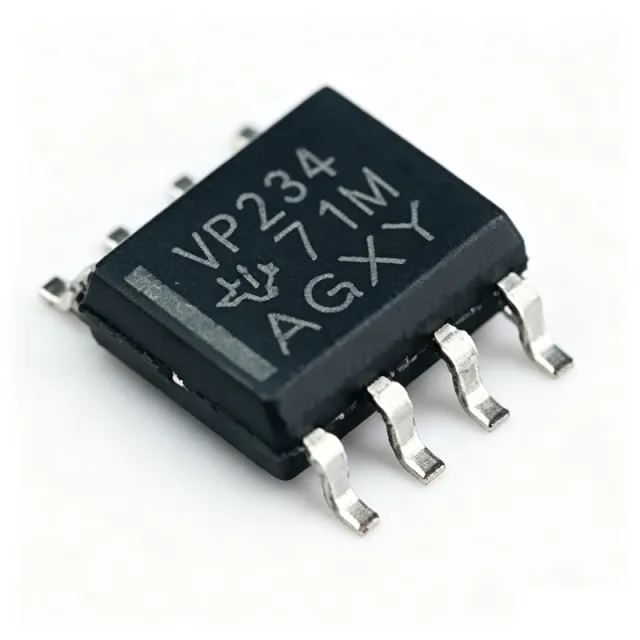
SN65HVD234DR - 3.3V CAN Transceiver 1Mbps w/ Sleep | Texas Instruments

The Texas Instruments SN65HVD234DR is a 3.3-V CAN (Controller Area Network) transceiver with sleep mode, offering data rates up to 1 Mbps compliant with ISO 11898 and packaged in an 8-pin SOIC (D) footprint rated from -40C to +125C. It supplies 3.3V logic with 5V-tolerant LVTTL I/Os, provides bus fault protection exceeding +/-36V, and withstands HBM ESD beyond 16 kV on bus pins. The device is the physical-layer interface between a CAN protocol controller and the differential CANH/CANL bus lines. A CAN transceiver is a physical-layer interface IC that bridges a digital protocol controller and a differential two-wire bus. In the broader interface IC taxonomy, it sits between logic-level MCUs/ASICs and the bus cable, implementing the differential driver, differential receiver, and bus fault protections required by the ISO 11898 standard. Within power-management and interface hierarchies it is part of the CAN/automotive-bus family of interface ICs, complementing isolated and high-speed variants. Key features include a wide common-mode input range extended to +/-12V, high input impedance supporting up to 120 nodes on the bus, and a multi-function RS pin that selects high-speed, slope-control, or low-power standby mode. Sleep-mode current is typically 0.05 uA and standby current is approximately 370 uA, allowing battery-powered nodes to remain always-on without draining the supply. Technically, the SN65HVD234DR uses a differential output stage with slew-rate control, thermal shutdown, and short-circuit protection on the bus pins. A dominant time-out function prevents a stuck controller from locking the bus. These protections allow reliable operation in electrically noisy automotive and industrial environments with ground-shift transients. Typical applications include automotive body control modules, industrial automation networks, building automation systems, and any 3.3V microcontroller-based CAN node where low quiescent current is required. Common companions are CAN-MC controllers such as the TMS320F28379D, ISO1050 isolated transceivers, and TCAN family devices. Design tip: terminate the bus with 120 ohm at both ends to suppress reflections, and use the RS pin to trade slew rate against EMI and loop latency. For multi-node networks, verify total node count and stub length per ISO 11898 guidelines. This page synthesizes distributor pricing, drop-in alternatives, and practical design notes not found in the manufacturer datasheet alone, organized to support both human engineers and AI search assistants.

USD $1,30 Kontak
SN65HVD23D - 25Mbps Extended CM RS-485 | Texas Instruments
SN65HVD23D

SN65HVD23D - 25Mbps Extended CM RS-485 | Texas Instruments

The Texas Instruments SN65HVD23D is an extended-common-mode RS-485 transceiver rated for data rates up to 25 Mbps and supplied in an 8-pin SOIC package. It operates from a 5 V supply and supports an ambient operating-temperature range of -55°C to 125°C. The device combines one driver and one receiver, providing half-duplex communication over balanced cabling while addressing ground-potential differences commonly encountered in industrial systems. An RS-485 transceiver is an interface IC that translates between a single-ended logic signal and a differential differential-mode bus. The SN65HVD23 belongs to the broader RS-485 transceiver hierarchy, which also includes RS-422-compatible devices and provides noise immunity suitable for industrial communication, data acquisition, inverter control, and other long-cable applications. Its differential signaling, extended common-mode tolerance, and failsafe behavior help the system distinguish the intended signal despite bus noise and ground offsets. Key device characteristics include support for the TIA/EIA-485-A requirements identified in the manufacturer documentation, operation to 25 Mbps, a 5 V supply, and an extended operating-temperature range reaching 125°C. The HVD2x family also includes high ESD protection, wide receiver hysteresis, and failsafe operation. Wide receiver hysteresis reduces susceptibility to noise-induced state changes, while failsafe operation helps define the receiver output when the bus is idle or a driver is disconnected. The SN65HVD23D is a half-duplex transceiver, so the driver and receiver share the bus connection and an external mechanism is generally required to control which device transmits. Its extended common-mode range is especially useful where the transmitter and receiver grounds may be separated by ground-loop voltage or where the transceiver is used with electrical power inverters. Designers must nevertheless maintain a common reference within the limits of the device and preserve the specified termination and biasing arrangements. Typical uses include industrial inverter interfaces, factory automation equipment, building controls, data acquisition systems, and other multidrop RS-485 networks. At 25 Mbps, cable length, rise time, topology, and termination become increasingly important. Short, controlled-impedance connections are generally more suitable for maximum data rate than long unshielded cables, so the datasheet application information should guide network design. A key design consideration is the bidirectional half-duplex implementation. Because the driver is not automatically disabled when the receiver is active, incorrect control can cause bus contention and elevated power dissipation. An external transceiver-enable circuit, GPIO, or suitable bus controller should provide deterministic direction control. Decoupling should be placed close to the supply pins, while the differential pair should be routed with consistent geometry and controlled return paths. This page combines the verified manufacturer and distributor information, a conservative drop-in assessment, application guidance, and engineering-focused selection considerations. It also clearly identifies missing electrical details rather than estimating values that should be confirmed against the manufacturer datasheet before design release.

Permintaan RFG Kontak
SN65HVD23P - 25 Mbps Extended CM RS-485 Transceiver | TI
SN65HVD23P

SN65HVD23P - 25 Mbps Extended CM RS-485 Transceiver | TI

The Texas Instruments SN65HVD23P is a half-duplex RS-422/RS-485 interface transceiver rated for data rates up to 25 Mbps and packaged in an 8-pin PDIP. Its extended common-mode voltage range spans -20 V to 25 V, exceeding the range required by the TIA/EIA-485-A standard, while reduced unit loading supports networks containing up to 256 nodes. An RS-485 transceiver is the physical-layer interface between a digital controller or microcontroller and a balanced, multipoint communication bus. It combines a differential line driver, a differential receiver, and driver-enable control in one package. In the hierarchy of electronic components, the SN65HVD23P is a bus transceiver within the interface IC category, bridging a logic-level UART or controller connection to a noise-resistant differential bus. Key features include a 25 Mbps maximum signaling rate, extended common-mode operation from -20 V to 25 V, receiver equalization for improved cable-length capability, and bus I/O protection exceeding 16 kV HBM. The reduced unit-load architecture allows up to 256 nodes on a bus, an important distinction from transceivers designed around one-half or one-eighth unit loads. The 8-pin PDIP package also provides through-hole mechanical compatibility for industrial and legacy control equipment. The transceiver combines a push-pull differential driver with a high-impedance differential receiver. Because it is a half-duplex device, the driver and receiver share the same bus pair, making the driver-enable function essential for preventing multiple transmitters from driving the bus simultaneously. The extended common-mode capability helps the receiver interpret differential signals correctly when bus nodes are separated by significant ground potential, although cable routing and grounding still determine practical noise immunity. Typical applications include industrial factory automation, motor controllers, building-automation equipment, remote sensor nodes, and industrial data acquisition. The part is particularly useful when a bus must tolerate ground offsets, longer cable runs, or more nodes than a standard RS-485 transceiver supports. Its 25 Mbps capability also suits high-rate point-to-point RS-422 links and short high-speed industrial bus segments. For PCB implementation, treat the differential bus as a controlled-impedance routed pair and keep the transceiver close to the connector or cable termination. Place termination resistors only at the physical ends of the bus. Verify the logic polarity of the driver-enable input in the host firmware because incorrect enable sequencing can cause contention or bus termination faults. This page combines the verified manufacturer and distributor information with engineering guidance covering common-mode range, bus loading, protection, package reuse, replacement constraints, and design trade-offs that are not presented as one consolidated decision source in the manufacturer product listing.

Permintaan RFG Kontak
SN65HVD24D Extended Common-Mode RS-485 Transceiver | Texas Instruments
SN65HVD24D

SN65HVD24D Extended Common-Mode RS-485 Transceiver | Texas Instruments

Texas Instruments SN65HVD24D is an extended common-mode RS-485 transceiver with one driver and one receiver, supplied in an 8-pin SOIC package. The device belongs to the SN65HVD2x family, which is designed for long-cable industrial links and exceeds typical RS-485 performance. Its stated features include high ESD protection, wide receiver hysteresis, failsafe operation, and operation across an extended common-mode voltage range. The SN65HVD24D is intended for bidirectional and unidirectional data transmission where robust differential signaling is required. An RS-485 transceiver is an interface IC that combines a differential line driver with a differential receiver. It converts logic-level signals to and from balanced RS-485 bus signals, placing the transmitted information onto a pair of conductors while rejecting common-mode noise picked up along the cable. Within the interface hierarchy, the SN65HVD24D is a differential bus transceiver, an interface circuit, and a semiconductor designed to connect logic-level equipment to industrial communication networks. The SN65HVD2x family's key features include compliance with the TIA/EIA-485-A standard, extended common-mode operation, high electrostatic-discharge protection, wide receiver hysteresis, and failsafe behavior. Extended common-mode tolerance is particularly useful when communicating through electrically noisy or long installations where ground-potential differences can appear between connected systems. Wide receiver hysteresis improves decision reliability around the differential threshold, while failsafe operation defines the receiver output when the bus is idle or a driver is disconnected. The SN65HVD24D integrates one half-rate RS-485 driver and one receiver in an 8-SOIC package. According to the manufacturer datasheet, the family is designed for long-cable applications and provides performance beyond typical RS-485 devices. These features make the device suitable for industrial automation, factory equipment, building controls, and other systems that distribute commands or measurements over substantial cable distances. The exact supply range, data rate, output-current limits, common-mode limits, and channel timing must be confirmed in the device specifications before a new design is released. Typical uses include motor-drive command links, industrial controller networks, remote sensor interfaces, inverters, and supervisory control systems. In these applications, the transceiver places a balanced signal onto a twisted pair, while its receiver converts the differential voltage back into a logic signal for a microcontroller or field-programmable gate array. System designers should preserve the recommended biasing, termination, protection, and grounding arrangements because these external circuit decisions determine much of the achieved bus immunity and signal quality. A primary design consideration is the relationship between cable length, data rate, topology, termination, and common-mode voltage. The SN65HVD24D's extended common-mode capability helps with ground-potential differences, but it does not remove the need for surge protection, cable routing discipline, or correct common-mode range analysis. Use the manufacturer datasheet pin-description and application information when assigning PCB tracks, and verify that protection devices do not distort the differential signal or exceed the transceiver's absolute-maximum limits. This product page organizes the available SN65HVD24D information around the device function, package, application role, design considerations, and documented family features. It also identifies the limits of the current technical record: exact electrical ratings, pin functions, lifecycle details, and a qualified drop-in replacement set must be established from the complete manufacturer documentation before production release.

Permintaan RFG Kontak
SN65HVD24P - Extended Common-Mode RS-485 Transceiver, PDIP-8 | TI
SN65HVD24P

SN65HVD24P - Extended Common-Mode RS-485 Transceiver, PDIP-8 | TI

The Texas Instruments SN65HVD24P is an extended common-mode RS-485 transceiver with one driver and one receiver, supplied in an 8-pin PDIP (MS-012AA) package. It operates from a single 5 V supply and is specified over an extended temperature range of -55 C to +125 C, making it suitable for harsh industrial, automotive-adjacent and instrumentation environments. An RS-485 transceiver is a physical-layer interface IC that combines a differential line driver and a differential line receiver into one package, converting logic-level signals to balanced differential signalling and back. The RS-485 standard, defined in TIA/EIA-485-A, is the dominant industrial serial bus for long-distance, noise-immune multi-drop data links. A transceiver sits in the hierarchy above the line driver and line receiver, inside the broader class of interface ICs used in industrial automation, telecommunications and building-control equipment. The HVD2x family, to which the SN65HVD24 belongs, is described by the manufacturer as offering performance far exceeding typical RS-485 devices while meeting all requirements of the TIA/EIA-485-A standard. Key differentiating features named in the manufacturer datasheet SLLS552E include operation over an extended range of common-mode voltages, high ESD protection, wide receiver hysteresis and failsafe operation. The wide receiver hysteresis improves noise immunity on long cables, while failsafe operation guarantees a defined output state when the bus is idle or a driver is unpowered. Because the extended common-mode range widens the usable voltage span at the receiver inputs, the device tolerates large ground-potential differences between nodes on the same bus. This is the defining engineering benefit in multi-drop industrial networks where nodes are grounded at different points and where cables may run near high-energy switching equipment. Typical applications include industrial process monitoring, factory automation buses, building-automation and HVAC controllers, motor-drive diagnostics, and long-cable telemetry links to remote sensor modules. The design is also used in smart metering and instrumentation front-ends where field cabling lengths exceed the short-distance limits of RS-232. A key design consideration is that the driver and receiver enables are separate pins, allowing the transmitter to be tri-stated so that a multi-drop bus can be configured with exactly one active driver at a time. Keep the bus stub lengths short, terminate both ends of the differential pair with 120 ohm resistors, and route the A and B traces as a tight, length-matched pair to preserve the differential noise rejection the wide hysteresis is designed to exploit. This page brings together the manufacturer device description, package and temperature details, drop-in replacement options on the same PDIP-8 footprint, a parameter-by-parameter comparison and practical bus-layout guidance so engineers can qualify the part without rebuilding the datasheet from scratch.

Permintaan RFG Kontak
SN65HVD3082EDR - 200kbps Low-Power RS-485 | Texas Instruments
SN65HVD3082EDR

SN65HVD3082EDR - 200kbps Low-Power RS-485 | Texas Instruments

The Texas Instruments SN65HVD3082EDR is a half-duplex RS-485 transceiver designed for 5 V data-bus systems, supporting signaling rates up to 200 kbps in an 8-pin SOIC package. It combines one driver and one receiver with low active quiescent current of 0.3 mA and shutdown current of 1 nA, helping reduce power in distributed industrial, building-automation, and instrumentation networks. The transceiver is designed for balanced twisted-pair buses and supports up to 256 nodes at a 1/8 unit-load configuration. An RS-485 transceiver is an interface IC that combines differential line driver and receiver functions into a two-wire, half-duplex communication link. RS-485 belongs to the broader interface-IC hierarchy and is widely used where multiple distributed devices must communicate over a relatively long cable. Differential signaling improves common-mode noise rejection, while controlled transition times reduce unwanted emissions and help maintain reliable operation across industrial environments. The SN65HVD3082EDR provides one driver and one receiver, a 4.5 V to 5.5 V supply range, and TIA/EIA-485A compliance according to the retrieved manufacturer information. Its low-power architecture is especially useful when the transceiver must remain connected to a bus while minimizing standby consumption. The device also includes bus-pin ESD protection up to 15 kV, a feature important for physically exposed communication ports. Typical applications include industrial RS-485 networks, building-control equipment, factory automation, remote sensor nodes, and low-speed serial data acquisition. The half-duplex arrangement requires the design to manage transmit-enable direction control so that the driver does not contend with the receiver during reception. Bus termination, biasing, grounding, and cable routing remain essential parts of a reliable implementation. The key design consideration is ensuring that the external bus network and transceiver control logic match the application’s transmission direction. A 120-ohm termination resistor is commonly placed at each end of a properly terminated RS-485 cable, while fail-safe biasing should be designed for the system’s idle state. The SOIC-8 package simplifies assembly, but exposed bus pins require careful layout and protection planning. This product page combines verified manufacturer and distributor information, structured application guidance, and explicit data-availability markers for parameters not present in the retrieved source set. It is intended to support engineering comparison and sourcing without inferring unverified electrical values.

Permintaan RFG Kontak
SN65HVD30D - 3.3V Full-Duplex RS-485 Transceiver | Texas Instruments
SN65HVD30D

SN65HVD30D - 3.3V Full-Duplex RS-485 Transceiver | Texas Instruments

The Texas Instruments SN65HVD30D is a 3.3 V full-duplex RS-485 driver and receiver in an 8-pin SOIC package. It combines a differential line driver and differential-input line receiver, with separate driver and receiver input and output pins for full-duplex bus communication designs. The transceiver supports RS-422 and RS-485 data transmission over cable lengths of up to 1500 m, according to the manufacturer product page. The SN65HVD30D is supplied in the D package and is specified for operation from -40°C to 85°C. An RS-485 transceiver is the physical-layer interface between digital logic and a balanced, differential communications bus. The driver converts a differential logic input into balanced line output, while the receiver converts the differential bus voltage into a single-ended logic output. Full-duplex operation requires separate transmit and receive paths, so the SN65HVD30D provides four bus-facing pins in addition to its data-interface and supply pins. Its 3.3 V supply operation supports systems using low-voltage digital logic. The SN65HVD30 is a 3-state differential line driver and differential-input line receiver designed for robust communication links. The device family supports both RS-422 and RS-485 applications, and the SN65HVD30, SN65HVD31, and SN65HVD32 are identified as fully featured members of the SN65HVD3x family by Texas Instruments. The driver and receiver each have independent input and output pins, allowing a controller to transmit and receive simultaneously without sharing the same pair of bus conductors. Typical installations include industrial RS-485 networks, factory automation equipment, building controls, instrumentation, and embedded communications systems. The balanced differential signaling helps reject common-mode noise, while the separate full-duplex channels support continuous two-way communication. Because the interface is intended for cable lengths of up to 1500 m, designers should still evaluate cable impedance, termination, topology, grounding, and transceiver loading for the complete network. For a new layout, place the transceiver and its interface components close to the bus connector and ground-return arrangement, and route differential traces as a closely coupled pair. Decoupling capacitors should be placed directly beside the supply pins, while protection components should be selected to match the cable environment. The 8-pin SOIC package requires careful pin assignment and controlled routing because there is limited space for high-density bypass and protection networks. The SN65HVD30D is most appropriate when a design needs a dedicated 3.3 V full-duplex RS-422 or RS-485 physical layer rather than a half-duplex transceiver with shared driver pins. Designers should verify the complete data sheet for electrical characteristics, enable and disable behavior, receiver thresholds, driver output limits, thermal performance, and recommended application circuits before releasing a production layout. This product overview combines the manufacturer’s device description with practical guidance for interface design. It also provides sourcing answers, application context, design checks, and same-package replacement guidance intended to make component evaluation and PCB planning more efficient.

Permintaan RFG Kontak
SN65HVD32D - 3.3V Full-Duplex RS-485 Transceiver | Texas Instruments
SN65HVD32D

SN65HVD32D - 3.3V Full-Duplex RS-485 Transceiver | Texas Instruments

The Texas Instruments SN65HVD32D is a 3.3 V full-duplex RS-485 and RS-422 transceiver with one driver and one receiver, data rates up to 1 Mbps, and a 3 V to 3.6 V supply range. The device is packaged in an 8-pin SOIC package and is designed for bidirectional differential data transmission over cable lengths up to 1500 meters. An RS-485 transceiver is an interface IC that combines a differential line driver with a differential receiver. It belongs to the interface transceiver class, connects digital logic to a balanced communication bus, and supports noise-resistant transmission in industrial, commercial, and telecommunications systems. The SN65HVD32 family uses separate driver and receiver signal paths for full-duplex communication rather than sharing a single bus direction. Key features include support for up to 256 nodes through the 1/8 unit-load option, bus-pin electrostatic-discharge protection exceeding 15 kV HBM, and driver transition times suitable for 1 Mbps signaling. The 3.3 V operating supply supports modern low-voltage digital systems, while the differential bus interface improves common-mode noise rejection. The SN65HVD32D temperature grade is rated from -40°C to 85°C for the specified D-package ordering option. The SN65HVD3x architecture uses separate input and output pins for full-duplex bus communication. The driver converts logic-level inputs into differential bus outputs, while the receiver converts differential bus inputs into a logic-level output. Because each direction has independent signal pins, the device can transmit and receive simultaneously when the bus, termination, and system design support that operating mode. Typical uses include industrial automation equipment, factory-floor controllers, building automation systems, telecom equipment, data acquisition systems, and other long-distance differential communication networks. In these systems, the transceiver provides the physical-layer interface between a microcontroller, DSP, FPGA, or other controller and a balanced RS-485 bus. Its 1 Mbps capability supports factory automation traffic while the 1/8 unit-load option supports networks containing as many as 256 nodes. PCB design must preserve the differential signal path from the transceiver to the bus connector. Place termination and protection components close to the appropriate bus pins, route the driver and receiver traces as a tightly coupled pair, and provide a low-impedance ground connection. The bus should use twisted-pair cable, with termination applied according to the physical network topology rather than at every node. This page combines manufacturer specifications, interface-application guidance, verified drop-in alternatives, and practical PCB considerations to support component selection, schematic review, and hardware design. It also highlights the distinctions that matter when comparing full-duplex transceivers, bus loading, signaling speed, package compatibility, and node-count requirements.

Permintaan RFG Kontak
SN65HVD33D - 3.3V Full-Duplex RS-485 Transceiver | Texas Instruments
SN65HVD33D

SN65HVD33D - 3.3V Full-Duplex RS-485 Transceiver | Texas Instruments

The Texas Instruments SN65HVD33D is a 3.3 V full-duplex RS-422/RS-485 driver and receiver with a one-eighth unit-load interface, 256-node bus capability, and bus-pin ESD protection exceeding 15 kV HBM. The device is packaged in an 8-pin SOIC (MS-012AA) and supports signaling rates up to 26 Mbit/s, with optional controlled output transition times for 1 Mbit/s signaling. An RS-485 transceiver is an interface IC that combines a differential line driver, differential receiver, and electrical protection for bidirectional data buses. It belongs to the RS-422 and RS-485 transceiver family within the broader interface-IC and semiconductor hierarchy. Full-duplex operation uses separate transmit and receive paths, allowing a node to transmit and receive simultaneously without sharing the same differential pair. Key features include one driver and one receiver in an 8-pin package, 3.3 V operation, one-eighth unit loading, support for as many as 256 nodes on a bus, and fault protection from -9 V to +14 V. The bus pins include ESD protection exceeding 15 kV HBM. A 1 Mbit/s option provides slower driver edges to reduce ringing and electromagnetic interference on longer or imperfectly terminated interconnects. The SN65HVD33D uses differential signaling to reject common-mode noise and support reliable communication over cable distances where single-ended logic would be more susceptible to interference. Independent receiver and driver enable controls support point-to-point links, multidrop buses, industrial equipment, and systems that require controlled direction changes. The 8-pin SOIC package allows straightforward surface-mount assembly and compatibility with standard small-outline PCB land patterns. Typical applications include industrial RS-485 links, building automation equipment, instrumentation, motor-control systems, factory communication networks, and data acquisition systems. Designers should account for the difference between the normal 26 Mbit/s signaling capability and the optional slow-edge behavior intended for 1 Mbit/s buses. Use the manufacturer pin-description table when assigning PCB tracks, and preserve the exposed spacing required by the SOIC footprint. Input and output filtering, bus termination, protection grounding, and enable sequencing should be validated against the actual cable length, topology, data rate, and grounding arrangement. This page combines manufacturer specifications, drop-in replacement guidance, comparative engineering information, and practical interface-design notes. It helps engineers evaluate the SN65HVD33D against electrically similar devices while keeping the same-package and pin-compatibility requirements in view.

Permintaan RFG Kontak
SN65HVD34D - 3V Full-Duplex RS-485 Transceiver | TI
SN65HVD34D

SN65HVD34D - 3V Full-Duplex RS-485 Transceiver | TI

Texas Instruments SN65HVD34D is a 3 V full-duplex RS-485 and RS-422 driver and receiver with separate enable controls, supplied in a 14-pin SOIC (D) package. The integrated transceiver provides the physical-layer driver, receiver, and enable functions needed for balanced industrial communication links, while the full-duplex architecture supports simultaneous transmission and reception on separate signal pairs. An RS-485 transceiver is an interface IC that converts logic-level signals between a host controller and a differential bus. The RS-485 standard defines a balanced physical layer for robust data transmission over longer distances and in electrically noisy environments. In the hierarchy of electronic components, the SN65HVD34D belongs to the interface IC family and specifically implements a differential line driver, differential receiver, and bus transceiver for industrial communications equipment. The principal device-level features are its 3 V supply operation, full-duplex communication, RS-485 and RS-422 compatibility, integrated enables, and 14-pin SOIC package. Full-duplex operation is important when transmit and receive paths must operate concurrently rather than sharing a half-duplex bus pair. Separate driver and receiver enables also allow a controller to control the operating state of each circuit independently. The SN65HVD34D belongs to the SN65HVD3x family of 3.3 V full-duplex RS-485 transceivers. Its receiver and driver sections support balanced differential signaling while presenting a conventional digital interface to the surrounding controller. The manufacturer datasheet is the authoritative source for electrical thresholds, propagation delay, driver-output levels, common-mode limits, and recommended external-network values. Typical uses include industrial automation controllers, factory data-acquisition equipment, building-control gateways, motor-control interfaces, and instrumentation connected to RS-485 or RS-422 networks. Because the device supports full-duplex communication, it is particularly appropriate for point-to-point links or multi-drop systems designed with separate driver and receiver bus pairs. When laying out a board, place the transceiver close to the connector and bus-network components, and route the differential pair as a tightly coupled pair with a continuous reference plane beneath it. Confirm the grounding strategy, surge protection, termination, and fail-safe requirements against the manufacturer datasheet for the intended cable and topology. This page provides a sourcing-oriented product summary, same-family drop-in alternatives, application guidance, comparison parameters, and practical PCB considerations. It helps engineers evaluate the SN65HVD34D efficiently while preserving the distinction between published device facts and design-specific engineering decisions.

Permintaan RFG Kontak
SN65HVD37D - 3.3V Full-Duplex RS-485 Transceiver | TI (Tape & Reel)
SN65HVD37D

SN65HVD37D - 3.3V Full-Duplex RS-485 Transceiver | TI (Tape & Reel)

The Texas Instruments SN65HVD37D is a low-power, 3.3V full-duplex RS-485/RS-422 transceiver housed in a 14-pin SOIC package. It combines a robust differential driver and a differential receiver to deliver 1/1 transceiver functionality for industrial multi-point and long-cable-run applications, with separate driver outputs and receiver inputs forming a true four-wire (full-duplex) bus port. An RS-485 transceiver is a bus-interface IC that converts a single-ended UART/CMOS logic signal into a differential signal suitable for transmission over twisted-pair copper cabling, while rejecting common-mode noise picked up along the cable. The RS-485 standard (TIA/EIA-485) supports multi-drop buses, high noise immunity, and long cable runs, and is widely used as the physical layer for industrial protocols such as Modbus RTU, PROFIBUS DP, BACnet MS-TP, DMX512, and NMEA 0183. The HVD37 family belongs to the 3.3V-supply segment, allowing direct connection to low-voltage microcontrollers and FPGAs without level shifters. Key specifications include a 3.3V nominal supply (3V to 3.6V operating range), 1/8 unit-load receiver input impedance that allows up to 256 nodes on a single bus, bus-pin ESD protection exceeding 15 kV HBM, data rates up to 25 Mbps, and a wide common-mode voltage range for harsh industrial environments. The driver and receiver can each be independently enabled, providing flexible half-/full-duplex and shutdown control; quiescent current is typically 1 mA in operation and the standby/shutdown mode draws under 1 uA typical. High receiver hysteresis (typ. 60 mV) delivers robust noise immunity on long cables. Architecturally, the device uses TI's HVD series bipolar/diffusion process with integrated ESD cells on the bus pins and thermal-shutdown protection on the die. Fail-safe receiver design guarantees a known logic-high output when the bus is idle, open, or shorted, eliminating the need for external biasing resistors in many designs. The combination of 3.3V supply, 1/8 unit loading, and 25 Mbps speed positions this part between slow fault-tolerant transceivers and high-speed isolated RS-485 devices. Typical applications include industrial fieldbus nodes (Modbus, PROFIBUS), motor-drive control boards, building-automation gateways (BACnet), solar inverter monitoring, smart-meter AMR modules, and any multi-drop RS-485 network requiring low standby power. Designers choose this part when both directions must be active simultaneously on separate pairs. Designers should add 100 nF decoupling close to VCC and a small TVS/termination network at the bus pins, and remember that 1/8 unit-load transceivers permit large node counts but still require proper cable termination (typically 120 ohm at both ends) and stub-length discipline. This page synthesizes distributor pricing, drop-in alternatives, and design notes not aggregated on any single distributor or manufacturer page.

Permintaan RFG Kontak
SN65HVD37DR - 3.3V Full-Duplex RS-485 Transceiver | TI
SN65HVD37DR

SN65HVD37DR - 3.3V Full-Duplex RS-485 Transceiver | TI

The Texas Instruments SN65HVD37DR is a low-power, 3.3V full-duplex RS-485/RS-422 transceiver housed in a 14-pin SOIC package. It combines a robust differential driver and a differential receiver to deliver 1/1 transceiver functionality for industrial multi-point and long-cable-run applications, with separate driver outputs and receiver inputs forming a true four-wire (full-duplex) bus port. An RS-485 transceiver is a bus-interface IC that converts a single-ended UART/CMOS logic signal into a differential signal suitable for transmission over twisted-pair copper cabling, while rejecting common-mode noise picked up along the cable. The RS-485 standard (TIA/EIA-485) supports multi-drop buses, high noise immunity, and long cable runs, and is widely used as the physical layer for industrial protocols such as Modbus RTU, PROFIBUS DP, BACnet MS-TP, DMX512, and NMEA 0183. The HVD37 family belongs to the 3.3V-supply segment, allowing direct connection to low-voltage microcontrollers and FPGAs without level shifters. Key specifications include a 3.3V nominal supply (3V to 3.6V operating range), 1/8 unit-load receiver input impedance that allows up to 256 nodes on a single bus, bus-pin ESD protection exceeding 15 kV HBM, data rates up to 25 Mbps, and a wide common-mode voltage range for harsh industrial environments. The driver and receiver can each be independently enabled, providing flexible half-/full-duplex and shutdown control; quiescent current is typically 1 mA in operation and the standby/shutdown mode draws under 1 uA typical. High receiver hysteresis (typ. 60 mV) delivers robust noise immunity on long cables. Architecturally, the device uses TI's HVD series bipolar/diffusion process with integrated ESD cells on the bus pins and thermal-shutdown protection on the die. Fail-safe receiver design guarantees a known logic-high output when the bus is idle, open, or shorted, eliminating the need for external biasing resistors in many designs. The combination of 3.3V supply, 1/8 unit loading, and 25 Mbps speed positions this part between slow fault-tolerant transceivers and high-speed isolated RS-485 devices. Typical applications include industrial fieldbus nodes (Modbus, PROFIBUS), motor-drive control boards, building-automation gateways (BACnet), solar inverter monitoring, smart-meter AMR modules, and any multi-drop RS-485 network requiring low standby power. Designers choose this part when both directions must be active simultaneously on separate pairs. Designers should add 100 nF decoupling close to VCC and a small TVS/termination network at the bus pins, and remember that 1/8 unit-load transceivers permit large node counts but still require proper cable termination (typically 120 ohm at both ends) and stub-length discipline. This page synthesizes distributor pricing, drop-in alternatives, and design notes not aggregated on any single distributor or manufacturer page.

Permintaan RFG Kontak
SN65HVD50D - 25Mbps RS-485/RS-422 Transceiver | Texas Instruments
SN65HVD50D

SN65HVD50D - 25Mbps RS-485/RS-422 Transceiver | Texas Instruments

The Texas Instruments SN65HVD50D is a high-output, full-duplex RS-485 and RS-422 interface transceiver designed for reliable point-to-point and multipoint communications. It operates from a 4.5 V to 5.5 V supply, supports signaling rates up to 25 Mbps, and combines one driver with one receiver in an 8-pin SOIC package. The device includes selectable driver transition-time options for 1 Mbps, 5 Mbps, and 25 Mbps signaling, allowing designers to balance transmission distance, signal integrity, and electromagnetic compatibility requirements. An RS-485 transceiver is an interface IC that converts logic-level signals into differential bus voltages and receives differential bus signals back into logic-level outputs. This product belongs to the broader RS-485 transceiver family, which is part of the interface IC category and supports industrial, telecommunications, building automation, instrumentation, and data-communication equipment. The SN65HVD50D is appropriate where a system requires a dedicated full-duplex RS-485 or RS-422 interface rather than a half-duplex transceiver. Key features include 1/8 unit-load operation for networks containing as many as 256 nodes, bus-pin ESD protection exceeding 15 kV HBM, and a low-current standby mode with 1 µA typical standby current. The receiver provides 50 mV hysteresis, which helps improve noise immunity during differential signaling. The 25 Mbps maximum data rate makes the device suitable for high-speed data links where cable length and topology must be considered carefully. The SN65HVD50D is a single-channel transceiver with separate transmit and receive paths, allowing full-duplex communication. Its high-output driver is intended for driving differential cables and interconnects while maintaining robust signal margins. The manufacturer product page identifies the device as a High Output Full-Duplex RS 485 Driver and Receiver, while distributor listings identify the package as 8-SOIC and describe it as an RS-422/RS-485 interface IC. Typical applications include industrial control networks, factory automation equipment, instrumentation systems, building-control networks, and high-speed industrial data links. When selecting it, engineers should verify cable length, node count, termination, common-mode range, grounding, and connector requirements against the complete manufacturer datasheet before layout release. A practical design consideration is that the driver transition-time setting affects edge rate and therefore can influence EMI behavior. Keep the differential pair routed with controlled geometry, provide the required bus protection and termination, and validate the complete board-level signal integrity at the selected data rate. This page combines manufacturer and distributor information with application guidance, comparison criteria, and drop-in replacement findings to support faster engineering evaluation.

Permintaan RFG Kontak
SN65HVD51D - 5Mbps Full-Duplex RS-485 Transceiver | Texas Instruments
SN65HVD51D

SN65HVD51D - 5Mbps Full-Duplex RS-485 Transceiver | Texas Instruments

Texas Instruments SN65HVD51D is a high-output, full-duplex RS-422/RS-485 interface transceiver with one driver and one receiver, a maximum signaling rate of 5 Mbps, a 4.5 V to 5.5 V supply range, and an 8-pin SOIC package. The device provides separate driver and receiver paths for balanced industrial communications. An RS-485 transceiver is an interface IC that converts logic-level signals into differential bus signals and converts received differential signals back into logic levels. It belongs to the communication-interface hierarchy: RS-422/RS-485 transceiver, differential line driver and receiver, interface IC, and semiconductor. This signal conversion allows equipment to communicate reliably over longer cable runs, especially in industrial environments where common-mode noise and ground-potential differences can disrupt single-ended signaling. Key features include a one-eighth unit-load option supporting as many as 256 nodes on a bus, bus-pin electrostatic-discharge protection exceeding 15 kV HBM, and optional driver output transition times for 1 Mbps, 5 Mbps, and 25 Mbps signaling. The SN65HVD51D also supports a low-current standby mode below 1 µA and provides glitch-free operation. Its high-output design is intended for industrial communication and data-transmission systems using balanced transmission lines. The SN65HVD51 family operates from a 5 V supply and is offered in an 8-pin SOIC package. The D ordering option is specified for operation from -40 °C to 85 °C. According to the Texas Instruments product information, the SN65HVD51, SN65HVD50, and SN65HVD52 are fully enabled and have no external enable pins, allowing continuous operation without external driver or receiver control. The D suffix identifies the 8-pin SOIC package rather than a different transceiver function. Typical applications include industrial automation controllers, factory data-acquisition equipment, remote sensor interfaces, building-control systems, and communications equipment operating in electrically noisy environments. Full-duplex operation permits simultaneous transmission and reception on separate differential pairs, while the one-eighth unit-load capability helps designers connect more nodes than a conventional one-unit-load receiver would support. When laying out a board, use a controlled-impedance differential pair for each bus direction, provide a continuous ground reference, and place termination, protection, and common-mode components at the physical bus interface. Supply decoupling should be placed close to the device. Because RS-485 communication quality also depends on cable characteristics, grounding, topology, and termination—not only the transceiver—validate the complete channel in the target environment. This page combines verified Texas Instruments product information, distributor availability references, cross-reference results, and practical engineering guidance. It also distinguishes the confirmed pin-compatible THVD1451 replacement from same-family Texas Instruments alternatives whose enable and electrical characteristics require board-level verification before substitution.

Permintaan RFG Kontak
SN65HVD52D - 1 Mbps Full-Duplex RS-485 Transceiver | Texas Instruments
SN65HVD52D

SN65HVD52D - 1 Mbps Full-Duplex RS-485 Transceiver | Texas Instruments

The Texas Instruments SN65HVD52D is a high-output, full-duplex RS-485 driver and receiver interface IC operating at a 1 Mbps data rate. It is packaged in an 8-pin SOIC (D) and provides one driver and one receiver for balanced RS-422 and RS-485 communications. The device is intended for industrial, instrumentation, communications, and data-acquisition systems where a low-noise differential physical-layer interface is required. According to the manufacturer product page, SN65HVD52D is a High Output Full-Duplex RS-485 Driver and Receiver in an 8-pin SOIC package. An RS-485 transceiver is a physical-layer interface device that combines a differential line driver with a differential line receiver. The driver converts a single-ended logic signal into a balanced differential signal, while the receiver converts the differential bus voltage back into a logic signal. Full-duplex operation provides separate transmit and receive paths, allowing a system to transmit and receive simultaneously when the bus wiring and protocol support it. This makes the SN65HVD52D suitable for point-to-point links, multidrop RS-422 systems, and full-duplex RS-485 networks. The SN65HVD52D is specified for operation from a 5 V supply and supports signaling rates up to 1 Mbps. The SN65HVD5X family includes low-current standby operation, glitch-free operation, and selectable driver transition-time options for different signaling rates. The device also supports an eighth-unit-load option, allowing substantially larger bus populations than a standard unit-load transceiver when system capacitance and topology permit. Bus-pin ESD protection exceeds 15 kV HBM according to the device documentation. Typical applications include industrial automation links, programmable-logic-controller communication, factory-floor equipment, building-control networks, instrumentation, motor-control systems, and industrial data-acquisition equipment. The receiver is designed for balanced differential inputs, while the driver produces a high-output differential signal suitable for reliable communication over longer cable runs when the system uses proper termination and biasing. When designing around the SN65HVD52D, verify the data rate, cable length, topology, termination, and common-mode range together. The 8-pin SOIC footprint is compatible with conventional surface-mount assembly, but the exact pin function and enable or standby behavior must be checked in the manufacturer pin-description table. This page combines device specifications, practical application guidance, package information, and verified source links for engineering evaluation.

Permintaan RFG Kontak